Archives for category: Charter Schools

The Texas-based IDEA charter chain, along with the Noble Network in Chicago and the Match charter school in Boston, is trying to boost its college graduation rates by encouraging its former students who dropped out of college to enlist in an online college program where requirements are minimal. 

By partnering with Southern New Hampshire University, which enrolls tens of thousands of students from across the country in its low-cost online college programs, the charter operators are coaching students through college. The university provides the coursework and confers degrees, while an arm or affiliate of the charter networks recruits and mentors students.

The Noble charter network in Chicago launched its partnership last year, following the IDEA network in Texas and Match Charter School in Boston. Together, the three programs now enroll nearly 1,000 students, and other charter operators say they’re watching closely.

It’s a notable extension of those networks’ mission, which for years has been to send their mostly low-income students of color to college. More recently, though, it’s become harder to ignore the reality that many of their alumni are leaving higher education without degrees

If successful, these programs will provide students another chance to earn a degree that could bolster their financial futures, while also boosting the charter networks’ college completion rates…

So far, though, students in the programs have earned only a few dozen bachelor’s degrees. And the expansion of these programs worries some observers, who question whether students are getting a high-quality college experience — and whether the degrees students do earn will pay off in the job market.

IDEA launched IDEA-U in 2017 with around 40 students, including Chapa. Now, the program has around 400 students from across Texas enrolled, about half of whom are IDEA graduates.

Around 95 students are enrolled in Noble’s program, known as Noble Forward, which launched last year. Nearly all are graduates of a Noble school in Chicago.

Match’s program, initially called Match Beyond, began in 2013 by enrolling mostly Match alumni, but was spun off as a nonprofit called Duet in 2018. It now serves around 500 students who graduated from high schools across the Boston area.

The programs differ slightly, but the academics work the same way. Students enroll in one of a handful of “competency-based” degree programs offered by Southern New Hampshire University and progress by completing projects designed to show they’ve mastered key skills.

There are no lectures, professors, or class discussions, but students are assigned readings and videos. Students work at their own pace — instead of on a set academic calendar — re-submitting projects as many times as they need, though the university says students average around two tries. Their projects are evaluated by a university “reviewer” with at least a master’s degree.

Underlying question: Is the goal of this program to provide a valuable education to students or to improve the data of the sponsors?


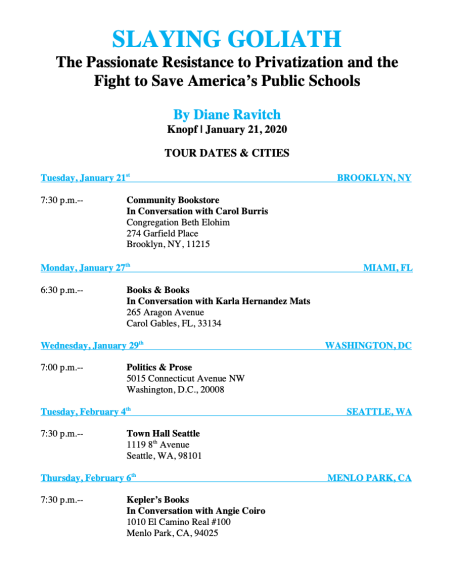
One of the very exciting episodes in my new book SLAYING GOLIATH describes the struggle in Massachusetts  surrounding a 2016 referendum to expand the number of charter schools in the state. The referendum was called Question 2. Yes on 2 received funding from billionaires (the Waltons and Bloomberg), DFER (hedge fund managers), and out-of-state groups whose donors were unknown. The last group is called “Dark Money” because it hides the names of the donors.

On February 26, I will be at the First UU Church in Cambridge at an event sponsored by Citizens for Public Schools, joined in conversation with two of the prominent figures in that campaign, Barbara Madeloni (who was president of the Massachusetts Teachers Union) and Maurice Cunningham (a professor of political science at the U of Mass whose blogs reported on Dark Money in the campaign),

The groups that fought Question 2 were teachers’ unions, civil rights groups, and local school boards.

The referendum was overwhelmingly defeated.

After the election, the Massachusetts Office of Campaign and Political Finance investigated the funding of the campaigns. It found that one of the funders of the “Yes on 2” side was a Dark Money front based in New York City. It required the group to disclose the names of its donors and fined the group nearly $500,000, which cleaned out its bank account. Not long after, the Dark Money Group (which had also stacked the deck in New York State without being exposed) collapsed and closed its doors.

Recently, the director of this state office retired, and parents thanked him for upholding the integrity of state elections.

This letter to the editor by a parent activist appeared in the Boston Globe.


Watchdogs have state’s outgoing campaign finance chief to thank
 

What a pleasure to read Matt Stout’s folksy portrait of Michael Sullivan, who retired last month as director of the Office of Campaign and Political Finance (“A career spent helping people ‘do things right,’ ” Business, Dec. 25). I met Sullivan at a “hackathon” sponsored by the New England Center for Investigative Reporting. The center needed volunteers to test computer software. We got pizza, and a little orientation from the state’s campaign finance chief, who trained neophytes to navigate Office of Campaign and Political Finance databases.

Behind the scenes, Sullivan’s staff investigated an unusual pattern of financial transactions. They discovered that Families for Excellent Schools – Advocacy Inc. of New York illegally solicited, received, and funneled funds to the Great Schools Massachusetts ballot question committee to influence the 2016 Massachusetts election and increase charter school market share. Sullivan skillfully negotiated a six-figure fine.

Thanks to Sullivan, citizens can comb campaign finance data for evidence of expenditures that reveal fake-news media events. Remember those rallies with people wearing blue T-shirts demanding “Great Schools Now”? It turns out Great Schools Massachusetts paid for the T-shirts and had people show up at events to give the illusion of massive dissatisfaction with our public schools.

If only I had a “Great Schools Now” campaign T-shirt, I would give it to Sullivan in gratitude for providing me a political education I never received in school.

Peggy A. Wiesenberg

Boston

What happens when Florida’s biggest for-profit charter chain takes over three low-performing public schools? Follow the money. Ka-Ching!

Sue Legg of the Florida League of Women Voters guides you through a path paved with greenbacks. 

Here is her summary:

The whole sordid affair was orchestrated by the current Senate Ed. Committee Chair.  Millions of dollars were poured into the K12 consolidated school that were not available until the state took the school over. The political and financial maneuvers were beyond sad.  Problem students were given 45 day suspensions.  They were given laptops and access to online courses made available by the once bankrupt Doral College which the Ed Chair manages.  Most disappeared. The school grades rose the first year, and now the elementary students are back to a ‘D’ grade.  These racially and economically segregated schools are the result of choice policies. 

Remember when the three Jefferson County schools were closed and taken over by Academica, the largest for-profit charter management company in the state?  The story makes your hair curl.  Here is a report by WLRN news that details where the money came from and where it went.

New funding included a $2.5 million special appropriation from the Florida Legislature, $2 million from federal startup grant funds, and a $1.9 million interest free loan from Academica’s Somerset division.  This was funding denied unless it became a charter district. Academica received $327,000 in fees in 2017-18 to manage the fewer than 800 student K12 school.  The per student cost rose to $16,600 which school leaders recognize cannot be sustained.  The state pays much less.

The behind the scenes orchestrators for the takeover were Senators Manny Diaz and Anitere Flores, both of whom have close ties to Academica. Diaz is an administrator at Doral College and is Chair of the Senate Education Committee.  Flores is deputy Majority Leader for the Florida Senate and moved from being the head of Doral College to the Academica foundation.  The current Doral College president, Rodriquez,  was named to supervise the transition of the Jefferson County schools to Academica.

In previous posts, I reported on a series of misdeedsassociated with Diaz and Flores related to their association with Doral College.  The college was bankrupt and had no students or faculty when Academica took it on.  It now offers online courses to Academica students.  The credit was worthless because the college had no accreditation.  Diaz worked to get a private school accreditation agency to recognize the college.  Diaz’s personal interest is noted here.  

What is the result of the takeover?  Behavioral specialists were hired to help students, teacher salaries increased, and the physical facilities were improved. Initially, the school grades rose to a ‘C’, but the elementary school has now reverted to a ‘D’.  The increase in the percentage of students passing the FSA state examinations in order to raise the school grades may have had as much to do with discipline policies as with learning strategies.  The charter school policy created a 45 day suspension policy in which students were given a laptop and sent home.  They were to take online classes from Doral College.  Many students never returned.  It is one way to raise school grades…just limit which students take the tests.

How convenient when those who give and those who receive public funds are one and the same.


Roger Léon, superintendent of Newark schools, wants to close four charter schools and ban most new ones. 

Patrick Wall of Chalkbeat reports:

The head of the Newark school system is calling for the closure of four local charter schools and a ban on most new charter schools, a clear signal that the district hopes to rein in the city’s fast-growing charter sector.

The schools — M.E.T.S., People’s Prep, Roseville Community, and University Heights — are up for renewal, meaning they must apply for state approval to continue operating after this academic year. In a series of letters this month, Newark Public Schools Superintendent Roger León asked the state to reject their applications, arguing that the publicly funded, privately managed charter schools sap funding from traditional public schools and are failing to serve their fair share of students with special needs.

The state education commissioner is expected to make a decision by Feb. 1.

León also urged the state to deny “any and all” applications for new charter schools or the renewal of existing charter schools unless they serve “a specific educational need.” While other local officials have sought to halt the expansion of Newark’s charter sector, whose student population quadrupled over the past decade, León is taking a more extreme position by demanding that existing charter schools be phased out.

“The writing is on the wall for corporate charter schools,” said Newark Teachers Union President John Abeigon, an outspoken critic of charter schools, which tend to be non-unionized. “The days of unchecked charter school applications are over.”

Poor Mark Zuckerberg! He dropped $100 million into Newark to make it the “New Orleans of the North.”

Now that 49% of New Orleans’ charters are rated D or F by the state, why would anyone follow that model.

Superintendent Léon has made clear that he’s not taking that route.

A state judge in Texas blocked the state takeover of the Houston Independent School District until she issues a final order in June. 

A state judge Wednesday evening immediately blocked Texas from taking over the Houston Independent School District until she issues a final ruling on the case, complicating the state’s plan to oust the district’s school board by March.

In doing so, Travis County District Judge Catherine Mauzy preliminarily sided with Houston ISD, the state’s largest school district, in a legal battle that will ultimately determine whether Texas can indefinitely seize power from its elected school board.

Calling the injunction a temporary setback, the TEA vowed in a statement to appeal the ruling.

The Texas Education Agency had planned to seize control of the district, oust the elected school board, and replace it with a governing board appointed by State Commissioner Mike Morath in March. Now the state must wait for the judge’s ruling in June.

The takeover was prompted by the persistent low test scores of Wheatley High School, which has a higher proportion of students in need than other schools in the district of 280 schools.

The state has failed to improve other, smaller districts that it has taken over.

Morath is a software developer, not an educator. He thinks that fixing a school district, one of the largest in the nation, is akin to ironing out bugs in a software program.

Critics in Houston think that Morath’s goal is to replace public schools with charter schools. During his single term on the Dallas school board, Morath led a failed effort to turn Dallas into a charter district, a goal he shared with billionaire John Arnold (Ex-Enron).

Mauzy hinted at her decision just before she stood to leave the courtroom Tuesday afternoon.

“Democracy is not always pretty,” she said. “But I am convinced it’s the best system we have. If we applied some of [the state’s arguments] to the Texas Legislature, I don’t know where we’d be.”

Now there is an interesting thought. Judge the members of the Texas legislature by their thoughtfulness, their diligence, and their intelligence, and how many would be ousted?

Uber-reformer John White announced that he is resigning as superintendent of Louisiana.

He has sterling disrupter credentials.

Teach for America. Broad Academy. Joel Klein’s inner circle. Briefly leader of New Orleans’ charter district.

Mercedes Schneider has the story here. She thinks the next state superintendent might actually be an experienced educator.

Under White’s leadership, Louisiana dropped to nearly the very bottom of NAEP.

Watch to see which disruption group or leader picks him up next: the Waltons? The City Fund? John Arnold? Charles Koch? Bill Gates? Jeb Bush?


Presidential candidate Bernie Sanders was one of the few members of the U.S. Senate to vote against No Child Left Behind when it was approved by Congress in 2001.

Today is the anniversary of the signing of that law.

Sanders writes that the federal mandate for annual testing in grades 3-8 has been an expensive failure.

In this article in USA Today, Sanders calls for an end to the NCLB mandate, which remained in place through Race to the Top and the Every Students Succeeds Act of 2015 (Every student succeeds is another way of saying “no child left behind.”)

He writes:

Wednesday marks 18 years since the signing into law of No Child Left Behind, one of the worst pieces of legislation in our nation’s history. In December 2001, I voted against NCLB because it was as clear to me then, as it is now, that so-called school choice and high-stakes standardized testing would not improve our schools or enhance our children’s ability to learn. We do not need an education system in which kids are simply taught to take tests. We need a system in which kids learn and grow in a holistic manner. 

Under NCLB, standardized tests were utilized to hold public schools and teachers “accountable” for student outcomes. As a result, some schools that underperformed were closed and their teachers and unions blamed. 

The long-term effects of this approach have been disastrous. NCLB perpetuated the myth of public schools and teachers as failing, which opened the door for the spread of school voucher programs and charter schools that we have today. Some of these charter schools are operated by for-profits; many of them are nonunion and are not publicly accountable.

One error here: 90% of charters are non-union, not “many.” That is why charters have the enthusiastic support of right-wingers like the Waltons, DeVos, Koch, and other billionaires (see Slaying Goliath for a comprehensive list of the billionaires, foundations, and corporations that support testing and charters)

On January 8, 2002, President George W. Bush signed the No Child Left Behind law.

Thus began an unprecedented federal intrusion into state and local education.

The law was sweeping in imposing federally mandated annual tests from grades 3-8.

No high-performing nation in the world tests every child every year.

The law mandated that every school must achieve 100% proficiency by 2014 or face increasingly onerous consequences, culminating in being privatized, taken over by the state or closed.

The law made appeals to research repeatedly, but there was no research whatever for its claim that pressure and punishment would ever produce 100% proficiency nor was there any evidence for the “remedies” it proposed.

NCLB was a hoax buil on a lie. The lie was Bush’s campaign claim that there had been a “Texas miracle,” the result of annual testing and accountability. We need only look at Texas’s middling standing on NAEP to see that there was no miracle. The hoax was the law itself, which threatened punishment to those who could not meet impossible goals and offered remedies that had never produced results for any district or state.

Today marks a sad day in the history of American education, when politicians proclaimed that they knew how to fix America’s schools.

They didn’t, and a new era of test abuse, failure, hubris, profiteering, consultants, and other ways to defund the nation’s public schools began.

The spirit of this failed law animated Race to the Top (President Obama said publicly that his RTTT was built on the foundation of NCLB) and survives in the current Every Student Succeeds Act, which continues to require annual testing and gives the Secretary of Education the power to review state plans for compliance with federal law.

NCLB was a noon for the testing industry and consultants but a tragedy for students and teachers. Teachers lost autonomy. Students lost the arts, recess, history, and the love of learning for its own sake. Test scores became the purpose of education.

The restoration of the promise of public education will begin when we have a President and Congress who expunge the legacy of this dreadful law from the books.


Peter Greene writes that state officials in North Carolina keep getting embarrassed by the facts about their charter schools.

In 2016, when the first report came out, the state sent it back to have the data massaged because it turned out that charters were effectively resegregating the students in the state.

This year, a similar problem arose when it was time to release the annual report.

The charters are highly segregated, and their grades reflect which students enroll in them. (Surprise!)

It is a well-known fact that the demographics of a school predict its test scores.

Charter officials don’t like those facts. They want different facts. They are still trying to find a way to hide the reality of charters.

Greene writes:

North Carolina’s 2020 Annual Charter Schools Report has caused some consternation among members of the state’s Charter Schools Advisory Board (CSAB). They’ve seen the first draft and requested a rewrite, because, well, members of the public might become confused by the information that suggests Bad Things about North Carolina’s charter industry.

This is not the first time the issue has come up. Back in 2016 the Lt. Governor called the report “too negative” and pushed to have it made “more fair.” The report was not substantially changed– just more data added. But in 2016 it still showed that North Carolina’s charter schools mostly serve whiter, wealthier student bodies. This prompted a remarkable explanation:

Darrell Allison, president of Parents for Educational Freedom in North Carolina, said that fact is simply a reflection of which families are applying to charters.

Well, yes. Education reform in North Carolina has been about crushing the teachers’ unions and teachers themselves,while also being aimed at enabling white flight and accelerating segregation. One might be inclined to deduce that they hope to set up a spiffy private system for whiter, wealthier folks (including a corporate reserve-your-own-seats policy) along with vouchers, while simultaneously cutting the public system to the bone so that wealthy taxpayers don’t have to spend so much educating Those People’s Children. North Carolina has done plenty to earn a spot in the education policy hall of shame, enabled by some of the worst gerrymandering in the country.

But while NC legislators don’t seem to experience much shame over what they do, they sometimes worry about how they look (remember the great bathroom bill boycott of 2017). So now the charter report is going to be carefully whitewashed.

For instance, the report included a section about the racial impact of charter schools. But amid concerns that it might contain “misleading” wording that could be “blown out of proportion,” that section will apparently be removed. Regarding the report, ” I think it doesn’t actually represent what I believe to be true,” said Alex Quigley, chairman of the CSAB. “And given the choice between facts and the stuff I choose to believe, well, my beliefs and our charter marketing should come first.” Okay, I made up the last part, but that first part he totally said.

What data said is that 75% of charter schools have a white student enrollment that is more than 10% “off” from the surrounding district. Well over 50% of charters were off by more than 10% on black enrollment numbers. State law says that charters have to “reasonably reflect” the makeup of the district’s where they are located…


Hi, Bill and Melinda,

We have never met but I feel that I know you because I am so familiar with your education projects.

I have tried in the past to meet you and have a candid conversation but have never had any luck.

You were always too busy or out of town.

But I am trying again.

I will be in Seattle on February 3-4.

I arrive on the afternoon of the 3rd and am speaking at a public event on February 4 at Town Hall. The wonderful teacher-leader Jesse Hagopian is introducing me.

I have some down time and wondered if we might be able to meet at last.

Are you available to meet in the late afternoon or evening of February 3 or during the day on February 4?

Please let me know if you can make time on your busy schedule.

My partner will be with me.

I hope you can do it!

We have a lot to talk about!

Diane