Archives for category: Billionaires

A secret recording of a lobbyist’s meeting in 2016 showed the true face of the voucher movement in Tennessee and elsewhere.

The lobbyist, an official with Betsy DeVos’s Tennessee Federation for Children, made clear that Republican legislators who opposed vouchers would face harsh retribution. He pledged that anti-voucher Republican legislators would be challenged in a primary by well-funded opponents committed to pass vouchers. Money would come in from out-of-state billionaires and millionaires to knock off Republicans who voted against vouchers.

The story came from NewsChannel 5 in Nashville.

NASHVILLE, Tenn. (WTVF) — A secret recording reveals how ultra-wealthy forces have laid the groundwork for the current debate in the Tennessee legislature over school vouchers by using their money to intimidate, even eliminate, those who dared to disagree.

In the recording obtained by NewsChannel 5 Investigates from a 2016 strategy session, Nashville investment banker Mark Gill discusses targeting certain anti-voucher lawmakers for defeat as a form of “public hangings.” At the time, Gill was a member of the board of directors for the pro-voucher group Tennessee Federation for Children.

Using their vast resources to defeat key incumbents, Gill argues, would send a signal to other lawmakers in the next legislative session…

Tennessee Gov. Bill Lee has teed up the issue this year with a plan for school vouchers that would send hundreds of millions of taxpayer dollars to private schools.

It follows a years-long effort by school privatization forces to elect lawmakers who would vote their way and to destroy those who would not.

In the 2016 recording, Mark Gill discusses the prospect of turning against Republican Rep. Eddie Smith from Knoxville because Smith had voted against a bill designed to cripple the ability of teacher groups to have dues deducted from teachers’ paychecks.

Gill has served on the Tennessee Board of Regents overseeing the state’s community and technical colleges since 2019.

“Think about it,” Gill says.

“What better way to say to people, OK, you want us to fall on our sword for you, to spend thousands of dollars — which I did personally — to get you elected, and you come up here and do this sh*t. Let me just show you what the consequences of that are,” Gill says…

At the time, Gill was also considering targeting Republican Judd Matheny from Tullahoma because Matheny was viewed as being too close to Tennessee teachers and would be a good “scalp” to hang on the school privatizers’ efforts.

“He also has, I think, put himself in a position where his scalp could be very valuable to all school reformers,” Gill says, noting Matheny’s relationship with the Tennessee Education Association. “He is one of the people who has bought the TEA line that you need to side with the TEA because of the teachers and that’s your safest route.”

The reporter for NewsChannel 5 played the recording for J.C. Bowman, leader of the Professional Educators of Tennessee.

Bowman was stunned.

“Judd Matheny was a conservative — a big Second Amendment guy. Some of the names they mention in there — conservative all the way through. So you are going to eat your own…”

NewsChannel 5 Investigates noted to Bowman that Gill was not talking about convincing lawmakers that the Tennessee Federation for Children was right on the issue of school vouchers.

“No, they are not even making that comparison,” the teacher lobbyist agreed.

“If you put this issue on the ballot — and that’s what I would say, put it on the ballot — vouchers would lose.”

A March 2022 NewsChannel 5 investigation revealed how the battle over education in Tennessee is largely financed by out-of-state billionaires and millionaires.

Last fall, NewsChannel 5 Investigates obtained a proposal — submitted to a foundation controlled by the billionaire Walton family of Walmart fame — detailing a plan by school privatization forces to spend $3.7 million in 2016 on legislative races in Tennessee.

That same year, The Tennessean reported on an Alabama trip where Gill had hosted five pro-voucher lawmakers for a three-day weekend at his Gulf Shores condo.

“I don’t think anybody is going to get unseated without some substantial independent expenditures coming in there,” Gill says, acknowledging that wealthy special interests would need to spend a lot of money to knock off lawmakers who did not vote their way.

That strategy was apparent in 2022 when Republicans Bob Ramsey and Terri Lynn Weaver were targeted and defeated. 

Weaver was among those Republicans who in 2019 refused to bow to pressure to vote for school vouchers.

And like these ads taken out against Bob Ramsey, Weaver also faced attacks from school privatization forces for supposedly being a corrupt career politician — attacks funded by so-called dark money.

“Tremendous amounts of money, much of which is outside money, [the] money was not from my district,” Weaver said. “They slander you. They want to win — and they’ll do anything to do it.”

Bowman said Gill’s strategy represents “the absolute destruction of people.”

We wanted to know, “Is there anyone on the public education side of the debate playing this sort of hardball politics?”

“None that I know of,” Bowman said. “I know of nobody playing that.”

To read the complete article and to listen to the recording, open the link.
If you are old enough to remember a different America, an America of neighborhood shops, of local bakeries, butchers, drugstores (with a soda fountain), shoe stores, bookstores, and dress shops, you may have wondered why most of them have been replaced by national chain stores and anonymous strip malls. Now we see even neighborhood public schools replaced by national charter chains, some even operated by for-profit corporations. Thom Hartmann explains the roots of this change in his new book The Hidden History of Monopolies: How Big Business Destroyed the American Dream. He is releasing the book a chapter at a time on his blog, which should whet our appetite to buy and read the book. This chapter describes the legal ploy that resulted in crushing local enterprise and creating billionaires.

He writes:

Robert Bork was Richard Nixon’s solicitor general and acting attorney general and had a substantial impact on the thinking in the Reagan White House—so much so that Reagan rewarded his years of hard work on behalf of America’s monopolists with a lifetime appointment to the federal bench in the DC Circuit, frequently a launching pad for the Supreme Court.

In the years following Lewis Powell’s 1971 memo, as numerous “conservative” and “free market” think tanks and publications grew in power and funding, Bork’s ideas gained wide circulation in circles of governance, business, and the law.

In 1977, in the case of Continental T.V., Inc. v. GTE Sylvania, the Supreme Court took up Bork’s idea and, for the first time in a big way, embraced the “welfare of the consumer” and “demonstrable economic effect” doctrines that Bork had been promoting for over a decade.

Neither of those phrases exists in any antitrust law, at least in Bork’s context. Nonetheless, the Supreme Court embraced Bork’s notion that the sole metric by which to judge monopolistic behavior should be prices that consumers pay, rather than the ability of businesses to compete or the political power that a corporation may amass.

When Ronald Reagan entered the White House in 1981, bringing with him Bork’s free market philosophy and a crew from the Chicago School, he ordered the Federal Trade Commission to effectively stop enforcing antitrust laws even within the feeble guidelines that the Supreme Court had written into law in GTE Sylvania.

The result was an explosion of mergers-and-acquisitions activity that continues to this day, as industry after industry concentrated down to two, three, four, or five major players who function as cartels. (A brilliant blow-by-blow cataloging of that decade is found in Barry C. Lynn’s book Cornered: The New Monopoly Capitalism and the Economics of Destruction.)

Bork’s reasoning—that antitrust law should defend only the consumer (through low prices), and not workers, society, democracy, or local communities—has become such conventional wisdom that in the 2014 Supreme Court case of FTC v. Actavis, Chief Justice John Roberts wrote a virtual word-for-word parroting of Bork: “The point of antitrust law is to encourage competitive markets to promote consumer welfare.”

Barak Orbach, professor of law at the University of Arizona, is one of a small number of scholars today who are genuine experts in the field of antitrust law. In a 2014 paper published by the American Bar Association, he wondered if Bork knew he was lying when he wrote that the authors of the Sherman Antitrust Act intended to reduce prices to advance “consumer welfare,” instead of protecting the competitiveness of small and local businesses, and the independence of government at all levels.

His conclusion, in “Was the ‘Crisis in Antitrust’ a Trojan Horse?” was that Bork was probably just blinded by ideology and had never bothered to go back and read the Congressional Record, which, he noted, says nothing of the kind.74

While Bork wrote that “the policy the courts were intended [by the Sherman Antitrust Act] to apply is the maximization of wealth or consumer want satisfaction,” Orbach said, “Members of Congress . . . were determined to take action against the trusts to stop wealth transfers from the public.” So much for that: today the Walton (Walmart) family is the richest in America and one of the richest in the world. They’re worth more than $100 billion, having squirreled away more wealth than the bottom 40% of all Americans. And they spend prodigiously on right-wing political causes, from the national to the local.

Amazon’s Jeff Bezos is now wealthier than any Walton; with a registered net worth of $112 billion, he is the richest single person in the world. Bezos is so rich that when he divorced his wife, MacKenzie Bezos, she received 19.7 million shares of Amazon worth $36.8 billion. She instantly became the world’s third-richest woman, and Jeff Bezos remained the world’s wealthiest man.75 While local newspapers are shutting down or being gobbled up all over the country, Bezos personally purchased the 140-year-old Washington Post in 2013 for $250 million. Now Bezos, like the Walton family, can use his sub- stantial wealth to obtain political ends that protect his wealth and allow Amazon to continue to grow.

Texas has several billionaire bullies who want the state to keep their taxes low, cut benefits to needy people, and enact vouchers so that more students can attend religious schools on the public’s dime.

Russell Gold writes in the Texas Monthly about Tim Dunn, a billionaire who has used his money to purge the Republican Party of moderates. In addition to being an oilman, Tim Dunn is a pastor and a devout Christian nationalist. He has funded numerous organizations that act as pass-throughs for his political contributions, such as Defend Texas Liberty PAC, the Texas Public Policy Foundation, the First Liberty Institute, Empower Texans, Texas Scorecard, Ballotpedia, Stand for Freedom PAC,

Gold writes:

You may not think about Tim Dunn. Indeed, unless you’re a close observer of Texas politics, it’s likely you haven’t heard of him. But Dunn thinks a lot about you.

For two decades he has been quietly, methodically, and patiently building a political machine that has pushed Texas forcefully to the right, sending more and more members of the centrist wing of the Republican Party into exile. A 68-year-old oil billionaire, Dunn seeks to transform Texas into something resembling a theocracy. If you ever wonder why state laws and policies are more radical than most Texans would prefer, the answer has a lot to do with Dunn and his checkbook. If you question why Texas’s elected officials no longer represent the majority of Texans’ views, the reason can be traced to the tactics employed by Dunn and the many organizations and politicians he funds and influences. He has built his own caucus within the Legislature that is financially beholden to him. And despite his Sunday school pleas for comity, Dunn has deepened Texas’s political divisions: there are the Democrats and what remains of the mainstream conservative Republican Party. And then there are Dunn and his allies….

In the past two years Dunn has become the largest individual source of campaign money in the state by far. Until recently his main tool for exerting influence has been the Defend Texas Liberty PAC, to which he has given at least $9.85 million since the beginning of 2022. This is nearly all the money he contributed to Texas races over that span and the majority raised by the committee. The political action committee targets Republicans, many of them quite conservative, whom it deems insufficiently loyal to the organization’s right-wing agenda. Dunn is not a passive donor who will dole out a few thousand dollars after a phone call and some flattering chitchat. The funding machine he has built is designed to steer politics and control politicians. 

Its methods are deceptively simple. A Dunn-affiliated organization lets lawmakers know how it wants them to vote on key issues of the legislative session. After the session, it assigns a number, from zero to one hundred, to each lawmaker based on these votes. Republicans who score high, in the eighties or nineties, are likely to remain in Dunn’s good graces. But those who see their scores drift down to the seventies or even sixties—who, in other words, legislate independently? Their fate is easy to predict. 

They’ll likely face a primary opponent, often someone little known in the community, whose campaign bank account is filled by donations from Dunn and his allies. This cash provides access to political consultants and operations that can be used to spread false and misleading attacks on Dunn’s targets, via social media feeds, glossy mailers, and text messages. “They told you point blank: if you don’t vote the way we tell you, we’re going to score against you,” said Bennett Ratliff, a Republican former state representative from Dallas County. “And if you don’t make a good score, we’re going to run against you. It was not a thumb on the scale—it was flat extortion.” Ratliff lost in 2014 to a Dunn-backed right-wing candidate, Matt Rinaldi, who scored a perfect one hundred in the next two sessions and quickly amassed power: Rinaldi now serves as the combative and divisive chair of the state GOP

Dunn’s influence goes well beyond campaigns and politics. His résumé is lengthy. He is vice chairman of the Texas Public Policy Foundation, a right-wing think tank located a couple of blocks south of the Capitol. TPPF generates policy proposals—from severe property tax cuts to bills that impede the growth of renewable energy—that are often taken up by the Texas Legislature and emulated in other red states. He has served for years on the board of the First Liberty Institute, a legal powerhouse that has won Supreme Court cases to advance Christianity’s role in public life. ..

In the past several years Dunn has become involved with multiple online media operations. “You can’t trust the newspapers,” he wrote in a 2018 letter to voters. But apparently you can trust Texas Scorecard, a political website that is often critical of politicians who don’t support his agenda. Texas Scorecard was published by Empower Texans, a group largely funded by Dunn that then became a separate organization in 2020. It continues to publish articles that are generally critical of candidates Dunn opposes.

He has also been an officer with Chicago-based Pipeline Media, which maintains a network of websites designed to look like independent local media outlets but that churn out often-partisan articles that amplify stances taken by special interest groups. The Tow Center for Digital Journalism at Columbia University found that this network has attacked renewable energy and advocated for property tax cuts. Further, Dunn is a longtime board member of the Lucy Burns Institute, publisher of the website Ballotpedia, which provides information on federal, state, and local elections. It recently launched an “ultra-local” initiative, publishing updates on candidate positions and endorsements in areas that have become news deserts after the closures of local newspapers. The site reported more than a quarter billion page views in 2022…

Dunn has a few key powerful officials in his pocket, including Lieutenant Governor Dan Patrick (a job considered more powerful than the governor) and Attorney General Ken Paxton, who escaped an effort to impeach him thanks to Dunn’s largesse.

Dunn is up-front about his desire to use politics to pave the way for a “New Earth,” in which Jesus Christ and his believers will live together. (“When heaven comes to earth and God dwells with his people as the King,” Dunn has said.) Until then, he remains a key player in the growing Christian nationalism movement, which rejects the importance of pluralism to American identity. Instead it contends that only devout Christians are good Americans. 

Back in 2010, Dunn met with Joe Strauss, the Republican Speaker of the Texas House of Representatives. Strauss represented San Antonio. He is Jewish. Dunn told Strauss that only Christians should be in leadership roles.

Considering that Jesus was Jewish, that’s not a very Christ-like sentiment. Unless you are a Christian nationalist.

Michael Hiltzik of the Los Angeles Times reports on Elon Musk’s latest foray into disrupting the lives of other people. He’s suing to destroy the National Labor Relations Board because it is weighing in on his company’s decision to fire some workers.

We are witnessing the accelerated rollback of the New Deal and the past nine decades of progressive reforms.

He writes:

Few business leaders have taken to heart more than Elon Musk the old lawyer’s saw that if you don’t have the facts or the law on your side at trial, pound the table.

Musk has truculently flouted regulatory standards of all varieties as the guiding spirit of companies such as Twitter, Tesla and SpaceX — keeping factories open despite pandemic shutdown orders, allegedly committing securities fraud by issuing misleading tweets about his investment plans and ignoring government safety recommendations for self-driving automotive technologies.

As I’ve reported, Musk has gotten his way with regulators and municipal officials “through bluster and intimidation.”

Now he’s trying what may be his most audacious flip-off to regulators yet:

Faced with an accusation by the National Labor Relations Board that SpaceX improperly fired nine employees in 2022, among other illegal acts, the company, which is controlled by Musk, filed a lawsuit in federal court in Texas to declare the NLRB’s action — indeed, the board itself — unconstitutional.

Now he’s trying what may be his most audacious flip-off to regulators yet:

Faced with an accusation by the National Labor Relations Board that SpaceX improperly fired nine employees in 2022, among other illegal acts, the company, which is controlled by Musk, filed a lawsuit in federal court in Texas to declare the NLRB’s action — indeed, the board itself — unconstitutional.

There’s more to it than that, however. The SpaceX lawsuit takes direct aim at the very enforcement structure of the NLRB, through which appointed administrative law judges weigh unfair labor practice charges laid against employers and recommend penalties to be imposed by the board itself.

The company’s argument is that because the judges are largely immune from being fired other than “for good cause,” their role in enforcement deprives accused parties of their constitutional right to trial by jury.

It also asserts that the board’s power to act as judge and jury in employment cases and the members’ immunity from being removed by the president violates the separation of powers principle in the Constitution. In sum, SpaceX claims that it’s being held “subject to unlawful proceedings before an unconstitutionally structured agency.”

More such claims are in the offing from businesses facing regulatory scrutiny. According to a transcript obtained by Bloomberg, grocery chain Trader Joe’s made the same argument at a Jan. 16 NLRB hearing on charges that it engaged in illegal union-busting by retaliating against unionization advocates among its workers.

What are these companies up to? The SpaceX claims are unusual, but they’re not unique in recent regulatory litigation. Similar claims have been brought against the Securities and Exchange Commission and the Consumer Financial Protection Bureau.

“This is an effort by a group of lawyers who are foes of the administrative state and the New Deal-era legislation that created the NLRB and the SEC to essentially end enforcement of those statutes,” says Catherine Fisk, an employment and labor law authority at UC Berkeley law school.

Unable to challenge the laws themselves — they’ve been upheld by Supreme Court decisions dating back to the 1930s — or the regulations directly, Fisk told me, “they’re arguing that the administrative structure is in some part unconstitutional.”

Before delving into the details of the SpaceX lawsuit, let’s examine the NLRB’s enforcement case. The agency says SpaceX illegally fired the nine workers for circulating an open lettercomplaining about Musk’s “repeated conduct of issuing inappropriate, disparaging, sexually charged comments on Twitter,” which he owns. The silence of SpaceX management about Musk’s conduct, the letter said, allowed a “culture of sexism, harassment and discrimination” to “pervade … the workplace.”

The NLRB filed a formal complaint against SpaceX on Jan. 3, encompassing not only the firings but charges that it illegally interrogated workers and conducted illegal surveillance of their activities. The agency scheduled a hearing on the charges before an administrative law judge for March 5 in Los Angeles.

The very next day, SpaceX filed its lawsuit.

By some measures, SpaceX’s response to the NLRB charges might be interpreted as overkill. Even if it’s found to have committed all the violations, the consequences are meager. The NLRB can’t levy monetary fines.

It can order back pay and reinstatement for workers who have been wrongly discharged, but those wouldn’t make much of a dent in the finances of a company that was reported to have brought in $8 billion in revenue last year from government and commercial contracts.

Moreover, SpaceX hasn’t yet come before an administrative law judge over the NLRB charges, much less having them voted on by the full board. Its lawsuit, then, looks like a shot across the NLRB’s bow. The company asks the trial judge in Texas to block the NLRB’s case against it, declare that the NLRB’s structure is unconstitutional, and permanently prohibit the agency from pursuing unfair labor practice charges via administrative law judges.

That points to the conclusion that this case, and others like it, aim to exploit the veer to the right seen throughout the federal judiciary generally and the Supreme Court in particular.

This variety of attack on regulations went out of fashion in the 1930s, Fisk observes. The Supreme Court, which had overturned a sheaf of New Deal initiatives as well as state minimum wage laws, turned back to the middle in the face of rising public disdain and the court-packing scheme of Franklin Roosevelt.

FDR ultimately abandoned his proposal, but after 1936 the court ceased ruling against the New Deal — upholding the National Labor Relations Act, which created the NLRB, in 1937.

“For 85 years, those arguments weren’t made,” Fisk says, “because lawyers knew that they would get nowhere with them — they might even get sanctioned. The Supreme Court signaled that it was up to Congress to design regulatory structures.”

But today’s Supreme Court isn’t your great-grandfather’s Supreme Court. “The Supreme Court has given lawyers reason to think that they might be able to invalidate part or all of these statutes as being unconstitutional.”

As recently as last week, a majority of justices appeared ready to overturn or at least pare back the so-called Chevron doctrine, the nearly 40-year-old principle that courts should defer to agencies’ interpretations of their governing laws as long as those interpretations aren’t plainly unreasonable.

Overturning the doctrine, as industry litigants urged the court to do during oral arguments Jan. 17, could sap regulatory agencies’ ability to base their rule-making on expert advice.

Although Congress could theoretically overcome any regulatory problems created by an adverse court ruling by amending the laws in question, that’s not a good bet given the profound dysfunction reigning these days on Capitol Hill. The industries will have achieved their goals for years into the future.

That brings us to Musk’s litigation strategy. SpaceX filed its lawsuit against the NLRB not in Southern California, where the company is headquartered, or Washington, D.C., where the NLRB maintains its main office, but in federal court in Brownsville, Texas, a judicial outpost on the Mexican border. This reflects the practice of filing anti-government lawsuits in remote federal courtrooms in Texas, where plaintiffs have a good chance of drawing a right-wing judge.

On the face of it, that tactic may have failed in this case, because the Brownsville court has two judges, one of whom was appointed by Donald Trump and the other by Barack Obama, and the SpaceX case was assigned to Rolando Olvera, who was Obama’s appointee.

SpaceX, however, is playing a longer game. Any appeal from the Texas federal court would go to the extremely conservative U.S. 5th Circuit Court of Appeals, which I’ve described in the past as “the hackiest of hack-ridden federal courts.”

The New Orleans-based appellate court upheld Texas’ malevolent SB 8 antiabortion law in 2022, for example, after which the Supreme Court allowed the law to go into effect.

Last year it partially endorsed a ruling by federal Judge Matthew Kacsmaryk of Texas narrowing access to the abortion drug mifepristone. Kacsmaryk’s ruling was based on a tendentious and long-abandoned reading of an antique 1873 law, but that was enough for the issue to come before the Supreme Court, which has the case on its docket this year.

More to the point, the 5th Circuit has implicitly endorsed the practice of challenging regulations by taking aim at the constitutionality of regulatory agencies. It did so in a case targeting the Consumer Financial Protection Bureau brought by the payday lending industry, which has long been in the CFPB’s crosshairs.

A 5th Circuit panel composed of three Trump-appointed judges ruled the bureau’s funding mechanism unconstitutional; the government appealed that ruling to the Supreme Court, which heard oral arguments on Oct. 3 but hasn’t yet ruled….

The NLRB has called foul on SpaceX’s choice of venue, calling the company’s rationale for filing in Brownsville “less than paper thin.” The allegedly unlawful conduct of SpaceX took place entirely at the company’s headquarters in the Southern California enclave of Hawthorne, and nothing actually happened in Texas. The government has asked Olvera to transfer the case to federal court in Los Angeles, but he hasn’t yet ruled.

Put it all together, and the SpaceX lawsuit bears watching.

As I’ve written before, conservative federal judges, many of them appointed by Trump, have the power to move the country to the far right for decades to come, eroding reproductive health care, eviscerating gun control laws and making life more difficult for ordinary Americans depending on the federal government to protect their rights. Elon Musk, pursuing his own personal interests, is urging them to keep at it.

Since I started following the cruel and unusual policies of Florida’s Governor Ron DeSantis, I have seen him repeatedly attack public schools, divert public money to private and religious schools, and remove whatever offends him from the curriculum (such as accurate histories of Black people).

I have also discovered some fearless bloggers who are not afraid of DeSantis. Billy Townsend and Jason Garcia. They take on political corruption without flinching.

Jason Garcia, an investigative reporter, wrote recently about how conservative billionaires have shaped DeSantis’s political agenda. The part I don’t understand is why someone of vast personal wealth would want to take food stamps away from impoverished children or make the lives of homeless people even more miserable. What kinds of sadists are they?

Jason Garcia writes:

Late last year, the administration of Florida Gov. Ron DeSantis made it harder for older Floridians to get food stamps.

Earlier this month, the DeSantis administration sued the federal government for the right to remove poor children from public health insurance.

And last week, the Republican governor came out in support of a plan to round up homeless people across Florida and — potentially — put them into secured camps.

Each move was, at least on the surface, a disparate executive decision. But they share something in common: They are all ideas promoted by conservative billionaires and the right-wing think tanks they fund.

Taken together, the moves offer a window into how super-rich mega donors shape action across DeSantis’ state government.

Let’s start with the food stamps.

Though it didn’t get much attention at the time, the Florida Department of Children and Families late last year changed the rules for the state’s food-stamps program, which is formally known as the “Supplemental Nutrition Assistance Program.”

Funded by the federal government but administered by the states, food stamps currently help more than 3 million impoverished Floridians buy groceries and keep food on the table for themselves and their families.

But the state of Florida makes it much harder for some people to qualify for food stamps, by imposing what are commonly called “work requirements” — mandatory employment and training programs that someone must participate in each week in order to obtain and continue receiving aid.

Florida had previously imposed work requirements on adults without children between the ages of 18 and 52. But late last year, the state expanded work requirements to adults without children up to age 59 — sweeping up somewhere around 100,000 more very low-income Floridians, according to materials provided to the governor’s office and obtained in a public-records request.  

Anti-poverty activists and advocates for working families have long argued that work requirements don’t actually work. Rather than helping people find sustainable employment in which they can work themselves out of poverty, mandatory work requirements merely create barriers that block some people from receiving any aid at all and push others into erratic, poor-paying and poverty-entrapping jobs — all while enriching a few private contractors that administer the programs.

But work requirements have some influential supporters — like the Foundation for Government Accountability, an anti-worker think thank based in Naples that is also pushing bills in Tallahassee this session that would weaken Florida’s child-labor lawserase wage and benefit protections for employees, and cut more laid-off workers off from unemployment insurance.

And the FGA isn’t just promoting work requirements generally. Records show it pitched this exact idea to DeSantis’ staff.

It happened in December 2022, when, emails show, the FGA met with senior staffers in the Governor’s Office and provided a series of policy proposals. One of the ideas they pitched? Forcing Floridians as old as 59 years old to participate in mandatory work requirements before they can get food stamps.

The recommendation was contained in a memo provided to the Governor’s Office tiled, “Taking Florida’s Food Stamp Work Requirements to the Next Level.”

One reason the FGA may have the ear of the DeSantis administration: Tax records show that its largest funder in recent years has been Richard “Dick” Uihlein, a Midwestern billionaire who is one of the biggest conservative donors in American politics.

More specifically, Uihlein is one of DeSantis’ top funders: Records show he has given DeSantis roughly $3 million in recent years — including $1.5 million to the Super PAC that supported DeSantis’ failed presidential campaign.

It’s important to note that the FGA wants DeSantis to go even further: The organization has also urged the Governor’s Office to extend food stamp work requirements to adults with children as young as six years old.

Kicking kids off health insurance

Food stamps aren’t the only safety net program that has come into DeSantis’ crosshairs recently.

Earlier this month, the state of Florida surprised anti-poverty advocates by suing the federal government over new rules related to Florida KidCare — a program that provides health insurance for low-income children whose families do not qualify for Medicaid.

KidCare is funded jointly by the federal government and the state. And Florida has long required families participating the program to pay monthly premiums in order to get coverage for their kids. 

But new federal rules require the state to provide at least one year of continuous health insurance coverage for any child who enrolls in the program — even if the child’s family misses a monthly premium payment.

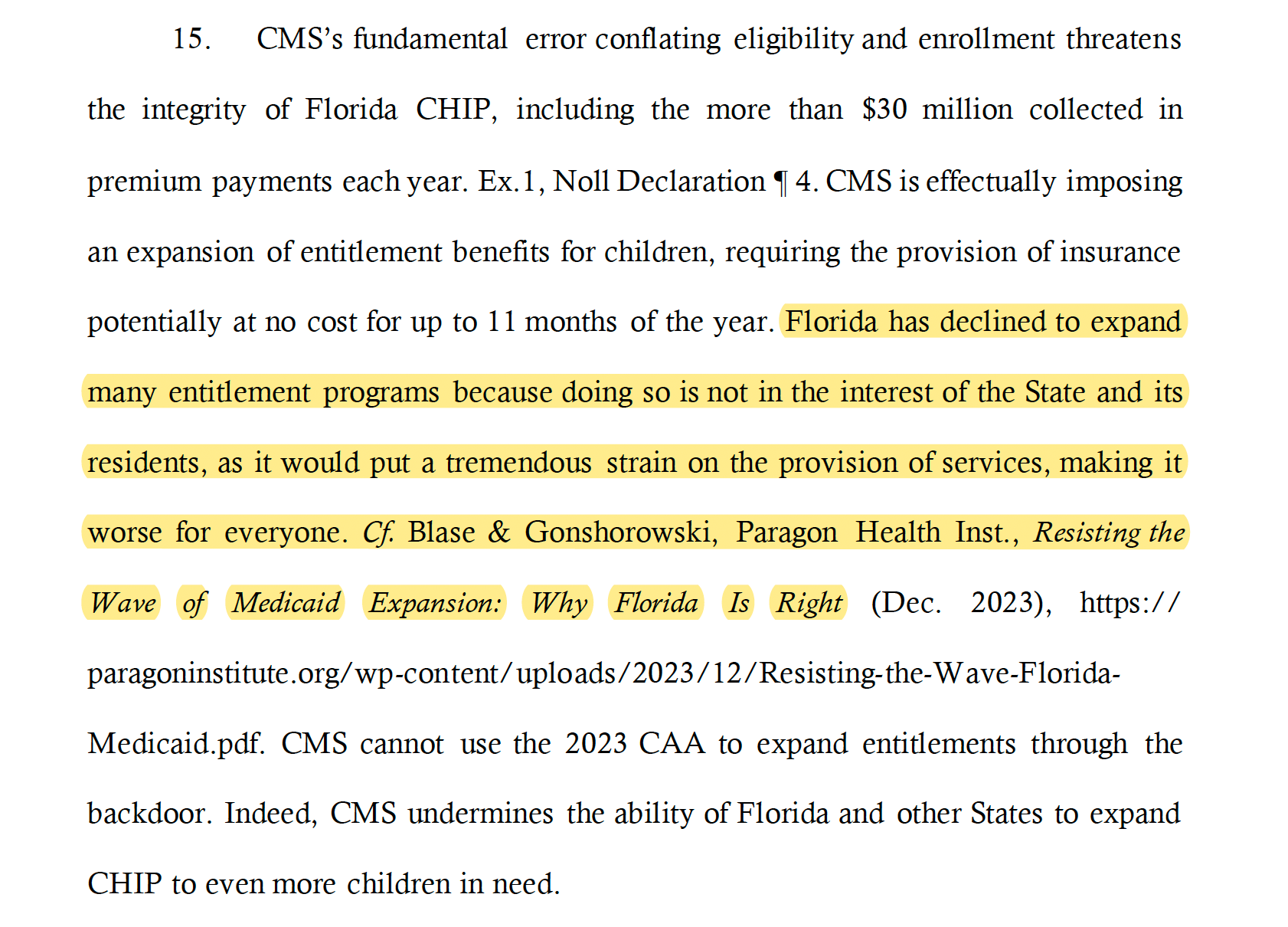
The DeSantis administration has sued to overturn that rule. The suit argues that federal officials have overstepped their authority, and that forcing Florida to continue providing health insurance to kids whose parents have missed a payment would undermine the integrity of the KidCare program.

To buttress its argument, the DeSantis administration cited a think tank report, published a little more than a month before the lawsuit was filed, titled, “Resisting the Wave of Medicaid Expansion: Why Florida is Right.”

An excerpt from Florida’s lawsuit against the federal government regarding eligibility rules for children’s health insurance.

The report was produced by a two-year-old organization called the Paragon Health Institute. Tax records show it is largely funded by the nonprofit network of billionaire industrialist Charles Koch, another of the nation’s biggest conservative political donors. 

All of Paragon’s first-year funding came from one of Koch’s “Stand Together Trust.” Most of its second-year funding came from the Koch group, too.

Paragon is also intertwined with the FGA. The institute’s president — and the lead author of the report Florida cited in its lawsuit — is Brian Blase. Blase is also a visiting fellow with the FGA, according to the group’s website.

Blase said he wasn’t consulted by anyone from the state about the litigation and that he didn’t know anything about the lawsuit before it was filed.

Asked if the Governor’s Office conferred with anyone from the Paragon Health Institute or the FGA before launching its suit, DeSantis spokesperson Jeremy Redfern responded, “Not to my knowledge.”

Other closely aligned conservative groups are now cheering on the state’s lawsuit — such as the Tallahassee-based James Madison Institute, which tax records show also receives substantial fundingfrom Charles Koch’s network.

Koch and his network were important early supporters of DeSantis, though they splintered during the governor’s presidential campaign when Koch’s Americans for Prosperity ultimately decided to endorse former South Carolina Gov. Nikki Haley.

But this is a relationship that DeSantis likely wants to repair as tries to rehabilitate his political reputation and prepare for a second presidential run. Politico Florida reported last week that DeSantis allies expect him to run again in 2028 — and to restart his political fundraising operation later this year.   

Several readers told me they were unable to access my conversation with Todd Scholl of the South Carolina Center for Educatot Wellness and Learning.

We talked about attacks on public schools, standardized testing, and privatization.

Todd sent these links:

The video can be found on the CEWL website at www.cewl.us. A direct link to the video can be found at https://youtu.be/Zm0Vi3S3RLM.

I will be in conversation with Todd Scholl of the Center for Educator Wellness & Learning in South Carolina tonight February 15 at 7 pm EST.

We will talk about privatization of public schools and the attacks on public schools.

The conversation will be livestreamed on Facebook.

Tonight February 15 at 7 pm.

Politico reported recently that Mayor Eric Adams is pulling out all the stops in his campaign to persuade the legislature to extend mayoral control of New York Ciry’s public schools.

That’s understandable. Every mayor wants as much power as he can gather. Guiliani wanted mayoral control. The legislature turned him down. Michael Bloomberg got it after he won the mayoralty in 2001, pledging to make the schools run efficiently and successfully after years of political squabbling and disappointing academic results.

A historical note: the last time that the independent Board of Education was abolished was in 1871, when Boss Tweed pushed through state legislation to create a Department of Education, in charge of the schools. The new Department immediately banned purchase of any textbooks published by Harper Bros., to retaliate for the publication of Thomas Nast cartoons ridiculing the Tweed Ring in Harper’s magazine. The new Department steered lucrative contracts to Tweed cronies, for furniture and all supplies for the schools.

Two years later, the corruption of the Tweed Ring was exposed, and criminal prosecutions ensued. In short order, the Department of Education was dissolved and the independent Board of Education was revived.

In the 2001 race for Mayor, billionaire Mike Bloomberg campaigned on promises to rebuild the city’s economy after the devastating attacks of 9/11/2001. He also promised to take over the school system, make it more efficient, improve student performance, and able to live within its budget of $12 billion plus. He won, and many people were excited by the prospect of a successful businessman taking over the city and the schools.

In 2002, the State Legislature gave Mayor Bloomberg control of the schools in New York City. It replaced the independent Board of Education, whose seven members were appointed by the five borough presidents and the mayor. Bloomberg had complete control of the school system, with its more than 1,000 schools and more than one million students. The new law allowed him to appoint the majority of “the Panel on Education Policy,” a sham substitute for the old Board of Education.

The new law still referred to “the Board of Education,” but the new PEP was a shell of its former self. It was toothless, as Bloomberg wanted. He picked the Chancellor, and he had the policymaking powers. Early on, in 2004, he decided that third graders should be held back based on their reading scores. Some of his appointees on the PEP opposed the idea and he fired them before the vote was taken. He wanted all his appointees to know that he appointed them to carry out his decisions, not to question them. The retention policy was later expanded through eighth grade but quietly abandoned in 2014 because it failed.

I won’t go into all the missteps of the Bloomberg regime, which lasted 12 years, but will offer a few generalizations:

1. The mayor should not control the schools because they will never be his first priority. The mayor juggles a large portfolio: public safety, the economy, transportation, infrastructure, public health, sanitation, and much more. On any given day, he/she might have 30 minutes to think about the schools; more some days, none at all on others.

2. Mayoral control concentrates too much power in the hands of one person. One person, especially a non-educator, gets an idea into his head and imposes it, no need to talk to experienced educators or review research.

3. Mayoral control marginalizes parents and community members, whose concerns deserve to be heard. At public hearings of the PEP, parents testified but rightly thought that no one listened to them. In the “bad old days,” they could speak to someone in their borough president’s office; now the borough presidents have no power. No one does, Except the mayor.

4. The Mayor picked three non-educators as Chancellor. Joel Klein disdained educators and public schools, even though he was a graduate of the NYC public schools. He created a “Leadership Academy” to train non-educators and teachers to bypass the usual path to becoming a principal by serving for years as an assistant principal. Klein surrounded himself with B-school graduates and looked to Eli Broad, Bill Gates, and Jack Welch for advice. Large numbers of experienced teachers and principals retired.

5. Bloomberg loved churn and disruption. He closed scores of schools and replaced them with many more small schools. Some high schools that had programs for ELLs, special education, career paths for different fields, were closed and replaced by schools for 300/400 students, too small to offer specialized programs or advanced classes.

6. New initiatives were announced with great fanfare (like merit pay), thanks to a vastly enlarged public relations staff, then quietly collapsed and disappeared.

7. Bloomberg and Klein imposed a new choice system. But all high schools and middle schools became schools of choice. A dozen students of the age living in the same building might attend a dozen different schools, some distant from their homes. One retired executive told me that this dispersal was intended to obstruct the creation of grassroots uprisings against the new dictates.

8. Bloomberg and Klein favored charter schools. In short order, more than 100 opened. The charters were supported financially and politically by some of the wealthiest Wall Street titans. When there was any threat to charters, their wealthy patrons quickly assembled multi-millions dollar TV campaigns to defend them. Because of the deep pockets of the charter patrons, the charter lobby gave generous contributions to legislators in Albany. The legislature passed laws favoring the charters, including one that required the public schools to provide free space for them or, if no suitable space was available, to pay their rent in private facilities.

9. Bloomberg and Klein made testing, accountability and choice the central themes of their reforms. Their approach mirrored President George W. Bush’s No Child Left Behind law, which began at the same time. Raising test scores became the goal of the school system. Schools were graded A-F, depending primarily on their ability to raise test scores. Eventually, teachers were graded by the rise or fall of their students’ scores. NYC faithfully mirrored the tenets of the national corporate reform movement.

10. NYC test scores improved on NAEP during the Bloomberg years, but not as much as in other cities that did not have mayoral control.

11. To get a great overview of “The Failure of Mayoral Control in New York City,” read this great summary by Leonie Haimson, which includes links to other sources. See, especially, the recent article in Education Week on the decline of mayoral control. Chicago had mayoral control similar to that in New York City, which allowed Mayor Rahm Emanuel to close 50 schools in black and brown communities in one day, completely ignoring the views of parents. It was an ignominious example of the danger of one-man control.

12. There is no perfect mechanism to govern schools, but any kind of oversight should allow parent voices to count. 95% of the nation’s school districts have elected school boards. Sometimes a small faction gains control and does damage. That’s the risk of democracy. Whatever the mechanism, there must be an opportunity for the public, especially parents, to make their voices heard and to have a role. The mayor controls the budget: that’s as much power as he should have.

History is an excellent overview of New York City school governance—history and myths. Again, by Leonie Haimson. (Note: her history leaves out the two years of mayoral control from 1871-1873.)

Umair Haque is an economist and a brilliant analyst of social and political trends. I read whatever he writes with a sense of amazement at his insight and his ability to synthesize events and their underlying causes. The following post from his blog called “The Issue” is especially alarming. It explains a lot about why we don’t have good health care, why the public sector is neglected, why privatization has run amok.

If you read one thing today, read this.

He writes:

He’s cruising towards clinching the nomination—as we all knew he would. The dreaded Trump-Biden rematch appears to be squarely in the sights.

And there are many, many theories being floated about Trump’s resurgence. Did he ever really go away, though? Still, it’s worth examining them for a moment. Trumpism’s a form of racial power, in a society divided. Trump’s power’s amplified by technology and society’s dependence on social media. Trump might win, but the coalition’s going to be so unstable he won’t accomplish much. It’s the last gasp of a nation facing demographic change. And so on.

I think that all these carry water. But I also think…there’s a truer truth at work here. Perhaps, in a sense, Trumpism’s America’s destiny. I know that’s a provocative thing to say, but I don’t mean it that way. I just can’t help thinking it lately, because…

What’s the most salient fact about America? Americans? Even—especially—Trumpists? The vast majority of Americans want a very, very different society. A more…can I say it? Liberal one. Even Trumpists don’t agree with most of Trump’s policies—they just support Trump, the Father Figure, come hell or high water. But when we ask Americans what kind of society they want, invariably, the vast, vast majority will plead for things like healthcare, childcare, retirement, stability, security. In short, Americans want eudaemonia—genuinely good lives.

But a kind of Stockholm Syndrome’s set in. They won’t…choose that form of sociopolitical economy. Even when it’s offered to them time and time again, whether in the way of a Bernie, or a Liz, and so forth.

Why is that? What explains that? This isn’t just “voting against your own interests”—it’s something stranger, deeper, weirder: remember, even Trumpists don’t agree with much of Trump’s agenda. So what can explain this pattern persisting over decades?

Let’s look at America objectively for a moment. What do you see? We’re going to speak factually, empirically—this isn’t about politics at all, really.

America’s a nation which failed to modernize, as I often say. It didn’t invest in itself. Europe and Canada’s investment rate is about 50%—while America’s is just 20% or so. Hence, Europeans and Canadians have cutting edge social contracts—made of the very things Americans desperately lack, like universal healthcare, childcare, high-speed rail, retirement, and so on. It’s true that in recent years, for example, in Europe, investment hasn’t kept pace—and hence, pessimism has grown there, too.

But America’s a special case. Its flatly refused to build a functioning social contract for…the entire modern era. Decade after decade, America’s rejected basic public goods. And so the result of course is that Americans pay eye-watering rates for everything that’s free in most other rich nations—education, healthcare, etc. My favorite example is universities. Harvard will set you back north of $60K a year—the Sorbonne in Paris is free. That’s the difference a functional social contract makes.

America’s social contract, sadly, is more pre-modern, Darwinian, Victorian: the strong survive, the weak fall and or perish, and that’s what’s not just right and just, but “efficient” and “productive.” Life is dog-eat-dog, and brutal competition defines every aspect of life. But how has that worked out?

Before we get there, another question needs to be asked. Why did—do—Americans fail to choose a modern social contract, time and again? There are many reasons, each one like the layer of an onion. It wasn’t offered to them. They were offered a lukewarm choice between Reaganomics, and then Clintonomics—etcetera. All of these, while they differed in the details, were variants of the same form of economy: nobody should have anything much as a basic right, everything should be financialized and capitalized, profit-maximization in “free” markets would unleash prosperity for all, and the wealth would trickle down.

But the very opposite happened. The wealth trickled up. We recently discussed how billionaires have gotten so much richer just during the pandemic that every American household would be $40,000 better off. That’s more than the median income—an astonishing statistic. And that comes after yet another wealth transfer upwards, during the last few decades—$50 trillion to the very richest. That’s half of the entire world’s GDP. Another startling statistic.

America, in other words, was the subject of Grand Social Experiment. Call it what you like—hypercapitalism, free markets, neoliberalism. We’re at the point where labels don’t matter much anymore—just the point does. The experiment failed. I’m not saying that American life is all bad, but I am saying that the results are self-evident: democracy’s on the brink, there’s a feeling of hopelessness on every side, among every social group, generation after generation’s experiencing rapid, sharp downward mobility, and young people say they “can’t function anymore”—just a smattering of statistics of social collapse.

So. America was a nation that failed to invest in itself—the Grand Social Experiment. We can put it in yet another way, a more philosophical one: all the old guff about “standing on your own two feet” and “pulling yourself up by your bootstraps” and whatnot. The results have been catastrophic: now democracy itself faces an existential challenge from a figure who’s already tried to unseat it once.

How are those two things linked? I think they’re connected in many, many ways. You see, when people experience what Americans have, especially those in the former working and lower middle class—a profound sense of dread, hopelessness, even trauma, shaped by downward mobility, and the disappearance of a future, community, social bonds, security, stability—they seek just strength and succor in the arms of demagogues. Those wounds open the door for an omnipotent Father Figure—they practically invoke the need for one.

These are shades of Weimar Germany, of course. The demagogue arrives, and scapegoats long-hated groups in society, blaming them for the woes of the pure and true. Isn’t that more or less what Trumpism’s appeal is based on? And doesn’t it begin to explain just why plenty of those who support Trump as demagogue even when they want a very, very different society from the one he’s going to deliver? They’re not thinking straight, as we all say. But there’s a reason why. The wounds go deep, right into existential territory itself. And then there’s an existential backlash, too. It’s me or you. I’m the master, you’re the slave. I deserve to live, you deserve to…

All Grand Social Experiments need…maybe not propaganda, but a certain ideological hardening to take place. They can’t happen otherwise. And this, too, is what happened in America. People were fed the myths of “free markets” and “trickle down economics” and so on for decades. So much so that even to this day to challenge them is to be labelled a “socialist.”

This was a process of ideological politicization. That is, these were all theories. Politics trucks in theories. But when those theories come true—or not—then we’re in the realm of empiricism, facts, reality. Americans were told that these theories had to come true. So much so that both parties offered slightly different versions of them. Sadly, that’s still true today—the Democrats are there for democracy’s sake, true, but they’re hardly offering much in the way of a modern social contract. Yes, on issues like abortion, the Democrats offer something better than theocracy. Still, their notion of progress falls well short of a truly modern social contract. Both parties agree, basically, that a modern social contract isn’t something Americans enjoy. That’s how deep this ideological hardening goes.

“Conditioning” might be too strong a word—but certainly, Americans were told to believe in the Grand Social Experiment for decades, to the point that any other alternative was considered “radical,” or even “communist” and so on—even while Europe and Canada proceeded to forge a different, socially democratic path. And of course it’s eminently true that there was a racial component to all this: Americans were told to reject “paying for those people’s schools” or educations or what have you, the clear implication being that “they” were different, lazy, foolish, liabilities. No clear aspiration to universalism was had, and in no sense were Americans bonded together as equals—the strong were to survive, and the weak perish, and that was what was moral, just, true, and theoretically sound, the key, somehow, to prosperity. Lead was to turn to gold. And to question it was taboo.

America still lives in the residue of this process of ideological hardening. This conditioning, though like I said, I think that’s too strong a word. I think that’s what explains this strange Stockholm Syndrome: Americans want a modern social contract, by and large, and yet here they are, unable to bring themselves to back one. In that vacuum, in that gap, what choice is left? The insecurity and instability, the fear and trauma—they turn people towards demagoguery. They reopen old wounds of hate and spite, instead of healing them with prosperity and trust and progress. They reduce people to their animal selves, seeking what stability and security they can find in older hierarchies of power and dominance, in which there appears to be some nostalgic certainty.

That’s a lot to chew on. I’m not saying I’m right. But I am saying that this may be where a society that fails to forge a modern social contract ends up. Haven’t we seen just this in plenty of “third world” countries? This oscillation between democracy and authoritarianism? I’m not saying America’s a “third world” country—don’t kid yourself, it’s not exactly Bangladesh. But I am saying that this place isn’t a stable equilibrium. The place the Grand Social Experiment—everyone’s a competitor, rival, adversary, in a brutal game called only the strong survive—ends? It might be right here. Destiny.

Destiny, of course, isn’t fate. It can be made and remade. But will America understand that before it’s too late?

This story by Michael Hardy was published by the Texas Monthly. It goes to the heart of serious problems in today’s journalism: is the Internet destroying the audience for daily newspapers? Can daily newspapers survive? The Baltimore Sun was just purchased by the rightwing Sinclair Network, which already owns a large number of local radio stations. Can newspapers be independent when they are owned by billionaires with a political agenda?

Billionaire Jeff Bezos bought The Washington Post but he doesn’t seem to have imposed his political views on the newspaper. Billionaire Rupert Murdoch famously bought The New York Post, the Wall Street Journal, and Fox News. He has pushed his properties to match his politics.

The Los Angeles Times was purchased by a billionaire doctor, Dr. Patrick Soon-Shiong, in 2018. He has not imposed his politics, but he has ordered drastic layoffs in newsroom personnel, which led to a one-day walkout last Friday by the newsroom guild, the first such work stoppage in the newspaper’s 142-year history. The pending layoffs would be the third round of cuts since June.

This is not a good sign for the health of our democracy.

The death of major newspapers over the past few decades has created “news deserts,” regions where there are no newspapers. It is more important than ever to support local journalism, which provide the sole source of information about local events, school board elections and meetings, elections, and local government.

Into the gap comes a new form of journalism, the nonprofit newspaper. Most such enterprises are supported by subscribers, advertisers, and foundation gifts. I support the Mississippi Free Press, which does an amazing job of covering news in the state. I also support the Texas Observer, which is a low-budget newspaper whose scrappy staff is known for investigative journalism. (I also subscribe to The Texas Tribune and The Texas Monthly).

In some cases, even the nonprofits depend on billionaires to keep them afloat. As this story shows, relying on billionaires can be hazardous. In some cases, their gifts come with long strings attached.

In a recent issue of The Texas Monthly, Michael Hardy reported what happened to a new nonprofit journal called the Houston Landung.

In its mission statement, the nonprofit Houston Landing describes itself as an “independent, nonpartisan news organization devoted to public service journalism,” one that “offer[s] solutions to pressing problems” and “holds the powerful accountable.” Its stories are free to read, and its website runs no ads or clickbait. Its vision of an independent, well-funded outlet built on rigorous investigative reporting attracted some of the city’s brightest journalism stars after its soft launch two years ago with financial backing from the philanthropic American Journalism Project and Houston billionaires John Arnold and Richard Kinder.

Among its first hires were Houston Chronicle investigations editor Mizanur Rahman, who became the Landing’s editor in chief (and helped write the mission statement), and the Chronicle’s Pulitzer Prize–winning reporter Alex Stuckey, who became the Landing’s top investigative journalist. Rahman and Stuckey helped build a newsroom of about thirty editors, reporters, photographers, and web designers that routinely punched above its weight, producing major stories about an epidemic of deaths in Harris County jails and a plague of stopped trains in Houston’s East End. Since the website’s official debut in June, it has regularly scooped the competition—including Texas Monthly—on stories ranging from the state takeover of Houston ISD to predatory lending at the Colony Ridge development north of Houston.

The Landing’s success made it all the more shocking when, on Monday morning, Rahman and Stuckey were summarily fired by CEO Peter Bhatia, a fifty-year newspaper veteran and former Detroit Free Press editor in chief who had been in the job for less than a year. Bhatia is longtime friends with Landing board member Jeff Cohen, a senior advisor at Houston philanthropy organization Arnold Ventures—a major funder of the Landing—and a former Chronicle editor in chief. The six-member board of directors appears to have brought Bhatia in to shake things up at the website. (None of the Landing’s six board members agreed to interview requests for this story; the author of this story worked briefly under Cohen at the Chronicle in 2017 and did sporadic freelance copy writing for the Arnold Ventures website from 2019 to 2020.)

“Over recent months I’ve become concerned about whether or not we were fully engaged in the process of being effective in the digital spaces,” Bhatia told Texas Monthly this week. “We’ve been putting out a newspaper on a website. There’s been some really good journalism and some high-impact stuff, for sure. But after a lot of conversations with Mizanur, I reached the conclusion that we had to make a change if we’re going to be as effective as we can in the digital space.” A document prepared for the November meeting of the Landing’s board and obtained by Texas Monthly showed that the site exceeded its 2023 goal for annual page views (1.5 million) and was within striking distance of its goal for unique visitors (1 million). For comparison, the nonprofit San Antonio Report, founded in 2012, claims 500,000 monthly page views.

Stuckey told Texas Monthly that she was blindsided by her firing. Just two weeks earlier, she had received a glowing performance review and a 3 percent pay raise. In a recording of Monday’s termination meeting provided by Stuckey, Bhatia can be heard saying he has “enormous respect for you as a journalist . . . you are an investigative reporter of the highest level.” But, he explains, there is no place for her in the “comprehensive reset” he believes is necessary at the Landing.

“If you had ever come to me and said, ‘I want you to revamp how you do stories,’ I would have done that in a heartbeat,” Stuckey tells him.

“It’s not my job to do that,” Bhatia replies. “It’s the editor’s job.”

“So I’m getting cut off at the knees because you felt that Mizanur didn’t do that?”

“Well, you can jump to that conclusion.”

At the end of the meeting, human resources director Susie Hermsen offered Stuckey three months of severance pay if she signed a nondisparagement agreement. Stuckey refused. “I believe in transparency,” she can be heard saying in the recording. “This is insanity, and I am absolutely not signing anything.”

The Landing’s newsroom was similarly dumbfounded by the firings. Much of the staff converged upon the organization’s sixth-floor office, in Houston’s Montrose neighborhood, on Monday to show solidarity with Rahman and Stuckey. Later, the staff wrote a collective letter to the Landing’s board of directors warning of “significant damage to employee retention and recruitment” and predicting that “the optics of such a massive restructuring during a moment of forward momentum will hurt our fundraising and financial efforts.”

Bhatia acknowledged that the newsroom was in open revolt against his leadership. “I have no illusion that some people are going to leave over this, and I respect that,” he told Texas Monthly. The Landing’s managing editor, John Tedesco, will temporarily take over for Rahman while Bhatia leads a search for a new editor in chief. Tedesco told me that he disagrees with the decision to fire Rahman and Stuckey and fears that “this turmoil will cause our best and brightest journalists to look for the nearest exit ramp.”

The Landing is one of dozens of local nonprofit newsrooms that have sprung up around the country in the past couple of decades. Often funded by a combination of wealthy donors, foundation grants, NPR-style membership drives, and paid events, these nonprofits have been touted as a supplement or even a replacement for declining local newspapers. But some observers worry that such publications are beholden to the whims of their billionaire patrons. (Texas Monthly is a for-profit magazine whose chairman is Houston billionaire Randa Duncan Williams.)

Where did the staff go wrong? Did they write anything critical of charter schools (billionaire John Arnold has poured many millions into promoting charters)? Or did they praise pensions for public service workers (another of Mr. Arnold’s pet peeves)? Or was it something that stepped on the toes of the other billionaire funder, Mr. Kinder? The publication was launched with $20 million, so it would not have been a financial issue.

This is what Thomas Jefferson said about the importance of a free press:

Jefferson believed that a free press was necessary to keep government in check. He wrote that if he had to choose between “a government without newspapers or newspapers without a government, I should not hesitate a moment to prefer the latter”:

The people are the only censors of their governors: and even their errors will tend to keep these to the true principles of their institution. To punish these errors too severely would be to suppress the only safeguard of the public liberty. The way to prevent these irregular interpositions of the people is to give them full information of their affairs thro’ the channel of the public papers, & to contrive that those papers should penetrate the whole mass of the people. The basis of our governments being the opinion of the people, the very first object should be to keep that right; and were it left to me to decide whether we should have a government without newspapers or newspapers without a government, I should not hesitate a moment to prefer the latter. But I should mean that every man should receive those papers & be capable of reading them.