In the midst of an article about Jackson Hole, Wyoming, a favorite retreat for the super-rich, we learned about the expansion of America’s billionaires.
That so much wealth could co-exist with so much poverty is no accident. It is a consequence of policy.
Here is an excerpt from the article:
A New York Times analysis shows the stunning velocity at which the fortunes of the 1 percent have increased across the country since President Trump first took office in 2017. The richest Americans saw their net worth soar 120 percent between 2017 and 2025, a colossal leap from the 45 percent growth they had seen over the previous nine years.
The number of U.S. billionaires jumped 50 percent by some estimates between 2017 and 2025, to more than 900 people.
More and more billionaires
The United States added new billionaires in 20 out of the last 25 years, as fortunes grew.
Source: New York Times analysis of the Forbes billionaires list.
Karl Russell/The New York Times
The list includes Elon Musk, who could become a trillionaire, and celebrities like Arnold Schwarzenegger, Tiger Woods, Bruce Springsteen and Jerry Seinfeld. But it also includes a number of people who are largely unknown to most Americans, people whose fortunes were lifted by investments and assets whose values have skyrocketed.
The minting of dozens of new billionaires occurred in the immediate wake of the 2017 tax cuts championed by Mr. Trump at the beginning of his first term, the nation’s biggest tax overhaul since 1986. The legislation, which slashed personal income taxes and doubled the estate tax exemption, was billed by Mr. Trump as “tax cuts for American families.” But the Times analysis, backed up by a range of new studies, shows that it disproportionately benefited wealthier taxpayers.
Most important, it cut the corporate tax rate and laid the groundwork for a surge in stock prices — creating a phenomenal accretion of wealth. The coronavirus pandemic intensified the dynamic. Tech prices soared as employees geared up to work at home and inflation tripled, weighing on the middle class and devastating the poor.
While the rich have been getting richer at a fairly steady pace over the years, the analysis shows that the net worths of those who were already billionaires experienced a pronounced shift after the tax cuts were signed into law, growing by 49 percent over eight years.
The irony in this significant u crease in billionaires is that it started with Trump’s tax cuts in 2017 and expanded with his tax cuts in 2025. And all the while, he was elected and re-elected by people who got the short end of the stick. MAGA was a front for the super-rich. It did nothing for Trump’s loyal base. He played them.
A very interesting blog called Status covers the media. It usually has the inside scoop on what’s going on behind the scenes, which journalists are seeing or leaving, what’s happening inside the major corporations.
In this post,Status explains how difficult it is to cover the war in Iran. The regime does not admit journalists. CNN is trying to provide coverage, as is The New York Times, but its reporters are not in Iran. The Washington Post is suffering from self/-influcted wounds because just a few weeks ago, Jeff Bezos eliminated his foreign correspondents in a cost-cutting move. Really smart for a guy with a net worth of $250 billion.
Natalie Korach wrote for Status:
As U.S. and Israeli forces launch deadly strikes on Iran, the inherent challenges of covering the country are exacerbated by recent newsroom cuts, social media distortion, and a White House prone to telling lies. When the U.S. invaded Iraq in 2003, Americans watched the war unfold through footage captured by journalists embedded with troops across the region. Two decades later, when Russia invaded Ukraine, foreign correspondents from U.S.-based networks raced to Kyiv and other areas of conflict, broadcasting live as missiles struck Ukrainian territory. But when the United States and Israellaunched strikes on Iran over the weekend, there were few, if any, Western journalists in the country to document the damage firsthand.
In a nation largely closed to Western media and with broadly limited internet access, the conflict is unfolding as something of an information black box, forcing news organizations to cover one of the most consequential military escalations in years largely from the outside. Adding to the challenge: Whether they can trust pronouncements coming from a Trump administration that has exhibited few compunctions about lying, from the president on down; and the degradation of social media, especially X, which is no longer a reliable source of information in breaking news situations.
Major television news networks and newspapers tasked with covering the war are having to piece together events from government statements, grainy videos circulating online, and reports from Iranian state media. In an era where many news organizations have been forced to scale back foreign bureaus and reporting resources—most notably the recent and devastating cuts at The Washington Post—the conflict is quickly becoming a test for media, exacerbated by the fact that Iran remains one of the most difficult places on earth for journalists to operate safely.
The geographic spread of the reporting team at CNN, the U.S. network with arguably the most foreign reporting resources, illustrates the challenge. The network has reporters fanned out across the region—Erin Burnett, Nick Paton Walsh, and Jeremy Diamond in Tel Aviv, Nic Robertson in Riyadh, Becky Anderson in Abu Dhabi, Paula Hancocks in Dubai, and Clarissa Ward reporting from Erbil in northern Iraq. Elsewhere across cable news, Fox News had Trey Yingst reporting live from Tel Aviv, Nate Foy on the ground in Cyprus, and Lucas Tomlinson in Istanbul. But none appeared to be inside Iran as of Sunday afternoon.
The New York Times is similarly mobilizing its global newsroom to cover the unfolding conflict. A spokesperson for the paper told Status that “hundreds of journalists from across The Times’ global newsroom–in New York, Washington, London, Seoul and a large and growing reporting team on the ground in the region–have been coming together to produce comprehensive coverage of every aspect of this military action.”
But few news organizations still possess the global infrastructure to support half a dozen or more reporters monitoring the situation on the ground in neighboring countries. Years of budget cuts have thinned the ranks of foreign correspondents in the region across the industry. At The Post, recent layoffs hit international coverage particularly hard, with the paper’s entire Middle East desk laid off. In January, Post reporter Yeganeh Torbati, who had been covering Iran, publicly appealed to owner Jeff Bezos on social media alongside colleagues, noting that she had spent months covering developments inside the country and wanted to continue the work. The appeals to Bezos to save the foreign reporting staff went unheeded.
“If I were The Washington Post right now, I’d still want international journalists,” Ian Bremmer wrote on social media, where many experts called attention to the terrible timing of The Post’s retrenchment during this moment of crisis abroad. Spokespersons for The Post did not respond to requests for comment, but the paper’s rolling coverage of the conflict dominated its homepage all weekend.
Ruth Marcus started her career at The Washington Post in 1984. She rose through the ranks and eventually became an editorial writer, a columnist, and deputy editor of the editorial page.
She wrote in The New Yorkerabout why she ultimately quit:
I stayed until I no longer could—until the newspaper’s owner, Jeff Bezos, issued an edict that the Post’s opinion offerings would henceforth concentrate on the twin pillars of “personal liberties and free markets,” and, even more worrisome, that “viewpoints opposing those pillars will be left to be published by others.” I stayed until the Post‘s publisher, Will Lewis, killed a column I filed last week expressing my disagreement with this new direction. Lewis refused my request to meet. (You can read the column in full below, but—spoiler alert—if you’re craving red meat, brace for tofu. I wrote the piece in the hope of getting it published and registering a point, not to embarrass or provoke the paper’s management.)
Is it possible to love an institution the way you love a person, fiercely and without reservation? For me, and for many other longtime staff reporters and editors, that is the way we have felt about the Post. It was there for us, and we for it. One Saturday night, in May, 1992, the investigative reporter George Lardner, Jr., was in the newsroom when he received a call that his twenty-one-year-old daughter, Kristin, had been shot and killed in Boston by an abusive ex-boyfriend. As I recall, there were no more flights that night to Boston. The Post’s C.E.O., Don Graham, chartered a plane to get Lardner where he needed to go. It was typical of Graham, a kindness that engendered the loyalty and affection of a dedicated staff.
Graham’s own supreme act of loyalty to the Post was his painful decision to sell the paper, in 2013, to Bezos, who made his vast fortune as the founder of Amazon. The Graham family was hardly poor, but in the new media environment—and under the relentless demands of reporting quarterly earnings—they were forced, again and again, to make trims, at a time when investment was needed. Instead of continuing to cut and, inevitably, diminish the paper that he loved, Graham carried out a meticulous search for a new owner with the resources, the judgment, and the vision to help the Post navigate this new era. Bezos—the “ultimate disrupter,” as Fortune had called him a year earlier—seemed the right choice.
For a long time, she writes, Bezos was a hands-off manager. During Trump’s first term, Bezos supported the newspaper’s editorial opposition to Trump’s 2016 election and its tough coverage of the chaotic Trump term.
She liked Bezos: In my experience of that time, Bezos came off as charming, smart, and unpretentious.
In 2020, the Washington Post endorsed Biden.
In 2024, Bezos stopped the editorial board from publishing its endorsement of Kamala Harris. The man Bezos selected as publisher was Will Lewis, a Brit who had worked in Rupert Murdoch’s media empire. Lewis defended the non-endorsement. Two opinion writers resigned, most signed a letter to Bezos objecting to his decision. Some 300,000 people cancelled their subscriptions.
After the election, Bezos seemed to fawn over Trump, defending him at every turn, donating to his inauguration fund. Two months after the election, Bezos offered Nelania $40 million to produce a documentary about her life in the White House. Many saw it as protection money.
Bezos defended his new view about Trump by saying that Trump had grown, was more deliberative since his last term. He told a reporter from The New York Times that Trump “is calmer than he was the first time and more confident, more settled.” Marcus said Bezos displayed “willful self-delusion.”
In early January, before the Inauguration, a cartoon by Pulitzer Prize-winning Ann Telnaes depicting the billionaires bowing to Trump was rejected by the editor David Shipley on grounds that it slduicated a column already published. Marcus thought this was an example of “obeying in advance,” that would not have happened if Bezos were not in charge.
Then came the order from Bezos on February 25, 2025, to editorial writers that The Post would publish only editorials and opinions that supported “free markets and personal liberties.” Those with opposing views would not appear in The Post.
No editorial writer had worked under these restrictions before. Marcus submitted a piece objecting to the restrictions; the publisher (Will Lewis) rejected it. She was stunned.
She tried to see him, but was told, “The decision is final.”
Marcus wrote:
So, too, was mine. I submitted my letter of resignation on Monday, to Bezos and Lewis. “Will’s decision to not run the column that I wrote respectfully dissenting from Jeff’s edict—something that I have not experienced in almost two decades of column-writing—underscores that the traditional freedom of columnists to select the topics they wish to address and say what they think has been dangerously eroded,” I wrote. “I love the Post. It breaks my heart to conclude that I must leave.”
The Washington Post that she had known and loved for forty-one years was dead.
In addition to blogging at Curmudgucation, Peter Greene is a Senior Contributor to Forbes, where this review appeared.
He reviewed my book in Forbes. You may be tired of seeing the wonderful reviews of my book by fellow bloggers. I agree with you….but…the book has been overlooked by the mainstream media. It is the first book I have published that was not reviewed by the New York Times.
I am thrilled that well-informed bloggers have taken the time to read and review it.
Peter Greene writes:
Diane Ravitch is one of the biggest turncoats in education policy history, and American education is better for it.
She tells the story in her newest book, her memoir An Education. From humble beginnings in Houston, she moved on to Wellesley, where she rubbed elbows with the likes of future Madeline Albright and Nora Ephron. Upon graduation. she married into the prestigious Ravitch family. Casting around for a career, she gravitated toward education history, starting with researching and writing a massive history of New York City public schools, launching her career as an academic.
She was in those days considered a neoconservative. She believed in meritocracy, standards, standardized testing, and color blindness, and these beliefs combined with her academic credentials formed a foundation for a burgeoning career of advocacy for the rising tide of education reform. By the time the 1990s rolled around, she was tapped for a role as Assistant Secretary of Education under President George H. W. Bush. She appeared in television, met and socialized with top political leaders, enjoyed other odd in-crowd perks like a visit to George Lucas at Skywalker Ranch. She was brought onto an assortment of conservative think tanks, served in various commissions and agencies under Presidents Bill Clinton and George W. Bush, and wrote several books that brought rounds of interviews on major media. She was a committed supporter and promoter of No Child Left Behind, which included all the emphasis on standards and testing that she thought she wanted to see in education.
When she graduated from high school, her English teacher gifted her with two quotes. The second was from Alfred, Lord Tennyson: “To strive, to seek, to find, and not to yield.” Those turned out to be prescient words for a woman who was about to engage in a public re-evaluation of her entire body of professional beliefs.
Michael Bloomberg was elected mayor of New York City and brought in Joel Klein to run the schools, and for four years Ravitch watched the ideas she championed implemented, and she saw the down side. She was critical, though carefully so (it was still not common knowledge that she had years ago left her husband for a woman). But she could see that Bloomberg and Klein were “faithfully, if erratically, imposing the right-wing policies that I had once endorsed and demonstrating their ineffectiveness.”
In the following years, Ravitch “step by step” abandoned her long-held views about education. Those long-held views had been her bread and butter, the web that sustained personal and professional networks. And Ravitch was willing not just to break those ties, but determined to “expose the big money propelling the cause of what I called corporate education reform.”
I changed my mind when I realized that the ideas I had championed sounded good in theory but failed in practice. I thought that standards, tests and accountability would lead to higher achievement (test scores). They didn’t. Even if they had, the scores would not signify better education, just a fortunate upbringing and the mastery of test-taking skills. I originally thought, like other so-called reformers, that competition and merit pay would encourage teachers and principals to work harder and get better results. They didn’t. The teachers were already working as hard as they knew how.
Ravitch came to view the punitive attempt to use test scores to determine teacher careers as demoralizing, destined to discourage young people from choosing the profession. The “toxic policy” of high-stakes testing was ‘inflicting harm on students and teachers.”
Ravitch became a key figure in the movement to support public education in the US. She co-founded the Network for Public Education and spoke out repeatedly against the education reform movement. Her blog became a popular outlet that connected many of the far-flung supporters of public education.
Ravitch has written page upon page critiquing the education reform movement of the past few decades, and in the final chapters of this memoir, the reader can find a clear, crisp encapsulated version of her conclusions and beliefs about the top-down government mandates and big-money attempts to dismantle the public school system and replace it with a multi-tiered privatized system. This brisk, readable book provides a historical recap of the ed reform movement and the resistance to it, as well as the rich history of a woman who, more than any other observer, has examined the pieces of the movement from both sides.
The First Amendment to the Constitution protects freedom of the press, among other protected rights. Yet days ago, independent journalists Don Lemon and Georgia Fort were arrested in Minneapolis for committing an act of journalism.
Arresting journalists for doing their job happens within a national context in which the major media are being bought up by billionaires and small-town media are struggling to survive. Late night comedians have been harassed , even canceled, because they dare to make fun of our Not-so-great leader. Trump’s erstwhile bestie Elon Musk bought and controls Twitter. His pals the billionaire Ellisons bought CBS.
In a healthy democracy, journalists are not handcuffed for doing their jobs. They are not dragged into courtrooms for showing up, asking questions, and bearing witness. They are not treated as threats simply because they point a camera toward power and refuse to look away.
Yet here we are.
This week, Don Lemon and Georgia Fort were arrested and charged under federal law with civil rights violations, including conspiracy to interfere with religious freedom and interfering with the exercise of First Amendment rights at a place of worship, while covering protests at a church in St. Paul, Minnesota. Not for committing violence. Not for inciting chaos. But for documenting what was happening, for talking to people on the ground, for doing exactly what journalism has always existed to do.
And that reality should stop us cold.
Because when a government begins going after journalists, history tells us something is deeply wrong.
We have only targeted journalists in this country during our most shameful chapters. During moments when fear outweighed principle. When those in power decided that controlling the narrative mattered more than the truth.
That is not coincidence. It is pattern.
Authoritarian systems do not begin by jailing everyone. They begin by isolating voices. They begin by making examples. They begin by teaching the public that speaking up carries a cost.
And journalists are always near the top of that list.
Why?
Because journalists give voice to the people.
They do not create dissent. They reveal it. They do not manufacture outrage. They document it. They do not invent injustice. They expose it.
When a journalist shows up, they bring sunlight. And sunlight makes lies harder to sustain.
Trump sees Don Lemon as a threat.
Not because Lemon suddenly changed who he is, but because his audience has changed.
Since leaving CNN, Lemon’s reach has exploded across social media. Younger people who never sat down to watch cable news are now watching his clips, sharing his reporting, and engaging with his long-form conversations. He is reaching people Trump cannot easily reach or control.
And Trump cannot shut Don Lemon down by calling his boss anymore.
The same is true for Georgia Fort.
They are independent.
They are not owned by a corporate parent that can be pressured behind closed doors. They cannot be silenced with a phone call.
The most threatening thing to an authoritarian regime is an independent reporter with a microphone.
The state is now alleging that Don Lemon interfered with parishioners’ right to worship.
But the truth runs in the opposite direction.
His presence protected that right.
Without reporters on the scene, there is no independent record of what happened. No documentation of how protesters were treated. No documentation of how parishioners were affected. No documentation of whether law enforcement actions were proportional or excessive.
Lemon did what journalists are supposed to do. He spoke with protesters. He also spoke with the pastor. He interviewed parishioners who were frustrated and hurt by the disruption. He allowed multiple sides to be heard in real time.
That is not interference.
That is accountability. That is transparency. That is how you protect rights, not undermine them.
Rights do not survive in darkness. They survive in public view.
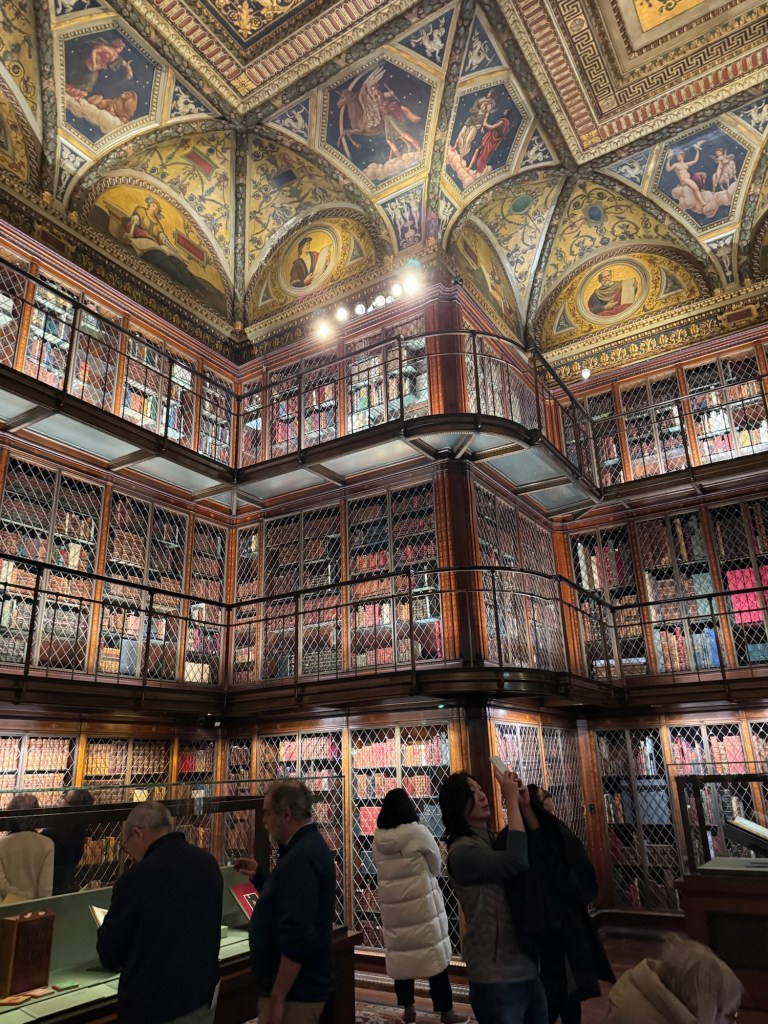
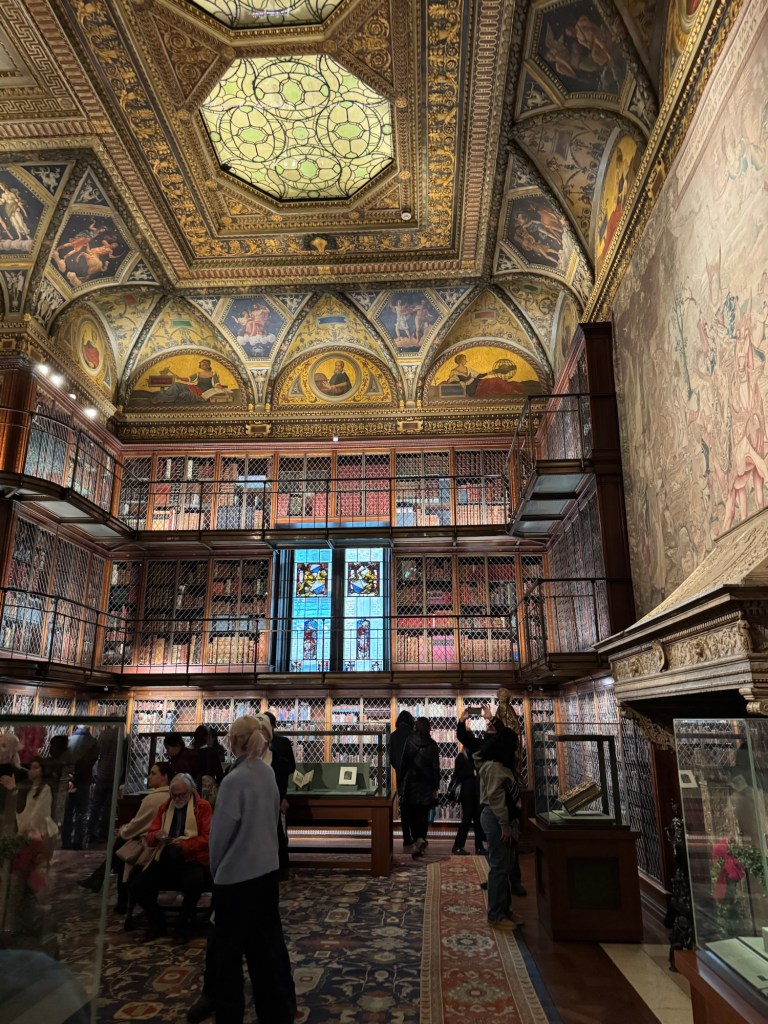
Last Friday, Mary and I took our oldest grandson, who is now 32, to The Morgan Library and Museum in Manhattan. The Morgan is a small but breath-taking collection of books and manuscripts that belonged to the personal collection of J.P. Morgan. The building is breathtaking, as are the books, which include an original Gutenberg Bible.
We began by seeing an exhibition of illustrated Bibles and other religious books that were over 1,000 years old. I kept thinking of the Hebrew scribes and Christian monks who spent years writing and illustrating these gorgeous volumes. Every letter, every line was perfect. How did they do it?
Then we visited the main library, a magnificent room with three layers of leather-bound books.
Mr. J.P. Morgan’s LibraryAnother view of this magnificent room
The room included a jewel-encrusted Bible, made in France and Austria in the 9th century
Mr. Morgan’s jewel-encrusted Bible
All of this splendor reminded me of the poverty in the streets outside his library and home, but I doubt that he thought much about the people outside.
In an exhibition case, there were several unusual printed documents. One was about a woman named Mary Toth or Toths, an English woman who pulled off an elaborate hoax in 1726, when she was 23 years old. She told doctors that she had given birth to bunnies. The illustration showed her, a few doctors, and many bunnies. The story spread rapidly, and many people believed that she had in fact given birth to bunnies. She was eventually discredited, briefly jailed, and eventually the charges against her were dismissed.
I said to my grandson, if that happened today, it would spread like wildfire on the internet and many people would swear it was true. My grandson said, “Some people will believe anything because they are ignorant.”
The stranger standing next to us interjected, “Some things never change.”
On the same day that we visited The Morgan Library, our frequent commenter Bob Shepherd left the following observation about why people are so gullible:
Three of the most powerful and important experiments ever performed were Stanley Milgram’s electric shock experiment, Solomon Asche’s line length determination experiment, and Philip Zimbardo’s prison experiment. I won’t go into the details of these here. You can look them up in a quick Google search if you are fuzzy on their details. What these experiments, which have been repeatedly replicated, show conclusively is that about two thirds of people are so driven by desire to be accepted by the group that they will conform to and actively participate in the most egregious behavior toward others in order to be themselves accepted by a perceived “authority.” Next time you are in a public place–at a game, in a restaurant, in a club–look around you. Two thirds of the people you see are potential collaborators–people capable of extreme evil, which, as Hannah Arendt pointed out, is TYPICALLY characterized by mediocrity.
Years ago, when I was a baby editor, I went to work for McDougal, Littell. Ms. Littell–the co-founder’s wife–was the editor of their literature program at the time, and she had chosen for the 12th-grade book an essay by the English historian Hugh Trevor-Roper about what an “evil genius” Hitler was. Well, I risked my job by objecting to this piece because Hitler was not a genius. He was a common thug and a psychopath, and people are sheep, easily led, easily bullied into submission and acquiescence. Or consider John Gotti–the psychopathic criminal Mafia thug. The press created an image of the brilliant “Dapper Don,” who could constantly evade punishment. But after he was finally imprisoned, tapes of wire taps on Gotti were released, and these showed that he was the lowest sort of ignorant thug, incapable of clear reasoning or speech, driven by the basest motivations, and unable to say anything without accompanying it with a string of curses that stood in for the words lacking in his fourth-grade vocabulary.
People want to belong. They want to get along. They want Daddy to tell everyone what to do. And they will idolize absolute monsters if they get that from them.
Bob is a polymath—an author, editor, guitarist, teacher, and humorist–who seems to have read deeply in every field.
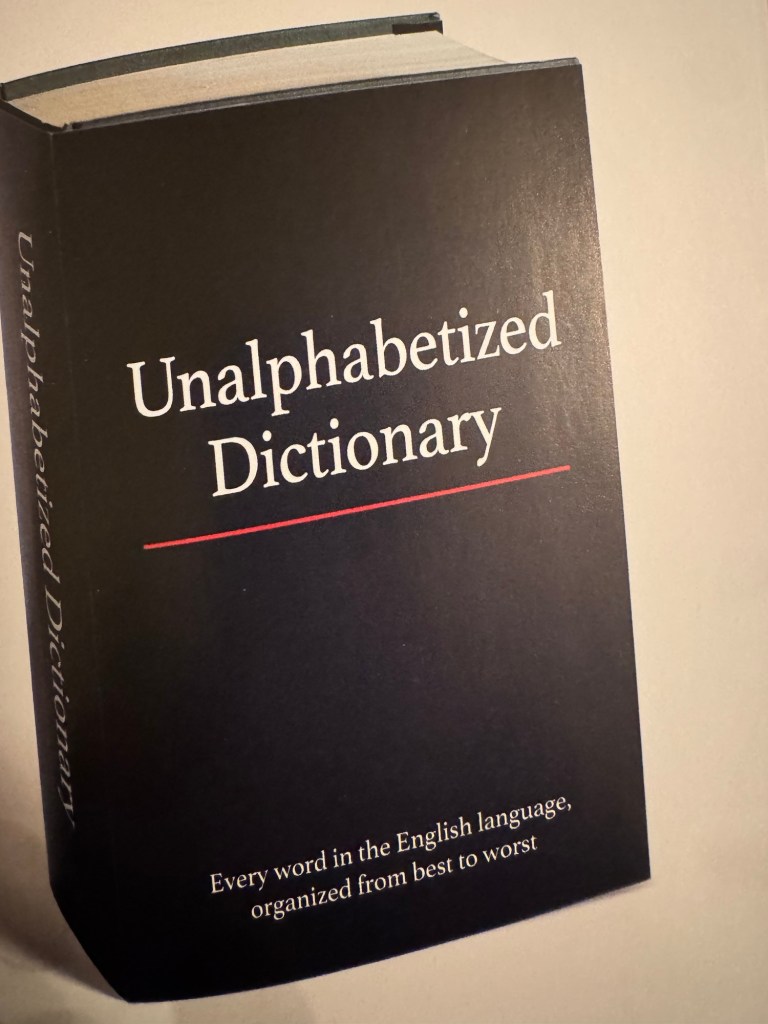
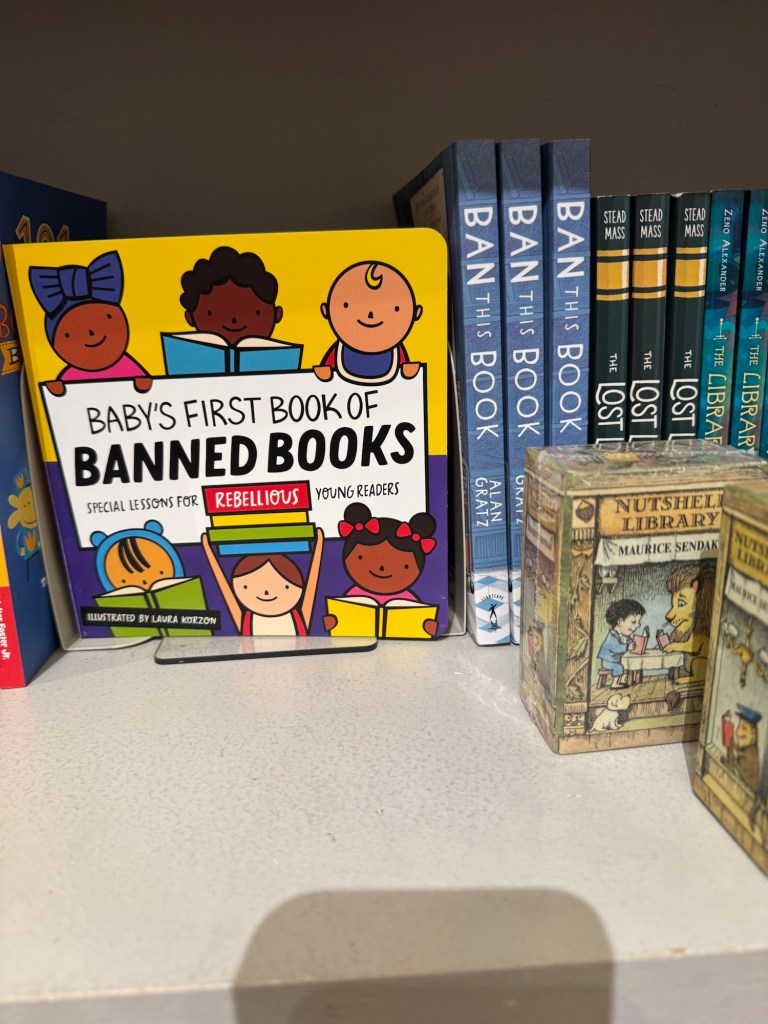
Oh, we stopped in the gift shop, and I bought a couple of delightful books. One was titled Rejected Books: The Most Unpublishable Books of All Time.
Some of those unpublishable books:
Famous People in Owl MasksUnalphabetized DictionaryTerrible Drawings of Horses
Dan Rather, legendary newsman, spent decades at CBS. Now, in retirement, he continues to have good sources at the network. In his blog “Steady,” he explains the back story of the censorship of the “60 Minutes” expose of inhumane conditions at the prison in El Salvador to which the Trump administration sent alleged terrorists.
CBS News “60 Minutes” correspondent Sharyn Alfonsi is walking the walk.
What she has done for journalism in the last two days is about as important, and courageous as it gets. With her cherished journalistic institution threatened, and her career on the line, Alfonsi is sounding the alarm that “60 Minutes” is sliding further into an increasingly irretrievable and dark place.
The Steady team spoke to sources inside the broadcast today to find out exactly what happened when the new CBS News boss, Bari Weiss, spiked a highly promoted piece at the last minute.
On background, we learned that Alfonsi and producer Oriana Zill de Granados had for months been working on a story about the Trump administration’s illegal deportations of Venezuelan migrants to CECOT, a maximum-security prison in El Salvador.
They interviewed former inmates about the brutal and torturous conditions inside the notorious prison. This is the place where Trump sent hundreds of Venezuelans he alleged were terrorists with gang ties. Human Rights Watch found that the 252 men were subject to “arbitrary detention and enforced disappearance.”
As part of the reporting, they repeatedly asked the White House, the Department of Homeland Security, and the State Department for comment, but received no response. That is no surprise since this story would be another black mark on Trump’s draconian immigration agenda.
Last Thursday, after the story had been fully fact-checked and legally vetted by CBS lawyers and its Standards and Practices team, the piece was screened for a fifth and final time for CBS News executives. Weiss was supposed to attend but did not.
She did, however, screen the story several hours later. At 11:50 p.m. Thursday, Weiss emailed the broadcast’s executive producer, Tanya Simon, outlining a few issues she had with the piece that she called “incredibly powerful.”
On Friday morning, Alfonsi made several changes to the script to address Weiss’s concerns, believed it was ready for air, and recorded her in-studio introduction
The listing of Sunday night’s “60 Minutes” pieces was released, which included Alfonsi’s “Inside CECOT.” Promos began to air, including on social media. The “Inside CECOT” clip on Instagram quickly racked up 4 million views, significantly more than usual.
But by Saturday morning, something changed. In an unprecedented move, Weiss reached out to Simon again. Her biggest issue now was the lack of response from the Trump administration. It was the first time she raised this concern.
“I realize we’ve emailed the DHS spox, but we need to push much harder to get these principals on the record,” Weiss wrote. She even provided phone numbers for Stephen Miller, the architect of Trump’s immigration policies, and border czar Tom Homan.
Not long after, Weiss killed the story, though promos kept running and the piece was still listed as airing.
Late on Sunday afternoon, just three hours before air time, “60 Minutes” posted an editor’s note on social media: “The broadcast lineup for tonight’s edition of 60 Minutes has been updated. Our report ‘Inside CECOT’ will air in a future broadcast.”
Within two hours, Alfonsi sent an email to her fellow correspondents and the production team that worked on the piece. “Our story was screened five times and cleared by both CBS attorneys and Standards and Practices. It is factually correct. In my view, pulling it now — after every rigorous internal check has been met — is not an editorial decision, it is a political one,” she wrote.
She continued, “Our viewers are expecting it. When it fails to air without a credible explanation, the public will correctly identify this as corporate censorship. We are trading 50 years of ‘gold standard’ reputation for a single week of political quiet.”
Alfonsi then addressed Weiss’s issue with the administration’s decision not to respond. “Government silence is a statement, not a VETO. Their refusal to be interviewed is a tactical maneuver designed to kill the story. If the administration’s refusal to participate becomes a valid reason to spike a story, we have effectively handed them a ‘kill switch’ for any reporting they find inconvenient.”
Alfonsi is the definition of courage. Kudos to her for speaking truth to power. The hard-won reputation of America’s most trusted television news program, and a big-time money maker for Paramount, is suddenly on the line.
During the CBS News morning editorial call on Monday, Weiss defended her decision. “I held a ‘60 Minutes’ story because it was not ready… We need to be able to get the principals on the record and on camera.”
Nothing happens in a vacuum in Trump World. The killing of the CECOT piece is no exception.
In August, David Ellison, the scion of Oracle founder and Trump supporter Larry Ellison, purchased CBS parent company Paramount. The acquisition by Ellison’s Skydance needed administration approval, which Trump’s regulators signed off on to the deep-pocketed Ellisons.
They signed off only after CBS agreed to settle a specious lawsuit in which Trump accused the network of deceitfully editing a “60 Minutes” interview with Vice President Kamala Harris during the presidential campaign.
As per usual, Trump’s warm and fuzzy feelings toward his sycophants was fleeting.
“For those people that think I am close with the new owners of CBS, please understand that 60 Minutes has treated me far worse since the so-called ‘takeover,’ than they have ever treated me before,” Trump posted on social media last week.
Friday night, at a rally in North Carolina, Trump said, “I love the new owners of CBS. Something happens to them, though. ‘60 Minutes’ has treated me worse under the new ownership… they just keep hitting me, it’s crazy.”
How Trump feels about the Ellisons is especially important right now as Paramount Skydance attempts a hostile takeover of another media giant, Warner Bros. Discovery. And once again, the Ellisons, who have been major donors to Trump, need governmental approval.
The president’s hatred of the revered news magazine seems to have been rekindled by a recent Lesley Stahl interview with the president’s newest nemesis, Rep. Marjorie Taylor Greene.
Right after that interview aired, he posted, “THEY ARE NO BETTER THAN THE OLD OWNERSHIP. Since they bought it, 60 Minutes has actually gotten WORSE!”
Not coincidentally, “Bari Weiss got personally involved,” with stories about politics after the Greene interview, a “60 Minutes” insider told CNN.
This brings us back to Alfonsi’s piece, which had the unfortunate luck of being scheduled to air the evening before David Ellison upped his bid for Warner Bros. Discovery. Staying in Trump’s good graces is, well, paramount at the moment.
The day Skydance bought Paramount was a dark day for CBS News and journalism as a whole. When Weiss, with no television reporting or news production experience, was installed as CBS News editor-in-chief, my heart sank again.
If the Trump administration doesn’t want to comment, they won’t, and didn’t. It happens dozens of times a day, every day to every journalist trying to cover this facts-adverse administration. No amount of wishing, or asking, or begging will make it happen. Weiss’s knee-jerk reaction was just an excuse.
The day has been filled with talk of journalists walking away from “60 Minutes.” As one insider told us, we have got nothing left but our integrity.
What happened to Alfonsi’s piece is no less hard to take even though anyone could see it coming. The barbarians are no longer at the gate. They have breached the walls and are now running the show.
This is a gift article that appeared in Bloomberg News. It describes the dramatic changes that Trump has made by executive order to redirect the flow of money.
It’s unlikely that Trump wrote these orders or even understood their implications. He is surrounded by people who know precisely what they are doing: windfalls for the rich.
Jeff Yass is one of the richest people in the world. He is the richest person in Pennsylvania. He is #25 or #27 on Bloomberg’s Billionaires’ Index, depending on which day you check. His net worth is about $65 billion. He co-founded the Susquehanna International Group, which is based in Pennsylvania. He is also a major investor in TikTok and is widely believed to have persuaded Trump not to ban it. In the last decade, he has given hundreds of millions to political campaigns, including the 2024 Trump campaign.
Yass was recently interviewed by The Washington Post, where he talked about his passion: Vouchers. The writers of the article were Laura Meckler, Beth Reinhard, and Clara Ence Morse.
Yass thinks the public should pay for students to go wherever their parents want them to go: to private schools, religious schools, charter schools, any kind of school, including public schools. He thinks all students should get vouchers, regardless of family income.
He believes the public schools are failing and that universal vouchers will turn American education into a great success.
Yass provided $6 million to Texas Governor Greg Abbott to run pro-voucher Republicans against moderate Republicans who supported public schools. Abbott ran a campaign of lies against the moderate Republicans, asserting that they opposed more funding for public schools and that they supported open borders.
With Yass’s money and Abbott’s lies, they managed to knock off enough moderate Republicans to finally pass a voucher bill. The voucher program is currently costing nearly $1 billion, and most of the voucher money pays the tuition of students previously enrolled in private and religious schools.
The strange part of Yass’s devotion to charter schools and vouchers for religious and private schools is that Jeff is a graduate of the New York City public schools. He graduated from Bayside High School in Queens. He then attended Binghamton University in New York, where he spent most of his time playing poker, betting on horse races, and honing a keen ability to calculate the odds and winning.
As a young man, he read Milton Friedan’s Capitalism and Freedom and became a Friedman devotee. He met Friedman several times; when he asked the great conservative economist which philanthropy he should support, Friedman said “school vouchers.”
Yass jumped in to support school choice. His ideological commitment to them is so strong that he ignores that show that most vouchers are taken by kids already enrolled in non-public schools. He thinks all students should get vouchers, including those whose families are wealthy.
Yass confidently told The Post that studies of voucher programs show “overwhelmingly” positive results. Several early studies of targeted voucher programs have indeed shown positive results on standardized tests, and some research shows positive impacts on other metrics such as college enrollment.
But most research over the past decade or so shows either no effect or a negative impact on test scores for larger-scale programs. Some charter schools struggle with low test scores just like traditional public schools do. That’s at least partly because educating children with many needs and few advantages is a challenging task
Yass maintains that these programs help children. But he also says he doesn’t really care what the studies say or how children perform on tests. He takes the libertarian point of view that all parents should be empowered to choose the school — public or private — that they want for their children, no matter what.
“If the mother or the parent wants the kid to go from one school to another, who the hell is anyone to tell them not to?” he told The Post. “I don’t care what the studies say.”
Yass has spent many millions in his home state of Pennsylvania, but thus far has failed to get sweeping voucher legislation passed.
He has a a starry-eyed and warped view of the U.S. economy.
In a 2021 conversation sponsored by the Adam Smith Society, part of a free-market think tank, he said that the U.S. is almost to the point where “no one” is hungry, cold or lacks basic health insurance.
“What’s the difference between a billionaire and a guy who’s making $100,000 a year? They’re both at home watching Netflix. And they’re both on their iPhones,” he said then. “The disparity between how rich people live and how poor people live in America has never been smaller.”
Government data shows that in 2024, there were 27 million uninsured Americans and in 2023, 18 million households were uncertain if they would have enough food. Wealth inequality has been rising for decades, with the richest families increasing their wealth at a faster rate than everyone else.
Despite Yass’s multi-million dollar contributions to candidates in Pennsylvania, his candidates have frequently lost. Yass has been singled out by protest groups who resent his efforts to buy elections and determine the future of the state.
Critics say his giving represents an absurd amount of influence for one person, who can press his political agenda simply because he is rich….
“Hey hey! Ho ho! Billionaires have got to go!” chanted about 50 protesters marching to Susquehanna’s front door. The group outside Yass’s office in late September wasn’t an unusual sight. All Eyes on Yass, a coalition of education, labor and civil rights groups, has worked to turn Yass into the state’s prime villain, creating an online “Yass tracker” that allows voters to look up whether their state elected officials have received money from Yass-funded PACs.
The protestors organized in response to Yass’s efforts to change the composition of the State Supreme Court.
In the last election, he supported three Republican candidates trying to defeat three Democratic judges on the State Supreme Court. All three of his candidates lost.
It was the 12th demonstration since 2022 organized by All Eyes on Yass. In a year when Musk’s role at the White House prompted intense criticism of billionaires in politics, this group stands out in its singular and persistent focus on Pennsylvania’s richest man.
“We’re here with a simple message: Billionaires like Jeff Yass can’t steal our elections,” said Raquel Jackson-Stone, 32, who works for a civil rights group called One Pennsylvania. “They don’t care about the same things we care about, like housing affordability and making our public schools better…”
Yass rarely if ever interacts with people he disagrees with on this subject. He volunteered to The Post that in business, he advises his employees to seek out alternative points of view. “I always say, ‘Go find the smartest person who disagrees with you,’” he said.
But he said he has never had a personal conversation with a public education advocate to try to understand their point of view. “I would love to do that,” he said….
In the interview with The Post, Yass stood by his comments. He said the divide in America is not about money but about how much satisfaction people get from their work. “That’s the inequality. Wealthy, educated people enjoy their jobs. Lower-income people don’t enjoy their jobs.”
His confidence feeds his opponents but also his conviction to keep spending. If the criticism bothers him, he doesn’t let it show. He sees no problem with one man using money made on Wall Street to press a personal agenda. And he compares his influence not against that of other individuals but to teachers unions and other large interest groups that represent thousands of people each.
As Yass sees it, he’s the one fighting for the underdog — a billionaire speaking up for those who don’t have billions.
“It’s David versus Goliath,” he said. “I represent David.”
So Jeff Yass has never talked to a public education advocate to test his views. I volunteer.
We have seen many repulsive sights in the Oval Office since Trump was sworn in last January. The covering of the room in fake gold ornaments is an abomination. Trump’s rude treatment of Zelensky was an outrage.
But the top abomination, at this moment, was his loving embrace of Saudi Arabia’s Crown Prince Mohammed bin Salman, who should be reviled for his brutal murder of journalist Jamal Khashoggi.
What next? A Presidential Medal of Honor for Putin?
Trump has many personal commercial ties to Saudi Arabia. Cynically speaking, Trump is building alliances by making personal deals with potentates who increase his family wealth. Surely, we cannot forget that MBS arranged to give Son-in-law Jared Kushner $2 billion after Trump left office in 2021. Kushner had no experience in financial investing. His background was real estate. Now, Trump’s real estate buddies Steve Witkoff and Howard Lutnick, are Trump’s envoys to Russia, the Middle East, and other hotspots. They too (and their children) are taking in millions and billions, because they are in “the room where it happens.”
The New York Timeswrote recently about how Lutnick’s sons are making lucrative deals , which are helped by the fact that their father is Secretary of Commerce. “But never in modern U.S. history has the office intersected so broadly and deeply with the financial interests of the commerce secretary’s own family, according to interviews with ethics lawyers and historians…”
But maybe those of us who worry about abstract ideas like ethics and laws are in the wrong. Maybe the best way to make a deal with the devil is to get in bed with him, speak his language, and buy his friendship. That’s Trump’s way. And nobody does it better.
Trump just threw a lavish state party to welcome a Saudi murderer. He defended the murderer’s crime, blamed the victim, and viciously attacked a reporter for asking the question on everyone’s mind: What about Jamal Khashoggi?
Khashoggi was also a frequent critic of the Saudi government. He frequently criticized the royal ruling family, not for their lavish lifestyles, but for their suppression of dissent, their refusal to allow free speech among the Saudi people, and their widespreadhuman rights abuses.
On Oct. 2, 2018, Khashoggi was murdered in Istanbul. He had gone to see about a visa for his Turkish fiancée at the Saudi consulate’s office, where he was attacked, stangled, and dismembered.
A recording made by Turkish intelligence agents in the building captured the whole gruesome ordeal: Khashoggi could be heard struggling against Saudi guards of the royal Crown Prince as his killing was recorded, complete with screams, the sounds of strangulation, then quiet, before a bone saw was heard dismembering his body.
· bin Salman’s total control of decision-making in the Saudi Kingdom;
· The direct involvement of bin Salman’s key adviser in the brutal attack, along with members of his personal security team; and
· bin Salman’s stated support for using violence to silence critics of the Saudi government abroad, including Khashoggi.
US intelligence added that, “Since 2017, the Crown Prince has had absolute control of the Kingdom’s security and intelligence organizations, making it highly unlikely that Saudi officials would have carried out an operation of this nature without the Crown Prince’s authorization.”
Despite these publicly available facts, Trump treated bin Salman to an unusually lavish state reception, complete with military officers in full dress carrying both Saudi and American colors. As the US taxpayer-funded Marine band played, Trump and Mr. Bone Saw were treated to a fly-over of advanced fighter jets, samples of the 48 F-35 jets Trump already sold to Saudi Arabia, despite national security concerns that China would be able to steal the aircraft’s advanced technology.
And no one has forgotten Trump’s son in law, Jared Kushner’s, $2 billion private “investment” fee from the Saudis, packaged when Saudi Arabia’s Public Investment Fund (PIF) announced a $55 billion acquisition. Kushner’s fee is widely regarded as payment for providing political cover and guaranteeing Trump’s regulatory protection. After the PIF’s own advisors initially rejected the deal, bin Salman personally overruled them and pushed it through.
Trump didn’t mention these deals this week when he rolled out the red carpet on taxpayers’ dime, but claimed instead with trademark ambiguity that the Saudis were going to “invest as much as $1 trillion in the US.”
Trump endorses the unthinkable
Journalists around the world, not to mention Khashoggi’s family, had to endure the nightmare of watching Trump fawn all over bin Salman. In every photo from the mainstream media, Trump couldn’t keep his hands off him, as if Trump were absorbing Saudi wealth through his fingers.
Tuesday, when journalist Mary Bruce asked bin Salman about intelligence reports concluding that he ordered the Khashoggi murder, Trump jumped in, answering for him. “He knew nothing about it! You don’t have to embarrass our guest by asking something like that.”
After sending this chilling message to his critics, Trump then attacked Bruce for asking a “horrible,” insubordinate,” and “just a terrible question,” dressing her down in garbled syntax before cameras of the world with, “You’re all psyched up. Somebody psyched you over at ABC and they’re going to psych it. You’re a terrible person and a terrible reporter,” and later demanded that ABC lose its broadcast license.
Saudi Arabia’s Crown Prince Mohammed bin Salman is condemned throughout the civilized world as a brutal 5th Century pariah. Trump just spent a taxpayer fortune to rebrand him “one of the most respected people in the world” to elevate and promote Trump’s own private business ventures.
It is fitting that Trump committed this atrocity in a formerly dignified room recently desecrated with tacky gold medallions. The Oval Office is now a bordello whose pimp is selling America to the highest bidder, and we, his trafficked victims, are letting him do it.
Sabrina Haake is a columnist and 25+ year federal trial attorney specializing in 1st and 14th A defense. Her Substack, The Haake Take, is free.






 Diane Ravitch's blog