Archives for category: Bigotry

Jeanne Kaplan was a tireless champion of public schools in Denver. She was elected to two terms on the Denver school board. She fought for better, more equitable, fully funded schools. She opposed charter schools because they drained funding from public schools. She was a long-time crusader for civil rights, and she appalled by the takeover of the Denver schools by charter interests, who flew a false flag, pretending to care about equity.

Jeannie learned that she had lung cancer last April. Her medical treatment did not slow the disease. She died yesterday. She was 78.

I met Jeannie in Denver in 2010 as I was traveling the country to promote my book The Death and Life of the Great American School System: How Testing and Choice Are Undermining Education. When I met her, we became fast friends. We were on the same page, and she told me about the damage that charter schools were doing to Denver’s public schools. Candidates for the Denver school board were funded by Dark Money, privatizers, and out-of-state billionaires. It was almost impossible for a parent to raise the money to be competitive with the corporate reform candidates.

Jeannie was a warm and caring person who inspired others to get involved, despite the odds crested by Big Money. She started her own blog called “Kaplan for Kids,” and I reposted some of them here.

I think the best way to honor her memory here is to post what seems to be her last commentary, which overflows with wisdom, candor, experience, and common sense. I humbly add her name to the honor roll of the blog.

Jeannie Kaplan wrote:

CHARTERS, CHOICE, and COMPETITION = CLOSURES, CHAOS, and CHURN Principles of Privatization

Posted on November 1, 2022 by Jeannie Kaplan

Reap what you sow and the chickens come home to roost. The elephant in the room.  Aphorisms appropriate to describe what is happening in public education in Denver. 

After 20 years,  more than 5  superintendents, and 11 different school boards, the results of education reform in Denver have become clear, and they aren’t pretty. After opening 72 charters in the last 20 years, 22 of which have closed, the declining enrollments in neighborhood schools have forced the prospect of school closures.  Who knew opening 26 privately run elementary charter schools in competition with district-run schools would ultimately force the district to make some hard financial decisions?  And who knew that ignoring its own 2007 data showing stagnant population growth would lead to less demand for elementary school seats in the 2020s?  Apparently, not those with the power for the last 20 years.  And, as an ironic aside, many of the same people who were the decision-makers in the past and who were unable to make substantive change then, have now decided they will somehow make these previously unattainable changes from their outside “oversight” committee, EDUCATE Denver. In fact one of the co-chairs, Rosemary Rodriguez, was a DPS board member when on March 16, 2017, a Strengthening Neighborhoods Resolution passed, stating:

NOW, THEREFORE, BE IT RESOLVED, that a citywide committee be formed to review changing demographics and housing patterns in our city and the effect on our schools and to make recommendations on our policies around boundaries, choice, enrollment and academic programs in order to drive greater socio-economic integration in our schools.

BE IT FURTHER RESOLVED, that in the face of the sharp decline in the number of school-aged children in gentrifying neighborhoods, the committee is also charged with how to think about school choice and school consolidation to ensure that our schools are able to offer high-quality, sustainable programs for our kids.

These former school board members and former and current civic leaders have formed a “shadow school board” to evaluate and oversee the current superintendent and school board.  Why?  It appears they don’t like what they are seeing being proposed by the current superintendent. What don’t they like?  It appears they have determined the current superintendent is not committed enough to their reform agenda.  You know – the one that has been in place when they were in power, the one that has produced the biggest gaps in the nation, more segregation, and more resource inequity.

As school closures have risen to the fore this week Chalkbeat disclosed these statistics:

“Over the past 20 years, Denver Public Schools has added a lot of schools. It has added students, too — but at a much slower rate.

  • The number of public schools in Denver grew 55% between the 2001-02 and 2021-22 school years, while the number of students grew just 12%.
  • Denver went from having 132 schools serving about 72,000 students in 2001-02 to 204 schools serving nearly 89,000 students in 2021-22.
  • The number of elementary schools in Denver grew 23% over the past 20 years, while the number of students grew just 4%.”

Through expensive marketing and often false narratives, charter schools have had free reign to prey on susceptible families resulting in DPS losing 7400 elementary school students who would have otherwise most likely attended a neighborhood school. Then add in:

  • a state law that prohibits a district from shutting down low enrollment charters, 
  • a district that has ignored demographic information predicting declining enrollment, 
  • a district that employs “attendance zones” and a secretive CHOICE system to often force place students into heavily marketed, often unwanted CHARTER SCHOOLS, and 
  • a competitive financial model called Student Based Budgeting (SBB – money follows the kid) to fund schools, depending on student needs, the goal of which is to close the achievement and resource gaps.  The 2010 Denver Plan/ Strategic Vision and Action Plan describes SBB this way:  
  • Established student-based budget formulas that increase dollars for middle and high school students, special education, English language learners, gifted and talented programs, and students living in poverty. Resource distribution is now more closely aligned with the costs of serving these students. p. 51
  • Refine Student-Based Budgeting formulas to ensure they are best meeting the needs of all of the district’s students. Continue to evaluate and adjust student-based budgeting formulas to 1) meet student needs, 2) make progress on closing the achievement gap, and 3) grow the number of high school graduates and college-ready students. p. 53

No one should be surprised the DPS superintendent is saying schools must be closed (new word is UNIFIED but it still means CLOSURE), given the quagmire he entered.  What would you expect to happen when 72 new charter schools are opened in a landscape of stagnant or declining population growth? Who should be held responsible for the chaos and churn caused by this over-expansion of new charter schools? 

I know, I know. One isn’t supposed to talk about charters any more. But it is the elephant in the room. Education “reformers” want you to believe charters are an irrevocable fact of life in public education, stare decisis if you will. But as we have recently witnessed, that precedent is non-binding. So let’s use it to the advantage of neighborhood school advocates. Let us not assume charters are inevitable, especially given the chaos and poor academic outcomes charters are producing. Denver isn’t the only place experiencing the madness of so many charters. Just this week lifelong educator Arthur Camins wrote:

It is time for Democrats–voters and the politicians who represent them–to abandon charter schools as a strategy for education improvement or to advance equity. Charter schools, whether for- or non-profit, drain funds from public schools that serve all students, increase segregation, and by design only serve the few.

It is worth repeating that in 20 years, DPS has added 72 charter schools, 22 of which have closed.  As students of public education repeatedly attest to, charters have been particularly harmful to neighborhood schools for they gut these schools of resources. Charters have also been disruptive to communities and have contributed to increasing inequity and segregation in our schools. It is not possible to have an honest conversation without addressing that elephant in the room.  Charter schools along with their partners – choice and competition – have had their chance in Denver and their biggest accomplishment has been to pressure neighborhood schools to close.

Let us not overlook the demographic projections DPS has been aware of since the mid 2000’s. 

“It’s really simple, we’ve seen a slow down in births,” said Elizabeth Garner, demographer for the state. “Starting back in 2007, that was our peak birth year, we’ve seen a slowing in births ever since. So with fewer kiddos, that means lower school enrollment.”

Let us not overlook who was supporting and approving this unchecked expansion.  DPS had strong indicators from as early as 2007 onward the population of the city and the number of school-age children was flattening, and yet the district with the strong support of many of the aforementioned  “oversight committee”, EDUCATE Denver, pushed for this proliferation of new charter schools without giving demographics its proper due.

Loss of students = loss of funding (SBB) = loss of programming and supports = closure

Superintendent Alex Marerro has been charged with improving student outcomes and reducing gaps by implementing his strategic plan.  School unifications are one way he has chosen to start this process.  He inherited a district suffering from years of “feel good” oversight from boards and the nonprofit world determined to paint a rosy picture of reform education success, a district more focused on good public relations stories than actual educational outcomes. Now he has to try to provide solutions to problems that have not been dealt with honestly for years. And yes, “unification” has raised as many questions as it has provided answers such as how transportation and language services will be provided and what will be done with these empty buildings. And there is the elephant in the room – again.  Charter schools. Why are they not included in his recommendations? Again, he has no authority to recommend closing them, even though several are also suffering from declining enrollment.  Given this reality, it will be interesting to see how he chooses to address this issue. In the end, how can the board fairly evaluate him according to measures both they and he just agreed on, if it rejects his operational ideas?

As for what neighborhoods these closures would most heavily affect – What would one expect to happen when new charters are opened in neighborhoods heavily populated by families of color and families struggling economically?  Why is there any surprise that most of the schools on the “unification” list affect these neighborhoods?  How could it be otherwise when these are the sites of uncontrolled, privately run options to public schools.  Sadly, it only makes sense that these are the neighborhoods that would suffer the highest impact of school closures.

Few like to close schools.  It is a heart-wrenching, disruptive, negative process. But given the lack of thoughtful planning and oversight for 20 years, what is the better option? Keeping schools open without the financial ability to provide necessary services and supports, or providing unified schools with the money to provide language support,  art, music, nurses, librarians, psychologists, speech therapists?  

Imagine a great school district that had paid attention to population warnings and  hadn’t opened so many charter schools over the last 20 years. Imagine all those charter school children filling those neighborhood schools.

The chickens have come home to roost.

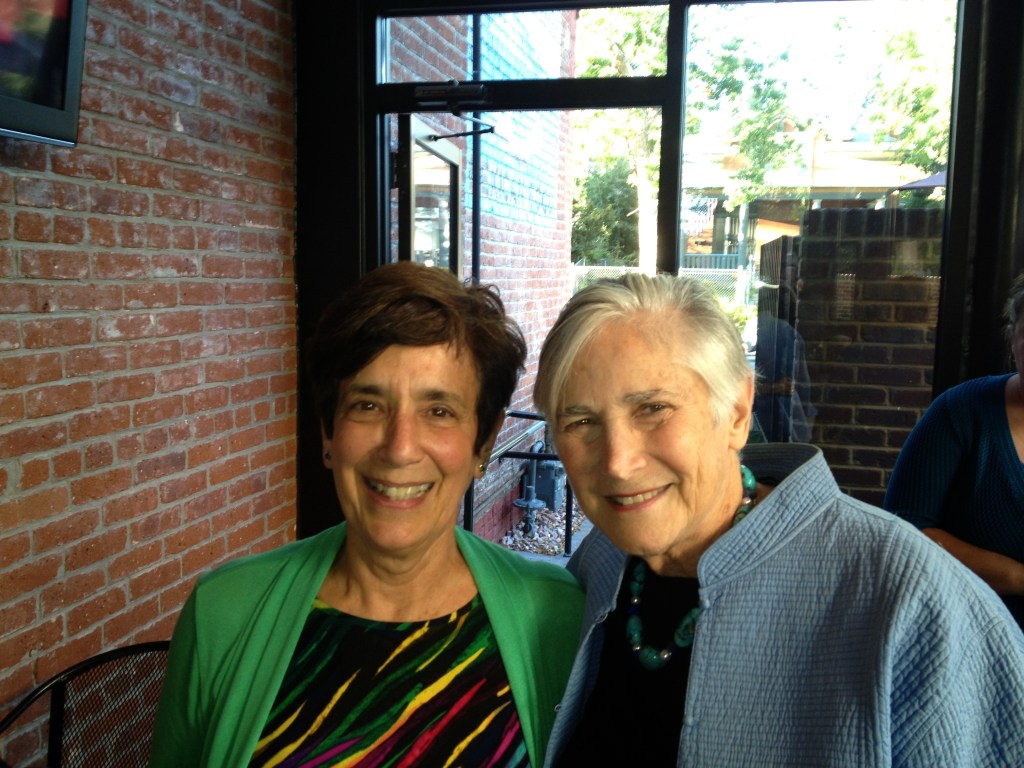
Jeannie and I in Denver, 2013.

Julie Vassilatos, public school parent, is shocked that Governor J.B. Pritzker has reversed course on his campaign pledge to let the state’s voucher program die. Vouchers are a zombie policy. They were sold over the past 30 years as a surefire way to “save poor kids from failing schools,” but poor kids do worse in voucher schools, and the primary beneficiaries are kids who never attended public schools, families who get a break on their private school tuition. Vouchers have failed. They are nothing more than a trick to fund families whose children attend private and religious schools.

She writes:

Just in time for Halloween, Illinois Gov. Pritzker says he’ll sign whatever “Invest in Kids” legislation crosses his desk. 

Hearing this news gave me a crickly, creepy feeling up the back of my neck. I honestly thought legislators had decided to allow this thing to die its timely death, reach its expected and planned demise. The legislation was originally supposed to sunset in 2023. But it sounds like it’s creeping back from wherever bad policy goes to die. Crawling back from the mostly dead, only to be reanimated, dressed up in a new school uniform, all its awful secrets covered up.

Secrets like: unaccounted-for dollarsOpaque student outcomesMore than $250M in taxes unpaid by the wealthiest Illinoisans. Private schools, with private school rules, getting public moneyDiscrimination against disabled students, non-religious students, LGBTQ students and familiesExpansion of wealth gaps and inequityDisinvestment of public schools

Subscribe

And worst of all? Tax-credit scholarship programs have demonstrated not just bad, but downright terrifying longterm results

Catastrophically bad results. I’m not being hysterical about this, either—these are results drawn from long term research by universities all over the country. Anyone concerned with education outcomes for children—for our most vulnerable children—should care about this data. Because offering children “choice” through vouchers does not help them. It looks like this:

— In Arizona, its recently implemented universal Empowerment Scholarship Accounts divert, on average, $300,000 away from every neighborhood school. The program—granting a $7300 scholarship per child to use for homeschooling or private school—is approaching $1B in cost, funds things like European trips, Disney+, and trampolines,supports “fly-by-night” unaccredited, unlicensed pop-up schools, and may bankrupt the state. Like Illinois’ program, accountability is thin and there is little transparency about the use of tax dollars or the actual results for children

— In Milwaukee, one of the longest running voucher programs in the country has failed to yield positive outcomes. “Among black eighth-graders in 13 urban school districts, Milwaukee—where black students make up more than 70 percent of all voucher recipients—ranked last in reading and second-to-last in math.” In 25 years we should be seeing something better than this—especially given the cost of these programs, both in tax dollars and in the financial hit taken by public schools. In 25 years, more importantly, the vulnerable children subjected to these programs should be flourishing, not failing. 

— In Florida, tuition tax credit program students made no gains in reading or math; in Louisiana, a University of Arkansas study found “large negative impacts after 4 years” for participants in the program

— Indiana University researchers have found that the larger voucher or tax credit scholarship programs become, the worse the results they generate. Large programs generate negative results that are shockingly bad, equaling or exceeding the impacts of natural disasters and the pandemic

Ignoring the damning data, proponents of tax credit scholarships depend on emotional rhetoric to support their cause—who could possibly be against “saving our scholarships”? They also depend on your tax dollars. Up to 5% of donations to the scholarship funds are used for lobbying and marketing purposes. So when you read about busloads and busloads of people wearing matching t-shirts arriving in Springfield, and fancy lobbyists flooding the zone, know that that’s your tax dollars at work. 

Those folks will tell you that “the teacher’s union” is against this good wonderful policy and everyone else supports it. They don’t tell you that 65 organizations are united against this legislation, including Access Living, Illinois PTA, the Network for Public Education, the League of Women Voters, and the American Association of University Women Illinois. 

Share

People. We have gone over this. This is not confusing, complicated, or even a close call. “Invest in Kids” should be called “Disinvest in Kids,” or, according to the nonpartisan Institute on Taxation and Economic Policy, “Invest in Inequality.” (I strongly encourage you to click that link and read a short, elegant explanation of how this “peculiar tax policy” works and what its impact is.) 

“Invest in Kids” should not, under any circumstances, be extended past its already-extended expiration date of January 2024. But in Eric Zorn’s recent clear, precise column about the drawbacks of “Invest in Kids,” he notes that Gov. Pritzker has “gone squishy” on this issue, which he opposed in 2018. Squishy, maybe. Scary, certainly. That he’ll sign whatever “Invest in Kids” legislation might come crawling back across his desk should frighten us all.

Tell your legislator you want this program to end here.

Maybe House Republicans got tired of not finding a new Speaker. Maybe they felt humiliated by their inability to agree on a leader. Every one of them finally agreed to endorse one of the most radical extremists in the House as their party’s leader. You know already that Mike Johnson is hostile to abortion and to gay rights. You know that he was a prominent leader in the effort to overturn Trump’s loss in 2020.

What you probably do not know is that Johnson is an extremist on economic issues as well. Paul Krugman, the Nobel Prize-winning economics columnist for the New York Times, wants you to know that his views on Social Security, Medicare, and Medicaid are also radical.

He writes:

There are no moderate Republicans in the House of Representatives.

Oh, no doubt some members are privately appalled by the views of Mike Johnson, the new speaker. But what they think in the privacy of their own minds isn’t important. What matters is what they do — and every single one of them went along with the selection of a radical extremist.

In fact, Johnson is more extreme than most people, I think even political reporters, fully realize.

Much of the reporting on Johnson has, understandably, focused on his role in the efforts to overturn the 2020 election. Let me say, by the way, that the widely used term “election denial” is a euphemism that softens and blurs what we’re really talking about. Trying to keep your party in power after it lost a free and fair election, without a shred of evidence of significant fraud, isn’t just denial; it’s a betrayal of democracy.

There has also been considerable coverage of Johnson’s right-wing social views, but I’m not sure how many people grasp the depth of his intolerance. Johnson isn’t just someone who wants to legalize discrimination against L.G.B.T.Q. Americans and ban gay marriage; he’s on record as defending the criminalization of gay sex.

But Johnson’s extremism, and that of the party that chose him, goes beyond rejecting democracy and trying to turn back the clock on decades of social progress. He has also espoused a startlingly reactionary economic agenda.

Until his sudden elevation to speaker, Johnson was a relatively little-known figure. But he did serve for a time as chairman of the Republican Study Committee, a group that devises policy proposals. And now that Johnson has become the face of his party, people really should look at the budget proposal the committee released for 2020 under his chairmanship.

For if you read that proposal carefully, getting past the often mealy-mouthed language, you realize that it calls for the evisceration of the U.S. social safety net — not just programs for the poor, but also policies that form the bedrock of financial stability for the American middle class.

Start with Social Security, where the budget calls for raising the retirement age — already set to rise to 67 — to 69 or 70, with possible further increases as life expectancy rises.

On the surface, this might sound plausible. Until Covid produced a huge drop, average U.S. life expectancy at age 65 was steadily rising over time. But there is a huge and growing gap between the number of years affluent Americans can expect to live and life expectancy for lower-income groups, including not just the poor but also much of the working class. So raising the retirement age would fall hard on less fortunate Americans — precisely the people who depend most on Social Security.

Then there’s Medicare, for which the budget proposes increasing the eligibility age “so it is aligned with the normal retirement age for Social Security and then indexing this age to life expectancy.” Translation: Raise the Medicare age from 65 to 70, then keep raising it.

Wait, there’s more. Most nonelderly Americans receive health insurance through their employers. But this system depends greatly on policies that the study committee proposed eliminating. You see, benefits don’t count as taxable income — but in order to maintain this tax advantage, companies (roughly speaking) must cover all their employees, as opposed to offering benefits only to highly compensated individuals.

The committee budget would eliminate this incentive for broad coverage by limiting the tax deduction for employer benefits and offering the same deduction for insurance purchased by individuals. As a result, some employers would probably just give their top earners cash, which they could use to buy expensive individual plans, while dropping coverage for the rest of their workers.

Oh, and it goes almost without saying that the budget would impose savage cuts — $3 trillion over a decade — on Medicaid, children’s health coverage and subsidies that help lower-income Americans afford insurance under the Affordable Care Act.

How many Americans would lose health insurance under these proposals? Back in 2017 the Congressional Budget Office estimated that Donald Trump’s attempt to repeal Obamacare would cause 23 million Americans to lose coverage. The Republican Study Committee’s proposals are far more draconian and far-reaching, so the losses would presumably be much bigger.

So Mike Johnson is on record advocating policies on retirement, health care and other areas I don’t have space to get into, like food stamps, that would basically end American society as we know it. We would become a vastly crueler and less secure nation, with far more sheer misery.

I think it’s safe to say that these proposals would be hugely unpopular — if voters knew about them. But will they?

Actually, I’d like to see some focus groups asking what Americans think of Johnson’s policy positions. Here’s my guess, based on previous experience: Many voters will simply refuse to believe that prominent Republicans, let alone the speaker of the House, are really advocating such terrible things.

But they are and he is. The G.O.P. has gone full-on extremist, on economic as well as social issues. The question now is whether the American public will notice.

Thom Hartmann has checked out the record and public statements of the new Speaker of the House of Representatives, Representative Mike Johnson of Louisiana. He is even more of an extremist than his idol Donald Trump.

Hartmann writes:

The election of Louisiana’s Mike Johnson as House Speaker proves the premise that all the GOP has left are Donald Trump and hate.

As Congressman Jamie Raskin told reporters yesterday:

“Donald Trump has cemented his control over the Republican conference in the House of Representatives. He has a stranglehold on the Republican Party. Even as he faces 91 criminal charges and several of his election lawyers have pleaded guilty now to election-related offenses, one of his enablers on January 6 has just become the speaker of the House Representatives.”

Johnson’s hate of Democrats is so deep that he led a Trump-backed effort in the House to get Republicans to back a lawsuit by 18 Republican state attorneys general to overturn Biden’s election as president.

Their lawsuit had no merit and no facts — everybody, including the Republicans involved, knew that Biden had won fair-and-square — but Republican hate of Democrats is now so deep that the idea of Democrats legitimately governing after winning an election is repugnant to them. No matter how big the Democrats’ victory (7 million votes in this case) may be.

Johnson went public with his support of Trump’s hateful, poisonous Big Lie just a week after the 2020 election, saying:

 “You know the allegations about these voting machines, some of them being rigged with this software by Dominion, there’s a lot of merit to that…They know that in Georgia it really was rigged.”

As The Washington Post noted at the time:

“Rep. Mike Johnson (R-La.), head of the conservative Republican Study Committee, spearheaded the effort to round up support on Capitol Hill. Johnson emailed all House Republicans on Wednesday to solicit signatures for the long-shot Texas case after Trump called. The congressman told his colleagues that the president ‘will be anxiously awaiting the final list to review.’”

Johnson got 106 of the 196 Republicans then in the House to sign on to the effort to force four swing states to throw out Democratic votes and declare Trump emperor for life: he was the legal architect of the argument. It doesn’t get more hateful against our republican form of government than that effort to destroy confidence in the vote at the cornerstone of our democracy.

Johnson’s hate of women having agency over their own bodies and lives is so intense that he has repeatedly championed a nationwide ban on abortion. 

His wife Kelly, a “licensed pastoral counselor” with whom he’s in a “covenant marriage,” makes money from Louisiana Right To Life, and before being elected to the House in 2016 he was an attorney for the far-right-billionaire-supported Alliance Defending Freedom that pushed the Dobbs case before the Supreme Court.

While there, he helped sue New York and New Jersey to force them to allow official state license plates that displayed an anti-woman, anti-abortion message; sued New Orleans to try to block benefits for the partners of queer city employees; and promoted a “National Day of Truth” to encourage homophobic students to hate on their LGBTQ+ peers.

Johnson and the GOP explicitly hate queer people and their allies.

“Radical homosexual advocacy groups” are promoting “the culture’s assault on traditional values,” Johnson wrote in an op-ed for a Louisiana newspaper. That “assault,” of course, was gay marriage, something that horrifies Johnson and his wife. 

He wrote:

“Same-sex ‘marriage’ selfishly and deliberately deprives children of either a mother or a father. Children need both. Homosexual relationships are inherently unnatural and, the studies clearly show, are ultimately harmful and costly for everyone.

“Society cannot give its stamp of approval to such a dangerous lifestyle. If we change marriage for this tiny, modern minority, we will have to do it for every deviant group. Polygamists, polyamorists, pedophiles, and others will be next in line to claim equal protection. They already are. There will be no legal basis to deny a bisexual the right to marry a partner of each sex, or a person to marry his pet.”

Johnson also supports a federal version of DeSantis’ “Don’t Say Gay” law that would outlaw any discussion of queer people in any public school classroom in America. In another anti-gay newspaper screed, Johnson wrote:

“Your race, creed and sex are what you are, while homosexuality and cross-dressing are things you do. This is a free country, but we don’t give special protections for every person’s bizarre choices. Where would it end? This is one Pandora’s box we shouldn’t open.”

While Johnson hates queer people, he apparently loves Vladimir Putin, an affection that has earned him the loyalty and help of Donald Trump.

Last month he joined Matt Gaetz and 93 other Republicans in voting to cut off all US military aid to assist Ukraine’s survival in the face of Russia’s ongoing terror campaign.

He’s also a friend to mass shooters and the psychopaths at the NRA. 

Johnson repeatedly voted against gun safety and gun control legislation, and voted against re-authorizing the Violence Against Women Act.

Hating on Medicare and Social Security is another specialty of Johnson and the GOP. As Social Security Works Executive Director Alex Lawson noted yesterday:

“Rep. Mike Johnson has a long history of hostility towards Social Security and Medicare. As Chair of the Republican Study Committee from 2019-2021, Johnson released budgets that included $2 trillion in cuts to Medicare and $750 billion in cuts to Social Security, including:
— Raising the retirement age
— Decimating middle class benefits
— Making annual cost-of-living increases smaller
— Moving towards privatization of Social Security and Medicare.”

Johnson also pushed for $3 trillion in cuts to Medicaid and the Affordable Care Act (Obamacare), saying slashing the entitlement programs should be Congress’ “top priority.” Johnson is also a huge advocate for a Catfood Commission to figure out ways to slash Social Security benefits to seniors (thus forcing them to eat catfood: the White House refers to it as a “death panel for Social Security”).

Like Red state Republican politicians beholden to the tobacco, alcohol, and pharmaceutical industries, Johnson also hates marijuana. He’s repeatedly argued and voted against legalization, as well as helping shoot down a bill that would let legal pot dispensaries use banks to conduct their business.  

Hating on science and our children’s future is a feature, not a bug, of Republican politics, and Mike Johnson fits right in. The largest single group of donors to his political career have been the oil and gas industries, and he happily takes their money and spreads their lies. For example, he argued:

“The climate is changing, but the question is, is it being caused by natural cycles over the span of the Earth’s history? Or is it changing because we drive SUVs? I don’t believe in the latter. I don’t think that’s the primary driver.”

The League of Conservation Voters gave his environmental record a 0 percent (yes, zero) score for 2022: this guy has burrowed so deeply in Big Oil’s pocket that he’s like a blood-filled tick on a shaggy dog. He’ll never let go.

On voting rights, Johnson hates voters in Blue cities in Red states as much as their own Republican legislatures do. A big fan of voter suppression laws, he argued that making it harder to vote and purging people from voter rolls would help the GOP in the 2022 election:

“They’re making sure that the election results can be counted upon, and that’s a critical thing for us to do.”

That was followed by his voting against the John Lewis Voting Rights Act and the For The People Act, both of which would have guaranteed Americans’ right to vote regardless of race, religion, or geography. On the other hand, he voted for a Republican bill that would have enshrined GOP voter suppression efforts nationwide. 

Like Rand Paul and Tommy Tuberville, Johnson apparently also hates our men and women serving in the armed forces.

He voted against the Honoring our Promise to Address Comprehensive Toxics (PACT) Actthat President Biden was cheerleading because it would aid service members like Biden’s son Beau who became deathly sick because of exposure to open-air burn pits and other toxins.

He also voted against a year-end package of bills to aid service members, including requiring states to honor the professional licenses of military spouses who find themselves stationed in states other than where they were originally certified. And he joined Tuberville in his opposition to the Pentagon paying to fly raped servicewomen stationed in countries or states where abortion is illegal to places where it is available.

Johnson has supported a few Republican military spending bills, but only, as military.comnoted, when they are “packed with GOP policy riders such as provisions to bar abortion services, transgender health care, and LGBTQ+ Pride flags at the VA.”

Johnson, like most Republicans who hate the idea of Brown people entering our country legally, is also a “border hawk,” having visited our southern border with Donald Trump and introduced two pieces of legislation that would restrict immigration and refugee status. Speaking of his desire to “build a wall” and keep would-be refugees out of the US, he said:

“Now, I have no illusions about this. I’m sure that President Biden will veto anything we send him, but it will send a very strong message. If we can’t override a veto, we’ll be ready to run when the next Republican president is elected two years later.”

Republicans like Johnson love to plaster the word “freedom” all over everything they do. But they’re just fine with a for-profit prison industry lobbying for harsher sentences, and to keeping draconian drug laws in place.

When Republicans say “freedom,” it’s a safe bet they mean they want the freedom to hate on minorities, the freedom of rich people and giant corporations to screw average working people, and the freedom of billionaires to continue paying only around 3 percent of their income in income taxes.

In MAGA Mike Johnson (what Trump calls him), Republicans have found the perfect embodiment of their deplorable basket of hatreds. At this point, the only “loves” they have are rightwing billionaires and the fossil fuel industry. And, of course, Trump’s good buddy and fossil fuel oligarch Vladimir Putin.

Thank you for reading The Hartmann Report. This post is public so feel free to share it.

The Republicans in the House of Representatives finally united to elect Rep. Mike Johnson as the new Speaker of the House. Johnson was elected to Congress in 2016. He was a leading figure in the effort to overturn the election in 2020. He gathered signatures among his colleagues to support an appeal by the Texas Attorney General to the U.S. Supreme Court to disqualify the votes cast in contested states. The Court didn’t hear the case, ruling that Texas did not have standing to reverse the results in other states.

So, yes, Johnson is an election denier. Less well known are his deeply conservative views on social issues. He opposes abortion and gay marriage. As a representative of oil country, he dismisses claims that fossil fuels contribute to climate change.

Politico wrote about Johnson:

BROADCAST NEWS — It’s finally over. After more than three weeks without a leader, House Republicans came together to unanimously select Rep. Mike Johnson (R-La.) as the 56th Speaker of the House of Representatives. Johnson served as a consensus pick among the numerous factions, appeasing both the right flank of the party that tossed out former Speaker Kevin McCarthy and moderates. While he’s served as vice chair of the Republican Conference, he has served just four terms in Congress and remains little-known within Washington.

What’s clear, however, is that Johnson is a social conservative’s social conservative — the most culturally conservative lawmaker to ascend to the speakership in decades, if not longer.

He has longstanding ties to the evangelical activist group Family Research Council — which could one day prove discomfiting to members from swing districts or of a more secular orientation.

His first brush with national prominence came in April 2015, when Johnson, then a Louisiana state legislator, proposed a bill called the Louisiana Marriage and Conscience Act that would have prevented “adverse treatment by the State of any person or entity on the basis of the views they may hold with regard to marriage.” Critics called it legalized discrimination against married gay couples, and the bill failed, but the media attention got him on the radar of the influential FRC and its president, fellow Louisiana native Tony Perkins.

Perkins, who hosts a national radio show called Washington Watch, began tapping Johnson to guest host. Johnson, a constitutional lawyer, appeared to be a natural — by December 2015, local Shreveport, La. ABC affiliate KTBS said he “may have a budding second career on the airwaves.”

The FRC and Perkins are political lightning rods among non-evangelicals — some of Perkins’ stances, like his argument that natural disasters are divine punishments for homosexuality, don’t sit well with broad swaths of the electorate. But Johnson’s political and religious beliefs dovetail with Perkins’ views. In a 2004 op-ed, Johnson argued that “homosexual relationships are inherently unnatural… society cannot give its stamp of approval to such a dangerous lifestyle.”

When he ran for Congress in 2016, Johnson placed his faith at the center of his campaign, telling the Louisiana Baptist Message, “I am a Christian, a husband, a father, a life-long conservative, constitutional law attorney and a small business owner in that order.”

His connection with Perkins — and his interest in evangelical radio as a political tool — continued after he was elected to the House in 2016. As a freshman lawmaker, Johnson announced his bid to lead the Republican Study Committee, a conservative caucus that currently counts 156, on Washington Watch with Perkins. He won the election.

Johnson used the skills he sharpened on talk radio and in televised FRC interviews to start a weekly podcast in 2022 with his wife, called “Truth be Told with Mike and Kelly Johnson.”

During the first episode in March 2022, entitled “Can America be Saved?” Johnson says that “we’ll review current events through the lens of eternal truth,” and noted that in each podcast they intended to incorporate a themed scripture because “the word of God is, of course, the ultimate source of all truth.” Guests have included Rep. Jim Jordan (R-Ohio), Charlie Kirk and Jordan Peterson.

On occasion, Kelly Johnson will tee up her husband for an answer. “Why are we the freest, most powerful, most successful, most benevolent nation in the history of the world, and why does every other nation on the planet look to us for leadership and even expect it of us?” she asks in one episode. Her husband responds explaining that America is the only country in the world founded upon a creed, or a “religious statement of faith.”

As a matter of fact, Kelly Johnson is wrong. The Constitution of the United States does not include a creed or a “religious statement of faith.” It specifically mandates freedom of religion and prohibits the establishment of any religion. It also bars any religious test for officeholders.

Mike Johnson is an evangelical Christian whose strong personal views are bound to affect his political views and actions.

The advocacy group Illinois Families for Public Schools were shocked by Governor Pritzker’s decision to extend the state voucher program. They were shocked because of his campaign promises not to support schools that discriminate, and they were shocked by the data showing that discrimination against students with disabilities and LGBT students is widespread among voucher schools. Most voucher schools are religious, and they are free to exclude any student they don’t want.

Illinois Families for Public Schools’ Statement on Gov. Pritzker’s Vow to Sign an Extension of the Illinois Voucher Program

Friday October 20, 2023

Illinois Families for Public Schools is profoundly disappointed at Governor Pritzker’s statement yesterday that he is committed to signing any bill sent to him that would extend the Invest in Kids voucher program.

This commitment contradicts the statements he made when he ran for governor in 2018, including his response to our candidate questionnaire:

“I oppose Bruce Rauner’s backdoor voucher program that was inserted into the school funding reform bill last year. As governor, I will work to repeal that measure.”

Worse yet, it conflicts with the values Pritzker has espoused again and again in his time in office: That Illinois is a welcoming and inclusive state where it is unacceptable to treat individuals differently because of their identity, where justice and equity make Illinois a safe space for all, where we want our young people “to become critical thinkers, exposed to ideas that they disagree with, proud of what our nation has overcome, and thoughtful about what comes next”, where K-12 schools are “liberatory learning environments that welcome and affirm LGBTQ+ young people, especially those how are transgender, nonbinary, intersex, Black, Indigenous, people of color, people with disabilities, and all communities that experience marginalization.

Since 2018, the Invest in Kids voucher program has diverted more than $250 million in state funds to private schools, 95% of which are religious. Religious schools, even those getting public dollars, can and do legally discriminate against nearly any protected category of student, family or staff:

  • At least 85 schools in the Invest in Kids program, nearly 1 in 5, have anti-LGBTQ+ policies.
  • Only 13% of private schools in the Invest in Kids program last year reported to the Illinois State Board of Education that they served any special education students. The majority of schools in the program are Catholic schools, and four of six Catholic dioceses in Illinois have policies that say schools may refuse to accommodate students with disabilities.
  • Policies that discriminate against pregnant and parenting students, students who have had an abortion, English-language learners, students with disabilities, undocumented students, and more are widespread in Illinois voucher schools as well.

Due to recent Supreme Court decisions, there is essentially no way to have a state voucher program that only funds non-religious schools or alternatively prohibits religious schools from discriminating based on religious belief. As such, there is no way to end discrimination in voucher schools in Illinois short of ending the program altogether.

Extending the voucher program is supported by anti-public good extremist groups, including Betsy DeVos-funded Illinois Federation for Children, the Koch-funded Americans for Prosperity, Awake Illinois, and Moms for Liberty Lake County.

Access to a well-resourced public education is a fundamental right. Illinois public schools are still short billions of dollars in state funding needed to educate their students.

Public dollars must be for used public schools that welcome and educate all children, as well as protect their civil rights. Strong public schools are the foundation of a healthy, pluralistic democracy and are a public good that benefits everyone in Illinois.

It is unacceptable to continue the Invest in Kids program in any form.

Why is Governor Pritzker thinking so small when it comes to our public schools?

###

Contact: 

Cassie Creswell, 773-916-7794, info@ilfps.org

About Illinois Families for Public Schools

Illinois Families for Public Schools (IL-FPS) is a grassroots advocacy group that represents the interests of families who want to defend and improve Illinois public schools. Founded in 2016, IL-FPS’ efforts are key to giving public ed parents and families a real voice in Springfield on issues like standardized testing, student data privacy, school funding and more. IL-FPS connects families and public school supporters in more than 100 IL House districts. More at ilfps.org.

The New Republic convened a meeting to discuss Trump, book banning and the culture wars. Randi Weingarten described the attack on schools as a coordinated strategy to destroy public schools and promote vouchers. Edith Olmsted of The New Republic interviewed her. None of this is new to readers of this blog, but the American public needs to hear this message. Again and again.

Book Bans Are a Conservative Plot to Destroy Public Schools, Says Randi Weingarten, The teachers union head denounced the “extremist strategy,” which also includes voucher campaigns and manufactured outrage over critical race theory.

DANIEL BOCZARSKI/GETTY IMAGES FOR MOVEON

Teachers union head Randi Weingarten says that the campaign by conservatives to ban books isn’t about the books at all, but part of a broader strategy to destroy public schools—one that was supercharged by the pandemic.

“You take the agita and the anxiety that people had at Covid, that fear, and you combine it with a right wing who has wanted to kill public schools for years and take that money for vouchers, and you have the scenario we have,” Weingarten, the president of the American Federation of Teachers, said Wednesday at The New Republic’s Stop Trump Summit.

Vouchers, which use public education dollars to fund private and religious school attendance, are just one pillar of the conservative campaign to “undermine, destroy, and defund” public schools, she said. The other two are book banning and manufactured outrage over critical race theory.

Weingarten pointed to conservative activist Chris Rufo and a comment he made at Hillsdale College, a Christian nationalist school, in which he admitted that focusing on these issues was all part of a master plan to promote universal vouchers: “To get to universal school choice, you really need to operate from a premise of universal public school distrust.”

In an interview with TNR after the event, Weingarten explained the “extremist strategy” Rufo and other conservatives have used to defund public schools. “The hook was trust. If you really create as much distrust as possible in public schooling, then parents will look at privatization as an option,” she said.

That’s where critical race theory comes in.

“[Rufo] tried to make a term that nobody knows so toxic, so that you can weaponize it and make fear,” she said. “Conversations about hard subjects became weaponized as indoctrination. Which is patently ridiculous, and dangerous.”

Race, as well as gender, is the subject conservatives have focused on in their campaigns to ban books in public schools and libraries.

“What [Republican Governor Ron] DeSantis is doing in the so-called ‘war on woke,’ is exactly part of their playbook—to make people afraid of books, and afraid of what we do in school,” Weingarten said. According to Pen America, Florida passed 15 “educational intimidation” bills in the last two and a half years.

The “parents’ rights” movement is made up of a loud minority, Weingarten said, and actively undermines what most parents want. “What we see in Florida is that 60 percent of the book banning has been done by 11 people,” she said.

The AFT has partnered with The New Republic in fighting back against such bans. TNR’s Banned Books Tour has been delivering thousands of banned books across the country this month, most recently in Florida.

ProPublica researched the power of Leonard Leo, the man most responsible for the rightwing majority on the U.S. Supreme Court and other levels of the federal judiciary. Few people know who he is. Now you are among them.

ProPublica writes:

The party guests who arrived on the evening of June 23, 2022, at the Tudor-style mansion on the coast of Maine were a special group in a special place enjoying a special time. The attendees included some two dozen federal and state judges — a gathering that required U.S. marshals with earpieces to stand watch while a Coast Guard boat idled in a nearby cove.

Supreme Court Justice Clarence Thomas’ decadeslong friendship with real estate tycoon Harlan Crow and Samuel Alito’s luxury travel with billionaire Paul Singer have raised questions about influence and ethics at the nation’s highest court.

Caterers served guests Pol Roger reserve, Winston Churchill’s favorite Champagne, a fitting choice for a group of conservative legal luminaries who had much to celebrate. The Supreme Court’s most recent term had delivered a series of huge victories with the possibility of a crowning one still to come. The decadeslong campaign to overturn Roe v. Wade, which a leaked draft opinion had said was “egregiously wrong from the start,” could come to fruition within days, if not hours.

Over dinner courses paired with wines chosen by the former food and beverage director of the Trump International Hotel in Washington, D.C., the 70 or so attendees jockeyed for a word with the man who had done as much as anyone to make this moment possible: their host, Leonard Leo.

I can’t think of anybody who played a role the way he has.

– Richard Friedman, a law professor and historian at the University of Michigan

Short and thick-bodied, dressed in a bespoke suit and round, owlish glasses, Leo looked like a character from an Agatha Christie mystery. Unlike the judges in attendance, Leo had never served a day on the bench. Unlike the other lawyers, he had never argued a case in court. He had never held elected office or run a law school. On paper, he was less important than almost all of his guests.

If Americans had heard of Leo at all, it was for his role in building the conservative supermajority on the Supreme Court. He drew up the lists of potential justices that Donald Trump released during the 2016 campaign. He advised Trump on the nominations of Neil Gorsuch, Brett Kavanaugh and Amy Coney Barrett. Before that, he’d helped pick or confirm the court’s three other conservative justices — Clarence Thomas, John Roberts and Samuel Alito. But the guests who gathered that night under a tent in Leo’s backyard included key players in a less-understood effort, one aimed at transforming the entire judiciary.

Many could thank Leo for their advancement. Thomas Hardiman of the 3rd U.S. Circuit Court of Appeals had ruled to loosen gun laws and overturn Obamacare’s birth-control mandate. Leo had put Hardiman on Trump’s Supreme Court shortlist and helped confirm him to two earlier judgeships.

Kyle Duncan and Cory Wilson, both on the 5th U.S. Circuit Court of Appeals, both fiercely anti-abortion, were members of the Federalist Society for Law and Public Policy Studies, the network of conservative and libertarian lawyers that Leo had built into a political juggernaut. As was Florida federal Judge Wendy Berger, who would uphold that state’s “Don’t Say Gay” law. Within a year of the party, another attendee, Republican North Carolina Supreme Court Justice Phil Berger Jr. (no relation), would write the opinion reinstating a controversial state law requiring voter identification.

Duncan, Wilson, Berger and Berger Jr. did not comment. Hardiman did not comment beyond confirming he attended the party.

The judges were in Maine for a weeklong, all-expenses-paid conference hosted by George Mason University’s Antonin Scalia Law School, a hub for steeping young lawyers, judges and state attorneys general in a free-market, anti-regulation agenda. The leaders of the law school were at the party, and they also were indebted to Leo. He had secured the Scalia family’s blessing and brokered $30 million in donations to rename the school. It is home to the C. Boyden Gray Center for the Study of the Administrative State, named after the George H.W. Bush White House counsel who died this May. Gray was at Leo’s party, too.

A spokesperson for GMU confirmed the details of the week’s events.

The judges and the security detail, the law school leadership and the legal theorists — all of this was a vivid display not only of Leo’s power but of his vision. Decades ago, he’d realized it was not enough to have a majority of Supreme Court justices. To undo landmark rulings like Roe, his movement would need to make sure the court heard the right cases brought by the right people and heard by the right lower court judges.

Leo began building a machine to do just that. He didn’t just cultivate friendships with conservative Supreme Court justices, arranging private jet trips, joining them on vacation, brokering speaking engagements. He also drew on his network of contacts to place Federalist Society protégés in clerkships, judgeships and jobs in the White House and across the federal government.

He personally called state attorneys general to recommend hires for positions he presciently understood were key, like solicitors general, the unsung litigators who represent states before the U.S. Supreme Court. In states that elect jurists, groups close to him spent millions of dollars to place his allies on the bench. In states that appoint top judges, he maneuvered to play a role in their selection.

And he was capable of playing bare-knuckled politics. He once privately lobbied a Republican governor’s office to reject a potential judicial pick and, if the governor defied him, threatened “fury from the conservative base, the likes of which you and the Governor have never seen.”

To pay for all this, Leo became one of the most prolific fundraisers in American politics. Between 2014 and 2020, tax records show, groups in his orbit raised more than $600 million. His donors include hedge fund billionaire Paul Singer, Texas real estate magnate Harlan Crow and the Koch family.

Leo grasped the stakes of these seemingly obscure races and appointments long before liberals and Democrats did. “The left, even though we are somewhat court worshippers, never understood the potency of the courts as a political machine. On the right, they did,” said Caroline Fredrickson, a visiting professor at Georgetown Law and a former president of the American Constitution Society, the left’s answer to the Federalist Society. “As much as I hate to say it, you’ve got to really admire what they achieved.” Belatedly, Leo’s opposition has galvanized, joining conservatives in an arms race that shows no sign of slowing down.

I read the NHInsider regularly to follow the doings of the libertarians and rightwing Republicans who currently control the state. The education articles are written by veteran journalist Gary Rayno. I was very impressed by this article posted yesterday, which aptly summarizes the mess the world is in today, relying on the wisdom of William Butler Yeats. Religious zealots and intolerance are steering events.

He writes:

Turning and turning in the widening gyre

The falcon cannot hear the falconer;

Things fall apart; the centre cannot hold;

Mere anarchy is loosed upon the world,

The blood-dimmed tide is loosed, and everywhere

The ceremony of innocence is drowned;

The best lack all conviction, while the worst

Are full of passionate intensity.

This quote from the William Butler Yeats poem “The Second Coming” — written in 1919 just after World War I — often appears in times like these when the world’s moral order crumbles and more resembles “Lord of the Flies.”

Today human tragedy is on the front pages of newspapers, on television and radio news programs, on Twitter (X) and other social media.

The world is teetering on the edge of World War III as some nations try to pull the world’s superpowers into a conflict that millions of people will not survive.

Today’s conflicts in the Mid East and Europe are made more dangerous by technology that can pinpoint artillery shells to blow up a tank or to kill civilians in large numbers depending on the depravity of the shooters.

The Mid East is the founding place of three of the world’s major religions and has seen its share or wars in the last century not just between Arabs and Israelites, but among Arab nations as well.

The region’s long history of conflicts did not prepare anyone for what happened last week on a Jewish holy day when the terrorist group Hamas, which has controlled the Gaza Strip for years, invaded Israel, killed nearly a thousand people, including families with young children, beheaded some, tortured others and took about 150 hostages back to Gaza to use as bargaining chips.

They not only killed, tortured and maimed Israeli citizens, they used their own citizens as human shields by preventing them from leaving Gaza.

The absence of respect for human life and suffering is inconceivable but all too common in today’s polarized world as the Marjorie Taylor Greenes of the world talk about killing Democrats and Hamas leaders talk about eliminating all Jews.

The Israeli government, as it often does, retaliates with even more force than used against it, and has the stated goal of eliminating Hamas. That objective means lost Palestinian civilian lives seen as collateral damage.

Once the fighting begins, war produces few white hats.

The wars in the Mideast are often both ethnically and religiously driven pitting the Muslim Palestinians against the Jewish Israelites with centuries of history to solidify the beliefs of both sides.

While religion is not the biggest driver for war, intolerance is, it is in the Mideast.

And the problem with religious wars was aptly stated by former President Richard Nixon when he said “In the long term we can hope that religion will change the nature of man and reduce conflict. But history is not encouraging in this respect. The bloodiest wars in history have been religious wars.”

The Mideast conflict has taken the focus away from Russia’s invasion of Ukraine and the atrocities the Russians have inflicted on the Ukrainians and their country.

The war in Eastern Europe is more ethnically driven than religious.

Until Putin decided to expand the Russian empire, Europe had been largely free of conflicts since World War II, but like the Mideast conflict, attempts are to draw the superpowers into the chaos and expand the carnage.

While the world’s eyes are on the Mideast and Eastern Europe, the United States government is being held hostage by a couple dozen extremists, particularly in the US House, but also the Senate, who want to see chaos and ensure the dysfunction of government as we know it.

The Christian Nationalist movement is the foundation of some of the extremists, but not all of them.

The House decided to remove Speaker Kevin McCarthy, and since that time more than a week ago, nothing is moving and that prevents any help to fund the nation’s allies in the two conflicts or to keep government functioning beyond the middle of November.

Republicans and their slim majority in the House cannot agree on a new Speaker and probably won’t until the crisis threatens to explode and Republicans realize they will pay politically for their inability to solve the civil war within their ranks.

One member of the House Republican caucus called it a clown show.

In the Senate a former football coach, Tommy Tuberville, is holding up hundreds of military appointments at this crucial time over the abortion issue, while others like Rand Paul and Ted Cruz are holding up key appointments like ambassadors etc. that will have a direct effect on what is happening in the world’s hot spots, mostly to create chaos and hits on their Twitter accounts.

The Grand Old Party appears to be more interested in creating chaos than governing.

At the state level, 19 Republican governors, and we all know governors are experts in foreign policy, criticize President Biden’s handling of the attacks on Israel including New Hampshire’s own Chris Sununu.

Not that long ago, politics was put aside when the nation faced serious threats such as the terrorist attacks on New York City and Washington DC or the beginning of Desert Storm, but no more.

The head of the National Republican Committee, Ronna McDaniel, referred to the latest conflict in the Mideast as a “great opportunity” to attack Biden.

You did not hear Democrats criticizing President George W. Bush after the 9/11 attack, or President George H. W. Bush after he began Desert Storm.

The nation came together to support their leaders’ actions. And you did not see the demonstrations on college campuses and city streets that happened this weekend pitting Palestinian supporters against those backing Israel.

Like the Palestinians and Israelites, much of what divides the United States has a religious undertone incorrectly based on the notion the United States was established as a Christian country.

That would be very interesting because many early settlers to the “new world” came here to escape religious persecution in nations with state religions.

The Constitution guarantees religious freedom as well as the founding principle of “all men (women) are created equal.”

Many on the right are trying to impose their religious beliefs on issues like abortion or LGBTQ+ rights or what young people can read or watch.

And you don’t have to look to the Mideast to see what can happen when religious beliefs become a driving force in politics.

In Littleton, Theater Up received a $1 million grant to help fix up the town’s aging Opera House, which is on the National Historic Building list, through a long-term lease. The group currently uses the building, but its lease ends in May.

After discussions with the town’s selectmen, one of whom is the state Senator for District 1, Carrie Gendreau, and who objected to murals painted on a private building in town earlier this year saying she objected to its LGBTQ+ theme, the theater group was informed the selectmen were not inclined to help pay for a $2,500 building study to determine what could and could not be done in the historic building.

The decision was due to the group’s affiliation with the LGBTQ+ community and complaints about its production of La Cage aux Follies, the award-winning play about a gay couple, the group was told.

Theater Up was also informed the selectmen continue to explore a ban on public art in the community which would certainly impact the group’s ability to continue its mission.

This is religious oppression in reverse, much like the group that tried to block the state from distributing COVID-19 in a new program serving the elderly two years ago.

This is imposing one’s beliefs on those who do not share them.

The second half of Yeats poem is not so well known as the first, but is more telling about where we might be headed and what a “second coming” could really mean.

Surely some revelation is at hand;

Surely the Second Coming is at hand.

The Second Coming! Hardly are those words out

When a vast image out of Spiritus Mundi

Troubles my sight: somewhere in sands of the desert

A shape with lion body and the head of a man,

A gaze blank and pitiless as the sun,

Is moving its slow thighs, while all about it

Reel shadows of the indignant desert birds.

The darkness drops again; but now I know

That twenty centuries of stony sleep

Were vexed to nightmare by a rocking cradle,

And what rough beast, its hour come round at last,

Slouches towards Bethlehem to be born?

Garry Rayno may be contacted at garry.rayno@yahoo.com.

Distant Dome by veteran journalist Garry Rayno explores a broader perspective on the State House and state happenings for InDepthNH.org. Over his three-decade career, Rayno covered the NH State House for the New Hampshire Union Leader and Foster’s Daily Democrat. During his career, his coverage spanned the news spectrum, from local planning, school and select boards, to national issues such as electric industry deregulation and Presidential primaries. Rayno lives with his wife Carolyn in New London.

While in Prague, I went with a group of about 25 people to visit Terezin. I wasn’t sure what to expect. I had seen a book of drawings created by the children of Terezin. Years ago, I had visited Auschwitz, which was an extermination camp, with gas chambers and huge ovens for incinerating bodies. The displays of luggage, hair, and other reminders of those who were gassed were gruesome and horrifying.

Terezin was not an extermination camp, though thousands of people died there. Most people sent to Terezin were later shipped to Auschwitz to be killed. I recalled reading that the Nazis used it as a propaganda showplace, where they demonstrated to Red Cross officials that the Jews there were living in a place similar to a resort, under idyllic conditions.

Terezin is one hour outside Prague. There were two parts to it. First was an all-male prison where members of the Czech resistance were held, as well as Jehovah’s Witnesses, homosexuals, and others whom the Nazis hated. This facility was a centuries-old fort with high walls and abysmal living conditions. Many prisoners died of malnutrition or disease.

Then we went to the other part of Terezin, about a mile away. Also known as Terezinstadt, it is a picture-perfect town of colorful houses surrounding a park. The Nazis evicted all its inhabitants and used the town to house Jewish families from Czechoslovakia and Germany and eventually from other countries. There was no barbed wire, though every entrance into the town was guarded.

The town originally had 3,000-5,000 inhabitants. After it was turned into an internment camp for Jews, as many as 60,000 people were crammed into the same buildings. Nazis sent out flyers in Germany and Czechoslovakia portraying Terezin as an idyllic town. Wealthy Jews from Germany paid to go there and were allowed to bring a few pieces of luggage.

Once there, all their possessions were taken away, and they were assigned to a crowded dormitory. Men and women lived in separate dormitories, as did children. Families, of course, were separated. Adults were required to work, and children were mostly confined to their dormitories. Workers were paid in scrip, which they could use to buy clothing that had been confiscated from new arrivals.

Food was scarce, and many died of malnutrition and disease. There were regular transports from Terezin to Auschwitz. Somehow the Jews in Terezin knew that it was very bad to be shipped East, so the Nazis compelled some of those who arrived at Auschwitz to write their friends in Terezin to assure them that Auschwitz was a swell place.

In 1944, the King of Denmark asked the International Red Cross to inspect Terezin because Danish Jews had been sent there. The IRC let the Nazis know that there were coming, and the Nazis selected a date that gave them time to clean up the camp and stage a performance. The chiildren played soccer before an enthusiastic audience. A well-known Czech conductor led an orchestra of imprisoned musicians. The Red Cross issued a report praising conditions at the camp.

A few days after the Red Cross inspection, the orchestra conductor was deported to Auschwitz, along with many of the musicians.

The Terezin museum was fascinating, and I regretted that we had only an hour there. One room was filled with names of children who passed through Terezin. There were 15,000, but only 8,000 names. Names are added whenever anyone is identified. There was a wall of children’s drawings. And there were beautiful poems written by children who knew they were doomed.

The museum also contained a graphic chronology of anti-Semitism in Hitler’s time—such as the Wannsee Conference, where Nazi leaders agreed on the necessity of a “Final Solution” to the Jewish problem: to kill every one of the 11 million Jews then living in Europe.

The architect of the Final Solution was Rudolph Heydrich, who was the deputy head of the Nazi “Protectorate” that included Czechoslovakia. He was assassinated by partisans in 1942.

In retaliation, the Nazis made an example of the towns of Lidice and Lezaky, believing the assassins came from there. The Nazis murdered every man in Lidice and sent the women to the Ravensbruck concentration camp, where most died. Lezaky was totally destroyed, and its inhabitants killed.

In the midst of great beauty and art that we see today in Central Europe, it’s hard to imagine these horrific events. So much death and destruction. Unthinkable. Unimaginable. But true.

As I left the Terezin museum, I saw a copy of a diary written by one of the children who survived both Terezin and Auschwitz: Helga’s Diary. But the shop was closed. I was the last person to exit. I got on the bus and ordered a copy online.