Archives for category: Accountability


The California Legislature is considering four bills to reform the state’s massive charter school industry (1,300 schools, mostly unregulated and unsupervised). One of the bills would prohibit school districts from authorizing charters in other districts. The following story is a classic example of rural school districts authorizing online charters in San Diego and Los Angeles, solely to get the commission attached to each student. In this case, the online charters were cash cows for their owners. [A personal aside: Last February, I was in Newport Beach, California, having breakfast at a hotel. The man at the next table was loudly discussing his schools with someone who was selling athletic services, $5 a student. When he got up to leave, I asked him if he was “in the charter school business.” He said, “Yes,” and said he owned 40 schools under six different corporate names. I asked him his name. He said, “Sean McManus.” I should have asked him to join us. He is one of the key figures in the following article.]

The San Diego Union-Tribune reports that eleven people connected to online charter schools have been indicted for “criminal charges of conspiracy, personal use of public money without legal authority, grand theft and financial conflict of interest.“

The online charters operate in San Diego and Los Angeles, but were authorized by other districts that get a slice of the revenues. This is one of the corrupt practices that have been rampant in California, where lax state law allows sharp operators to get public money and cheat students with no consequences. The Legislature is currently debating a proposal to stop allowing District A to authorize a charter in District B, a practice that is mercenary and predatory. Until now, the powerful California Charter Schools Association—enriched by billionaires like Reed Hastings and Eli Broad—has fought all accountability for charter schools.

At the center of the allegations are leaders of the charter school management corporation A3 Education, a Newport Beach corporation whose leaders control 13 charter schools across California, according to an indictment filed May 17.

A3’s chairman, Sean McManus, and president, Jason Schrock, essentially owned and operated the charter schools throughout California at the same time that A3 contracted with those schools, according to the indictment.

McManus and Schrock operated multiple businesses that charged their own charter schools millions of dollars for services. Then they channeled money from those businesses into their own charitable trust and personal bank accounts, according to the indictment.

A3 Education and the businesses affiliated with McManus and Schrock together have invoiced at least $83.3 million from the 13 charter schools, according to the indictment.

From the affiliated businesses, at least $8.18 million went into personal bank accounts, some in Australia, and into charitable trust accounts for McManus, Schrock and their wives, and $500,000 went to a family member of McManus, according to the indictment.

McManus and Schrock also used $1.6 million of A3 Education’s funds to buy a private residence for McManus in San Juan Capistrano, the indictment states.

Also according to the indictment, six people, including McManus and Schrock, conspired to collect state money for students who were listed as being enrolled in Valiant Charter Schools but were not receiving services.

The two Valiant schools will close permanently on June 30. Several thousand students will need to find new schools. The San Diego online charter was authorized by the Dehesa School District, and the one in Los Angeles was authorized by the Acton-Agua Dulce Unified School District.

The children were not assigned to teachers who have state-required professional certificates, the indictment said. The students were not in contact with the schools or provided with educational services during the summer months, as some of the co-conspirators claimed, according to the indictment…

Also indicted is Nancy Hauer, who is superintendent of Dehesa School District, which authorized several charter schools, including Valiant Academy of Southern California. The Dehesa district office did not immediately provide a comment Tuesday.

Also among the indicted is Steve Van Zant, a former Mountain Empire Unified superintendent who three years ago pleaded guilty to violating conflict-of-interest laws, after he brokered deals with charter schools to operate in other school districts, prosecutors said at the time.

Valiant Academy had 43 students two years ago, 726 last year, and 2,250 this year. It’s academic performance was so poor that even the California Charter School Association recommended that it be closed.

Betsy DeVos says that parents always know what’s best. Why were they enrolling their children in these failing “schools.”?


I am very excited!

My new book was just announced!

The title is: SLAYING GOLIATH: The Impassioned Fight to Defeat the Privatization Movement and to Save America’s Public Schools. 

It will be published on January 14, 2020, by Knopf, the most prestigious publisher in America. The editor is the brilliant Victoria Wilson, who is also an author, having written the definitive biography of Barbara Stanwyck.

In Slaying Goliath, you will read about the heroes of the Resistance, those who stood up to Big Money and defeated disruption in their schools, their communities, their cities, their states.

It is a book of inspiration and hope.

It shows how determined citizens—parents, students, teachers, everyone—can stand up for democracy, can stand up to the billionaires, and win.

Please consider pre-ordering your copy so you can be sure to get the first edition.


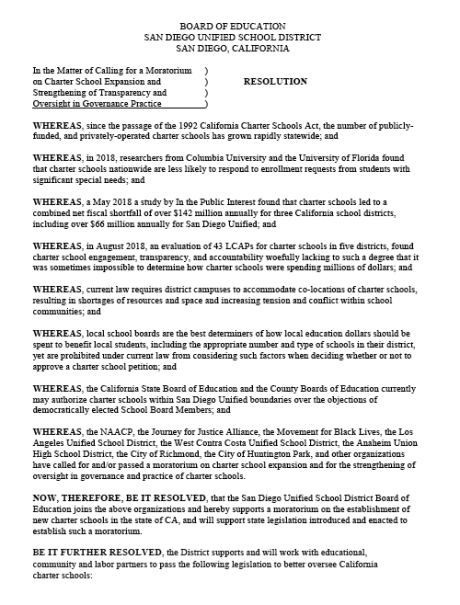
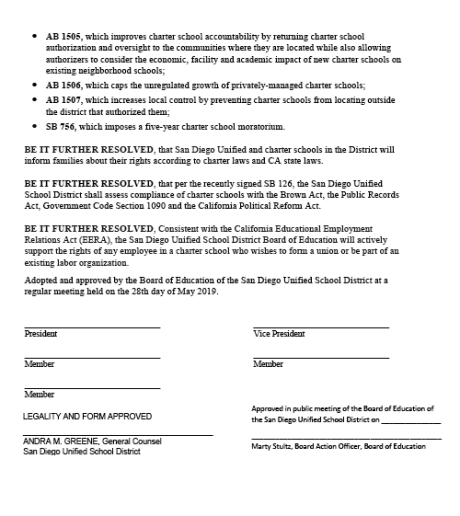
Last night, the elected Board of Education of the San Diego Unified School District passed a strong resolution endorsing four bills in the State Legislature that would impose discipline on the Wild West unregulated charter industry. The bills are described in the resolution. They would impose a moratorium on charter school expansion, revive local control, and increase oversight of charters. This resolution demonstrates that the board is willing to stand up to the rapacious charter industry.

Screen Shot 2019-05-28 at 5.40.05 PMScreen Shot 2019-05-28 at 5.40.16 PM


Former Vice President Joe Biden released his education plan yesterday. 

He pledges a dramatic increase in federal funding for education.

The plan is notable for what it does not say.

It does not say anything about the failed strategies of Race to the Top.

It does not say anything about charter schools, which was a major focus for the Obama-Duncan program. Will he repeal the failed federal Charter Schools Program or will he give his approval to continue funding corporate charter chains like KIPP, IDEA, and Success Academy?

It does not say anything about testing, nor does it say anything about revising the federal “Every Student Succeeds Act,” which mandates annual testing. Will Biden support the continuation of the ESSA law?

It does not say anything about evaluating teachers by the test scores of their students, which was a favorite Duncan policy. States bidding for Race to the Top billions changed their laws to adopt this punitive and wrong-headed policy. Will he oppose this practice or let it slide?

It makes no reference to the Common Core, which had the enthusiastic support of the Obama administration, which was legally prohibited from funding it, but which supplied $360 million to create two Common Core testing programs, PARCC and Smarter Balanced Assessment Consortium. Is Biden for or against it.

In sum, I like everything he said. But I wonder about what he didn’t say. He ducked all the tough issues, most of which are the legacy of the Bush-Obama era, of which he was a part.

Biden clearly prefers to duck the contentious issues. I hope that they will be posed to him in town halls.

We need to know where he stands on all the issues that matter to students, parents, teachers, and schools.


Thomas Pedroni of Wayne State University sent the following urgent message for readersof this blog.

Professor Pedroni writes:

“In 2016, seven Detroit school children and their parents joined together as plaintiffs to sue the State of Michigan for depriving them of what they deemed to be their basic right— the right to access literacy in minimally sufficient learning conditions. The plaintiffs, along with the vast majority of Detroit school children, had endured years of worsening conditions in the district— exploding class sizes, dilapidating and rat-infested schools, freezing or searing classroom temperatures, classrooms with no teachers and no books, profit-driven experimentation by self interested ed tech companies— all during a time of direct and unchecked control of the district  by a string of state-imposed emergency managers.

“The students’ class action lawsuit, brought pro bono by California law firm Public Counsel, was dismissed in 2018 by Judge Stephen Murphy of the U.S. District Court Eastern District of Michigan in Detroit. Judge Murphy argued that although students were inarguably being subjected to what he called deplorable learning conditions, and although literacy was clearly necessary for the full enjoyment of life in the United States today, there was no constitutional right to access literacy. The students  immediately filed an appeal.

“Candidate Gretchen Whitmer campaigned for Michigan Governor in part on an agenda of strengthening the state’s public schools. She explicitly addressed the lawsuit in interviews, arguing that, “Despite what the federal court said, despite what Bill Schuette and Governor Snyder say, I believe every child in this state has a constitutional right to literacy.” In the fall, an independent audit of the state of the district’s buildings concluded that an investment of at least $500 million would be required to bring the city’s schools, which had simply been neglected during the period of state emergency management, to minimally acceptable condition.

“But on Friday, the administration of newly elected Governor Whitmer submitted the state’s brief in response to the plaintiffs’ ongoing appeal. According to the brief, all of the parties named as defendants in the filing, including the Governor, the state superintendent, and the elected State Board of Education, asked the court to dismiss the appeal on mootness of grounds. The defendants now named— including Governor Whitmer— were no longer the defendants named in the original case, the state’s brief argued, and some local control had been returned to the Detroit Public Schools; moreover the Governor has committed to increased educational spending in her new budget.

“In fact, not all members of the State Board of Education saw things as stated in the State’s filing. While seven board members held that the case was moot, with the two Republicans on the board also rejecting outright the notion that the state constitution guaranteed access to literacy, one member’s perspective was not represented in the State’s brief at all. Board Vice President Pamela Pugh, a Saginaw Democrat who is also the Chair of the NAACP Michigan State Conference Education Committee and the Chief Public Health Advisor to Flint Mayor Karen Weaver, withheld her fundamental agreement with the arguments of the plaintiffs in the case.

“Instead, Vice President Pamela Pugh has issued the following statement, titled The Time is Now for Governor Whitmer, Education Officials, and Michigan Lawmakers to Guarantee Michigan Children’s Fundamental Right to Learn to Read and Write.”

Vice President Pamela Pugh wrote:

Greetings,

This message serves to inform you that relative to the Detroit Right to Literacy lawsuit, I have notified the office of the Michigan Attorney General that I did not communicate in any way that I would be taking or supporting the legal position that the U. S. Court of Appeals for the Sixth Circuit should dismiss Plaintiffs’ appeal on mootness grounds. It was represented in the reply brief filed by the State Defendants on Friday, May 24, 2019, that this is the legal position taken by all named defendants in this litigation.  I have also confirmed with the office of the Attorney General that I am exploring the options available to me, as a member of the Michigan Board of Education, to properly and procedurally address this matter.

This case has caused me to reflect deeply upon my beliefs, my values, and the very reason that I decided to run for the office of the State Board of Education; a role that the framers of our state constitution created to function distinct from that of the Governor and the state’s Executive Branch

I am reminded that in 1964 Rev. Dr, Martin Luther King pronounced, “the walling off of Negroes from equal education is part of the historical design to submerge him in second-class status”.  Dr. King went on to say, “As Negroes, we have struggled to be free and had to fight for the opportunity for a decent education.”  Now in 2019, 55 years later, with African Americans still struggling and fighting to be free, and to have an opportunity for an equitable and decent education, I am reminded of the urgency of the matter. 

Michigan ranks among the worst states in the nation for the educational performance of African American students.  While our children and educators are being labeled as failures, Michigan’s K-12 public education has been built on a crumbling foundation of racism and historic segregationist practices; many of which were sanctioned by our very own state government.  There is no doubt that these practices, and the policy makers who were unwilling to determinedly address the inequitable effects of them, are ultimately responsible for the failure of our children, their parents, and their teachers/educators.  

Through decades of inequitable funding and disastrous education program experiments, there’s been a perpetuation of children of color being deprived of the basic and proven conditions necessary for them to learn. Classroom learning is thwarted without literacy. Essential to a decent education are an adequate number of well trained teachers, sufficient teaching resources, and school buildings that aren’t environmental health hazards.  

Compounding this is the misuse and overuse of standardized tests, and, more importantly, the manipulative and abusive consequences that now accompany them.  These devices, and their penalties, such as “Read or Flunk” and “A-F” Laws, are now the primary tool, or the new and improved 21st century mechanism, used to submerge and maintain African Americans and communities of color in second class status.

In 1947, as an undergraduate at Morehouse College, Rev. Dr. Martin Luther King told us that, “The function of education is to teach one to think intensively and to think critically. Intelligence plus character – that is the goal of true education.”

I am reminded of our beloved Martin’s call for us to think for ourselves, to be outspoken and committed to what’s moral and right. As the Vice President of the Michigan State Board of Education, I am motivated by his words which call for us to speak with clarity and boldness in standing against the real and imminent threats to a decent and equitable education for all Michigan children.

Anything short of Governor Whitmer and state education officials completely separating from former Attorney General Bill Schuette’s arguments, and taking responsibility for our children of color being granted the equal right to critical learning conditions that are afforded to students in other school districts is simply unacceptable.  This is especially true for Detroit Public Schools where special compensation is needed due to state control of the district for almost 20 years. In my opinion this robbed Detroit children of the basic right to literacy, a fundamental right which I believe should be determined to be guaranteed by the U. S. Constitution, as well as other constitutional rights which require literacy skills. .

The time is now for Michigan lawmakers, the Governor, and state education leaders to move with urgency, clarity, and boldness to call for an appropriate level education funding for all our children. We owe the children of our state a decent education that includes adequate literacy skills as a core component to their training. This is an urgent matter, especially in the face of the cumulative effects of destructive policies that have derailed the educational progress of our low income children and children of color, and caused the failure of Michigan’s K-12 public education system.

Pamela L. Pugh, DrPH, MS
Michigan State Board of Education

Vice President
pampugh@umich.edu


Governor Gretchen Whitmer was elected in Michigan last fall as a progressive Democrat. She promised to reverse the destructive anti-public school policies of her predecessor Republican Rick Snyder.

But Governor Whitmer announced plans to close Benton Harbor High School, over the objections of school board members and students. They say that Governor Whitmer made her decision without listening to their voices. Whatever happened to democracy?

Governor Whitmer, I call upon you to meet with the elected Benton Harbor school board and student representatives.

School board member Patricia Rush wrote this letter:

Hi all –

Things have hit a new high of chaos with the Benton Harbor Schools.
From the School Board perspective, we thought we were making great progress – straightening out the budget, establishing a strategy for building repairs, increased teacher pay, etc
UNTIL Friday when Governor Whitmer (a newly elected progressive Democrat) – pulled the rug out by announcing her unilateral decision that the State is closing Benton Harbor High School in 2020 and dispersing the students to a new Charter School and 9 local, predominantly white school districts.
So the past 3 days have been extremely chaotic.
Attached is our Press Release and an Open Letter to the Governor opposing the State’s moves.
The state completely under-estimated the pushback from the Community – not just BH but across the State.
Also the State not only did not consult the elected local BH School Board but excluded also the State School Board (which is 40% minority).
The State also refused to hold open public hearings and tried to get our School Board to meet with them in small groups which sidesteps the Open Meeting Act.
See this video written, produced and performed by the High School students – which they have been working on PRIOR to the current mess.
The school board of Benton Harbor released these statements.

FOR IMMEDIATE RELEASE


From the Benton Harbor Area Schools Board (BHAS)


May 27, 2019


Contact: Steve.Mitchell@bhas.org or Joseph.Taylor@bhas.org
Benton Harbor Area Schools Board and the Community Demand Reconsideration of Governor Whitmer’s Plan to Close Benton Harbor High School


BENTON HARBOR, Mich. – On Tuesday June 4, 2019 at 6pm – the Benton Harbor Area Schools Board will hold the first of several Open Public Meetings at the High School Public Commons to discuss the future of Benton Harbor High School and the entire K-12 school district. Students, families, teachers, and community members are strongly encouraged to participate.
We are urgently requesting that Governor Gretchen Whitmer appear in person at our June 4 Public Meeting – and fulfill 3 of her campaign promises: to support public schools, especially in high-poverty communities, to fight urban poverty, and to hold government accountable. Please see Whitmer’s campaign website: https://www.gretchenwhitmer.com/issues/.

Attached is the Board’s Open Letter to Michigan Governor Whitmer. We respectfully request that all news media PRINT OUR ENTIRE LETTER TO WHITMER – and display on your website.

As has been widely covered in the media over the past few days, Governor Whitmer’s Office, Michigan Treasury, and parts of the Michigan Department of Education have proposed a unilateral plan to close Benton Harbor High School in 2020 with re-distribution of BHAS high school students to a proposed charter school under Lake Michigan College and nine other local school districts.

Parts of the story not reported in the media:

– Governors Office and Michigan Treasury did NOT consult the elected Trustees of the BentonHarbor Board members prior to their unilateral decision. The two BHAS Board members who were briefed in the State Capital Lansing on Friday 5/24/19 were told by the Governors Office staff that this decision to exclude the elected Benton Harbor Board was intentional.


– Likewise, on 5/23/19, the elected state-wide Trustees of the Michigan Department of Education were informed that the Governor’s Office had also excluded them from giving input into the fate of Benton Harbor High School.

– On 5/24/19, the Governors Office informed the two Benton Harbor Board members attending the Lansing meeting that the Governors Office had not held an open public meeting for community input – and did not plan to do so. Instead, the Governors Office met with undisclosed community members that the Governor felt were “representative.”

– The BHAS Board were told that the Governors Draft Plan is a “Yes – or – No Decision with no opportunity for negotiation.” BHAS Board was told it must decide by close of business Friday June 7 to accept the Plan or risk that the State may elect to dissolve the entire Benton Harbor Areas Schools district at any time.

This one-sided decision-making by Michigan State officials is unacceptable. We, the Benton Harbor Area Schools Board are going to hold our State government accountable.

In April 2019, the BHAS Board unanimously voted to support the Fresh Start Resolution petitioning the State of Michigan to reexamine public school accountability and finance systems, calling for a system of improvement strategies developed collaboratively by all stakeholders – to ensure all students and teachers have a voice and receive the opportunities and support they deserve.

The State bears direct responsibility for a significant portion of the BHAS debt. The legacy of this debt should be transparently reviewed and addressed – but the High School cannot be held hostage for the State to agree to debt forgiveness.

The fate of the Benton Harbor High School and the entire School District requires careful planning by all involved parties – especially the opportunity of full community input plus input from both the state and local School Board Trustees who were duly elected by the community to represent them.

//
The BHAS Board OPEN LETTER TO GOVERNOR WHITMER Follows immediately


We respectfully request that all news media PRINT OUR ENTIRE LETTER TO WHITMER and display on your website.

FOR IMMEDIATE RELEASE
From the Benton Harbor Area Schools Board (BHAS)
May 27, 2019
Contact: Steve.Mitchell@bhas.org or Joseph.Taylor@bhas.org


OPEN LETTER TO MICHIGAN GOVERNOR GRETCHEN WHITMER FROM THE ELECTED SCHOOL BOARD OF BENTON HARBOR AREA SCHOOLS, BENTON HARBOR, MICHIGAN.


Dear Governor Whitmer –


We respectfully and urgently request that you visit Benton Harbor in person to meet in an Open Public Meeting with the community and the elected School Board trustees regarding the future of Benton Harbor High School and the K-12 District as a whole.

The School Board is hosting an Open Public Meeting at the Benton Harbor High School Student Commons on Tuesday June 4 at 6pm. We would love to host you and let you hear the full story.

Hopefully you are aware that representatives from your office, Treasury and the Department of Education are claiming that, on your behalf, a unilateral decision has been made to close Benton Harbor High School in 2020. The Board was told by your representatives that a decision was made by your office to intentionally exclude the elected School Board trustees and exclude open community input from the decision-making process. Honestly, we are completely shocked and dismayed by this action. Our Board has been working in good faith with both Treasury and Education to address issues at BHAS including an outline for a new Strategic Plan, submitted to Treasury, but upon which your departments have taken no action.

We also want to openly confront the many “elephants in the room” that neither your staff nor the news media have addressed:

• The land upon which the Benton Harbor High School sits with its athletic fields and adjacent School Board properties are the LAST MAJOR UNDEVELOPED WATERFRONT PROPERTIES in Berrien County, Michigan. Is this just a coincidence, given that your office just told our Board representatives on 5/24/19 that your plan to close Benton Harbor High School has major (but unnamed) supporters in the nearby business community?

• The Draft Plan from your office is explicitly a transfer of wealth from an overwhelmingly poor and black community (Benton Harbor) to nearby white, more affluent communities. Under your Plan, that transfer of wealth will occur through the loss by Benton Harbor of its school facilities and use of school land, transfer of state funding from Benton Harbor to the adjacent nine school districts where you plan Benton Harbor students to be redistributed, and loss of jobs for local teachers and staff of all levels.

• The contention by representatives of your office that hiring a single staff person to act as a “Cultural Dean” to smooth over “discomfort” that the displaced 700 black students might feel when transported out of their community to predominantly white schools is an appalling insult to our youth and the community. Such insensitivity to the painful history of racial segregation, unsuccessful past desegregation efforts, and continued State-sponsored dis-investment in Benton Harbor calls for a swift and strong response.

We call upon you to meet with us – to hear the students voices and the expertise of our teachers.


We call upon you to fulfill your 2018 campaign promises to support public schools, especially in high-poverty communities, to fight urban poverty, and to hold government accountable.

BHAS needs balanced, constructive leadership from you, your office and all State agencies.

We need complete transparency. We need State and local leaders to stop sensationalizing limited
facts about Benton Harbor in the media and on the Michigan.gov website created by your office to
promote your Plan to close Benton Harbor High School. Our community needs to feel that our
youth are respected, valued and worth meaningful investment so that they may achieve their
tremendous potential. The students, their families, our teachers, and our community deserve that.


Sincerely, Steve Mitchell, Trustee and Board President
Joseph Taylor, Trustee and Board Vice-President
Patricia Rush, Trustee and Board Secretary
Denise Whatley-Seats, Trustee and Board Treasurer
Matthew Bradley, Trustee
Lue Buchana, Trustee
Michelle Crowder, Trustee
//


Audrey Amrein-Beardsley is an education scholar who specializes in smoking out quack reforms, like the “value-added” accountability measures used to judge teacher quality.

In this post, She investigates whether the 13 states that grade states with a single letter grade of A-F achieve higher scores on the National Assessment of Educational Progress after implementing this strategy. 

Jeb Bush initiated the idea of giving schools a single letter grade.

I have long believed that it was a singularly stupid idea. If your child came home from school with a report card that contained only one letter grade, you as a parent would be outraged. No individual child is an A or B or C or D or F. She may be great in math but weak in science, average in reading but excellent in art or history.

If it’s wrong to give a single letter grade to one child, it is ludicrous to give a single letter grade to an institution that has hundreds of students, staff, programs, etc.

Amrein-Beardsley concluded:

In reality, how these states performed post-implementation is not much different from random, or a flip of the coin. As such, these results should speak directly to other states already, or considering, investing human and financial resources in such state-level, test-based accountability policies.

In short, this is a costly and useless school reform policy that benefits no one.


Steven Singer doesn’t research or data to describe what is happening to his school district. He sees it. It is being gobbled up outsiders intent on turning public schools into charter schools and voucher schools. 

The state auditor of Pennsylvania said a few years ago that the Pennsylvania charter law is”the worst in the nation.”

Singer shows why.


Our middle school-high school complex is located at the top of a hill. At the bottom of the hill in our most impoverished neighborhood sits one of the Propel network of charter schools.

Our district is so poor we can’t even afford to bus our kids to school. So Propel tempts kids who don’t feel like making the long walk to our door.

Institutions like Propel are publicly funded but privately operated. That means they take our tax dollars but don’t have to be as accountable, transparent or sensible in how they spend them.

And like McDonalds, KFC or Walmart, they take in a lot of money.

Just three years ago, the Propel franchise siphoned away $3.5 million from our district annually. This year, they took $5 million, and next year they’re projected to get away with $6 million. That’s about 16% of our entire $37 million yearly budget.

Do we have a mass exodus of children from Steel Valley to the neighboring charter schools?

No.

Enrollment at Propel has stayed constant at about 260-270 students a year since 2015-16. It’s only the amount of money that we have to pay them that has increased.


The state funding formula is a mess. It gives charter schools almost the same amount per regular education student that my district spends but doesn’t require that all of that money actually be used to educate these children.

If you’re a charter school operator and you want to increase your salary, you can do that. Just make sure to cut student services an equal amount.

Want to buy a piece of property and pay yourself to lease it? Fine. Just take another slice of student funding.

Want to grab a handful of cash and put it in your briefcase, stuff it down your pants, hide it in your shoes? Go right ahead! It’s not like anyone’s actually looking over your shoulder. It’s not like your documents are routinely audited or you have to explain yourself at monthly school board meetings – all of which authentic public schools like mine have to do or else.

Furthermore, for every student we lose to charters, we do not lose any of the costs of overhead. The costs of running our buildings, electricity, water, maintenance, etc. are the same. We just have less money with which to pay them.

Read his post in full. You will understand.


Shawgi Tell, a Professor in upstate New York, thinks the public needs that charter school failure is widespread, commonplace, and underreported. Even now, mainstream publications like the New York Times and the Wall Street Journal treat charter schools reverentially, as if they know how to perform education miracles.

Professor Tell assembles research showing the frequent failure of charters. 

Open the link to see a great cartoon.

He writes:

It is worth noting that both public schools and privately-operated nonprofit and for-profit charter schools are victims of expensive, curriculum-narrowing, time-consuming, high-stakes standardized tests produced by large for-profit corporations that have no idea what a human-centered education looks like. Such corporations are retrogressive and harmful in many ways; they are not concerned with the growth and well-being of children, or the future of society.

The research on how damaging and unsound these expensive corporate tests are is robust, unassailable, and constantly-growing.

High-stakes standardized testing has nothing to do with learning, growth, joy, or serving a modern society and economy. Unsound assessments do not prepare young people for life. High-stakes standardized testing does not even rest on a scientific conception of measurement; it is discredited psychometric pseudo-science through and through.

Still, with these important caveats in mind, thousands of charter schools, even when they cherry-pick students with impunity, dodge tests and ratings, and massage or misreport test scores, perform worse on these flawed, top-down, widely-rejected corporate tests than public schools.

Thanks to Los Angeles blogger Sara Roos for calling my attention to this very interesting article by journalist Rachel Cohen. We have had an extended exchange about the article.

Cohen says that the typical origin story of charter schools credits the idea to AFT President Al Shanker. She shows that the idea was percolating long before Shanker began promoting charters in 1988. The idea of public-private partnerships was in the air in the late 1980s and was the underpinning of what was called Third Way politics, as practiced by Bill Clinton and Tony Blair.

Cohen does an excellent job of describing the milieu in which the charter idea emerged. Shanker was not its originator but he was an important publicist for the idea. Without his support, charters might never have achieved national attention.

Right-wingers today, as Cohen notes, like to credit paternity of charters to Shanker, which is amusing since 90% of charters are non-union. Charter advocates who think of themselves as progressive also cling to Shanker as their forebear, but can’t explain why the charter sector is both non-union and highly segregated.

Cohen fails to mention that Shanker renounced charters in 1993, five years after embracing them, because he realized that his idea had been sabotaged and had turned into a tool with which to bust unions and to privatize public schools. In one of the paid advertisements that he published every Sunday in the New York Times, he wrote that charters were no different from vouchers. And he denounced them.

Strangely, neither the right-wingers nor the progressive charter fans ever acknowledge that Shanker denounced what was allegedly his big idea.

It is important to recall what Shanker had in mind when he supported charters.

1. He saw them as schools-within-schools, not as independent schools operating with their own school board, nor as corporate chains replacing public schools.

2. He saw them as teacher-run schools.

3. He saw them recruiting the weakest and most alienated students, the ones who had dropped out or were at risk of dropping out.

4. He said they should not be authorized without the support of the teachers in the school where they would operate.

5. He said they should not be authorized without the permission of the local school board.

6. He expected that the teachers in the charter school, operating as a school-within-a-school, would be members of the same union as the other teachers in the building.

7. He believed that the charter should run for five years, which would allow it to try out new ideas and share them with the rest of the school.

8. He did not envision the charter school as a permanent entity, but as a five-year or longer experiment designed to allow innovation and collaboration.

9. He did not envision charters run by non-educators, entrepreneurs, corporations, and grifters.

10. He did not envision corporate charter chains.

11. He did not envision a charter industry that is 90% non-union, more segregated than district public schools, and inclined to cherrypick the most motivated students.

When he saw businesses moving into the public school sector, he realized his own ideas had been destroyed by greed.

What he thought initially was a progressive idea was captured by the Waltons, the DeVos family and others on the right who wanted to destroy public schools and unions.