Archives for category: Accountability

Heather Cox Richardson reviews the events of the weekend. One update: the Vice President of Venezuela, Delcy Rodriguez, initially gave a defiant speech declaring that Maduro was still the President of Venezuela. But she later remarked that the best response to the new situation was to be “cooperative,” implying that she has had conversations with Rubio and has agreed to hold Venezuela together by remaining in office. Her statement late Sunday included this: “We extend an invitation to the U.S. government to work together on a cooperation agenda, oriented toward shared development, within the framework of international law, and to strengthen lasting community coexistence.”

Trump and Marco Rubio may have learned a lesson from our disastrous invasion of Iraq, where U.S. forces removed everyone–civilian and military– associated with Saddam Hussein, who built a powerful resistance. Apparently they intend to “run” Venezuela by using the current regime to do their bidding.

Most frightening fact about this event is that Trump and his close associates believe they can take military action anywhere in the world without consulting Congress, as the Constitution requires. They treat Congress and the Constitution as useless appendages, not worthy of even a nod. So long as the Republicans who control Congress accept Trump’s disdain, they may as well go home and stop pretending that they matter.

Trump said after Maduro’s removal that he’s still determined to take Greenland away from Denmark, because we need it for our “national security.” Rubio issued a warning to Cuba, implying that it was in our sights. Trump is now reveling in the successful capture of Maduro and Venezuela. Who’s next?

Richardson wrote:

Secretary of State Marco Rubio took the administration’s message about its strikes on Venezuela to the Sunday talk shows this morning. It did not go well.

Asked by George Stephanopoulos of ABC’s This Week under what legal authority the U.S. is going to run Venezuela, as President Donald J. Trump vowed to do, Rubio served up a lot of words but ultimately fell back on the idea that the U.S. has economic leverage over Venezuela because it can seize sanctioned oil tankers. Seizing ships will give the U.S. power to force the Venezuelan government to do as the U.S. wants, Rubio suggested. This is a very different message than Trump delivered yesterday when he claimed that the people standing behind him on the stage—including Rubio—would be running Venezuela.

When Stephanopoulos asked Rubio if he was, indeed, running Venezuela, Rubio again suggested that the U.S. was only pressuring the Venezuelan government by seizing sanctioned oil tankers, and said he was involved in those policies. When Kristen Welker of NBC’s Meet the Press also asked if Rubio was running Venezuela, Rubio seemed frustrated that “People [are] fixating on that. Here’s the bottom line on it is we expect to see changes in Venezuela.” Historian Kevin Kruse commented: “Yeah, people are fixating on a Cabinet Secretary being given a sovereign country to run because the president waged war without congressional approval and kidnapped the old leader. Weird that they’d get hung up on that.”

When Stephanopoulos asked why the administration thought it didn’t need congressional authorization for the strikes, Rubio said they didn’t need congressional approval because the U.S. did not invade or occupy another country. The attack, he said, was simply a law enforcement operation to arrest Maduro. Rubio said something similar yesterday, but Trump immediately undercut that argument by saying the U.S. intended to take over Venezuela’s oil fields and run the country.

Indeed, if the strikes were a law enforcement operation, officials will need to explain how officers managed to kill so many civilians, as well as members of security forces. Mariana Martinez of the New York Times reported today that the number of those killed in the operation has risen to 80.

Rubio highlighted again that the Trump administration wants to control the Western Hemisphere, and he went on to threaten Cuba. Simon Rosenberg of The Hopium Chronicles articulated the extraordinary smallness of the Trump administration’s vision when he wrote: “We must also marvel at the titanic idiocy of our new ‘Donroe Doctrine’ for it turns America from a global power into a regional one by choice. I still can’t really believe they are going through with this for it is so batsh*t f-ing crazy, and does so much lasting harm to our interests.”

Shortly after Trump told reporters yesterday that Venezuela’s former vice president, now president, Delcy Rodríguez is “essentially willing to do what we think is necessary to make Venezuela great again,” Rodríguez demanded Maduro’s return and said Venezuela would “never again be a colony of any empire, whatever its nature.” Indeed, U.S. extraction of Maduro and threats to “run” Venezuela are more likely to boost the Maduro government than weaken it.

In a phone call today with Michael Scherer of The Atlantic, Trump threatened Rodríguez, saying that “if she doesn’t do what’s right, she is going to pay a very big price, probably bigger than Maduro.” Tonight on Air Force One, Trump told reporters that the U.S., not Rodríguez, is in charge of Venezuela.

Trump also told Scherer that he does indeed intend to continue to assert U.S. control in the Western Hemisphere, telling Scherer that “we do need Greenland, absolutely. We need it for defense.” Greenland is part of the North Atlantic Treaty Organization (NATO), meaning it is already part of U.S. national defense.

Although he ran for office on the idea of getting the U.S. out of the business of foreign intervention, Trump embraced the idea of regime change in Venezuela, telling Scherer: “You know, rebuilding there and regime change, anything you want to call it, is better than what you have right now. Can’t get any worse.” He continued: “Rebuilding is not a bad thing in Venezuela’s case. The country’s gone to hell. It’s a failed country. It’s a totally failed country. It’s a country that’s a disaster in every way.”

At Strength in Numbers, G. Elliott Morris noted that military intervention in Venezuela is even more unpopular with the American people “than Trump’s tariffs and health care cuts.” In September, only 16% of Americans wanted a “U.S. invasion of Venezuela,” with 62% against it. A December poll showed that 60% of likely voters opposed “sending American troops into Venezuela to remove President Maduro from power.” Only 33% approved. Even support for strikes against the small boats in the Caribbean could not get majority support: 53% opposed them while only 42% approved.

“By the time American forces touched Venezuelan soil early Saturday morning,” Morris writes, “Trump had already lost the public.”

But officials in the administration no longer appear to care what the American people want, instead simply gathering power into their own hands for the benefit of themselves and their cronies, trusting that Republican politicians will go along and the American people will not object enough to force the issue. The refusal of the Department of Justice to obey the clear direction of the Epstein Files Transparency Act seems to have been a test of Congress’s resolve, and so far, it is a gamble the administration appears to be winning.

Morris notes that a December CBS poll showed that 75% of Americans, including 58% of Republicans, correctly believed a president must get approval from Congress before taking military action against Venezuela. The president did not get that approval. By law, the president must inform the Gang of Eight before engaging in military strikes, but if an emergency situation prevents that notification, then the president must inform the Gang of Eight within 48 hours. The Gang of Eight is made up of the top leaders of both parties in both chambers of Congress, as well as the top leaders from both parties on the House and Senate Intelligence Committees.

Representative Jim Himes (D-CT) who as ranking member of the House Intelligence Committee is a member of the Gang of Eight, told CBS’s Margaret Brennan this morning that neither he nor House minority leader and fellow Gang of Eight member Hakeem Jeffries (D-NY) had been briefed on the strikes. Himes said: “I was delighted to hear that Tom Cotton, chairman of the Senate Intelligence Committee, has been in regular contact with the administration. I’ve had zero outreach, and no Democrat that I’m aware of has had any outreach whatsoever. So apparently we’re now in a world where the legal obligation to keep the Congress informed only applies to your party, which is really something.”

Senate minority leader Chuck Schumer (D-NY)—also a member of the Gang of Eight—told reporters that he hadn’t been briefed either and that the administration had deliberately misled Congress in three classified briefings before the strikes. In those briefings, officials assured lawmakers that the administration was not planning to take military action in Venezuela and was not pursuing regime change. “They’ve kept everyone in the total dark,” he said.

Nonetheless, Himes told Brennan that he thought Trump’s Venezuelan adventure would not go well: “We’re in the euphoria period of…acknowledging across the board that Maduro was a bad guy and that our military is absolutely incredible. This is exactly the euphoria we felt in 2002 when our military took down the Taliban in Afghanistan in 2003, when our military took out Saddam Hussein, and in 2011, when we helped remove Muammar Gaddafi from power in Libya. These were very, very bad people, by the way, much, much worse than Maduro and Venezuela, which was never a significant national security threat to the United States. But we’re in that euphoria phase. And what we learned the day after the euphoria phase is that it’s an awful lot easier to break a country than it is to actually do what the president promised to do, which is to run it…. [L]et’s let my Republican colleagues enjoy their day of euphoria, but they’re going to wake up tomorrow morning knowing what? My God, there is no plan here any more than there was in Afghanistan, Iraq, or in Libya.”

Representative Ted Lieu (D-CA) was more direct: “The U.S. attack on Venezuela is illegal,” he posted. “Congress never authorized this use of military force. I will vote to stop it. This is insane. Health care costs and food prices are surging. Trump’s response is we’re going to run another country. Batsh*t crazy.”

—
Jeff Bryant, a veteran education journalist, dissects he plan to destroy public schools. Governor Ron DeSantis and the Legislature has unleashed the for-profit vultures to pick the bonds and funds of the state’s public schools. Not because the charges are better schools, but because the rightwingers have close ties to members of the legislature. Want to open a charter school? Want the state to pay all your expenses? Come on down to the Sunshine State!

This article was produced by Our Schools. Jeff Bryant is a writing fellow and chief correspondent for Our Schools. He is a communications consultant, freelance writer, advocacy journalist, and director of the Education Opportunity Network, a strategy and messaging center for progressive education policy. His award-winning commentary and reporting routinely appear in prominent online news outlets, and he speaks frequently at national events about public education policy. Follow him on Bluesky@jeffbinnc.

The letters started coming in October 2025. In the first wave, according to the Florida Policy Institute (FPI), “at least 22 school districts in Florida” got letters alerting them that charter school operators, including a for-profit charter school management company based in Miami, intended to use a state law recently enacted to open new charter schools on the campuses of existing public schools beginning August 2027.

In Broward County, a South Florida district that includes Fort Lauderdale, the Mater Academy charter school chain, operated by for-profit charter management company Academica, claimed space in 27 public schools. Mater Academy claimed space in nearly 30 schools in Hillsborough County, home to Tampa Bay, “along with more than a dozen [schools] in Pinellas [County] and six in Pasco [County],” Tampa Bay Times reported. In Sarasota County, Mater claimed space in three public school campuses.

At least two more charter chains—New York-based Success Academy and New Jersey-based KIPP NJ—have joined in the campaign.

“So far, 480 schools in 22 counties have received 690 ‘letters of intent’ from charter school organizations expressing their intent to occupy space in public school buildings,” FPI’s Norin Dollard told Our Schools in late November. When schools receive letters from multiple charter organizations, it’s first come, first served, she explained, and the timeline for schools to respond is incredibly short—just 20 days.

Once the charter occupies part of the public school, Dollard explained, it operates rent free, and the public school district becomes responsible for much of the charter’s costs, including those for services charters don’t customarily provide, such as bus transportation and food service, as well as costs for school support services like janitorial, security, library, nursing, and counseling. Even any construction costs the charters might incur have to be covered by the public school.

This new law will force some public schools to convert to charter schools, said Damaris Allen, “and that’s intentional.” Allen is the executive director of Families for Strong Public Schools, a public schools advocacy organization that is rallying opposition to the law.

The letters have caught the attention of national news outlets, including the Washington Post, which reported, “The Florida law is an expansion of a state program called ‘Schools of Hope,’ which was set up to allow certain charters to operate in areas with low-performing local public schools. The new law allows ‘Schools of Hope’ operators to take over space at any public school that’s under capacity, regardless of whether it is high- or low-performing.”

“The expansion of the Schools of Hope idea has been on a slippery slope,” Dollard explained, “much like school vouchers have been in the state.” Originally, in 2017, schools identified for Schools of Hope transition from public governance to charter management were very narrowly defined as persistently underperforming schools. That changed in 2019 when the legislature altered the definition of low-performing to target more schools and added schools in so-called opportunity zones—government-designated areas selected for economic development—as open territory for charters. Now, the new law allows charter schools to take over “underused, vacant, or surplus” space in traditional public schools and operate free of charge.

As the reach of the Schools of Hope idea morphed, so did its rationale. According to a 2025 op-ed by former Florida Governor Jeb Bush, the program was originally conceived as an “initiative that incentivizes high-quality charter operators to open schools for students trapped in failing ones.” The aim now, according to Bush, is to solve the “problem” of underutilized space in existing public schools.

With school enrollments in steep decline in nearly every district in the state, fear of a potential mass charter school industry takeover of public school spaces—along with the costs local districts will incur—looms over district leaders across the state and strikes them as a clear existential threat.

Other consequences of colocating more charters in public schools have not been well-thought-out, according to Allen. For instance, on the issue of school safety, public schools have undertaken a number of measures to protect against school shootings, such as converting buildings to single-point entry. Charter schools don’t have to do that. So what happens when a charter operation moves into a building and doesn’t comply with the single-point entry? Also, the state legislature created new rulesfor public school libraries in 2022. Charters don’t have to follow those rules. How is that going to work in a colocation?

Allen fears the daunting challenges of charter colocations will cause some school boards and communities to sell school buildings or convert them to district-operated charters rather than give in to charter schools run by outside, for-profit companies.

And while proponents of Florida’s Schools of Hope program see it as a way to expand education options for students and families, critics point to evidence that Florida charter schools, which one expert called “a shitstorm,” need stricter oversight rather than a free rein. And, regardless of the outcomes, they warn that the idea is sure to get promoted as an “education innovation” that other Republican-dominated states will likely adopt.

A warning sign, not a model

When Nancy Lawther, a retired college professor of French, got involved in public schools advocacy, she became very skeptical about the oft-told narrative about the need for more education options because “too many poor children are trapped in failing public schools.” After all, in Dade County, Miami, where she lives, the public system has an A rating by the state despite having a challenging student population that is overwhelmingly Hispanic, with many living in households earning less than the state’s median income.

Her skepticism only increased when she first heard about expanding the Schools of Hope program to more schools, especially when she saw the results from the first schools taken over.

The original “Schools of Hope” weren’t individual schools; it was a whole district. In 2017, the Jefferson County school board voted in favor of participating in a pilot project for the new Schools of Hope initiative. The board’s approval to join the pilot meant that the district was required to turn over the management of their schools to a “high-performing” charter management company, which, in this case, happened to be Somerset Academy, another charter chain managed by the for-profit Academica management company.

But the results of the pilot would be a warning sign about the abilities of charter management firms to improve the education outcomes of public schools. As a 2025 op-ed for the Orlando Sentinel recounted, “[T]axpayers saw higher costs, stagnant results, and constant staff churn. By 2022, the takeover collapsed. Local leaders called it ‘an absolute disaster.’ The state had to step in with a $5 million bailout just to get the district running again.”

A 2024 account of the pilot in the Tallahassee Democrat reported, “[F]rom 2017 to 2022,… [Jefferson County] remained troubled by students’ lagging academic performance and mounting disciplinary issues, like fighting that in one case led to the arrest of 15 students. … [And] the school district was still getting a D grade” from the state.

Nevertheless, after Florida lawmakers expanded the Schools of Hope program in 2019, which has cost more than $300 million as of 2025, “There are only about a dozen Schools of Hope in Florida. In 2024, eight of them got C or D grades,” pointed out the Bradenton Times.”

‘All about market share’

Given its track record of failure, Lawther suspects that expanding Schools of Hope has nothing to do with improving education outcomes or making better use of publicly funded school buildings.

Indeed, Sarasota County, one of the districts targeted for charter colocations, has been an A-rated system since the state created the grading system in 2004, according to the district website.

Also, in districts where there are enrollment slides, there are few signs that demand for charters will soak up excess building capacity. According to a 2025 analysis of Sarasota County by Suncoast Searchlight, “The number of charter schools has grown in recent years, but the share of students at charters has not shifted much.” And building utilization rates of the different sectors are nearly identical—82 percent for public schools and 84 percent for charters, WUSF stated. “Some of the lowest-performing charters are barely a third full.”

Mater Academy, the charter operator using the Schools of Hope law to claim space in Sarasota public schools, does not currently operate a school in the district.

“This is all about market share,” Lawther said. “It’s about getting an advantage over charter operators that are not Schools of Hope providers, and independent charters that can’t compete in a market geared to the large chains,” like those operated by Academica.

Further, while enrollments in Florida charter schools continued to grow, it has shown signs of slowing down—from 3.7 percent in 2024 to 2.6 percent in 2025—and the number of charter schools decreased, from 739 in 2023-2024 to 732 in 2024-2025.

Also, the charter industry in the state faces many more privately-operated competitors. “Expansions of voucher programs are creating a more competitive market for charter schools,” Lawther noted, “and private schools, microschools, and homeschooling are growing forms of school choice.”

Indeed, charter schools no longer appear to be the fastest-growing form of school choice in the state.

After the Republican-led Florida legislature passed a bill in 2023 that did away with income requirements for families to receive state-sponsored school vouchers, the share of state funding diverted from the public system—which, technically, includes charters—to private schools and homeschooling doubled from 12 percent in 2021 to 24 percent in 2025, WUSF reported. In the school year 2023-2024, the number of vouchers, often called “scholarships,” given out to help families pay for private school tuition and homeschooling increased by approximately 142,000 students, according to Next Steps, a school choice advocacy group.

Florida has also experienced a 46 percent increase in homeschooling over the past five years, WEAR statedin 2025. And the state has freed up 50,000 new community facilities to serve as microschools, according to the Center for American Progress.

It would seem that in this increasingly competitive education landscape, the Florida charter school industry could use a new competitive angle like the one offered by Schools of Hope. “Officially, charter school advocates say Schools of Hope is an amazing opportunity to expand parent choice,” Dollard said, “but unofficially, this is an incredibly lucrative business opportunity.”

An industry in decline?

The charter school industry’s desire for new business strategies that enable charter operators to seize public school classrooms—or even whole buildings—is not confined to Florida.

In Indiana, for years, public school districts have been required to notify the state, within 10 days, when one of their buildings becomes vacant and to make the building available to lease to a charter school for $1 per year or sell the building to a charter operator outright for $1.

In Ohio’s 2025 approved budget, a new provision allows the state to force school districts to close some public school buildings and sell those properties to charter or private schools “at below market value,” Ideastream Public Media reported.

Arkansas is also likely to adopt a Schools of Hope-like measure, Allen speculated, because its state secretary of education Jacob Oliva served in Florida. Oliva was Florida’s state education chancellor during the failed Schools of Hope pilot in Jefferson County.

One market condition that’s likely behind these increasingly aggressive charter school industry is land grab, as revealed in a 2025 analysis by the National Center for Charter School Accountability (NCCSA). According to the report, charter school closings have been accelerating nationwide, while the pace of new charter openings has slowed significantly during the same time.

“[T]he 2023-24 school year saw just 12 more open charter schools than during the previous year,” the report found. This is “a dramatic departure” from the heydays of industry growth when “[t]he number of charter schools increased by 421” between 2010 and 2011.

Charter school enrollment growth has also stalled, according to the report, increasing by 0.1 percentage point—from 7.5 percent to 7.6 percent of total charter enrollment—between 2020 and 2023.

In the most recent school years, based on official data from 2022-2023 and 2023-2024, NCCSA found, “Most states experienced declines or stagnation [in charter school market share], and preliminary indicators suggest that, once the 2024 data is finalized, the trend will likely worsen.”

North Carolina offers a clarifying example of the significant headwinds that the charter school industry now faces.

In the Tar Heel state, charter schools have enjoyed widespread support among state lawmakers and private investors. The state legislature has made dramatic changes to state laws regarding charters, including loosening regulations and fast-tracking approval of new schools. And a 2024 analysis by the Charlotte Observer found “at least $279 million in private equity investments in North Carolina charter schools since 2013.”

Despite this support, the number of charter schools in North Carolina declined in 2024-2025, from 211 to 208 in 2023-2024, according to an industry spokesperson. And many of the newest charter schools to open in the state have not fared well. “State data show that only about 26 percent of new charter schools in the past five years met or exceeded their enrollment projections,” NC Newsline reported, “and more than half of those that missed the mark are now closed or never opened.”

The report’s findings revealed that although charters tend to locate in low-income neighborhoods, they serve far fewer children from low-income families, fewer children who are English learners, and fewer children with disabilities, resulting in leaving traditional public schools with elevated needs and higher costs.

Critics of the Schools of Hope law noted that these industry shifts, as well as a historical tendency for education policies enacted in Florida to get picked up in other Republican-dominated states, will spur other states to adopt similar policies, regardless of any evidence that they might harm public schools.

“More generally,” Baker added, “Florida charter schools are a shitstorm, both underserving higher need populations and underperforming with those they do serve.”

‘A shitstorm’

Among the critics of Florida’s Schools of Hope legislation is Bruce Baker, a professor and chair of the department of teaching and learning at the University of Miami and an expert on charter schools and public school finances.

“I’m, of course, deeply concerned with granting preferential access to any charter operator, at the expense of a fiscally strapped school district,” Baker wrote in an email. “I’m more concerned when it may present a slippery slope regarding control over land and buildings that should—by the [state] constitution, which supersedes this regulatory change—be solely under the authority of the local boards of education elected by the taxpayers who financed those facilities and continue to maintain them. It becomes even more problematic if this eventually creates an avenue to transfer ownership. That would be a particularly egregious violation of local board authority and private taking of public assets. We aren’t there yet, but it’s a concern.”

Baker’s assessment of charter schools in the Sunshine State is evident in his 2025 report, which looks at the impacts of the industry on school funding adequacy, equity, and student academic outcomes across the state, and, more specifically, in the Miami-Dade district.

Also, charters, despite having an advantage of educating less challenging and less costly student populations, underperform public schools on state assessments while “serving otherwise similar student populations.” This finding holds statewide and in Miami-Dade.

The report concludes that Florida charters are “compromising equity, eroding efficiency, and producing poor educational outcomes for those it serves.”

Given these findings, the report recommends that state lawmakers “[i]mpose a moratorium on charter school expansion, including the Schools of Hope Program.” It also calls for “new regulations for evaluating existing charter operators,” stronger vetting of new charter operators, and stricter enforcement of regulations about charter school student outcomes.

Schools of nope

Several district school superintendents across Florida have urged their communities to oppose the state’s Schools of Hope charter school expansion in public school buildings. When the state’s current education commissioner defended the Schools of Hope law in his address at a 2025 conference for school board members and district leaders and suggested it could be used to shut down whole districts, the audience roundly booed him.

Grassroots groups such as Families for Strong Public Schools have held events to educate the public about the negative impacts of charter colocations. A coalition that includes the United Teachers of Dade, NAACP Miami-Dade Branch, the Miami-Dade County Council of PTA/PTSA, and others has formed to protest charter colocations. And a senator in the state legislature has introduced a bill to repeal the Schools of Hope expansion.

Much of the opposition has rallied under the banner of “Schools of Nope” and is organizing call-ins and an email campaign targeting state legislators.

Opposition organizers like Damaris Allen see this as a do-or-die moment in the state. “Either we win this fight, or it’s the death of public schools in Florida,” she said.

Richard Haas was president of the council on Foreign Relations for 20 years, so he qualifies as an expert on foreign affairs, not a pundit.

He writes a blog called “Home and Away,” where he comments on international issues. Open the link to his post to see his links to sources. The only salient point he overlooks, I believe, is that Trump’s decision to kidnap Maduro and his wife is a huge distraction from the Epstein files, as well as a chance to raise Trump’s sagging poll numbers.

He wrote today:

Welcome to this special edition of Home & Away. It is hard to believe we are only four days into the new year. I find it even harder to believe that I committed myself to making this a dry January.

As you would expect, the focus of today’s newsletter is Venezuela. Nicolás Maduro, the former president of Venezuela, is being held at the famous or, more accurately, infamous Metropolitan Detention Center in Brooklyn. This is hardly the end of the story though. To the contrary, his ouster Saturday at the hands of U.S. Special Forces is best understood as the end of the beginning rather than the beginning of the end.

To be sure, few in Venezuela, or anywhere outside of Havana, Moscow, and Beijing, will mourn Maduro’s removal. He was an autocrat who stole an election, repressed his people, ran his country’s economy into the ground despite possessing enormous oil reserves, and trafficked in narcotics.

But that does not mean that this military operation was either warranted or wise. In fact, it was of questionable legality. The United States also had other options. Maduro hardly posed an imminent threat to the United States. Make no mistake: this was a military operation of choice, not of necessity.

There are some superficial similarities between this operation and the one launched by President George H.W. Bush in 1989 to remove Panamanian strongman Manuel Noriega from power. But there was a stronger legal case against Noriega, one involving not just drugs but also the killing of a U.S. serviceman. There were legitimate concerns about the threat to other U.S. military personnel stationed in Panama and the security of the Panama Canal itself. And U.S. motives were largely strategic rather than commercial.

The choice to target Venezuela is revealing of President Donald Trump’s motive. The main priority, Trump suggested during his press conference after the operation, was American access to Venezuela’s oil reserves, the world’s largest. Secondary objectives included ending Venezuela’s involvement in the drug trade, helping those who left the country return home, and tightening the squeeze on Cuba, which is heavily dependent on subsidized Venezuelan oil to bolster its struggling, sanctioned economy.

But it would be premature in the extreme to declare the operation a success. It is one thing to remove an individual from power. It is another, fundamentally different and more difficult task, to remove a regime and replace it with something more benign and enduring. With regard to Venezuela, former Secretary of State Colin Powell’s “Pottery Barn rule” applies: we broke it, so now we own it.

Trump has declared that the United States will “run Venezuela.” Details are scarce. One thing, though, is clear, at least for now: the Trump administration prefers to work with remnants of the existing regime (it seems to have reached an understanding with Maduro’s vice president, who is now heading up the government) rather than empower the opposition. This aligns with a policy motivated by the prospect of commercial gain, not by a desire to promote democracy and safeguard human rights.

It is possible this leadership (rather than regime) change will suffice, and the new government will offer up oil concessions and rein in drug trafficking. But to assume this would be foolhardy. In addition, a breakdown in order is possible. Pro-regime elements will be active, and the opposition is anything but united and may well resist being shut out. The society has been ravaged by two and a half decades of brutal rule, while some eight million citizens have left the country, taking their skills with them. All of which is to say the Trump administration could find itself facing some difficult policy choices if developments were not to unfold as hoped for.

It is as well possible the Trump administration is exaggerating the commercial benefits likely to come its way. Yes, Venezuela has enormous oil reserves, but massive investment will be required to recover them given the poor state of the fields. Companies are likely to think twice given the cost, the low price of oil, and the uncertainty as to Venezuela’s future.

The operation captures the essence of Trump’s foreign policy. It was unilateral to its core. It paid little heed to legality or international opinion. It emphasized the Western Hemisphere rather than Europe, the Indo-Pacific, or the Middle East. The goal was commercial benefit, in this case access to oil reserves, and to strengthen homeland security, reflecting concerns over drugs and immigration. Military force was used, but in bounded ways.

The biggest downside of the Venezuela operation could be the precedent it sets, affirming the right of great powers to intervene in their backyards against leaders they deem to be illegitimate or a threat. One can only imagine Russian President Vladimir Putin, who is calling for the “de-Nazification” of Ukraine and the removal of President Volodymyr Zelensky, nodding in agreement. Trump’s military operation in Venezuela makes a negotiated end to the Russia-Ukraine war even more remote than it already was.

A similar reaction is likely in China, which views Taiwan as a breakaway province and its government as illegitimate. This is not to say that President Xi Jinping will suddenly act on his ambitions for Taiwan, but events in Venezuela could increase his confidence that he would succeed if he were to invade, blockade, or otherwise coerce the island.

The operation to oust Maduro makes clear that the recently released U.S. National Security Strategy should be taken seriously, and that the Trump administration sees the Western Hemisphere as a region where U.S. interests take precedence. Russia and China will welcome this as a sign that Trump shares their vision of a world divided into spheres of influence, where the governments in Moscow and Beijing have the upper hand in Europe and the Indo-Pacific, respectively. A global order that has endured for eighty years is on the verge of being replaced by three regional orders that are likely to be anything but orderly – or free.

As always, some links to click on. And feel free to share Home & Away.

Trump’s military attack on Venezuela was unauthorized by Congress. It was lawless. His actions deserve condemnation by the UN and world leaders.

He mocks the very idea of a rules-based international order. He mocks the idea that Congress is a co-equal branch of the federal government.

But he achieved three goals by his audacious actions.

  1. He completely changed the national discussion away from the Epstein files.
  2. He showed Congress that they are irrelevant.
  3. He played the one card that might lift his very low poll ratings: military action. The public usually rallies round the flag. Going to war–especially when no American life is risked–typically raises the President’s popularity. Will it work this time in the absence of a casus belli? (Reason for war?)

The great irony in the current situation was that he recently pardoned Juan Orlando Hernandez, the ex-President of Honduras, who had been sentenced to 45 years in federal prison for sending some 400 tons of cocaine into the U.S.

Maduro should have had a better lobbyist or helped underwrite the Trump ballroom and he would be a free man.

Meanwhile, the U.S. has returned to the days of gunboat diplomacy, where it ruled the hemisphere by force.

Perhaps he has made a deal with Putin and Xi. Trump gets his hemisphere. Putin gets Europe. Xi gets Asia.

I think Orwell predicted this long ago.

Trump’s brazen appropriation of the John F. Kennedy Center for the Performing Arts was shocking. Its board has been bipartisan since its opening more than fifty years ago. Trump fired the board members named by Biden, replaced them with his loyal allies, named himself chairman of the board, then was shocked, shocked, when the board decided to put his name on the Center, now the Donald J. Trump & John F. Kennedy Center for the Performing Arts. The logo was designed before the vote.

The name-change was disrespectful of President Kennedy and typically self-aggrandizing for Trump.

The Center was first conceived as a “national cultural center” in 1955 during the Presidency of Dwight D. Eisenhower. In 1964, Congress named the Center as a living tribute to the assassinated President Kennedy, who was a lover of the arts and who helped raise money for the new Center. Only Congress can change its name.

It opened on September 9, 1971, with Leonard Bernstein’s controversial MASS, commissioned by Jacqueline Kennedy Onassis. Read its history here. The MASS was both anti-war and anti-establishment and was a mixture of styles and genres.

In Trump’s many years as a resident of New York City, he never showed any interest in the arts.

Two performers who were scheduled to appear at the Kennedy Center recently canceled their appearances. (Many others had previously canceled after Trump’s takeover, including the blockbuster show HAMILTON, which was supposed to run from March 3 to April 26, 2026.)

One was Chuck Redd, a musician, who had been host of the Center’s annual Christmas Eve Jazz Concert for nearly two decades. Redd objected to the name change and canceled his appearance, which canceled the event as well.

Richard Grennell, Trump’s choice to be president of the Center, sent a letter to Redd informing him that the Center would be suing him for $1 million.

Adele M. Stan wrote in The New Republic:

The grounds for the suit aren’t entirely clear. The thing is, the Kennedy Center lost zero dollars due to Redd’s cancellation; it was a free concert. The only people who lost money due to vibrophonist’s protest were Redd and likely the musicians who were scheduled to perform with him. And, of course, one could argue that Redd’s move actually saved the Kennedy Center money, on staff and heating and the like.

But that didn’t stop Kennedy Center president Richard Grenell from either lying about that or displaying ignorance in his letter threatening Redd: “Your dismal ticket sales and lack of donor support, combined with your last-minute cancellation has cost us considerably,” Grenell wrote to Redd in an undated letter released on December 26. “This is your official notice that we will seek $1 million in damages from you for this political stunt.”

How one has “dismal ticket sales” for a free concert is never explained. However, the Washington Post reports that sales for tickets that cost actual money, such as those for the National Symphony Orchestra or the ballet, have plummeted since Grenell took over the Kennedy Center, reaching their lowest levels since the pandemic.

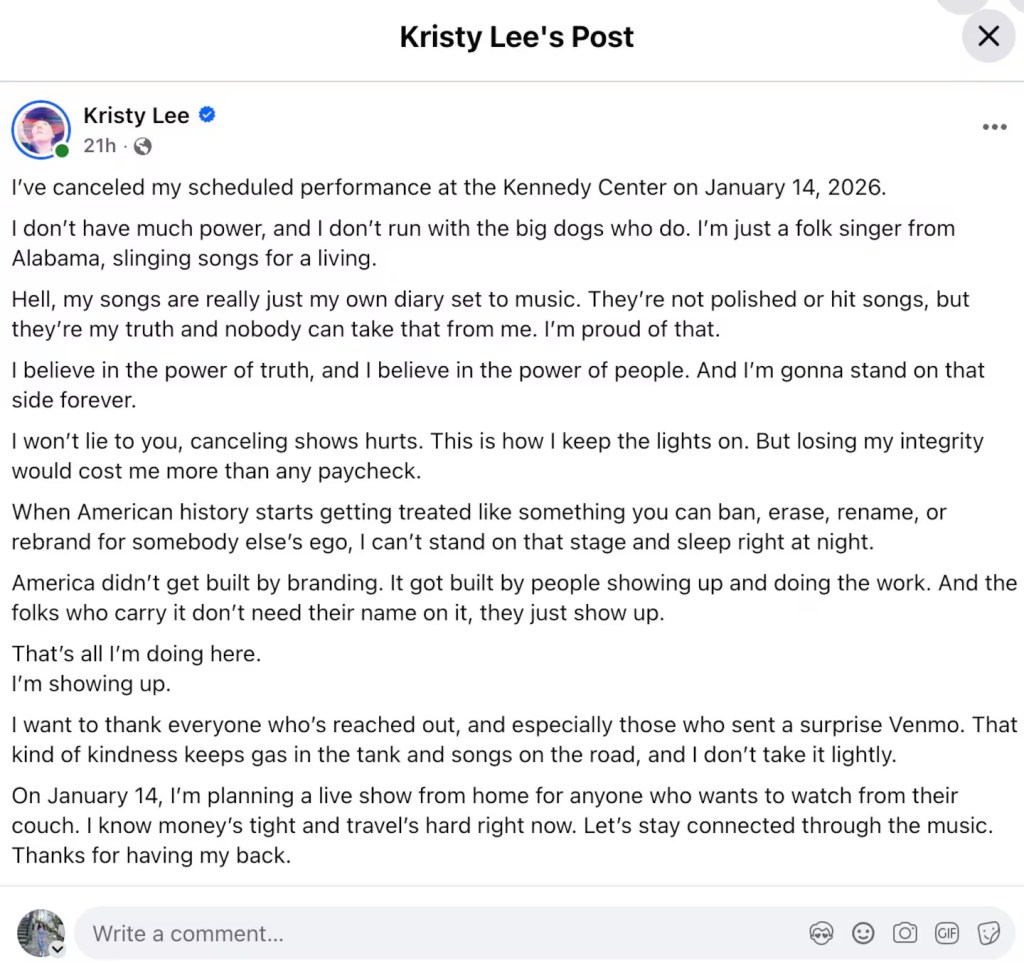
A second performer who took umbrage at the politicization of the Kennedy Center was a country singer from Mobile, Alabama, named Kristy Lee.

You may or may not have heard of her (count me among the not), but she sure nailed it.

The Daily Beast reported:

The artist who pulled out of a performance at the Kennedy Center after Donald Trump slapped his name on the storied arts institution is being lauded by fans for her decision.

Kristy Lee, a folk singer from Mobile, Alabama, told fans in a statement that she couldn’t “sleep at night” if she went through with her performance at the former John F. Kennedy Memorial Center for the Performing Arts, which was scheduled for Jan. 14.

“When American history starts getting treated like something you can ban, erase, rename, or rebrand for somebody else’s ego, I can’t stand on that stage and sleep right at night,” Lee shared with her 42,000 Facebook followers on Monday.

As of publication, the independent folk singer received nearly 300,000 likes on her Facebook post, compared to her 42,000 followers. 

Her cancellation came after the White House announced Thursday that the John F. Kennedy Memorial Center for the Performing Arts would be renamed to include Trump’s name following a vote by the venue’s board, which is now stacked with MAGA loyalists.

“I won’t lie to you, canceling shows hurts. This is how I keep the lights on,” the independent artist wrote. “But losing my integrity would cost me more than any paycheck.”

After Lee made headlines for pulling out of the show, she said she was flooded with messages of support—and even monetary donations. The singer later announced she would perform a live show from home in response to the outpouring of love.”I believe in the power of truth, and I believe in the power of people,” Lee wrote on Facebook. Chad Edwards/Courtesy of Kristy Lee/Chad Edwards 

“I want to thank everyone who’s reached out, and especially those who sent a surprise Venmo,” she wrote. “That kind of kindness keeps gas in the tank and songs on the road, and I don’t take it lightly.”

A spokesperson for Lee told The Daily Beast that the singer cited “institutional integrity” as her primary reason for canceling her performance at the venue, where ticket sales have reportedly plummeted since Trump’s takeover.

“As an artist, Kristy believes publicly funded cultural spaces must remain free from political capture, self-promotion, or ideological pressure,” the spokesperson said, adding that her decision was not directed at any patrons, staff, or artists at the Center. 

“Performing under these circumstances would conflict with the values of artistic freedom, public trust, and constitutional principles that the Kennedy Center was created to uphold.”

Trump set his sights on the Center months ago and has repeatedly suggested, both in speeches and on social media, that it be renamed the Trump-Kennedy Center. The board now includes White House Chief of Staff Susie Wiles, Attorney General Pam Bondi, second lady Usha Vance, Deputy White House Chief of Staff Dan Scavino, and Allison Lutnick, the wife of Commerce Secretary Howard Lutnick.

A source told CNN that Trump phoned into Thursday’s board meeting ahead of the vote. A day later, the president’s name was swiftly and conspicuously added to the building, which now reads: “The Donald J. Trump and The John F. Kennedy Memorial Center for the Performing Arts.”

The Daily Beast has reached out to the Kennedy Center for comment.

Redd and Lee are the latest to cancel. Ticket sales have plummeted since Trump took control of the Kennedy Center in February.

The Washington Post reported:

In the weeks after the February board changes, at least 20 productions were canceled or postponed, with names such as comedian and actor Issa Rae pulling out of planned performances at the center, and musical artist Ben Folds and opera singer Renée Fleming saying they were stepping down as artistic advisers.

www.bloomberg.com/graphics/2025-capital-flow-trump/

This is a gift article that appeared in Bloomberg News. It describes the dramatic changes that Trump has made by executive order to redirect the flow of money.

It’s unlikely that Trump wrote these orders or even understood their implications. He is surrounded by people who know precisely what they are doing: windfalls for the rich.

As has been widely reported, CBS’ “60 Minutes” announced that it would release a program about the notorious prison in El Salvador– CECOT–where the U.S. sent migrant prisoners, who were allegedly hardened criminals, “the worst of the worst.”

The program interviews released prisoners, who describe torture, beatings, and inhumane conditions that would never be permitted in U.S. prisons. It also reviewed records and concluded that few of those sent to CECOT were hardened criminals or terrorists.

Bari Weiss, the editor-in/chief of CBS News, stopped the release of the segment because no one in the Trump administration agreed to respond to it. Critics said that if that was legitimate grounds for blocking a story, the Trump administration could block all critical coverage by refusing to comment.

After CBS was sold to the Ellison billionaires, David Ellison hired Bari Weiss to be editor-in-chief and bought her website “The Free Press” for $150 million. Weiss has no experience in the broadcast industry.

Apparently the show aired in Canada, where a viewer copied it and posted it on Reddit.

Here is the link on Reddit. Decide for yourself whether Weiss was right to stop the show until someone from the Trump administration commented.

“Go to ProgressiveHQr/ProgressiveHQ13h agoCrystalVibes52

The 60 minutes interview that was not aired in the US was aired and recorded in Canada and posted on YouTube. It has since been taken down. No worries though, I screen recorded it.“

See it before it is taken down.

It was originally posted on YouTube but was taken down.

Trump filed a lawsuit against the board of the Pulitzer Prizes in 2022, demanding that it retract any prizes awarded to reporters from The New York Times and The Washington Post who covered the investigation into Trump’s relationship with Russia in his first term.

Trump refers to the episode and the FBI’s investigation as the “Russia, Russia, Russia Hoax.”

The Pulitzer board issued the following response:

A Statement from the Pulitzer Prize Board

The Pulitzer Prize Board has an established, formal process by which complaints against winning entries are carefullyreviewed. In the last three years, the Pulitzer Board has received inquiries, including from former President Donald Trump, about submissions from The New York Times and The Washington Post on Russian interference in the U.S. election and its connections to the Trump campaign–submissions that jointly won the 2018 National Reporting prize.

These inquiries prompted the Pulitzer Board to commission two independent reviews of the work submitted by those organizations to our National Reporting competition. Bothreviews were conducted by individuals with no connection to the institutions whose work was under examination, nor any connection to each other. The separate reviews converged in their conclusions: that no passages or headlines, contentions or assertions in any of the winning submissions were discredited by facts that emerged subsequent to the conferral of the prizes.

The 2018 Pulitzer Prizes in National Reporting stand.

The case has dragged on. Recently the board of the Pulitzer Prizes announced a new twist. It has asked Trump to provide full records of his medical history, his psychological tests, and his income tax returns since 2015.

Trump might rethink this particular lawsuit. Other groups sued by the litigious Trump should scrutinize the Pulitzer board’s strategy.

At the start of the second Trump administration, Trump unilaterally created a fake “Department of Government Efficiency,” led by Elon Musk. Only Congress can create or eliminate Departments. According to the Constitution, the House of Representatives is responsible for funding and defunding the federal government.

Trump ignored the Constitution and Congress and let Musk and his team ransack the Federal Government, fire thousands of civil servants, and close agencies at will. DOGE decisions were made not by experts but by Musk and his team, most of whom were young men in their 20s, even a teenagers. From their point of view, their greatest accomplishment was to copy massive amounts of personally identifiable data from the Treasury Department and the Social Security Administration.

While DOGE slashed and burned agencies and Departments with abandon, the cruelest cut of all was the near-total elimination of foreign aid. Millions of people in impoverished countries relied on U.S. AID for food, medicine, and medical care. The aid is gone. Hundreds of thousands of people died. If you say it in the active tense, Trump and Musk murdered “hundreds of thousands of people” whose lives depended on US AID. The food aid was more than a humanitarian impulse: American farmers lost at least $2 billion that was used to pay them to supply food for US AID.

Matt Johnson wrote for MS NOW:

“We spent the weekend feeding USAID into the wood chipper,” Elon Musk boasted in February, shortly after President Donald Trump gave him permission to hack his way through the federal government. As a “special government employee” with no oversight running the “temporary organization,” the Department of Government Efficiency, or DOGE, Musk destroyed the 64-year-old humanitarian agency in a matter of days, abruptly halting deliveries of lifesaving medicine, emergency food aid and many other forms of support to the poorest people on the planet. This was done in the name of DOGE’s mission to “maximize governmental efficiency and productivity.”

Musk claimed that DOGE would slash government spending by “at least $2 trillion,” but it ended up saving a microscopic fraction of that figure. Now that DOGE has been disbanded, Musk claims “We were a little bit successful” — but admits that he wouldn’t do it again. 

Musk tried his hand at government, shrugged and moved on. The same can’t be said for the people who are dead and dying thanks to the DOGE-led onslaught on the U.S. Agency for International Development. “No one has died as [a] result of a brief pause to do a sanity check on foreign aid funding,” Musk declared in March. According to models created by Boston University epidemiologist Brooke Nichols, hundreds of thousands of people have in fact died as a result of eliminated and disrupted aid. 

It’s impossible to calculate the ultimate human toll of shuttering USAID. The U.S. was responsible for 40% of the total foreign aid tracked by the United Nations in 2024, and much of the infrastructure that delivered this aid has now been destroyed. Beyond the frozen payments for active aid projects, partner organizations have closed, supply chains for medicine and food deliveries have been severed and staff who administered and monitored programs have been fired. Early warning systems for starvation and infectious diseases have shut down. 

The individual stories are harrowing. A South Sudanese child with HIV died from pneumonia because he didn’t receive the medication necessary to sustain his immune system. People participating in studies were abandonedwith experimental drugs in their systems and medical devices in their bodies. Cases of acute malnutrition at refugee camps have surged. 

In the MAGAverse, none of this is true because USAID was never an aid organization to begin with. Mike Benz, a right-wing influencer who has accused the agency of being a terror organization and subverting governments around the world, was a big influence on Musk’s assault on USAID, which Benz called the “Terror Titanic.” Like Musk before him, Benz has now been appointed as a special government employee to investigate his allegations that USAID was a massive covert influence operation and front for the CIA. 

Benz’s campaign is just the latest example of MAGA propaganda using USAID as a convenient political scapegoat. DOGE viewed the takeover of USAID as an opportunity to find instances of “viral waste,” which could be broadcast to the American people as a justification for its other cost-cutting efforts. One example cited by White House Press Secretary Karoline Leavitt was the “50 million taxpayer dollars that went out the door to fund condoms in Gaza.” Trump later declared that the money had been “sent to Gaza to buy condoms for Hamas.” 

There was just one problem: The money was actually for family planning in a province of Mozambique called Gaza….

This is not the full article. Open the link to read the rest.

David French was hired by The New York Times to be a conservative opinion writer. He is a lawyer who practiced commercial law, then joined the military during the war in Iraq and served there as a lawyer. After deployment, he was a writer for the conservative National Review.

His explanation of the “laws of war” and the “rules of engagement” was very helpful to my understanding of current events, which is why I share it now.

He wrote:

In their military campaign in South America, Donald Trump and Pete Hegseth aren’t just defying the Constitution and breaking the law. They are attacking the very character and identity of the American military.

To make this case, I have to begin in the most boring way possible — by quoting a legal manual. Bear with me.

Specifically, it’s the most recent edition of the Department of Defense Law of War Manual. Tucked away on page 1,088 are two sentences that illustrate the gravity of the crisis in the Pentagon: “The requirement to refuse to comply with orders to commit law of war violations applies to orders to perform conduct that is clearly illegal or orders that the subordinate knows, in fact, are illegal. For example, orders to fire upon the shipwrecked would be clearly illegal.”

Here’s another key line: “It is forbidden to declare that no quarter will be given.” A no quarter order is an order directing soldiers to kill every combatant, including prisoners, the sick and the wounded. The manual continues, “Moreover, it is also prohibited to conduct hostilities on the basis that there shall be no survivors, or to threaten the adversary with the denial of quarter.”

Before we go any further, it’s important to define our terms. This newsletter is going to focus on the laws of war, not a related concept called rules of engagement. The laws of war reflect the mandatory, minimum level of lawful conduct, and all soldiers are legally obligated to obey them at all times and in all conflicts.

Rules of engagement are rules devised by commanders that are often more restrictive than the laws of war. For example, when I was in Iraq, our rules of engagement sometimes kept us from attacking lawful targets, in part because we wanted to be particularly careful not to inflict civilian casualties.

In my service, we were often frustrated by the rules of engagement. We did not, however, question the laws of war.

There are now good reasons to believe that the U.S. military, under the command of President Trump and Hegseth, his secretary of defense, has blatantly violated the laws of war. On Nov. 28, The Washington Postreported that Hegseth issued a verbal order to “kill everybody” the day that the United States launched its military campaign against suspected drug traffickers.

According to The Post, the first strike on the targeted speedboat left two people alive in the water. The commander of the operation then ordered a second strike to kill the shipwrecked survivors, apparently — according to The Post — “because they could theoretically call other traffickers to retrieve them and their cargo.” If that reporting is correct, then we have clear evidence of unequivocal war crimes — a no quarter order and a strike on the incapacitated crew of a burning boat.

And if it’s true, those war crimes are the fault not of hotheaded recruits who are fighting for their lives in the terrifying fog and fury of ground combat but rather of two of the highest-ranking people in the American government, Hegseth and Adm. Frank M. Bradley, the head of Special Operations Command — the man the administration has identified as the person who gave the order for the second strike.

My colleagues in the newsroom followed on Monday with a report of their own, one that largely mirrored The Post’s reporting, though it presented more evidence of Hegseth’s and Bradley’s potential defenses. Hegseth, our sources said, did not order the second strike, and the second strike might have been designed to sink the boat, not kill survivors.

But if that’s the explanation, why wasn’t the full video released? The administration released limited video footage of the first strike, which created the impression of the instant, total destruction of the boat and its inhabitants. Now we know there was much more to see.

At the same time, Hegseth and the Pentagon have offered a series of puzzling and contradictory statements. Sean Parnell, the Pentagon spokesman, told The Post that its “entire narrative was false.”

Hegseth weighed in with a classic version of what you might call a nondenial denial. In a social media post, he said the Post report was “fabricated, inflammatory and derogatory,” but rather than explain what actually happened (and make no mistake, he knows exactly what happened), he followed up with an extraordinary paragraph:

As we’ve said from the beginning, and in every statement, these highly effective strikes are specifically intended to be “lethal, kinetic strikes.” The declared intent is to stop lethal drugs, destroy narco-boats, and kill the narco-terrorists who are poisoning the American people. Every trafficker we kill is affiliated with a Designated Terrorist Organization.

“Biden coddled terrorists,” Hegseth wrote later in the same post. “We kill them.”

We shouldn’t forget that this incident occurred against the backdrop of Hegseth’s obvious disdain for military lawyers. He has called them “jagoffs” and — along with Trump — fired the senior military lawyers in the Navy and Air Force.

We also know that the commander of Southern Command, which is responsible for operations in Central and South America, Adm. Alvin Holsey, announced that he was stepping down after holding the position for less than a year. As our newsroom reported, two sources “said that Admiral Holsey had raised concerns about the mission and the attacks on the alleged drug boats.”

He announced his departure in October, weeks after the September strike.

Unlike many wartime incidents, airstrike incidents can be rather easy to investigate. Unless an airstrike is in response to an immediate battlefield emergency, the intelligence justifying the strike and the orders authorizing it are frequently preserved in writing, and the video and audio of the strikes are typically recorded. If this Pentagon, which proudly calls itself the “most transparent” in history, were to release the full attack video and audio, it would help answer many questions.

It’s a mistake, however, to limit our focus to the legality of this specific strike — or even to the important question of the legality of the Caribbean strikes in general. We live in an era in which our nation’s first principles require constant defense.

In other words, as we dig into incidents like this one, we cannot presume that Americans are operating from a shared set of moral and constitutional values or even a basic operating knowledge of history. We will have to teach the basic elements of American character anew, to a population that is losing its grasp on our national ideals.

The laws of war aren’t woke. They’re not virtue signaling. And they’re not a sign that the West has forgotten how to fight. Instead, they provide the American military with a number of concrete benefits.

First, complying with the laws of war can provide a battlefield advantage. This year I read Antony Beevor’s classic history of the end of Nazi Germany, “The Fall of Berlin 1945.” I was struck by a fascinating reality: Hitler’s troops fought fanatically against the Soviets not simply to preserve Hitler’s rule (most knew the cause was lost) but also to slow the Red Army down, to buy more time for civilians and soldiers to escape to American, British and French lines.

In short, because of our humanity and decency, Germans surrendered when they would have fought. The contrast with the brutality of the Soviets saved American lives.

I saw this reality in Iraq. By the end of my deployment in 2008, insurgents started surrendering to us, often without a fight. In one memorable incident, a terrorist walked up to the front gate of our base and turned himself in. But had we treated our prisoners the way that prisoners were treated at Abu Ghraib, I doubt we would have seen the same response.

Men will choose death over torture and humiliation, but many of those men will choose decent treatment in prison over probable death in battle.

Second, the laws of war make war less savage and true peace possible. One of the reasons the war in the Pacific was so unrelentingly grim was that the Japanese military never made the slightest pretense of complying with the laws of war. They would shoot shipwrecked survivors. They would torture prisoners. They would fight to the death even when there was no longer any military point to resistance.

We were hardly perfect, but part of our own fury was directly related to relentless Japanese violations of the laws of war. We became convinced that the Japanese would not surrender until they faced the possibility of total destruction. And when both sides abandon any commitment to decency and humanity, then the object of war changes — from victory to annihilation.

Even if only one side upholds the law of war, it not only makes war less brutal; it preserves the possibility of peace and reconciliation. That’s exactly what happened at the end of World War II. For all of our faults, we never became like the Soviets and thus have a very different relationship with our former foes.

Finally, the laws of war help preserve a soldier’s soul. We are a nation built around the notion of human dignity. Our Declaration of Independence highlights the worth of every person. Our Bill of Rights stands as one of the world’s great statements of human dignity. It is contrary to the notion of virtuous American citizenship to dehumanize people, to brutalize and oppress them.

We are also a quite religious society, and all of the great faiths that are central to American life teach that human beings possess incalculable worth.

If we order soldiers to contradict those values, we can inflict a profound moral injury on them — a moral injury that can last a lifetime. I still think about a 2015 article in The Atlantic by Maggie Puniewska. She described soldiers haunted by the experience of the wars in Iraq and Afghanistan.

“Some of these soldiers describe experiences in which they, or someone close to them, violated their moral code,” she wrote, “hurting a civilian who turned out to be unarmed, shooting at a child wearing explosives, or losing trust in a commander who became more concerned with collecting decorative pins than protecting the safety of his troops.” Others, she said, citing a clinical psychologist who worked with service members who recently returned from deployments, “are haunted by their own inaction, traumatized by something they witnessed and failed to prevent.”

There are moral injuries that are unavoidable. I’m still haunted by decisions I made in Iraq, even though each one complied with the laws of war. Armed conflict is horrific, and your spirit rebels against the experience. But I can’t imagine the guilt of criminal conduct, of deliberately killing the people I’m supposed to protect.

In fact, when I first read the Washington Post story, I thought of the terrified pair, struggling helplessly in the water before the next missile ended their lives. But I also thought of the men or women who fired those missiles. How does their conscience speak to them now? How will it speak to them in 10 years?

I want to close with two stories — one from Iraq and one from Ukraine. There was a moment in my deployment when our forces were in hot pursuit of a known terrorist. We had caught him attempting to fire mortar rounds into an American outpost. Just when we had him in our sights, he scooped up what looked like a toddler and started running with the kid in his arms.

No one had to give the order to hold fire. There wasn’t one soldier who wanted to shoot and risk the toddler’s life. So we followed him until the combination of heat and exhaustion made him put the child down. Even then we didn’t kill him. We were able to capture him without using lethal force.

I’ll never forget that day — and the unspoken agreement that we would save that child.

Now, let’s contrast that moment of decency with the stories I heard in the town of Bucha, just northwest of Kyiv. It was the site of some of the most intense fighting in the first phases of Russia’s invasion of Ukraine. As I walked in part of the battlefield, I heard the stories of Russian soldiers looting and murdering their way across northern Ukraine.

One woman told me that the Russians shot a neighbor, a civilian, in his front yard and then threatened his wife when she tried to leave her home to retrieve his body. So he just lay there, day after day, until the Russians were finally driven back. That’s the character of the Russian military, and it’s been the character of the Russian military for generations.

Something else happened when I first read the Washington Post story; I instinctively rejected it. The account was completely at odds with my experience. There is not an officer I served with who would issue a no quarter order. There is not an officer I served with who would have given the order to kill survivors struggling in the water.

But I also knew that Hegseth is trying to transform the military. As The Wall Street Journal reported, he has been on a “decades-long quest” to rid the military of “stupid rules of engagement” — even to the point of becoming a champion of soldiers convicted of war crimes. In one of his books, he wrote that he told soldiers who served under his command in Iraq to disregard legal adviceabout the use of lethal force.

I don’t think that all of our rules of engagement are wise. I have expressed profound doubts about many of the rules that were imposed in Iraq and Afghanistan that went far beyond the requirements of the laws of war. Not every soldier accused of crimes is guilty of crimes.

But there is a difference between reforming the rules and abandoning the law — or, even worse, viewing the law as fundamentally hostile to the military mission. There is a difference between defending soldiers against false accusations and rationalizing and excusing serious crimes.

The pride of an American soldier isn’t just rooted in our lethality. It’s rooted in our sense of honor. It’s rooted in our compassion. We believe ourselves to be different because we so often behave differently.

Hegseth, however, has a different vision, one of unrestrained violence divorced from congressional and legal accountability. If that vision becomes reality, he won’t reform the military; he’ll wreck it. And he’ll wreck it in the worst way possible, by destroying its integrity, by stripping its honor and by rejecting the hard-earned lessons and vital values that have made the American military one of the most-trusted institutions in the United States.