During that time, Virginia Gov. Glenn Youngkin was the co-CEO of the firm. After 25 years with the company, Youngkin resigned in 2020 to run for office in Virginia.
The first thing Youngkin did as governor of Virginia was sign an executive order to “end the use of inherently divisive concepts, including critical race theory, and restoring excellence in K-12 public education in the commonwealth,” a measure that’s comparable to DeSantis’ “Stop WOKE Act.”
The story reviewed Accelerate’s website and learned the following:
Accelerate Learning’s website includes an undated diversity statement which says the company commits to hold more diversity training, examine current business and recruitment practices and continue to be inclusive in all levels of the company.
“Our nation’s black communities have long faced the repeated, harmful effects of systemic racism within the justice and education systems,” the statement said.
The company also matched all employee donations to the NAACP, Black Lives Matter and Equal Justice organizations.
“Accelerate Learning, Inc. is committed to supporting diversity in all its manifestations, which requires a consequent commitment to equity and inclusivity,” the statement said.
Sounds like the winner of the math textbook competition is woke and espouses critical race theory.
Yesterday, the Florida Legislature passed legislation enacting Governor DeSantis’ personal vendetta against the Disney corporation, dissolving the special district status it enjoys, where it supplies all its own services, such as security and sanitation. Disney is a huge economic boon to the state, drawing millions of tourists to Florida every year. DeSantis wanted to punish Disney for criticizing his anti-gay law. Some pundits think this will backfire because it is likely to raise taxes in the counties that will have to pay for those services.
But Greg Sergeant of the Washington Post says that DeSantis’s retaliation against Disney is very dangerous for democracy. This is the behavior of a banana republic thug. Will he next punish corporations that encourage diversity, inclusion, and equity, another of his obsessions?
He writes that DeSantis’ thuggishness is admired by other Republicans, and that’s ominous:
What’s at issue is the use of such a policy as retaliation against Disney for taking a stand on DeSantis’s law. The measure bars or restricts instruction on sexual orientation and gender orientation in a way that’s plainly designed to chill even the most routine discussion of LGBTQ topics. Disney opposes the law on the grounds that “it could be used to unfairly target” LGBTQ kids and families. And this is an absolutely understandable fear.
But here again, the law’s specifics are beside the point. You don’t have to back Disney’s stance to agree that the company should not be punished with a change in government policy for expressing its opinion of the law.
So what does this tell us about a possible GOP future? Well, on multiple fronts, the Republican Party is growing much more inclined to use state power to fight the culture wars, well beyond just DeSantis.
In an interview published this week, J.D. Vance told Vanity Fair that he envisions a kind of “de-Baathification” or a “de-woke-ification” of the “institutions of the left.”
Vance, who’s running for Senate in Ohio in the New Right nationalist vein, said that if Donald Trump is elected president, he should “fire every single midlevel bureaucrat” and “every civil servant in the administrative state,” and “replace them with our people.”
It’s worth taking this seriously. Other members of that New Right movement recently told me they envision a ramped-up use of the state to impose a post-liberal moral order, justified by hyperbolic visions of the supposedly hegemonic power of the left over our institutions.
Meanwhile, GOP elected officials seem to be moving this way. Congressional Republicans have vowed retaliation against companies for opposing Georgia’s voter suppression bill and for cooperating with the congressional investigation into Trump’s coup attempt.
And DeSantis is a front-runner for the 2024 GOP presidential nomination. Importantly, he’s flaunting his willingness to use state power this way as a selling point for the presidency.
So let’s run a thought experiment. What might it look like if a President DeSantis took this view of the administrative state and decided to wield his power this way?
Donald Moynihan, an expert on the administrative state at Georgetown, says you can envision various scenarios. Such a president, he said, might use regulatory agencies staffed with right-thinking political employees (which Vance explicitly wants) to harass or investigate companies perceived as “culturally disloyal.”
Another possibility, Moynihan said, might be to change the tax status of liberal-leaning foundations. Those are already another favorite target of right-wing populists.
Faced with a president “who’s fully willing to use the powers of the administrative state,” Moynihan told me, such foundations might refrain from advocating for various causes or fund certain types of research, “because it’s not worth the potential risks.”
What if such a president were backed in this project by congressional leadership? Josh Chafetz, a Georgetown law professor who studies Congress, says you could see legislation targeted at offending companies, and even if it didn’t survive the courts, it could still function in a punitive way.
Those companies would sink large sums of money into litigating against such measures, even as Congress relied on taxpayer-funded lawyers on their side, Chafetz told me, meaning “the onus of the expense would fall on the companies, which would have a chilling effect.”
So a lot is at stake in how DeSantis’s war with Disney turns out. To glimpse the future, just look at what DeSantis is saying and doing right now. And given all the accolades he’s getting from the right, does anyone doubt that this could get a whole lot worse?
Allie Pitchon of The Miami Herald reported that state officials told some publishers of math textbooks why the state would not buy their books. The initial announcement said that some math books were too “woke,” contained “critical race theory,” or included concepts from Common Core, which Governor Ron DeSantis turned against because former President Obama endorsed it. Former Florida Governor Jeb Bush, the conservative education guru, also championed Common Core, but that did not mollify DeSantis’s rejection of it.
Publishers were left in the dark about why their math books offended DeSantis, and yesterday the state provided some details. The state informed publishers what had to make changed to get on the state approved list and gave them two weeks to resubmit.
The state posted a few examples on its website.
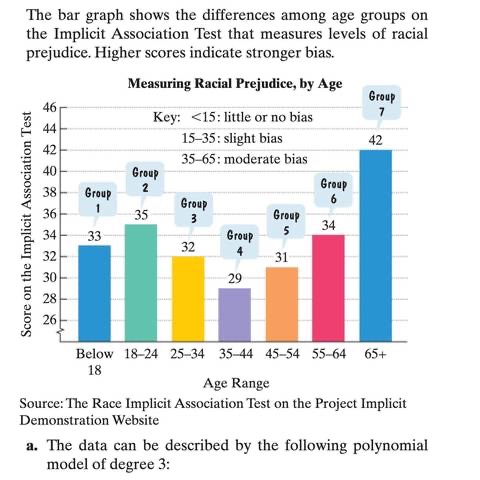
One example: A colored bar chart showing how levels of racial bias can vary by age group. It is part of a mathematical brain teaser involving polynomial models and is nestled on the bottom right-hand corner of page 56 in a pre-calculus online textbook consisting of more than 1,000 pages. The book is not identified on the state’s website…
Two other examples that originated with public complaints make reference to Social Emotional Learning (SEL), a methodology wherein students try to get in touch with their emotions and demonstrate empathy for others.
Here is the woke bar graph:
Publishers were well aware, the Department of Education said, that their books would be rejected if they had even a trace of “critical race theory” or “social-emotional learning” or Common Core.
The press release provided a withering quote from Gov. Ron DeSantis: “It seems some publishers attempted to slap a coat of paint on an old house built on the foundation of Common Core, and indoctrinating concepts like race essentialism, especially, bizarrely, for elementary school students.”
Education Secretary Richard Corcoran chimed in, stating Florida was “focusing on providing … children with a world-class education without the fear of indoctrination or exposure to dangerous and divisive concepts in our classrooms.”
In a tweet, Christina Pushaw, the governor’s press secretary, went further, while addressing those who take issue with “book banning”: “The state declining to purchase certain textbooks isn’t banning them. If you want to teach your kid Woke Math, where “2+2=4” is white supremacy, you’re free to buy any CRT math textbook you want. You just cannot force Florida taxpayers to subsidize this indoctrination.” She’s right that local school districts can allocate at least part of their book buying budget toward textbooks not on the state’s approved list.
The American Federation of Teachers released the following statement about the U.S. Department of Education’s proposals to reform the federal Charter Schools Program, which grants $440 million annually to open or expand charter schools. Authorized in 1994, when there were a small number of charter schools, the CSP has never been reformed in its nearly three decade history. The industry captured the program and glossed over widespread waste, fraud, and abuse in federally-funded charter schools.
The AFT wrote:
For Immediate Release Wednesday, April 20
Contact: Andrew Crook 607/280-6603 acrook@aft.org AFT Responds to Department of Education on Charter School Regulations
WASHINGTON—American Federation of Teachers President Randi Weingarten sent the following letter to the U.S. Department of Education responding to proposed regulations on Charter Schools Program grants.
The text of the letter follows, and it can be read online with additional footnoting and formatting here.
~April 11, 2022
Ms. Porscheoy Brice
U.S. Department of Education
400 Maryland Avenue SW
Washington, DC 20202-5970
Dear Ms. Brice,
The American Federation of Teachers welcomes the opportunity to comment on the U.S. Department of Education’s proposed regulations to the Charter Schools Program grant programs. These proposed regulations represent a positive development for America’s children, and if fully implemented, these improvements to the Charter Schools Program grant applications will not only advance equity, but also move to restore charter schools to their original purpose by integrating them into the broader education community.
We applaud the department’s proposed regulations, which seek to improve community integration of charter schools. We also applaud the department for taking steps to prevent for-profit charter schools—which studies have shown underperform, compared with both public schools and their nonprofit counterparts—from receiving charter school grants. These steps will undoubtedly improve educational outcomes for children in both charter and traditional public schools. As a union of 1.7 million educators, healthcare workers and public service workers, including educators at more than 250 charter schools, we appreciate that the department is seeking to increase collaboration between charters schools and traditional public schools
The AFT strongly supports the department’s collaboration priority:
We appreciate that the department is recognizing the need for collaboration between charter schools and district schools. Charter schools were originally intended to be vehicles for experimentation and collaboration, not walled gardens within our education system, and these proposed regulations reflect that the charter industry has strayed from that original intent. As a union of education professionals, we have concerns over the pervasiveness of noncompete and nondisclosure agreement practices in charter schools and the chilling effect that such agreements are already having on charter-district collaboration.
We recommend that the Charter Schools Program grant applications be modified to have applicants certify that they will void all such noncompete/nondisclosure provisions, if they exist, during the life of the grant.
Noncompete clauses, which prevent charter teachers from taking jobs in traditional public schools for a set period of time (or within a geographic region proximate to the charter school), are obvious barriers to the department’s proposed priority of fostering district-charter collaboration. For example, according to Donald Cohen and Allen Mikaelian’s recently released book The Privatization of Everything, Summit Academy Schools of Ohio sued 50 teachers in three years for violating noncompete clauses.
There have been repeated suggestions that, beyond chilling collaboration, nondisclosure agreements prevented charter school teachers from blowing the whistle on fraud and malfeasance occurring at their schools.
We would ask that, in support of this priority, the CSP grant application be modified to include a certification by applicants that they either 1) do not utilize nondisclosure agreements and/or noncompete agreements at their schools, or 2) will void all such agreements for the life of the grant.
Collaboration between district schools and charter schools would be enhanced by putting district schools and charters on the same footing with respect to enrollment requirements:
Practices at certain charter schools have the effect of filtering out some subpopulations of students, leading to the concentration of higher-needs students in district schools. This behavior includes the counseling out of special education students; the use of entrance barriers that disincentivize enrollments of English language learners, low-income students and students with disabilities; and a reluctance to backfill when students leave the charter school. Charter schools that create enrollment barriers for ELLs, students with disabilities and low-income students are often already doing so in violation of federal law, but other disparate policies are not currently unlawful. The interests of district-charter collaboration would be furthered by asking applicants to disclose whether they engage in discriminatory enrollment practices.
Practices that exclude certain students from charter schools create divisions between district and charter teachers and administrators. In our experience, the prevalence of these practices varies significantly across the country and is unfortunately common in some states. The ACLU examined charter school enrollment barriers statewide in both Arizona and California, finding that more than 20 percent of California charter schools and 50 percent of surveyed Arizona charter schools utilized exclusionary enrollment practices.
These practices included denying applicants on the basis of prior academic performance, requiring application fees, capping special education enrollments, discouraging immigrant applicants and requiring parent volunteer hours.
While many exclusionary charter application practices amount to violations of the letter or spirit of the law (or both), charter schools are permitted under federal law to decline to backfill student vacancies created as a result of a student withdrawal or expulsion. When charter schools refuse to backfill vacancies, it both compounds existing student population disparities between district and charter schools and creates new ones. Student mobility is associated with lower student performance, so limiting midyear entrants gives charter schools an advantage that comes at the expense of the district schools that are required to accept all enrollments.
To preserve the department’s proposed priority of fostering district-charter collaboration, we suggest amending the proposed regulations to request that charter school applicants disclose information about their application, selection, turnover and backfilling practices. Specifically, applicants should certify that application materials are available in all languages spoken in the community; that they do not cap the number of students with a disability (or the type of students with a disability they accept); and that they do not charge a fee for applicants. If applicants currently operate charter schools, they should disclose annual student turnover figures for the past five years. The regulations should also be modified so that charter school applicants disclose whether they use admissions tests, consider past academic or behavioral issues during admissions, and backfill vacancies either midyear or between school years, and they should require applicants to disclose how they have recruited students from diverse populations across their catchment areas.
Unions can help facilitate a collaborative school atmosphere, and regulations should be modified to reward applicants who pledge to support their workers’ right to organize:
Collaboration between district school and charter school teachers would be easier if both groups were on the same professional footing. Unfortunately charter school teachers are often underpaid, and turnover in the industry is alarmingly high. Some charter schools operate with teaching staffs that are largely uncredentialed. Many operators in the charter school industry seem to have abandoned any attempt at employee retention, choosing instead to focus on building recruitment “pipelines” to solve the rapid turnover of their teaching force. The department’s laudable goal of fostering collaboration between district and charter schools will be difficult in high-turnover conditions and where significant disparities exist between district school and charter school staff.
We have seen, however, how beneficial it can be when charter and district teachers belong to the same union. In Chicago, several charter schools in the city are organized with the Chicago Teachers Union, with charter and district teachers belonging to the same union. The Chicago Teachers Union QUEST Center brings together both charter and district teachers for professional development courses. Unions can be the space where collaboration across district schools and charter schools can occur—but when charter teachers want to organize a union, their school management often stands in the way. In furtherance of the department’s stated goal of district-charter collaboration, as envisioned within these proposed regulations, we submit that the proposed regulations should be modified to reward schools that pledge not to interfere with teachers who wish to exercise their rights to organize and bargain collectively.
The AFT respectfully requests that language be inserted into the grant application to allow applicants to make a good-faith certification that they will remain neutral in any union organizing effort for the term of the grant award.
We applaud the department on the introduction of a community impact analysis and recommend a few minor improvements:
The AFT supports provisions that would have applicants analyze the impact of charter expansion on the schools that the applicant is, or would be, drawing students from. The focus on preventing charter school expansion from undermining district desegregation efforts is a welcome metric, and we are pleased to see it included in the impact analysis. We would suggest that the regulations be expanded to include an analysis on the fiscal impact of proposed charter growth.
Charter school growth is universally understood to negatively affect the financial condition of the sending districts. Credit ratings agencies and academia have reached a consensus on this point. The ratings agency Moody’s has opined that charter school growth can drag down the finances of their host districts, writing that “charter schools can pull students and revenues away from districts faster than the districts can reduce their costs.” Districts, being unable to reduce costs as quickly as they lose funding for charter schools, are left with diminished resources for students in their public schools. That finding has been bolstered by academic research, which has endeavored to estimate the net fiscal impact of charter school growth on district finances.
While charter school proponents have suggested that charter competition will improve district resources, academic and credit rating agency opinion has coalesced around the opposite conclusion.
Moody’s has said that “A city that begins to lose students to a charter school can be forced to weaken educational programs because funding is tighter, which then begins to encourage more students to leave which then results in additional losses.’’ University of Michigan researcher David Arsen has conducted research in Michigan that supports this conclusion, noting that “contrary to expectations, Michigan school districts respond to charter competition by devoting a smaller share of their spending to instructional services.”6 Faced with decreased revenues, which “decline more rapidly than costs in districts losing students to charter schools,” school districts are simply unable to free up the resources needed to improve education for the students remaining in traditional public schools.
For far too long, the Charter Schools Programs grant programs have ignored the economic reality of charter school growth and its impact on the resources available to traditional public school students. When charter schools expand, traditional public school students are left with fewer resources. We urge the department to amend its community impact analysis guidelines to ask applicants whether a credit rating agency has identified charter school growth as a credit negative for the sending district(s) from which the proposed (or current) school intends to draw its students.
We appreciate the proposed regulations’ increased attention to the problems of the for-profit charter school industry: The proposed regulations’ focus on tightening disclosure regulations around education management organization contracts is well-warranted and consistent with ensuring that CSP funds are allocated to high-performing charter schools. The for-profit charter school industry is disgraceful, and charter operators should not be able to evade the eligibility requirements of the Charter Schools Program by utilizing complex organizational structures and service contracts.
Research shows that for-profit virtual charter schools—which comprise a significant portion of all for-profit schools—are poorly serving America’s students. Additionally, a recent National Education Policy Center study found that for-profit virtual charter schools underperform compared with their nonprofit and publicly run counterparts, suggesting that profit-seeking itself undermines educational success.
We appreciate the department’s proposed regulations:
We thank the Department of Education for these proposed regulations, which will significantly improve outcomes for students in both charter and traditional public schools. While this comment contains some minor suggestions we feel would make these proposed regulations more robust, the substance and spirit of the proposed regulations are a welcome indication that the department is serious about unifying a fractured education system and improving educational outcomes for all children, regardless of the type of public school they attend.
Sincerely,
Randi Weingarten
President, American Federation of Teachers
######
The American Federation of Teachers is a union of 1.7 million professionals that champions fairness; democracy; economic opportunity; and high-quality public education, healthcare and public services for our students, their families and our communities. We are committed to advancing these principles through community engagement, organizing, collective bargaining and political activism, and especially through the work our members do.
Randi Weingarten Fedrick C. Ingram Evelyn DeJesus PRESIDENT SECRETARY-TREASURER EXECUTIVE VICE PRESIDENT
American Federation of Teachers, AFL-CIO Communications Department • 555 New Jersey Ave. N.W. • Washington, DC 20001 • T: 202-879-4458 • F: 202-879-4580 • www.aft.org
This third issue, state responsibility, starts with the acknowledgement that the pursuit of market-based approaches in the United States has exacerbated inequity and segregation in many contexts. A different course for public education provision could include investing in full-service community schools. According to J4J Alliance, these schools would have engaging, culturally relevant and challenging curriculum, educator roles in professional development and assessment design and use, and wrap around supports such as health and other care for students needing those services. Overall, the U.S. case provides an important and instructive example that other countries should examine before scaling up similar education approaches.
This brings us to a final international point about policy, politics, and influence. While the GEM Report does call attention to the myriad actors and political acrimony that divides opinion on the role of markets and governments in education, the report does not go far enough in naming the power asymmetries in terms of finance and access of different constituencies (e.g., technology companies and venture capital funds having orders of magnitude more resources and policy influence than civil society). To that end, I would add a third question to the report – Who chooses? Who loses? And who benefits? – to interrogate how non-state actors derive profit from the education sector and to help us remember that students should remain the recipients of our education expenditures and resources.
State Senator Mallory McMorrow gave a speech of four minutes to her colleagues in the Michigan Legislature. A Republican State Senator accused Senator McMorrow of wanting to “groom” and “sexualize” kindergartners, a charge right out of the QAnon cuckoo playbook.
Senator McMorrow replied with a powerful speech that has gone viral. Watch it.
Kris Nordstrom of the NC Policy Watch notes the loud whining by charter advocates who are outraged by the common sense reforms proposed b6 the Biden administration’s Department of Education. They are whining, writes Nordstrom, because they are guilty of every malpractice that the reforms aim to cure.
Nordstrom begins:
Advocates for charter schools have long justified the existence of charters by claiming they serve as laboratories of innovation for traditional schools. They have claimed that operational flexibility and exemption from regulation allows them to operate more efficiently than traditional public schools. And they have claimed that they are not only willing – but better suited – to serve students from families with low incomes.
These premises have been disproven over the course of North Carolina’s nearly 30-year-long experiment with charter schools. There are no examples of charter school innovations that have offered new approaches for traditional schools (after all, traditional schools can’t follow the example of “successful” charters that garner high test scores by pushing out struggling students). Nor have charters delivered efficiency gains. Charters spend substantially more on administration than their traditional school counterparts. Most North Carolina charters outspend their neighboring traditional schools while serving a more advantaged student population and delivering weaker academic outcomes. Meanwhile, North Carolina charters continue to exacerbate racial segregation and raise costs for traditional inclusive public schools.
Charter advocates have long disputed the overwhelming evidence of their ineffectiveness. But now, they are making the case themselves.
At issue are recent changes to the terms of the federal Charter School Program (CSP) grant programs. The CSP provides money to states to run grant programs, “to open and prepare for the operation of new charter schools and to replicate and expand high-quality charter schools.” North Carolina was awarded these federal grant funds specifically to support charters, “focused on meeting the needs of educationally disadvantaged students.”
Unfortunately, the program run by North Carolina’s Department of Public Instruction has failed to meet these goals. Much of the federal funding has been awarded to schools with a history of serving as white flight charter schools and that enroll substantially fewer students from families with low incomes than nearby inclusive public schools. Incredibly, Torchlight Academy was awarded a $500,000 grant in 2020. Just two years later, this school has had its charter revoked for rampant corruption and poor student results…
Are high-quality charters unwilling to operate if they can no longer divert as much money as possible into the pockets of corporations? Are charters unwilling to serve as laboratories for innovation that work with traditional public schools to expand promising practices? Are charters unable to craft community impact statements because they are unable to demonstrate community benefits? Are they unwilling to commit to greater school integration efforts because they’d rather effectively pick and choose who their students are?
By opposing the CSP rule changes, charter supporters are implicitly answering the above questions in the affirmative. Their protests affirm the arguments made by charter critics that such schools are overly focused on profit-hoarding, unable to serve as collaborative partners in developing and scaling instructional innovation, exacerbate budget challenges, and contribute to segregation.
The proposed CSP rule changes do not in any way undermine charter schools. They simply ask charters seeking supplemental federal funds to try to live up to the promises made by charter advocates. The protests of charter advocates indicate that – as many of us have been arguing for years – charter schools are largely unable to live up to these promises.
And if charters are – as they now admit – unable to meet these promises, then policymakers should question not just whether they deserve supplemental federal funding through the CSP…but whether such schools are deserving of public funding at all.
Jane Mayer is a brilliant and meticulous journalist for The New Yorker. She is the nation’s leading expert on “Dark Money,” the money funneled into politics whose donors are anonymous. In this article, she details the group that was behind the effort to derail the Supreme Court nomination of the highly-qualified Judge Ketanji Brown Jackson. The smear campaign was ultimately unsuccessful, because it was built on lies and distortions, and the attacks foundered in the face of Judge Jackson’s poise, demeanor, and temperament.
Formed in 2020, the group is called The American Accountability Foundation. It is registered as a tax-exempt charitable organization (like the odious ALEC), but is up-to-its-eyeballs in negative political activism. Its goal appears to be to block all Biden nominees with smear campaigns, lies, and distortions of their record and their views.
She writes:
While the hearings were taking place, the A.A.F. publicly took credit for uncovering a note in the Harvard Law Review in which, they claimed, Jackson had “argued that America’s judicial system is too hard on sexual offenders.” The group also tweeted that she had a “soft-on-sex-offender” record during her eight years as a judge on the United States District Court for the District of Columbia. As the Washington Post and other outlets stated, Jackson’s sentencing history on such cases was well within the judicial mainstream, and in line with a half-dozen judges appointed by the Trump Administration. When Jackson defended herself on this point during the hearings, the A.A.F. said, on Twitter, that she was “lying.” The group’s allegation—reminiscent of the QAnon conspiracy, which claims that liberal élites are abusing and trafficking children—rippled through conservative circles. Tucker Carlson repeated the accusation on his Fox News program while a chyron declared “jackson lenient in child sex cases.” Marjorie Taylor Greene, the extremist representative from Georgia, called Jackson “pro-pedophile.”
Their attack on Judge Jackson failed, but Mayer shows that they have slimed other well-qualified nominees, leaving key positions unfilled. she calls AAF “the slime machine.”
Among the nominees the group boasts of having successfully derailed are Saule Omarova, a nominee for Comptroller of the Currency, and Sarah Bloom Raskin, whom Biden named to be the vice-chair for supervision of the Federal Reserve Board. David Chipman, whom the President wanted to run the Bureau of Alcohol, Tobacco, Firearms and Explosives, and David Weil, Biden’s choice for the Wage and Hour Division of the Department of Labor, both saw their nominations founder in the wake of A.A.F. attacks. Currently, the group is waging a negative campaign against Lisa Cook, who, if confirmed, would become the first Black woman to serve on the Federal Reserve’s Board of Governors.
Tom Jones, the A.A.F.’s founder and executive director, is a longtime Beltway operative specializing in opposition research. Records show that over the years he has worked for several of the most conservative Republicans to have served in the Senate, including Ron Johnson, of Wisconsin; Ted Cruz, of Texas; Jim DeMint, of South Carolina; and John Ensign, of Nevada, for whom Jones was briefly a legislative director. In 2016, Jones ran the opposition-research effort for Cruz’s failed Presidential campaign. When I asked Jones for an interview, through the A.A.F.’s online portal, he replied, “Ms. Meyers . . . Go pound sand.” Citing an article that I had written debunking attacks on Bloom Raskin from moneyed interests, including the A.A.F., he said, “You are a liberal hack masquerading as an investigative journalist—and not a very good one.” Jones subsequently posted this comment on his group’s Twitter account, along with my e-mail address and cell-phone number…
Mayer describes vicious A.A.F. campaigns against Biden nominees, most of whom were women or people of color. one such was the sliming of Lisa Cook.
Mayer writes:
Liberal and conservative political groups habitually scrutinize a prominent nominee’s record or personal life in search of disqualifying faults. But the A.A.F. has taken the practice to extremes, repeatedly spinning negligible tidbits or dubious hearsay into damning narratives. The group recently deployed its unorthodox methods, Politico has reported, while “desperately pursuing dirt” on Lisa Cook, the nominee for the Federal Reserve. Cook, who has been a tenured professor of economics and international relations at Michigan State University since 2013, has attracted bipartisan support. Glenn Hubbard, the chair of the Council of Economic Advisers during the George W. Bush Administration, has said, “Cook’s talents as an economic researcher and teacher make her a good nominee for the Fed, adding to diversity of perspectives about policy.” In college, Cook won a Marshall Scholarship. She subsequently obtained a Ph.D. in economics from the University of California, Berkeley, taught at Harvard’s Kennedy School of Government, and served as a staff economist on President Barack Obama’s Council of Economic Advisers. She also held appointments at the National Bureau of Economic Research and at various regional Federal Reserve banks. The A.A.F., though, has portrayed her as unqualified, and suggested that her tenure at Michigan State is undeserved.
On April 13th, Jones sent out the latest of at least three e-mail blasts from the A.A.F. to about fifty of Cook’s colleagues at Michigan State. In the most recent of these messages, which were obtained by The New Yorker, Jones said that Cook “did not warrant” tenure. Through a Freedom of Information Act request, the A.A.F. obtained records showing that the school’s provost had granted Cook full professorship in 2020, overruling a decision not to give her that title the previous year. Jones sent these personnel records to dozens of Cook’s colleagues, and asked, “Are any of you concerned that . . . she’s not good enough to sit on the Federal Reserve Board?” He urged any detractors to “not hesitate to” contact him. Meanwhile, Jones fished for further information by posting a message on an anonymous online gossip forum, Economics Job Market Rumors, which has been decried by one prominent economist as “a cesspool of misogyny.”
Some of the A.A.F.’s attacks on Cook carried racial overtones. Cook had made donations to bail funds for impoverished criminal defendants, including racial-justice protesters who had been arrested; she was following a tradition of activist lawyers in her family, and considered it a form of charity. The A.A.F. argued on Twitter that she had made “racist comments” and “even bailed out rioters who burned down American cities.” Cook’s reputation was sullied enough that the Senate Banking Committee vote on her nomination resulted in a tie, with no Republicans supporting her. Cook’s nomination can still proceed to the Senate floor, but her confirmation remains in limbo, as one conservative news outlet after another repeats the A.A.F.’s talking points. A writer for the Daily Caller, Chris Brunet, said in a Substack column that Cook is a “random economist at Michigan State University who has shamelessly leveraged her skin color and genitalia into gaining the backing of several key White House officials.” Brunet tweeted proudly that his critique had been promoted on Fox News by Tucker Carlson.
Cook’s nomination might yet go forward, but other targets with exemplary records, have been rejected because of A.A.F. slime campaigns.
Dark Money is a blight on our democracy. This particular group is using its resources to derail the agenda of the Biden administration. It is yet another strategy to undermine our democracy by preventing the duly elected President from staffing his administration with fully qualified appointees of his choice.
The rejected books make up a record 41% of the 132 books submitted for review, the Florida Department of Education said in a statement.
Of them, 28 were rejected because they “incorporate prohibited topics or unsolicited strategies, including [critical race theory],” the statement said.
Critical race theory has been described by scholars as an examination of racism and its impact through systems, such as legal, housing and education. However, it is typically not taught in K-12.
Twelve books were rejected because they did not meet Florida’s benchmark standards, while 14 books were rejected because they both included prohibited topics and failed to meet curriculum standards.
The names of the rejected books were not included.
Since the names of the rejected books were not revealed, no one can judge how dreadful or how innocuous the content is.
Among grade levels, 70% of the math materials for kindergarten through fifth grades were rejected. Twenty percent of the materials for grades 6-8 were rejected, and 35% of materials for grades 9-12 were rejected.
The subject of vouchers—public money for religious and private schools—has been proposed in every legislative session since 1995. Vouchers have gone down to defeat every time.
Dr. Charles Luke of Pastors for Texas Children wonders whether the voucher lobby—led by Lt. Gov. Dan Patrick—wants another showdown. How many times do you have to fail before you get the message?
On top of vouchers consistently failing in the Texas Legislature, three other states have recently voted against vouchers. Oklahoma, Georgia, and Utah recently rejected private school vouchers aimed at providing state dollars to private schools.
In Oklahoma, a voucher bill that would have provided $128.5 million taxpayer dollars for private schools failed in the Senate by a narrow margin in March of this year. Senate Bill 1647, called the Oklahoma Empowerment Act, was defeated by a 24-22 vote against the bill. The bill, authored by Senate Pro Tem Greg Treat was also supported by Governor Kevin Stitt who pledged to sign the bill if it passed. Had the bill passed the Senate, it likely would have failed in the House as Speaker Charles McCall had said he would not give the bill a hearing.
Opponents of the bill cited multiple problems. Rev. Clark Frailey, the Lead Pastor of Coffee Creek Church in Edmond and the Executive Director of Pastors for Oklahoma Kids said, “In Oklahoma, there are many reasons to oppose private school vouchers that are funded by taking resources away from public schools. There are religious liberty problems, constitutional issues, and practical implications for parents. In this session, it was made quite clear by parents in rural, urban, and suburban Oklahoma communities that they want well-resourced schools in their own communities. They are not interested in being forced to transit hours a day just to have access to good schools.”
Likewise, Georgia Senators refused to pass a voucher bill supported by their Senate Pro Tem, Butch Miller. Senate Bill 601, which would have given private schools up to $6,000 per student, failed by a vote of 29-20. While supporters of the bill argued that it would give some parents more educational options, opponents pointed out that the voucher would likely be used by wealthier parents that are able to supplement tuition from their disposable income. “If you were really going to try to allow lower income families to exercise school choice, this bill would be means-tested,” said Sen. Elena Parent, an Atlanta Democrat. “Instead, it’s going to be used a lot more by individuals who already have the means.”
In February, Utah lawmakers overwhelmingly rejected a $36 million voucher bill which would have provided leveled funding for private schools based on the parents’ income. House Bill 331 was struck down by a vote of 22-53. Critics noted that, even at the highest funding level, the amount of the voucher would not have covered private school tuition for many schools in Utah. Others questioned the accountability of private schools’ use of public taxpayer dollars, pointing out that private schools are not held to the same transparency standards as public schools. “I don’t see strong accountability measures here,” said Rep. Joel Briscoe of Salt Lake City. “There’s very minimal accountability measures here and then with an opportunity to opt out.”
All the issues cited in these cases have been raised in Texas for nearly 30 years since vouchers were first proposed in the Texas Legislature.
Vouchers do not typically provide enough money to cover private school tuition, so they are often used by parents wealthy enough to send their children to private schools already. They normally do not cover transportation costs so poor parents who are often working more than one job may not be able to get their kids to a private school, even if they could afford to supplement the voucher. Many private schools are religious in nature. Should taxpayer funds be used to provide a religious education in violation of the Establishment Clause of the First Amendment?
Finally, vouchers are a redistribution of taxpayer funds to private citizens that divert funds from the common good of public education. Is it even right or just that such a thing occurs?
While some state leaders and voucher proponents claim that Texas citizens want vouchers, a recent poll has shown that parents overwhelmingly approve of Texas public schools and that 80% of them would keep their kids in their current school even if other options were available.