Archives for the month of: July, 2024

Jennifer Rubin of The Washington Post described Donald Trump and JD Vance as a ticket whose common bond is misogyny. They have done a first-rate job of portraying their disdain for the rights of women. Apparently, they think the role of women is to be barefoot and pregnant or in Trump’s case, willing and grateful recipients of his sexual escapades. In a recent interview on MSNBC, Governor Tim Walz of Minnesota referred to Vance as “President of the He-Man Woman-Haters Club,” a reference to a 1994 comical film called The Little Rascals, where a group of pre-adolescent boys swear their eternal enmity towards women.

Rubin wrote

If you wanted to design a presidential ticket most likely to offend women voters, you would pick as the presidential nominee an adjudicated rapist, someone caught bragging about sexually assaulting women and who comes with a history of demeaning and insulting women. You would make it someone who mused about punishing women for having an abortion and who boasts about taking away women’s bodily integrity.

Then, for vice president, you would find someone who has implied women should stay in abusive relationships (he denies that’s what he meant but listen for yourself), wants to ban abortion even in cases of rape and incest, favors a “federal response” to prevent women from traveling to states where abortion is legal, accuses single women (“childless cat ladies”) of lacking a stake in America’s future, votes against protection for in vitro fertilization and wants higher taxes for childless people. (He later said he had not meant to offend cats.)

Well, that’s the MAGA Republican Party ticket of convicted felon and former president Donald Trump and his running mate, Sen. JD Vance of Ohio. Trump, having normalized overtly racist speech and demonization of immigrants during his campaigns and presidency, now seems bent on making misogyny acceptable, as well.

Indeed, the MAGA movement’s anti-woman outlook relies on a whole pseudo-academic underpinning to justify relegating women to the home as baby-making machines. “Vance, along with his New Right fellow-travelers, is about to introduce voters to a more conceptual take on sexism — one which many women, and indeed many men, might find even more alarming,” Laura K. Field wrote last week for Politico. Field detailed the right-wing groups that have concocted a philosophical framework to propound “a deep skepticism about modern feminism and gender equality”; its aim is “to roll back much of feminism’s gains.”

Their declaration for a “revival of faith, family, and fertility” comes straight from the fascism playbook, which historically has sought to domesticate women and put them under the thumb of their fathers and husbands. “Control over female bodies in the name of population growth is a throughline of authoritarianism, as are persecutions of LGBTQ+ individuals,” writes historian Ruth Ben-Ghiat. “In Europe and America, the century-long focus of the far right on demographic emergencies supposedly created by declines of White births and upticks in non-White immigration have created support for controls on female bodies.” She continues: “These controls are predicated on negating the personhood of women and consigning them to roles as vessels of population growth.”

From the “great replacement theory” to abortion bans, the Make America Great Again movement echoes past demographic freakouts and accompanying efforts to dominate women. As Ben-Ghiat puts it, the MAGA crew, like its intellectual ancestors, insists that for “White Christian civilization to continue, women must be deprived of reproductive rights and demeaned, disciplined, and criminalized if they resist.”

But you don’t have to rely on historians. Project 2025, which Vance has championed and many close Trump advisers put together, explicitly commits to restore the centrality of a male-headed, heterosexual family with children. (“Families composed of a married mother, father, and their children are the foundation of a well-ordered nation and healthy society.”) Running through every policy recommendation, the plan gives preference to the “traditional family,” (often called “healthy family”), deeming all other family units as “unnatural.”

Please open the link to finish reading the column.

How smart is it for two men to run for the Presidency and Vice-Presidency by promising to reduce the rights of women and restore them to their traditional role as baby-makers? Some women may like their ideas but most won’t, including a significant number of Republican and independent women. Women are half the population. Women vote.

Ever since the general public began hearing Project 2025, the document scared those who listened. Although it was described by its authors as the agenda for Trump’s second term and it was written by veterans of the Trump administration, Trump pretended he knew nothing about it. Who wrote it? What does it say? Never heard of it.

For sure, very few people have read its 900+ pages. I read the section on education. Eliminate the Department of Education. Voucherize programs like Title 1, Headstart, special education funding, with no federal regulations attached to the money. Promote funding for religious and private schools. Ditch separation of church and state.

It also calls for a national ban on abortion and for eliminating the Civil Service and replacing career government employees with people loyal to Trump. It is the document that describes—department by department, agency by agency—how to destroy “the administrative state.”

There’s a saying that comes to mind: “When an authoritarian tells you what he plans to do, believe him.”

Heather Cox Richardson wrote about Trump’s clumsy efforts to distance himself from an agenda written by senior officials in his administration:

On Friday, speaking to Christians at the Turning Point Action Believers’ Summit in West Palm Beach, Florida, Trump begged the members of the audience to “vote. Just this time. You won’t have to do it anymore. Four more years, you know what: it’ll be fixed, it’ll be fine…. In four years, you don’t have to vote again, we’ll have it fixed so good you’re not going to have to vote.”

The comment drew a lot of attention, and on Monday, Fox News Channel personality Laura Ingraham gave him a chance to walk the statement back. Instead, he said: “I said, vote for me, you’re not going to have to do it ever again. It’s true.” “Don’t worry about the future. You have to vote on November 5. After that, you don’t have to worry about voting anymore. I don’t care, because we’re going to fix it. The country will be fixed and we won’t even need your vote anymore, because frankly we will have such love, if you don’t want to vote anymore, that’s OK.”

Trump’s refusal to disavow the idea that putting him back into power will mean the end of a need for elections is chilling and must be viewed against the backdrop of the Supreme Court’s July 1, 2024, decision in Donald J. Trump v. United States. In that decision, written by Chief Justice John Roberts, the court’s right-wing majority said that presidents cannot be prosecuted for crimes committed as part of a president’s “official duties” and that presidents should have a presumption of immunity for other presidential actions. 

John Roberts defends the idea of a strong executive and has fought against the expansion of voting rights made possible by the 1965 Voting Rights Act. The idea that it is dangerous to permit minorities and women to vote suggests that there are certain people who should run the country. That tracks with a recently unearthed video in which Republican vice presidential candidate J.D. Vance calls childless people “psychotic” and “deranged,” and refers unselfconsciously to “America’s leadership class.” 

The idea that democracy must be overturned in order to enable a small group of leaders to restore virtue to a nation is at the center of the “illiberal democracy” or “Christian democracy” championed by Hungarian prime minister Viktor Orbán. Orbán’s imposition of an authoritarian Christian nationalism on a former democracy, in turn, has inspired the far-right figures that are currently in charge of the Republican Party. As Heritage Foundation president Kevin Roberts put it: “Modern Hungary is not just a model for conservative statecraft but the model.”

Kevin Roberts has called for “institutionalizing Trumpism” and pulled together dozens of right-wing institutions behind the Heritage Foundation’s Project 2025 to create a blueprint for a second Trump term. Those who created Project 2025 are closely connected to the Trump team, and Trump praised its creators and its ideas. 

Today, The New Republic published the foreword Vance wrote for Kevin Roberts’s forthcoming book. Vance makes it clear he sees Kevin Roberts and himself as working together to create “a fundamentally Christian view of culture and economics.” Like others on the Christian right, Vance argues that “the Left” has captured the country’s institutions and that those institutions must be uprooted and those in them replaced with right-wing Christians in order to restore what they see—inaccurately—as traditional America.  

That determination to disrupt American institutions fits neatly with the technology entrepreneurs who seem to believe that they are the ones who should control the nation’s future. Vance is backed by Silicon Valley libertarian Peter Thiel, who put more than $10 million behind Vance’s election to the Senate. In 2009, Thiel wrote “I no longer believe that freedom and democracy are compatible.” 

“The 1920s were the last decade in American history during which one could be genuinely optimistic about politics,” he wrote. “Since 1920, the vast increase in welfare beneficiaries and the extension of the franchise to women—two constituencies that are notoriously tough for libertarians—have rendered the notion of ‘capitalist democracy’ into an oxymoron.” 

Thiel set Vance up to invest in companies that made him wealthy and touted Vance for the vice presidential slot, and in turn, the Silicon Valley set are expecting Vance to help get rid of the regulation imposed by the Biden administration and to push cryptocurrency. Trump appears to be getting on board with comments about how the tech donors are “geniuses,” praising investor Elon Musk and saying, “We have to make life good for our smart people.” In a piece that came out Sunday, Washington Post reporters Elizabeth Dwoskin, Cat Zakrzewski, Nitasha Tiku, and Josh Dawsey credited the influence of Thiel and other tech leaders for turning Vance from a Never-Trumper to a MAGA Republican. 

Judd Legum of Popular Information reported today that the cryptocurrency industry is investing heavily in the 2024 election, with its main super PAC raising $202 million in this cycle. Three large cryptocurrency companies are investing about $150 million in pro-crypto congressional candidates. 

On Saturday, Trump said he would make the U.S. “the crypto capital of the planet and the Bitcoin superpower of the world.” He promised to end regulations on cryptocurrency, which, because it is not overseen by governments, is prone to use by criminals and rogue states. That regulation is “a part of a much larger pattern that’s being carried out by the same left-wing fascists to weaponize government against any threat to their power,” Trump said. “They’ve done it to me.”

But the problem that those trying to get rid of the modern administrative state continue to run up against is that voters actually like a government that regulates business, provides a basic social safety net, promotes infrastructure, and protects civil rights. In recent days, Minnesota governor Tim Walz has been articulating how popular that government is as he makes the television rounds.

On Sunday, CNN’s Jake Tapper listed some of Walz’s policies—he passed background checks for guns, expanded LGBTQ protections, instituted free breakfast and lunch for school kids—and asked if they made Walz vulnerable to Trump calling him a “big government liberal.” Walz joked that he was, indeed, a “monster.” 

“Kids are eating and having full bellies so they can go learn, and women are making their own health care decisions, and we’re a top five business state, and we also rank in the top three of happiness…. The fact of the matter is,” where Democratic policies are implemented, “quality of life is higher, the economies are better…educational attainment is better. So yeah, my kids are going to eat here, and you’re going to have a chance to go to college, and you’re going to have an opportunity to live where we’re working on reducing carbon emissions. Oh, and by the way, you’re going to have personal incomes that are higher, and you’re going to have health insurance. So if that’s where they want to label me, I’m more than happy to take the label.” 

The extremes of Project 2025 have made it clear that the Republicans intend to destroy the kind of government Walz is defending and replace it with an authoritarian president imposing Christian nationalism. And when Americans hear what’s in Project 2025, they overwhelmingly oppose it. Trump has tried without success to distance himself from the document. 

He and his team have also hammered on the Heritage Foundation for their public revelations of their plans, and today the director of Project 2025, Paul Dans, stepped down. The Trump campaign issued a statement reiterating—in the face of a mountain of evidence to the contrary—that Trump had nothing to do with Project 2025 and adding: “Reports of Project 2025’s demise would be greatly welcomed and should service as notice to anyone or any group trying to misrepresent their influence with President Trump and his campaign—it will not end well for you.” 

The Harris campaign responded to the news by saying that “Project 2025 is on the ballot because Donald Trump is on the ballot. This is his agenda, written by his allies, for Donald Trump to inflict on our country. Hiding the 920-page blueprint from the American people doesn’t make it less real—in fact, it should make voters more concerned about what else Trump and his allies are hiding.” 

The reasoning behind the idea of a strong executive, or a “leadership class” that does not have to answer to voters, is that an extremist minority needs to take control of the American government away from the American people because the majority doesn’t like the policies the extremists want. 

When Trump begs right-wing Christians to turn out for just one more election, he is promising that if only we will put him into the White House once and for all, we will never again have to worry about having a say in our government. As Trump put it: “The country will be fixed and we won’t even need your vote anymore.”

Voters in Arizona voted overwhelmingly against voucher expansion in a state referendum in 2018, but Republican Governor Doug Ducey and the Republican legislature expanded them anyway. The pro-voucher campaign was funded by Charles Koch and Betsy DeVos.

The financial blow to the state has been devastating. As in every other state, most vouchers are used by private and religious school students from affluent families.

ProPublica writes here about the voucher disaster in Arizona:

In 2022, Arizona pioneered the largest school voucher program in the history of education. Under a new law, any parent in the state, no matter how affluent, could get a taxpayer-funded voucher worth up to tens of thousands of dollars to spend on private school tuition, extracurricular programs or homeschooling supplies.

In just the past two years, nearly a dozen states have enacted sweeping voucher programs similar to Arizona’s Empowerment Scholarship Account system, with many using it as a model.

Yet in a lesson for these other states, Arizona’s voucher experiment has since precipitated a budget meltdown. The state this year faced a $1.4 billion budget shortfallmuch of which was a result of the new voucher spending, according to the Grand Canyon Institute, a local nonpartisan fiscal and economic policy think tank. Last fiscal year alone, the price tag of universal vouchers in Arizona skyrocketed from an original official estimate of just under $65 million to roughly $332 million, the Grand Canyon analysis found; another $429 million in costs is expected this year.

As a result of all this unexpected spending, alongside some recent revenue losses, Arizona is now having to make deep cuts to a wide swath of critical state programs and projects, the pain of which will be felt by average Arizonans who may or may not have school-aged children.

Among the funding slashed: $333 million for water infrastructure projects, in a state where water scarcity will shape the future, and tens of millions of dollars for highway expansions and repairs in congested areas of one of the nation’s fastest-growing metropolises — Phoenix and its suburbs. Also nixed were improvements to the air conditioning in state prisons, where temperatures can soar above 100 degrees. Arizona’s community colleges, too, are seeing their budgets cut by $54 million.

Still, Arizona-style universal school voucher programs — available to all, including the wealthiest parents — continue to sweep the nation, from Florida to Utah.

In Florida, one lawmaker pointed out last year that Arizona’s program seemed to be having a negative budgetary impact. “This is what Arizona did not anticipate,” said Florida Democratic Rep. Robin Bartleman, during a floor debate. “What is our backup plan to fill that budget hole?”

Her concern was minimized by her Republican colleagues, and Florida’s transformational voucher legislation soon passed.

Advocates for Arizona’s universal voucher initiative had originally said that it wouldn’t cost the public — and might even save taxpayers money. The Goldwater Institute, a conservative think tank that helped craft the state’s 2022 voucher bill, claimed in its promotional materialsat the time that the vouchers would “save taxpayers thousands per student, millions statewide.” Families that received the new cash, the institute said, would be educating their kids “for less than it would cost taxpayers if they were in the public school system.”

But as it turns out, the parents most likely to apply for these vouchers are the ones who were already sending their kids to private school or homeschooling. They use the dollars to subsidize what they were already paying for.

The result is new money coming out of the state budget. After all, the public wasn’t paying for private school kids’ tuition before…

Arizona doesn’t have a comprehensive tally of how many private schoolers and homeschoolers are out there, so it remains an open question how much higher the cost of vouchers could go and therefore how much cash should be kept on hand to fund them. The director of the state’s nonpartisan Joint Legislative Budget Committee told lawmakers that “we’ve never really faced that circumstance before where you’ve got this requirement” — that anyone can get a voucher — “but it isn’t funded.

Most importantly, said Beth Lewis, executive director of the public-school-advocacy group Save Our Schools Arizona, only a small amount of the new spending on private schools and homeschooling is going toward poor children, which means that already-extreme educational inequality in Arizona is being exacerbated. The state is 49th in the country in per-pupil public school funding, and as a result, year after year, district schools in lower-income areas are plagued by some of the nation’s worst staffing ratios and largest class sizes.

Spending hundreds of millions of dollars on vouchers to help kids who are already going to private school keep going to private school won’t just sink the budget, Lewis said. It’s funding that’s not going to the public schools, keeping them from becoming what they could and should be.

In an opinion piece in The Washington Post, President Joe Biden proposed important reforms to the U.S. Supreme Court. He recommended a term limit of 18 years and an ethics code for Justices of the Supreme Court. Public opinion of the Court is at its lowest since polling began in 1987. This may be in response to ethical and partisan scandals associated with the Court, as well as politically-motivated decisions.

During Trump’s single term, he was able to add three justices to the Court, stacking it with a 6-3 hard-right majority (thanks to the Federalist Society, its leader Leonard Leo, President Trump, and the canny Republican Senate Majority Leader Mitch McConnell).

The Court first showed its radicalism by overturning Roe v. Wade, then followed with several other extremist decisions, giving the President “absolute immunity” for any crimes he commits while in office (Trump v. U.S.), sharply reducing the powers of regulatory agencies (the “Chevron Doctrine”), eroding the line between church and state (Carson v. Makin)), and more. You might reasonably wonder why President Biden didn’t push these goals sooner. As an institutionalist, he was loath to breach the separation of powers, and he knew he did not have the votes in Congress to win. Nonetheless, he is laying out important aims for the future.

President Biden wrote:

This nation was founded on a simple yet profound principle: No one is above the law. Not the president of the United States. Not a justice on the Supreme Court of the United States. No one.

But the Supreme Court’s 6-3 decision on July 1 to grant presidents broad immunity from prosecution for crimes they commit in office means there are virtually no limits on what a president can do. The only limits will be those that are self-imposed by the person occupying the Oval Office.

If a future president incites a violent mob to storm the Capitol and stop the peaceful transfer of power — like we saw on Jan. 6, 2021 — there may be no legal consequences.
And that’s only the beginning.

On top of dangerous and extreme decisions that overturn settled legal precedents — including Roe v. Wade — the court is mired in a crisis of ethics. Scandals involving several justices have caused the public to question the court’s fairness and independence, which are essential to faithfully carrying out its mission of equal justice under the law. For example, undisclosed gifts to justices from individuals with interests in cases before the court, as well as conflicts of interest connected with Jan. 6 insurrectionists, raise legitimate questions about the court’s impartiality.

I served as a U.S. senator for 36 years, including as chairman and ranking member of the Judiciary Committee. I have overseen more Supreme Court nominations as senator, vice president and president than anyone living today. I have great respect for our institutions and the separation of powers.

What is happening now is not normal, and it undermines the public’s confidence in the court’s decisions, including those impacting personal freedoms. We now stand in a breach.

That’s why — in the face of increasing threats to America’s democratic institutions — I am calling for three bold reforms to restore trust and accountability to the court and our democracy.
First, I am calling for a constitutional amendment called the No One Is Above the Law Amendment. It would make clear that there is no immunity for crimes a former president committed while in office. I share our Founders’ belief that the president’s power is limited, not absolute. We are a nation of laws — not of kings or dictators.

Second, we have had term limits for presidents for nearly 75 years. We should have the same for Supreme Court justices. The United States is the only major constitutional democracy that gives lifetime seats to its high court. Term limits would help ensure that the court’s membership changes with some regularity. That would make timing for court nominations more predictable and less arbitrary. It would reduce the chance that any single presidency radically alters the makeup of the court for generations to come. I support a system in which the president would appoint a justice every two years to spend 18 years in active service on the Supreme Court.

Third, I’m calling for a binding code of conduct for the Supreme Court. This is common sense. The court’s current voluntary ethics code is weak and self-enforced. Justices should be required to disclose gifts, refrain from public political activity and recuse themselves from cases in which they or their spouses have financial or other conflicts of interest. Every other federal judge is bound by an enforceable code of conduct, and there is no reason for the Supreme Court to be exempt.

All three of these reforms are supported by a majority of Americans — as well as conservative and liberal constitutional scholars. And I want to thank the bipartisan Presidential Commission on the Supreme Court of the United States for its insightful analysis, which informed some of these proposals.

We can and must prevent the abuse of presidential power. We can and must restore the public’s faith in the Supreme Court. We can and must strengthen the guardrails of democracy.
In America, no one is above the law. In America, the people rule.

Margaret Hartmann, a senior editor at New York magazine, compiled six examples (by no means definitive!) of Trump rants.

Hartmann’s article includes tweets and videos that I did not include. Open the link to read the article in full.

She writes:

Donald Trump’s rally speeches have always been a dizzying mix of fearmongering, conspiracy theories, threats against his enemies, and laments about how America is a “nation in decline.” Since Trump made Joe Biden’s decrepitude the centerpiece of his 2024 campaign, even before the Democrat’s calamitous debate, you might have expected the Republican to focus on appearing more competent and presidential at his MAGA gatherings. Yet Trump’s rallies are now weirder than ever.

It’s not just that the substance of Trump’s remarks has grown more disturbing, though it certainly has (for example, he regularly celebrates the January 6 rioters and uses Nazi rhetoric to describe migrants). These days his speeches are also littered with pointless and astoundingly strange musings, like his anti-shark diatribes and tributes to a fictional serial killer.

Trump insists he isn’t incoherent; he’s just misunderstood. “The fake news will say ‘Trump is rambling,’” he declared recently in Philadelphia. “No, it’s genius what I’m doing up here, but nobody understands.”

You can be the judge of that. Here’s a running list of Trump’s most bizarre rally rants from the 2024 campaign trail.

Trump claims magnets don’t work underwater.

Trump likes to brag that he’s “like, a really smart person,” often citing his MIT professor-uncle as proof that scientific brilliance is in his genes. But it seems Uncle John forgot to cover the basics properties of magnets.

“Think of it, magnets,” Trump said at a January 2024 rally in Mason City, Iowa. “Now all I know about magnets is this, give me a glass of water, let me drop it on the magnets, that’s the end of the magnets.”

Fact check: It is not.

Trump brags about putting on pants.

Okay, so Trump isn’t smarter than a fifth-grader when it comes to magnets. But as he revealed at the same January rally in Mason City, he does dress himself like a big boy.

“First they say, ‘Sir, how do you do it? How do you wake up in the morning and put on your pants?’” Trump mused. “And I say, ‘Well, I don’t think about it too much.’ I don’t want to think about it because if I think about it too much maybe I won’t want to do it, but I love it because we’re going to do something for this country that’s never been done before.”

Trump is so proud of his ability to put on pants that he bragged about it again at a rally in the Bronx in May.

Trump blasts Abraham Lincoln for not negotiating his way out of a Civil War.

Trump has a longstanding rivalry with Abraham Lincoln. It seems he knows this will not be received well by the public, as Lincoln is beloved, and also dead. But during a January rally in Newton, Iowa, the 45th president could not resist jabbing the 16th president for failing to prevent the Civil War via negotiation.

“So many mistakes were made” ahead of the Civil War, Trump said. “See, there was something I think could have been negotiated, to be honest with you. I think you could have negotiated that. All the people died. So many people died.”

Trump went on to suggest that concerns about his legacy might have prevented Lincoln from embracing the lessons of The Art of the Deal.

“Abraham Lincoln, of course, if he negotiated it, you probably wouldn’t even know who Abraham Lincoln was,” Trump said. “He would’ve been president, but he would’ve been president, and he would have been — he wouldn’t have been the Abraham Lincoln.”

Trump imitates Dread Pirate Robert E. Lee in Gettysburg.

In April, Trump showed off another thing he has on Lincoln: His predecessor’s Gettysburg Address did not feature a pirate impression. (As far as we know!)

After describing the Battle of Gettysburg, in which about 50,000 soldiers died, as “so beautiful in so many different ways,” Trump delivered a fake quote from Confederate general Robert E. Lee in a Captain Jack Sparrow voice:

Robert E. Lee, who’s no longer in favor — did you ever notice it? He’s no longer in favor. “Never fight uphill, me boys, never fight uphill.” They were fighting uphill. He said, “Wow, that was a big mistake.” He lost his big general. “Never fight uphill, me boys,” but it was too late.

Trump reveals he’d rather die by shark than by electrocution.

The chances of Donald Trump being caught on a sinking boat and forced to choose between electrocution and being devoured by a shark are fairly slim. Yet he seems to think about this dilemma quite a lot.

He debuted his shark-versus-electrocution riff during an October 2023 rally in Ottumwa, Iowa. There was no context that would have explained these remarks, other than the fact that Trump has a well-documented shark phobia and an irrational disdain for electric-powered vehicles.

No one had any idea what Trump was talking about, but that did not keep him from telling the tale again and again during rallies, or insisting in June that we’re dumb for not understanding his “smart story” about ways he might die at sea.

Trump praises ‘great man’ Hannibal Lecter.

If there’s one Trump rant that’s guaranteed to make your brain melt, it’s the one where he gushes about fictional serial killer Hannibal Lecter. Praising the Silence of the Lambs villain is now a regular part of Trump’s stump speech, but most people only noticed in May because he went on and on about it.

Trump does sort of have a reason for bringing up Lecter: He’s invoking the movie villain to demonize migrants. But Trump’s tale is all wrong, both factually and dramaturgically. Here’s why:

• Trump says many migrants have been in mental institutions like the one shown in Silence of the Lambs, but there is no evidence that criminals and mentally ill people are flooding into the U.S.

• Trump has repeatedly said that Hannibal Lecter is a “great man’ who deserves our “congratulations” — so why keep him out of the U.S.?

• Trump seems confused about whether Hannibal Lecter is a character or the man who played him. He’s remarked, “Hannibal Lecter, how great an actor was he?”

• Trump has said he loves Lecter because the actor once said “I love Donald Trump” in a TV interview. It’s unclear who he was referring to, but all the actors who have portrayed Lecter — Anthony Hopkins, Mads Mikkelsen, and Brian Cox — have said they dislike Trump.

• Trump often refers to “the late, great Hannibal Lecter,” but the character does not die in any of the book, TV, or film adaptations.

• By the end of The Silence of the Lambs, Lecter has escaped from the Baltimore State Hospital for the Criminally Insane and is stalking his next victim in the Bahamas. So this is an example of the United States unleashing its inmates on a foreign country, not the other way around….

Trump isn’t stressing about any of these details. The once-and-possibly-future president of the United States just loves yelling “Hannibal Lecter!” at his rallies, even if it doesn’t make any sense.

Even at his rambling 92-minute speech accepting the Republican nomination, he went off-script to refer to “the late, great Hannibal Lecter.” Why? Any ideas why he is obsessed with this film creature?


Ten days ago, a friend suggested that Tim Walz would be Kamala Harris’s best choice for her VP. My response was: “Tim who?” I looked him up on Google, and I was intrigued. He is Governor of Minnesota. He grew up in Nebraska. He taught public school for 20 years. He believes in community schools. He believes in public schools.

Then I saw Jen Psaki interview him on MSNBC, and I became a believer. Without being asked about education, he volunteered that vouchers were a terrible idea, and he was well informed about why. He had read the research.

I was pleased to see that Ryan Cooper of The American Prospect agrees with me.

He wrote:

With Kamala Harris abruptly taking Joe Biden’s place as the next Democratic nominee for president, speculation about who will be her running mate has naturally exploded. Some reporting has the choice being narrowed down to Pennsylvania Gov. Josh Shapiro, Sen. Mark Kelly of Arizona, Gov. Roy Cooper of North Carolina, and perhaps Secretary of Transportation Pete Buttigieg.

I am neither capable of nor interested in trying to predict which one she will pick. However, I do believe there is a better choice that fits all the apparent criteria: Minnesota Gov. Tim Walz.

First, the other contenders have some significant downsides. As David Klion writes at The New Republic, Shapiro is one of the worst Democrats in the country on the Gaza war. He supports legal prohibitions on the BDS movement, joined in the cynical Republican dogpile on University of Pennsylvania President Liz Magill, repeatedly implied that all the protesters against Israel’s war are antisemites, and in general supported Benjamin Netanyahu’s psychotic violence for the last nine months. To be fair, Shapiro had also said that Netanyahu is “one of the worst leaders of all time” who is leading Israel in the “wrong direction.”

Biden’s support for Israel’s war has badly split the Democratic Party, and alienated key youth and minority constituencies. It is vital for Harris to at least paper over this crack (and, one hopes, actually force an end to the war should she become president). She seems to realize this, and sources close to her are leaking stories to reporters about how she would likely take a different tack on Gaza.

Picking Shapiro would immediately reopen that wound in the party coalition. Many activists would immediately start attacking her vociferously, deflating the rare moment of party goodwill and optimism that has built up.

Sen. Kelly is not so incendiary as Shapiro, but he has one massive black mark on his record: Back in 2021, he refused to support the PRO Act, a sweeping overhaul of labor law that would make it easier to organize and add some actual punishments for companies that break the law. One of the reasons so many employers routinely infringe on their workers’ rights is that when they do, the typical punishments are tiny fines or being forced to put up a sign. Even Sen. Joe Manchin (I-WV) supported the PRO Act. Picking Kelly would also mean Dems have to win a special election in 2026 to keep his Senate seat, while he would otherwise not be up until 2028.

Unions are not only a core Democratic Party constituency and source of campaign cash and precinct walkers, as Hamilton Nolan argues in his recent book The Hammer, they are absolutely vital for rebuilding a source of institutional ballast in the party that isn’t a handful of ultra-rich donors, and, indeed, for protecting American democracy over the long term. Kelly reversed course and endorsed the PRO Act on Wednesday, but this belated conversion makes his sincerity somewhat questionable.

Buttigieg is great on TV, but he has also never held even statewide office, and his tenure at the Department of Transportation has been marred by severe problems in both the airline industry and at Boeing. That’s not really his fault, but also probably not something Americans want to be reminded of.

Of the named contenders, Roy Cooper is perhaps best on paper. He’s a white guy from a swing state, he’s term-limited out, he’s been elected repeatedly in this otherwise Republican state that some think could swing Democratic this year with him on the ticket, and best of all, he’s got an excellent surname. However, he’s also a bit old at 67, and doesn’t have a very inspiring record—mainly he has been trampled underfoot by feral Republicans in the state legislature, who have all but abolished democracy at the legislative level with extreme gerrymandering. That’s not his fault, but it also doesn’t give him much of a record to boast of.

So let’s consider Walz. Demographically, he’s just what the party apparently thinks it needs: a straight, white, cis man from the Midwest. He’ll also be term-limited out in 2026. Though he doesn’t exactly look it, he’s also on the younger side—almost exactly the same age as Harris, as it happens. He’s also quite a good attack dog on TV.

More importantly, he’s had the best record of any recent Democratic governor. (Some might argue for Michigan Gov. Gretchen Whitmer, but she’s taken herself out of the veepstakes.) By way of comparison, New York Gov. Kathy Hochul, blessed with an overwhelmingly Democratic legislature, recently canceled a congestion pricing scheme that had been in the works for decades, flushing perhaps a billion dollars down the toilet in the process. Meanwhile, Walz, with just a one-vote majority in the state Senate, has signed a legitimately sweeping set of reforms. As I detailed in a Prospect piece some time ago, these include a major expansion of labor rights (including a first-in-the-nation ban on employers compelling employees to attend anti-union meetings), a new paid family and medical leave system, protections for abortion and LGBT rights, legal recreational marijuana, restored voting rights to felons, universal free school breakfast and lunch, and more.

That reform package isn’t some kind of radical craziness far out of the Democratic mainstream. It amounts, more or less, to a state-level version of Biden’s Build Back Better agenda. Picking Walz would signal that Harris is serious about her plans to take another big policy swing, should Democrats win control of Congress, and likely inspire rank-and-file Dems to work even harder on her behalf.

The choice of running mate is often discussed in terms of campaign strategy—how the candidate might pander to certain regions or demographics, how the media might react, and so on. But as we are seeing right now, there is also the possibility it will be a very consequential decision. Just as Harris is taking Biden’s place in the campaign, her vice president might have to take over in turn. Tim Walz has shown he has what it takes.

ProPublica reported on a speech by J.D. Vance in which he praised the notorious Alex Jones, who has been ordered to pay $1.5 billion to the parents of children murdered in the Sandy Hook school massacre. Jones claimed that the massacre was staged by “crisis actors” to build support for gun control. The parents of the dead children were harassed by Jones’ followers for years.

Now we learn, in a report by Andy Kroll of ProPublica and Nick Sugrey of Documented, that Vance’s views are more extreme than we knew.

They wrote:

Sen. J.D. Vance, whom Donald Trump named as his vice presidential running mate Monday, told a group of influential young conservatives in a closed-door speech in 2021 that they should stand up for “nonconventional people” who speak truth, such as Infowars founder Alex Jones.

“If you listen to Rachel Maddow every night, the basic worldview that you have is that MAGA grandmas who have family dinners on Sunday and bake apple pies for their family are about to start a violent insurrection against this country,” Vance said. “But if you listen to Alex Jones every day, you would believe that a transnational financial elite controls things in our country, that they hate our society, and oh, by the way, a lot of them are probably sex perverts too.”

Vance went on, “Sorry, ladies and gentlemen, that’s actually a hell of a lot more true than Rachel Maddow’s view of society.”

He said that every person in attendance for his speech believed “something that’s a little crazy.” In his case, he said, “I believe the devil is real and that he works terrible things in our society. That’s a crazy conspiracy theory to a lot of very well-educated people in this country right now.”

Vance made these remarks at a September 2021 gathering of the Teneo Network, an invitation-only group of young conservatives that counts elected officials, pro athletes, financial executives and media figures among its members. Vance joined Teneo six years ago. ProPublica and Documented obtained a video recording of his 30-minute speech and question-and-answer session, which has not been previously reported.

Vance’s remarks at the conference — which you can read a transcript of or watch in full below — give a rare unvarnished look at his thinking and illustrate how aligned he is with various factions within the conservative and MAGA movements. “I’ll throw out the standard campaign speech,” he began his Teneo talk. “[I’ll] actually just try to level with you guys about what I do see is the big — a few big problems that are in our country right now.”

Watch J.D. Vance’s Speech at a Private Teneo Network Event

Vance’s 2021 speech lays out what he sees as the “big problems” facing the United States and what the conservative movement should do to address them. (Obtained by ProPublica and Documented)

According to tax records, the Teneo Network’s chairman is Leonard Leo, the legal activist who built a pipeline of lawyers who interpret the Constitution based on the “original intent” of the framers or the meaning of the words in the text when they were written. One of the most influential conservatives of the past three decades, Leo helped confirm all six conservative justices currently serving on the U.S. Supreme Court. Leo-aligned judges have pushed to restrict abortion rights and rein in the government’s power to regulate corporations.

Leo has said he views the Teneo Network as a way to extend his influence beyond the judiciary to industries including finance, media, government and Silicon Valley. The network identifies and cultivates conservative leaders in “other areas of American culture and American life where things are really messed up right now,” as Leo put it in a Teneo video.

According to internal Teneo documents, Vance joined Teneo in 2018, several years before he ran for Senate in his home state of Ohio. His book, “Hillbilly Elegy,” had already become a bestseller, and Vance was a commentator for CNN while running his own nonprofit and investment fund backing startup companies outside of Silicon Valley.

“JD Vance has been part of the organization for at least five years and his appearance at the 2021 Teneo Retreat was well received by many young professional leaders in attendance,” Leo said. A spokesperson for the Trump campaign did not immediately respond to a request for comment.

By the time Vance spoke at Teneo’s 2021 conference, he had joined the race to fill outgoing Sen. Rob Portman’s seat. Despite his past criticisms of Trump, which included calling the former president an “idiot” and comparing him to Adolf Hitler, Vance won Trump’s endorsement in 2022 and cruised to a comfortable victory.

Vance’s connection to Teneo could form a bridge between different factions of the Republican Party that seem to be at odds. Previous news stories have reported that Trump and Leo, who advised the former president on judicial nominees during his administration, are no longer as close as they once were. Russ Vought, a Trump ally, publicly denigrated the Federalist Society, the legal networking group Leo and others built into a juggernaut.

Adding Vance to the ticket bolsters the connections between Leo’s network and the Trump 2024 campaign. It also strengthens ties between Trump’s reelection bid and the Project 2025 blueprint, which outlines plans for a second Trump administration, including firing thousands of career civil servants, shuttering the Department of Education and replacing ambitious goals to combat climate change with ramped-up fossil fuel production. In a recent TV interview, Vance said the document contained “some good ideas” but claimed that “most Americans couldn’t care less about Project 2025” and that the Trump campaign wasn’t affiliated with it.

In his Teneo remarks, he bemoaned that decades ago major corporate CEOs reliably donated money to Republicans but now they give heavily to Democrats. He lamented that conservatives had “very few oligarchs on our side,” had “lost every institution in American society” and needed to make corporations “taking the side of the left in the culture wars feel real economic pain.”

“So we’ve not just lost the academy,” meaning universities, “which we’ve lost for a long time; we haven’t just lost the media, which has been on the side of the left for a long time; we now find ourselves in a situation where our biggest multinational corporations are active participants in the culture war on the other side,” he said. “It’s really been a few of us over the past few years who have recognized that the big corporations have really turned against conservatives in a very big and powerful way.”

He argued that conservatives needed to take action against corporations that, say, defended abortion rights or punished employees who spoke out against abortion access. “If we’re unwilling to make companies that are taking the side of the left in the culture wars feel real economic pain, then we’re not serious about winning the culture war,” he said.

He said that Americans were “terrified to tell the truth” and “point out the obvious,” including that “there are real biological, cultural, religious, spiritual distinctions between men and women.” He added, “I think that’s what the whole transgender thing is about, is like fundamentally denying basic reality.”

Shortly before he spoke at the Teneo conference, Vance drew criticism when he tweeted that “Alex Jones is a far more reputable source of information than Rachel Maddow.” Jones, founder of the online show Infowars, gained a following with his promotion of conspiracy theories about the Sept. 11 terrorist attack. More recently, judges in several states ordered him to pay $1.5 billion to the families of the victims of the Sandy Hook school shooting, which Jones had called a hoax.

Umair Haque, an economist, warns us that democracy is in deep trouble and only one force can save it. We the people.

He writes:

Code Red for American Democracy

The last week or two’s felt like a lifetime. It’s been body blow after body blow for democracy in America.

The Supreme Court ruled Trump was effectively already something like a dictator, enjoying “presumptive immunity.” A lunatic tried to assassinate Trump, and the far right promptly blamed it on the center and left, despite the assassin being a Republican. Meanwhile, Trump announced Vance as Vice Presidential pick. And all that came on the heels of the media carrying water for Trump, while trying their very best, it seemed, to take down Joe Biden, time and again, this time with character assassination of every stripe and form.

lifetime.

So what does all this add up to? 

Code red. 

If this moment feel severe, historic, let me assure that it is.

Democracies rarely and barely face as much and as many troubles as all this.

Let’s now simplify some of the above. The range of forces arrayed against democracy by now includes: billionaires, a supine press, lunatics, crackpots, pundits, the judiciary. And even that’s an incomplete list. That is a long and powerful list of forces inimical to democracy.

And on the other side awaits what we can all now openly call fascism.


Are These the Final Stages of American Collapse?

It’s been a decade or so since I began predicting American collapse. And we went through a familiar cycle, many of you right along with me. I’d bet that even many of you who are long time readers might have been skeptical, then grudgingly accepting, and by now, your hair’s on fire.

By now, it’s hard to deny.

My prediction, in other words, was all too prescient, and I take no comfort from that. I warned precisely because I didn’t want this to happen.

But you might wonder: what happens next? Where are we, precisely?

America’s now in a very bad place.

Let’s now put some of the above even more formally. 

  • The Supreme Court’s mounting what amounts to a rolling judicial coup, assigning the Presidency unassailable powers.
  • The press appears uninterested in providing people facts, information, or basic knowledge with which to make informed decisions, focusing on personal attacks on Biden and other forms of tabloid journalism.
  • The GOP’s effectively been transformed into an instrument of Trumpism.
  • Project 2025 is its agenda, and it involves essentially creating a totalitarian state, or at least the beginnings of one. Who’s going to check, after all, that people are obeying all these new rules which cause them to lose their basic freedoms? 

I could go on, but the point should already be clear.

All these are forms of institutional collapse. Pretty advanced and severe institutional collapse. Democracy’s a fragile thing, and each of its institutions must work in tandem to provide it the sustenance and support it needs. Those institutions, at their most basic level, are the rule of law, the press, political “sides” not being against openly authoritarian, their bases accepting basic democratic norms of peace and consent and the transfer of power and so forth, aka civil society, and of course, leaders not openly aspiring to dictatorship.

You can think of all that as kind of a checklist for the basic health of a democracy.

And the frightening thing in America right now is that almost none of that checklist can be ticked off anymore. Almost none of democracy’s institutions work anymore. Some work partially, some barely, and many, not at all.

Worse, you can see the sort of degeneration before your eyes. Take the example of the press. A few weeks or months ago, even, its behavior today would have been unthinkable to many. Hundreds of articles attacking Biden, while portraying Trump as a hero, a martyr, a glorious and noble figure? Today, as we’ve discussed, the media’s enabling the strongman myth before our eyes, perhaps “obeying in advance,” as Timothy Snyder, the scholar, calls it.

The point is that the rate, scale, and pace of collapse is increasing swiftly. Institutions which are fundamental to democracy’s functioning are simply ceasing to function before our very eyes.


Democracy’s Last institution, and Why It’s the One Which Matters Most

All of that leaves us with one remaining institution. Have you guessed it yet?

The people.

This isn’t some kind of idealistic paean. I’m just going to tell it like it is, as a scholar and survivor of social collapse.

When the people are united, all those other institutions can fail, and democracy, in the end, can still survive. We’ve seen recent examples of just such a thing, in Poland, for example, and arguably, a very close call in other parts of Europe.

All of that brings us to Biden. Should he drop out? Shouldn’t he? This is politics as sport. Don’t fall for it. The truth is that it doesn’t matter very much. Whomever comes next? They’ll face precisely the same brutal abuse and hazing by media as Biden has, and most likely, even worse, since they’ve done it to everyone from Carter to Hillary to Al Gore and beyond.

The point isn’t the candidate. It’s the people.

Right now, America’s in a very perilous—and very singular—place. If those who are sane, and thoughtful, and on the side of democracy unite in its defense, then they will win. They’ll win decisively, in fact. At 60% turnout, it’s an easy victory, at 70%, it’s a landslide. The numbers are clear. 

The questions are unity, and motivation. In that sense, you might say, the candidate counts, but that’s an evasion. Like I said, whomever the candidate is—they’ll be portrayed as weak by a media that’s now dismally attached to the strongman myth. Weak, feminine, incompetent, inexperienced (never mind Trump being a reality TV star), shallow, inept, not an orator to rival Cicero, not as fearless as Alexander the Great, not as wise as Sun Tzu, and so on. 

The candidate counts, but only in a weak sense. And that weak sense is: are Americans willing to grit their teeth, roll up their sleeves, and unify, whomever the candidate is? Enough of them, on the side of democracy and sanity? If they’re not, then it’ll be always and altogether too easy to divide them—there’ll always be some kind of foolish myth, some kind of fatal flaw, that the press, pundits, and the enemies of democracy will cook up, and spit out, over and over again.

So are Americans on the side of democracy willing to stop playing this game of fatal flaws? And say enough is enough: whomever the candidate is, we back them? In European politics, we call this, simply, voting for your party. The GOP, by the way, excels at it, too. The Democrats, never having built a party of great solidarity, or a modern party organization, rich in networks and communities, are poor at it. So people in America, on the center and left, don’t vote for the party. They look down on it, in fact. But there is nothing to be contemptuous of here: this is precisely how Europe and Canada built social democracies to begin with.


The Myth of the Fatal Flaw, or Democracy’s Greatest Test

In other words, this is democracy’s greatest test.

It goes like this.

When the chips are down—this down—and every institution has failed, welcoming fascism with open arms, every institution save one, will the people themselves remember they are that crucial institution?

You see, this is what fascism hopes to terrorize people away from realizing. To give up on their power, and instead succumb to fatalism—that’s why it’s so loud, explosive, violent, threatening, always intimidating, never shutting up, always promising the worst. Because it’s trying to terrorize the people into submission, giving up on their own unity and togetherness, and thus ceding it all in advance. We’ll discuss all that more tomorrow.

This is democracy’s greatest test. On the one side, fascism. Now behind it, every institution that should be preserving democracy. Save one, the people. And the people, in situations like this, find themselves easily divided, because all this is frightening, upsetting, destabilizing, even terrifying. Finding themselves demoralized, the people give up, focusing on the very Fatal Flaws that a failed media and those in league with the fascists trumpet over and over again.

But in truth none of these are Fatal Flaws. Sure, Biden’s old. Would you rather have an old guy or a dictator? Easy choice—if you’re thinking rationally and sanely. But if you’re scared out of your wits, then maybe, suddenly, all that clear thinking goes foggy. 

The next Fatal Flaw? Let’s rewind, so you really understand this. Al Gore wasn’t “likable.” Hillary was “difficult.” Carter wasn’t manly enough. Howard Dean was a “weirdo.”  Doesn’t matter—do you get the point yet? There’ll always—always—be a fatal flaw.

In fact, I can point out plenty in advance, and you should be able to, too, now that I’ve taught you how to think about all this. Kamala will probably be “unlikable,” too, like “Al Gore,” or “distant,” or even more “difficult” than Hillary. Gavin Newsom will be “slick” or too “polished” or not enough a “man of the people.” Anyone remotely to their left will be a socialist, etcetera. See how simple this is once you get the hang of it?

So this test of democracy, the greatest one of all? It’s never really about the candidates. Because nobody is perfect. Least of all politicians. This test is about the people, who must be willing to brook some degree of imperfection, and come to their senses, instead of being frightened into searching for an unattainable degree of perfection because…

That’s The Only Thing That Can Win.

That’s the reason we’re told to search for Unattainable Perfection, isn’t it? Anything less is Doomed to Lose. And yet the fact—the fact—is that united, the people can’t be defeated. That sounds trite, but let me remind you, we’re talking about statistical realities. Even in the most extreme social collapses, the majority never support the extremists, which is why they are extremists. Hitler had to seize power, the Bolsheviks had to revolt, Mao had to “re-educate” a society, and so on. The people united cannot be defeated.

But that unity is hard—incredibly hard—to come by. Because the more destabilized a society gets, the less of it it has. And so a kind of vicious cycle sets in, what in complexity theory we call an dynamic system: destabilization destroys unity, which intensifies destabilization.

That is how extreme minorities collapse societies. And it’s why despite the majority not backing the fanatics and lunatics even in the most extreme social collapses, we see social collapses. Because the unity of the majority in the thinking, sane center doesn’t hold.

So. This is democracy’s greatest test of all. When the chips are this down, so far they’re in the abyss, can the people remember that united, they can’t be defeated? That through unity, the preservation of democracy is assured—but in its absence, all history’s horrors and follies recur, like a waking nightmare?

Understand my words, my friends. I say none of this lightly. I predicted American collapse. I can tell you what happens next. But that’s not the part you need to know. It’s that you still have the power to change it.
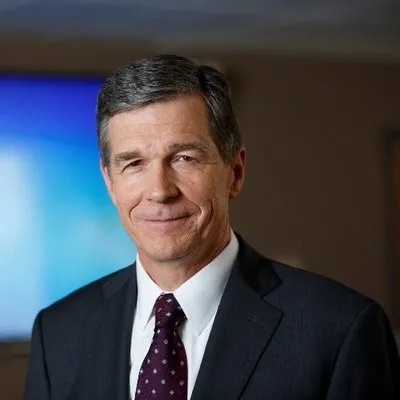
Back in February, long before President Biden stepped back and Vice-President Kamala Harris became the Democratic nominee for President, two red-state Governors spoke out against vouchers. Both are Democrats who understand the importance of public schools for their communities. They are Governor Roy Cooper of North Carolina, whose gerrymandered legislature has a Republican supermajority, and Governor Andy Beshear of Kentucky, whose legislature is controlled by Republicans. When Beshear ran, he picked a teacher as Lieutenant Governor.

The two Governers wrote this article in USA Today:

In North Carolina and Kentucky, public schools are the center of our communities. We’re proud public school graduates ourselves – and we know the critical role our schools play in teaching our students, strengthening our workforces and growing our economies.

We’ve seen record-high graduation rates of almost 90% in our public schools. North Carolina and Kentucky rank in the top 10 for National Board-certified teachers, one of the highest recognition teachers can earn.

In Kentucky, we’ve seen significant improvement in elementary school reading, even with setbacks from the pandemic like many states experienced. In North Carolina last year, public school students completed a record 325,000 workforce credentials in areas like information technology and construction. The bottom line? Our public schools are critical to our success and an overwhelming number of parents are choosing them for their children.

That’s why we’re so alarmed that legislators want to loot our public schools to fund their private school voucher scheme. These vouchers, instituted in the 1950s and 1960s by Southern governors to thwart mandatory school desegregation, are rising again thanks to a coordinated plan by lobbyists, private schools and right-wing legislators.

Voucher programs chip away at the public education our kids deserve

This is their strategy: Start the programs modestly, offering vouchers only to low-income families or children with disabilities. But then expand the giveaway by taking money from public schools and allowing the wealthiest among us who already have children in private schools to pick up a government check.

In North Carolina, the Republican legislature passed a voucher program with no income limit, no accountability and no requirement that children can’t already go to a private school. This radical plan will cost the state $4 billion over the next 10 years, money that could be going to fully fund our public schools. In Kentucky, legislators are trying to amend our constitution to enshrine their efforts to take taxpayer money from public schools and use it for private schools.

Both of our constitutions guarantee our children a right to public education. But both legislatures are trying to chip away at that right, leaving North Carolina and Kentucky ranked near the bottom in per-pupil spending and teacher pay.

Public schools are crucial to our local economies. In North Carolina, public schools are a top-five employer in all 100 counties. In many rural counties, there are no private schools for kids to go to – meaning that those taxpayer dollars are torn out of the county and put right into the pockets of wealthier people in more populated areas.

Governor Roy Cooper, North Carolina

In fact, in Kentucky, 60% of counties don’t even have a certified private school. This has caused rural Republicans in red states like Texas and Georgia to vote against voucher schemes that would starve their rural schools.

Governor Andy Beshear, Kentucky

Private schools get taxpayer dollars with no real accountability

As governors, we’ve proposed fully funding our public schools, teacher pay raises to treat our educators like the professionals they are and expanded early childhood education. We know that strong public schools mean strong communities. Families in Kentucky and North Carolina know that too. In North Carolina, nearly 8 in 10 children go to public schools.

Our public schools serve all children. They provide transportation and meals and educate students with disabilities. And they’re accountable to taxpayers with public assessments showing how students and schools are doing and where they need to improve.

But private schools that get this taxpayer money have little to no accountability. They aren’t even required to hire licensed teachers, provide meals, transportation or services for disabled students. They don’t even have to tell the taxpayers what they teach or how their students perform. North Carolina’s voucher system has been described as “the least regulated private school voucher program in the country.”

Studies of student performance under school voucher programs not only showed that they don’t help them, but that they could actually have harmful effects. Results from a 2016 study of Louisiana’s voucher program found “strong and consistent evidence that students using an LSP scholarship performed significantly worse in math after using their scholarship to attend private schools.” In Indiana, results also showed “significant losses” in math. A third study of a voucher program in Ohio reported that “students who use vouchers to attend private schools have fared worse academically compared to their closely matched peers attending public schools.”

We aren’t against private schools. But we are against taxpayer money going to private schools at the expense of public schools.

The future of our nation goes to class in public schools, and all Americans must be on guard for lobbyists and extremist politicians bringing similar plans to their states. Our segregationist predecessors were on the wrong side of history, and we don’t need to go back.

We are going to keep standing up for our public school students to ensure that they have the funding they need, and that teachers are paid like the professionals they are. It’s what’s best for our children, our economy and our future.

Roy Cooper is the governor of North Carolina. Andy Beshear is the governor of Kentucky.

Celine Dion sang at the closing ceremony on the opening day of the Olympics in Paris. Standing within the Eiffel Tower, surrounded by fireworks, Dion sang “Hymn to Love,” written by the great French singer Edith Piaf.

Here is a full description of this thrilling performance:

Situated on the iconic Eiffel Tower, which was adorned by the Olympic rings, the French Canadian singer serenaded the world with Édith Piaf’s “L’Hymne à l’amour” (“Hymn to Love”) after the Olympic cauldron was lit.

Dion is afflicted with a rare disease called “stiff person syndrome” that could cause her to go into a seizure at any moment. She thought it ended her career four years ago.

What courage to perform this thrilling song before an international audience of millions of people!

Born to a French-Canadian family in Quebec, Dion is the youngest of 14 children.