Archives for the month of: February, 2024

Jonathan V. Last writes for The Bulwark, a site created by Republican Never Trumpers. I find there sone of the most interesting writing about the political issues of our day.

Last offers sound advice to President Biden about defusing the age issue: Make a virtue of your age. Don’t pretend to be 40. Speak up for the wisdom and experience of your years.

Age is not what separates Biden from Trump. Biden will protect our institutions from all enemies, foreign and domestic. Trump has already made deals with them.

Last writes:

My headline probably oversells it: Biden can’t defuse the political problems his age creates for him. But he can mitigate them…

But first I want to lay out the strategy Biden’s team should be using. It has three components:

  1. Hang a lantern on his age.
  2. Make it relatable.
  3. Put it in context.

Contra the conventional wisdom, I think Biden’s hasty press conference last Thursday was a good idea that was executed fairly well. It’s important that Biden takes ownership of “elderly.”

In fact, I’d have him go further. He ought to mention it every time he speaks in public. He ought to joke about it. He should have a handful of stock lines ready at all times: People talk about life before the internet? I remember what it was like before we had electricity!

The cornier the better.

Biden should set the expectation that he’s going to have senior moments in every appearance. Hell—he should flub things on purpose sometimes and then wink at the audience and razz them if they don’t catch it.

If we’ve learned anything from the Trump years, it’s that one problem is a tragedy, but a thousand problems are just white noise. So don’t be defensive about the age and don’t complain about the media fixating on it.¹ Lean all the way in. Make it a part of the candidate’s identity.


Next: Make it relatable.

Nick Grossman mentioned this today and it ought to be said constantly: We all get mixed up. I call my kids by the wrong names probably a dozen times a day. When I go to the pharmacy to pick up a prescription for one of them and have to give their birthdate, I always get the month and day right. But the year? I have to stop and think about that every damn time.

Sitting here typing I could not even tell you without looking it up what year we started The Bulwark. I think it was 2018, but it could have been 2019.

Our brains are set up to have amazing recall and processing speed that generally peaks in our 20s and declines every year after. It is not an accident that Einstein did his most important work at age 26.


Finally, there’s the context: We don’t choose our leaders based on recall and processing speed. 

What does it mean to grow old? It means that you’re not as quick on your feet as you used to be. Old people, in general, don’t want to get dragged into real-time debates with 45-year-olds. The synapses don’t fire as quickly; the gift of gab wanes. You very rarely look at an old guy and think, “That dude is slick.”

But slick isn’t what we want in our leaders. We want wisdom.

There is a reason that we have a minimum age for voting in this country and not a maximum age—it’s because we don’t trust young people, with all of their rapid recall memory and synaptic lightning, to be wise enough to vote.

By the same token, we don’t have a maximum voting age, because we recognize that the losses elderly people experience in the ability to rapidly process are over-balanced by the accumulated wisdom of years and experience.

Especially in a president, we value wisdom over speed.

And Joe Biden has demonstrated the power of wisdom throughout his term. It allowed him to reach deals with Republicans in Congress. It led him to focus like a laser on the economy and get America back on its feet. 

It was wisdom that let Biden understand the stakes in Ukraine and wisdom that helped him navigate the maintenance of our alliance against Vladimir Putin. It is wisdom that allows Biden to see the incalculable benefits America receives from leading the global order.

Just as it was wisdom that made Biden cooperate with the special counsel and respect the rule of law.

President Biden is the wisest guy to sit in the Oval Office since Reagan and that’s not in spite of his age—it’s because of it. 


Meanwhile, the problem with Donald Trump is NOT that he, too, is old. The problem with Trump is NOT that he sometimes forgets what day it is, or who he’s running against.

The problem with Trump is that he’s a madman who wants dangerous things.

He is on Putin’s side. He sees NATO as a threat to American prosperity. He thinks laws must not apply to him. He believes that democracy is only useful to the extent that it provides him advantage. He thinks that dictatorship would be preferable—so long as he gets to be the tyrant. 


If I were Biden’s speechwriter, I might put it like this:

Am I elderly? You betcha. Don’t move like I used to. And I have the occasional senior moment. I’ll probably have one during this speech, just so folks from the New York Times have something to write about.

But I know what the hell I’m doing.

Let me tell you about getting older. You aren’t as fast on your feet. You have to think a moment before you remember stuff.

But also: As you get older, you’re able to see what really matters. You’re able to let go of your ego and focus on what’s important. That’s why I was able to work with the Republicans in Congress even while they said nasty things about me in public: Because I didn’t care what they said—I’m too old for that. What I did care about was passing gun reform laws that both parties knew we needed.

I cared about lowering the costs of medicine for seniors and capping the price of insulin. I cared about infrastructure—getting roads and bridges fixed and new semi-conductor factories built so that young people could get good jobs and provide for their families.

And let me tell you what else age has done for me: It made me realize that I’m the president of all Americans. Not just the people who voted for me. Because I’m old, I understand that it’s my duty to make sure that even the people who run around saying that I’m part of a crime family—God love ‘em—are able to get good jobs, and have broadband internet, and have more and better police keeping their communities safe.

So am I old? You bet. I’m 87. No, wait, 78. I forget. Whatever—I’m old. Older than you. And that’s why America is prospering, everyone who wants a job has one, crime is coming down, more people have health insurance, and the Russians and the Chinese understand that there’s a united West, led by America, opposing them and holding them to account.

Thank you, Jonathan V. Last!
The Hur report led to an onslaught of news stories about whether Biden was too old. The day after the Hur report came out, Trump invited Russia to attack any NATO nation that had not paid its bills in full.

So which is scarier: Biden’s age or Trump’s acting like Putin’s puppet?

Umair Haque, a British economist, sees these issues in perspective.

“An elderly man with a poor memory.” That’s what the report by Special Counsel Robert Her said about Joe Biden. It’s been endless fodder, instantaneously, for everything from the absurd to the predictable to the asinine. Cue op-eds in the New York Times breathlessly demanding Joe Biden step down. Presto, articles about invoking the 25th Amdenment to force Biden out of office, on grounds of mental incompetence.

Let’s take a deep breath, and understand what’s really going on here, which is sad, pathetic, and ugly. 

There are many, many reasons not to like Joe Biden. Especially right now. Just 15% of young people approve of his handling of what’s happening in Gaza. Minorities are shaking their heads and walking away, baffled, while the Democrats suddenly tack hard to the right, shattering their fragile progressive-center coalition. Don’t like him? Fair enough, I’m not here to persuade you to.

But. We need to be clear about our grounds. There’s a difference between a substantive grounds for breaking a coalition, fair enough. And a flimsy one, that only plays into the hands of the hard right. 

There’s a big difference between age and ageism, in this case.

America’s a brutal, indifferent society. And one of the ways in which it’s so is that it’s profoundly ageist. You don’t notice this, entirely, until you live elsewhere. And then suddenly you realize that in America, elderly people are effectively disappeared. You barely see them in everyday life, if at all, whereas in most of the rest of the world, from Asia to Europe, there they are, going about their business, because, after all, they exist too.

When I was really young, growing up between continents, this struck me so intensely that I’d follow old people around in America when I saw them—curious, perplexed. Where did they go? Why didn’t I see them nearly as often as everywhere else?

Ageism is a norm, and it’s one that’s to be expected from a hypercapitalist society. As your “utility” and “productivity” diminish—or, worse, are thought to diminish—so too your place in society disappears. You no longer have the right to exist, socially, morally, culturally. And in America, we can see this norm in operation everywhere. In the corporate world, 40 is now considered “old.” Looking for a job after 50 is considered to be a dicey affair, that’ll provoke looks of pity, crossed with scorn. You leave your age off your CV after you cross your 30s, nervously hoping that recruiters and “human resource” managers won’t piece the puzzle together. You pretend to be young.

Young and perfect. And this norm has accelerated, sped up, turbo-charged, in recent years. Who do we pretend to be on social media? Not old and wise. YouTube face is a sardonic expression of youthful naïveté. Wow, Mom, I’m amazed! I’m gawping in awe! On Instagram, beauty standards for women have crossed the point of caricaturing youth, and become grotesque, provoking a backlash even amongst the young. 

Who does America lionize? Americans are told to revere figures like boy geniuses—Zuck. Middle-aged billionaires—the creepy guy who bought Twitter. And so on. Ageism and patriarchy go hand in hand. Go gray, and your career’s in peril, whether artist, singer, tycoon. If you’re a woman, the price is exponentially higher. Stay young at all costs is the message, and it’s received loud and clear, in the form of plastic surgery, fillers, enhancements, endless workouts, the appearance of youth—not just superficially, but in its deeper values of energy, enthusiasm, and positivity—everywhere, all the time.

Ageism is bad for us. It’s bad for all of us. There is absolutely no link—none whatsoever—between youth and, in this case, good political leadership. Take a hard look at Europe’s rising far right. It’s led by relatively young people, for politics—in their 40s, often. Shall we say that just because someone is younger, it makes for a better leader, then? Surely only a fool would conclude that.

Ageism is a form of bias, in this sense. But what form of bias, in particular, in this context?

The reason that the far right is rising is because people are seeking safety, security, and strength, in an age of chaos, ruin, and fracture. So they’re turning to strongmen, as the turn of phrase goes. Strongmen. Strong-men. Strong…men. 

What image does that conjure up in your head? Muscles. Manes of hair, maybe. Virility. A bellowing tone of voice, perhaps. It doesn’t matter—we all know what the cliche of male power is. It’s exemplified, of course, by one Donald Trump. Just a few years younger than Biden—and yet his image management, as crude as it is, works wonders, to a media as feckless and gullible as America’s. He shouts and roars and jeers and taunts and whines. He dyes his hair and combs it over his bald spot. He wears oversized suits to hide the decades of ill-health. 

Miraculously, or whatever the opposite of miraculous is…all this crude manipulation of an image works.

Works…in his favor. Because there’s an ageist, patriarchal bias. And so by portraying this incredibly crude image of male power, Trump becomes the strongman. Even though he’s also an elderly man, in far poorer health, most likely than Biden, and if mental acuity is really the test here, well, whose finger would you prefer to hold the nuclear trigger? Are you kidding? Comparing the mental acuity of a figure like Joe Biden—as problematic as he is—to someone like Trump, who just said out loud that Russia should happily attack NATO countries…is beyond absurd. Past ridiculous. It’s grotesque and obscene. Trump’s out there giving Putin license to start World War III…and Biden’s the one with mental issues?

This is how ageism warps us. Our judgments. Biases make us stupid. In this case, rather than seeing Trump for who he is, he’s able to portray the image of a strongman, using, like I said, the incredibly crude tools of hair dye, oversize suits, jeering-whining-shouting, and belligerence plus aggression. That’s what male “strength” is, or at least the caricature of it, to a patriarchal system, and in that system, too, age is a burden and a liability, so even the king must appear to always be virile, manly, and not just “powerful”, but more precisely, all-powerful.

Ageism makes us stupid in that way. We’re unable to see Trump as the pathetic moral weakling that he is, at least enough of us, dazzled by this dollar store Hitler he’s portraying. Trump’s two decade older than Hitler, though, if you see my point, which is that the manipulation works, because the bias is there to fool us into believing a lie.

Age and ageism. What is it that makes us so…mean…to old people? In a sense, the answer’s obvious. We hate them. For reminding us that this terrible malady is coming for us, too. And there’s not a thing we can do about it. We must all endure this curse together. We must all endure this curse alone. We will age. Our bodies will wear out. Our minds will slow. The ache in us will grow. We will burn out like candles. No part of us is permanent. Every single day, we live in denial of this fact, bought with stuff, purchased with status, given to us by our children. And yet the inescapable truth remains. Time turns us all to dust. Hooded fate watches us, holding his scythe, preparing for the threshing.

We hate old people for reminding us. Not just of our mortality. But of what’s even deeper than that. Our powerlessness over it. The ways in which we will become weak, and the despair and loneliness of it. The certainty of it, and the finality of it. We hate them with a bitter, cruel vengefulness, and their existence itself warns us what awaits us, which is why we disappear them.

But there are gifts, too, that come with age, and only with age. Wisdom. Grace. Truth. As we age, so, if we live well, our capacities to love, to hold, to see, to know—all these ripen, and suddenly unfurl, exploding into the fullness of what human possibility really is. Is a man or woman weak because they can barely walk anymore—or are they incredibly strong, because they can teach us how to love and what to cherish and what matters in every moment? Is a person weak, because they can’t recall what they had for breakfast yesterday morning—or are they wise, because they can trace the patterns of history, and reveal the meaning of grace?

Every human heart is broken. Only as we age do we really understand this fully, well, truly, and appreciate the beauty in it. We take the time to contemplate all our regrets. The failed relationships, the broken marriages, the lost loved ones. The ways in which our lives didn’t work out. Through this process, and only through this process, do we understand the universality of human suffering. The inescapability of it. The follies of the lesser sins of egotism, narcissism, selfishness. The destructive power of the greater ones, of vanity, greed, and hatred. And through our broken hearts shines the light of creation itself, in this way, embracing all, in the spirit of love and truth and goodness.

Age doesn’t equal maturity. Trump is old, but he’s a man-child, who never matured. Biden? He remains the problematic figure that perhaps he was destined to be. Count that against him if you must. But what’s certain is that a lapse in memory here or there is no mark against maturity. The human heart, like the mind, comes to be full, as it ages. Full of so much. Regret, remorse, mistakes, misjudgments, could-have-beens. Maturity transforms that lead into gold. Through this pain the ego surrenders itself to the universal, and in that precise instant, love is born. The highest kind. Not just that of the mother for the newborn. But that of the first mother and father, for all the children who ever were.

This may be the earliest Presidential endorsement ever by a major newspaper. The Houston Chronicle endorsed Joe Biden. Come to think of it, why should any newspaper hesiatate when the choice is between Biden, a lifelong centrist and accomplished President, and the unhinged Trump, who is facing multiple criminal indictments and attempted a coup when he lost in 2020?

The editorial says:

Now that the Kansas City Chiefs have triumphed over the San Francisco 49ers in Super Bowl LVIII — and without the help of Taylor Swift and the CIA, as far as we know— this nation can turn its attention to another winning team. We have in mind the Biden administration. Under the leadership of the oldest and arguably the most experienced president in American history, the team in the White House for the past three years has performed remarkably well, despite the rancor and divisiveness that have afflicted this nation for nearly a decade.

The accomplishments of an administration dedicated to governing, one that believes in the power of government to make life better for the American people, is a key reason we heartily endorse the reelection of President Joe Biden. The other reason, equally important, is to fend off the chaos, corruption and danger to the nation that would accompany the return of Donald Trump to the White House.  

The president has his shortcomings, to be sure, but what his administration has managed to get done during the past three years is a potent reminder to his fellow Democrats, to independents and to those Republicans who have somehow resisted Trump’s cultish appeal that the nation has a viable alternative. Here is a sampling:

If it’s really “the economy, stupid,” that determines success in presidential elections, then Biden can probably rest easy at neutral. No, Bidenomics alone didn’t save us but neither did they damn us. One of the clear advantages of a president as experienced as Biden is wisdom: in this case, the wisdom to get the heck out of the Fed’s way as it masterfully applied the breaks to what could have been runaway inflation.  

The economy has recovered from the perils of the pandemic and is now healthier than that of any other advanced nation. With unemployment approaching a 50-year low, companies large and small need workers. (Notice the “help wanted” signs in shop windows, the “We’re Hiring” signs outside huge warehouses and distribution centers just off I-10 east of Brookshire.)

Inflation is trending downward, somehow, despite all dire prophecies of economists, without the bitter medicine of a recession or a period of high unemployment. Food prices are still high, and hard-working Americans are still wincing at grocery store receipts, but gas prices have fallen, as the U.S. produces more oil than any country in history, including Saudi Arabia. In an ongoing effort to wean ourselves off fossil fuels, the administration is investing $7 billion in an ambitious solar-power projectand is promoting other alternative energy projects, as well.

The stock market is percolating along and hitting record highs.

“Infrastructure week” became a punch line during the inept Trump administration, but the Biden administration in its first year managed to pass a bipartisan Infrastructure Investment and Jobs Act that’s expected to add an estimated 1.5 million jobs per year for the next 10 years. This administration’s “infrastructure week” is investing in clean water and high-speed internet. It’s repairing roads and bridges, upgrading air- and seaports, modernizing our power infrastructure, investing in public transit and pahssenger rail and cleaning up Superfund and brownfield sites.

A little heralded initiative related to infrastructure involves “strategic sector” investments in employment-distressed counties around the nation. In 2021, according to a study conducted by Brookings Metro (a think tank) and MIT’s Center for Energy and Environmental Policy, these 1,071 counties have received about $82 billion in private-sector investment from industries the Biden administration has targeted. Industries that will locate in these areas include manufacturers of semiconductors (in this country instead of China) and equipment to generate solar and wind power.

One of the distressed areas to benefit is Wilbarger County, Texas, along the Red River northwest of Wichita Falls. A $4 billion private-sector venture is constructing a mega-scale green hydrogen plant that’s expected to create 115 permanent jobs and more than 1,300 construction jobs in a county where population has declined almost every decade since 1940. It’s worth noting that Wilbarger County in 2020 cast 21 percent of its votes for Biden, nearly 78 percent for Trump.  

Steadily growing reliance on the Affordable Care Act during this administration has made coverage more affordable and more accessible for millions of Americans. More than 21 million Americans are now enrolled, up from 12 million shortly before the pandemic.

The Biden White House also has given Medicare the power to directly negotiate with Big Pharma, thereby lowering drug prices and placing a $35-per-month cap on the cost of insulin for Medicare beneficiaries. 

After decades of “thoughts and prayers” and little else in response to mass killings, the Biden White House managed to shepherd a bipartisan Safer Communities Act through a balky Congress. With the support of 15 Republican senators and 14 Republican House members, the act represents at least a modest effort to address gun safety in this country.

The Biden administration has managed to organize and lead an allied response to a brutish dictator’s invasion of a neighboring democracy. As Ukraine desperately tries to hold off Russia’s invasion, Biden, in the words of former Republican Party operative Stuart Stevens, is “standing on the side of freedom versus tyranny in the largest land war in Europe since WWII.” 

Under the leadership of a president with decades of experience in the Middle East, the administration is seeking a path to peace and stability in the post-October 7 conflagration involving Gaza, Iran and Israel and the desperate Palestinian people. The administration also is trying to tamp down the potential danger of a region-wide war. It’s hard to imagine Biden’s predecessor having either the patience or the prowess to play a significant role in resolving a devilishly complex crisis.

Another attribute of the Biden administration is its normality. Stevens, the former GOP operative, put it this way in a recent article in The New Republic: “One of the greatest gifts of a democratic civil society is the freedom not to think about government, to wake up and not worry about the mood of a leader. Joe Biden has made governing boring and predictable, both fundamental rights of the people in a healthy democracy.” 

We are well aware that the Biden administration has not been successful on every front. The calamitous withdrawal from Afghanistan was the most obvious failure. The administration’s inability to quell chaos at the border is another, although blame primarily belongs to caviling and cynical MAGA Republicans in the House. In servility to Trump, they torpedoed a bipartisan border-security plan painstakingly crafted in the Senate. Biden can’t solve the crisis by executive order; he needs Congress to act.   

We are well aware of Biden’s age, 81, (and Trump’s, 77), as well as memory lapses that have prompted near-panic among many of the president’s fellow Democrats. Those of us who remember the energetic, garrulous, occasionally even eloquent Joe Biden of years past can see the difference a few years have made, even if he was always prone to gaffes. Accounts other than the report of Special Counsel Robert Hur suggest, however, that Biden remains focused, engaged and in command on the vital issues that occupy a president. Experience counts.   

We are reassured in large part because Biden has restored the tradition of a capable team running the White House, a tradition trampled by Trump’s deeply flawed scheme to run a one-man show. Like Ronald Reagan, Lyndon Johnson and Franklin Roosevelt, Biden’s deft management of his team has made him, arguably, the most productive president since LBJ in the early months of his administration. 

He has, as they say, forgotten more than his presumed Republican rival will ever know. That’s not saying much, and at the same time, it says it all.

Heather Cox Richardson displays the value of learning history in order to understand the world today. In this post, she reviews the facts about the Trump campaign’s connection to Ukraine in 2016. The one important point she overlooked is the change in the Republican platform of 2016, made at the request of the Trump campaign. The 2012 Republican platform stated the Party’s support for Ukraine. That section was deleted in 2016.

She wrote:

Although few Americans paid much attention at the time, the events of February 18, 2014, in Ukraine would turn out to be a linchpin in how the United States ended up where it is a decade later. 


On that day ten years ago, after months of what started as peaceful protests, Ukrainians occupied government buildings and marched on parliament to remove Russian-backed president Viktor Yanukovych from office. After the escalating violence resulted in many civilian casualties, Yanukovych fled to Russia, and the Maidan Revolution, also known as the Revolution of Dignity, returned power to Ukraine’s constitution.


The ouster of Yanukovych meant that American political consultant Paul Manafort was out of a job. 


Manafort had worked with Yanukovych since 2004. In that year, the Russian-backed politician appeared to have won the presidency of Ukraine. But Yanukovych was rumored to have ties to organized crime, and the election was full of fraud, including the poisoning of a key rival who wanted to break ties with Russia and align Ukraine with Europe. The U.S. government and other international observers did not recognize the election results, while Russia’s president Vladimir Putin congratulated Yanukovych even before the results were officially announced. 


The government voided the election and called for a do-over.  


To rehabilitate his reputation, Yanukovych turned to Manafort, who was already working for a young Russian billionaire, Oleg Deripaska. Deripaska worried that Ukraine would break free of Russian influence and was eager to prove useful to Vladimir Putin. At the time, Putin was trying to consolidate power in Russia, where oligarchs were monopolizing formerly publicly held industries and replacing the region’s communist leaders. In 2004, American journalist Paul Klebnikov, the chief editor of Forbes in Russia, was murdered as he tried to call attention to what the oligarchs were doing.  


With Manafort’s help, Yanukovych finally won the presidency in 2010 and began to turn Ukraine toward Russia. In November 2013, Yanukovych suddenly reversed Ukraine’s course toward cooperation with the European Union, refusing to sign a trade agreement and instead taking a $3 billion loan from Russia. Ukrainian students protested the decision, and the anger spread quickly. In 2014, after months of popular protests, Ukrainians ousted Yanukovych from power and he fled to Russia.  

Manafort, who had borrowed money from Deripaska and still owed him about $17 million, had lost his main source of income. 


Shortly after Yanukovych’s ouster, Russia invaded Ukraine’s Crimea and annexed it, prompting the United States and the European Union to impose economic sanctions on Russia itself and also on specific Russian businesses and oligarchs, prohibiting them from doing business in U.S. territories. These sanctions were intended to weaken Russia and froze the assets of key Russian oligarchs. 


By 2016, Manafort’s longtime friend and business partner Roger Stone—they had both worked on Richard Nixon’s 1972 campaign—was advising Trump’s floundering presidential campaign, and Manafort was happy to step in to help remake it. He did not take a salary but reached out to Deripaska through one of his Ukrainian business partners, Konstantin Kilimnik, immediately after landing the job, asking him, “How do we use to get whole? Has OVD [Oleg Vladimirovich Deripaska] operation seen?” 


Manafort began as an advisor to the Trump campaign in March 2016 and became the chairman in late June.  


Thanks to journalist Jim Rutenberg, who pulled together testimony given both to the Mueller investigation and the Republican-dominated Senate Intelligence Committee, transcripts from the impeachment hearings, and recent memoirs, we now know that in 2016, Russian operatives presented Manafort a plan “for the creation of an autonomous republic in Ukraine’s east, giving Putin effective control of the country’s industrial heartland, where Kremlin-armed, -funded, and -directed ‘separatists’ were waging a two-year-old shadow war that had left nearly 10,000 dead.” 

In exchange for weakening NATO, undermining the U.S. stance in favor of Ukraine in its attempt to throw off the Russians who had invaded in 2014, and removing U.S. sanctions from Russian entities, Russian operatives were willing to help Trump win the White House. The Republican-dominated Senate Intelligence Committee in 2020 established that Manafort’s Ukrainian business partner Kilimnik, whom it described as a “Russian intelligence officer,” acted as a liaison between Manafort and Deripaska while Manafort ran Trump’s campaign. 


Now, ten years later, Putin has invaded Ukraine in an effort that when it began looked much like the one his operatives suggested to Manafort in 2016, Trump has said he would “encourage Russia to do whatever they hell they want” to NATO allies that don’t commit 2% of their gross domestic product to their militaries, and Trump MAGA Republicans are refusing to pass a measure to support Ukraine in its effort to throw off Russia’s invasion. 
The day after the violence of February 18, 2014, in Ukraine, then–vice president Joe Biden called Yanukovych to “express grave concern regarding the crisis on the streets” and to urge him “to pull back government forces and to exercise maximum restraint.”  


Ten years later, Russia has been at open war with Ukraine for nearly two years and has just regained control of the key town of Avdiivka because Ukrainian troops lack ammunition. President Joe Biden is warning MAGA Republicans that “[t]he failure to support Ukraine at this critical moment will never be forgotten.”


“History is watching,” he said.

Debra Hale-Shelton of the Arkansas Times reported on a battle over censorship on the State Library Board. Governor Sarah Huckabee Sanders appointed two new members to the board. One of them—Jason Rupert— proposed to cut off funding to libraries that were suing the state to block a censorship law. But other members of the State Library Board voted him down, including Governor Sanders’ other pick.

A former state Senator, Rapert is founder and president of the National Association of Christian Lawmakers and Holy Ghost Ministries.

Hale-Shelton writes:

Please give the women, especially those who respect the First Amendment, a round of applause.

I refer to the women on the Arkansas State Library Board — even Shari Bales, the one recently appointed by Gov. Sarah Huckabee Sanders.

Thanks to them, former state senator Jason Rapert did not get a second on a motion today to defund libraries pushing back against a new state censorship law.

Today was the first meeting of the seven-member State Library Board since Sanders appointed Rapert and Bales. As expected, Rapert talked more than any other board member, tapping his foot on the floor much of the time. His motion was to suspend funds to any library suing the state or Arkansas taxpayers pending the outcome of litigation.

Libraries that would have been immediately affected include the Central Arkansas Library System, the Fayetteville Public Library and the Eureka Springs Carnegie Public Library. They are among the plaintiffs in a lawsuit challenging the new state law, Act 372, which seeks to impose criminal penalties on librarians or others who make supposedly “harmful” materials available to minors. The challenged portions of the law are on hold pending a bench trial, set to begin Oct. 15 at the earliest.

To keep funding those libraries amounts to writing them a check to help pay for the lawsuit, Rapert said.

Other members of the board pointed out that defunding the libraries would hurt their communities.

Later in the meeting, Rapert wanted to know if Arkansas libraries contain certain books that some have found objectionable, such as “Gender Queer.”Not surprisingly, Rapert chose to focus on books with LGBQT+ themes and not those with extreme violence or steamy heterosexual sex scenes. Arkansas State Library Director Jennifer Chilcoat suggested that he email her details of his request.

SUPPORT LOCAL JOURNALISM!

Since I started following the cruel and unusual policies of Florida’s Governor Ron DeSantis, I have seen him repeatedly attack public schools, divert public money to private and religious schools, and remove whatever offends him from the curriculum (such as accurate histories of Black people).

I have also discovered some fearless bloggers who are not afraid of DeSantis. Billy Townsend and Jason Garcia. They take on political corruption without flinching.

Jason Garcia, an investigative reporter, wrote recently about how conservative billionaires have shaped DeSantis’s political agenda. The part I don’t understand is why someone of vast personal wealth would want to take food stamps away from impoverished children or make the lives of homeless people even more miserable. What kinds of sadists are they?

Jason Garcia writes:

Late last year, the administration of Florida Gov. Ron DeSantis made it harder for older Floridians to get food stamps.

Earlier this month, the DeSantis administration sued the federal government for the right to remove poor children from public health insurance.

And last week, the Republican governor came out in support of a plan to round up homeless people across Florida and — potentially — put them into secured camps.

Each move was, at least on the surface, a disparate executive decision. But they share something in common: They are all ideas promoted by conservative billionaires and the right-wing think tanks they fund.

Taken together, the moves offer a window into how super-rich mega donors shape action across DeSantis’ state government.

Let’s start with the food stamps.

Though it didn’t get much attention at the time, the Florida Department of Children and Families late last year changed the rules for the state’s food-stamps program, which is formally known as the “Supplemental Nutrition Assistance Program.”

Funded by the federal government but administered by the states, food stamps currently help more than 3 million impoverished Floridians buy groceries and keep food on the table for themselves and their families.

But the state of Florida makes it much harder for some people to qualify for food stamps, by imposing what are commonly called “work requirements” — mandatory employment and training programs that someone must participate in each week in order to obtain and continue receiving aid.

Florida had previously imposed work requirements on adults without children between the ages of 18 and 52. But late last year, the state expanded work requirements to adults without children up to age 59 — sweeping up somewhere around 100,000 more very low-income Floridians, according to materials provided to the governor’s office and obtained in a public-records request.  

Anti-poverty activists and advocates for working families have long argued that work requirements don’t actually work. Rather than helping people find sustainable employment in which they can work themselves out of poverty, mandatory work requirements merely create barriers that block some people from receiving any aid at all and push others into erratic, poor-paying and poverty-entrapping jobs — all while enriching a few private contractors that administer the programs.

But work requirements have some influential supporters — like the Foundation for Government Accountability, an anti-worker think thank based in Naples that is also pushing bills in Tallahassee this session that would weaken Florida’s child-labor lawserase wage and benefit protections for employees, and cut more laid-off workers off from unemployment insurance.

And the FGA isn’t just promoting work requirements generally. Records show it pitched this exact idea to DeSantis’ staff.

It happened in December 2022, when, emails show, the FGA met with senior staffers in the Governor’s Office and provided a series of policy proposals. One of the ideas they pitched? Forcing Floridians as old as 59 years old to participate in mandatory work requirements before they can get food stamps.

The recommendation was contained in a memo provided to the Governor’s Office tiled, “Taking Florida’s Food Stamp Work Requirements to the Next Level.”

One reason the FGA may have the ear of the DeSantis administration: Tax records show that its largest funder in recent years has been Richard “Dick” Uihlein, a Midwestern billionaire who is one of the biggest conservative donors in American politics.

More specifically, Uihlein is one of DeSantis’ top funders: Records show he has given DeSantis roughly $3 million in recent years — including $1.5 million to the Super PAC that supported DeSantis’ failed presidential campaign.

It’s important to note that the FGA wants DeSantis to go even further: The organization has also urged the Governor’s Office to extend food stamp work requirements to adults with children as young as six years old.

Kicking kids off health insurance

Food stamps aren’t the only safety net program that has come into DeSantis’ crosshairs recently.

Earlier this month, the state of Florida surprised anti-poverty advocates by suing the federal government over new rules related to Florida KidCare — a program that provides health insurance for low-income children whose families do not qualify for Medicaid.

KidCare is funded jointly by the federal government and the state. And Florida has long required families participating the program to pay monthly premiums in order to get coverage for their kids. 

But new federal rules require the state to provide at least one year of continuous health insurance coverage for any child who enrolls in the program — even if the child’s family misses a monthly premium payment.

The DeSantis administration has sued to overturn that rule. The suit argues that federal officials have overstepped their authority, and that forcing Florida to continue providing health insurance to kids whose parents have missed a payment would undermine the integrity of the KidCare program.

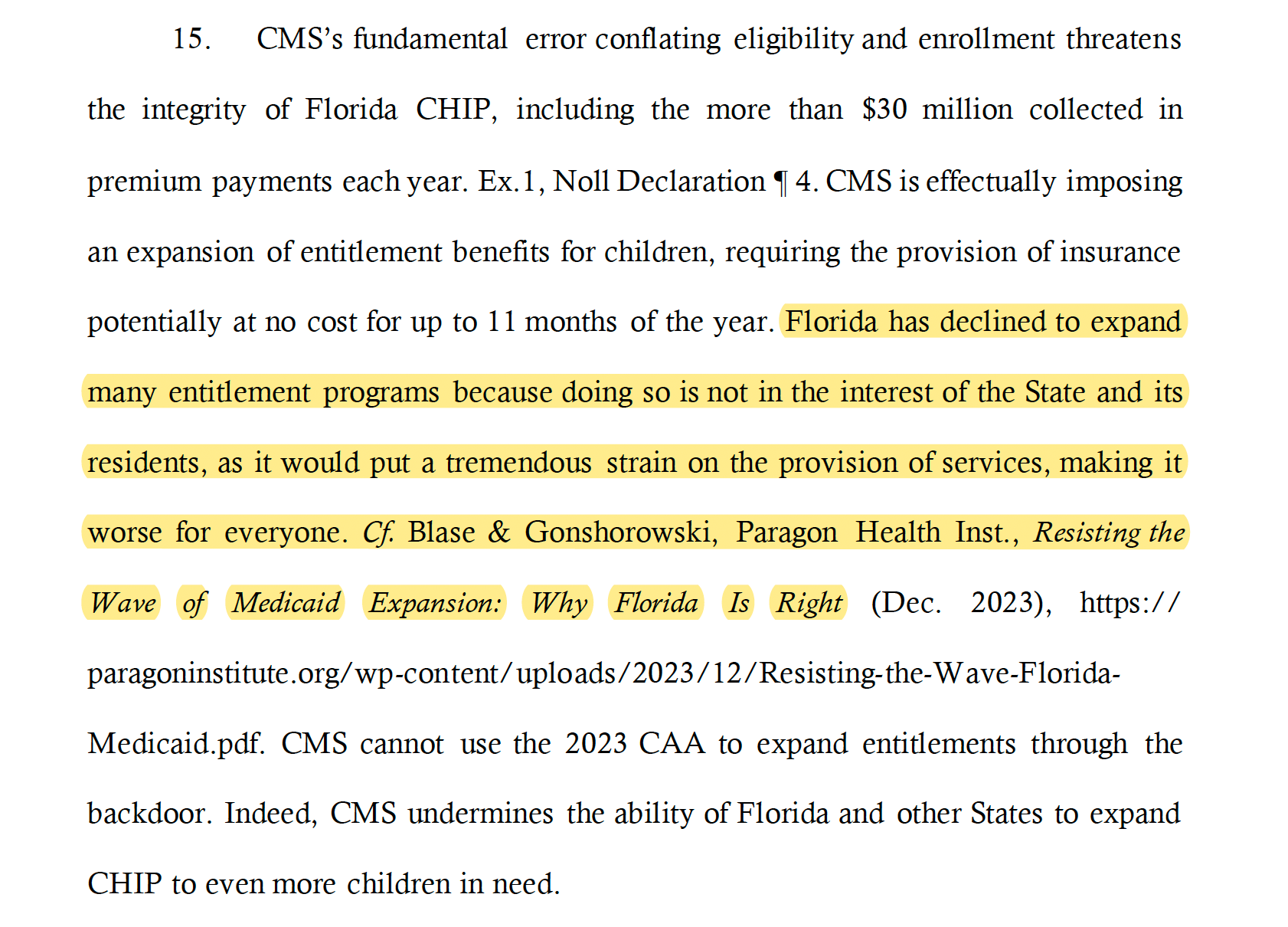
To buttress its argument, the DeSantis administration cited a think tank report, published a little more than a month before the lawsuit was filed, titled, “Resisting the Wave of Medicaid Expansion: Why Florida is Right.”

An excerpt from Florida’s lawsuit against the federal government regarding eligibility rules for children’s health insurance.

The report was produced by a two-year-old organization called the Paragon Health Institute. Tax records show it is largely funded by the nonprofit network of billionaire industrialist Charles Koch, another of the nation’s biggest conservative political donors. 

All of Paragon’s first-year funding came from one of Koch’s “Stand Together Trust.” Most of its second-year funding came from the Koch group, too.

Paragon is also intertwined with the FGA. The institute’s president — and the lead author of the report Florida cited in its lawsuit — is Brian Blase. Blase is also a visiting fellow with the FGA, according to the group’s website.

Blase said he wasn’t consulted by anyone from the state about the litigation and that he didn’t know anything about the lawsuit before it was filed.

Asked if the Governor’s Office conferred with anyone from the Paragon Health Institute or the FGA before launching its suit, DeSantis spokesperson Jeremy Redfern responded, “Not to my knowledge.”

Other closely aligned conservative groups are now cheering on the state’s lawsuit — such as the Tallahassee-based James Madison Institute, which tax records show also receives substantial fundingfrom Charles Koch’s network.

Koch and his network were important early supporters of DeSantis, though they splintered during the governor’s presidential campaign when Koch’s Americans for Prosperity ultimately decided to endorse former South Carolina Gov. Nikki Haley.

But this is a relationship that DeSantis likely wants to repair as tries to rehabilitate his political reputation and prepare for a second presidential run. Politico Florida reported last week that DeSantis allies expect him to run again in 2028 — and to restart his political fundraising operation later this year.   

Donald Trump continued his March to the Republican Presidential nomination and found time to attend “SneakerCON” in Philadelphia. There he hawked his new line of sneakers, proudly showing off the top of the line: Golden Trump sneakers priced at $399. The 1,000 pairs on hand quickly sold out. A business triumph for Trump, who is in hock for nearly half a billion $$$ in New York.

Have we ever seen a former President monetizing his campaign?

And at last, Trump mentioned Navalny’s death, but he didn’t mention Putin. Instead, he compared himself to Navalny. Chutzpah!

He wrote on his Truth Social site:

“The sudden death of Alexei Navalny has made me more and more aware of what is happening in our Country,” Trump posted to Truth Social on Monday. “It is a slow, steady progression, with CROOKED, Radical Left Politicians, Prosecutors, and Judges leading us down a path to destruction. Open Borders, Rigged Elections, and Grossly Unfair Courtroom Decisions are DESTROYING AMERICA. WE ARE A NATION IN DECLINE, A FAILING NATION! MAGA2024.”

Words fail me when I read that Trump can’t bring himself to condemn Putin, and even more astonishing that he sees himself as analogous to Navalny.

Yulia Navalnaya announced that she would step in to continue her husband’s long campaign to rid Russia of dictatorship and corruption. She stepped in because her husband encouraged everyone to engage, not to be afraid.

RIGA, Latvia — Yulia Navalnaya, the widow of Alexei Navalny, President Vladimir Putin’s most formidable opponent, vowed on Monday to carry on her husband’s crusade against the Russian regime, striving to build “a free, peaceful, happy Russia, a beautiful Russia of the future, which my husband dreamed of so much.”

Navalnaya, 47, made her announcement in a video statement on YouTube, in which she accused Russian authorities of fatally poisoning Navalny in the Arctic prison where he died suddenly on Friday at age 47.

“Putin did not only murder the person, Alexei Navalny,” she said, clad in black and her voice occasionally trembling during the dramatic video address. “He wanted, along with him, to kill our hope, our freedom, our future.”

Navalnaya also accused the Russian authorities of refusing to hand over Navalny’s body to his 69-year-old mother so they could cover up the cause of death.


“They lie pathetically, and wait for the traces of another Putin’s Novichok to disappear there,” said Navalnaya, referring to the class of nerve agent that international investigators said Russian security agents used in an August 2020 attempt to assassinate her husband.

“My husband could not be broken, and that’s exactly why Putin killed him, in the most cowardly way,” she continued. “He did not have the courage to look him in the eye or even say his name. And now they are also cowardly, hiding his body, not showing him to his mother, not giving it to her.”


Three days after Navalny’s sudden death Friday, the location of his body was still unclear on Monday and his mother, Lyudmila Navalnaya, was again rebuffed by morgue officials in the Arctic town of Salekhard, 33 miles from the prison colony where he died, Navalny’s press secretary said.

Navalny’s grieving family and political team have demanded the return of his remains since Saturday but have faced an extended, almost surreal, struggle to recover his body or even to establish its location — with Russian officials seemingly determined to obstruct any independent investigation into the cause of death and delay a funeral.


Navalnaya was in Brussels on Monday to address European Union foreign ministers who invited her in a show of solidarity and as a follow-up to her emotional appearance at the Munich Security Conference on Friday shortly after the news broke of her husband’s death.
At the meeting in Brussels, she sat next to the European Union’s foreign policy chief, Josep Borrell, surrounded by diplomats and officials, looking exhausted but determined.


“We expressed the E.U.’s deepest condolences to Yulia Navalnaya,” Borrell posted on X, formerly Twitter. “Vladimir Putin & his regime will be held accountable for the death of Alexei.” … “As Yulia said, Putin is not Russia. Russia is not Putin,” Borrell continued. “We will continue our support to Russia’s civil society & independent media.”


Navalnaya also met with European Council President Charles Michel.


In her video statement, Navalnaya vowed that she and her husband’s team would find out those directly responsible for her husband’s death and expose exactly how it was done. “We’ll name names and show faces. But the main thing we can do for Alexei and for ourselves is to keep fighting,” she said.
“I will continue the work of Alexei Navalny,” Navalnaya proclaimed, adding:

“By killing Alexei, Putin killed half of me, half of my heart and half of my soul. But I still have the other half, and it tells me that I have no right to give up. I will continue Alexei Navalny’s cause.”


She also directly addressed one of the resonant questions in the West about her husband: Why did he return to Russia in 2021 after recovering from the poisoning attack in Germany, risking likely arrest and possible death, when he could have lived peacefully with his family in exile?


“He could not,” she said, fighting back tears. “Alexei loved Russia more than anything else in the world, loved our country, loved you. He believed in us, in our strength, in our future and in the fact that we deserve the best.”

Jonathan V. Last writes for The Bulwark, which was founded by Republican Never Trumpers. It is one of the most engaging websites I read. This post is newsworthy, since so many Trumpers were citing Dinesh D’Souza’s book about election fraud.

Last writes:

Last August we talked about True the Vote, the group whose “data” on election fraud in Georgia constituted a large part of Dinesh D’Souza’s 2000 Mules.

Let me refresh your memory:

True the Vote is a Texas-based group which filed a complaint with the Georgia State Election Board alleging fraud in the 2020 presidential campaign.

The Georgia State Election Board (the SEB) investigated this complaint and found no fraud. So it asked True the Vote to share its evidence. True the Vote declined and instead said—whoopsie!—they’d like to just take the complaint back.

The SEB explained that that’s not how it works with sworn statements and subpoenaed the extensive evidence that True the Vote claimed in its complaint to have.1 The whole thing devolved into litigation that bore a striking resemblance to George Costanza’s attempt to convince his dead fiancée’s parents that he owned a house in the Hamptons.

Anyway, this week the Atlanta Journal-Constitution broke the news that True the Vote finally gave up and told the judge in the case that they don’t have any of the so-called evidence, or data, or names, or identities—or any of those other fancy legal whosywhatsits:

True the Vote said in a recent court filing that it doesn’t know the identity of its own anonymous source who told a story of a “ballot trafficking” scheme allegedly organized by a network of unnamed groups paying $10 per ballot delivered.

True the Vote also told the court it doesn’t have documents about illegal ballot collection, the name of its purported informant or confidentiality agreements it previously said existed.

You can read True the Vote’s filing here. It’s wild. But the cajones on these guys! In a non-court-filed public statement, True the Vote went on to say that while they don’t have any of this stuff they said they had, they know that the Georgia Election Board could come up with it if they really wanted:

“The [Georgia Bureau of Investigation] consequently has ready access to the underlying data, and could, we believe, reconstruct it, but it declines to do that,” True the Vote said in a statement. “At this point, it would be redundant and cost-prohibitive for True the Vote to do so on its own. It is in that sense that there is nothing more for True the Vote to provide that it has not already provided to the GBI.”

Translation: The real evidence of voter fraud isn’t in a computer. It’s in our hearts.

Jennifer Rubin is one of my favorite columnists at The Washington Post. She is both a journalist and a lawyer. She cuts to the heart of whatever matter she examines. She was hired to be the conservative commentator on the opinion page; she had Sterling credentials. But Trump pushed her out of the conservative bubble and into the center.

Here she pins the blame for the Hur fiasco where it belongs: on Merrick Garland, who appointed Hur knowing he was a loyal Republican.

She wrote:

Special counsel Robert K. Hur had a single task: determine if President Biden illegally retained sensitive documents after his vice presidency. The answer should not have taken nearly 13 months or a more than 300-page report. Hur also should have avoided trashing “the fundamental ethos of a prosecutor to avoid gratuitous smears,” as former White House ethics czar Norm Eisen told me.

Hur found that “the evidence does not establish Mr. Biden’s guilt beyond a reasonable doubt” and that prosecution was “also unwarranted based on our consideration of the aggravating and mitigating factors.” He seemed to intentionally disguise that conclusion with contradictory and misleading language that “Biden willfully retained and disclosed classified materials after his vice presidency when he was a private citizen.” He conceded that was not legally provable. (As Just Security pointed out, the media predictably and widely misreported this: “The press incorrectly and repeatedly blast out that the Hur report found Biden willfully retained classified documents, in other words, that Biden committed a felony; with some in the news media further trumpeting that the Special Counsel decided only as a matter of discretion not to recommend charges.”)

Hur acknowledged that Biden’s cooperation, “including by reporting to the government that the Afghanistan documents were in his Delaware garage,” leaves the impression he made “an innocent mistake, rather than acting willfully — that is, with intent to break the law — as the statute requires.” Moreover, Hur conceded that the documents “could have been stored, by mistake and without his knowledge, at his Delaware home since the time he was vice president, as were other classified documents recovered during our investigation.”

The body of the report refutes the element of willfulness — noting a variety of factors (e.g., a good-faith belief the Afghanistan memo was no longer classified, presidents’ practice of taking notes with them). Hur also distinguished Biden’s behavior from four-times-indicted former president Donald Trump:

Several material distinctions between Mr. Trump’s case and Mr. Biden’s are clear. Unlike the evidence involving Mr. Biden, the allegations set forth in the indictment of Mr. Trump, if proven, would present serious aggravating facts. Most notably, after being given multiple chances to return classified documents and avoid prosecution, Mr. Trump allegedly did the opposite. According to the indictment, he not only refused to return the documents for many months, but he also obstructed justice by enlisting others to destroy evidence and then to lie about it. In contrast, Mr. Biden turned in classified documents to the National Archives and the Department of Justice, consented to the search of multiple locations including his homes, sat for a voluntary interview, and in other ways cooperated with the investigation.

That should have been the end of the matter.
But it was Hur’s gratuitous smear about Biden’s age and memory — most egregiously, his far-fetched allegation that Biden could not recall the date of his son Beau’s death — that transformed a snide report into a political screed. Speculating about how a jury might have perceived the president years after the incidents took place was entirely irrelevant because the lack of evidence meant there would be no case.

Former prosecutors were almost uniformly outraged. Jeffrey Toobin remarked, “It was outrageous that Hur put in some of that stuff in this report. That had no place in it.” He added, “There is no reason this report had to be 300 pages. There is no reason this fairly straightforward case had to be treated this way. … The job of prosecutors is to put up or shut up.”

Former prosecutor Andrew Weissmann called Hur’s jabs “entirely inappropriate.” He tweeted, “Of course, no crime was committed by Biden, but as anticipated, Hur takes the opportunity to make a gratuitous political swipe at Biden. … [Attorney General Merrick] Garland was right to have appointed a Special Counsel but wrong to pick Hur and to think only a Republican could fit the bill.” (Weissmann analogized to former FBI chief James B. Comey, who exonerated Hillary Clinton of crimes but savaged her conduct just days before the 2016 election.)

Likewise, ethics guru Matthew Seligman told me, “What Hur should have written — and all he should have written — is that there is insufficient evidence to prove beyond a reasonable doubt that President Biden’s level of intent rose to the willfulness standard required by the statute.” Eisen argues that Hur violated the Justice Department’s prosecutorial principles. (“Federal prosecutors should remain sensitive to the privacy and reputation interests of uncharged parties,” the rules say.)
Hur is not solely to blame for going beyond his mandate and introducing smears. Garland erred in appointing and giving free rein to a Republican loyalist. He should have anticipated that a rock-ribbed Republican such as Hur would echo GOP campaign smears attacking Biden’s memory and age. Garland’s lousy judgment wound up sullying and politicizing the Justice Department.

As former prosecutor Shan Wu wrote, “It was Garland’s responsibility to ensure that Hur’s report did not stray from proper Justice Department standards. Garland should have known the risks when he picked Hur — who had clerked for conservative Chief Justice William Rehnquist, served as the top aide to Deputy Attorney General Rod J. Rosenstein, who assisted [Attorney General] Bill Barr’s distortion of the Mueller Report, and who was a Trump-appointed U.S. Attorney.” (Hur also clerked for Judge Alex Kozinski, a right-wing icon on the U.S. Court of Appeals for the 9th Circuit who was forced to resign over accusations of decades-long egregious sexual harassment.) Unlike Barr, Garland did not even release a summary to focus on the salient facts. This blunder, coupled with his unconscionable delay in investigating Trump, bolsters criticism that Garland has been the wrong man for the job.

Finally, the media — which made a spectacle of itself hollering at and interrupting Biden in his news conference after the report was released — certainly amplified the GOP talking point. Many outlets failed to explain that there was insufficient evidence of willfulness. For days, headlines focused on the memory smear rather than on Biden’s exoneration. Worse, Sunday news shows misreported the report.

The Biden-Harris campaign decried the media’s obsession with Biden’s age while virtually ignoring another rambling, incoherent Trump speech in which he insisted Pennsylvania would be renamed if he lost. (In South Carolina on Saturday, he was at it again, inviting Russia to invade NATO countries and insulting Nikki Haley’s deployed husband.) By habitually and artificially leveling the playing field, much of the media enables MAGA propaganda and neglects Trump’s obvious mental and emotional infirmities.

Still, facts matter. Biden acted responsibly and committed no crime. Trump faces multiple felony counts, including intentionally withholding top-secret documents and obstructing an investigation. Three years separate Biden and Trump in age, but the distance between their mental and emotional fitness remains incalculable — as is the chasm between the media we have and the media democracy requires.