Archives for the year of: 2023

In Bucks County, Pennsylvania, voters elected a new school board pledged to reverse the policies of their Moms-for-Liberty style predecessors. That meant ending censorship of library books and ending the ban on gay-friendly displays, among other things. The old school board gave the retiring superintendent a $700,000 going-away gift; the new one is trying to recover the gift.

The Philadelphia Inquirer reported:

The new Democrat-controlled Central Bucks school board moved quickly Monday to roll back some of its GOP-led predecessors’ most controversial actions — from suspending policies restricting library books to authorizing potential legal action into the former superintendent’s $700,000 payout.

What shape the new board’s actions will ultimately take isn’t yet clear. The board’s new solicitor, for instance, said earlier Monday that he needed to learn more about the separation agreement reached between the prior board and now-resigned superintendent Abram Lucabaugh before pursuing a lawsuit.

But the crowd that lined up outside the Central Bucks administrative building to witness the swearing-in of new members Monday was ready to celebrate regardless — cheering new leadership after what numerous speakers described as two years of “chaos,” bookended by highly contentious, big-money elections.

Republicans who cemented their majority in 2021 enacted bans on teacher “advocacy” in classrooms — including the display of Pride flags — and “sexualized content” in library books, and faced a federal complaint alleging the district had discriminated against LGBTQ students.

But Democrats swept the Nov. 7 school board elections — as they did in a number of area districts where culture-war issues had dominated debate.

“Two years ago, I stood in this room a broken woman,” said Silvi Haldepur, a district parent. But “this community banded together and stood up against the hate.”

Keith Willard, a social studies teacher, told the board it was “incredibly difficult” to work for the district when the previous board had “actively marginalized people” and pushed the “belief that staff are indoctrinating kids.”

“What I ask of this board is that you help steer the ship… and return the stewardship to the people that do the real work every day” — teachers and staff, said Willard, who drew a standing ovation.

The room again broke into applause as the board voted to suspend the library and advocacy policies,as well as a policy banning transgender students from participating in sports aligned with their gender identities — a measure the former board passed at its final meeting in the wake of last month’s elections.

Has the U.S. Supreme Court stripped away all limits on the right to buy and carry arms? We are soon to find out, as the Court just heard a case challenging restrictions on domestic violence abusers. A federal appeals court decided that even violent people should have the right to bear arms, because that is what the Founders wanted. Some states allow open carry of weapons; some require no background checks for purchasers. We may soon be living in the “O.K. Corral,” where shootouts are a common occurrence.

Rachel Barkow of the website CAFE analyzes the case and the likely ruling of the High Court. Barkow is a professor at the New York University School of Law, specializing in criminal law.

She writes:

Since 2008, there has been no greater obstacle to confronting America’s epidemic of gun violence than the Supreme Court. That was the year five justices on the Court decided the Heller case, which held, for the first time in the country’s history, that the Second Amendment of the Constitution protected an individual’s right to bear arms and was not, in spite of its plain language, cabined to protecting the collective right of a militia to bear arms. The Court’s majority claimed its view was consistent with the original meaning of the clause, but legal historians have demolished that claim. The Court’s decision was instead the product of an orchestrated campaign by the National Rifle Association over decades to shift opinion on the Constitution’s meaning. Heller was the culmination of those efforts and the decision drastically curtailed the ability of voters to limit gun possession because it entrenched a constitutional right to possess firearms. The actual holding of Heller covered only the ability to possess a gun inside one’s home for self-defense, but it was just the first step in the Court’s takeover of gun policy.

Despite widespread criticism by legal scholars and historians of the Court’s interpretation of the Second Amendment, the Court (pardon the pun) stuck to its guns. Last Term in Bruen, the Court expanded the scope of the Second Amendment by striking down a New York law that required people to show “proper cause” to get a permit to carry guns for self-defense in public. That decision not only expanded the right to bear arms to include carrying a weapon in public, but it also changed the manner in which the Court would analyze Second Amendment claims to make it even harder for sensible gun regulations to survive the Court’s review.

The Court, in an opinion authored by Justice Thomas, rejected the argument that a regulation that covers guns outside the home can be upheld if it promotes an important interest. Instead, “The government must affirmatively prove that its firearms regulation is part of the historical tradition that delimits the outer bounds of the right to keep and bear arms.”

In other words, no matter how much the government might want to address the scourge of gun violence and mass shootings, its hands are tied by what the Court believes white men in the 18th century would have wanted. Moreover, this is an inquiry that the Court typically gets wrong because it is not a body composed of trained historians, but of lawyers doing back-of-the-envelope history (derisively and accurately referred to as “law office history”) that typically just so happens to yield the very result a majority of justices would like to see.

That is how we have arrived at the surreal moment at the Court on Tuesday in which the justices heard arguments about whether the government can remove guns from domestic violence abusers. That is the issue in United States v. Rahimi, a case out of the Fifth Circuit, a conservative federal intermediate appellate court that covers Louisiana, Mississippi, and Texas. The Fifth Circuit believed it correctly followed the framework from Bruen and struck down a federal law that prevents people subject to domestic violence restraining orders from possessing firearms. To obtain such a restraining order, a court must find, after notice and a hearing, that a person presents a credible threat to their intimate partner or child, and that the order is necessary to protect the partner or child from “domestic gun abuse.”

In a sane world, the question of whether someone should lose access to weapons would turn on the adequacy of the procedures for making that determination and the evidence that the person poses a threat. In the Supreme Court’s world, in contrast, whether someone is stripped of access to guns depends solely on whether the government of the 18th century disarmed similarly situated people. According to the Fifth Circuit, the government’s evidence from the 18th century about taking guns from “dangerous” people was not sufficiently similar, so the federal law could not pass muster.

Will five justices of the Supreme Court agree with the Fifth Circuit that the historical record is too thin to support the domestic violence law? The Court’s three liberal justices will almost certainly side with the government. Justices Kagan and Sotomayor have already expressed their disagreement with the Court’s flawed framework for deciding these issues by joining Justice Breyer’s dissent in Bruen. Justice Jackson was not on the Court in Bruen, but she expressed skepticism about the Bruen framework in her questioning at oral argument in Rahimi. She got to the heart of the insanity of the matter when she asked Rahimi’s lawyer if the Court’s task, in his view, was to look for “the regulation of white Protestant men related to domestic violence,” or if it was possible to take the level of generality up a notch.

The question is whether at least two of the six conservative justices will agree, and all signs from the oral argument are that the government has amassed enough evidence to get five votes to uphold this particular law. Justice Barrett wrote an opinion when she was on the Seventh Circuit that recognized firearms can be removed from dangerous people, and her questions at argument suggested she sees Rahimi as falling into that category. Indeed, she talked about domestic violence as being in the heartland of danger. Justice Gorsuch also gave indications that the facts of this case would survive Second Amendment scrutiny because he kept carving out issues for future cases. It is likely other justices will join this decision as well, given the clear finding of danger under the facts of the case. Even Rahimi’s counsel had a hard time arguing his client was not a danger when asked at oral argument.

It is less clear that there are enough votes to shift the framework for deciding these cases so that the government in 2023 and beyond is not hamstrung by what the government did in the 18th century. Part of the debate at oral argument was over how specific a historical analog has to be to allow a gun regulation today. If the Court does not make clear that governments today can identify threats and dangers – even if the Framing generation did not identify those same threats and dangers – as suitable for disarmament, the government in Rahimi will have won a battle, but not the war, on gun violence. Whether gun regulations survive will depend on what five lawyers on the Supreme Court think.

The Court’s track record in Second Amendment cases does not inspire confidence. The Court got the history of the Second Amendment’s scope wrong in Heller. It is not an individual right but a collective one in the service of militias. The Court then made matters far worse in Bruen by broadening the scope of that right and preventing the government from regulating firearms unless the Framers passed a similar regulation. Everything comes down to an interpretation of 18th century America’s approach to guns, despite the fact that almost nothing about firearms is the same as it was at the time of the framing.

Nor does the Court limit itself to history so rigidly in other contexts. That is what led legal scholar Khiara Bridges to declare “the right to bear arms the most protected of rights in the Constitution.”

The Court’s inconsistent approach to originalism is the reason people can more easily lose their liberty than their right to keep a firearm. Although we are supposed to have a presumption of innocence in America and that is a concept firmly rooted in the original meaning of due process, if you are merely charged with a crime – not convicted – you can be locked in jail, according to the Supreme Court, as long as a judge thinks you are dangerous. No originalist should permit this, as the Framing generation did not condone incarceration on the basis that someone was merely accused of a crime and then deemed dangerous by a judge before conviction. Yet we have hundreds of thousands of people incarcerated on just this basis because the Court has not taken the same strict originalist approach to pretrial detention. We can only ponder why we ended up with a regime that would allow liberty to be taken away so cavalierly, but that treats gun rights as inviolate without a sufficiently precise historical analog.

The Framers were not so foolish as to place greater protections on guns than freedom. But the Supreme Court does not seem to understand the relevant history. Whatever the Court decides in Rahimi, we are a long way from a sensible constitutional framework for thinking about these issues as long as the inquiry will depend on the Court’s faulty historical analysis. Tragically, this is an area where the Court’s law office history is literally killing us.

It’s worth subscribing to the Orlando Sentinel just to read Scott Maxwell. His commentary on Florida politics is priceless. This one asks: “Why not ban voting altogether?”

He writes:

A common trait among Florida legislators, especially those in positions of power, is that they think they’re really smart. Usually smarter than they are. And definitely smarter than you.

It’s not completely their fault. Many live inside bubbles filled with staffers and lobbyists who constantly tell them they’re brilliant. (And attractive. And hilarious joke-tellers.) Plus, they’re surrounded by a bunch of other politicians. So it’s a low bar.

I mention all this because Republican legislators are resuming one of their long-running crusades, trying to make it harder for you to set the policies and priorities you want in the state in which you live. And they do so because they think you’re too dumb to be trusted — at least when it comes to changing state laws.

See, if 50.1% of voters put a politician into office, that politician usually believes voters have demonstrated the wisdom of Solomon.

But if 60% of you vote for something they dislike — like medical marijuana or a higher minimum wage — then they’re convinced you don’t understand what you’re doing. You’re an idiot. So the politicians want to protect you from yourself.

Republican lawmakers began this crusade about two decades ago. Florida voters had already used the constitutional amendment process to demand things like smaller class sizes — and it really ticked off lawmakers.

So the politicians teamed up with deep-pocketed donors, like Publix and the Florida Association of Realtors, to fund a campaign to raise the threshold for future amendments from 50% to 60%. And it worked.

But the politicians and special interests had a problem: You people — the annoying voters — kept on voting for things they disliked by margins of 60% or more.

So now GOP lawmakers want to raise the bar to 66.7%.

You already live in a state where the minority rules. Now they want to make it the superminority.

This is why I think it would be simpler if these guys were just honest about what they really want — for you people not to vote at all.

Just let them run the show. They’re smarter. And they will protect you from your own bad ideas … like quality pre-K programs for all.

Voters should play as little of a role as possible in democracy. That’s the basic idea from Rep. Rick Roth, a Republican from Palm Beach, perhaps by way of Pyongyang or Havana.

Roth is the sponsor of the bill to raise the amendment threshold to 66.67%. And he has a lot of support within his party. Almost all of the Republicans in the State House supported Roth’s bill last year. It was the Senate that said no.

House Republicans called their 67% bill an effort to demand “broader support.” Yet would you like to guess who didn’t receive “broader support” at the polls? Most of the legislators who supported this bill.

Local reps Doug Bankson, Tom Leek, Rachel Plakon, Susan Plasencia, Tyler Sirois and David Smith were all among the House Republicans who voted for the supermajority requirement for issues but fell short of that in their own personal campaigns. They, of course, still felt quite comfortable taking office.

Give those guys a 51% victory, and they consider it a mandate. But a 63% vote for Fair Districts? Well, you dumb voters just didn’t understand what you were doing.

Many lawmakers also claim the amendment process should be tougher because the Florida Constitution is some sort of sacred document whose hallowed words should not be altered by mortal men — an argument that is a total crock. The Florida Constitution wasn’t handed down to Moses on a mountaintop thousands of years ago. It was last ratified in 1968 when the Beverly Hillbillies was still on TV.

And lawmakers themselves have tried to ram all sorts of half-baked ideas into the constitution in recent years,  including a non-binding rant against Obamacare they wanted to insert in 2012.

That they find worthy of inserting into our state’s supposedly sacred constitution. But not restoring civil rights to former felons.

The reason Roth’s push to make the amendment process tougher is getting extra attention this year is that GOP lawmakers are extra nervous about abortion. All over America, moderate Republicans are uniting with Democrats and independents to pass laws guaranteeing the right to abortion access.

Kansas particularly freaked these guys out. When they saw that nearly 60% of voters in that very conservative state supported abortion rights, they knew they needed to change the rules in Florida so that 60% would no longer be considered a victory.

If you can’t win the game on the field, move the goal posts.

But again, it seems like it’d be simpler for these politicians just to ban voting altogether.

Instead of moving the threshold of victory from 50% plus one — which it’s been since the beginning of time — to 60% and then 67% and then who-knows-what later on, just tell citizens they can’t vote anymore.

After all, the politicians are obviously smarter than the rest of us. Just look at the deft way they’ve handled property insurance and things like unemployment benefits.

Citizens, with their silly notions about democracy, fairness, civil rights and quality education, just tend to get in the way.

smaxwell@orlandosentinel.com

The Center for Budget and Policy Priorities in D.C. issues reports on high-profile issues. This one should be in the hands of every legislator, school board member, and policymaker. It succinctly explains why states should not authorize vouchers.

Iris Hinh and Whitney Tucker wrote this report, which was published in June 2023. One conclusion is clear: vouchers inflict damage on public schools, attended by the vast majority of children, while helping affluent families. .

Hinh and Tucker write:

K-12 school vouchers are typically funded through state revenues and give families a set amount of money per eligible student to cover a portion of private school tuition. These vouchers divert money away from public schools, sometimes by directly re-routing education funding to private schools, and other times indirectly by making it harder to pay teachers, buy new textbooks, and provide quality after-school programming. The support for public schools is high: families overwhelmingly support their schools, and many teachers and other advocates for public education oppose vouchers.[1]

In the past few months, state lawmakers have expanded and created a record number of school voucher programs with little to no limits on eligibility. This will deplete available state revenues for public education and other critical services and do little to expand opportunity for students.

Regardless of whether school vouchers directly or indirectly divert funding from public schools to private education, state K-12 funding formulas depend on some metric of student count to allocate per-pupil funding. Some school districts can absorb some of the cuts with layoffs and reduced spending on textbooks and supplies. But fixed expenses such as air conditioning, school buses, and building maintenance can lead to funding shortfalls and layoffs.

In early 2023, these states created or expanded their school voucher policies:

  • Nebraska passed the state’s first voucher program, a K-12 tuition tax credit initially capped at $25 million annually, though the cap could rise to $100 million a year depending on demand for tax credits. Individuals and businesses can donate up to half of their taxes owed (with a maximum of $100,000); donations are funneled to scholarship granting organizations (SGOs), which pay private school tuition and other eligible expenses on behalf of students and their families. The tax credits reduce tax liability and thus, decrease the state revenues available for investments in public services, including public schools. Public school advocates are planning to challenge the bill on the 2024 ballot.
  • ArkansasLEARNS Act created, among other harmful policies for public education and teachers, an education savings account (ESA) program, which will phase in universal eligibility by the 2025-2026 school year and provide state-funded vouchers for families to use toward private school tuition and several other allowable expenses (like homeschooling, exam fees, and tutoring).
  • Florida broadened eligibility requirements to make its existing ESA program available to all students (rather than only students with disabilities or those from low-income families), with an estimated cost of $4 billion in the first year of implementation.
  • Iowa created an ESA that is initially targeted to families with lower incomes. But it will expand over time to include all students by the 2025-2026 school year and cost over $340 million per year when fully in effect.
  • South Carolina expanded the state ESA, lifting household income eligibility to 400 percent of the federal poverty level beginning in 2026-2027, but placing a 15,000-student cap on the program.
  • Utah created an ESA starting in the 2024-2025 school year that is available to all students but gives priority to students based on their household’s income.

Other states should not follow the paths of these states. For one, school vouchers primarily benefit wealthier students, families, and businesses. States with existing voucher programs — Arizona, Missouri, New Hampshire, and Wisconsin — have reported that most families who benefitted were already covering the costs of private schools and homeschooling prior to the voucher becoming available.

Wealthy people and companies also benefit when vouchers take the newer form of K-12 tuition tax credits. People and companies who donate to SGOs are allowed to opt out of paying tax to fund public needs and instead fund tuition scholarships at private K-12 schools. This tax incentive can provide state credits — up to 100 percent of the donation — to families with incomes over $200,000 and even allows businesses to profit from claiming federal expense deductions and avoiding capital gains tax.

Vouchers can also increase the likelihood that students experience discrimination and harm. Private schools are not required to offer the same federal civil rights protections for students as public schools. In fact, many voucher bills explicitly require families to waive students’ protections and rights under the federal Individuals with Disabilities Education Act for educational services that students with disabilities may need to learn.

Further, vouchers do not necessarily expand opportunities for students with the greatest needs. Students from families with low incomes often face barriers to navigating the voucher application and private school admission processes. Smaller, rural areas often rely on their local public schools as community hubs and primary sources of employment. Private schools can more easily push students out without recourse based on how they style their hair, what they wear, test scores, and subjective disciplinary action.

Voucher costs often grow beyond what is projected and thus, reduce overall revenues for other state spending. A recent study of school voucher programsin seven states shows how state voucher spending from 2008 to 2019 increased by hundreds of millions of dollars annually, while K-12 spending for public education declined despite public school enrollment increases. Arizona became the first state to implement a universal voucher program in 2022, and as of mid-March 2023, the ESA program is expected to cost the state at least $345 million more than initial projections for the first year. New Hampshire’s voucher program was estimated to cost $130,000 in 2021 and it now costs $14.7 million. And a few private schools in Iowa are already raising tuition only a few months after the new voucher program passed in January of this year.

Some state lawmakers understood the great cost at the expense of public services and stopped multiple school voucher bills this year. For example, 16 House Republicans broke with their party to defeat Georgia’s universal voucher proposal in the final hours of session. And Idaho Senate Republicans raised concerns about the long-term cost of a universal ESA bill, which also applied to subsequent voucher bills.

As some states continue to debate school vouchers during legislative sessions, state lawmakers should understand that their actions now and in the future will have large fiscal and harmful consequences for public education and student opportunities.

Another state that did NOT pass vouchers was Texas, even though Governor Greg Abbott called four special sessions of the legislature. Rural Republicans refused both bribes and threats and voted against vouchers because they wanted to protect their community schools.

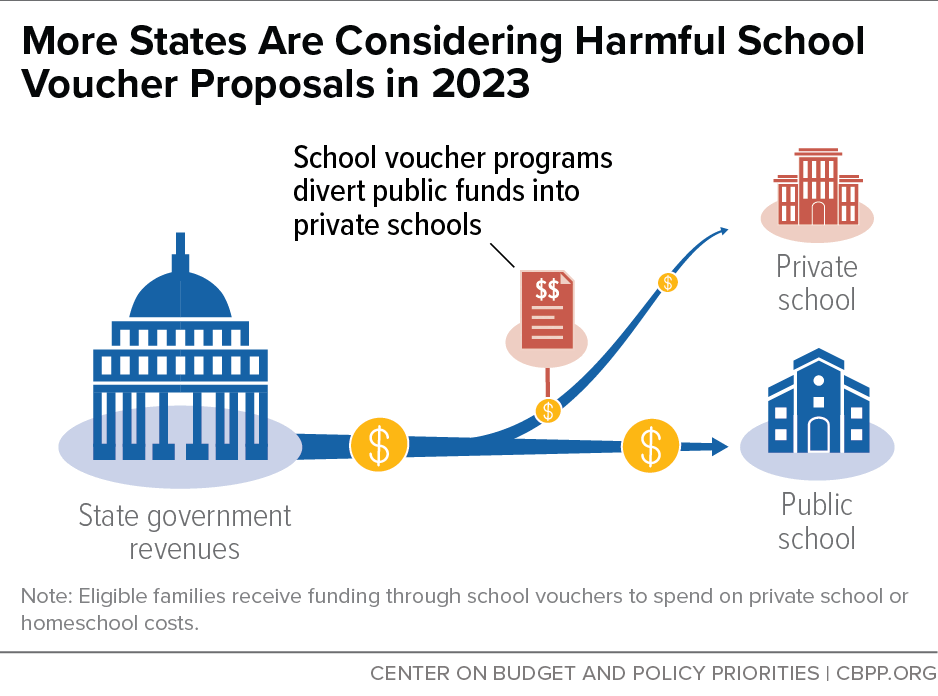
More States Are Considering Harmful School Voucher Proposals in 2023

The graph above appeared in an earlier version of this report, published in March 2023.

The following post by Jess Piper was reposted by the Network for Public Education. Jess Piper is a fearless rural mom in Missouri who supports public schools.

New post on Network for Public Education.

Jess Piper: Poisoned Water in Missouri Public Schools? Let The Kids Eat Cake.

Jess Piper is a powerful defender of public education on TikTok and other social platforms. In this post, she talks about a recent run-in with Jean Evans, head of Betsy DeVos’s advocacy group in Missouri.

As a former public school teacher, with 16 years in the classroom, and an outspoken advocate for rural public schools, I have had more than my fair share of dealings with Jean. A few stand out in particular: one in which she said that “educational freedom” in rural Missouri is not a brick and mortar building staffed with certified teachers, but one in which rural kids could attend online schools and hire private tutors. That sure would free up some time for these kiddos to go to work, am I right?

Yes, she knows there is no school choice in rural Missouri, but our kids don’t deserve it anyway. I mean, we are just hayseeds out here and what do we expect?

That response is very indicative of the thought pattern for the grifters who want to privatize public schools…whose intentions are to siphon taxpayer money to private hands. But, what I loathe, yet enjoy, so much about Jean Evans is her ability — no, her insistence— on saying the quiet part out loud.

Yes, she works for a billionaire to defund Missouri schools. Yes, she is willing to say that defunding rural schools will displace children and close their schools.

But, what else is she willing to say publicly?

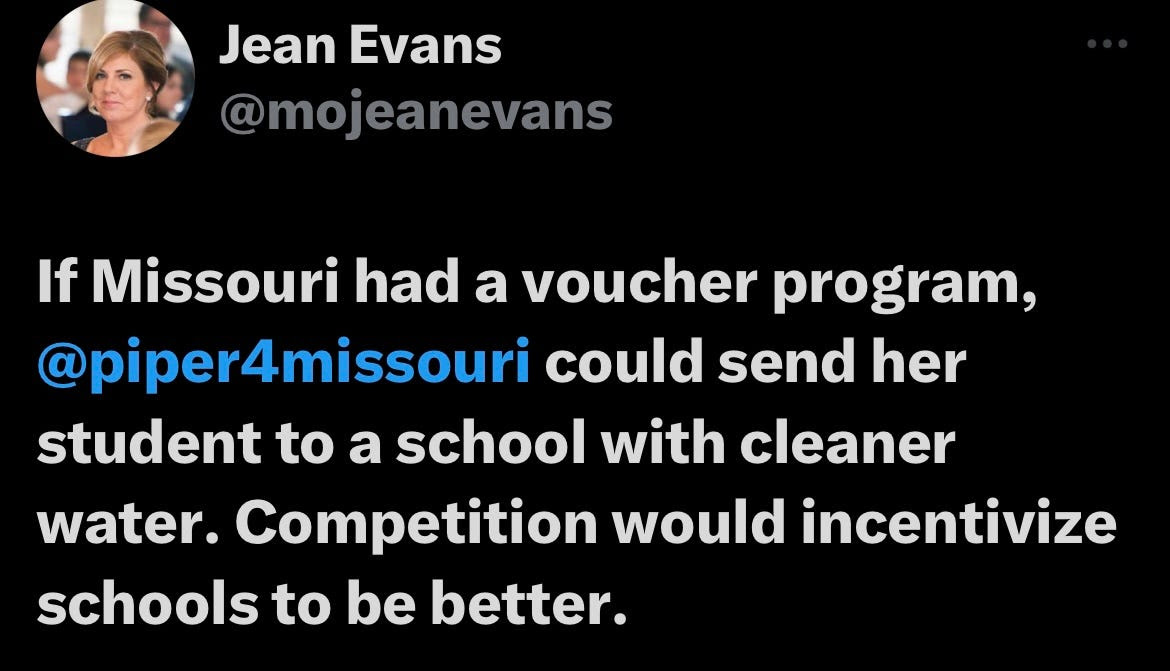
She was willing to tell me that the rural kids at my local public school would be deserving of clean drinking water if only Missouri would pass a voucher program. One may wonder if Jean herself snacked on too many lead paint chips as a child?

It all started with a letter from my local school reporting on the findings of lead in the water at the school. Most water sources were within EPA levels of lead in the water—not particularly great news, but I suspect most old schoolhouses reported much of the same. One faucet, in the nurse’s office, reported an elevated level more than four times the recommended limit. The school is addressing the water faucet and is attempting remediation. No children will drink this water.

I tweeted the findings and reminded my Twitter audience that over 80% of Missouri children test positive for lead in their blood. Jean responded by tweeting this:

Yes, if only we would expand Missouri’s current ESA scheme to defund schools and agree to a full-on voucher scheme, maybe the kids in my town wouldn’t be drinking poisoned water? If only rural folks would acquiesce to closing our schools and going along with the plan to keep our rural kids at home for online learning, and the occasional visit from a tutor, our kids wouldn’t be drinking lead.

Read the full post here.You can view the post at this link : https://networkforpubliceducation.org/blog-content/jess-piper-poisoned-water-in-missouri-public-schools-let-the-kids-eat-cake/

John Thompson, historian and retired teacher in Oklahoma, noticed that the Carnegie Unit is under fire. Do you know what a Carnegie Unit is? It’s a measure of time spent learning a subject. Here’s the definition on the website of the Carnegie Foundation for the Advancement of Teaching:

The unit was developed in 1906 as a measure of the amount of time a student has studied a subject. For example, a total of 120 hours in one subject—meeting 4 or 5 times a week for 40 to 60 minutes, for 36 to 40 weeks each year—earns the student one “unit” of high school credit. Fourteen units were deemed to constitute the minimum amount of preparation that could be interpreted as “four years of academic or high school preparation.”

Why is this controversial?

John Thompson explains:

I was stunned when reading the opening paragraph of Mike Petrilli’s “Replacing Carnegie Unit Will Spark Battle Royale.” Petrilli is the president of the corporate reform-funded Thomas B. Fordham Institute, with a history of fervent support for Common Core. But now, Petrilli warns of the ways that the Carnegie Foundation’s and Laurene Powell Jobs’ XQ Institute’s competency-based model could open a “Pandora’s Box.” He writes:

The scant coverage of this initiative—and the limited number of players involved—implies that many see this as just a technocratic reform, one that merely seeks to replace “credit hours” with mastery-based approaches to learning. Don’t be mistaken: If it gets traction, this move is likely to spark a battle royale that will make the Common Core wars look like child’s play.

While recognizing the Carnegie Unit – where graduation standards are driven by time in class and credits earned – is flawed, Petrilli correctly argues “we can’t just focus on ‘disrupting’ the current system.”  Moreover, he says the heart of this disruptive model would be “a lot more high-stakes testing.”

Petrilli notes that a rapid, digital transformation of schooling “has huge potential upsides for high-achieving students.”  Even though Petrilli was one of the true believers in college-readiness who pushed Common Core without, I believe, adequately thinking ahead, he now asks whether they should set the graduation bar “at the ‘college-ready’ level” if that “means denying a diploma to millions of young people who are nowhere near that bar today and not likely to clear it tomorrow?” For instance:

How do we deal with the enormous variation in student readiness upon arrival in high school? Will the new system allow students prepared to tackle advanced material to do so, even if it means further stratification along line(s) of achievement, race, and/or class?

In 2019, Chalkbeat reported on the slow growth and mixed successes and setbacks of Jobs’ innovation schools. Back then, Matt Barnum wrote, “what kinds of change, exactly, XQ wants people to get behind remains unclear to some.” And he quoted Larry Cuban on the number of schools that abandoned the effort, “To have that kind of mortality rate at the end of three years — that would strike me as high given that huge amount of money.”

And, I’d certainly worry about transformative changes, such as those pioneered in Rhode Island, that are “driven” by XQ’s Educational Opportunity Audit (EOA). Given the failure of data-driven reformers’ efforts to create reliable and valid metrics for measuring classroom learning “outputs,” it’s hard to imagine how they could evaluate the learning produced by the large (perhaps limitless?) number of their untested approaches.

I followed the few links to Tulsa’s experiment, under Deborah Gist, to “re-imagine” high schools.” In 2019, the district received $3.5 million for three schools for “Tulsa Beyond,” using a “nationwide high school redesign model,” which was “funded through Bloomberg Philanthropies and XQ Super Schools.”  It would be hard to evaluate any reforms’ outcomes during the Covid years and today’s rightwing attacks. But, then again, those reforms were based on the claim that data-driven accountability can do more measurable good than harm.

Only two of the three Tulsa schools have published state “grades” before and after their experiment.  Daniel Webster H.S received a “D” in both 2017-2018, and a “D” in 2021-2022. Nathan Hale H.S received an “F” in both years. Again, I don’t have data to make a serious evaluation of the Tulsa reforms, but it is the corporate reformers who have promised a method of evaluating them. And they should carry the burden of proof, as opposed to dumping the costs of failed gambles on students.

Petrilli’s article, and the sources he cited, convinced me that the push to replace the current system without learning the lessons of edu-political history and adequately planning for a post-Carnegie Unit era is extremely worrisome. I checked with another corporate reformer who I have opposed, but also respect, about the lessons of history that mastery-learning advocates should consider. He said, “Nothing ever gets learned.” Given the failed track record of the disruptive change, as well as Petrilli’s advocacy for it, we need to pay attention when he goes on record saying that the under-reported story of “‘multiple pathways’—via multiple diplomas” could create “multiple pitfalls.”

This is the most bizarre story I have read in many a day. The Boston Globe reported on a study showing a “serious literacy crisis” among the state’s youngest children. This is strange because Massachusetts regularly performs at the top of NAEP reading assessments.

The study was conducted by WestEd, a research group based in California. Apparently the researchers assessed the literacy skills of children in kindergarten, first and second grades. It is not surprising that most children in K and 1 and even 2 can’t read. They are only beginning to read.

The story starts:

A new state-commissioned study of young elementary students found that more than half showed early signs of reading difficulties — more evidence that the state has a serious literacy crisis, despite its reputation for educational excellence.

The report, released Friday, provides a first-of-its kind look at the reading skills of the state’s youngest children, whose reading prowess is not assessed by the state until the first MCAS exam in third grade.

The results are troubling: Nearly 30 percent of students in grades K-3 were at high risk of reading failure, and as many as 20 percent showed signs of having dyslexia, a language processing disorder that must be addressed with specialized reading instruction. Low-income students, those learning English or receiving special education services, Latino students, and Black students were most likely to experience reading struggles, according to researchers with WestEd, a San Francisco-based nonprofit that conducted the analysis.

The report suggests schools are not helping most struggling readers catch up: 60 percent of students who began the school year at risk of reading difficulties ended the school year in the same concerning position. But it found that younger students are much more likely to improve with extra help than older students are, a powerful argument for early intervention…

The extent of the state’s early literacy struggles have been laid bare annually in MCAS results, which, as the Globe’s Great Divide team previously reported, regularly show tens of thousands of students advancing from grade to grade without the reading skills they need to be successful.

The Globe investigation found nearly half of the state’s school districts last school year were using a reading curriculum the state considered “low quality.” A national nonprofit ranked Massachusetts this year in the bottom half of the nation in preparing educators to teach reading.

Massachusetts has not, as other states have, required evidence-based methods of reading instruction.

The “national nonprofit” that gave low scores to teacher education programs in the state is the National Council on Teacher Quality, a conservative group created by the Thomas B. Fordham Foundation and the George W. Bush administration. Its goal is to promote phonics. When NCTQ ranks Ed schools, it doesn’t visit them; it reads their catalogues.

If Massachusetts has a “serious literacy crisis,” the rest of the nation is a dumpster fire.

On NAEP, fourth grade students in Massachusetts typically score at or near the top in the nation. The percentage of students in Massachusetts who performed at or above NAEP Proficient in 2022 was 43%.

NAEP Proficient is equivalent to an A.

The only jurisdiction with higher scores in fourth grade was the Department of Defense schools. Five states had scores that were not significantly different from Massachusetts. Those six states outperformed 45 states and jurisdictions in fourth grade.

The point of the WestEd study seems to be that the state must push through a greater emphasis on phonics in teacher education programs, and that MCAS testing in grade 3 should start sooner.

The children who need extra help are low-income, limited-English, or in need of special services, etc. This is not news.

The “serious literacy crisis” looks and smells like a manufactured crisis. This report looks like a hit job on the state’s teachers and colleges of education. If the rest of the nation’s children matched the performance of those in Massachusetts, that would be cause for a national celebration.

Geert Wilders is a Dutch politician who has espoused anti-Islamic views for many years. He has campaigned on a platform of putting Dutch people first and blocking immigration from Muslim countries. He has been called the Dutch Trump. In the recent parliamentary elections, his party came in first among a field of 15 parties. It won 37 of 150 seats and will need to persuade other parties to join in a coalition in order to govern. In the past, Wilders has promised to close mosques and Islamic schools, but he is already moderating his hardline views to win over partners. Wilders will need 76 votes—39 more than he has now— to form a new government.

The BBC reported:

Veteran anti-Islam populist leader Geert Wilders has won a dramatic victory in the Dutch general election, with almost all votes counted.

After 25 years in parliament, his Freedom party (PVV) is set to win 37 seats, well ahead of his nearest rival, a left-wing alliance.

“The PVV can no longer be ignored,” he said. “We will govern.”

His win has shaken Dutch politics and it will send a shock across Europe too…

He told the BBC that “of course” he was willing to negotiate and compromise with other parties to become prime minister.

The PVV leader won after harnessing widespread frustration about migration, promising “borders closed” and putting on hold his promise to ban the Koran

A Wilders victory will send shockwaves around Europe, as the Netherlands is one of the founding members of what became the European Union.

Nationalist and far-right leaders around Europe praised his achievement. In France, Marine Le Pen said it “confirms the growing attachment to the defence of national identities”.

Mr Wilders wants to hold a “Nexit” referendum to leave the EU, although he recognises there is no national mood to do so. He will have a hard time convincing any major prospective coalition partner to sign up to that.

He tempered his anti-Islam rhetoric in the run-up to the vote, saying there were more pressing issues at the moment and he was prepared to “put in the fridge” his policies on banning mosques and Islamic schools.

The strategy was a success, more than doubling his PVV party’s numbers in parliament.

For Americans, the elections in the Netherlands and Argentina raise an urgent question: are these elections a portent of the persistence of far-right politics or are they the after-effects of the Trump era? Are they the future or an echo of the past?

Thom Hartmann analyzes the implications of the recent presidential election in Argentina. The victor was an unconventional candidate with bizarre ideas and minimal experience in office. We have already had our Trump. Now it’s Argentina’s turn.

Hartmann writes:

I hope I’m wrong, but I think I just saw the future of America if Republicans manage to sweep the 2024 elections, Trump or no Trump.

Argentina just embarked on a Grand Experiment, untried before in any developed country in the world; it’s one that multiple American billionaires have been pushing in the US ever since David Koch ran for VP on the Libertarian ticket in 1980.
When I arrived at the airport in Buenos Aires on Sunday morning this week, Election Day, I asked my cab driver who he’d be voting for and why.

The cab driver said he would assuredly vote for Javier Milei, because inglation was out of control and things couldn’t get worse.

I asked him about the Libertarian Congressman’s (and now newly elected president’s) plans to replace the national “Medicare for All” type of healthcare system Argentina has with American-style private, for-profit health insurance plans that people must finance out of their paychecks (if they have a job, otherwise they’re SOL); to end the nation’s free colleges; and his plan to turn all the nation’s public schools and prisons over to “entrepreneurs” to run for profit.

And what about his promise to end all government support for average people, including disability payments, unemployment insurance, and all forms of welfare? His saying that abortion is murder and he’ll re-criminalize it, along with ending women’s and queer rights?

He shrugged.

“Things can’t get any worse,” was his terse reply, adding that he’s driving an airport car as a second job because inflation has wiped out the income from his regular job. This working two and three jobs, he said, has become common across the country.

Argentina has been suffering from an ongoing economic crisis for decades, but it got really bad when the “currency crisis” hit the nation in 2018 after they complied with IMF demands, wiping out half the purchasing power of the peso virtually overnight.

Much like the United States, up until the 1960s Argentina had a top income tax bracket of 90%, which stabilized the economy and prevented massive wealth inequality. Subsequent administrations, including the military dictatorship, cut that down to 35%, like today’s US, with enough loopholes that, like America, most billionaires pay virtually nothing.

Like the US, they also cut taxation on capital gains (although they’ve taken them all the way down to zero), giving a huge boost to Argentina’s morbidly rich and stripping massive amounts of revenue from the federal government.

Their draconian tax cuts, like Reagan’s, drove huge federal deficits. Right wingers, citing the deficits, demanded cuts in social programs, but, until now, weren’t successful in gutting Social Security and other social programs in either country.

In part, because the US dollar is the world’s reserve currency, we can sell debt (treasuries) to finance our deficits; Argentina has a much harder time, because nobody else uses the peso and international investors are wary, so they’ve been pursuing a policy of printing money and borrowing from the IMF, which has debased their currency leading, in part, to today’s massive inflation.
Inflation this year has been over 100%, exacerbated by previous presidents experimenting with neoliberalism as demanded by the IMF, irresponsible borrowing, along with several years of climate change-induced drought which have badly damaged Argentina’s agricultural production, driving up food prices.

Milei’s opponent in Sunday’s runoff election was the nation’s finance minister, so he took much of the blame for the state of things while Milei — often referred to as “Argentina’s Trump” because he’s a wealthy former TV star, tantric sex instructor, and crackpot economist with no governmental experience other than his first year in parliament — promised to dump the rapidly devaluing peso and replace it with the US dollar. (He campaigned carrying around a chainsaw, saying he was going to take it to “welfare,” the “deep state,” and the nation’s social programs.)

When Milei won the top slot in the runoff election a few months ago, his victory caused the peso to fall further, as markets anticipated mass chaos resulting from the possible implementation of his plan to abandon the Argentinian currency if he won the general election. (It’s going to require huge cooperation from the IMF, and they don’t seem inclined to want to help.)

His primary win set off a run on the peso and produced a further currency devaluation (inflation is at 143% today) which, in turn, caused greater voter discontent. Ironically, that funneled more votes to Milei, who overwhelmingly (55%) won Sunday’s election.

The Libertarianism that Milei and American politicians like Rand Paul and Mike Lee embrace, as I’ve noted previously, is a political/economic system that was invented and named in the 1950s by a front group for the real estate lobby to rationalize their opposition to rent control, which was then spreading out of New York City and across America.

It basically argues, as Koch did in his 1980 campaign, that the only “commons” (things publicly owned and administered) a country can legitimately claim are the police and the courts.
They, in turn, have the primary job of making sure that property rights of wealthy people supersede all other rights, including the rights to healthcare, education, clean air and water, protection from abuse by employers, housing, and anti-poverty programs (including Social Security). All of these, Libertarians will tell you, are simply vestigial forms of socialism (or communism) and should be turned over to billionaires or giant corporations.
Libertarians’ key rationalization for this is that “private industry is always more efficient than government,” an argument that, while false, anybody who’s ever stood in line for an hour at the DMV can understand.

Ever since the 1980s, when Reagan embraced the libertarian worldview claiming that, “The nine most frightening words in the English language are, ‘I’m from the government and I’m here to help,’” the GOP has increasingly embraced Libertarian policies. Republican presidential candidates now compete for who can gut or shut down the most federal government agencies, from the EPA to the DOE to, well, ask Rick Perry.
Milei haș taken it so far as to say that poor people should feel free to sell their body parts, children, and organs to wealthy people on private, unregulated exchanges to pay their rent and medical expenses.

Billionaires and big corporations love Libertarianism because they end up with all the formerly-government-run sectors that they can then turn into profit centers to rip off the public. And shutting down regulatory agencies like the EPA, Interior, and USDA means they no longer have to pay for pollution controls, food safety systems, and other pesky protections for the “little people.”

Probably the example most Americans would recognize is Medicare Advantage, a privatized health insurance scam for seniors that makes billions in profits every week for our largest insurance companies while routinely refusing to pay for doctor’s visits, procedures, and even hospitalizations. It’s literally killing people by denying them care.

Milei ran on the promise of shutting down 10 of Argentina’s 18 federal agencies, throwing most of his countrymen, women, and children into the arms of the nation’s largest and richest corporations and the billionaires who own them.
He’s also a climate change denier, winning him — like Trump — the support of the nation’s fossil fuel industry, claiming the country’s drought and wildfire problems are part of natural climate variations.

Milei is a climate change denier, so count on Argentina to do nothing to mitigate climate change.

Milei claims that any attempts to “fix the problem of hunger” or “fix the problem of poverty,” or even deal with unemployment is “communism or socialism”; all of these problems should be left to billionaires and giant corporations to solve through private charity or minimum wage work.

Programs like public schools, the free college system that Argentina has that allows any capable student to become a doctor or lawyer at no cost, their national healthcare system, housing supports, Social Security, and even a minimum wage and unemployment insurance are “abhorrent,” Milei says. He claims that “social justice” is simply another word for “theft from rich people.”

Rightwing Republicans were giddy about Argentina’s new president.

Trump posted to his vanity Nazi-infested social media site, “MAKE ARGENTINA GREAT AGAIN!” while Vivek Ramaswamy tweeted, “May the spirits of {neoliberalism’s founders] Mises & Hayek be with you…”

Because Milei doesn’t have a parliamentary majority, it’s unlikely any effort to replace the peso with the dollar will to go anywhere, but all bets are off on his reconfiguring the federal government to trash the poor, gut social services, and privatize the nation’s schools, colleges, and medical system. Converting the country to dollars, however, would require a massive stock of the US currency that is simply unavailable within the country; the World Bank is suggesting they are unlikely to finance necessary reserves…

His victory is an international marker, of sorts, for America’s billionaires and largest corporations who share Milei’s desire to end liberal democracy and the so-called “welfare state” both in Argentina and around the world.

In its wake, expect to see the GOP double down on Milei-like language and policies as they try to drive America back toward their own libertarian ideal, which hundreds of years ago in Europe was simply known as “feudalism.”
Jeffrey Herf is a distinguished university professor of modern European history at the University of Maryland, College Park, and the author of Israel’s Moment: International Support for and Opposition to Establishing the Jewish State, 1945-1949 (Cambridge University Press, 2022).

Since I am posting this exposé of Hamas, let me make clear that I oppose the Netanyahu government. I oppose the indiscriminate bombing of Gaza. I deplore the wanton killing of civilians. I was sickened by the barbaric murders, rapes, pillage, and hostage-taking on October 7. I support a two-state solution (Hamas does not). I pray for a time when two self-governing states live side by side in peace.

In this article, Herf explores the sympathy of leftists and liberals in the West for Hamas, a terrorist organization. He analyzes the Hamas charter of 1988 and its revision in 2017, whose language was intended to place Hamas in the mainstream of leftist ideology about resistance to colonialism and to obscure its historic anti-Semitism and its determination to extinguish the state of Israel.

He begins:

The mass murders by Hamas on October 7 were the outcome of its core ideology, clearly expressed in its founding charter of 1988. That “ideology of mass murder” has its origins in the fusion of Nazism and Islamism that first took place in the 1930s and 40s, and then persisted in the Islamist politics of the Muslim Brotherhood in Egypt, of which Hamas is an offshoot. Hamas’ ability to gain supporters, first in the universities, now in the streets, rests as well on its revised charter of 2017, which draws on the anti-Zionism of the secular Left. Hence a close reading of the revised charter, whose language and arguments now echo on campuses and in the streets, is in order.

The authors of the Hamas charter of 1988 were explicit about their ideological connections to the radical antisemitic conspiracy theories that had emerged in 20th-century Europe, and to the virulent hatred of Jews, Judaism, and therefore Israel that they derived from their anti-modernist Islamist interpretation of Islam. Yet the deadly implications of this document received far too little attention in the mainstream media of the West, despite being easily accessible online in English and German translations. Instead, an objectively pro-Hamas Left began developing among academics in Europe, Britain, and the United States, as became apparent in 2014 during one of Hamas’ attacks on Israel. They found themselves in the peculiar position as leftists of repeating Hamas’ arguments.

They did so because they had adopted the view of Israel that had become the common coin of the international Left since the 1960s. According to that view, the Jewish state is in reality a colonialist and racist endeavor built on the expulsion of the indigenous population in 1948. Relying on that profound misinterpretation of the events surrounding Israel’s founding, they were willing to make common cause with an organization that is profoundly hostile to the modernist values that had long been associated with at least some segments of leftist politics.

Seventy years of Soviet and Palestine Liberation Organization (PLO) propaganda mischaracterizing Zionism and Israel, equally unbalanced UN resolutions, and New Left romance about third-world revolutions had placed Israel on the “wrong” side and the Palestinians on the “right” side of the global divide between oppressors and oppressed. In the course of doing so, a distinctive leftist form of antisemitism, expressed in the language of anti-Zionism and support for armed attacks on Israel, fostered an opening to support not only the secular PLO but also Hamas. In Britain, that support and leftist antisemitism gained political influence in 2015 when Jeremy Corbyn won election as the leader of the Labour Party. This bizarre fusion of the Islamist Right and the secular Left was the first time since the Hitler-Stalin pact that leftist organizations made common cause with a movement of the extreme right, and the only time I can recall when they supported a group rooted in religious fanaticism. Their shared antagonism to Israel surmounted the contrasting ideological starting points.

At the same time, the Hamas charter of 1988 remained an embarrassment at least for some leftist and liberal academics and intellectuals, for the anti-Zionist Left in the universities, and for activist organizations of the left. Its celebration of antisemitic conspiracy theories voiced by the Nazi regime was impossible to deny or justify, and its calls to take up arms against the Jews were unequivocal. Its selective quotations from the Koran offered very uncomfortable evidence that Hamas—in the tradition of Islamists from Haj Amin al-Husseini, Hassan al-Banna, and Sayyid Qutb, all associated with the Muslim Brotherhood—defined Islam as an inherently anti-Jewish religion. For those who thought like Karl Marx that religion was the opiate of the people, the Hamas charter of 1988 revealed that such a theologically induced drug had an Islamic component as well.

The revisions in the 2017 Hamas charter were intended to resolve those issues and present Hamas as a humanitarian organization that opposed Zionism, not Jews. The new language succeeded to the extent that leftist groups were celebrating the massacre of October 7, 2023, as soon as it happened.

Please open the link to read the rest of the article.