Archives for the month of: April, 2021

Please join me and the Network for Public Education in calling for an end to the federal Charter Schools Program. For the past four years, it functional as Betsy DeVos’s personal slush fund. She handed out $440 million a year, mostly to corporate charter chains.

Two studies by the Network for Public Educatuon combed through the records of the CSP and found that nearly 40% of the schools it funded never opened or closed soon after opening. The hundreds of millions the charter industry received were never returned.

Carol Burris wrote:

It is time for a moratorium on the federal Charter Schools Program (CSP). As Congress prepares the next budget, we need to let members know enough is enough. END CSP FUNDING

Right now, there are bills in seven states that would either establish charter schools or greatly expand them. This is in addition to additional bills to expand vouchers.

Right-wing Libertarians, funded by DeVos and the Koch network, are committed to destroying public education. And while they may prefer vouchers, charter schools are certainly part of their plan.

Send your email here

Here is the bottom line. The federal government should not be in the business of funding new charter schools, and as our two reports on the CSP demonstrate, the CSP program is rife with waste and abuse–funding schools that do not open, those that open and shut down, and those with policies designed to exclude disadvantaged students. As our latest report on for-profits shows, the CSP has generously supported the start-up of for-profit-run schools as well.

Send your email and then call your representatives in Congress. You can find your Representative’s phone number here and your Senators’ numbers here.

Below is a script you can use.

My name is [name], and I am calling to ask [Representative] to eliminate funding for the Charter Schools Program in the 2022 budget. The program has wasted approximately one billion dollars on schools the never opened or that have shut down. 

In addition, it lacks quality control and real accountability. It has funded charter schools run by for-profits, schools that do not participate in the federal lunch program, and schools that make special education students unwelcome. The program should be defunded in 2022. Thank you.

Please act today.

You can share our newsletter with this link: https://npeaction.org/cspmoratorium/

Thanks for all you do,

Carol Burris

Network for Public Education Action Executive Director

I know this is an education blog, but I sometimes take excursions into other areas of life that interest me.

So from time to time, I will share a few things that I have learned that I want to share.

Today I am going to tell you about the best treatment for leg cramps that I have ever discovered.

After I had a total knee replacement in 2014, I started getting occasional leg cramps that were beyond painful. My thighs would start cramping, then the rest of my leg, and the pain was excruciating. It would always catch me unawares, watching television, or while sleeping at night. There was nothing I could do other than wait it out, as tears rolled down my cheeks.

A couple of years ago, my son told me about a cure for leg cramps. I am always skeptical but it was worth a try. It’s called CrampsAway. It comes as little packets in a small box of 10. I bought a box online to give it a try. There is nothing in it but vitamins. It works. It is amazing. On three occasions since I bought it, I have had leg cramps and immediately opened the packet and swallowed the couple of tablespoons within. Cramps gone.

I am not a doctor or a physical therapist. I have no credentials. This is an over-the-counter product that you can buy without a prescription. It contains no prohibited substances. It worked for me.

In case you are wondering, I wrote this post in late March before my surgery. I’m guessing that at the moment, I am totally sedated on the operating table.

Jack Schneider is a historian of education at the University of Massachusetts in Lowell. He and Jennifer Berkshire recently published a superb book, A Wolf at the Schoolhouse Door, which I recommend to you.

The “Public” in Public Schools

There are two stories that we tell over and over these days about our schools. The first is that schools are a mechanism for getting ahead in our society. In a competition of each against every, schools are the ostensibly meritocratic sorting mechanism that determines who gets what. The second story is that schools are the engine of the economy. Education builds human capital, which in turn promotes economic growth.

These aren’t entirely wrong. Despite the fact that the privileged work feverishly to tilt the playing field for their children, schools can and often do serve a leveling function. And it is impossible to imagine the American economy thriving in the same way without an educated populace. Yet this is a torturously narrow way of understanding the value of public education.

We don’t have public schools in this country so that young people can win advantage in an unequal society (and we especially don’t have public schools so that racially and economically advantaged families can launder their privilege). Nor do we publicly fund education so that the private sector can reduce the costs of training labor. Instead, we tax ourselves to pay for universal K-12 education because public schools are the bulwark of a diverse, democratic society. 

The founders knew this. As early as the 18th century, leaders were making the case that education was too important to be left to the whims of the market. If the young republic was to be governed by the people, those people needed access to schooling. Of course, education wasn’t universal from the outset; racially minoritized students were excluded and segregated, low-income students attended poorly-funded schools, and students with disabilities were refused at the door. But access to public education increased in commensuration with the recognition of other rights. Over time, our notion of “we the people” has expanded most obviously in our schools, and the benefit of this has accrued to all of us. We live in a stronger and healthier society because of our investments in public education.

And public schools weren’t merely seen as purveyors of academic content. As early advocates like Horace Mann understood, an increasingly diverse society needed a mechanism for fostering civic relationships and mutual understanding. Schools could draw young people from various walks of life together under a common roof and teach them to work in common cause. Although this inclusive vision of education has often remained an elusive ideal, integrated schools are also a reality. They have strengthened all of the communities in which they exist, and at a time of increased social fracturing it is perhaps more important than ever to heed the wisdom of Thurgood Marshall—that “unless our children begin to learn together, there is little hope that our people will learn to live together.”

As Jennifer Berkshire and I document in our new book, A Wolf at the Schoolhouse Door (which Diane wrote about in The New Republic), public education in this country is presently facing an extinction threat. Those who wish to privatize it like to make the case that the “public” part of public education isn’t so important; in fact, they argue that it’s a liability. I vehemently disagree. In the nineteenth century, we had a system much like the one envisioned by the radical right. And is essential to remember that public education was developed as a replacement for that largely-private system, which had proven insufficient at advancing the public good. There are things that all young people in this country should learn, and common destinies for which they should be prepared. Moreover, this is work that should be done in equal fashion for all, since we all stand to benefit from the education of our populace.

We’ve been so distracted by the use of schools for social mobility and economic sorting that many of us have forgotten about the essential role education plays in making and sustaining an American public. Yet what other institutions do we have for fostering the kinds of civic virtues that increasingly seem so short in supply? Shall we leave it to private entities to build that public? Do we trust that the profit motive will advance the interests of us all? Whatever the flaws in our existing system, we risk tremendous harm in unmaking it. 

Karen Francisco is the editorial page editor of the The Fort Wayne Journal-Gazette in Indiana. She is one of the few journalists who are outspoken supporters of public education. I met her when I visited Fort Wayne in 2010 after the publication of The Death and Life of the Great American School System: How Testing and Choice Are Undermining Education. She offered the following post to help me get through the period when I am in the hospital and unable to write. She is brave, thoughtful, and relentless in standing up to the powerful elites in Indiana who are dismantling a once much-admired public school system.

Why I fight to save public schools

Karen Francisco, editorial page editor, The Fort Wayne (Ind.) Journal Gazette

There’s an episode of “The Twilight Zone” in which an airplane passenger looks out the window to see a monster dismantling the aircraft engine. His terror escalates when he realizes he’s the only one who can see it happening.

There have been many occasions over the past two decades where I have felt like William Shatner’s character in that classic episode: Why don’t people realize public education is being dismantled in front of their own eyes?  

That’s my motivation for fighting for public schools.  People must understand what’s at risk.

It was as a parent that I had my first glimpse of the destruction underway. On a back-to-school night in September of 2000, I listened as a middle school math teacher complained that he would not be introducing any new material until the state’s standardized tests were administered.  He had been instructed by the administration to spend the first six weeks of the school year reviewing fifth-grade math lessons to bolster performance on the tests.  I instantly knew why my then-sixth-grader was, for the first time ever, complaining he was bored in school.

As an opinion journalist, I have opportunities other parents don’t have to question elected officials. When our editorial board met the next week with the Indiana superintendent of public instruction, I recounted how my children were spending so much time reviewing past lessons, and I asked Dr. Suellen Reed why so much emphasis was being placed on standardized testing.  

She launched into the accountability talking points I could eventually recite by heart. It was my first clue that not everyone saw the damage I sensed was beginning to occur. A costly scheme to label public schools with failing grades would help convince taxpayers and parents that children from low-income households needed vouchers to escape those schools. 

To her credit, Reed would be among the first of Indiana’s elected officials to acknowledge where high-stakes testing was headed, but her resistance cost her the position she held for four terms.  The governor wanted a superintendent supportive of his privatization agenda, so he tapped Tony Bennett, an affable high school basketball coach with a newly earned superintendent’s license. Together, they pushed through massive charter school expansion and a voucher school program. When he signed the bill, Gov. Mitch Daniels literally gave it a kiss.

I am fortunate to work for a publisher who is a strong supporter of public education, so our editorial pages became a persistent voice challenging Indiana’s unbridled rush to privatization, and I was eager to write editorials and bylined columns about what was happening all around us. The governor’s press secretary called my editor to complain after I served on a panel at a public education advocacy event. On a visit to our newsroom, Bennett told me he thought of me as one of those angry parents screaming at the coach from the stands. 

Unfortunately, our editorial voice was about as effective as one of those basketball parents. The vast majority of our readers and area lawmakers were either supportive of the far-ranging privatization effort or silent.  It would have been easy to give in to the complaints from some readers that our editorial board was wrong to oppose school vouchers, if not for the voices of educators and academics.  

“The Death and Life of the Great American School System,” by the esteemed proprietor of this blog, was a revelation. I had the opportunity to interview Diane about the book and later to meet with her when she delivered a lecture at our regional university campus. Her address energized a growing community of ed reform critics. including Phyllis Bush, a retired Fort Wayne teacher who galvanized a group of educators under the Northeast Indiana Friends of Public Education. In West Lafayette, Indiana, Superintendent Rocky Killion teamed with Steve Klink, a staunch public education supporter, to produce  “Rise Above the Mark,” a 2014 documentary that was an early warning cry about the growing obsession with testing and its detrimental effects on education. The Indiana Coalition for Public Education joined the fight. Its board now includes three of the four former Indiana state superintendents, with Bennett being the exception.

I wish I could say Indiana has seen some success in fighting off the privatization monster, but that’s far from the truth. More than $1 billion has now flowed to private and parochial schools through the voucher program, with no accountability.  A scandal involving a virtual charter school cost taxpayers at least $85 million, with seemingly no concern from lawmakers or taxpayers. In the current legislative session, the Republican supermajority is throwing everything at school choice: income limits that make vouchers available to wealthy families, ESAs, full funding for online-only schools and more.

There was a time when newspaper editorial boards could move mountains. As my industry has withered, that is no longer the case. But I’m taking heart this year in a growing number of voices questioning the support of private and parochial schools at the expense of Indiana public schools. It seems like there are now many of us aware of the destruction and determined to stop the monster before it sends public education crashing to the ground. 

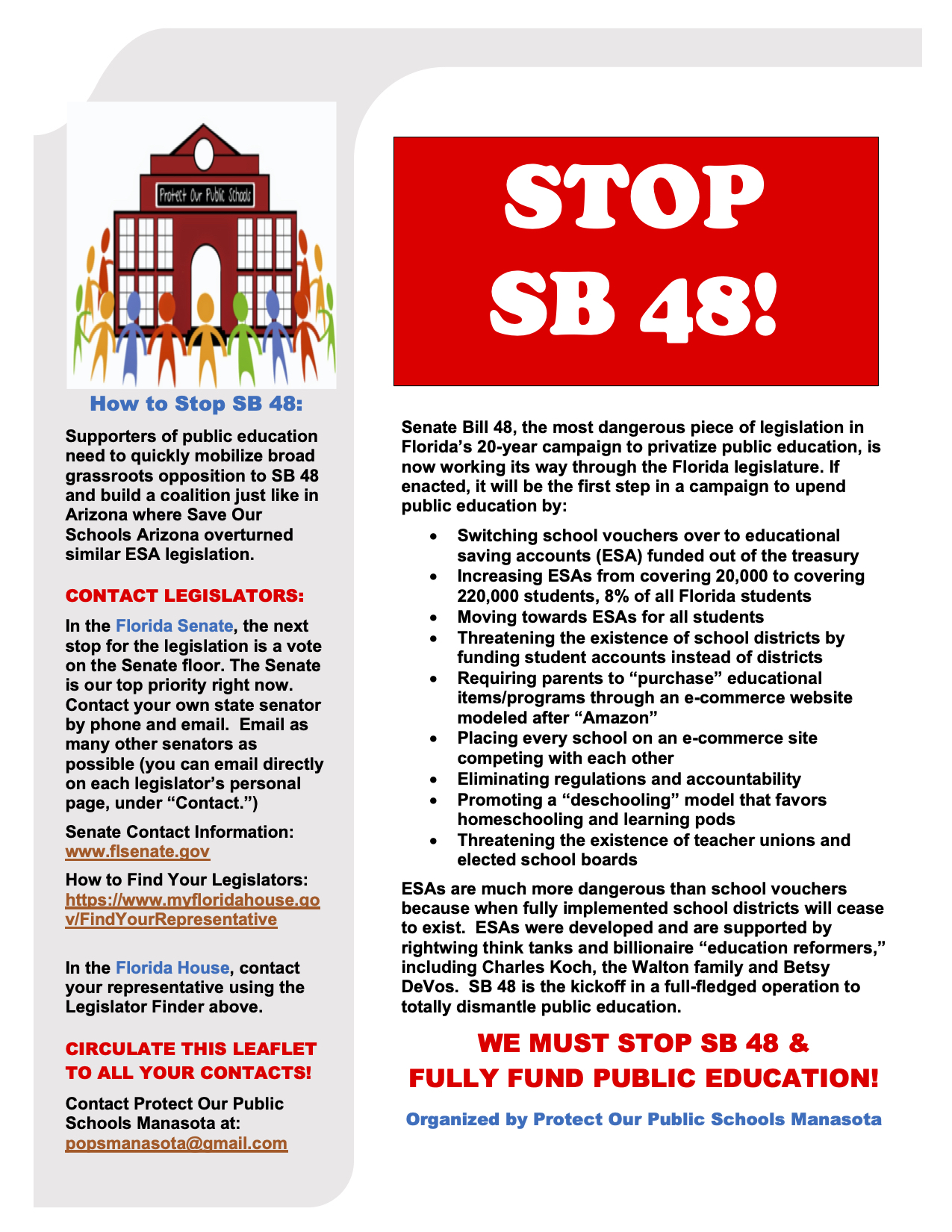
The privatizers are on the move again in Florida. They want to send billions more to unaccountable, low-quality voucher schools. They will take money away from your public schools to pay for vouchers for religious schools where students are not required to take state tests and teachers are not required to be certified. Stop the Steal of public education!

I recently had the pleasure of speaking to the North Texas School Boards Association by Zoom. Right now, Texas is ground zero for the charter industry. This is astonishing because the public schools in Texas far outperform the charter schools. The charter school lobby markets themselves as “saviors” of children, but they are far more likely to fail than public schools. This is a summary of what I told my friends in Texas:

I am a graduate of the Houston public schools. My father, who grew up in Savannah, never finished high school; my mother, who was born in Bessarabia, was very proud of her high school diploma from the Houston public schools.

I believe that all of us, whether or not we have children, whether or not we have children in public school, have a civic obligation to support public schools, just as we must support other public services, like police, firefighting, public roads, public parks, and public libraries. Taxes are the price we pay for a civilized society, and no investment is more precious than investing in the education of our children. They are our future. 

Texas, like every other state, guarantees a free public education to everyone. The clause in the state constitution says:

A general diffusion of knowledge being essential to the preservation of the liberties and rights of the people, it shall be the duty of the Legislature of the State to establish and make suitable provision for the support and maintenance of an efficient system of public free schools.

As constitutional scholar Derek Black shows in his book Schoolhouse Burning, the founding fathers of this nation wanted every state to provide free public education. They didn’t have it in their own time, but they saw it as essential to the future of the nation. In the Northwest Ordinance of 1785, the Founders said that any territory that wanted to become a state had to set aside one lot in each town for a tax-supported public school. Not a private academy supported by tax funds, but a tax-supported public school.

The leadership of Texas doesn’t care about the state constitution. Every time the legislature is in session, someone offers a bill to send public funds to religious schools, which are not public schools. Thus far, a coalition of urban Democrats and rural Republicans and the dedicated leadership of Pastors for Texas Children has defeated vouchers.

The Republicans who control the state have substituted charters for vouchers in their eagerness to provide alternatives to the right guaranteed by the state constitution. And they have not given up on vouchers.

Texas now has more than 800 charter schools. These are schools under private management, paid for with tax dollars. Contrary to their marketing strategy, they are not public schools. Some of those charters are part of big corporations, like KIPP or IDEA. Some are nonprofit schools that are managed by for-profit corporations. The GOP leadership wants more of them, even though the existing public schools are underfunded and have not recovered from a devastating budget cut of more than $5 billion in 2011.

When the idea of charter schools first emerged in the early 1990s, I was enthusiastic about their promise. I was in Washington, DC, working as Assistant Secretary of Education for Research in the first Bush administration. We heard from their sponsors that charter schools would be more innovative, would cost less than public schools because of their lack of bureaucracy, would be more successful, and would be more accountable than public schools because they were free of most regulations. 

Three decades later, this is what have we learned: 

   a). Charter schools are not more innovative than public schools. The only innovation associated with charters is harsh disciplinary practices called “No excuses,” where children are punished for minor infractions of strict rules. The largest charter chain in Chicago, the Noble Network, recently announced that it was getting rid of “no excuses” because it is a racist policy, meant to force black children to adopt white middle-class values.  

    b) Charter schools are not more accountable than public schools. In most states, the charter associations fight any effort to impose accountability or transparency. They don’t want to be audited by independent auditors. The only time they are accountable is when they close their doors because of low enrollment or abject academic failure. 

    c) Charter schools do not cost less than public schools. They typically demand the same public funding as public schools, even though the public schools pick up some of their costs, like transportation, and even though they have fewer high-need students than public schools. In some states, like Texas, charter schools get more public money than public schools.

    d) Charter schools are less effective than public schools. Those that have high test scores choose their students and families carefully and push out those they don’t want. On average they don’t outperform public schools, and they spend more money on administration than public schools. In some states, like Ohio, the majority of charter schools are rated D or F. 

Charters are unstable. They open and close like day lilies. Sometimes in mid-semester, leaving their students stranded.

The worst charter schools are the virtual schools. 

The state pays the cybercharters full tuition to provide nothing more than a computer, a remote teacher, and some textbooks. They charge double or triple their actual costs.

Virtual charter schools have high attrition rates, low graduation rates, and low test scores.

There have been huge scandals associated with virtual charter schools.

In Ohio, the Electronic Classroom of Tomorrow collected close to a billion dollars over 18 years. It was started by a businessman, who made generous contributions to political leaders. It had one of the lowest high school graduation rates in the nation. In 2017, ECOT was audited by the state and found to have collected tuition for phantom students. Rather than pay the state $80 million, ECOT declared bankruptcy in 2018. No one was fined, no one went to prison, no one was held accountable.

The biggest scandal in charter history was the A3 virtual charter chain. It had a massive scheme to enroll fake students. Eleven people were indicted. Eventualy, the leaders of A3 agreed to repay the state $215 million.

The largest of the virtual charters is K12 Inc; it is registered on NY Stock Exchange. Its results are familiar: high attrition, low test scores, low graduation rates. Their top executives are paid millions of dollars each. K12 is are operating in dozens of states.

Poor academic performance is not punished; financial fraud is not punished. There is no accountability. 

IDEA in Texas is in a class of its own when it comes to luxuries. They get hundreds of millions of tax-payer dollars, but they decided they needed to lease a private jet for their executives. When the story got into the newspapers, they dropped that idea. The media also reported that IDEA bought season tickets for special seating at San Antonio Spurs games. When the CEO decided to retire, he received a $1 million golden parachute. How many school superintendents do you know who got such a generous going-away present?

Charter schools claim that they “save poor kids from failing schools.” 

That’s not true. There are currently some 356,000 students in charter schools in Texas. Three-quarters of them are enrolled in charter schools in A or B school districts. The charter school students are being drawn away from successful schools in successful districts.

The charter lobby claims that there are long waiting lists. Don’t believe it. The so-called wait lists are manufactured. They are never audited. In Los Angeles, at least 80% of the existing charters have empty seats, yet still the lobbyists talk about wait lists. In New York City, charters buy advertising on city buses. When you have a waiting list, you don’t buy advertising.

The charter industry in Texas has a number of charter expansions already approved and expects to grow by 50,000 students every year. Unless the legislature plans to increase spending on education, charter growth will mean budget cuts for public schools. Charters in Texas currently divert $3 billion a year from public schools. Since they started, they have diverted more than $20 billion that should have gone to the state’s public schools. 

Charter schools in Texas are not more successful than public schools. Texas researcher William Gumbert reported that 86% of public school districts are rated either A or B by the state, compared to 58.6% of charter schools. Only 2.6% of public school districts were rated D or F, compared to 17.7% of charter schools.  

Texas Public Radio reported that graduation rates at charter schools were 30 points lower than the rates at public high schools. 

Two economists—Will Dobbie and Roland Fryer—studied the outcomes of charter schools in Texas. They concluded that charter schools have “no impact on test scores and a negative impact on earnings.”

William Gumbert, an independent analyst in Texas, has calculated that graduates of charter schools enter college less well prepared and are less likely to perform well in college, compared to students who went to public schools. He reported that the 2019 state ratings showed nearly 40% of charters approved by the state have been closed. 

The charters claim that they can close historic achievement gaps between children of different racial and ethnic backgrounds. This is not true. According to careful research by analyst Gumbert, public schools do a better job of narrowing the achievement gaps between black and white students and between Hispanic and white students than charters in the same districts. 

Again, using state records, Gumbert found that graduates of public schools were more successful in college than graduates of charter schools. Public school graduates were more likely to have a higher grade-point average in freshman year than charter school graduates. First-year grade-point average has been shown to predict college graduation. 

Now the charter industry is lobbying for a vast expansion in Texas. They don’t want to have to deal with elected school boards or other elected officials. Democracy is a nuisance, an obstacle. So they are promoting SB 28, which would remove any elected school boards or elected municipal officials from the charter approval process. The state board of education could veto a charter application only with a supermajority. Only one appointed state official—the State Commissioner, appointed by the Governor– would decide whether charters may invade your district, recruit the students they want and locate the charter school wherever they want. That is a major blow to local control of schools. 

Why are state officials in Texas, why is the Legislature, opposed to local control of schools?

After three decades of experience, we have learned about the policies and practices of charter corporations.

First, many charter schools are run by non-educators. They see a business opportunity and they compete for market share. 

Second, they market charter schools by making extravagant claims. They promise that their students will be successful in school and will go to college even before they open their doors. As we have seen, this is usually false.

Third, the few that get high test scores do so by cherry-picking their students or by setting the standards so high that only high-scoring students choose to enroll. BASIS is an example of that. Students have to pass a certain number of AP exams to graduate, so average students need not apply. In Arizona, where most of the state’s students are Hispanic or Native American, the BASIS schools enroll mostly white and Asian students.

Fourth, some charter schools raise test scores by pushing out students who get low scores. That means excluding students with disabilities and students who don’t speak or read English. It also means counseling out or finding creative ways to discourage the kids who are discipline problems or the kids who perform poorly on tests. The most successful charter chain in NYC accepts kids by lottery in kindergarten. Then they begin weeding out those they don’t want, and after third grade, no new students are accepted. By senior year, most of the students who started in K or first grade have disappeared

Fifth, charter schools typically hire young and inexperienced teachers who cost less than older experienced teachers. The turnover is high—sometimes as much as half the staff leaves every year and is replaced by newcomers to teaching. 

Sixth, the true secret of charter expansion is the money behind them. They are supported by a long list of billionaires who want to eliminate public schools. They mock our community schools as “government schools,” but they might as well mock our community police officers as “government security agents.” Our community public schools belong to “we, the people.” We pay for them with our taxes. They reflect our community history. They have the trophies that our parents, our cousins, our aunts and uncles won at football, basketball, baseball, volleyball, chess, and debate tournaments. They are audited and overseen by our neighbors. We elect the school board, and if we don’t agree with their decisions, we elect another one. 

Don’t give your public dollars to entrepreneurs and corporations to educate your children. 

Don’t replace your public schools with a free market where schools compete for customers. Markets produce winners and losers, not equality of educational opportunity. Use your tax dollars to make your public schools the best they can be for all the children.

Whatever your political views are, these schools belong to you, not to Wall Street or libertarian billionaires or opportunists. Tell your legislators to support your public schools. 

School choice means that the schools choose.

Public schools must take everyone. 

School choice is a hoax.

Don’t fund failure.

At a time when there are so many divisions in our society, we need our public schools to teach appreciation for our common heritage as Americans and as Texans.

I especially appeal to those with conservative values: Conservative conserve. Conservatives don’t blow up traditional institutions. People who want to blow up community institutions are anarchists, not conservatives.

Preserve and improve your community public schools for future generations. 
Carol Corbett Burris was a teacher and principal on Long Island, in New York state for many years. After retiring, she became executive director of the Network for Public Education.

She writes:

Last spring, HBO released Bad Education, which tells the story of how a Roslyn, New York Superintendent named Frank Tassone conspired to steal $11.2 million with the help of his business officer, Pamela Gluckin.  Promo materials called the film “the largest public school embezzlement in U.S. history.”

I did not watch it. I am waiting. I am waiting for HBO to release a movie on how a crafty fellow from Australia, Sean McManus, defrauded California taxpayers out of $50 millionvia an elaborate scheme to create phony attendance records to increase revenue to an online charter chain known as A3. 

Or the documentary about the tens of millions that the Electronic Classroom of Tomorrow (ECOT) owes taxpayers for cooking the books on attendance. Or perhaps there will be a mini-series about the fraud and racketeering that charter operator Marcus May engaged in that brought his net worth from $200,000 to $8.5 million in five years and landed him a 20-year sentence in jail. 

The truth is, Frank Tassone and his accomplice are small potatoes compared to the preponderance of charter school scandals that happen every day. What is different is how lawmakers respond. 

When the Tassone case hit the news, I was a principal in a neighboring district. The New York State Legislature came down hard with unfunded mandates on public schools.

We all had to hire external auditors and internal auditors that went over every receipt, no matter how small. Simple things like collecting money for field trips or a club’s T-shirt sale suddenly became a big deal. Although there was no evidence that any other district was engaging in anything like what happened in Roslyn, every district transaction came under scrutiny.

Whether those regulations and their expenses were justified or not is irrelevant. What is relevant is that despite the years and years of scandal in the charter sector, state legislatures never change laws or impose new rules. For-profits run schools doing business with their related companies behind a wall of secrecy, and lawmakers do not worry a bit. 

I am puzzled. Why can’t charter schools be as transparent as public schools?  Why is the ability to easily engage in fraud necessary to promote innovation? 

No one has been able to answer my question yet. 

In New York, several school districts announced an “opt in” policy for state testing, led by the Ossining School District. The deal: If parents want their children to take the tests, they must write a letter asking for them to “opt in.” Other districts followed. Now the entire state of New York will allow districts to have an “opt in” policy. If parents want their child tested, it will be done. If they don’t, they don’t have to “opt out” or do anything. Some districts may prefer to stick with the old way of requiring everyone to take the tests.

This is a remarkable turn of events!

The U.S. Department of Education has denied waivers to states that don’t want to administer the tests. This was an incredibly tone-deaf decision that brought an outcry from educators and parents, who know it is unfair to administer standardized tests in the midst of a pandemic. During the campaign, candidate Joe Biden promised to get rid of the annual standardized tests. But his test-happy minions in the Department of Education issued a decision breaking his promise, even before Secretary Cardona was confirmed. He has had to explain and try to justify an very bad decision.

May New York’s Opt-In strategy travel far and wide!

Valerie Jablow is a parent advocate in the District of Columbia. Here she remembers Elizabeth Davis, the president of the Washington Teachers Union, who died tragically in an automobile accident on Easter evening. She was part of the new wave of teacher unionism, which is social justice unionism, a commitment not just to the benefits of teachers but to the well-being of students and to their opportunity to have a well-resourced and equitable education.

Teaching for Change posted this beautiful tribute to Liz Davis and her amazing life in DC. It is both a very welcome personal history–and the story of our DC schools.

Indeed, Liz Davis’s work as the head of the Washington Teachers’ Union has lived larger in my life as a DCPS parent than that of all other DC education leaders I have known put together—and touched the lives of hundreds of thousands of other DC residents. Just since the start of 2021, my email inbox has broadly distributed messages from Liz about needed action on nearly every current pressing matter in DC education, including the research practice partnership, DCPS re-opening, PARCC testing, a survey about teacher computers, re-examining school governance, and school librarians being excessed.

Our mayor may be in control of our schools—but no mayor, and no other elected or appointed leader in DC, has ever been in command of DC education advocacy and justice like Liz Davis. Her tenacity in the face of injustice has been both balm and shield for everyone who has battled for better schools in DC.

Yet always, always, behind everything I ever knew she did or said was that quiet, unflagging belief in a better, more equitable future, which seems to be the legacy of every great teacher. When I chose to sue DC over the chancellor selection panel excluding teachers, parents, and students and had only a few plaintiffs, Liz Davis simply put me in touch with a teacher who agreed to be a plaintiff. Then, without a word otherwise, Liz had the WTU submit an amicus brief. That document was indeed a friend (per the Latin word amicus) in what was for me, a DCPS parent, a notably unfriendly proceeding.

It is hard for me to believe that someone who was so alive is gone–and so suddenly. 

The last email I got from Liz was a letter to the chancellor about IMPACT, DCPS’s teacher review process. Fittingly, it came on April Fool’s Day.

Her last phone call to me was Easter morning, when she left a voicemail about a special education committee meeting this week she thought I might want to know about–and then noted what she thought were two important posts from this blog regarding IMPACT (here and here).

How lucky have we been to have known Liz Davis–and what a great teacher we have lost.

Privatization of important parts of the public sector is a great scourge of our times. No institution is more fundamental to the American Dream than public education, and it is under assault by powerful and well funded forces. By billionaires who have dreams of lower taxes and libertarians who want to destroy whatever government provides. We must fight privatization of the goods and services that belong to us.

Frankly we should join together to fight for a society where there are no billionaires and no poverty. Let us agree to take care of one another and have a fairer society, where everyone has a decent standard of living, where there is no hunger or homelessness. I recommend a book called The Spirit Level: Why Greater Equality Makes Societies Stronger, in which two British sociologists-Richard Wilkinson and Kate Pickett-demonstrate that societies with more equality are happier than those where great inequality persists. By contrast, scan Bloomberg Billionaires Index. I am not a socialist, but I don’t believe we should have either billionaires or poverty.

The pandemic impoverished millions of people. But the billionaire class got richer, much much richer. Senator Bernie Sanders said recently that the fifty richest people in this country have wealth equal to the bottom 50 percent of the population. That is gross, disgusting, obscene inequality.

Our nation and its democratic ideals are being undermined by extremes of wealth and income. The middle class is struggling not to slip into poverty.

From Forbes in 2018:

In the 1950s, a typical CEO made 20 times the salary of his or her average worker. Last year, CEO pay at an S&P 500 Index firm soared to an average of 361 times more than the average rank-and-file worker, or pay of $13,940,000 a year, according to an AFL-CIO’s Executive Paywatch news release today.

This is not the America I grew up in, and it’s not what America should be.

I have found these old English rhymes to be inspiring.

The law locks up the man or woman
Who steals the goose off the common
But leaves the greater villain loose
Who steals the common from the goose.

The law demands that we atone
When we take things we do not own
But leaves the lords and ladies fine
Who takes things that are yours and mine.