Archives for the month of: December, 2019

Terrsa Hanafin of the Boston Globe’s Fast Forward writes about Rudy Guiliani:


My word, Rudy Giuliani barely stepped foot back in the US before that foot was firmly planted in his mouth. He told The New Yorker that he was instrumental in forcing out Marie Yovanovitch, the highly respected ambassador to Ukraine, because “I needed [her] out of the way. She was going to make the investigations difficult for everybody.” What investigations? His efforts to dig up dirt on Trump’s political rivals, particularly possible Democratic presidential nominee Joe Biden, aided by Trump administration officials like EU ambassador Gordon Sondland.

Giuliani was peeved that Yovanovitch, renowned for championing anti-corruption efforts in Ukraine, wouldn’t give visas to Giuliani’s shady buddies (a decision backed up by the State Department) so they could travel to the US to “give evidence” about Biden and the Democrats and I guess he hasn’t heard of videoconferencing. So he pulled the classic Trumpian projection move and started accusing her of corruption.

Then he told The New York Times that he briefed Trump about his efforts several times, telling Trump that Yovanovitch was an obstacle to Giuliani carrying out his “investigations” to benefit Trump politically. He also passed along “rumors” that Yovanovitch was bad-mouthing Trump (she denied this under oath and nobody has corroborated it), which Giuliani knew would drive the vainglorious Trump batty. Trump sent him to Secretary of State Mike Pompeo, who asked for more information, and before you know it, the Trump-Giuliani smear campaign against her began and Trump removed her from her post. Pompeo stood by silently as one of his career diplomats was trashed and fired, stunning the US diplomatic world.

The New York Times reports that the Sackler family, one of the nation’s wealthiest families, busily transferred assets to themselves as the opioid crisis worsened

The Sacklers derived most of their billions from Purdue Pharma, prominent manufacturer and marketer of Oxycontin.

Jonathan Sackler is a major supporter of charter schools. He underwrote charter schools in Connecticut, created ConnCAN, then 50CAN, and the many state affiliates of that group. At this very moment, GeorgiaCAN is pushing charters on the receptive Atlanta school board (whose president is ex-TFA).

The Times reports:

As scrutiny of Purdue Pharma’s role in the opioid epidemic intensified during the past dozen years, its owners, members of the Sackler family, withdrew more than $10 billion from the company, distributing it among trusts and overseas holding companies, according to a new audit commissioned by Purdue.

The amount is more than eight times what the family took out of the company in the 13 years after OxyContin, its signature product, was approved in 1995. The audit is likely to renew questions about how much the Sacklers should pay to resolve more than 2,800 lawsuits that seek to hold Purdue accountable for the opioid crisis.

The family has offered to contribute at least $3 billion in cash as part of a settlement to resolve thousands of lawsuits brought by state and local governments against Purdue. But 24 states, led by Massachusetts and New York, have refused to sign onto the agreement, arguing that the Sacklers should pay more.

The new report, a 350-page forensic accounting prepared by Alix Partners, a consulting firm that Purdue has hired to help guide the company through Chapter 11 restructuring, was filed in bankruptcy court in White Plains, N.Y., Monday evening.

Sarah Darer Littman wrote about Jonathan Sackler’s long involvement in the charter school movement.

She says he brought his knowledge of marketing opioids to the charter school industry.

He is on the Board of Directors of the Achievement First charter school network. Until recently, Sackler served on the board of the New Schools Venture Fund, which invests in charter schools and advocates for their expansion. He was also on the board of the pro-charter advocacy group Students for Education Reform.

Through his personal charity, the Bouncer Foundation, Sackler donates to the abovementioned organizations, and an ecosystem of other charter school promoting entities, such as Families for Excellent Schools ($1,083,333 in 2014, $300,000 in 2015according to the Foundation’s Form 990s) Northeast Charter School Network ($150,000 per year in 2013, 2014 and 2015) and $275,000 to Education Reform Now (2015) and $200,000 (2015) to the Partnership for Educational Justice, the group founded by Campbell Brown which uses “impact litigation” to go after teacher tenure laws. Earlier this year, the Partnership for Educational Justice joined 50CAN, which Sackler also funds ($300,000 in 2014 and 2015), giving him a leadership role in the controversial—and so far failing cause—of weakening worker protections for teachers via the courts.

Just as Arthur Sackler founded the weekly Medical Tribune, to promote Purdue products to the medical professional who would prescribe them, Jon Sackler helps to fund the74million.org, the “nonpartisan” education news website founded by Campbell Brown. The site, which received startup funding from Betsy DeVos, decries the fact that “the education debate is dominated by misinformation and political spin,” yet is uniformly upbeat about charter schools while remarkably devoid of anything positive to say about district schools or teachers unions.

Charter chains are known for their lavish rallies, paid organizers, and “swag.”

These are techniques learned from the Sacklers and Purdue, writes Littman.

The description of “lavish swag” will sound familiar to anyone who has witnessed one of the no-expenses-spared charter school rallies that are a specialty of Sackler-funded organizations like Families for Excellent schools. Then there is the dizzying array of astroturf front groups all created for the purpose of demanding more charter schools. Just in Connecticut, we’ve had the Coalition for Every Child, A Better Connecticut, Fight for Fairness CT, Excel Bridgeport, and the Real Reform Now Network. All of these groups ostensibly claim to be fighting for better public schools for all children. In reality, they have been lobbying to promote charter schools, often running afoul of ethics laws in the process.

Take Families for Excellent Schools, a “grassroots” group that claims to be about parent engagement, yet was founded by major Wall Street players. In Connecticut, the group failed to register its Coalition for Every Child as a lobbying entity and report a multimillion-dollar ad buy expenditure and the costs of a rally in New Haven. 

In Massachusetts, Families for Excellent Schools-Advocacy (FESA) recently had to cough up more than $425,000 to the Massachusetts general fund as part of a legal settlement with the Office of Campaign and Political Finance, the largest civil forfeiture in the agency’s 44-year history. Massachusetts officials concluded that FESA violated the campaign finance law by receiving contributions from individuals and then contributing those funds to the Great Schools Massachusetts Ballot Question Committee, which sought to lift the cap on the number of charter schools in the state, in a manner intended to disguise the true source of the money. As part of the settlement, the group was ordered to reveal the names of its secret donors. Jonathan Sackler was one of them.

In addition, Purdue heiress Madeleine Sackler directed the pro-charter film “The Lottery” about Eva Moskowitz and her Success Academy charter chain.

The Sacklers have used their vast wealth, derived from the opioid crisis, to burnish their family reputation and to destroy public schools.

As the Times reports, they are doing their best to get their money out of the company before it is bankrupted by lawsuits.


Jan Resseger describes here the ideology and shamelessness behind the expansion of vouchers for religious schools in Ohio.

She shows how the plan was cooked up by legislators who are contemptuous of public schools and public school teachers.

They don’t care that nearly 90 percent of the parents in Ohio send their children to public schools.

This action will drain resources from the public schools that enroll the vast majority of students.

Let’s hope it comes back to bite the representatives who refuse to represent the public schools and students in their home districts.

Senator Matt Huffman told O’Donnell that one reason he is such a devoted supporter of vouchers is that many private schools spend less per pupil than public school districts spend once state and local dollars are combined.  A high school EdChoice voucher costs the school district $6,000. Huffman explained: “The $6,000 is a better deal to the taxpayers than $12,000.”  What Huffman ignores is that the vast majority of the students taking a voucher never intended to enroll in the public schools; their parents have chosen religious education.  Now, however, Ohio’s public school districts are being required by the state to absorb the full cost of educating a whole group of additional students whose families  always intended to enroll their children in private schools.

Let’s hope Senator Huffman’s constituents remember him when they go to the polls next November and remember that he transferred money away from their public schools to pay for students who never attended public schools.

Remember in November!

Indiana is a swamp of school choice corruption.

If you read this post, your hair might catch on fire if  you are sensitive to things like ethics, honesty, and responsible stewardship of public money.

Seven years ago, the state superintendent of Indiana was a school choice firebrand named Tony Bennett. There was nothing he wouldn’t do to transfer public money from public schools to charter operators or religious schools. He was briefly riding high–the Thomas B. Fordham Institute named him the “reformiest of all reformers.” But then he came a cropper. An AP reporter unearthed the fact that he raised the grade of a charter school owned by one of his campaign donors. That was too much, even for the corrupt swamp overseen by Indiana Republicans. Bennett was defeated when he ran for re-election.  Bennett promptly became State Commissioner of Florida. That gig lasted only weeks, and he had to resign because of the ethics problem he left behind in Indiana.

One of his decisions during his tenure in Indiana was to hand over three low-performing schools in Indianapolis to the for-profit chain called Charter Schools USA, which is owned by a pal of Jeb Bush. The chain was supposed to “turn” those schools around.

As Indiana blogger Steve Hinnefeld writes, the schools continued to struggle. An extraordinary number of their students decided to homeschool, which boosted the graduation rate of the schools.

Lewis Ferebee, then the superintendent of Indianapolis, now the superintendent in D.C., was happy to work with Charter Schools USA.

Hinnefeld writes:

Charter Schools USA is a for-profit Florida company that operates over 80 schools in six states, according to its website. Its founder and long-time CEO, Jonathan Hage, has played influential roles in Florida Republican politics, including serving on Gov. Ron DeSantis’ education transition team.

Sherry Hage, who is married to Jonathan Hage, is founder and CEO of Noble Education Initiative, the nonprofit that would operate the three Indianapolis schools under a charter issued to ReThink Forward Indiana. There’s also ReThink Forward, a CSUSA arm that’s active in Tennessee; its vice chair is Tony Bennett, the former Indiana superintendent of public instruction.

Noble Education Initiative’s director of educational development and partnerships, Byron Ernest, is on the Indiana State Board of Education. Ernest worked for CSUSA as principal of Emmerich Manual for two years after the state took it over. (He has recused himself from state board decisions about CSUSA).

‘Turnaround academies’

Schools taken over by the state and turned over to managers like CSUSA are called turnaround academies. But they haven’t turned around quickly. T.C. Howe earned six more consecutive F’s under Indiana’s grading system after being taken over. Emma Donnan earned five F’s, then a C.

That’s despite approximately $22.3 million in federal School Improvement Grants that the State Board of Education has awarded to CSUSA for the schools. In recent years, the board has rejected recommendations from the Indiana Department of Education and its leader, Superintendent of Public Instruction Jennifer McCormick, to give a bigger share to district-run public schools that were struggling.

Charter Schools USA asked the Indiana charter board to turn the three Indianapolis schools into charters that it could add to its chain.

Shockingly, the charter board voted 4-3 NOT to give the schools to Charter Schools USA. 

As Chalkbeat reports,

Indiana Charter School Board denied charters Friday for three Indianapolis turnaround schools — a stunning move that could spell the end to the Florida-based Charter Schools USA’s operations in Indianapolis.

As a result, the three Indianapolis schools — Howe High School, Manual High School, and Emma Donnan Middle School — face the prospect of another rocky transition to new management, or even possible closure.

But the board’s 4-3 votes against the charters, which elicited gasps from the audience, marked a major victory for Indianapolis Public Schools, which could win back the three schools that have been under state takeover since 2011. (Two members of the charter board were not present for the vote.)

IPS could reclaim the three schools or close them.

But Charter Schools USA, despite its money and political influence, lost three juicy plums.

(Hint: the state schools’ chief Jennifer McCormick is secretly a friend to genuine public schools. Don’t tell the governor or the legislature.)


If I conducted a poll of readers of this blog about their choice for the Democratic nominee in 2020, I suppose that Sanders and Warren would lead the pack, overwhelmingly.

But here is a different point of view.

The North America editor of the BBC has a warning for Americans.

Pay attention to what happened in the British elections, where Boris Johnson walloped the Labour Party.

If you want to beat Trump, he says, don’t look for someone who promises the moon.

Sanders and Warren are popular with the young, but not with older voters, he says.

Choose a centrist.

Every blogger who has written about MSNBC’s Public Education Forum expressed gratitude that a big cable network paid attention to our most important democratic institution.

Nancy Bailey is angry about the issues that were ignored, the ones that threaten the future of students, teachers, and public education.

She is also streamed that the program was not on live TV. Public education not important enough for live TV? 50 million children are in public schools. They have parents. Quite an audience to overlook.

Good work, Nancy!

She writes (in part, read it all):

Candidates talked about making the wealthy pay their fair share of taxes to help schools, but no one mentioned Bill Gates, the Waltons, Eli Broad, Mark Zuckerberg or any of the corporate reformers who are taking control of public schools.

They didn’t mention Common Core or the failure of the initiatives funded by the Gates Foundation and taxpayers. Nor did they speak about portfolio schools, the latest corporate endeavor to push choice and charters.

No one mentioned using Social Impact Bonds or Pay for Success to profit off of public schools. See: “Wall Street’s new way of making money from public education — and why it’s a problem” by Valerie Strauss.

CEO Tom Steyer mentioned corporate influence towards the end, but it was brief, and no moderator attempted to explore what he said.

Ed-Tech

No one mentioned what might be the biggest threat to public education, the replacement of teachers and brick-and-mortar schools with technology.

Disruption was initially described by Clayton Christensen and Michael Horn in their book Disrupting Class: How Disruptive Innovation Will Change the Way the World Learns. This is seen as the revolution by those in business and the tech industry and is being played out in online charter schools like Summit and Rocketship. Summit also has an online virtual school.

Many students across the country get school vouchers to be used for substandard online instruction like K12 and Connections Academy.Preschoolers are subjected to unproven Waterford UPSTART.

The candidates might want to review Tultican’s “Ed Tech About Profits NOT Education.”

Wrench in the Gears is another blog good at describing the threat of technology.

Teach for America

Teach for America corps members with little training have taken over classrooms, and they run state departments of education!

Do Democratic candidates have Teach for America corps members as consultants on their campaigns? It’s troubling if they do. They should not be wooing teachers with professional degrees and experience while relying on TFA behind the scenes.

Other insidious reform groups are also about replacing education professionals. Relay Graduate School, The New Teacher Project, New Leaders are a few.

This needs to be addressed, sooner, not later.

Betsy DeVos et al.

I don’t know anyone who doesn’t enjoy hearing Democratic candidates say they’re going to boot Education Secretary Betsy DeVos out.

But President Obama had individuals from the Bill & Melinda Gates Foundation, and other corporate reform groups, working in the U.S. Department of Education. Arne Duncan was no friend to teachers or public schools.

So, while applause against DeVos are justifiable, now’s the time to address the role Democrats have played (and continue to play) in corporate school reform.

The fact is, many groups and individuals are working to end public education, who wear Democratic name tags. It’s imperative that Democratic candidates address this.


Jan Resseger shares her reactions to the Public Education Forum. She was heartened by what she saw and heard, as candidates recognized the need to increase investment in education. 

She invites you to watch the video if you missed the event.

Summit Public Schools, a Bay Area chain of charter schools that receives tens of millions of dollars from the Chan Zuckerberg Initiative and the Gates Foundation, found a way to skirt the intention of California’s recently passed charter transparency bill, SB 126. They held a board meeting 12/12/19 and only allowed six members of the public in the boardroom. Summit’s CEO said it was because allowing more of the public to join in person would “create an inappropriate working environment.” The rest of the 40 or so students, parents, and teachers who drove 30 miles to attend the meeting were shuttled into in a nearby Summit charter school to watch over video.
One provision of SB 126 requires charter management organizations with multiple campuses to establish two-way video-conferencing from each campus for their board meetings — with the intent of making these board meetings accessible — so that families, students, and teachers don’t have to travel hundreds of miles if they are not able to attend in person. It appears that Summit is using this provision to decrease transparency and democracy by preventing members of the public from being able to attend charter board meetings in person.
This was an important meeting because, last month, out of nowhere, Summit announced it was closing one of its schools, Summit Rainier, at the end of the school year, with seemingly little plan for what would happen to Rainier students. Summit educators, who recently unionized, have demanded to bargain for weeks about the impacts of this closure on Summit students, families, and teachers.
Students from Summit Rainier wanted to attend the meeting but were told to watch it in an adjoining room by video.
Student journalists wrote this article about being excluded from what should have been an open public meeting of the Summit board.
They got a lesson about what democracy is not.

Numerous community members prepared to attend today’s Summit Public Schools board meeting to discuss the closure of Summit Rainier but faced a surprise. Upon entering Home Office, where the board was meeting, they found out they had limited access to speaking to the board in-person. 

CEO Diane Tavenner informed the crowd a total of six people could enter the board meeting and the rest would have to watch from an overflow room at Summit Prep, a school building adjacent to the SPS Home Office. 

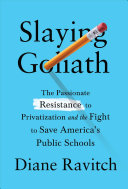
IT WON’T BE OFFICIALLY PUBLISHED UNTIL JANUARY 21, BUT YOU CAN PRE-ORDER YOUR COPY FROM YOUR BOOKSELLER OR AN ONLINE BOOK DEALER (PLEASE PATRONIZE INDEPENDENT BOOKSTORES, IF YOU STILL HAVE ONE NEAR YOU!).

I PROMISE YOU WON’T BE DISAPPOINTED!

IF YOU COME TO THE ANNUAL MEETING OF THE NETWORK FOR PUBLIC EDUCATION IN PHILADELPHIA MARCH 28-29, I WILL PERSONALLY INSCRIBE YOUR COPY OF THE BOOK!


EDUCATION

Slaying Goliath: The Passionate Resistance to Privatization and the Fight To Save America’s Public Schools

Knopf. Jan. 2020. 352p. ISBN 9780525655374. $27.95. ED
COPY ISBN

In this incisive, meticulously researched book, Ravitch (education, New York Univ.; The Death and Life of the Great American School) argues persuasively that the U.S. school privatization movement has resulted in poor test scores, the closure of public schools, and attacks on the teaching profession. Ravitch blames the so-called school reformers, whom she renames the disruptors, such as Bill Gates, Alice Walton, Michelle Rhee, Mark Zuckerberg, and Eli Broad, who spend millions to replace public schools with charter schools and private institutions that are run like businesses. Though disruptors view themselves as opposing the status quo, Ravitch contends that they are doing everything they can to maintain it. She devotes most of her book to the resisters, or the teachers, parents, and union leaders who have taken on the disruptors and are working to keep their local public schools open. Through this lens, Ravitch discusses the Common Core teaching standards, standardized testing, the Obama administration’s Race to the Top grant program, and Teach for America.

VERDICT This extensive analysis is required reading for anyone concerned about American education. [See Prepub Alert, 7/8/19.]

John Thompson, historian and retired teacher in Oklahoma, shares his thoughts about what matters most. What matters most for the future is not test scores, yet we have spent an entire generation–now almost two generations of young people who have passed through our schools since 2000–focusing only on test scores. Will we pay a price? Will they?


As I left the computer to walk the dog, a thought provoking title jumped off the screen, “2019 NAEP Results Show There’s Something Wrong Going On.” Our neighborhood is gentrifying too much, but the park still offers a wonderful place for cross-generational, cross-cultural conversations about what is going right and wrong. Only our spoiled dogs complain when daily discussions last a long time when recounting the latest Trump assaults on our constitutional democracy.

In contrast to corporate school reformers, who claimed that schools could be the answer to inequities, when a dog walker shared a link about another path to progress, we knew there is no single, silver bullet. We loved the New York Times’ “Dogs Will Fix Our Broken Democracy,” but we knew that the doggies, on their own, can’t teach us “to step outside of our narrowest selves.”

https://www.the74million.org/article/petrilli-2019-naep-results-show-theres-something-wrong-going-on-3-theories-about-what-might-be-happening-in-our-schools-and-beyond/
https://www.nytimes.com/2019/08/31/opinion/dogs-democracy.html

The NAEP title also provoked contemplation on the school reform blinders which blocked out conversations about issues outside the school building. For two decades, as test-driven, competition-driven reform treated schools as a sped-up Model T assembly line, school segregation was increased and the curriculum was narrowed. The Billionaires Boys Club undermined instruction about issues outside of the classroom, such as deindustrialization, globalization, the increase of economic inequality, mass migration, climate change, and the decline in a sense of community.

Most inexplicably, schools ignored the moral dilemmas prompted by the digital revolution and we mostly failed to help our kids face its challenges, ranging from the gig economy to social media.

During the entire 21st century, both sides of the school wars have fought off their opponents with their metaphorical right hands, barely able to use our left hands for tackling the problems of poverty and segregation. Sure, the privatizers started this unnecessary battle, but why can’t they accept a truce? Why can’t we focus on the big picture issues that could explain the NAEP decline?

Shouldn’t we also wrestle with the biggest tragedies that are going on, threatening our democracy and our planet, and that contribute to NAEP scores declines?

Imagine my initial rejoicing when I returned from the dog walk to the NAEP story. The author of this appropriately-titled essay focused on what was going on outside the classroom, (as well as the minds of reformers, I would add.) He hypothesized that the Great Recession hurt student performance in two ways, “first, via its devastating impact on fragile families and their young children; and second, through its negative impact on school spending, as many state coffers ran dry.”

The author also noted that “the roaring ’90s led to a huge decrease in ‘supplemental’ child poverty rate … And that could explain much of the NAEP gains we saw in the 2000s, gains that were most dramatic for low-performing children and kids of color.” He then followed the cohorts of students who endured the years from 2009 to 2012 when the unemployment rate was 8 percent. He noted the correlation between the rise and fall of 4th grade scores and the stagnation and decline of 8th grade scores for low-income kids to the unemployment rate and education spending cuts. More affluent students, who didn’t have to face those challenges, continued to show steady gains.

A similar pattern was described in terms of screen time, and the anxiety and isolation it can cause. He notes, “Children from lower-income families spend an average of three and a half hours each day on screen media, … That amount is 40 percent longer than middle-income children (two hours and 25 minutes) and almost double the screen time spent by affluent children (one hour and 50 minutes).” As “screen time for low-income kids has absolutely skyrocketed in recent years,” their reading scores declined.

So, it seems logical that we should help teach children to use, but not be used by the cell phones. Given the massive and rapid economic transformations, that are unnerving adults, we should be preparing children not for worksheets and drill and kill, but for a healthy, productive, meaningful life in the 21st century. Contrary to corporate school reformers’ theory, which fought the legacies of segregation with segregation by choice, and the stress of poverty with the stress of high stakes testing, the logical conclusion would be that poor children need holistic and culturally relevant instruction.

But then the author, called for a “recalibration” including “much more demanding academic standards that were aligned to readiness for college and career.” He would do this by …?

For some reason that I still can’t understand, this author – who often acknowledges the failures of school reform – dug in his heals and called for a return to “the form of the Common Core; much higher-quality and more rigorous assessments, in the form of Smarter Balanced and PARCC and their successors.”

Readers, you probably guessed that the author who twisted himself into a pretzel when so contradicting  himself, was the Fordham Institutes’ Mike Petrilli. And he then called for “tougher tests and accountability systems.”

In other words, corporate reformers like Petrilli do provide at least one valuable feature. They are a great case study in how to present “alt facts.” Fordham et. al start with something we can agree on, something unifying, for instance like our shared,  heart-warming desire to cuddle a kitty. But they always end on a note of survival of the fittest, demanding the defeat of the educational institution that kitty-hating educators defend. Their spin could be featured in a great lesson of how political propaganda is spread on the web!

Seriously, “2019 NAEP Results Show There’s Something Wrong Going On” illustrates the huge opportunity costs of having to fight off reformers when we should have been concentrating on the existential dangers that that our youth face. And a New York Times Magazine special edition that was published the same week offers a horrifying glance at the battle we should have been engaging in.

The Magazine’s “The Internet Didn’t Turn Out the Way We Hoped” is so direct in its warning that its cover features the meanest-looking, ugliest kitty they could photograph. Kevin Roose’s “A Cleaner Internet” is illustrated with a cat embodying the beauty we hoped for, along with three stained kittens. He cites Marc Andreesen who said, “in the future there will be two types of people: ‘people who tell computers what to do, and people who are told by computers what to do.’”

Below are just a few of the special issue’s examples of today’s and tomorrow’s virtual realities that we haven’t educated our kids about. Jamie Lauren Keiles describes the “cursed dynamics on online fandom,” and explains, “Today’s fandom is more like a stateless nation, formed around a shared viewing heritage, but perpetuated through the imaginations and interrelations of those who enjoy and defend it” (It sounds to me that “fandom” also describes corporate reform.)

Yiren Lieu describes the “much more powerful apps” that are “flowering in China,” and concludes, “Whatever it is that takes place when Chinese –style super-app-dom meets the American teenager, it sounds like the future of the internet.”

The article that made me feel sickest was Elizabeth Weil’s “All My Selves Are My Favorite.” It begins with 15-year-old’s “Ninth Grade Makeup Transformation” YouTube video. She used “dozens” of brushes and powders, “bouncing between one shell of identity and the next.” And, “45 minutes later, tender, glittering and shellacked with cosmetics, she was ready for school.”

The teen’s commentary was full of expressions like, “I need to not be annoying, and I’m not doing a good job of that.  … I also look ugly, and I’m really depressed!”

Fortunately, at the end, she at least listened to, even if she didn’t hear, a 23-year old’s wisdom, “I’m like, Oh, this is what happens when someone is raised on the internet.”

https://www.nytimes.com/interactive/2019/11/14/magazine/internet-future-dream.html

Yes, behind the NAEP decline, there is “something wrong.” As John Merrow recently noted, “we have managed to teach our children how NOT to think, and today not even 14% of American 15-year-olds are able to distinguish facts and opinion.”

So, it’s a terrible shame that we educators have been distracted from one of our biggest tasks – helping kids learn how to control their own destinies. A generation of students has attended schools where they have been treated as test scores. Worse, venture philanthropists’ market-driven reforms are just one part of venture capitalists who see humans –  inside and outside of schools –  as data points.

https://themerrowreport.com/2019/12/05/the-national-assessment-of-educational-paralysis-naep/