Archives for the month of: November, 2019

We are entering into a strange era where religious belief is being permitted to trump scientific fact.

Ohio legislators in the House passed legislation allowing students to receive credit for wrong answers on science tests if their answer is based on their religious beliefs.

Does anyone think that actions such as this one will prepare students to live and thrive in the modern world? Will students so ill prepared with knowledge and understanding of the scientific method be prepared for careers in science, engineering or technology or any other field that requires a firm grasp of evidence and reality? Will they even know how to think critically about history and current affairs?

Every Republican in the House supported the bill. It now moves to the Republican-controlled Senate.

The Ohio legislature is also enthusiastic about charter schools and vouchers.

Former Governor John Kasich presents himself to a national audience as a “moderate” but it was under his leadership that this kind of zealotry took root in Ohio.


The Resistance has opened a new front in Wisconsin!

The proper place for accountability is at the top: with those who decide how much money is available, and those who write the laws and the mandates and the regulations.

The legislature determines whether funding is available to reduce class size, to provide adequate staff, to offer appropriate compensation to those who work in the schools.

The lawmakers should be held accountable!

Get active! Get involved!

This notice was distributed by Heather DuBois Bourenane <hdb@wisconsinnetwork.org>


The Department of Public Instruction issues its school and district report cards today, a legislative mandate which requires our students and schools to be held accountable for many things they cannot control.

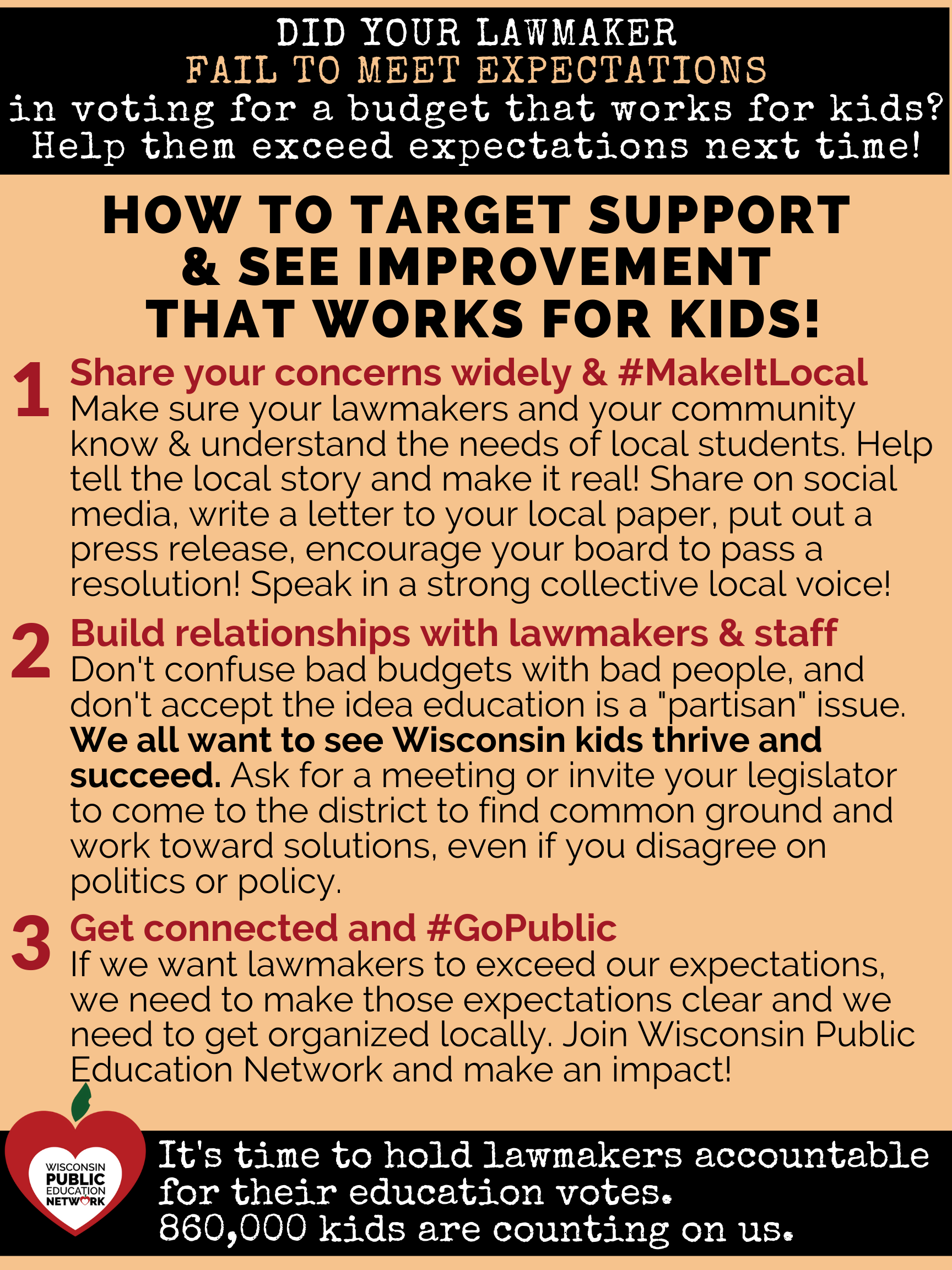
It’s only fair to hold our lawmakers accountable for the one thing they can control: their votes.

Today we have issued a new tool to help hold them accountable: our first ever Legislative Report Cards that help connect the dots between the performance of our legislators and the needs of our children.

Despite the countless successes of students and public schools around the state, we have invested in widening the gaps between “haves” and “have nots” — gaps that are reflected very clearly in standardized test results.  We know that Wisconsin has the worst racial performance gaps in the nation. We know that our funding formula is profoundly inequitable, unpredictable, and inadequate. We know we are worst in the nation for how we fund special education. Our support for bilingual and bicultural needs – which increased by zero dollars in this year’s budget – has been described as “pitiful.”

The 2019-2021 state budget made gains in some areas, but failed to even meet the 2/3 funding mark. 40% of districts received less aid this year than last year. We did not move the needle for our kids. How can we continue to hold our kids and schools “accountable” but not those whose votes reflect the state’s failure to meet our most basic expectations?

You asked for a tool for holding legislators accountable, and we created one: a rubric for assessing budget votes based on the priority needs of our students as outlined by the bipartisan Blue Ribbon Commission on School Funding and put forward in the budget requests of Governor Evers.

Click here to read the full release and access our Legislative Report Cards for all Wisconsin lawmakers: http://www.WisconsinNetwork.org/blog/report-cards.

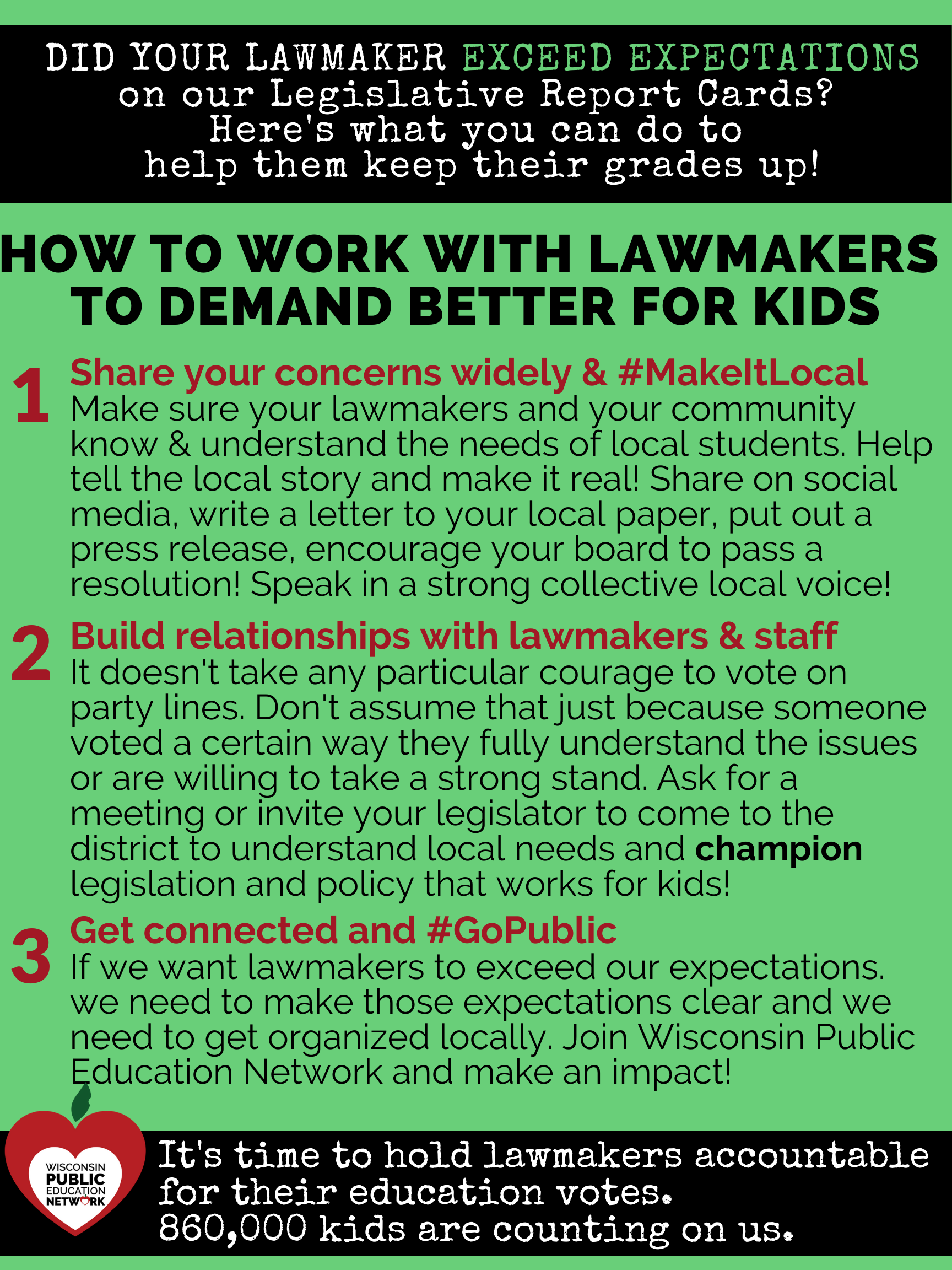
Then use the tools below to demand better. This isn’t about people – it’s about policy. It’s not about politics – it’s about what’s best for our kids. Take time to tell your local funding story and share details on what might have been different in your district if nearly a billion dollars hadn’t been cut from the proposed education budget this year. Look for local releases from our partners around the state and use them to shine a flashlight on Wisconsin’s school funding crisis.

Whether your lawmaker “exceeds” or “fails to meet” our high expectations, we all need to work together to ensure every student in every public school has equal opportunity thrive. We believe we can make that happen, and we call on all of you to join us in holding lawmakers accountable for making success a reality for every child in every public school in Wisconsin.

FOR IMMEDIATE RELEASE


Contacts: Heather DuBois Bourenane, Executive Director, Wisconsin Public Education Network, (608) 572-1696, hdb@WisconsinNetwork.org; Dr. Julie Underwood, President of the Wisconsin Alliance for Excellent Schools board of directors, julie.madison.wisconsin@gmail.com, (608) 469-2287

View this release online here.


Lawmakers Held Accountable for Votes on Education with Report Cards

As districts statewide receive state-mandated report cards, public education advocates demand an assessment of lawmakers who set budgets that determine schools’ ability to succeed


As the Wisconsin Department of Public Instruction issues its annual school and district report cards today, the nonpartisan Wisconsin Public Education Network is doing the same for state legislators.


The organization’s Legislative Report Cards provide much-needed political context for understanding how the DPI assesses school and district performance. They assess state lawmakers across five categories: K-12 budget overall, special education, bilingual/bicultural needs, mental health and public funding of private schools. The report cards are available to the public at http://www.WisconsinNetwork.org/blog/report-cards.


The DPI’s school and district report cards fulfill a state mandate to hold all schools “accountable” to taxpayers. That mandate was put forward in 2011, the same year Wisconsin saw the largest cuts to education funding in state history.


In conjunction with its Legislative Report Cards, the Wisconsin Public Education Network has issued the following statement:


“In Wisconsin, our lawmakers use report cards to hold our children and their schools accountable for circumstances and state-level policy decisions that are beyond their control. How well a school does on a report card is often closely connected to factors like revenue limits, the number of students living in poverty, the number of English-language learners and the resources available for serving students with disabilities. 


What the report cards do not reveal is the fact that Wisconsin is last in the nation in state support for students with disabilities, and last in the nation in state support for English language learners. The state does not live up to its commitment to support student mental needs and we lack a coherent state policy to support children challenged by poverty. We can trace these failures back to the statehouse, not the classroom.


 It only makes sense that we hold lawmakers accountable for their education votes.


Parents and communities are told that school report cards represent a single ‘snapshot’ of student performance, but that snapshot becomes a frozen image impacting property values and undermining the successes that cannot be accounted for using test scores and other data points. Research shows that test scores often measure little more than economic status. Holding our schools accountable for student needs while failing to provide sufficient resources to ensure student success is unfair and unethical.


Senator Luther Olsen has often said the state report cards should be used as a ‘flashlight’ and ‘not a hammer’ to demonstrate where we can best meet the needs of our students and schools.


We present these legislative report cards in the same spirit. They reflect a single snapshot: a picture of the budget votes of the elected officials who determine how much state aid is provided to our public schools. 


In 2019, Wisconsin legislators approved a budget that cut nearly $1 billion from the governor’s proposed public education budget, withholding much-needed aids for special education, mental health and English language learners, while failing to meet the much-touted goal of providing two-thirds of school funding.


Given the state’s continued refusal to provide the funding needed to close Wisconsin’s opportunity gaps, we are holding lawmakers accountable for their education votes.


The 2019 Legislative Report Cards reflect a failure to meet the expectations that were outlined clearly by the Blue Ribbon Commission on School Funding, at the budget hearings of the Joint Committee on Finance and by parents, board members, educators and school leaders statewide.


Public education should not be a partisan issue. Support for schools should not fall along party lines. We strongly encourage all who care about great public schools to take time to provide targeted support and encourage improvement from those legislators who fail to meet Wisconsin’s high expectations for supporting student success. Every child attending public school in Wisconsin deserves an equal opportunity to succeed, and our lawmakers, just as our schools, must be held accountable for making that opportunity equally accessible to all.”


About Wisconsin Public Education Network (WPEN)


Wisconsin Public Education Network is a nonpartisan grassroots coalition supporting strong public schools that provide equal opportunity for all students to thrive. The Network is a project of the Wisconsin Alliance for Excellent Schools (WAES), a 501(c)(3) nonprofit organization. Contributions can be sent to: P.O. Box 6592, Monona, WI 53716. Learn more at http://www.WisconsinNetwork.org.
 

Tonight, the United Teachers of Los Angeles endorsed Senator Bernie Sanders for the Democratic nomination for president.

LOS ANGELES — United Teachers Los Angeles, the second-largest teachers’ local in the country, is proud to endorse Senator Bernie Sanders for US President in the 2020 Primary Election, making UTLA the first teachers’ union in the country to endorse a presidential candidate.

Tonight, the UTLA House of Representatives – the elected leadership body of the 34,000-member union — voted 80% in favor of endorsing Sen. Sanders, capping the most comprehensive member engagement process that UTLA has ever conducted for a political candidate.

vote

Thursday’s House vote followed a six-week discussion at school sites. Following that member engagement, on Wednesday at nine regional meetings, more than 500 elected site representatives voted 72.5% yes to the presidential endorsement of Sen. Bernie Sanders. Wednesday’s vote was opened up to allow any member who attended to vote alongside elected chapter leaders.

UTLA President Alex Caputo-Pearl said: “Why now, and why Bernie? Because we want him to win in the primary election and because we need an unapologetic, longstanding ally of progressive policies to make public education a priority in the White House. Sanders is the first viable major candidate in 25 years in the Democratic Party to stand up against privatization, the charter billionaires, and high-stakes testing and to stand up for a massive redistribution of wealth to schools and social services. Critically, like UTLA, Sen. Sanders believes in building a national movement for real, lasting change.”

Bernie Endorse

Teachers are the number one profession among his donors for a reason: Sanders has the most comprehensive, progressive plan for public education among the candidates. His platform calls for a salary floor for public school teachers, tripling Title I federal education funding, boosting funding for special education (IDEA), and placing a moratorium on charter school growth. For the last several decades the unregulated growth of corporate charter schools has siphoned money from public schools, with little protection against fraud and little attention paid to equity or quality when it comes to educating students.

In addition to education issues, Sanders’ platform aligns with our values on a range of issues, including rebuilding the US labor movement and winning Medicare for All.

Bernie spoke at UTLA’s Leadership Conference in July, and he brought down the house with his defiant message about leading a movement for fundamental political and social change, including a strong, fully funded public education system. Sen. Sanders also signed a pledge to support Schools and Communities First and Our New Deal for Public Schools. He was the first major US politician to publicly support our 2019 strike, and he pushed for donations to our strike fund, leading to a cascade of influential support and an increase in the fund of more than $100,000.

BSUTLA

LA educators are standing behind a candidate who has the electability to beat Trump. Sanders is leading in Democratic fundraising, is strong in swing states and among independent voters, beats Trump in head-to-head polls, and has major support in demographics that will vote heavily in 2020, including Latinx voters, Black women, and millennials. As the electorate becomes more diverse, defeating Trump will require a candidate who can motivate a diverse coalition of voters.

Sanders’ platform is not just a corrective to the destructive presidency of Donald Trump but also to failed policies of the past few decades that have starved public schools and left behind working-class and middle-class families while giving massive tax breaks to corporations and billionaires. Long-standing Democratic Party leaders have been a part of these problems.

“We must take the most anti-Trump stance that we can take,” said UTLA Vice President Gloria Martinez. “That includes endorsing Sen. Sanders. We see in Bernie the same fighting spirit that drove 60,000 people — teachers, students and parents — to the streets of LA in January during UTLA’s strike to invest in our students.”

The following is a timeline of UTLA’s endorsement.

  • Sept. 11 – UTLA Board of Directors votes 35-1 to begin exploring an endorsement process for Sen. Bernie Sanders.
  • Sept. 18 – UTLA House of Representatives votes 135-46 to confirm the process to explore endorsing Sanders.
  • Oct. 2 – School site leaders discuss and review endorsement materials.
  • Oct. 2-Nov. 12 — School site leaders engage members on consideration of a UTLA endorsement of Sen. Bernie Sanders.
  • Nov. 13— Membership advisory up or down vote at 9 regional area meetings. 72.5% of voters, representing more than 500 LAUSD schools, say yes to endorsing Sanders.
  • Nov. 14 — House of Representatives votes 80% to endorse Sen. Bernie Sanders.

###

The Kentucky governor’s race is over at last.

Matt Bevin conceded defeat.

Kentucky Gov. Matt Bevin on Thursday conceded to Attorney General Andy Beshear after a recanvass of votes confirmed Mr. Beshear’s victory in last week’s governor’s election.

“We’re going to have a change in the governorship based on the vote of the people,” Mr. Bevin, a Republican, said in a brief speech from a podium in front of the governor’s office.

Mr. Bevin, who had raised unspecified allegations of voter fraud and left open the option of challenging the results, instead acknowledged the victory of Mr. Beshear, a Democrat and the son of a two-time Democratic governor.

Mr. Beshear’s margin of victory remained unchanged after the recanvassing, according to the secretary of state: 5,136 votes out of more than 1.4 million cast.

Thank you, teachers of Kentucky! You remembered in November, as you promised.

Trump won the state by 30 points in 2016. Bevin’s attack on teachers and on their pensions ended in his defeat.


Jack Hassard, having taught science education for many years, is scrupulous about evidence. So he took seriously Trump’s demand that everyone read the transcript of his “perfect” phone call with the president of Ukraine.

He gives a close reading to that transcript here. 

What transpired, he says, based on the transcript, was not a “quid pro quo.” A this-for-that can be completely legitimate: You mow my lawn, I’ll trim your hedge. You take my dog for a walk, I will do your dishes.

What happened, he says, is bribery.

Read the transcript yourself.

Parent activist Lynn Davenport posted this warning about a “public-private partnership” that leaves out the public. Corporate interests are plotting to privatize public schools while hiding behind the facade of the “portfolio model,” a term used to deceive the public of Grand Theft Public Schools.

Davenport writes:

The new oil in Midland is student data. The Midland Collective Impact initiative under Educate Texas was launched in October 2015. I’ve written extensively on what “collective impact” really means and how there’s no “public” in public-private partnerships. Although Educate Texas concluded its work with the initiative in April 2017, Educate Midland continues with the collective impact framework which is one giant data grab. Key Midland funders include the Abell-Hanger Foundation, Scharbauer Foundation and Henry Foundation. Scharbauer Foundation wrote a letter to the TEA endorsing the Transformation Zone grant and Abell-Hanger Foundation piloted an outcome measurement system.

What data did Educate Midland and MISD give to them? Do parents have to consent to the data being collected for use by foundations? As a charter operator governing partner does the Educate Midland board have access to academic and behavior data of children to be used for “educational research.”

The “portofolio model” allows appointed boards to govern public schools with taxpayer funds. Article VII of the Texas Constitution makes provision for public free education. If we replace elected trustees with appointed boards, that is taxation without representation. Once our voice is removed, we will likely never get it back.

To read more about the scandalous effort to privatize the public schools in Midland, read Lynn Davenport’s additional report here. 


A friend share this link about a program in which the United Negro College Fund is funded by the far-right Walton Family Foundation to give summer internships to young African Americans to work in organizations that undermine public education, unions, and the teaching profession. The purpose of the program is to build a “robust pipeline of African Americans engaged in education reform in America.”

All of the summer interns will serve with trusted arms of the ultra-conservative movement.

Summer Internship – One of the principal elements of the paid summer internship program that exposes fellows to professional careers at leading K-12 education organizations and schools focused on education reform. Specifically, fellows are deployed as interns to organizations and schools located in such cities as Boston, New York, Washington, DC, Atlanta, New Orleans, Chicago, Indianapolis, Memphis and Nashville. Examples of internship host organizations include Teach for America, New Schools Venture Fund, Paul Public Charter School, BUILD, Black Alliance for Educational Options, Thomas B. Fordham Research Institute and Stand for Children. During their internships, fellows apply what they have learned, acquire new skills, gain an understanding of the professional needs of education reform organizations and make meaningful contributions.

You can be certain that none of these bright young people will be assigned as interns at the NAACP, which called for a moratorium on charter schools in 2016.

Nor will any be detailed to work for Journey for Justice, a grassroots civil rights group that fights for democratically controlled community public schools.

Nor do I expect that any will have a chance to learn about the Walton assault on public education by spending a summer as an intern for the Network for Public Education.

They are not likely to have the chance to offer their services at any of the scores of local and state organizations that are fighting the power of billionaires like the Waltons and could really use their help.

Instead they will be trained up by the faithful servants of the privatizers and the oligarchy.


Shawgi Tell is a professor of education at Nazareth College in New York.

He points out that “More than 765 Charter Schools Have Closed in Three Years.”

This is what Disrupters refer to as “high-quality seats.” Here today, gone tomorrow.

Currently, about 3.2 million students are enrolled in roughly 7,000 privately-operated charter schools across the country. This represents less than 7% of all students and 7% of all schools in the country.

According to the National Center for Education Statistics, more than 765 charter schools closed between 2014-15 and 2016-2017, leaving thousands of families stressed, abandoned, dislocated,and angry. This figure represents more than one out of ten charter schools in the country by today’s numbers. The real closure figure is likely higher. To be sure, more than 3,000 charter schools have closed in under three decades.

The top three reasons privately-operated charter schools close are financial malfeasance, poor academic performance, and low enrollment.

With regard to academic performance, the Washington Post (November 1, 2019) reminds us that:

When you take all charters and all public schools into consideration, students at charters do worse than those at public schools. According to the Department of Education’s National Assessment of Educational Progress, public school students in fourth, eighth and 12th grades outperform charter school students in math, reading and science.

It is also worth recalling that the vast majority of high-performing nations do not have charter schools.

Today, nearly 60% of charter schools are in urban settings where schools tend to be under-funded, over-tested, constantly-shamed, and attended mostly by poor and low-income minority students. Charter school advocates prefer to target urban schools because this is where they can make the most profit given economies of scale and other factors.

While choice” has worked out well for major owners of capital, what good is “choice” when it cannot deliver stable, reliable, high-quality education free of corruption, segregation, and overpaid administrators? How does funneling billions of dollars annually from public schools to unstable privately-operated charter schools that frequently perform poorly help the economy, education, or society? Do pay-the-rich schemes like charter schools advance the national interest?

There is no justification for the existence of privately-operated non-profit and for-profit charter schools. They do not provide a net public benefit. Endless news reports show that charter schools are always mired in scandal and controversy. It is time to stop bashing public education, reject the hype surrounding charter schools, fully fund all public schools, and vest real decision-making power in the hands of the public. The rich must be deprived of their ability to privatize public education with impunity. The content, purpose, and direction of education must not be in the hands of privatizers, neoliberals, and corporate school reformers.


Justin Parmenter, an NBCT teacher in North Carolina, explains in this article why Democratic Governor Roy Cooper vetoed a pay raise for educators passed by the ultra-conservative state legislature. 

He begins:

Asheville City Schools full-time instructional assistant Angel Redmond is in her 4th year with the school system and her 21st year in education. Angel has a degree in psychology, and her duties include teaching math and reading to small groups, handling discipline issues, proctoring standardized tests, and substitute teaching when needed. Her current salary is just $22,000 per year, which means that she has to put in 15 hours a week at her second job in order to make ends meet.

Under a General Assembly plan for educator pay which was vetoed last week by Gov. Roy Cooper, Angel would have seen an increase of only $18.26 per month. That’s enough for roughly half a tank of gas.

Cooper’s veto of the poorly-named “Strengthening Educators’ Pay Act” came at the request of public school educators and advocates. On the surface it might seem like a peculiar move for a governor who has vowed to bring much-needed improvements to public education in our state, and Senate leader Phil Berger wasted no time framing Cooper as an enemy of teachers.

However, the legislation would have provided little more than table scraps from a General Assembly majority that has consistently underfunded public education and deprived our schools of billions in potential revenue via massive tax rate cuts since taking control of the House and Senate nearly a decade ago.

Under the bill, teachers with 0-15 years experience would not have received any raise this year. Teachers with 16-20 years would see only $50 more a month before taxes. Teachers from 21-24 years of experience would get $150 more a month, while our most dedicated veterans with 25 years or higher would have salaries raised $60 a month.  For school year 2020-21, teachers with 0-15 years would again get nothing, and teachers with 16 years or more would all get another $50 a month.

These measly raises were promised, not funded.

Governor Cooper was right to veto what amounted to an insult, not a pay raise.

Teachers deserve a living wage. Teachers deserve to be paid as valued professionals.