Archives for the month of: September, 2019


Investigative journalist Jeff Bryant has published a bombshell article about entrepreneurs who operate superintendent searches, then call on their Superintendents to buy professional development, technology, training, and other services. The conflicts of interest and self-dealing are shocking. Districts lose millions of dollars and buy services they don’t need, while the search service continues to pay them.

Most of us are familiar with the case of Barbara Byrd-Bennett, former Superintendent of Chicago Public Schools, who is currently serving a jail sentence for taking kickbacks.  But the web of corruption has involved many superintendents and school districts.

Bryant writes:

In July 2013, the education world was rocked when a breaking story by Chicago independent journalist Sarah Karp reported that district CEO Barbara Byrd-Bennett had pushed through a no-bid $20 million contract to provide professional development to administrators with a private, for-profit company called SUPES Academy, which she had worked for a year before the deal transpired. Byrd-Bennett was also listed as a senior associate for PROACT Search, a superintendent search firm run by the same individuals who led SUPES.

By 2015, federal investigators looked into the deal and found reason to charge Byrd-Bennett for accepting bribes and kickbacks from the company that ran SUPES and PROACT. A year-and-a-half later, the story made national headlines when Byrd-Bennett was convicted and sentenced to prison for those charges. But anyone who thought this story was an anomaly would be mistaken. Similar conflicts of interest among private superintendent search firms, their associated consulting companies, and their handpicked school leaders have plagued multiple school districts across the country.

In an extensive examination, Our Schools has discovered an intricate web of businesses that reap lucrative school contracts funded by public tax dollars. These businesses are often able to place their handpicked candidates in school leadership positions who then help make the purchasing decision for the same businesses’ other products and services, which often include professional development, strategic planning, computer-based services, or data analytics. The deals are often brokered in secrecy or presented to local school boards in ways that make insider schemes appear legitimate.

As in the Byrd-Bennett scandal, school officials who get caught in this web risk public humiliation, criminal investigation, and potential jail time, while the businesses that perpetuate this hidden arrangement continue to flourish and grow.

The results of these scandals are often disastrous. School policies and personnel are steered toward products that reward private companies rather than toward research-proven methods for supporting student learning and teacher performance. School governance becomes geared to the interests of well-connected individuals rather than the desires of teachers and voters. And when insider schemes become public, whole communities are thrown into chaos, sometimes for years, resulting in wasted education dollars and increased disillusionment with school systems and local governance.

Bryant lays out the evidence of collusion, corruption, and conflicts of interest. He reviews districts in Illinois, Maryland, and elsewhere. The evidence is devastating.

Nashville was victimized by entrepreneurs who manipulated the district and the process.

One of the first school districts to become entangled in the conglomeration of firms Wise and Sundstrom assembled was Nashville, which in 2016 chose Jim Huge and Associates to help with hiring a new superintendent. The following year the board hired Shawn Joseph, whom Huge had recommended.

Shortly after Joseph arrived in Nashville, according to local News Channel 5 investigative reporter Phil Williams, he began pushing the district to give $1.8 million in no-bid contracts to Performance Matters, a Utah-based technology company that sells “software solutions” to school districts.

Williams found Joseph had spoken at the company’s conference and he had touted the company’s software products in promotional materials while he was employed in his previous job in Maryland. Williams also unearthed emails showing Joseph began contract talks with Performance Matters two weeks before he formally took office in Nashville. What also struck Williams as odd was that despite the considerable cost of the contract, district employees were not required to use the software.

In addition to pushing Performance Matters, Williams reported, Joseph gave an “inside track” to Discovery Education, a textbook and digital curriculum provider and another company he and his team had ties to from their work in Maryland. With Joseph’s backing, Discovery Education received an $11.4 million contract to provide a new science, technology, engineering, art, and math (STEAM) program even though a smaller company came in with a bid that was a fraction of what Discovery proposed.

By June 2018, Nashville school board member Amy Frogge was questioning Joseph about possible connections these vendors might have to ERDI. A district audit would confirm that ERDI’s affiliated companies—including Performance Matters, Discovery Education, and six other companies—had signed contracts totaling more than $17 million with the district since Joseph had been hired.

Frogge also came to realize that all these enterprises were connected to the firm who had been instrumental in hiring Joseph—Jim Huge and Associates.

“The search that brought Shawn Joseph to Nashville was clearly manipulated,” Frogge told Our Schools in an email, “and the school board was kept in the dark about Joseph’s previous tenure in Maryland and his relationships with vendor companies.”

Frogge said some of the manipulation occurred when the search firm told school board members that disputes among current board members—over charter schools, school finances, and other issues—indicated the district was “‘too dysfunctional’ to hire top-level superintendents and therefore needed to hire a less experienced candidate.”

But previous investigations of school leadership search firms conducted by Our Schools have found companies like these frequently forego background checks of prospective candidates they recommend, promote favored candidates regardless of their experience or track record, and push board members to keep the entire search process, including the final candidates, confidential from public scrutiny.

“Too often, national search firms are also driven by money-making motives and/or connections with those seeking profit,” Frogge contended. That conflict of interest is a concern not only in Nashville but also in other districts where school leaders with deep ties to education vendors and consultants have resulted in huge scandals that traumatized communities and cost taxpayers millions…

Frogge noted school boards have alternatives to using private search firms that promote tainted candidates willing to feed the search firms’ side businesses.

“School board members need to become better informed and more savvy about profit motives and organizations that seek to influence their selection,” she wrote. “School boards can instead opt to hire a local school boards association (for example, the Tennessee School Boards Association) or a local recruiter with a reputation for personal integrity to conduct a search. They can also choose to hire from within.”

Tom Ultican, a former teacher of physics and advanced mathematics in California, is diligently analyzing the tentacles of the Corporate Reform Movement, which he calls the Destroy Oublic Education Movement.

Relay Graduate School: a Slick “MarketWorld” Education Fraud

In this post, he scrutinizes the Relay “Graduate School of Education,” a program run by the charter industry to give master’s degrees to charter teachers who have mastered the arcane arts of no-excuses discipline and test-score raising.

You must read the entire post. It is carefully documented and chilling. He names the key players, the funders, and gives powerful insight  the emptiness of the program.

He begins:

Relay Graduate School of Education is a private stand alone graduate school created and led by people with meager academic credentials. Founded by leaders from the charter school industry, it is lavishly financed by billionaires. Contending that traditional university based teacher education has failed; Relay prescribes deregulation and market competition. Relay does not offer “coursework in areas typical of teacher education programs—courses such as school and society, philosophy of education, and teaching in democracy ….” Rather, Relay trains students almost exclusively in strict classroom management techniques.

Ken Zeichner is one of America’s leading academics studying teacher education. In a paper on alternative teacher preparation programs he noted that Match Teacher Residency and Relay “contribute to the inequitable distribution of professionally prepared teachers and to the stratification of schools according to the social class and racial composition of the student body.” Zeichner clarified,

“These two programs prepare teachers to use highly controlling pedagogical and classroom management techniques that are primarily used in schools serving students of color whose communities are severely impacted by poverty. Meanwhile, students in more economically advantaged areas have greater access to professionally trained teachers, less punitive and controlling management practices and broader and richer curricula and teaching practices. The teaching and management practices learned by the teachers in these two independent programs are based on a restricted definition of teaching and learning and would not be acceptable in more economically advantaged communities.”

Relay is another component of the destroy-public-education infrastructure that mirrors Professor Noliwe Rooks’ definition of segrenomics; “the business of profiting specifically from high levels of racial and economic segregation.”

Founding Relay Graduate School of Education

Relay’s foundation was laid when the Dean of City University of New York’s Hunter College school of education, David Steiner, was approached by Norman Atkins of Uncommon Schools, David Levin of KIPP charter schools, and Dacia Toll of Achievement First charter schools. Dean Steiner agreed to establish the kind of Teacher Preparation program at Hunter College that these three charter industry leaders wanted. The new program which began in 2008 and was called Teacher U.

Kate Peterson studied Relay for a Philadelphia group. She noted,

“Receiving $10 million from Larry Robbins, founder of the hedge fund Glenview Capital Management and current board member of Relay, and $20 million from the non-profit The Robin Hood Foundation, the three charter school leaders partnered with Hunter College in New York to implement their program ….”

The following year the newly elected and extremely wealthy Chancellor of the New York State Board of Regents, Merryl H. Tisch, tapped David Steiner to be Commissioner of Education.

Read it all.

Personally, I find it offensive that a charter industry program calls itself a “graduate school of education” when it has no scholars on its “faculty,” no library, no research. It is a training program with one purpose only: to award master’s degrees to charter teachers who know nothing of the history, philosophy, economics, or sociology of education, who know only one form of pedagogy, who know nothing of child or adolescent psychology. Their students are indoctrinated into the charter way of thought, not educated to think for themselves, not exposed to different points of view.

Robert Hutchins, who was president of the University of Chicago and a great thinker, said long ago that the purpose of professional education is to teach people to become critics of the profession.

That will never happen at Relay.

Teresa Hanafin writes “Fast Forward” for the Boston Globe, where this appeared. I love her writing.


Trump has no public events on his schedule today, probably clearing the decks so he and his toadies can figure out how to explain away a troubling revelation by The Washington Post: This summer, during communications with a foreign leader — one US official said it was a phone call — Trump made a promise to that foreign leader that was so disturbing that an official in the US intelligence community filed a formal whistleblower report with the community’s inspector general.

That inspector general, Michael Atkinson, concluded that the report was credible and Trump’s conversation was a matter of “urgent concern,” a level of threat that requires intelligence officials to notify Congress — specifically, the oversight committees — within seven days.

Atkinson turned the complaint over to his boss, the acting director of national intelligence, Joseph Maguire, who read the details and then refused to turn them over to Congress — apparently deciding that breaking the law to protect Dear Leader was far more important than protecting the country.

Atkinson, the IG, is testifying this morning before the House Intelligence Committee in a classified session closed to the public.

This is hardly the first time that the largemouth bass in the Oval Office has endangered national security. As recently as last October, he was using an unsecured iPhone to chit-chat with Lord knows who, calls that the Chinese and Russians eavesdropped on, freaking out intelligence officials who kept telling Trump to please knock it off.

And you may recall when the blunderbuss told two top Russian officials in the Oval Office about a top-secret intelligence operation in Syria, compromising the Israeli spy involved. And CNN reported that US intelligence officials were so worried about Trump’s loose lips that they yanked a valuable, high-level US spy out of Moscow.

And just yesterday, he screwed up again, revealing that the replacement steel fence being erected at the Mexican border is wired with sensors to detect climbers. That prompted Lieutenant General Todd Semonite, acting head of the Army Corps, to basically tell Trump to zip it: “Sir, there could be some merit in not discussing that.”

Trump also claimed that the wall was so hot, making it impossible to climb, that you could “fry an egg” on it. He then went over and touched the wall, signing it with a Sharpie. Nothing went up in smoke.

Rhode Island Governor Gina Raimondo is a true believer in corporate reform.  She wants to fixlow test scores by opening charter schools and hiring TFA teachers to staff them and the public schools.

Governor Raimondo was previously an investment banker.

Bob Shepherd, expert teacher, curriculum writer, assessment developer, and author, has an offer for Governor Raimondo:

Dear Governor Raimondo: I can do TFA one better and supply teachers from among the Florida redneck community with only 3 hours’ training and no education whatsoever. Only $10,000 apiece finder’s fee. Call me. –Bob Shepherd, CEO of Bob’s Real Good Florida Schools

I bet he is willing to negotiate the finders’ fee.


Faced with low test scores in Providence, Central Falls, and other districts, Rhode Island Governor Gina Raimondo wants more teachers from Teach for America, who have only five weeks of training.

She is a deep-dyed Corporate Reformer who believes in the magic of privatization by charter schools and inexperienced, ill-trained TFA.

This will not end well for the students.


Nancy Bailey posted this great piece last May, but I missed it then. It remains super-timely.

35 Ways They Dumb Down America: Still, There’s Hope!

She writes.

If you’ve ever worried what the future will hold without public schools, watching legislators destroy those schools in Florida and Tennessee this past week was gloomy.

But there they were with smiles in Florida, and a little less jubilant in Tennessee.

These policymakers, who are supposed to represent everyone, seem to take no interest in the research surrounding the importance of democratic public schools and the lack of any evidencesupporting vouchers or charter schools.

There’s not even proof that private and parochial schools are great.

But before those of you who care about kids and public schools get too gloomy, there’s always hope! One just needs to know where to look.

Nancy lists 35 ways that policy makers have dumbed down America.

Feel free to add your own to her list.


The definition of insanity: funding an experimental education program, discovering that it failed, then funding it some more and expecting different results.

Another definition of insanity: funding a voucher program that depresses student achievement, then demanding more voucher funds so more students can fall behind.

Why fund failure?

Despite Poor Academic Results Groups Sue to Grow Private School Voucher Program

A few weeks ago a pro-school privatization organization, Institute for Justice, announced a lawsuit against the State of Nevada over the impact of AB 458 to private school vouchers recipients, scholarship granting organizations and businesses receiving tax incentives.

Though pro-voucher advocates are framing the suit as “saving vouchers,” in reality, the voucher program did not lose funding. The controversy over some students losing their scholarships is actually the result of a single scholarship granting organization interpreting a law passed this legislative session (AB 458) differently than all other scholarship organizations. Certain families who went through this organization for their voucher funds were the only ones whose funds were not renewed, leaving those students in limbo as the law’s purpose is clarified by the State.

To be clear, AB 458 did NOT cancel funding for the voucher program but only ended the requirement that funding for the controversial program grow by 10% each year. Given that growth in public education funding often struggles just  to keep up with inflation (approximately 2%), automatically growing a voucher program with scant accountability and poor results just doesn’t make sense.

Businesses are also suing on the claim that they would not be able to increase their contributions to vouchers because there is no increase in tax incentives. However ,they could choose to continue supporting private school tuition through donations without having to receive any incentive if it’s a cause that they deem so critical.

Ultimately, the courts will decide if the legal argument holds water, but the policy and evidence behind limiting the program’s growth is sound.

Voucher programs don’t work – both in Nevada and nationwide. The latest results from the Nevada Department of Education showed that more voucher recipient scores decreased than increased year-to-year, mirroring similar trends across the nation. For example, Louisiana has seen consistent abysmal results – with voucher recipients performing worse and numerous private schools fraught with poor school ratings, fraud, and cheating scandals.

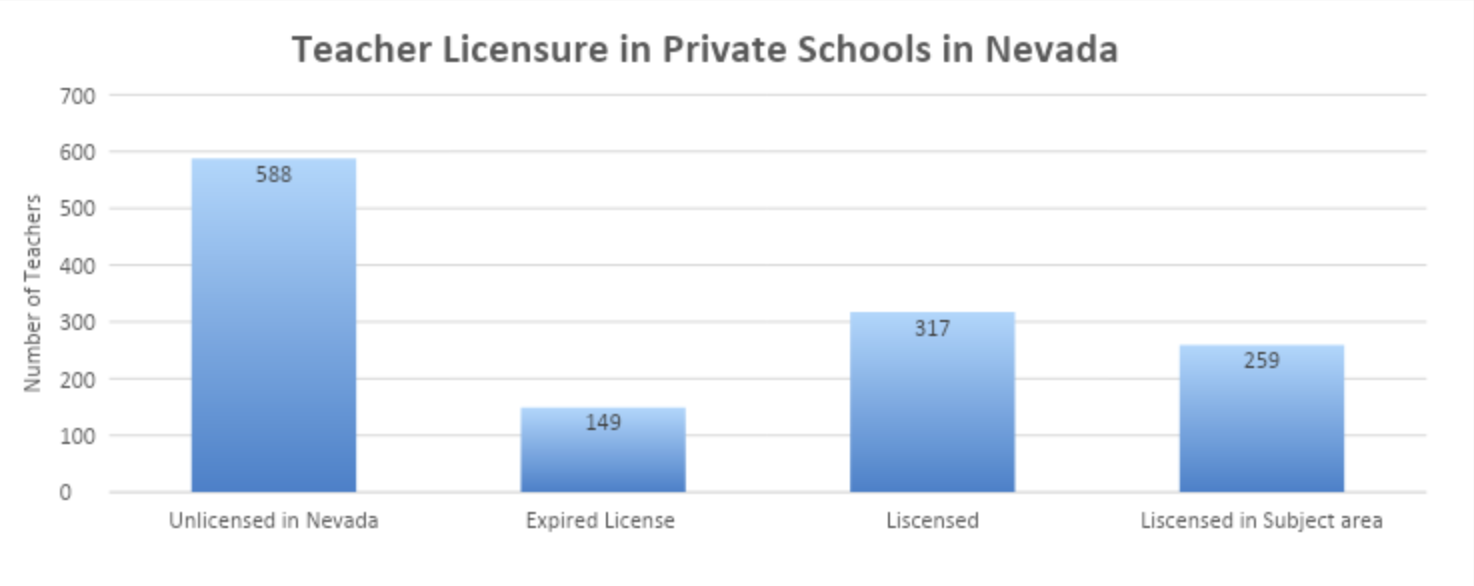
Lack of accountability in voucher programs has continued to raise red flags. Nevada private schools have no requirement that their teachers be licensed. An analysis by ENN found that of the schools that made the information available, less than 50 percent of teachers were ever credentialed in the state of Nevada, while some schools had no staff with Nevada licenses.

A look at the number of teachers who are licensed at private schools that have Opportunity Scholarship students enrolled. **This chart only includes data from schools who make staff information publicly available. Numbers exclude theology teachers and support staff.**

And the overwhelming lack of accountability – uniform testing, treatment of students with unique needs (private schools are less likely to accept students with an IEP), anti-discrimination, and other issues closely monitored in our public schools – means poor outcomes and underqualified staff may only be the tip of the iceberg.  North Carolina, for example, is grappling with testing issues, discrimination against LGBTQ students, and questionable academic content (with one popular textbook claiming the KKK was fighting to protect morality and slaves were treated well by their slave owners). One can argue that teacher quality, curriculum, or treatment of students is the prerogative of these schools because they are private, but if private schools are now operating using public taxpayer dollars, we must demand more.

Ultimately efforts would be better spent advocating for increased dollars for our public schools to ensure all our students have access to a quality education regardless of religion, sexual preference, gender, race or income.


To learn more about national efforts to fight private school vouchers, check out the new Public Funds Public Schools campaign supported by Education Law Center, Southern Poverty Law Center and the SPLC Action Fund.


About Educate Nevada Now
The Rogers Foundation, a Nevada leader in support of public education, joined with local, state and national partners to launch Educate Nevada Now (ENN) in 2015. The organization is committed to school finance reform and improved educational opportunities and outcomes for all Nevada public school children, especially English language learners, gifted and talented students, students with disabilities or other special needs, and low-income students.

More information about ENN can be found at www.educatenevadanow.com
###


Audrey Watters writes a brilliant blog about Ed-tech and its misadventures. It is called HEWN, or Hack Education Weekly Newsletter.

She wrote a post recently about what happened when a tech investor tweeted that he refused to invest in AltSchool because it was a truly bad idea. AltSchool raised $174 million to demonstrate that the solutions to the problems of education were embedded in technology. Investors included Mark Zuckerberg, Laurene Powell  Jobs, Peter Thiel, Pierre Omidyar, and other big players in the “reinvent school” sector.

Watters commented on an article in The New York Times written by Nellie Bowles, one of the most insightful journalists at the Times. Bowles wrote about the shunning of Jason Palmer, a venture capitalist., because of a tweet criticizing AltSchool. 

Palmer tweeted:

$174M lessons here. We passed on @Altschool multiple times, mainly because disrupting school was a terrible strategy, but also b/c founders didn’t understand is all about partnering w/existing districts, schools and educators (not just “product”) https://www.sfchronicle.com/business/article/AltSchool-s-out-Zuckerberg-backed-startup-that-14058785.php 

I would say that Jason Palmer is one smart guy. He understands that disrupting an institution you know nothing about is inherently a dumb idea.

AltSchool was created by Max Ventilla, a Google techie, and it was a failure, despite a plethora of positive articles in the national media predicting that it would “reinvent” school as we know it.

As Bowles wrote, Silicon Valley was outraged by Palmer’s tweet. How dare he criticize a failed start-up! She says that he eventually made amends for daring to speak truth.

Audrey Watters thinks the problem in the Ed-tech world runs deeper than enforced conformity and silence cling of dissent.

She writes:

To a certain extent, I think Bowles misses the point of the whole dust-up. The danger isn’t only that many people are afraid to challenge the orthodoxy. The danger is that many do not really think all that differently. Many in Silicon Valley (and more broadly those working in science and tech and in elite university labs) believe they’re all The Very Smartest Men, and if nothing else, they’ve convinced themselves to that end. Sugar Daddy Science.

There’s a whole other set of truths that Bowles never touches upon in her quest to talk about the demand for good Silicon Valley manners in order to get to be in good Silicon Valley company. See, Sugar Daddy Science is bad science. And Jason Palmer was absolutely right. AltSchool was a terrible idea. It was obviously a bad investment. Its founder had no idea how to design or run a school. He had no experience in education — just connections to a powerful network of investors who similarly had no damn clue and wouldn’t have known the right questions to ask if someone printed them out in cheery, bubble-balloon lettering. It’s offensive that AltSchool raised almost $175 million. It’s offensive that so many ed-tech journalists carried the company’s water, touting its innovative and disruptive potential. I care much less that we were all supposed to be nice about the startup. I care that this was a startup — like far too many in ed-tech — that, with its normalizing of surveillance, was poised to hurt kids…Without a grounding in theory or knowledge or ethics or care, the Silicon Valley machine rewards stupid and dangerous ideas, propping up and propped up by ridiculous, self-serving men. There won’t ever be a reckoning if we’re nice.

You do have to wonder why Silicon Valley is so quick to shout from the rooftops about any perceived failures in education yet resist any honest accounting of their own failures. Remember the infamous TIME magazine cover called “Rotten Apples,”  which declared that Silicon Valley had found the answer to “fixing” schools? Firing teachers whose students don’t get high test scores. That was about the Vergara lawsuit in California, funded by a tech billionaire to eliminate teacher tenure on the absurd theory that poor kids have low test scores because their teachers have tenure. “Absurd” because teachers in high-performing districts are more likely to have tenure than those in low-performing districts,where teacher turnover is higher. Fortunately, the Vergara case was thrown out, along with copycat suits in other states.


Every year since 2014, Democrats who fervently support the privatization of public schools have gathered at a conference they pretentiously call “Camp Philos.”

https://campphilos.org/

Check the agenda of meetings present and past.

There you will see the lineup of Democrats who sneer at public schools and look on public school teachers with contempt.

These are the Democrats who support the DeVos agenda of disrupting and privatizing public schools.

They are meeting again this year, and they will slap each other on the back for supporting school closures, charter schools, high-stakes testing, evaluating teachers by the test scores of their students, and hiring inexperienced teachers.

They have the chutzpah to call themselves “stakeholders,” although none of them are teachers, parents of public school students, or have any stake in the public schools that enroll 85-90% of all American students. Exactly what do they have a “stake” in?


The Denver school Board is up for grabs, and a battle looms between progressives supporting public schools and a slate controlled by Stand for Children, Democrats for Education Reform, and groups controlled by Wall Street and billionaires. The “reformers” support school closures, disruption, charter schools, and high-stakes testing. The powerful, who control the board, say that any challenge to their total power is “divisive.”

Denver Public Schools at a crossroads: 3 new board members will help decide district’s direction

The Denver Public Schools board will welcome three new members next year, but voters will have to decide whether it also has a new direction.

Board president Anne Rowe, who represents District 1, and at-large member Allegra “Happy” Haynes are term-limited, and District 5 representative Lisa Flores opted not to run again. Each of the three open seats seat has attracted three candidates.

A vocal group of teachers and activists are looking to “flip” the board, putting the majority that has favored tactics such as closing poor-performing schools and opening new charters into the minority. Two current members of the nine-person board have been skeptical of the so-called “reform” movement, though votes don’t always break down along ideological lines.

Fundraising numbers suggests that candidates aligned with the current majority on the reform side may not go easily, however.

Wendy Howell, deputy director of the Colorado Working Families Party, said the overriding issue is reducing corporate influence in education. The party hasn’t released its endorsements yet, but Howell is been active in the online Flip the Board community, which is attempting to turn energy from February’s DPS teachers strike into a political force.

Charter schools started with good intentions, but they’ve become a way to privatize public education services without improving students’ results, Howell said. Districts also have had to add extra administrative staff to deal with compliance issues for different types of schools, which diverts money from classrooms, she said.

“We want to get Wall Street out of our school board,” she said.

The flip community supports candidates who want to pause the development of new charter schools and to examine other ways of improving education, Howell said. They also want to see new board members take a critical look at DPS’ finances, she said.

“This experiment (with reform) has gotten out of control,” she said.

The Denver Classroom Teachers Association has endorsed candidates who aligned themselves with the Flip the Board movement: Tay Anderson, Scott Baldermann and Brad Laurvick. Students for Education Reform and Stand for Children have backed candidates who gravitate toward the reform side: Alexis Menocal Harrigan, Diana Romero Campbell and Tony Curcio.

Now look at the rhetoric of the privatizers. Only they care about children. They have been in total control for years and accomplished nothing other than disruption of schools, communities, and families. But they will call upon their billionaire funders to keep the disruption gang in power. Questioning their failure is “divisive.”

Krista Spurgin, executive director of Colorado Stand for Children, said the emphasis on flip versus reform candidates is “divisive,” and that the focus should be on working together to improve education. The parent volunteer committee that made the endorsement decisions wasn’t focused on ideology, but on whether candidates had a record of commitment to have students reading by third grade and on-track to graduate high school, she said.

“It’s about them having the experience and the knowledge to make improvements for families,” she said. “They also have the ability to push the district to improve.”

The candidates they endorsed also support school choice, which is valuable to parents, and giving schools autonomy to figure out what will work for their kids, Spurgin said.

Christian Esperias, national director of campaign strategy of Students for Education Reform, said the questions their student leaders considered when making their endorsement decisions weren’t focused on issues like charter schools and school closures, but on how candidates would close the opportunity gap for underserved groups like students of color and low-income kids. They also looked for candidates who support higher pay for teachers, he said.

“I would frame it as putting kids first versus focusing on the bureaucracy and the special interests,” he said.

Krista Spurgin, executive director of Colorado Stand for Children, said the emphasis on flip versus reform candidates is “divisive,” and that the focus should be on working together to improve education. The parent volunteer committee that made the endorsement decisions wasn’t focused on ideology, but on whether candidates had a record of commitment to have students reading by third grade and on-track to graduate high school, she said.

“It’s about them having the experience and the knowledge to make improvements for families,” she said. “They also have the ability to push the district to improve.”

The candidates they endorsed also support school choice, which is valuable to parents, and giving schools autonomy to figure out what will work for their kids, Spurgin said.

Christian Esperias, national director of campaign strategy of Students for Education Reform, said the questions their student leaders considered when making their endorsement decisions weren’t focused on issues like charter schools and school closures, but on how candidates would close the opportunity gap for underserved groups like students of color and low-income kids. They also looked for candidates who support higher pay for teachers, he said.

“I would frame it as putting kids first versus focusing on the bureaucracy and the special interests,” he said.