British Prime Minister Boris Johnson’s dog resigned.
https://link.newyorker.com/view/5be9de332ddf9c72dc2a1b9aapeei.12g7/5c26ca6e
British Prime Minister Boris Johnson’s dog resigned.
https://link.newyorker.com/view/5be9de332ddf9c72dc2a1b9aapeei.12g7/5c26ca6e
Since that infamous event on November 8, 2016, when the U.S. government was taken over by the loony and cruel Rightwing, I have said that two things would help us through the next four years: Art and humor. They would enable us to see the world as it is and as it should be and to dream of a better future.
No one has been a more reliable source of humor than Randy Rainbow.
Watch this short video to learn more about him.
In this post, Carol Burris lays out a devastating bill of indictment against the charter industry in Pennsylvania. Technically, it is run by “non-profit” Boards, but most of the time those words are fig leaves for for-profit corporations that are growing rich with the help of the state legislature.
Governor Wolf recently announced his determination to hold charter schools accountable, and the charter industry howled with rage. They don’t want any of their cushy deals to be jeopardized.
Carl Petersen, a veteran of the charter wars in Los Angeles, writes her about the serious defect in the charter reform law.
The law finally allows local school boards to determine whether proposed charter schools will damage the fiscal stability of the public schools, a welcome change.
But it also allows the unelected County Board of Education to overturn the decisions of the elected district school board. If the elected school boards determine that the proposed charter will damage the district, the unelected County Board can reject the decision of the local elected board. That is just plain wrong.
And nowhere is it wronger than in Los Angeles, where Corporate Reformers funded by billionaires fight to control the LAUSD school board. When the public manages to get the upper hand, the decisions of the school board can be overruled by a charter-friendly unelected county school board.
The county board in LA is dominated by phony Reformers, including the candidate who lost to George McKenna, a true friend of public schools, and Kate Braude, the executive director of astroturf Speak Up, the voice of the charter industry.
Elected officials should have the last word, not charter shills.
With so much billionaire cash sloshing around California to promote charter schools and to disparage public schools, it can be difficult to know which groups are real and which are Memorex.
Here is one that definitely is not a real parents’ group. It is called Speak Up and it is populated with people who are embedded in the charter sector. It recently chastised L.A. Superintendent Austin Beutner for not moving swiftly enough to clamp ratings on every school, the better to close them with and set them up for privatization. How will parents know how to choose a school if the district doesn’t give it a grade or a rating? They say he is in danger of “breaking a promise” to the parents of Los Angeles, who are longing to have their schools rated.
Schools should be evaluated based on such issues as their class size; the experience of their teachers; the resources invested by the district, such as: does the school have a library with a librarian? Does it have a school nurse? Does it have classes in the arts for all students?
But Speak Up seems to be interested mostly in test scores. Are they going up or down? Most people these days recognize that test scores measure the demographics of the students enrolled, not the quality of the school.
So who is this group?
Its founder and executive director is Katie Braude, a former KIPP executive. Until recently, she was on the Los Angeles County Board of Education, which has the power to overrule the LAUSD Board of Education on charter school decisions.
On Speak Up’s board of directors is Russell Altenburg, who is also connected to KIPP, was a program officer at the Broad Foundation, and a fellow at the NewSchools Venture Fund. And he was part of the “inaugural cohort” at the Pahara Next Gen Network.
Mary Najera was a founder of the Los Angeles Parents Union, now known as the Parent Revolution, which used the Parent Trigger law to try to convert public schools into charter schools. Parent Revolution was funded by Walton, Broad, Gates, Arnold and other billionaires. She is “chief community officer” at the Extera Public Schools charter chain.
Rene Rodman is another member of the board of directors of Speak Up. She is a also on the board of the Palisades Charter High School, where she served as president.
Aida Rodriguez is Vice President of Advocacy and Government Relations at Alliance College-Ready Public Schools, a charter school network. She too worked for Parent Revolution.
Speak Up is an organization led by charter school advocates. Twenty percent of the students in Los Angeles are enrolled in charter schools. Eighty percent are not.
Nowhere on Speak Up’s website does it list the names of its funders. One can only guess. Waltons? Broad? Hastings? Gates?
When you see a press release from Speak Up, remember that they are speaking up for Eli Broad, Reed Hastings, the Waltons, Bill Gates, and the charter industry, not for the 80 percent of students in the public schools.
The House that Bush Built
Billyan errs and Common Cores
Rickety stairs and creaky floors
Leaky roofs and shaky stoops
That’s the house that Bush built
Flooded basements, cracked
foundations
Broken casements, termite nations
Sagging beams and cracking seams
That’s the house that Bush built
Failing kids and firing teachers
Software bids and testing leechers
Standardizing and capitalizing
That’s the house that Bush built
In a comment, I told SDP that the only thing missing was how Obama and Duncan reinforced the foundation of this awful building.
Parents and students demand a seat at the table in Providence as state leaders prepare to take control of district.
A group of high school students and Providence parents have filed a motion with the state Department of Education Wednesday demanding a formal role for parents and students to weigh in on the takeover plan for the Providence public schools.
Parents are joined by several youth organizations, including Youth in Action, Providence Youth Student Movement, Alliance of Rhode Island Southeast Asians for Education, and the Providence Student Union.
The group, represented by the Rhode Island Center for Justice, is asking State Education Commissioner Angélica Infante-Green to ensure parent and student involvement in the plan for improving the city’s schools, the leaders who will implement it, and the goals, progress and criteria for success for the plan.
The groups argue that students and their parents have a clear, strong, personal stake in the success of the district, and have a legal right to participate in decisions about the takeover.
In their motion, the parents, students and community groups are saying to the state: “No one has a greater stake in demanding improvements in the schools than parents and students, and no turnaround will succeed without a clear plan that includes the community.”
Finland’s educational success became an international sensation when the nation’s students unexpectedly topped the PISA test a few years back. The Finns really don’t care much about rankings and standardized tests, and they were as surprised as everyone else. Thousands of visitors came to Finland to find out what they were doing. Then Finland slipped out of first place, and the gossip mill began spinning out theories about why Finland was losing its luster. Finland still doesn’t care about rankings or test scores.
In this post, Finnish expert Pasi Sahlberg and Finnish educator Peter Johnson explain what Finland is doing and what it is not doing to improve its schools (not its test scores).
They identify the three cornerstones of Finnish education:
*Education systems and schools shouldn’t be managed like business corporations where tough competition, measurement-based accountability and performance-determined pay are common principles. Instead, successful education systems rely on collaboration, trust, and collegial responsibility in and between schools.
*The teaching profession shouldn’t be perceived as a technical, temporary craft that anyone with a little guidance can do. Successful education systems rely on continuous professionalization of teaching and school leadership that requires advanced academic education, solid scientific and practical knowledge, and continuous on-the-job training.
*The quality of education shouldn’t be judged by the level of literacy and numeracy test scores alone. Successful education systems are designed to emphasize whole-child development, equity of education outcomes, well being, and arts, music, drama and physical education as important elements of curriculum.
They then debunk the myths and misperceptions that have been bruited about.
Unlike the U.S., where billions of dollars are wasted in efforts to switch control of schools from public to private, Finnish educators are trying to work through the problems of building a curriculum and pedagogy for the 21st century–and beyond.
The original rationale for charter schools was that they would be innovative, would be accountable, and would have lessons to share with public schools. We now know that the only innovation associated with charter schools is the adoption of stern discipline, reminiscent of schools a century or more ago.
We now know that charter lobbies fight any accountability.
They no longer see themselves as collaborators but as competitors. If they have anything to share, they are not doing it.
Their biggest innovations are diverting resources from the public schools and choosing the students they want. As a sector, the charter industry has produced a plethora of frauds and scandals, which is what you would expect to happen when entrepreneurs get government money without supervision, oversight or accountability.
Charter advocates claimed they would “save poor kids from failing schools,” but in most states the poor kids are better off staying in their public school.
Texas is about to be flooded with dozens of new charter schools, thanks to recent brats by Betsy DeVos to big charter chains IDEA and KIPP. These grants came from the federal Charter Schools Program, which DeVos uses as her personal slush fund to undermine public schools.
Here is a report from Texas:
By: William J. Gumbert
The State’s Efforts to Privatize Local Public Schools is NOT Improving Student Outcomes –
The State’s Academic Accountability Rating System Provides the Evidence
The Texas Education Agency (“TEA”) has released its 2019 Academic Accountability Ratings for taxpayer funded schools. In this regard, ratings were assigned to both locally governed, community-based school districts and State approved, privately-operated charters that comprise the State’s “dual education” system (see “TXSchools.gov”). In total, 1,089 taxpayer funded entities received ratings from TEA: 1,020 community-based school districts and 169 State approved, privately-operated charters (“charters”).
Charters are private organizations that the State unilaterally approves to operate schools in local communities with taxpayer funding. Originally authorized by the Texas Legislature in 1995, the State has provided privately-operated charters with over $20 billion of taxpayer funding to improve student learning in local communities. The “charter promise” was that in exchange for the State transferring the control of local schools to private organizations and allowing charters to be more autonomous with taxpayer funding, charters would produce better student outcomes.
However, the State’s 2019 Academic Accountability Rating System documents that privately-operated charters are producing lower student outcomes than community-based school districts. As a result, students and taxpayers are both paying the price for the State’s ongoing policies that support the operation and expansion of lower performing, privately-operated charters in local communities.
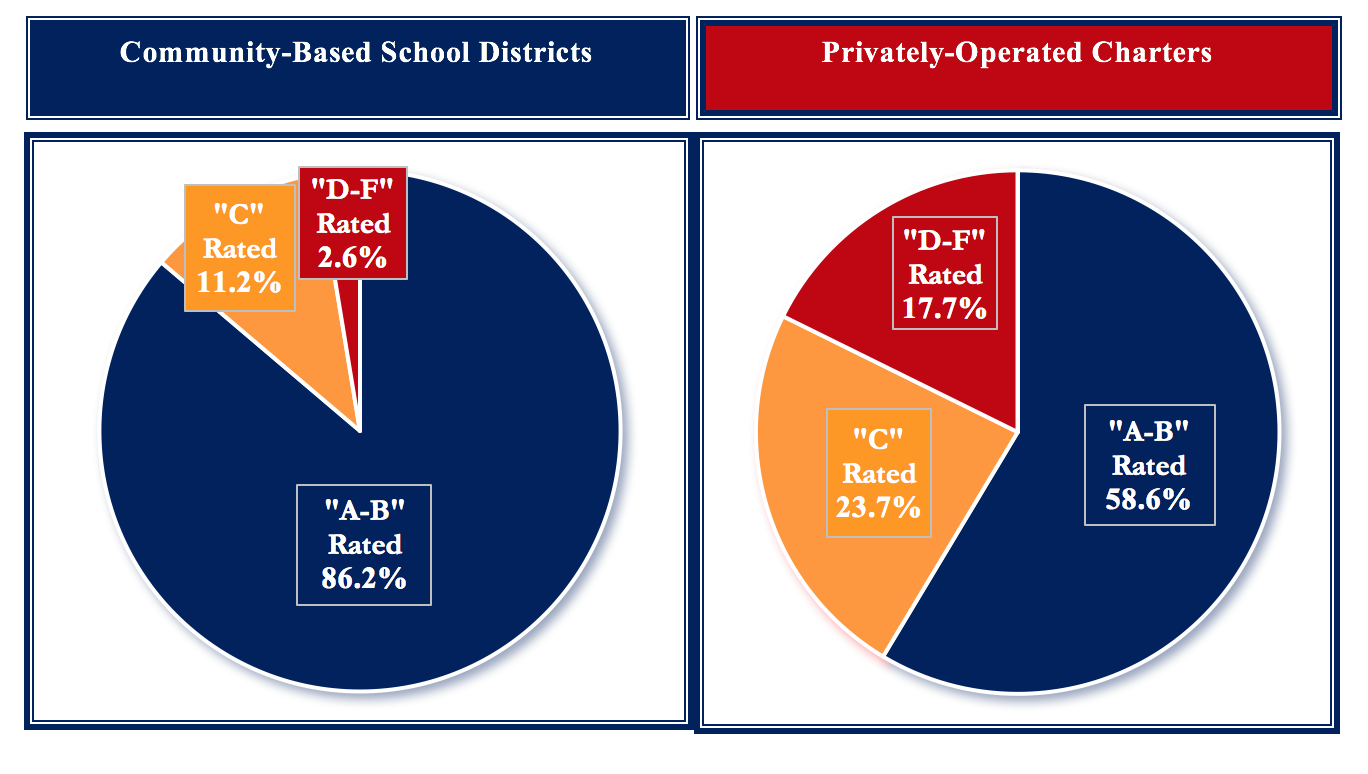
Rating Summary: According to the State’s ratings, an impressive 86.2% of community-based school districts received an “A” or “B” rating and only 2.6% of community-based school districts were assigned a “D” or “F” rating. In other words, 97.4% of the 1,020 community-based school districts were awarded the “good housekeeping seal of approval” by the State.
In comparison, the percentage of charters receiving an “A” or “B” rating was significantly lower at 58.6%, which is 27.6 percentage points lower than the percentage of community-based school districts with “A” or “B” ratings. The differences do not stop there. The percentage of charters receiving a rating of “C” or below was 41.4%, while the percentage of community-based school districts rated “C” or below was only 13.8%. In addition, an alarming 17.7% of State approved charters received a “D” or “F” rating. In other words, almost 1 of every 5 charters was deemed “low performing” by the State.
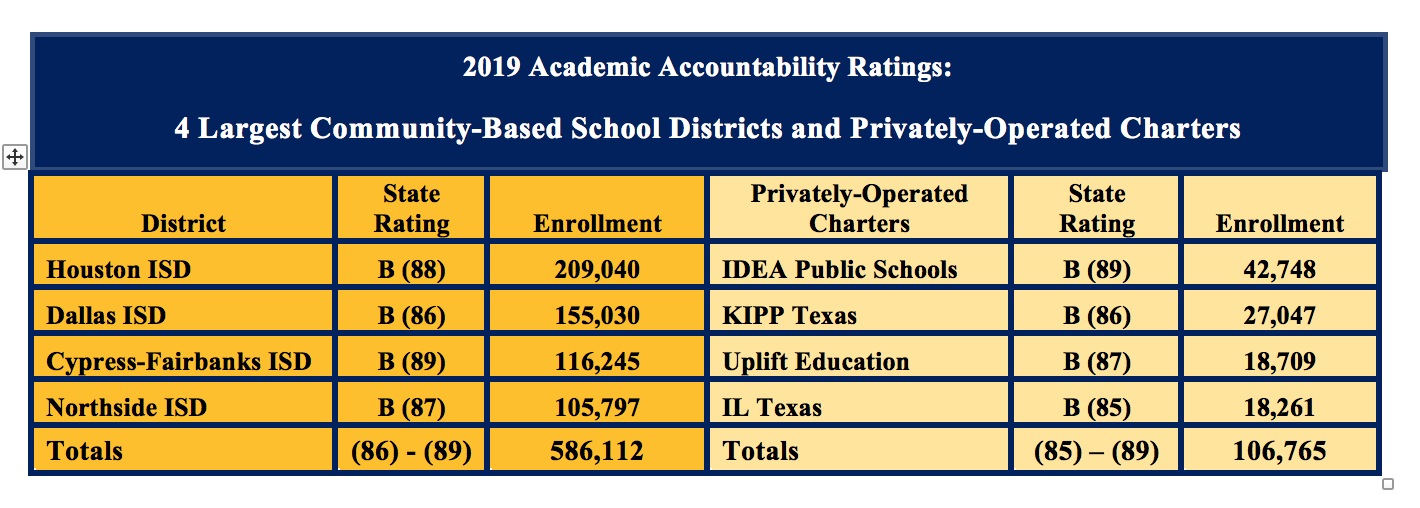
Largest Community-Based School Districts and Privately-Operated Charters – Rating Summary: The 4 largest community-based school districts in Texas serve the unique needs of 586,112 students and these school districts are not immune to scrutiny and criticism. Often, the criticism is from politically motivated State legislators, privately funded charter school advocacy organizations and charter school leaders that claim community-based school districts are failing students.
Despite these “self-serving” criticisms to promote the need for more charter schools, these claims are simply NOT true according to the State’s Academic Accountability Ratings. The reality is that although the largest community-based school districts enroll and serve the diverse needs of all students in their community, each received a high “B” rating (86-89) from the State. In comparison, despite the benefits of excluding enrollment to certain students and serving 479,347 fewer students, the 4 largest privately-operated charters that the State approved to improve student learning also received a “B” (85-89) rating.
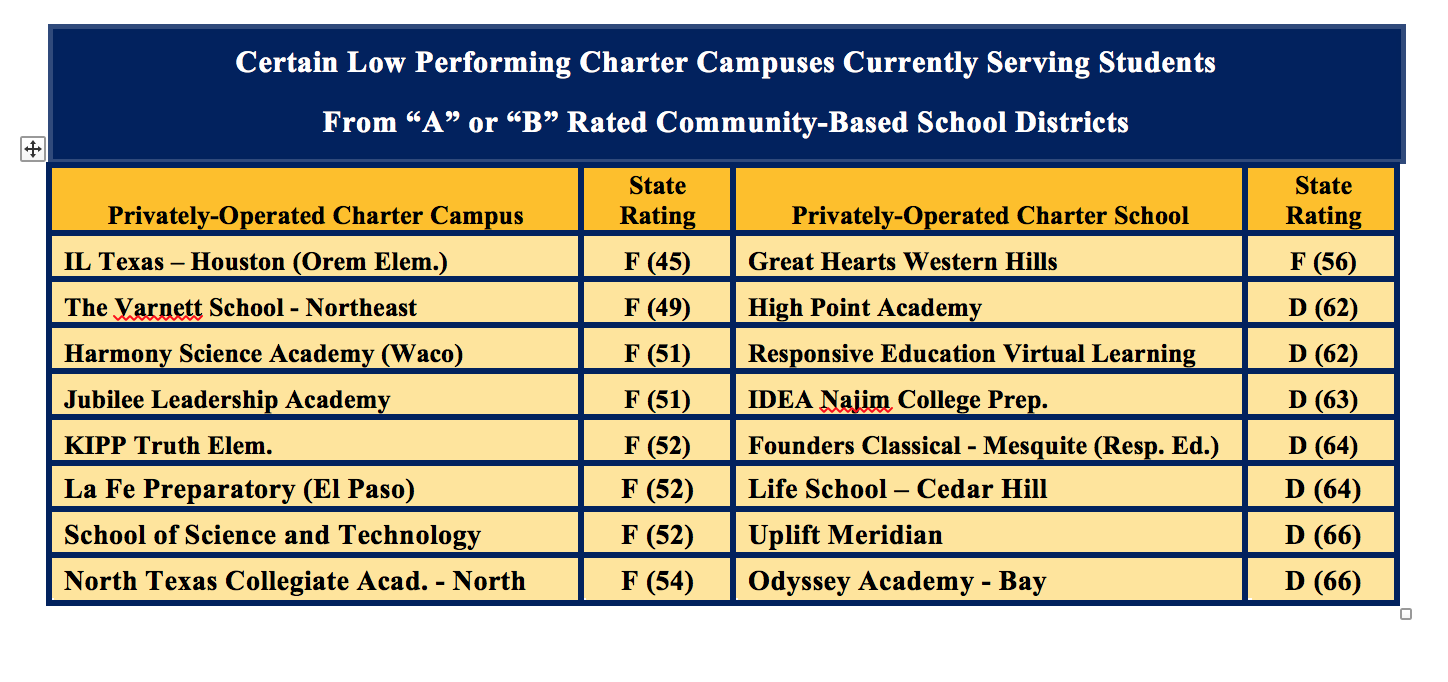
Low Performing Charter Campuses: The State has approved 288 separate charters to operate in local communities. To date, 110 of these charters have been surrendered or mandatorily closed and are no longer permitted to serve students. Despite these closures, many charters are still negatively impacting student outcomes. According to the State’s academic ratings. 17.3% of privately-operated charter campuses were rated “D” or “F” and many of these campuses serve students in higher performing community-based school districts. The table below summarizes a few of the “low performing” charter campuses that currently serve students from community-based school districts with “A” or “B” academic ratings.
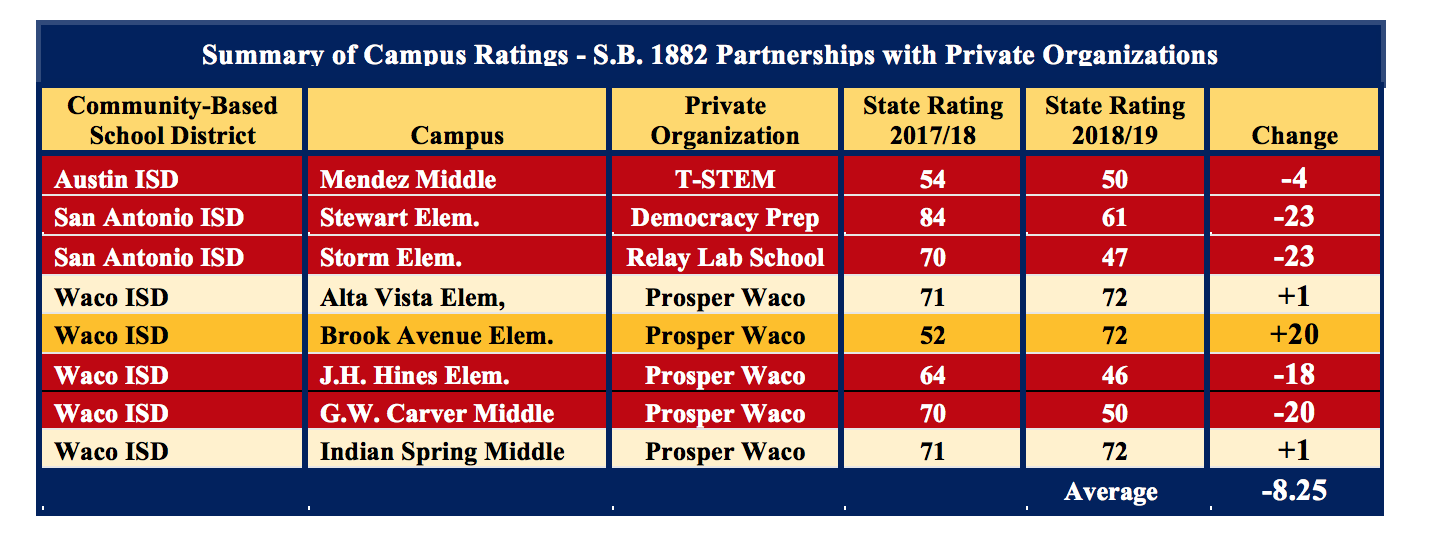
S.B. 1882 Partnerships – Results: In 2017, the Legislature approved S.B. 1882 that provides financial and accountability incentives for community-based school districts to partner with private organizations to operate existing schools. S.B. 1882 and TEA rules also require that any community-based school district campus with a “D” or “F” rating for 5 consecutive years must be turned over to a private charter/non-profit or closed. If neither of these occur, the community-based school district becomes subject to a State takeover.
S.B. 1882 is based upon the premise that “privatization” will improve the results of low performing campuses. However, the State’s premise is not based upon documented research or fact. For the 2018/19 school year, the 8 community-based school district campuses listed below were turned over to privately-operated charters/non-profits pursuant to S.B. 1882 partnerships. Unfortunately, most of these privately-operated campuses experienced a decline in student performance. In fact, the average academic ratings of these campuses declined by 8.25 points with private organizations at the helm. In addition, 4 of the campuses that had previously been rated “met standard” were relegated to an “Improvement Required” (“F”) rating under the control of private organizations.
Conclusion: While it can certainly be debated that the State’s Academic Accountability Rating System does not accurately reflect the effectiveness of a school, especially since it relies upon the performance of students on the standardized STAAR test and it ignores the many other positive educational attributes that schools provide to students every day. However, the system is the measuring stick that the State has chosen to evaluate student learning. It is also the accountability system that the State has chosen to govern the quality of public education deployed in local communities.
So:
♣ The purpose of privately-operated charters was to “improve student learning” by providing a State controlled, taxpayer funded alternative to community-based school districts; but
♣ The State’s Academic Accountability Rating System documents that:
⎫ Community-based school districts have significantly higher academic ratings than State approved charters;
⎫ Charters continue to operate a higher percentage of the “low performing” schools in local communities; and
⎫ The “privatization” of campuses pursuant to S.B. 1882 partnerships has primarily resulted in reduced student outcomes.
So why is the State continuing to support the operation and rapid expansion of privately-operated charter schools in community-based school districts? Why is the State offering financial incentives to “privatize” local schools? Could the answer be that politics and “special interests” are driving the State’s efforts to “privatize” schools in local communities?
The State created privately-operated charters to improve student learning in community-based school districts and it created the Academic Accountability Rating System which documents that State approved charters are producing lower student outcomes than community-based school districts. This creates quite a dilemma for the current policies of the State, but that is usually what happens when a “politically motivated” bad policy is exposed by another bad policy.
If it is truly about the “kids” and providing the highest quality education to students, it is time for parents, taxpayers and communities to hold the State accountable. It is time to return the control of public schools to taxpayers and democratically governed, community-based school districts that have proven to consistently produce better outcomes for students!
DISCLOSURES: The author is a voluntary advocate for public education and this material solely reflects the opinions of the author. The author has not been compensated in any manner for the preparation of this material. The material is based upon information provided by the Texas Education Agency, TXSchools.gov and other publicly available information. While the author believes these sources to be reliable, the author has not independently verified the information. All readers are encouraged to complete their own review and make their own independent conclusions.
During the era in which Mayor Michael Bloomberg took control of the New York City public schools (2002-2012), the city increased the number of selective admissions schools and set a uniform and very high standard for entry to gifted and talented programs. To enter the latter, children as young as four took a standardized test, and could gain admission only by scoring in the very top of the distribution. The stated rationale was to increae equity but the actual result was an escalation of inequity and racial segregation.
Faced with intense criticism for the low numbers of Black and Hispanic students admitted toselective schools, the city is now mulling a report that calls for phasing out gifted and talented programs.
Because of the explosion of school choice, districts go to great lengths to hold on to write parents, who will leave for a charter if they don’t get what they want in the public schools. .
To follow the debate, read this well-informed article by Erin Einhorn, who used to cover the NYC schools for the Daily News.
And read this informative post by Peter Goodman, who writes often about NYC and NY stateeducation issues. Goodman includes a useful summary of the report.
Goodman quotes Council Member Mark Treyger:
Let’s be clear: the School Diversity Advisory Group’s second set of recommendations do not seek to end enrichment programs. Instead, they call for the end of the Bloomberg-era ‘gifted and talented’ admissions model, which has been rejected by national gifted education experts and advocates. This model has failed to live up to its promise of equitable opportunities, resulted in the closure of half of all Gifted and Talented programs which disproportionately impacted communities of color, and increased segregation of all kinds in our schools,” said Council Member Mark Treyger (D-Coney Island, Bensonhurst, Gravesend)
Goodman adds: “Today there are 103 Gifted and Talent classes in grades K to 5 across the city, only one class in District 23, perhaps the poorest district in the city.”
What do you think?

 Diane Ravitch's blog