Archives for the month of: July, 2017

I wrote a few posts last week (see here and here) about the devastation of public schools in Indianapolis by corporate reformers. Their short term goal is to close public schools and replace them with privately managed charters. In the meanwhile, they are eliminating the neighborhood high school concept and requiring students to choose a high school based on its programs, not its proximity to home. They are preparing young people to be consumers and busting up any sense of community. The long term goal is the death of public education in Indianapolis.

The major movers of corporate reform in Indianapolis are the Mind Trust, which leads the privatization movement, abetted by Stand for Children, which brings in big bucks to buy elections for the corporate reform plan.

Remember, this is Mike Pence’s state, where rightwing extremists run the state.

Now comes another addition to the reform firmament of community disruption.

“A pair of Chicagoans are moving to Indianapolis in the next few weeks, and they are bringing with them a sense of urgency that defines the best of what you can find in many schools and classrooms. It’s an urgency that is critical for so many children who face immense challenges and the risk of lost potential.

“Deeply concerned about children locked in poverty, Jacob Allen and Marie Dandie founded a nonprofit after-school program in Chicago four years ago. They built pilotED around the concepts of civic engagement and a belief in the broader benefits of helping students develop a pride and belief in themselves. They peppered the curriculum with lessons centered on the lives and neighborhoods of the students they served.”

Allen and Dandie say their hallmark is “urgency.” Apparently no teachers or principals in Indianapolis public schools have that sense of urgency that this pair will bring with them to Indianapolis.

Not surprisingly, the two are TFA alums. They were recently recognized by a Forbes on its “30 Under 30” list in education. If they are under 30, how long have they been educators? How long did they stick with the school they started in Chicago?

Disruption is the hallmark of the Mind ztrust. It just got a gift of $7 million from the Lily Endowment to keep on with its plans for more disruption and innovation. Its goal is privatization of public education in Indianapolis. The Mind Trust is an affront to democracy.

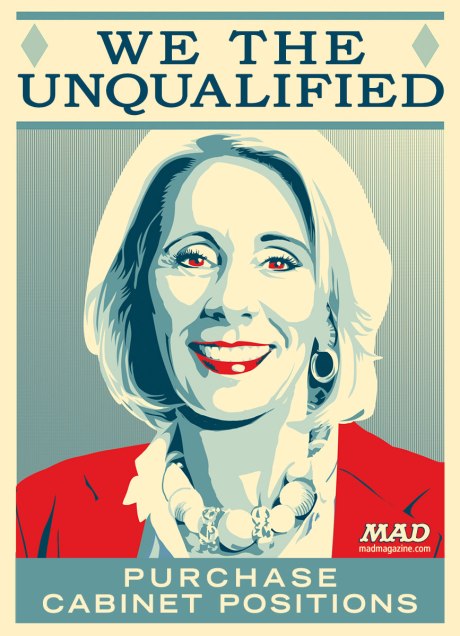
In case you want to print out your very own Betsy poster, here is the link.

Jeff Bryant argues cogently in this article that Democrats should unite on behalf of a charter school moratorium.

If the Democratic party wants to revive its base–labor and civil rights–it should heed Jeff’s sound advice.

Charters and school choice were never a natural fit with the public philosophy of the Denocratic party, which recognized the power of government to advance the common good, because charters are typically non-union, typically more segregated than the district they are in, and are aligned with the privatizing philosophy of the Republican Party.

It is passing strange to see any Democrat lending support to a policy championed by Betsy DeVos, Donald Trump, Jeb Bush, the Walton family, the Koch brothers, and every Republican governor.

Read the entire article. Here is an excerpt:

“Democrats know that success for their party relies on bringing labor and civil rights advocates together on key issues.

“Faced with disastrous Donald Trump, labor and civil rights advocates are rallying in common cause behind health care for all, a living wage for every worker, a tax system where the wealthy pay their fair share, tuition-free college, and an end to senseless, never-ending wars.

“Here’s another rallying point labor and civil rights agree on: A moratorium on charter schools.

“This week, the nation’s largest labor union, the National Education Association, broke from its cautious regard of charter schools to pass a new policy statement that declares charter schools are a “failed experiment” that has led to a “separate and unequal” sector of schools that are not subject to the same “safeguards and standards” of public schools.

“To limit the further expansion of these schools, the NEA wants a moratorium on new charters that aren’t subject to democratic governance and aren’t supportive of the common good in local communities.

“The NEA’s action echoes a resolution passed earlier this year by the national NAACP calling for a moratorium on the expansion of charters and for stronger oversight of these schools. These declarations also align with a policy statement issued last year by the Movement for Black Lives, a network Black Lives Matter organizers, calling for a moratorium on charter schools.

“Now that labor and civil rights groups have come together in a unified call for a moratorium on these unregulated, privately-operated schools, prominent leaders in the Democratic party can champion this issue knowing they have a grassroots constituency that supports them.

“Democrats in states where charters have been the most controversial – such as Ohio, Michigan, Pennsylvania, and California – should be especially interested in leading on this issue for a number of reasons.

“A Shared Concern For Basic Rights

“First, in most communities, unregulated charters are segregating students and undermining democratically governed public institutions.

“In their calls for a charter school moratorium, NEA, NAACP, and the Movement for Black Lives express a basic concern that these privately-operated schools are not subject to the same legal constraints as other public institutions, including federal and state laws and protections for students with disabilities, minorities, and school employees.

“The statements share a belief that charter schools have become counter-productive to a school system intent on serving the needs and interests of all students, and they argue that charters are reversing the progress achieved by civil rights milestones like the Brown v. Board of Education Supreme Court decision.

“All three organizations maintain that charter schools, as currently conceived, undermine local public schools, particularly those that are in communities that are already marginalized by racial prejudice and economic inequities. These organizations insist that charters must not be financially supported at the expense of local schools.

“Each statement shares the concern that charter schools are not subject to the same transparency and accountability standards as public schools, and they argue that making charters subject to a democratically elected local authority is the way to bring these schools back in line with responsible governance.

“Charters: An Idea Gone Awry

“In a press release announcing its new charter school policy, the NEA declares that charter schools have evolved far from their original intent to serve local communities as “incubators of innovation” and have instead become a force undermining local schools “without producing any overall increase in student learning and growth.”

“NEA’s contention that charter schools are an idea gone awry has widely held support.”

“The original vision of charter schools as laboratory schools, where teachers would have a stronger voice, has evolved to a more politically conservative vision that views charters as competitors of public schools in a market where only the schools with greater advantages can survive.”
Jersey Jazzman notes that Chris Christie will soon leave office as the most unpopular governor in the nation. He loved to ridicule those who disagreed with him, and one of his favorite targets was the state’s public schools and teachers, most especially their union. He never acknowled that the state is one of the three top-performing states on national tests (NAEP), the other two being Massachusetts and Connecticut.

Christie has cemented his rotten reputation as a greedy, crude bully with his latest escapade. The state was in a budget impasse, and many state beaches were closed on this past weekend. But Christie and his family went to the governor’s beach house and enjoyed the sun and an empty beach, while the public was excluded.

What really bothers JJ about Christie is his callow hypocrisy. He sends his own kids to private schools that are well funded while underfunding the state’s public schools.

His idea of “reform” does not translate into reduced class sizes or other necessities. A true “reformer,” he offers charters and vouchers instead of funding.

JJ writes:

“To be clear: I really don’t have a problem with Christie, or anyone else, sending their children to elite private schools, or to wealthy suburban public schools. What I find so disturbing is when some of those same people then turn around and declare how important education is for purposes of social equity, but refuse to support policies that adequately and equitably fund schools.

“Even worse is when these people substitute funding reform for “reforminess.” They claim that things like charter schools, gutting teacher workplace rights, expanded testing, test-based teacher evaluation, curricular changes, “personalized learning,” and school vouchers can serve as substitutes for adequately and equitably funding schools.

“But they then turn around and put their own children in elite private schools that spend far more per pupil than public schools — especially urban public schools. And again: these schools enroll very few children with special needs, keeping their costs relatively low.

“You will often hear these reformsters acknowledge that factors such as economic inequality and segregation negatively impact educational outcomes; however, in the same breath, they will gravely intone, “We can’t wait to fix poverty!”

“And so, their thinking goes, we have to expand charter schools no matter the negative consequences, or expand testing and its unvalidated uses no matter the negative consequences, or put more unproven digital stuff into schools no matter the possible negative consequences, and so on. And we have to do all this right now.

“It seems to me, however, that we now have more than enough evidence that school funding matters. It matters a lot. I mean, funding really matters. It does.

“Maybe we can’t solve poverty and segregation quickly; we could, however start getting more resources into schools that need it today. But getting adequate funding to schools — a necessary pre-condition for educational success — isn’t so much a problem of a lack of resources as it is a matter of political will.

“We’ve got plenty of money in this country (even if it is distributed extraordinarily unequally). There’s very little evidence we’re overspending on schooling relative to the rest of the world. We could drive more resources into the schools that enroll our least advantaged students much more quickly than we could expand private schools using vouchers or expand properly regulated charter schools.

“But we don’t. Instead, our leaders keep pushing reformy schemes based on outlier “successes” rather than funding reform, a policy that would quickly provide improvements across the K-12 education system. Worse, many of these same leaders then refuse to subject their own children to their designs, opting instead to enroll them in highly resourced schools.

“Chris Christie will be gone in a few months, and New Jersey might then begin to have a serious conversation about education funding. Sadly, many of our nation’s leaders, Republican and Democrat alike, are following Christie’s example. They refuse to address the issue of inadequate and inequitable school funding head on.

“Fortunately, even conservatives are starting to realize that effective schools and other government services come at a price. Let’s hope the era of Chris Christie and his ilk — and era where unproven reformy nonsense has replaced a commitment to getting schools the resources they need — will soon come to an end.

“If I had to pick one…

“ADDING: In the very earliest days of this blog — April, 2010 — I said that where Chris Christie sent his own kids to school was no one’s business.

“I was wrong.

“Of course, this was before Christie repeatedly underfunded the public schools, even after the Great Recession. This was before the lies of Chapter 78. This was before Christie tried to slash funding to the urban districts with his cruel “Fairness Formula.” This was before Christie showed repeatedly he never took education policy seriously. This was even before Christie unloaded some of his worst invective at the NJEA and teachers around the state.

“But I still should have known better. Anyone who is against the adequate and equitable funding of public schools yet sends their own children to a well-resourced private or public school is a massive hypocrite.

“They should be called so in no uncertain terms.”

Indiana has one of the nation’s largest voucher programs (34,000 students) and has been in operation long enough to collect four years of data.

The latest voucher study reached the conclusion that students who get vouchers fall behind in the first two years, notably in math, but eventually catch up to their public school peers.

But do they?

Steve Hinnefeld reported on the release of the study, but then had second thoughts.

He writes:

“The study, by Joe Waddington of the University of Kentucky and Mark Berends of the University of Notre Dame, was released Monday. Its findings were covered by National Public Radio, Chalkbeat, Education Week, the Indianapolis Star and the Fort Wayne Journal-Gazette. A headline in the Washington Post was typical: “School voucher recipients lose ground at first, then catch up to peers, studies find.”

“But the students who “catch up” are only a handful among voucher students included in the study. The study analyzed test scores for 3,913 students who received vouchers during the first four years of the Indiana program, from 2011-12 to 2014-15. But they had four years of test-score data for only about 5 percent of those students.

“The only students to produce four years of data were those who were in certain grades and received a voucher in the first year of the program. (Indiana gives standardized tests to students in grades 3-8, so those who were in sixth grade or higher in the first year of the program would have aged out of the annual tests in four years).

“By contrast, the researchers analyzed two or more years of data for over half the students in the study. So the finding that voucher students lost ground in the first and second year after moving to a private school seems considerably more solid.

“The study also includes data for 15 percent of voucher students who left their private school and returned to a public school. Those students, on average, had fallen further behind in math than the typical voucher student, and they also had lost ground in English/language arts.

“Here’s a possible interpretation: Maybe the voucher students who stayed in private schools for four years weren’t representative of all low-income students who received vouchers. Maybe they were disproportionately high-achieving or ambitious students who were more likely to make a go of it in private school.

“And the students who gave up or lost their vouchers and returned to public schools – maybe they left because their parents saw the private school wasn’t helping them and may have been hurting. Or maybe the private schools, which can set their enrollment standards, gave some of those students a nudge.

“Maybe the message isn’t that voucher students who stick with private schools do OK academically, but that voucher students who do OK academically are more likely to stick with private schools.

“If that’s the case, you can’t make a credible claim that voucher students will necessarily regain what they lost if they just persist in their private school. Some will, but others won’t.”

Thus, when you see a headline saying that voucher students lose ground but eventually catch up to their peers in public school, take a second look. Who persisted long enough to “catch up”?

Weren’t voucher schools supposed to “save poor kids from failing public schools”? There is no evidence for that assertion. If the kids are lucky, or work hard, they just might catch up to their peers in public schools.

A reader sent me the link to this poster, which appears in the current issue of MAD Magazine. I don’t customarily engage in ridicule, but what DeVos is doing to the public schools of America, what she is doing to civil rights enforcement, and what she is doing to college students struggling to pay for their education is beyond ridiculous.

maddevos

Led by Massachusetts Attorney General Maura Healy, the state attorneys general in 19 states sued Betsy zdezvos, who is failing to protect the interests of college students who are preyed upon by for-profit colleges, like the defunct Trump University.

This Secretary has carved out a unique role as the defender of corporate interests against the rights of students. Her motto might as well be “Let the predators prey!” In her mind, “preyer” is always a good thing, and when the powerful prey on the weak, well, as Betsy would say, “That’s life. Get used to it.”

Mercedes Schneider blogged about it here.

The Washington Post reported:

“A group of 19 state attorneys general is suing Education Secretary Betsy DeVos for delaying an overhaul of rules to erase the federal student debt of borrowers defrauded by colleges.

“With no notice, with no opportunity for comment … the DeVos team is trying to cancel this rule,” Massachusetts Attorney General Maura Healey, who is leading the lawsuit, said on a call with reporters Thursday. “It is important that we take action where we see activity by the federal government, Secretary DeVos and the Department of Education, that is unsustainable, unfair and illegal.”

“The complaint, filed in U.S. District Court on Thursday, accuses the Education Department of violating federal law by halting updates to a regulation known as the borrower defense to repayment. The rule, which dates to the 1990s, wipes away federal loans for students whose colleges used illegal or deceptive tactics to get them to borrow money to attend. The Obama administration revised it last year to simplify the claims process and shift more of the cost of discharging loans onto schools.

“Before the changes could take effect July 1, DeVos suspended them last month and said she would convene a new rulemaking committee to rewrite the borrower defense regulation, reviving a process that took nearly two years to complete. Proponents of the revised rule were livid that DeVos made a unilateral decision without soliciting or receiving input from stakeholders or the public.”

Let’s begin with the stipulation that the lists of “America’s Best High Schools” based on test scores or AP coursetaking encourage schools to game the system and are invalid on their face.

Then, congratulations to Gary Rubinstein! He not only demonstrated that New York City’s KIPP high school gamed the rankings by U.S. News & World Report, but the magazine noticed his critique, decided Gary was right, and dropped that KIPP school from its list.

Gary wrote:

“U.S. News and World Report publishes an annual list of the best high schools based on a metric involving mostly AP tests. Two months ago I noticed something strange when examining the data for a KIPP high school in New York that was ranked 29th in the country and 4th in the state on this list. Though there is just one KIPP high school in New York, there were four KIPP high schools in the rankings. These schools were actually middle schools. One of those schools had 100% of their students passing an AP while the other three had 0%. The only logical explanation for this is that KIPP manipulated their rosters, assigning kids who passed APs to one ‘school’ and kids who didn’t to the other three ‘schools’ even though they were all just part of one high school.”

He now wonders whether all the publications that hailed KIPP’s success will print the correction: Rupert Murdoch’s New York Post; Campbell Brown’s The 74; and the National Review.

Gary writes:

“In my years of blogging and uncovering things like this, this is a nice tangible ‘victory.’ I’m pretty sure that if I had never discovered this discrepancy, this correction would have not happened. KIPP had done the same thing with this school for a few years and have surely been using it in fund raising materials and maybe even grants. In the scheme of things it is a pretty small victory but still worth feeling good about.”

Thank you, Gary. You are a hero of the Resistance to corporate reform. You most certainly belong on the Honor Roll.

Success Academy is hiring!

Of course they are always hiring teachers due to the high rate of teacher turnover. More than 50% leave every year.

https://www.themuse.com/jobs/successacademycharterschools/real-estate-acquisitions-coordinator-9da675

Success Academy is looking for a Real Edtate Acquisitions Coordinator, who will report to the Associate Director of Operations, who reports to the Director of Operations. It doesn’t say to whom the Director of Operations reports.

Success Academy is a thriving business with substantial assets, a guarantee that the city will provide free space, or reimburse the business if it rents private space.

David Gamberg, superintendent of schools in both Southold and Greenport, on Long Island, in New York, had a dream. He wanted to install a custom-made Mother Goose shoe, in which children could play. He wanted it to symbolize the district’s commitment to childhood and play. He started a fundraising campaign. He was just short of his goal. A local businessman, who owns the town grocery store, contributed what was needed to meet the goal. The giant shoe will be built!

There is a lesson here about philanthropy. The donor helped the school do what it wanted to do. He didn’t step up and tell them what he wanted. He supported their goal instead of imposing his own.

Listen up, Bill Gates and Zuckerberg!