Once again, we are reminded that charter schools are a Republican cause, and their champion is Betsy DeVos.

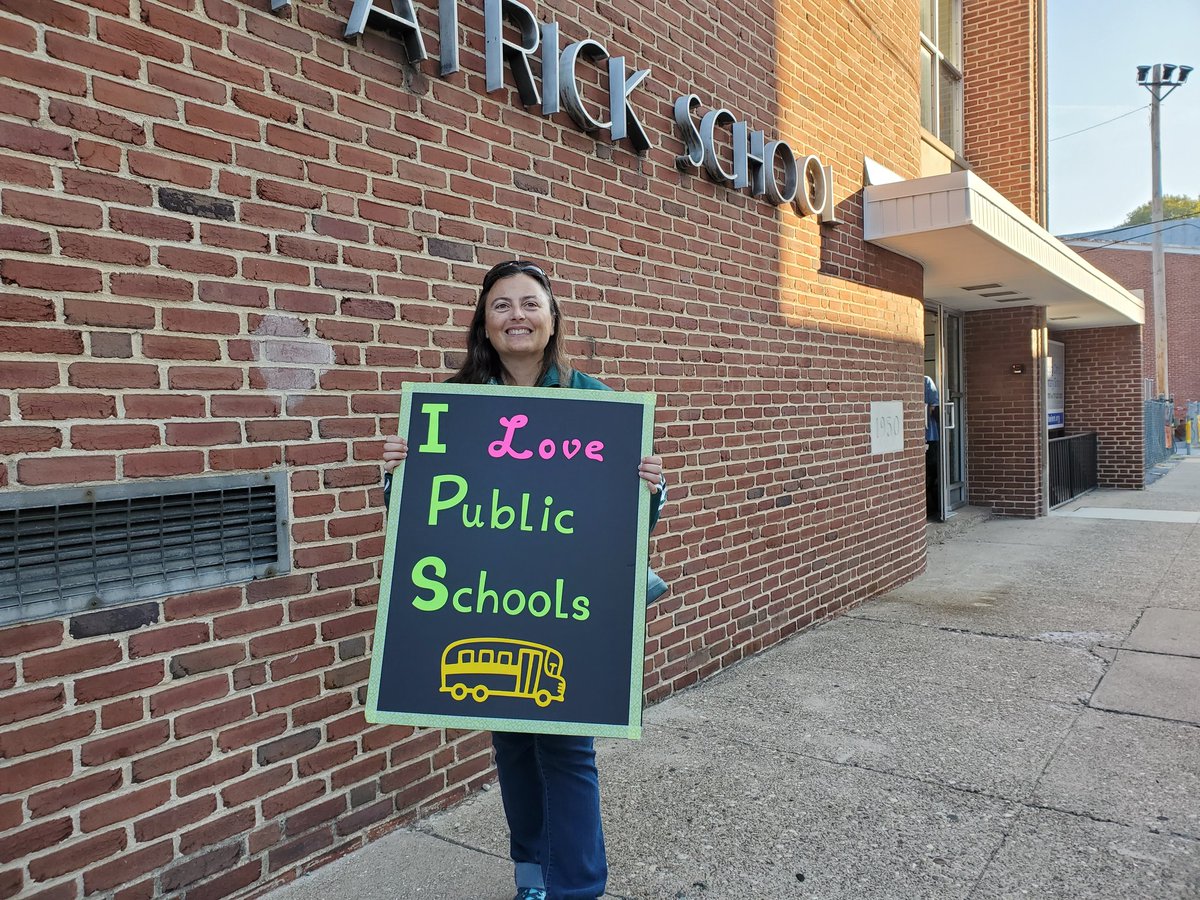
Mike Turzai, Republican Speaker of the House in Pennsylvania, was on his way to a meeting with Betsy DeVos when he encountered some public school teachers, who were picketing with signs saying they loved their public schools.

Turzai found this deeply offensive, and he proceeded to lambaste the teachers as a “special interest group” defending a “monopoly.”

In the video, Turzai praised charter schools, which receive government funding but operate independently of the public school system, saying that in charter schools. “you have to care about each child, not about the monopoly.” He then claimed that the public school advocates were part of a monopoly 

“What you care about is a monopoly and special interests,” said Turzai, whose district encompasses the North Hills municipalities of McCandless, Pine, Marshall, Bradford Woods, and Franklin Park. 

One of the advocates then said, “I am little offended from that,” to which Turzai responded, pointing to the posters they were holding, “Oh, I am offended by your posters.”

One poster read “I love public schools.” The other read “Public Money for Public Schools.”

We ♥ our teachers.

Sincerely,
All of Pennsylvania

View image on Twitter


Bill Phillis of the Ohio Coalition for Equity and Adequacy points out the obvious: State-issued school grades punish schools and districts for enrolling too many poor kids.

Ohio’s school report card grades predict median household income, child poverty rate, level of education attainment of adults
 
An “F” rating on Ohio’s school report card is guaranteed in districts with lowest median household income, highest child poverty rates and lowest level of education attainment by adults.
 
Rich Exner of the Cleveland Plain Dealerdid the numbers. “A” districts on average have the highest median household income and “F” districts have the lowest. Low poverty rates and high education attainment rates are found in “A” rated districts; and high poverty rates and low education attainment rates are found in “F” rated districts.
 
That Ohio’s report card measures demographics and not the aptitude and competence of the board of education and its personnel is obvious; however, state officials blame low report card grades on school district leaders and personnel. Therefore, state officials want to have the state takeover “F” rated school districts. Totally illogical.
 
The state takeovers in Youngstown and Lorain have failed to produce positive results; however, some members of the Senate Education Committee want to continue down the path of this failed strategy. How asinine.


The Bill & Melinda Gates Foundation issued an annual report called the “Goalskeepers Report 2019,” signed by Bill & Melinda Gates.

The theme is “Examining Inequality.”

It is a useful compilation of data about inequality from around the world, focused mainly on Africa.

There are two things that really bother me, however.

First of all, Bill Gates has never admitted or apologized for the damage he has done to American education by his munificent support for high-stakes testing, evaluating teachers by test scores, Common Core, and charter schools. His initiatives have wreaked havoc, demoralized teachers, harmed schools and communities, and he never says “I was wrong.”

The second thing that bothers me is that I do not believe that Bill & Melinda Gates wrote the report to which they affixed their names. It is unethical to claim authorship of something you did not write yourself.


Jennifer Berkshire presents here a podcast in which she interviews Quinn Strassel, the Ann Arbor high school teacher who wrote the musical “Betsy DeVos: The Musical.”

The podcast includes both an interview and some of the songs.

The DeVos-funded Mackinac Center, funded by DeVos, did not like the musical! 

Suffice it to say that DeVos has been a one-woman wrecking crew in Michigan who is now doing her best to dumb down the entire nation with her wacky, failed ideas about vouchers and charters.

I can’t wait until the show reaches Broadway or off-Broadway or off-off-Broadway.

Quinn, save a pair of tickets for me!

Rev/Dr. Anika Whitfield wrote the following letter to newly re-elected Governor Asa Hutchinson of Arkansas about the failed state takeover of the Little Rock School District, whose only purpose was to take away any democratic control of the district’s public schools by its residents. Dr. Whitfield is both a podiatrist and a minister, so she is Rev/Dr.

Rev/Dr. Whitfield is included in my new book “Slaying Goliath” as a hero of the Resistance to Privatization. She stands up to the Governor and the Waltons, who think they own the state as their private plantation. She shows time and again that one person can make a difference; one person can organize Resistance; one person can speak out for justice and demand it and eventually they will be heard.


Governor Hutchinson,
Two days prior to being sworn in for your second and final term as Governor of Arkansas, KATV-7 interviewed you and captured you sharing this quoted statement:

“He said, ‘Well, I have to look forward to the swearing in, just to have that mark where you have another 4 years to serve the people of this state. But also, it’s just affirming to know that they said you’ve had 4 years, we think you’ve done a good job, we want you again.'”

Sadly, we, the LRSD community, do not have the same assessment of your leadership.  Good is not the adjective we would use. We have experienced four years of you serving as a the leader of an evil, politically and economically driven abduction and seizure of the LRSD our local, political, and economic power.  Rather than serving The People of Little Rock, you have reverted to enslaving us, keeping tax paying residents from our local ability to provide our children, our schools, our neighborhoods and community with the type of compassion, protection and oversight needed to protect our beloved community from the violence we have been forced to endure at the control of your political, economic, and racial whips and lynching.
And, Little Rock is not the only city suffering from your style of leadership. Pine Bluff, and several other AR Delta cities can testify to the same or similar abuses at the control of your hands.
We have had enough!  
The insurrection of your violent and abusive leadership is coming. Your violent actions are making fertile ground for persons of diverse backgrounds and experiences to join together in solidarity to take back what is rightfully ours and should have never been taken from The People in the first place.   You can look at the state board of education meetings (that you did not attend) that were held in Little Rock these past three weeks and see the diversity, yet strong unity in our powerful presence and voices. 
We will no longer allow you to sale our public schools, drive our students and good teachers away, and cover up the gross neglect and violence that has occurred at the state and district levels under your slave master leadership.
We won’t stand four more years of your abuse. 
We will not stand for four more years of your unwarranted control of our children’s present and future fate, our school’s present/future fate, our neighborhoods and cities present/future fate, and visible attacks on the health and well being of the African American/Black, Latinx, poor, and uninsured living in Little Rock (in Pine Bluff, and other cities in the AR Delta). 
We are aware of your tax cuts and breaks that only further the expansion of greed allowing your wealthy political donors to take over land, property, schools, and neighborhoods  allowing them to avoid paying property taxes, and even by giving incentives and awards for those who are renaming formerly predominately low income (but historically rich) African American/Black owned neighborhoods and communities. 
The harm you have caused Arkansans under your four years and eight months of “leadership” is visible, palpable and unconscionable.  
We have students all over Arkansas afraid to go to school and parents afraid to go to work because you refused to declare Arkansas a Sanctuary State. 
We have requested on numerous occasions meetings with you and your appointed official, Commissioner Johnny Key, and both of you refused to do so until we called upon our elected Senators and Representatives, with you only conceding to give us one visit each.
We are no longer asking that you do us no more harm, we are demanding that you STOP your violence against us!
Give the LRSD back now!
Rev./Dr. Anika T. Whitfield 
Despite her fervent plea, the state board voted to continue state control of the Little Rock School District. One member also proposed disbanding the Little Rock teachers’ union. The motion received a second and will likely pass at the board’s next meeting.
Dr. Whitfield wrote:
The Arkansas State Board of Education voted unanimously to keep our schools under some sort of state control even after January 28, 2020.  They have adopted the draft as their working plan at today’s meeting despite the public outcries to discuss the draft further as it still has too many uncertainties, variables and undesirable state control even after the “release” of the LRSD.   
 
After voting to adopt this framework for reconstituting the LRSD, a board member made a motion to dissolve the Little Rock Education Association (our largest teachers/educators union).  The motion was not called for a vote, but did receive a second.  They adjourned the meeting and will vote on dissolving our union at their next meeting in October.
 
It is time for moral fusion, direct, non-violent, civil disobedience action!
 

Steven Singer has written recently about the origins of charter schools. He insists that Albert Shanker, president of the AFT, was not their father.

The real fathers of this first big step towards privatization, he writes, were Ted Kolderie and Joe Nathan of Minnesota, who wrote the nation’s first charter school law and opened the door wide for entrepreneurs, grifters, and attacks on unions.

Singer is a flame-thrower in this post, because he has come to see that behind the “progressive” facade of charters lurks Betsy DeVos, the Walton Family, the Koch brothers, ALEC, and a galaxy of public school haters.

He begins:

If bad ideas can be said to have fathers, then charter schools have two.

And I’m not talking about greed and racism.

No, I mean two flesh and blood men who did more than any others to give this terrible idea life – Minnesota ideologues Ted Kolderie, 89, and Joe Nathan, 71.

In my article “Charter Schools Were Never a Good Idea. They Were a Corporate Plot All Along,” I wrote about Kolderie’s role but neglected to mention Nathan’s.

And of the two men, Nathan has actually commented on this blog.

He flamed on your humble narrator when I dared to say that charter schools and voucher schools are virtually identical.

I guess he didn’t like me connecting “liberal” charters with “conservative” vouchers. And in the years since, with Trump’s universally hated Billionaire Education Secretary Betsy Devos assuming the face of both regressive policies, he was right to fear the public relations nightmare for his brainchild, the charter school.

It’s kind of amazing that these two white men tried to convince scores of minorities that giving up self-governance of their children’s schools is in their own best interests, that children of color don’t need the same services white kids routinely get at their neighborhood public schools and that letting appointed bureaucrats decide whether your child actually gets to enroll in their school is somehow school choice!

But now that Nathan and Kolderie’s progeny policy initiative is waning in popularity, the NAACP and Black Lives Matter are calling for moratoriums on new charters and even progressive politicians are calling for legislative oversight, it’s important that people know exactly who is responsible for this monster.

And more than anyone else, that’s Kolderie and Nathan.

Over the last three decades, Nathan has made a career of sabotaging authentic public schools while pushing for school privatization.

He is director of the Center for School Change, a Minneapolis charter school cheerleading organization, that’s received at least $1,317,813 in grants to undermine neighborhood schools and replace them with fly-by-night privatized monstrosities.

He’s written extensively in newspapers around the country and nationwide magazines and Websites like the Huffington Post.

Read it all. Joe Nathan has frequently commented on this blog, defending charters as just a different kind of public school. I disagree vigorously because it is obvious by now that charters have become vehicles for busting unions (more than 90% are non-union), charters are more segregated than public schools (especially in Minnesota, where there are charters specifically for children of different ethnic and racial groups), and they remove democratic control in communities of color. The proliferation of corporate charter chains adds to their reputation as destroyers of democracy.

Bottom line is that Walton money, Koch money, DeVos money is not meant to advance public education but to eliminate it.

There is a reason that the Democratic candidates for president are distancing themselves from the charter idea. They understand that they can’t support the DeVos agenda. Betsy did us all a favor by removing the mask.

William J. Gumbert has posted a series of analyses of charter school performance and demographics in Texas, based on public data compiled by the state. This is a summary of earlier posts. You may recall from an earlier post about Houston that the state commissioner of education is threatening to take control of the Houston Independent School District because of the persistently low rest scores of one school, Wheatley High School. Please check out its demographics in the chart below.


By:  William J. Gumbert


Ever since the “A Nation at Risk: The Imperative for Educational Reform” report was released in 1983, corporate education reformers and privately funded, “public policy” organizations have promoted the “privatization of public schools”.  In 1995, the Texas Legislature gave in to the political rhetoric and authorized privately-operated charters (“charters”) to open and independently operate public schools with taxpayer funding.  As a result, taxpayers are funding a “dual education system” that consists of locally governed, community-based school districts and State approved charters.

Charters promised to improve student results by transferring the control of public schools to private organizations that had more autonomy to expend taxpayer funding without community oversight.  However, charters have not fulfilled their promise.  Despite the State funneling over $22.5 billion of taxpayer funding to privately-operated charters over the last 24 years, charters have not to produced better student outcomes than community-based school districts.   Most recently, 86.2% of community-based school districts received an “A” or “B” rating pursuant to the State’s 2019 Academic Accountability Ratings.  In comparison, only 58.6% of charters received an “A” or “B” rating. In addition, almost 1 of every 5 charters received a “D” or “F” rating from the State.

Despite the Perception – Charters Serve a Different Student Population:   Charter advocates have consistently promoted that charters serve a higher percentage of “economically-disadvantaged” and “minority” students from underserved communities.  But charters have also routinely stated that their student populations closely correlate with the school districts they choose to operate within. In this regard, Houston ISD and Dallas ISD collectively have over 75,000 students enrolled in State approved charters and both districts serve student populations that are at least 80% “economically-disadvantaged” and “minority”.   Thus, it is fair to say that both charters and school districts serve a high percentage of “economically-disadvantaged” and “minority” students.  However, the similarities in the types of students served by charters and school districts stop here.

The reality is that charters “underserve” many of the student subgroups that the “No Child Left Behind Act” identified as having potential achievement, opportunity or learning gaps in comparison to their peers.  The Texas Education Agency (“TEA”) tracks the performance of student subgroups in Texas public schools and while “economically-disadvantaged” and “minority” students are identified as subgroups, so are “at risk”, “special education”, “disciplinary” and “mobile” students.

With the needs of each student being unique, it is important to emphasize that a student can be included in more than one subgroup.   For example, a student can be identified solely as “economically-disadvantaged” or a student can be “economically-disadvantaged”, “at risk” and “mobile”.  The more subgroups that are applicable to a student, the more challenging it becomes to ensure that student is successful.   I highlight that “challenging” is not referenced as an excuse for schools to have low student performance, but rather to recognize the additional time, effort, care and resources that are required to help certain students overcome adverse circumstances and obtain a quality education.

A review of the student subgroups reported by TEA shows that privately-operated charters enroll a significantly lower percentage of “at risk”, “disciplinary placement” and “special education’ students than community-based school districts.  TEA data also demonstrates that charters enroll students with significantly lower “student mobility”.   Why?  It is hard to definitively say. But these types of students have proven to be more costly to serve, require the most effort to achieve good “test scores” and are the least likely to continue on the “road to college”.  It may also be that charters do not actively recruit students in these subgroups.  Either way, here are the facts.

 “At Risk” Students:  Students identified as “at risk” of dropping out are performing below academic standards and/or are confronting other challenges.  TEA’s definition of “at risk” includes a student that:

  • Did not perform satisfactorily on a readiness or assessment instrument;
  • Has a grade below 70 in 2 or more subjects in the foundation curriculum for the preceding or current school year;
  • Is of limited English proficiency;
  • Was not advanced from one grade level to the next for one or more school years; and
  • Has been placed in an alternative education program in the preceding or current school year.

As shown below, despite having a large presence in each of the 5 urban school districts listed below, some of the largest charters enroll 19.3% fewer “at risk” students.   In other words, for every 1,000- seat school campus, the school districts serve 193 more students that have been identified as “at risk” of dropping out.   While it may be surprising to some, the listed charters also serve a lower percentage of “at risk” students than the statewide average.


Privately-Operated Charter “At Risk”

Students

School District “At Risk”

Students

IDEA Public Schools 45.9% Houston ISD 71.7%
Harmony School of Excellence – Houston 43.5% Dallas ISD 63.2%
KIPP, Inc. – Houston 46.7% Austin ISD 51.3%
Uplift Education 54.8% San Antonio ISD 73.5%
YES Prep. 50.2% Fort Worth ISD 77.8%
Average – 5 Charters 48.2% Average – 5 School Districts 67.5%
5 Charters: Avg. Per 1,000 Seat Campus 482 Students 5 Districts:  Avg. Per 1,000 Seat Campus 675 Students
                                                                   State Average:   50.8% or 508 Students  


Disciplinary Placements:  TEA data shows that 73,713 students have been identified as “Disciplinary Placements” in public schools.  These are students that have previously had behavioral issues or been placed in a District Alternative Education Program (“DAEP”).  By law, privately-operated charters can exclude enrollment to this student subgroup and most charters do. In fact, charter proponents have previously stated that many charters are not prepared and could not afford to serve these students.  As such, the responsibility to deploy the educational services and resources needed to serve “disciplinary” students resides mostly with school districts.  Once again, despite having a large presence in the same 5 school districts, the same charters served only 11 “disciplinary” students and the school districts welcomed 6,532 “disciplinary” students.

Privately-Operated Charter Discipline

Students

School District Discipline

Students

IDEA Public Schools 0 Houston ISD 1,996
Harmony School of Excellence – Houston 0 Dallas ISD 1,843
KIPP, Inc. – Houston 0 Austin ISD 1,140
Uplift Education 0 San Antonio ISD 879
YES Prep. 11 Fort Worth ISD 674
  Total – 5 Charters 11   Total – 5 School Districts 6,532


 Special Education:  Students identified with physical or learning disabilities comprise an average of 9.1% of all students in Texas public schools.  But at the same charters listed below, only 6.2% of students are identified by TEA as “students with disabilities”.   The enrollment gap for “student with disabilities” among certain charters and school districts can be alarming, especially since it is permitted to occur with the State’s blessing.  For example, IDEA Public Schools is rapidly expanding in Austin ISD, but Austin ISD welcomes more than double the percentage of “students with disabilities”.   For every campus with 1,000 students, IDEA only serves 52 students with “special needs” and Austin ISD serves 109 students with “special needs”.  If Austin ISD served the same percentage of “students with disabilities” as IDEA, it would serve an estimated 4,500 fewer students with “special needs”.

Privately-Operated Charter Special Education Students School District Special Education Students
IDEA Public Schools 5.2% Houston ISD 7.1%
Harmony School of Excellence – Houston 6.3% Dallas ISD 8.2%
KIPP, Inc. – Houston 6.3% Austin ISD 10.9%
Uplift Education 7.0% San Antonio ISD 10.3%
YES Prep. 6.1% Fort Worth ISD 8.3%
Average – 5 Charters 6.2% Average – 5 School Districts 9.0%
  State Average: 9.1%  


Student Mobility:  TEA defines “student mobility” as the percentage of students that were enrolled at a campus for less than 83% of the school year.  In other words, the “student mobility” rate refers to the volume of students that were not consistently enrolled in a charter/school district throughout a school year.  With an inconsistent learning environment, students that regularly change schools are faced with unique social and educational challenges in comparison to other students.  For example, Education Week has reported that: “various studies have found student mobility – and particularly multiple moves – associated with lower school engagement, poorer grades in reading (particularly in math), and a higher risk of dropping out of high school”.

As summarized below, the “student mobility” rate of the listed school districts is a challenging 20.3%, while the “student mobility” rate of the charters is only 6.3%.   As such, for every 1,000-seat campus, the school districts must meet the unique challenges of educating 203 “mobile” students during a school year.  In comparison, the charter campus has a much more stable population with only 63 “mobile” students.


Privately-Operated Charter Student

Mobility Rate

School District Student

Mobility Rate

IDEA Public Schools 7.0% Houston ISD 19.2%
Harmony School of Excellence – Houston 10.0% Dallas ISD 19.9%
KIPP, Inc. – Houston 4.5% Austin ISD 17.9%
Uplift Education 5.5% San Antonio ISD 23.6%
YES Prep. 4.4% Fort Worth ISD 21.1%
Average – 5 Charters 6.3% Average – 5 School Districts 20.3%
5 Charters:  Avg. Per 1,000 Seat Campus 63 Students 5 Districts:  Avg. Per 1,000 Seat Campus 203 Students
                                                                   State Average: 16.0% or 160 Students  

Comparison of Campuses Located Within 3 Miles of Each Other:  While each student subgroup presents unique challenges, schools that are primarily comprised of students in multiple subgroups have the most challenges to consistently achieve high student performance. In this regard, it is not a coincidence that many school district campuses labeled as “low performing” by the State are comprised of students included in multiple subgroups.

The table below further illustrates the disparities of the student populations enrolled at State approved charters and school districts by comparing the student populations of 7 charter campuses that are located within 3 miles of a school district campus.   In each comparison, the charter campus competing for students with a nearby school district campus served fewer “at risk”, “disciplinary”, “special education” and “mobile” students.  It most cases, the differences were substantial.  On average, for each 1,000-seat campus, the comparisons revealed that the charter campuses served:

  • 325 fewer “at risk” students;
  • 65 fewer “special education” students;
  • 199 fewer “mobile” students; and
  • No charter campus enrolled a student with a “discipline placement”.
Campus “At Risk” Discipline

Placement

Special Education Student Mobility
Wheatley H.S.     (Houston ISD) 88.1% 36 19.0% 31.2%
YES Prep. – 5th Ward 51.1% None 7.6% 4.4%
Travis H.S.         (Austin ISD) 77.1% 46 14.2% 30.3%
IDEA Allan College Prep. 53.7% None 10.4% 8.6%
Morningside M.S.   (Fort Worth ISD) 88.0% 2 14.1% 25.9%
Uplift Mighty M.S. 67.8% None 10.7% 2.9%
Sharpstown H.S.    (Houston ISD) 90.2% 39 9.7% 30.9%
KIPP Sharpstown College Prep. 52.2% None 5.4% 4.4%
Douglass Elem.      (SAISD) 78.5% 6 9.6% 28.7%
IDEA Carver Academy 17.4% None 5.1% 9.5%
Andress H.S.         (El Paso ISD) 66.3% 51 21.1% 18.0%
Harmony School of Excel. – El Paso 49.4% 0 8.5% 12.1%
Carter H.S.          (Dallas ISD) 70.7% 20 11.8% 24.0%
Uplift Hampton Prep.  H.S. 39.5% None 6.4% 7.6%
Average –  7 School District Campuses 79.8% 26 14.2% 27.0%
Average –  7 Charter Campuses 47.3% None 7.7% 7.1%
Average Charter Difference – Per 1,000 Seat Campus 325 Fewer Students — 65 Fewer Students 199 Fewer Students


Conclusion:  The “A Nation at Risk” report started the false narrative that our public schools were failing and the attack on school districts has continued ever since.  These strategic attacks have served to fuel the “privatization of public education agenda” of corporate reformers and society-controlling billionaires that persuaded the Legislature to provide privately-operated charters with the freedom to expand in local communities with taxpayer funding.

The State has provided privately-operated charters with many educational advantages to produce better student outcomes than community-based school districts.  These advantages include less taxpayer oversight; greater instructional, staffing and enrollment flexibility; and the ability to stop serving students by closing campuses.  Privately-operated charters are also permitted to underserve certain student subgroups that have been identified as having potential achievement, opportunity or learning gaps, such as “at risk”, “disciplinary”, “special education” and “mobile” students.

With all the educational advantages afforded to State approved charters, common sense tells us that charters should be outperforming school districts by a wide margin.  But despite these advantages and 24 years of experimentation, the State’s 2019 Academic Accountability Ratings document that privately-operated charters continue to produce lower student outcomes than locally governed school districts!

It is time for the State to apologize to school district teachers, support staffs, administrators and Boards of Trustees across the State and admit that “privatization” was a misguided experiment.   It is time for the Legislature to apologize to taxpayers for increasing the costs of public education by diverting over $22.5 billion of taxpayer funding to privately-operated charters that have failed to consistently improve student outcomes in local communities.  It is time to implement education policies that are based upon the facts, not political charades or charter advertisements.  The future of young Texans is counting on it!


DISCLOSURES:  The author is a voluntary advocate for public education and this material solely reflects the opinions of the author.  The author has not been compensated in any manner for the preparation of this material.  The material is based upon information provided by the Texas Education Agency, TXSchools.gov and other publicly available information.  While the author believes these sources to be reliable, the author has not independently verified the information.  All readers are encouraged to complete their own review and make their own independent conclusions.

Rob Levine, a Resistance-to-Privatization blogger in Minneapolis, reports here on the failure of the Bush Foundation’s bold “teacher effectiveness” initiative, which cost $45 million. All wasted.

The foundation set bold goals. It did not meet any of them.

Levine writes:

Ten years ago the St Paul-based Bush Foundation embarked on what was at the time its most expensive and ambitious project ever: a 10-year, $45 million effort called the Teacher Effectiveness Initiative (TEI). The advent of the TEI coincided with the implementation of a new operating model at the foundation. Beginning in 2009 it would mostly would run its own programs, focusing on three main areas: .

  • “developing courageous leaders and engaging communities in solving problems”
  • “…supporting the self-determination of Native nations”
  • “…increasing the educational achievement of all students”

Bush foundation president Peter Hutchinson told a news conference that the initiative would “increase by 50 percent the number of students in Minnesota, North Dakota and South Dakota who go to college.”

The Teacher Effectiveness Initiative was the foundation’s real-world application of its broad educational philosophy. Peter Hutchinson, the foundation’s president at the time, told a news conference announcing the plan that the initiative would “increase by 50 percent the number of students in Minnesota, North Dakota and South Dakota who go to college.” How was this miraculous achievement to be done? By “[enabling] the redesign of teacher-preparation programs” at a range of higher educational institutions where teachers are educated in the three-state area.

The foundation also said that, through “Consistent, effective teaching” it would “close the achievement gap.” It would achieve these goals by “producing 25,000 new, effective teachers by 2018.”

Not only was the Bush Foundation going to do all these things, but they would prove it with metrics. It contracted with an organization called the Value Added Research Center (VARC) to expand its Value Added Model (VAM) to track test scores of students who were taught by teachers graduated from one of its programs. The foundation, which paid VARC more than $2 million for its work, would use those test scores to rate the teachers ‘produced’ – even giving $1,000 bonuses to the programs for each ‘effective’ teacher.

10 years later: Fewer students in college, ‘achievement gap’ unchanged

By just about any measure the Teacher Effectiveness Initiative was a failure. Some of the top-line goals were missed by wide margins. The promise of 50% more college students in the tri-state area over the 10 years of the project? In reality, in Minnesota alone the number of post-secondary students enrolled actually dropped from almost 450,000 in 2009 to 421,000 in 2017 – a decline of about six percent.

Just one more example of the complete and utter failure of the hoax of “reform,” which was always about privatization and union-busting, not improving schools or helping students.


The federal Charter Schools Program handed out $440 Million this year. Betsy DeVos uses this money as her personal slush fund to reward corporate charter chains like KIPP ($89 million), IDEA (over $200 million in two years), and Success Academy ($10 million). Originally, it was meant to launch start-up charters, but DeVos has turned it into a free-flowing spigot for some of the nation’s richest charter chains.

Last March, the Network for Public Education published its study of the ineptness of the Charter Schools Program, revealing that at least one-third of the charters it funded had either never opened or had closed soon after opening. About one billion dollars was wasted by this federal program.

Despite the program’s manifest incompetence and failure, Betsy DeVos asked Congressional appropriators to increase its funding to $500 million a year, so she could more efficiently undermine public schools across the nation.

House Democrats responded by cutting the Charter Schools Program to $400 Million ($400 million too much), but $100 million less than DeVos asked for.

Senate Republicans want to increase the funding for the destructive Charter Schools Program to $460 million, giving DeVos a boost of $20 million. The Senate Republicans added a special appropriation of $7.5 million for charter schools in rural districts. Is there a need for charter schools in rural districts that may have only one elementary school and one high school?

The best remedy for the federal Charter Schools Program would be to eliminate it altogether.

Charter schools are amply funded by the Walton Family Foundation, the Gates Foundation, Reed Hastings, Eli Broad, Michael Bloomberg, the Koch foundation’s, hedge fund managers, and a bevy of other billionaires on Wall Street and in Silicon Valley.


George Packer, who usually writes for the New Yorker, recently wrote an angry tirade about the progressive elementary school in which he enrolled his child. Readers quickly  identified it as Brooklyn New School, one of the most progressive in the city. He complained, among other things, that he and his child felt pressured to “opt out” of state testing, and he seems to like the state tests. But that was only one of his complaints about the school. He hated the pedagogy and the emphasis on victim groups. I did not post the piece because I know that what he experienced at BNS is totally atypical for NYC public schools. NYC has an extremely low opt out rate, parents are not pressured to opt out, they are pressured NOT to opt out. The typical public school pressures students to prepare for the tests and to take them.

Another education journalist, Meredith Kolodner, responded to Packer’s article, and linked to it on Twitter.

If you are on Twitter, you will find her comments very contrary to those of Packer. Her child in enrolled in BNS and loves it. So does she.

Different parents, different views.

Read it if you can.

Word on the street is that Packer’s child now attends BASIS, which runs a for-private private school in Brooklyn. BASIS is known for its emphasis on testing and its high attrition to those students who can’t make it. Its owners, Michael and Olga Block, pay themselves millions each year for running a chain of high-performing charter schools in Arizona, where test scores are everything.