Journalist Valerie Strauss interviewed historian Jack Schneider. Is Betsy DeVos right to say that American public schools have not changed for a century, she asks. He answers: Not true. Betsy DeVos doesn’t know what she is talking about.

Schneider says:

If we could transport ourselves to a typical school of the early 20th century, the basic structural elements — desks, chalkboards, textbooks, etc. — would be recognizable. And we might see some similar kinds of power dynamics between adults and children. But almost everything else would be different. The subjects that students studied, the way the day was organized, the size of classes, the kinds of supports young people received — these essential aspects of education were all different. Teachers were largely untrained. Access to education was entirely shaped by demographic factors like race and income; special education didn’t exist. Latin was still king. It was just a completely different world. To say that schools haven’t changed is just an extraordinarily uninformed position.

DeVos says these ridiculous things because she wants to disrupt public schools. The reality is that they are constantly evolving.

Teachers and principals are too busy working every day to “reinvent” their schools.

Strauss quotes Professor Adam Laats of Binghamton University (SUNY) who wrote that DeVos’ idea of education anywhere everywhere is actually an early 19th century idea. It didn’t work, it left many children behind, and forward-thinking educators realized the need for free, universal public education.


The surveillance state is bearing down on us, our children, our grandchildren, all of us.

Audrey Watters is watching.

There is money in this business.

The Providence Journal reports on the state’s slow motion takeover of the Providence schools. 

No superintendent has been appointed. Meanwhile the state has placed Frances Gallo in charge of Providence as Interim Superintendent. Previously Gallo was superintendent of the state’s lowest performing district, Central Falls.

Some candidates have already turned down the job.

One of our readers asserted that it was unfair to raise taxes on billionaires and alluded to the famous saying by Lutheran pastor Martin Niemöller. Only he put it this way:

First they came for the billionaires. Then they came for the millionaires. Then they came for those with $100,000 a year. Then they came for you. And private property was no longer permitted. That’s what socialists want. No private property for anyone. That used to be called slavery, to the state this time.

Thus, we must object to taxing the billionaires, because taxation inevitably leads to socialism! Never mind that taxation pays for the military, the police, highways, bridges, tunnels, parks, schools, medical and scientific research, and other public functions.

So…

This is what Pastor Niemöller actually wrote:

First they came for the socialists, and I did not speak out—because I was not a socialist.

Then they came for the trade unionists, and I did not speak out— because I was not a trade unionist.

Then they came for the Jews, and I did not speak out—because I was not a Jew.

Then they came for me—and there was no one left to speak for me.

The reader, a contrarian, is neither a socialist, nor a trade unionist, nor a Jew. He typically defends Trump and all his actions.

Our blog poet, SomeDAM Poet, responded with this poem:

First they came for Gates

First they came for Gates
And I did not speak out
About the taxing rates
Cuz Gates was just a lout

Then they came for those
Who have a hundred mill
And I did not oppose
Cuz they were simply swill

Then they came for those
Who have 100k
And I did not impose
No chance, no how, no way

Then they came for me
Who hasn’t got a cent
And I was glad, you see
Cuz jail means food and rent


The teachers at Passages Charter School, who belong to the Chicago Teachers Union, won their demands.

CTU |

Victory at Passages Charter School

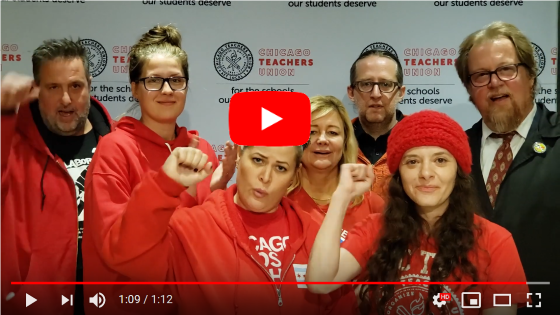
Educators at Passages Charter School won a tentative agreement today that enshrines in the contract key provisions that are still not settled in bargaining for educators at district-run schools. Among those are big wins on paraprofessional pay and rights as well as grievable protections for special education minutes and support. Bold action made these wins possible. When Passages educators learned that the charter operator was holding a fundraising gala Thursday, they threatened to confront donors with conditions in the school, forcing management to cancel the high-ticket gala. That direct action got the goods. Watch their video message to all their CTU family on YouTube.

Bargaining Update

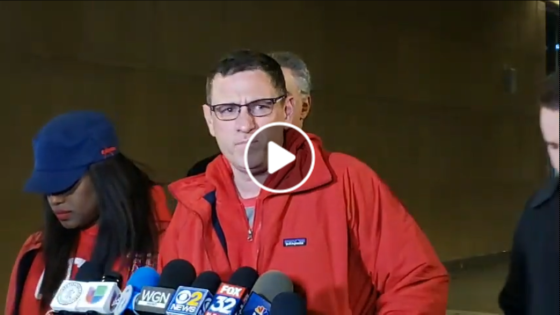
As usual, the officers held an evening press availability to talk about bargaining. As President Sharkey related, our bargaining with the Board has gotten past aspects of the contract that were somewhat easier to bargain. We are now negotiating on the toughest parts, where we have the biggest disagreements. Talks were cordial, but there were no breakthroughs on questions like class size, staffing, prep time or PSRP wages—all of which members have told the bargaining team are critical.

Click to watch Facebook Video

For Jesse’s comments to the press, watch the video above. However, the most frank and open discussion of the state of bargaining has been in member spaces. First, our office posted a point-by-point summary of positions on the biggest issues in our contract. Check it out on the MemberLink Portal. After that, we held a TeleTown Hall with district members. If you weren’t able to join the call, we’ll provide a recording in MemberLink as soon it’s available. As Vice President Stacy Davis Gates pointed out during the call, we’ve now won a range of tentative agreements on issues that management had simply refused to bargain over before our union hit the picket lines. On the big outstanding issues, it will take our ongoing strength on the lines and in the streets to turn the tide and land an agreement.

Our bargaining team returns to the table Saturday, and negotiations will continue all weekend. Our strategy in the press, on the picket line and in the streets is designed to encourage the Board to compromise on these essential issues.

Saturday’s Plan

10:00am Family Fun at Union Park

Facebook Event

Labor and Community Solidarity Rally
Union Park (Washington & Ashland)

As a celebration, a show of solidarity and a general pick-me-up from the exhilarating, but exhausting, work of bargaining and striking, the Chicago Federation of Labor has organized a day at Union Park. You’ll hear from the victorious Passages bargaining team at the rally This will be a family-friendly event for CTU, SEIU, Chicago Labor and all of Chicago!

Getting Information

Our members want to get as much information as possible, as soon as possible. Those include questions about the potential need for strike loans, health care and more. The CTU has a Strike FAQ page to provide some answers and links to other resources.

In addition, the union has set up a structure to pass information along and get speedy responses to questions. Members should always ask their delegate first. Delegates have access to Strike Captains, who can rely on their Field Organizers. This chain of information is a good way to get quick answers without going directly to CTU staff who have a lot on their plate coordinating activities on a citywide basis for 25,000 people. Staff will always do their best to provide you with information as quickly as possible, but asking up the chain may actually be a more efficient way to find out what you need to know.

Scammon steps it up

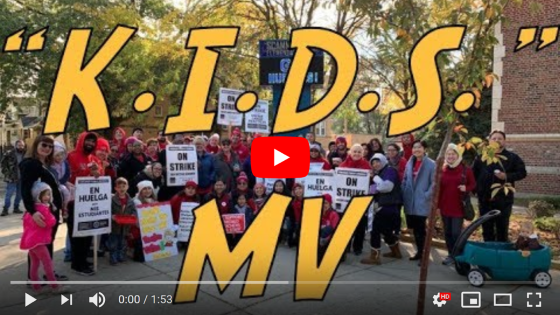
We have so loved all the videos of dance routines, cheers and songs to keep our picket lines up and exciting. The picket team at Scammon Elementary and their videographer, Mr. Lee, has upped the ante, so to speak, on these videos. We hope everyone enjoys tonight’s from-the-line video, “We do it for the K-I-D-S” as you kick off your weekend.

Click for YouTube video

Chicago Teachers Union • 1901 W. Carroll Ave.• Chicago, IL 60612 • 312-329-9100
www.ctulocal1.org
for the schools Chicago’s students deserve


Anthony Cody read the post about the collaboration between the Thomas B. Fordham Institute and the Center for American Progress, which are sponsoring a low-budget “moon shot for kids.”

Not many (or any) of those who work at TBF or CAP have been career teachers.

Anthony Cody offers his advice:

I worked in the public schools of Oakland, CA, for 24 years, 18 of them as a middle school teacher of science and Math. I have witnessed firsthand the destructive effect of previous philanthropic efforts in education. There must be a radical change in approach.

The key to successful investment in this arena is leveraging a relatively small amount of money to create a ripple effect that delivers further deeper investment — and not just of funds, but of public trust and engagement.

A coalition of philanthropists would heed the convincing evidence from Anand Giridharadas that their prior efforts have had the effect of suppressing investment and engagement in common public schools. They would reverse course, and instead of seeking to undermine public schools under control of democratically elected school boards, create a campaign to support such schools. They would create a process to empower a democratically elected leadership team composed of students, teachers and parents.

The project would work to:


1. Support efforts to reduce income inequality, since there is a direct connection between educational and economic well-being.

2. Overturn Citizen’s United, since this absurd notion has allowed for legalized bribery.

3. Recognize the destructive effects of high stakes tests and work to end them at all levels.

4. Reaffirm the value of racial and economic desegregation, so all children have equal access to high quality schools, and the chance to learn together.

5. Significantly reduce class sizes across the nation, setting a cap of 20 on grades k to 3, and 25 on grades 4 to 12. This would allow for genuine personalization of education.

6. Make “virtual schools” ineligible for public funds.

7. Minimize screen time and eliminate farcical descriptions of this as “personalization.”

8. Create democratically elected teams of teachers, parents and students to participate in decision-making at every level of the education system.

This is a significant departure from previous philanthropic efforts in education. But given that prior work has been so devastating to our schools, it is time for such a correction.

THIS SHOULD BE THE PLATFORM OF THE DEMOCRATIC CANDIDATE FOR PRESIDENT.


Mercedes Schneider loves Elizabeth Warren’s plans for K-12 education.

Note that in Warren’s plan, the term, “public school” means traditional public school– the neighborhood school, sufficiently supported and defended against much of the corporate ed reform attack against it.

Warren’s education plan is refreshing to read, and extensive. I encourage readers to view Warren’s entire ed plan firsthand.

Below are some of my favorite parts. But my favorites-of-favorites is the ending of federal funding for charter schools and Warren’s pledge to fight against charter schools’ outsourcing operations to for-profit companies.

She proceeds to describe what she likes best in the Warren plan.

Schneider is a tough critic with a keen nose for fraud. When she likes something, pay attention.


Arizona is a swamp of charter corruption.

Earlier this year, the Arizona Republic won the distinguished George Polk Award for its coverage of charter school corruption.

Now star reporter Craig Harris has another blockbuster story.

He reports that the founder of a charter chain paid companies he owns or co-owns nearly $47 million in the past year. 

American Leadership Academy, an East Valley charter school chain, paid this past fiscal year at least $46.8 million to companies owned or co-owned by founder Glenn Way or his relatives, newly released financial records show. 

The payouts include more than $30 million to the management company that employs the schools’ teachers and staff, millions to another firm for operational services, and almost half a million to an apparel firm for school or athletic uniforms. Way or one of his relatives is a co-owner in all of those businesses.

In total, the payments to so-called related parties made up more than half of ALA’s annual $79 million budget.

An Arizona Republic investigation last year found that businesses owned by or tied to Way resulted in profits of about $37 million in real estate deals associated with the expansion of ALA schools, a figure Way said at the time was closer to $18 million because of other costs. 

Arizona is fortunate to have the Arizona Republic looking out for frauds and corruption because the state doesn’t care.

Arizona also has Curtis Cardine of the Grand Canyon Institute, a former superintendent of both public and charter schools. Cardine became so incensed about endemic corruption that he has studied the finances of every charter school in the state (except those that keep their book secret). He reported in a book called Carpetbagging America’s Public Schools that nearly 3/4 of the state’s charter schools do business with “related” companies, companies connected or owned by the charter owner.

The hard-right Governor Doug Ducey is a stand-in for the Koch Foundation. His elections were funded by the Koch brothers, the DeVos family, and other billionaires who hope to eliminate public education.

Parents and teachers managed to defeat their last attempt to expand vouchers by fighting for a referendum, in which vouchers were overwhelmingly rejected by voters.

Someone needs to demand accountability and transparency for charters.

Arizona is the only state that openly endorses for-profit charters. The other states ban for-profits, but allow for-profit management companies to operate nonprofit charters, which is a shell game.


Reverend Dawn Douglas Flowers of Madison, Mississippi, speaks out on behalf of public schools and the newly formed Pastors for MS Children.

Writing in the Mississippi Business Journal, Rev. Flowers makes the moral case for funding public schools and supporting their teachers. She writes that it is time to invest in our children, our families, and our teachers.

She writes:

I am the product of the Mississippi public school system.  Both of my parents were public school teachers in Mississippi, and my husband currently works within the public school system in Mississippi.  My three children are receiving their education within our public schools, and my oldest has been in 3 different public school districts since she began kindergarten. 

This is what I know.  My children are loved and supported by wonderful teachers, and are being shaped in a positive way by their experience within our community public schools.      

This is what I know.  90% of all school age Mississippi children are educated within our public schools.  Supporting public schools is a faithful response to my call as a person of faith to love my neighbor.  Every child has the right to an education and the best way for this to be fulfilled is for us to support public policies that ensure access for all children to free public school.

This is what I know.  Mississippi is not currently providing adequate funding to meet the needs of every child because Mississippi is not adequately funding our public schools. 

This is what I know.  In the last seven years, Mississippi public schools have suffered their worst underfunding ever.  By underfunding MAEP, our Legislature is fostering inequity, and every child in every community deserves equitable, fully funded public education.      

This is what I know.  Mississippi pays our teachers less than any of our neighboring states. 

This is what I know.  Funding matters.  I am always amazed at what our teachers and our schools do for our children with the limited resources available.  Just imagine what fully funded public schools and supported teachers could do.

Pastors for Texas Children has organized clergy across the south to advocate for children and public schools. The other bpnew organization is Pastors for North Carolina Children. These pastors are dynamic. They are motivated by love of God and people, and they can’t be stopped. They bear witness and demand justice. It is exciting to see them supporting the important American tradition of separation of church and state.


The teachers of Dedham, Massachusetts, voted overwhelmingly to go out on strike.

DEDHAM — Hundreds of striking teachers took to the streets Friday in this suburban town, holding placards, marching with students and parents, and cheering fresh support from high-profile Democratic politicians. Meanwhile, signs emerged that stalled negotiations could resume this weekend.

The first teachers strike in 12 years in Massachusetts followed an overwhelming vote of 275 to 2 on Thursday to walk off the job despite a state ruling that the strike is illegal. Public schools were closed Friday in this community of 25,000 people, bordering Boston.

Timothy Dwyer, president of the Dedham Education Association, called the strike “a last resort” after nearly two years of failed negotiations over salary increases, health insurance, and other issues such as sexual harassment grievances and cellphone use in the classroom.