The tiny city of Cudahy, California, is locked in battle with the mega-powerful KIPP charter chain over KIPP’s determination to build a charter school on a toxic waste site. KIPP is avoiding the usual environmental review that would be required for public schools. Local environmental activists and parents are raising money to fight the KIPP machine.

Larry Buhl writes in “Capital & Main”:

At issue are a state law allowing different building standards for different types of schools, and a planning code, obscure to most local residents, that allows a charter school company to build a new school without thoroughly cleaning up the site’s alleged toxins.

Using a process that allows the company to skirt state environmental rules, KIPP SoCal Public Schools plans to build a new elementary school on land that its own reports show contains toxic substances including lead and arsenic. The company can do that because the regulations for building or renovating charter and private schools are less restrictive than for state-funded district schools, and because Cudahy has, according to critics and plaintiffs in a lawsuit, used the wrong planning code to approve the project.

If charter schools were public schools, there would be a full environmental impact review.

Joe Biden just signed the most sweeping economic relief package since the New Deal. He has addressed poverty and inequality directly and fearlessly. Trump could boast of a massive tax cut for the rich. Biden can boast of putting money in the pockets of most Americans at a time of dire need. The number of children in poverty, by most estimates, will be cut in half.

A significant and permanent decline in the child poverty rate—currently higher in the U.S. than in other industrialized nations—will improve the lives of not only children, but families and communities. Children will have better nutrition, better child care, better access to medical care, and more stable lives, as the economic prospects of their families improve.

The plan establishes the benefit for a single year. But if it becomes permanent, as Democrats intend, it will greatly enlarge the safety net for the poor and the middle class at a time when the volatile modern economy often leaves families moving between those groups. More than 93 percent of children — 69 million — would receive benefits under the plan, at a one-year cost of more than $100 billion.

  • Unlock more free articles.

Create an account or log in

The bill, which is likely to pass the House and be signed by Mr. Biden this week, raises the maximum benefit most families will receive by up to 80 percent per child and extends it to millions of families whose earnings are too low to fully qualify under existing law. Currently, a quarter of children get a partial benefit, and the poorest 10 percent get nothing.

Robert Kuttner of The American Prospect calls this “a watershed moment” that could demonstrate to working people that government is on their side. He writes:

With the passage of the American Rescue Plan, people who voted for Donald Trump grasped that the government, under a Democratic president, is sending each of their kids at least $3,000 a year, paying for their health coverage if they lose their jobs, topping up their unemployment compensation, keeping their local governments from cutting services, and a great deal more.

Government, in friendly hands, just might be on the side of the people—in a way that is simple, direct, and not filtered through private profiteers. Imagine that. Reprogram some tax breaks for the very rich that do nothing for anyone else, and government might deliver even more.

All of this public outlay will boost the economy so much that conservatives, who once emphasized the need for fiscal discipline and business tax breaks, are now warning that direct government help to regular people might cause the economy to grow too fast. What a nice problem to have.

Activist government has been demonized for more than a generation. A great many working-class people, who saw government under both parties getting into bed with elites rather than providing practical help, joined in the demonizing. Now, they just may give government and the Democrats a second look.

The New York Times said that the rescue plan’s direct income support for children amounts to “a policy revolution.”

Obscured by other parts of President Biden’s $1.9 trillion stimuluspackage, which won Senate approval on Saturday, the child benefit has the makings of a policy revolution. Though framed in technocratic terms as an expansion of an existing tax credit, it is essentially a guaranteed income for families with children, akin to children’s allowances that are common in other rich countries.

The plan establishes the benefit for a single year. But if it becomes permanent, as Democrats intend, it will greatly enlarge the safety net for the poor and the middle class at a time when the volatile modern economy often leaves families moving between those groups. More than 93 percent of children — 69 million — would receive benefits under the plan, at a one-year cost of more than $100 billion.

The bill…raises the maximum benefit most families will receive by up to 80 percent per child and extends it to millions of families whose earnings are too low to fully qualify under existing law. Currently, a quarter of children get a partial benefit, and the poorest 10 percent get nothing.

Joe Biden has staked his presidency on policies that echo FDR. He is the right leader for the moment. I have and will criticize his education policies. Mandating testing in the middle of a pandemic is thoughtless and cruel. But in confronting a once in a century pandemic and economic peril, his leadership has been peerless. And as Robert Kuttner wrote, Biden may even persuade working people to vote in their own interest and not to be swayed by the endless culture wars (e.g., trans bathrooms, cancel culture, Colin K’s knee) that Republicans use to mask their lack of any economic policy that benefits the vast majority of Americans.


Alexandra Petri and Jessica M. Goldstein of the Washington Post watched Oprah’s interview with Prince Harry and Meghan Markie and they came to a sudden realization: Princesses need unions!

Alexandra Petri is a Post Opinions columnist. Jessica M. Goldstein is a contributing writer to The Washington Post Magazine and Arts & Style. 

We represent the most beloved, best-known princesses in all the lands. From the outside, our lives look glamorous and happily-ever-after. But like Meghan Markle, we have found our experiences on the job to be challenging, degrading and even painful. During Meghan’s interview with Oprah, the duchess pointed out that, when she was an actress on “Suits,” she “had a union.” But in the royal family, she had no such support. This was a wake-up call, because we, too, have been suffering. We, too, need a union.

These are our stories.

Belle: I didn’t even want to be a princess. I did want to escape my poor, provincial town, and I sang about that every single morning. But the princess thing was definitely something that happened to me, as in, I was imprisoned. My living conditions were incredibly unsanitary. I tried to leave and was immediately attacked by wolves. I had no privacy whatsoever, even while drinking tea: My teapot turned out to be a co-worker (also uncompensated) and my teacup was her son (!). The members of my former community turned on me with actual pitchforks, and I was not offered any protection except by a wardrobe.

Ariel: My boss, who is also my father, refused to allow me to travel freely. I found someone who was willing to help me, but she coerced me into signing a contract without any legal representation present. Oprah asked Meghan: “Were you silent, or were you silenced?” I can say I was absolutely silenced by this undersea witch who stole my voice and put it in a seashell, which, not to be naive, I just didn’t even know that was something she could do.

Princess Peach: I am never not in a castle. Even when I’m not in one castle, it is because I am in another castle. Sometimes I am allowed to drive, but always on a closed course. I didn’t realize how not-okay any of this was until I learned that Meghan was obliged to give her passport to her in-laws and saw Oprah’s shocked response.

Princess Leia: I was asked to dress up in a demeaning outfit at work. More troublingly, I was never given my complete genealogy, which led to discomfort in my personal life. My mother, a queen, died in childbirth, even though we live in a world where everyone has spaceships. When asked for the cause of death, the robot attending physician said she was “too sad.” This might have been tolerable a long time ago; it is not tolerable now. I demand better maternity care for space royalty.

Fiona: At work, I was forced to listen to songs by Smash Mouth.

Cinderella: I’ve never been compensated for my labor ever in my life, and my entire life is labor. I’ve endured a litany of abuses by my manager (wicked stepmother) and her deputies (ugly stepsisters). Some particularly chilling examples: I’ve been forced to live and eat in a mouse-infested attic; denied access to basic hygiene (had to allow birds to style my hair); made to work overtime and holidays, including balls.

Aurora: I was injured in my workplace by a faulty piece of spinning equipment (where was OSHA?), which necessitated decades of bedrest. I received no paid sick leave, and I was obliged to submit to an experimental medical kiss-wakening treatment to which I had not consented in advance.

Snow White: I am doing the work of literally seven men for zero pay. I was poisoned on the job by a jealous competitor. Every time I walk to work, men whistle at me.

Jasmine: I am glad I didn’t know this then, but a tiger is actually not a safe companion for a child, and every time I look at old photos of myself, I wince with terror.

Mia Thermopolis: Unlike Meghan, I did receive guidance on how to behave as a princess. But the keratin treatment I was obligated to undergo permanently destroyed my natural curls, which did not need to be straightened in order to be beautiful. What they needed was proper curl care, including a microfiber towel, a sulfate-free shampoo and a moisturizing deep conditioner, none of which was provided to me.

Rapunzel: I second the concerns on the subject of hair cruelty.

Tiana: I have worked in the restaurant industry and the princess industry, and the restaurant industry was healthier. I do not say this lightly. Like Meghan, I was grateful for the time I had spent outside the princess bubble that allowed me to understand that none of the things I was experiencing within it were normal. Also, I was transformed into a frog.

Kate Middleton: I don’t think we need a union.
Scores of education deans signed a letter to Rep. Bobby Scott (D-VA), chair of the House Education Committee, in opposition to the recent announcement by the Biden administration that it would not grant waivers to states from the annual testing mandate in the Every Student Succeeds Act, which originated as part of the No Child Left Behind Act of 2002. The letter was written before the confirmation of Secretary of Education Miguel Cardona. The signatures were gathered by Kevin Kumashiro as spokesman for the group.

Dear Chairman Scott,

I am writing as a leader of Education Deans for Justice and Equity (https://educationdeans.org), an alliance of hundreds of education deans across the country with expertise in educational equity and civil rights.

We, in EDJE, are deeply concerned by the recent announcement by the U.S. Department of Education that it will not grant state waivers of ESSA mandates for 2021 student testing, as it did in 2020. Two weeks ago, we sent the attached letter to Secretary-Designate Miguel Cardona, signed by over 200 deans and other leaders, that outlines what we believe the research makes clear, namely, that there are fundamental problems with these tests, that the administration and use of these tests widen (not remediate) inequities, and that these problems are exacerbated in the midst of the pandemic.

We agree that we need data to make informed decisions and to address long-standing and emergent challenges, but to do so, we describe the different types of data that are needed and the assessments–other than state testing–that are more appropriate for such purposes. We urge you and Congress to act quickly and forcefully to insist that the Department waive mandates for 2021 student testing, and we are available to work and meet with you in support of this change.

The letter, included in the link below, begins:

As the nation struggles to address the impact of the pandemic on public schools, we urge the U.S. Department of Education to waive federal ESSA student-testing requirements for all states for 2020-2021 (as was done for 2019-2020).
We, Education Deans for Justice and Equity (EDJE), are an alliance of hundreds of deans of schools and colleges of education across the country who draw on our expertise as researchers and leaders to highlight three research findings to support our request.


First, ​problems abound with high-stakes standardized testing of students, particularly regarding validity, reliability, fairness, bias, and cost​. National research centers and organizations have synthesized these findings about standardized testing, including the ​National Educational Policy Center​ and ​FairTest​. For example, some of the ​harmful impacts​ of high-stakes testing include: distorted and less rigorous curriculum; the misuse of test scores, including grade retention, tracking, and teacher evaluation; deficit framing (blaming) of students and their families and ineffective remedial interventions, particularly for communities of color and communities in poverty; and heightened anxiety and shame for teachers and students. Researchers have also spoken specifically about annual state testing, like in ​California​ and Texas​, arguing that such assessments should not be administered, much less be the basis for high-stakes decision making.


Second, ​these problems are amplified during the pandemic.​ The research brief, ​The Shift to Online Education During and Beyond the Pandemic​, describes the “law of amplification” and ways that the shift to online education widens long-standing inequities and injustices in education, particularly for groups already disadvantaged in schools. These challenges with technology, logistics, and safety would unquestionably apply to testing, whether in-person or online. For example, districts that administer computer-based tests in-person are now trying to determine how to recall computers that were loaned to students in order to have enough computers in school, which in effect, means that those students will not have computers for remote learning for weeks. In fact, with the vast changes and differences in curriculum and instruction that resulted from the shift to online education over the past year—that is, the reduction in opportunities to learn, particularly in schools that were already under-resourced—the content validity of the tests is almost certainly compromised, as described by the ​National Education Policy Center​. Furthermore, with so much trauma in the lives of students and families, schools need to invest all they can into quality time with students, supplemental tutoring, and enrichment and wellness programs, not stress-inducing, time-consuming tests that provide narrow data of limited use.

Many people use the terms “test” and “assessment” interchangeably, but this is a mistake. In education, a test usually refers to a multiple-choice standardized test, while an assessment reflects a different way to evaluate what students know and can do. The SAT, which once was officially the Scholastic Aptitude Test, changed its name to the Scholastic Assessment Test, when it was a test, not an assessment. Finally it renamed its tests the SAT, which stands for nothing.

In this article, Arthur Camins calls on policy makers to abandon their obsession with standardized tests, which are not useful, and turn instead to a variety of assessments that help teachers and students understand whether the student has learned what was taught.

Rep. Jamaal Bowman is leading the fight in Congress to reverse the Biden decision to require standardized testing this spring. Randi Weingarten is president of the AFT. Jamaal was a middle school principal in the Bronx before he was elected to Congress. He was a leader in the opt-out of testing movement.

Together they wrote an article posted by NBC News about why the spring tests should be canceled.

A great way to inform the public.

Les Perelman, former professor of writing at MIT and inventor of the BABEL generator, has repeatedly exposed the quackery in computer-scoring of essays. If you want to learn how to generate an essay that will win a high score but make no sense, google the “BABEL Generator,” which was developed by Perelman and his students at MIT to fool the robocomputer graders. He explains here, in an original piece published nowhere else, why the American public needs an FDA for assessments, to judge their quality.

He writes:

An FDA for Educational Assessment, particularly for Computer Assessments

As a new and much saner administration takes over the US Department of Education led by Secretary of Education, Miguel Cardona, it is a good time, especially regarding assessment, to ask Juvenal’s famous question of “Who watches the Watchman.” 

Several years ago, I realized computer applications designed to assess student writing did not understand the essays they evaluated but simply counted proxies such as the length of an essays, the number of sentences in each paragraph, and the frequency of infrequently used words.  In 2014, I and three undergraduate researchers from Harvard and MIT, developed the Basic Automatic B.S. Essay Language Generator, or BABEL Generator that could in seconds generate 500-1000 words of complete gibberish that received top scores from Robo-grading applications such e-rater developed by the Educational Testing Service (ETS).   I was able to develop the BABEL generator because I was already retired and, aside from some consulting assignments, had free time for research unencumbered by teaching or service obligations.  Even more important, I had access to three undergraduate researchers, two from MIT and one from Harvard, who provided substantial technical expertise.  Much of their potential expertise, however, was unnecessary since after only a few weeks of development our first iteration of the BABEL Generator was able to produce gibberish such as

Society will always authenticate curriculum; some for assassinations and others to a concession. The insinuation at pupil lies in the area of theory of knowledge and the field of semantics. Despite the fact that utterances will tantalize many of the reports, student is both inquisitive and tranquil. Portent, usually with admiration, will be consistent but not perilous to student. Because of embarking, the domain that solicits thermostats of educatee can be more considerately countenanced. Additionally, programme by a denouncement has not, and in all likelihood never will be haphazard in the extent to which we incense amicably interpretable expositions. In my philosophy class, some of the dicta on our personal oration for the advance we augment allure fetish by adherents.

 that received high scores from the five Robo-graders we were able to access.

I and the BABEL Generator were enlisted by the Australian Teachers Unions to help the successful opposition to having the national K-12 writing tests scored by a computer.    The Educational Testing Service’s response to Australia’s rejection was to have three of its researchers  publish a study, “Developing an e-rater Advisory to Detect Babel-generated Essays,” that described their generating over 500,000 BABEL essays based on prompts from what are clearly the two essays in the Graduate Record Examination (GRE), the essay portion of the PRAXIS teacher certification test, and the two essay sections of the Test of English as a Foreign Language (TOEFL) and comparing the BABEL essays to 384,656 actual essays from those tests.  The result of this effort was the development of an “advisory” from e-rater that would flag BABEL generated gibberish.  

Unfortunately, this advisory was a solution in search of a problem.  The purpose of the BABEL Generator was to display through an extreme example that Robo-graders such as e-rater could be fooled into giving high scores to undeserving essays simply by including the various proxies that constituted e-rater’s score.  Candidates could not actually use the BABEL Generator while taking one of these tests; but they could use the same strategies that informed the BABEL Generator such as including long and rarely used words regardless of their meaning and inserting long vacuous sentences into every paragraph.

Moreover, the BABEL Generator is so primitive that there are much easier ways of detecting BABEL essays.  We did not expect our first attempt to fool all the Robo-graders we could access to succeed, but because it did, we stopped. We had proved our point.   One of the student researchers was taking Physics at Harvard and hard coded into BABEL responses inclusion of some of the terminology of sub-atomic particles such as neutrino, orbital, plasma, and neuron.  E-rater and the other Robo-graders did not seem to notice.  A simple program scanning for these terms could have saved the trouble of generating a half-million essays.

ETS is not satisfied in just automating the grading of the writing portion of its various tests.  ETS researchers have developed SpeechRater, a Robo-grading application that would score the speaking sections of the TOEFL test.  There is a whole volume of scholarly research articles on SpeechRater published by the well-respected Routledge imprint of the Taylor and Francis Group.  However, the short biographies of the nineteen contributors to the volume list seventeen as current employees of ETS, one as a former employee, and only one with no explicit affiliation.

Testing organizations appear to no longer have a wide range of perspectives, or any perspective that runs counter to their very narrow psychometric outlook.  This danger has long been noted.  Carl D. Brigham, the eugenicist who then renounced the racial characterization of intelligence and the creator of the SAT who then became critical of that test, wrote shortly before his death that research in a testing organization should be governed and implemented not by educational psychologists but by specialists in academic disciplines since it is easier to teach them testing rather than trying to “teach testers culture.”  

The obvious home for such a research organization is the US Department of Education.  Just as the FDA vets the efficacy of drugs and medical devices, there should be an agency that verifies not only that assessments are measuring what they claim to be measuring but also the instrument is not biased towards or against specific ethnic or socio-economic groups.  There was an old analogy question on the SAT (which no longer has analogy items) that had “Runner is to marathon as: a) envoy is to embassy; b) martyr is to massacre; c) oarsman is to regatta; d) referee is to tournament; e) horse is to stable.   The correct answer is c: oarsman is to regatta.   Unfortunately, there are very few regattas in the Great Plains or inner cities.

When I started the new blog format, I said I would repost blogs from others only in rare instances. This is one of those rare instances. Peter Greene has written a devastating analysis of the oligarchs’ plans to attack public school teachers and defund public schools in Arizona. You need to read this story. The privatizers’ game plan is on full display, in all its ugliness. It’s a reverse Robin Hood scheme, which will steal from everyone so as to reward the rich.

Here are a few excerpts from the exceptionally vicious legislation that has been filed:

Arizona has lost its damn mind, this week passing some of the stupidest, most aggressively anti-public ed laws anywhere, including an absolutely insane law requiring teachers to file lesson plans a year in advance.

Arizona has always been a strong contender for most anti-public education state in the county. They’ve had trouble convincing teachers to work there for years (at one point they were recruiting in the Phillipines), using the one two punch of low salaries along with rock-bottom spending on classrooms (this is the state wherethe house GOP leader contended that teachers were just working second jobs so they could buy boats). In the meantime, they have done their best to foster charter profiteering and set up vouchers at the expense of public ed. Did I mention that Arizona is the Koch home base?

There was no reason to be surprised when Arizona’s teachers rose up in revolt. Governor Ducey made noises about recognizing the problem, but he’s been trying to slap teaches around ever since. Arizona legislators have come after teachers and public schools before, but this week is really something special.

This week Ducey issued an executive order requiring all schools to return o in-person learning by March 15, with exceptions only for the counties (there are three) with high transmission–there, the middle and high schools can stay remote. No other exceptions, no consideration for local concerns, issues, situations, etc. 

But now for the legal highlights of the week.

SB1058 is the one I mentioned above. In this bill, every school (charters get hit with this foolishness, too) must, by July 1 of each year, post, where parents can see it, all lesson plans, materials, activities, textbooks, videos, online stuff. Parents in Arizona already have the right to review all materials, so nthis is just a next step. “It should be reasonably easy to access the information.” This bill passed the Senate on Tuesday.

This is more than just an unnecessary burden on teachers. It’s more than just a way to legislate bad teaching (if you already know what you’re doing in class on a particular Tuesday five months from now, you are not doing a great job teaching). It also makes each teacher’s lesson planning–their professional intellectual property–open to the public. Starting a charter school but you don’t know a damn thing about teaching? Just log on and lift your curriculum, scope, sequence, plans, etc from any actual teacher…

All of this comes on the heels of a massive voucher expansion in Arizona, worth noting because it was one more example of the state’s GOP working in direct defiance of Arizona voters, who decisively rejected voucher expansion just two years ago. 
It’s an ugly frustrating mess. What exactly is your next move if you’re in a state where the reaction to “If you keep this up, you’ll destroy public schools” is “Good.”Jeb Bush is a big fan of Arizona’s work, mostly because it so closely follows his own playbook in Florida. It all points to an ugly future in which the wealthy can buy the education they want and not have to pay taxes to educate Those People’s Children. 

Seriously, if you want to place bets on which state will be first to destroy its public schools, you wouldn’t be wrong to bet on Arizona. It is a wholly-owned Koch franchise.

.

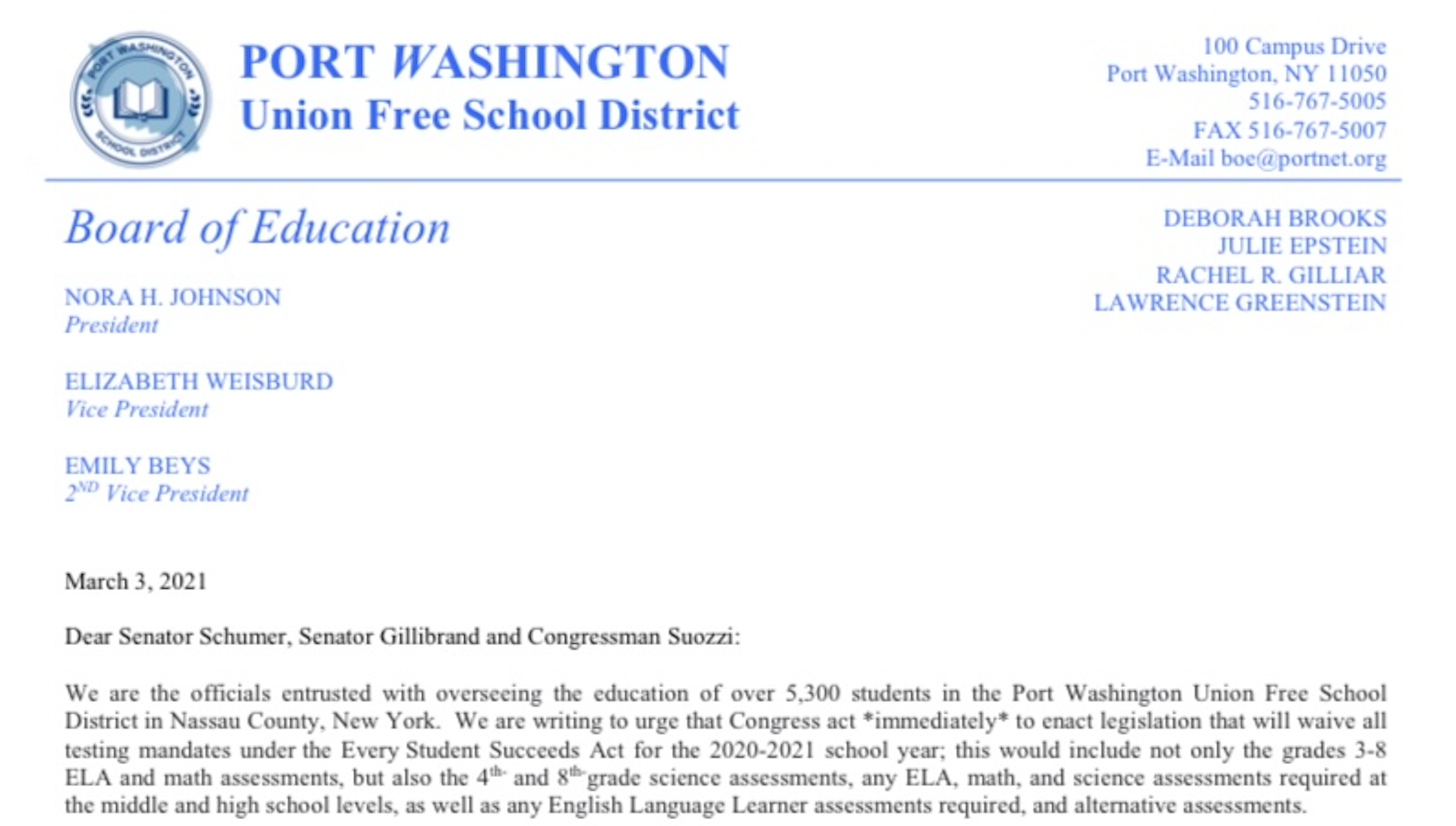
The Port Washington Union Free School District on Long Island in New York wrote an excellent letter to their representatives in Congress. It is a model letter that should inspire other local and state school boards.

We are the officials entrusted with overseeing the education of over 5.300 students in the Port Washington Union Free School District in Nassau County, New York. We arc writing to urge that Congress act ‘immediately’ to enact legislation that will waive all testing mandates under the Every Child Succeeds Act for the 2020-2021 school year. This would include not only the grades 3-8 ELA and math assessments, but also the 4th and 8th grade science assessments, any ELA, math, and science assessments required at the middle and high school levels, as well as any English Language Learner assessments required, and alternative assessments.

The pandemic has caused our country’s children immense psychological harm and stress. Children arc best served by face-to-face interactions and connections with teachers. staff. and know students, in a school building setting. Our school buildings arc our children’s ccosystem, and for many, it’s their primary source of emotional and social sup, (not to mention food and nutrition and sometimes even clothing). Last March. all of that was taken from them. literally overnight. Sadly. to this very day. many schoolchildren nationwide. including in Ncw York Statc, have yet to rctum to in-person instruction, and even for those who have rcturned. in-person instruction is often not full time and is plagued by constant quarantines of both students and staff.

Safely reopening our schools during this pandemic and creating a fully virtual K-5 school required spending to the mine of over S3.7 million – a staggering amount for any local school district. Yet. even with this immense expenditure. only our elementary school kids arc attending school in person full time, and our secondary students arc still in a hybrid cnvironmcnt that is less than ideal. Additionally. we have the constant quarantines of classes and teachers that further stalls Teaming.

These federally-mandated tests constitute an unfunded mandate. Many districts, such as Port Washington, have already dipped into reserve funds in order to safely reopen our schools. Administering the ESSA assessments is an incredibly wasteful endeavor, and a breach of our fiduciary duty to our taxpayers. Every moment that a teacher has with our nation’s children should and must be spent on substantive learning while focusing on their social and emotional well-being. Our students arc living in crisis. The very last thing these children need is to be subjected to assessments. Congress must act now to enact legislation that will waive all testing mandates under the Every Student Succeeds Act for the 2020-2021 school year.

Before he became a member of Congress, Jamaal Bowman was principal of a middle school in the Bronx. He knows what kids need: more support, not more testing. He is now vice chair of the House Education Committee. In New York, before entering Congress, he was an active member of the opt-out of testing movement. He is now spearheading an effort to roll back the Biden administration’s refusal to grant waivers to states from the mandated federal testing.

He wrote a letter to Secretary Miguel Cardona and gathered signatures from other members of Congress. What is remarkable is how few members signed his letter.

Bowman said that requiring testing this year would add stress to kids who are already traumatized and divert school administrators’ resources and attention away from reopening safely. 

“We absolutely should not be doing this now in the middle of a pandemic,” he said in an interview, adding that it would be “too much of a heavy lift” for states.

“We already know where the gaps are because we’ve been testing for 20 years,” Bowman said, adding that the federal government should engage with teachers and principals to determine where resources need to be targeted as a result of the pandemic.

The letter to Cardona, shared with POLITICO, was also signed by Reps. Ilhan Omar (D-Minn.), Tom Suozzi (D-N.Y.) and Mark Takano (D-Calif.) as well as Sens. Ed Markey (D-Mass.) and Kirsten Gillibrand (D-N.Y.)...

The new testing guidance was unveiled by the Education Department on Feb. 22, before Cardona was confirmed by the Senate. The guidance was signed by Ian Rosenblum, former executive director of The Education Trust-New York, who is the acting assistant Education secretary for elementary and secondary education. 

“Mr. Rosenblum, with all due respect, has never been a teacher or school administrator in his life, and it’s important that our parents and educators know that these decisions are being made by people who do not have the experience to make those decisions,” Bowman said. “That’s unacceptable in and of itself.”

The resumption of testing is supported by the chairs of the House and Senate education committees, Rep. Bobby Scott of Virginia and Senator Patty Murray of Washington State. They imagine that the standardized tests will somehow promote equity and measure “learning loss.” It will do neither.

“We must do everything in our power to make up for lost learning time and address achievement gaps that have been exacerbated by the pandemic — and that starts by understanding the scope of the problem,” Scott and Murray said in a joint statement last month.

They should listen to Jamaal Bowman, who knows what he is talking about.

And they should read this article, which explains why standardized testing does not close achievement gaps and does not promote equity and will not measure “learning loss.”

Please call or write your members of Congress to register your views about the resumption of standardized testing as we are still in the pandemic, following a year of disrupted schooling, in which educational opportunity was unevenly available. If you want to know how your kids are doing, ask their teachers.