Posted on Twitter by @Ve10Ve_Ghost
Posted on Twitter by @Ve10Ve_Ghost
On Friday, a large continent of Black students walked out of North Star Academy, a high-scoring no-excuses charter school in Newark, New Jersey. The students were protesting the mistreatment of Black students and teachers.
Hundreds of students walked out of a Newark charter school and rallied outside City Hall on Friday to call attention to what students said is the frequent mistreatment of Black students and faculty.
Around 9 a.m., students began streaming out of the Lincoln Park High School campus of North Star Academy, which is New Jersey’s largest charter school operator with more than 6,000 students in Newark and Camden. After marching from the Central Ward campus to nearby City Hall, student organizers and a former teacher gave speeches about a culture of anti-Blackness they said pervades the school, while scores of students cheered and waved signs.
“We’re tired and we’ve been fed up,” 12th grader Kwadjo Otoo called out from the steps of the historic building, adding that some Black teachers and students continue to feel disrespected despite efforts by the charter operator’s leadership to address complaintsabout the schools. “Now they’re trying to pretend like something changed, but we know it’s the same school we’ve been going to forever now.”
Several students said multiple Black teachers over the years have left the school, which the students said is because the teachers felt overworked and undervalued. When well-liked Black teachers depart, their absence can leave students feeling isolated, they said.
“It’s very upsetting for us to build bonds with our teachers, to build relationships and connect,” said L. Drummond, a senior at the Lincoln Park campus, “and then see them chased out by the school.”
The school went into lockdown during the protest, and students who left were not allowed back in after they returned from City Hall. Locked out of school, the students began to disperse around 10:30 a.m.; some said they planned to walk home while others set out for a different North Star campus downtown.
John Thompson, historian and retired teacher in Oklahoma, writes about the legislators who are offering bills to undermine public schools, control their curriculum, even meddle with the school lunch program. Their goal is clear: the demoralization of teachers and the destruction of public schools.
Thompson writes:
Why are some Republican legislators in Oklahoma trying to “strip” school lunch programs from the State Department of Education and move them to the Agriculture Department?
The Tulsa World reports:
“The House author told us that some in the Legislature feel too much focus was put on making sure kids were fed during the pandemic and not on educating kids,” said Carolyn Thompson, chief of government affairs and deputy chief of staff at the Oklahoma State Department of Education (SDE).
The author of HB 3432, Rep. Dell Kerbs, claims he wants “to take something off of education’s plate and hopefully move more schools away from ‘heat and serve’ meal options.” But education leaders have said that that is “ridiculous,” and “a solution in search of a problem.” In fact:
The legislation would create duplication within the state’s overall bureaucracy, because their department must still obtain child nutrition data for a host of purposes including calculating state aid funding, school accountability and accreditation, and the federal E-Rate Program that provides schools with discounted telecommunications services.
This new bill should be considered in the light of numerous other anti-education bills filed this session. As The Frontier explained, they are often pushed by national conservative organizations, sometimes using “word-for-word language copied from model legislation.”
For instance, SB 1508, “would require school districts to submit to the State Department of Education detailed expenditure reports on diversity, inclusion and social justice training for teachers and administrators.” HB 3432 also brings to mind bills by Sen. Shane Jett that “would outlaw teaching of social-emotional learning in schools;” “require higher education institutions to post their budget for student and teacher diversity curriculum online;” and “ban voluntary surveys in schools from asking questions about sexuality or gender and would ban school libraries and curriculum from including books that deal with sexuality or gender.”
To understand the purpose of these restrictions, they must also be considered in the context of bills filed by Standridge that “would require teaching ‘patriotic education’” about Oklahoma history; or “impose civil penalties of at least $10,000 on school personnel who teach lessons related to critical race theory [and] require the employee to be fired and blacklisted from educational employment for at least five years.”
Similarly, these bills’ common purpose must also be understood within the context of Sen. Nathan Dahm’s attempt to “require social studies classes to teach at least 45 minutes every Nov. 7 on “Victims of Communism Day;” to “require schools to distribute historical Thanksgiving day proclamations, all of which list the importance and role of Christian faith;” to “add reading requirements for high schoolers that contain some theological themes;” and “require the Oklahoma State Department of Education to contract for curriculum for a four-year pilot project for 11th graders on U.S. history that “narrowly tailors the subject areas to align with free high school curriculum courses from Hillsdale College.”
And, of course these mandates must be seen within the context of successful and unsuccessful bills prohibiting school boards from issuing mask mandates; requiring an “opt in” system for teachers union membership, even though that is already the law; and at a “cost over $116 million” providing “state dollars to students to spend on private school tuition and other education expenses instead of attending a public school.”
To fully understand these vituperative assaults on schools, we must also consider the New York Times’ coverage of the Enid, Ok. school board battles, which concluded: From lockdowns to masks to vaccines to school curriculums, the conflicts in America keep growing and morphing, even without Donald Trump, the leader who thrived on encouraging them, in the White House.
But the fights are not simply about masks or schools or vaccines. They are, in many ways, all connected as part of a deeper rupture — one that is now about the most fundamental questions a society can ask itself: What does it mean to be an American? Who is in charge? And whose version of the country will prevail?
The Times also explained that Enid is in a county which “experienced one of the largest increases in racial diversity in the country over the past decade.” Since 1980, it dropped from 94 percent white to about 68 percent.
And this brings us back to the two, somewhat separate but intertwined agendas that drive these education bills. The corporate establishment and the leaders of the Trump wing of the Republican Party see both political threats and opportunities in demographic change. In the short-run, in order to keep their majority, they must use gerrymandering (such as moving one of the most progressive areas in Oklahoma City into the Panhandle’s congressional seat hundreds of miles away) and reverse trends that expanded the opportunities to vote. But these demographic changes give them better chances for winning in 2022 and 2024 by stoking the fears of Oklahomans who see themselves as being replaced by immigrants, other people of color, and new generations of progressives.
All of these education bills, primarily, are fact-free, fear-based campaigns to win elections at any costs. Being a Baby Boomer who saw the damage done to schools by McCarthyism, and how it persisted into my K-12 education and even into my teaching career, I worry about the long-term effects of these scorched earth campaign tactics.
The second, overarching theme is privatization. Whether it is Gov. Stitt’s undermining of public health institutions as we entered the Covid crisis, privatizing Medicaid, or disempowering the Pardon and Parole Board by preventing them from considering evidence of innocence in their deliberations, or wrecking public education, they want to dismantle governmental institutions.
Whether all of the legislators who support these bills understand it or not, the real goal is kicking vulnerable school systems that are exhausted by the Covid crisis while they are down. Then, rightwingers can ramp up their efforts to fund their cronies, while claiming that the Free Market will find replacements for what they call a rotten, socialist system that doesn’t respect their political base.
Finally, as I was about to submit this post, the New Yorker arrived, featuring Jill Lepore’s The Parent Trap. Lepore also describes the efforts of many Republicans as “whipping up a frenzy about parents’ rights” to win the mid-term and, perhaps the presidential elections. But she then goes back a century to the Scopes Trial, which also followed a global pandemic; explains the racist roots of the anti-evolution campaigns; and the Scopes aftermath, with “’purging’” libraries and “’hounding’” teachers.
Now, the campaign includes the “highhandedness, moral crusading, and snobbery” of today’s corporate reformers’ school choice movement. Lepore concludes, “It’s still going on today.” Some activist parents seem to “want to destroy public education.” So, everyone should read how this isn’t just a brutal fight in Oklahoma Red State politics, but “another long game, a hundred years war: the campaign against public education.”
This story appears on Apple News, taken from the BBC News site. Google it on the BBC site and watch the video if you can. I couldn’t. Anyone who blames the Ukrainians for this cruel war is insane. The attack on Ukraine was completely unprovoked. The Russian forces are now engaged in reducing the city of Mariupol to rubble. 90% of its buildings have been destroyed. Hundreds of women and children are buried in the rubble of a theater where they were sheltering. Hundreds more are buried under an arts school. And the world watched in horror.
In his hospital bed, little Artem stares into space. He clutches a small yellow toy tractor but says nothing as specialist nurses monitor his condition. The Russian shell that blasted shrapnel into his belly also badly wounded his parents and grandparents as they tried to flee Mariupol. A victim of Putin’s war and he’s not yet three years old.
In the next bed to Artem lies 15-year-old Masha, also from near Mariupol. Her right leg was amputated after it was torn apart by the blast from a Russian shell last Tuesday.
The very worst of Vladimir Putin’s war in Ukraine and what the relentless Russian bombardment has done to the people trapped in the besieged city of Mariupol, can be seen at the Regional Children’s Hospital in the nearby city of Zaporizhzhia.
Hundreds of people have been evacuated here. Their physical wounds are obvious and may, to an extent, heal. The psychological trauma will live with them for ever.
Doctors here and the children’s surviving relatives, asked us to tell their stories, among them Dr Yuri Borzenko, head of the Children’s Hospital. He can’t hide his contempt for what Russia has done.
“I hate Russia,” says Dr Borzenko, without a flicker of emotion on his face. “The girl who lost her leg (Masha) was so traumatised she wouldn’t eat or drink for days. She couldn’t mentally handle what had happened. We had to feed her intravenously.”
“Another boy,” says the doctor, “a six-year-old, with shrapnel in his skull described – without any tears or emotion – watching his mother burn to death in their car after it was hit. Two days later he said ‘dad buy me a new mum, I need someone to walk me to school’.”
What is happening in Mariupol is a humanitarian disaster, even – perhaps – a war crime. An estimated 90% of the city’s buildings have been damaged or destroyed. After last week’s destruction of a theatre where more than 1,000 people were sheltering, reports today that an arts school, with 400 people inside, has also been attacked.
Those who’ve been able to escape Mariupol talk of unimaginable horrors. First-hand accounts of bodies lying in the streets, of homes destroyed. Carrying those memories they put as much physical distance as they can between themselves and what they went through….
At Zaporizhzhia’s Children’s Hospital, I came across one grief-stricken, inconsolable father whose family had been completely torn apart.
His daughter Natasha, who was 26, and his 4-year-old granddaughter Dominica, were killed when a Russian shell landed near the shelter where the whole family was seeking refugee from the bombardment of Mariupol.
“I looked at the ground and there lay my little granddaughter with her head completely torn to pieces,” says Vladimir. “She lay there without a single breath and right next to her was my daughter with her legs fractured, open fractures.”
Dominica – whose pictures her grandfather almost caresses on his phone – was killed instantly. Her mother died from her injuries the next day.
As broken as he is, Vladimir is trying to stay strong for his second daughter, Diana. She was also critically wounded in the blast and was about to undergo emergency surgery.
But he could not hide his pain. “God, why would you bring all this upon me? I was not supposed to bury my children, my lovely girls, I failed to protect you.”
Craig Harris of USA Today wrote a blistering expose of the money grab by charter schools for federal COVID funds. Harris was previously a reporter for the Arizona Republic who often covered charter school scandals in that state where deregulation has enabled grifters to get rich by opening charter schools. This story is a national scandal. Unfortunately, it is behind a paywall, so I urge you to run out and buy the Sunday March 20 USA Today.
The story begins:
America’s charter schools received at least a $1 billion windfall during the pandemic, an unneeded cash infusion for most from a federal program intended to bail out struggling small businesses, USA TODAY has found.
More than 1,000 of the publicly funded but privately operated schools that educate a fraction of U.S. children jumped at the chance to collect forgivable loans up to $10 million after Congress created the Paycheck Protection Program in March 2020.
The hastily launched program was designed to save small businesses during the pandemic by helping them cover employee salaries and other costs.
While more than 90% of all eligible businesses across the country took the roughly $800 billion inloan allocations, charter schools were among the first to get the money — ahead of mom-and-pop shops and minority-owned companies — during the early days of the crisis when the economy was cratering and many business owners scrambled to get a financial lifeline.
And charter schools were uniquely positioned to get the loans — even though they continually received funding from taxes, just like traditional public schools. But unlike those schools, which educate the vast majority of American children, charters qualified for what would eventually become pots of free money because they are considered a business.
A USA TODAY investigation, based on public records,found 93%of the charter schools may not have needed the money because they were in states that continued to fund them at the same level as before the pandemic, or at even higher levels in some cases. These schools also had access to federal COVID grants.
Records show some of the private companies that operate the charter schools used the money to pad savings accounts or, in one case, hand millions of dollars to an investor.
USA TODAY’s investigation is based on publicly available documents from 1,139 charter schools, as well as federal and state agencies, including 37 departments of education that oversee local funding for charter schools.
“It makes me furious because there was absolutely no reason for those (charter) schools to get that money and take it from small businesses,” said Carol Corbett Burris, a critic of charter schools and executive director of the Network for Public Education Foundation, an advocacy group in New York City. “They successfully double-dipped….”
Charter school advocates said operators were entitled to the loans, which ranged from $150,746 to $9.8 million,because they are technically private businesses.
“Funding is always difficult to secure but was even more challenging during the pandemic,” said Nina Rees, president and CEO of the National Alliance for Public Charter Schools.
Rees added that charter schools typically receive less public funding than traditional school districts and Congress intended for them to get the money because of “the special nature of these unique public schools.”
Critics have a different view.
A congresswoman who has monitored the program said that while the schools may have done nothing legally wrong, their decisions to take the money were “terrible.” And one superintendent who leads an inner-city San Diego charter operation said that despite the legality, the behavior was unethical because financially strong charter businesses took money from those truly in need.
“At the time PPP became available, we had not suffered financially,” said David Sciarretta, superintendent of the Albert Einstein Academies, which has 1,450 students from kindergarten to eighth grade at two San Diego campuses. “I saw PPP as a way to help small businesses, especially those in the service sector…There is a fiscal way to look at it, and there’s a moral and ethical way to look at it.”
While Sciarretta declined to call out specifics schools, USA TODAY found, for example, that at least 14 affiliates of the California-based charter chainKnowledge Is Power Program (KIPP) took a collective $28.4 million in loans and had them forgiven at locations around the U.S.
Its national headquarters in San Francisco, meanwhile, saw its bottom line swell 56% to $75 million during the first year of the pandemic….
The concerns about charter schools have spurred critics to pressure the federal Small Business Administration, which is in charge of forgiving the loans if companies used them to save jobs and cover COVID-related expenses, to claw back the money.
The SBA declined repeated requests for interviews in response to questions about financially solid charter schools having their loans forgiven.
The agency in a late December email told USA TODAY it was committed to helping businesses reopen and that it had removed hindrances for small businesses to have their loans forgiven.
SBA two months later, following additional questions from USA TODAY, blamed the Trump administration for issues of “fraud, waste and abuse” in the program. Yet, nearly all of the loan forgiveness has happened at SBA during the Biden administration.
California Congresswoman Judy Chu is a member of the House Small Business Committee, and she has sought answers about where the money went and which businesses received loan forgiveness. Shamed by media attention in the early days of the pandemic, the Los Angeles Lakers and the national chain Shake Shack returned their multi-million dollar PPP loans.
Congresswoman Chu said:
It was never the intent of Congress to forgive loans to companies, such as charter schools, that experienced no economic loss.
“It’s terrible,” Chu said about the charter schools. “But nonetheless, it is in the realm of what is permissible.”
Permissible, but not ethical. Charter schools got their ”loans” early on because of their relationships with their banks, but minority-owned businesses waited for months.
The PPP program was a boon to the charter industry, which never lost its state funding, but it was ineffective. Harris quotes a study by the National Bureau of Educational Research which found that the program “the program kept up to three million workers employed an additional year at a cost of up to $258,000 per job retained.”
This is a very powerful, well researched article that raises important questions. if charter schools are “businesses,” how can they call themselves ”public schools?” Public schools were not eligible for PPP funds because they are not businesses. Charter schools qualified for public school funding and for PPP funding. They are both fish and fowl. They did not lose money, like the mom-and -pop stores that had to close their doors. But they eagerly took the money that was supposed to save the jobs of people who lost them and save the businesses on the edge of bankruptcy.
Permissible? Perhaps. Ethical? No.
Yakov S. is a 23-year-old art history student in Kharkiv. In this article, which appeared in American Purpose, he describes his life during the invasion.
It is 5:30 in the morning on February 24, and war has broken out in my city and country. I wake up to a phone call from my friend. His voice is convulsive; he is shouting. The war has started, he says. We’re leaving. You have to leave, too. Run.
My first thought: Where are my parents? I rush out of my house to look for them.
The war actually started around 2:00 in the morning. My parents, when I find them, believe everything will be fine. They live in the highest area of the city; you can watch almost everything from their windows. For months, I’ve been able to see the sadness, fear, and despair washing over us. But now the war has arrived. Its terror has hit our hometown of Kharkiv.
I am a Jew—by nationality, as we used to think of it under the Soviets. We still have my grandmother’s wedding veil from her marriage near Poltava at the end of the 19th century. But my great-grandmother was a Cossack who spoke Ukrainian. I was not a Ukrainian patriot; I never understood people who would shout, “Glory to Ukraine! Glory to the heroes!” I thought they were just trying to sell the country to Europe and America. But I was a local patriot—of Kharkiv. And I feel that patriotism starting to wash over me.
As I read the news, I get more and more worried. The attack is coming from all sides—the separatist-controlled territory of Donbas, the pro-Putin Belarus, the previously Russian-seized Crimea. There are air strikes on all the regional centers. People are starting to rush toward Poland by car and train. Borders are closing. Some have managed to flee, but many don’t have time. Others have decided to join the fight. Some are hiding. Panic is spreading
Friends and relatives gather at our house. Around 11:00 a.m. we walk to the bomb shelter in the city center. The country is surrounded by war.
The government confidently says we are repelling the invaders. We will fight. I didn’t think such valor and will existed in the world any longer. I thought the real heroes were gone decades ago, the heroes of the Second World War posthumously awarded medals for defending the country from the Germans.
As in 1941, without a declaration of war, the fascists are attacking our country. And the most terrible thing, what breaks the heart, is that we are attacked by those who fought with us. Who have always been with us, our brothers, our people. The southeast of Ukraine has always been filled with our brothers, yes, brothers; we have always been one people with the Russians. And now they are rapidly and confidently bombing our city.
They start with strategic objects. They are getting closer to the city. Our military is giving a strong rebuff to the Russians. The Armed Forces of Ukraine are working, our tanks are coming. I’ve always been merciful. Now there is no mercy in me. They came to kill us. On Russian television they say that we attacked them! It brings tears to our children and anger to our military.
Today is February 26, day three in the bomb shelter. I have anger, hatred. They came to kill and they will be killed. To quote the classic, “Whoever comes to us with the sword, from the sword they will leave.” Because of the bombing every day, there is no way to get out. We just go outside for a cigarette break, or just to breathe outside air. And the most important thing is to watch the news, to find out from loved ones whether they are alive and healthy.
Our grandparents are old; they refuse to come to the bomb shelter. Many Kharkiv residents hide in basements. One’s heart doesn’t slow down, not for a single minute. We get out of here just to find out the news and check on loved ones. Sitting here with only thoughts, I wish I could go out and not hear the bad news.
As the war began, I called my ex-girlfriend, saying whatever had happened to us, whatever happens next, I still love you. I ask her to take care of herself.
The regional administration building is now the military headquarters. Sometimes you want to believe that it’s just a dream. My St. Petersburg relative says the same thing. He says that all the people there are terrified. They are Russian intellectuals; they have different opinions, like many Russian stars who are shocked by Putin’s war against his own people.
Tell us, modern Hitler, what wrong have we done to you? What kind of Nazis are you talking about here in Ukraine? There’s nothing like that here. We defend our country; we love every citizen of our country. Be damned. I hate you. I hate everyone who comes to us with war. I pray to God to save my family, our country. I believe in the mothers of those soldiers whom this devil sends to die in our country. I hope these mothers will have their say about these military men who fought alongside ours in Afghanistan.
I believe in those people who are ready to go to the squares of Russia to say no to war. They come out into the squares of Europe and America. And they say “no to war.” And those who now burn Russian passports.
I believe in our victory. God bless our soldiers. From the news and stories of loved ones, the war is going on throughout the border regions, as well as air strikes throughout the country. Air strikes are under way in all districts of Kharkiv. The modern Hitler says that we are saving Ukraine, we do not touch residential areas; but these creatures shoot at all residential areas. They go to our homes, to the roads. Rockets stick out of the asphalt.
Thousands of Russian soldiers are dying, more than died in the two Chechen wars. I feel sorry for these young guys who are dying. But they came to kill; in the end we will kill them.
We sit in the bomb shelter. We believe in the end of the war, in our victory. I’m waiting for the moment when I can get into private bakeries to help bake bread for our military and prepare their meals. I hope to replenish my bank account soon to transfer money to those in need. My work has stopped. I do not earn anything now.
I am twenty-three years old. Since the age of sixteen, I have been engaged with Russian art. I write about our pre-revolutionary artists. Today, I have become a little disgusted by the very word “Russian.” I don’t know what’s going to happen next. Now I think about one thing: life and health, loved ones and our soldiers.
A peaceful sky is overhead. I am reminded of Shevchenko’s words in Ukrainian: “Utni, father, gray eagle! Let me cry. Let me see my Ukraine one more time!” The troops are very close to our city, they are close to our capital—Kyiv, hold on. I believe in our president. I see that he is not running away, as Putin would have him run away. I believe in our citizens and our soldiers, true heroes. I believe in the guy who sacrificed his life; so that the Russian troops would not go further, he blew up a bridge.
I believe in God. I believe in the people who died in these first three days, who will complain to God for us. I remember a child wounded in Yugoslavia, a small wounded child with a torn stomach: “I will soon meet with God, I will complain to him about you, I will tell him everything.”
I am proud to say, “Glory to Ukraine! Glory to the heroes!”
Please open the link and read the rest of this article, which transports you to Ukraine.
The National Education Policy Center has published a thoughtful critique of the strategy of closing schools. This approach was encouraged by George W. Bush’s No Child Left Behind and by Barack Obama’s Race to the Top. Typically, the local board (or mayor) claims that the district will save money or the students will surely move to a better school. But what if this is not the case. NEPC identifies Oakland, California, as the district planning to close several schools. But it is not alone. In Chicago, Mayor Rahm Emanuel closed 50 schools in a single day, the largest school shutdown in U.S. history. Studies subsequently showed that the students did not benefit. School closures typically harm students of color more than white students. The same is true in Oakland.
NEPC writes:
Like others before it, the latest round of urban school closures disproportionately impacts people of color and students from low-income families. Yet there’s limited evidence that closures achieve their stated goals of saving money or improving academic outcomes.…
It’s happening again.
Another urban school district, this time Oakland Unified in California, has voted to close schools that serve a disproportionate number of students of color from low-income families.
Two schools will close this year, and five more next year, according to the plan the school board approved last month. Black students comprise 23 percent of the Oakland school dis- trict but 43 percent of the students in the schools slated for closure.
Oakland is the latest in a growing collection of urban school districts that have decided in recent years to close schools that disproportionately enroll students of color and students from low-income families. Other examples include Chicago, which closed or radically recon- stituted roughly 200 schools between 2002 and 2018, St. Paul Minnesota, which approved six school closures in December, and Baltimore City, where board members decided in Jan- uary to shutter three schools.
“Closures tend to differentially affect low-income communities and communities of color that are politically disempowered, and closures may work against the demand of local ac- tors for more investment in their local institutions,” according to an NEPC brief authored in 2017 by Gail Sunderman of the University of Maryland along with Erin Coghlan and Rick Mintrop of UC Berkeley.
In Oakland, community members and educators reacted to the closures with protests, marches and a hunger strike.
When urban school boards close campuses, they typically cite the schools’ poor academic performance or to the need to save money by shuttering buildings that are under enrolled
Yet it’s unclear that closures serve either goal.
In their policy brief, Sunderman, Coghlan, and Mintrop find limited evidence that student achievement improves as a result of school closures designed to improve academic performance.
“[S]chool closures as a strategy for remedying student achievement in low-performing schools is a high-risk/low-gain strategy that fails to hold promise with respect to either stu- dent achievement or non-cognitive well-being,” they wrote.
It causes political conflict and incurs hidden costs for both districts and local communities, especially low-income communities of color that are differentially affected by school closings. It stands to reason that in many instances, students, parents, local communities, district and state policymakers may be better off in- vesting in persistently low-performing schools rather than closing them.
Similarly, NEPC Fellow Ben Kirshner and his CU Boulder colleagues Matt Gaertner and Kristen Pozzoboni found several harms for the high school closure they closely studied. Writing in the journal, Educational Evaluation and Policy Analysis, they identified declines in the displaced students’ academic performance after transferring to their new schools, and they found that these students had difficulty adjusting to their new schools after their old relationships were disrupted.
The Oakland closures have mainly been justified as saving money by closing under enrolled schools that can’t take advantage of the economies of scale available to larger schools. Similar arguments were made in Baltimore and St. Paul…
In Oakland, a combination of factors, including gentrification and pandemic-related enroll- ment declines, caused the student population to decline 11 percent over the past five years to just over 37,000. The school closures were touted as a way to address the district’s $90 million budget shortfall.
Yet in a commentary in The Mercury News, NEPC Fellow and CU Berkeley professor Janelle Scott pointed out that even the claimed fiscal savings are minimal. A consultant’s report estimates the Oakland closures could save as little as $4.1 million.
“These estimates don’t fully account for disillusioned families and school staff who will like- ly leave OUSD for private, charter and public schools, fatigued by the constant threat of closure and consolidation,” Scott wrote.
Please open the link and read the full report. Many schools have been closed since the passage of No Child Left Behind. Arne Duncan, among others, celebrated these closings, promising to replace the closed schools with even better ones. That didn’t happen.
.
Jill Lepore is a historian at Harvard University and a writer for The New Yorker. In this recent article, she reviews a history of attacks on one of our nation’s most important democratic institutions: our public schools. To read the complete article, subscribe to The New Yorker. It is a wonderful magazine.
She begins:
In 1925, Lela V. Scopes, twenty-eight, was turned down for a job teaching mathematics at a high school in Paducah, Kentucky, her home town. She had taught in the Paducah schools before going to Lexington to finish college at the University of Kentucky. But that summer her younger brother, John T. Scopes, was set to be tried for the crime of teaching evolution in a high-school biology class in Dayton, Tennessee, in violation of state law, and Lela Scopes had refused to denounce either her kin or Charles Darwin. It didn’t matter that evolution doesn’t ordinarily come up in an algebra class. And it didn’t matter that Kentucky’s own anti-evolution law had been defeated. “Miss Scopes loses her post because she is in sympathy with her brother’s stand,” the Times reported.
In the nineteen-twenties, legislatures in twenty states, most of them in the South, considered thirty-seven anti-evolution measures. Kentucky’s bill, proposed in 1922, had been the first. It banned teaching, or countenancing the teaching of, “Darwinism, atheism, agnosticism, or the theory of evolution in so far as it pertains to the origin of man.” The bill failed to pass the House by a single vote. Tennessee’s law, passed in 1925, made it a crime for teachers in publicly funded schools “to teach any theory that denies the story of the Divine Creation of man as taught in the Bible, and to teach instead that man has descended from a lower order of animals.” Scopes challenged the law deliberately, as part of an effort by the A.C.L.U. to bring a test case to court. His trial, billed as the trial of the century, was the first to be broadcast live on the radio. It went out across the country, to a nation, rapt.
A century later, the battle over public education that afflicted the nineteen-twenties has started up again, this time over the teaching of American history. Since 2020, with the murder of George Floyd and the advance of the Black Lives Matter movement, seventeen states have made efforts to expand the teaching of one sort of history, sometimes called anti-racist history, while thirty-six states have made efforts to restrict that very same kind of instruction. In 2020, Connecticut became the first state to require African American and Latino American history. Last year, Maine passed “An Act to Integrate African American Studies into American History Education,” and Illinois added a requirement mandating a unit on Asian American history.
On the blackboard on the other side of the classroom are scrawled what might be called anti-anti-racism measures. Some ban the Times’ 1619 Project, or ethnic studies, or training in diversity, inclusion, and belonging, or the bugbear known as critical race theory. Most, like a bill recently introduced in West Virginia, prohibit “race or sex stereotyping,” “race or sex scapegoating,” and the teaching of “divisive concepts”—for instance, the idea that “the United States is fundamentally racist or sexist,” or that “an individual, by virtue of his or her race or sex, is inherently racist, sexist or oppressive, whether consciously or unconsciously.”
While all this has been happening, I’ve been working on a U.S.-history textbook, so it’s been weird to watch lawmakers try their hands at writing American history, and horrible to see what the ferment is doing to public-school teachers. In Virginia, Governor Glenn Youngkin set up an e-mail tip line “for parents to send us any instances where they feel that their fundamental rights are being violated . . . or where there are inherently divisive practices in their schools.” There and elsewhere, parents are harassing school boards and reporting on teachers, at a time when teachers, who earn too little and are asked to do too much, are already exhausted by battles over remote instruction and mask and vaccine mandates and, not least, by witnessing, without being able to repair, the damage the pandemic has inflicted on their students. Kids carry the burdens of loss, uncertainty, and shaken faith on their narrow shoulders, tucked inside their backpacks. Now, with schools open and masks coming off, teachers are left trying to figure out not only how to care for them but also what to teach, and how to teach it, without losing their jobs owing to complaints filed by parents.
There’s a rock, and a hard place, and then there’s a classroom. Consider the dilemma of teachers in New Mexico. In January, the month before the state’s Public Education Department finalized a new social-studies curriculum that includes a unit on inequality and justice in which students are asked to “explore inequity throughout the history of the United States and its connection to conflict that arises today,” Republican lawmakers proposed a ban on teaching “the idea that social problems are created by racist or patriarchal societal structures and systems.” The law, if passed, would make the state’s own curriculum a crime.
Evolution is a theory of change. But in February—a hundred years, nearly to the day, after the Kentucky legislature debated the nation’s first anti-evolution bill—Republicans in Kentucky introduced a bill that mandates the teaching of twenty-four historical documents, beginning with the 1620 Mayflower Compact and ending with Ronald Reagan’s 1964 speech “A Time for Choosing.” My own account of American history ends with the 2020 insurrection at the Capitol, and “The Hill We Climb,” the poem that Amanda Gorman recited at the 2021 Inauguration. “Let the globe, if nothing else, say this is true: / That even as we grieved, we grew.”
Did we, though? In the nineteen-twenties, the curriculum in question was biology; in the twenty-twenties, it’s history. Both conflicts followed a global pandemic and fights over public education that pitted the rights of parents against the power of the state. It’s not clear who’ll win this time. It’s not even clear who won last time. But the distinction between these two moments is less than it seems: what was once contested as a matter of biology—can people change?—has come to be contested as a matter of history. Still, this fight isn’t really about history. It’s about political power. Conservatives believe they can win midterm elections, and maybe even the Presidency, by whipping up a frenzy about “parents’ rights,” and many are also in it for another long game, a hundred years’ war: the campaign against public education.
Please subscribe and finish reading.
NBC News debunks the conspiracy theorists who have claimed that Russia invaded Ukraine to eliminate biolabs funded by the United States. The main promoters of this claim are QAnon, Tucker Carlson, and the Russian propaganda machine.
It begins:
Russia’s early struggles to push disinformation and propaganda about Ukraine have picked up momentum in recent days, thanks to a variety of debunked conspiracy theories about biological research labs in Ukraine. Much of the false information is flourishing in Russian social media, far-right online spaces and U.S. conservative media, including Tucker Carlson’s show on Fox News.
The theories, which have been boosted by Russian and Chinese officials, come as U.S. officials warn that Russia could be preparing a chemical or biological weapons attack of its own in Ukraine.
Most of the conspiracy theories claim that the U.S. was developing and plotting to release a bioweapon or potentially another coronavirus from “biolabs”’ throughout Ukraine and that Russia invaded to take over the labs. Many of the theories implicate people who are often the targets of far-right conspiracy thinking — including Dr. Anthony Fauci and President Joe Biden — as being behind creating the weaponized diseases in the biolabs.
Disinformation experts said the biolabs theory echoes other Russian propaganda meant to justify its military efforts, which often makes allegations against other countries and populations that reflect similar attacks it plans to make.
Question: If this was the Russian goal, why are they also bombing apartment houses, maternity hospitals, schools, and residential areas? Is all of Ukraine one giant biolab?
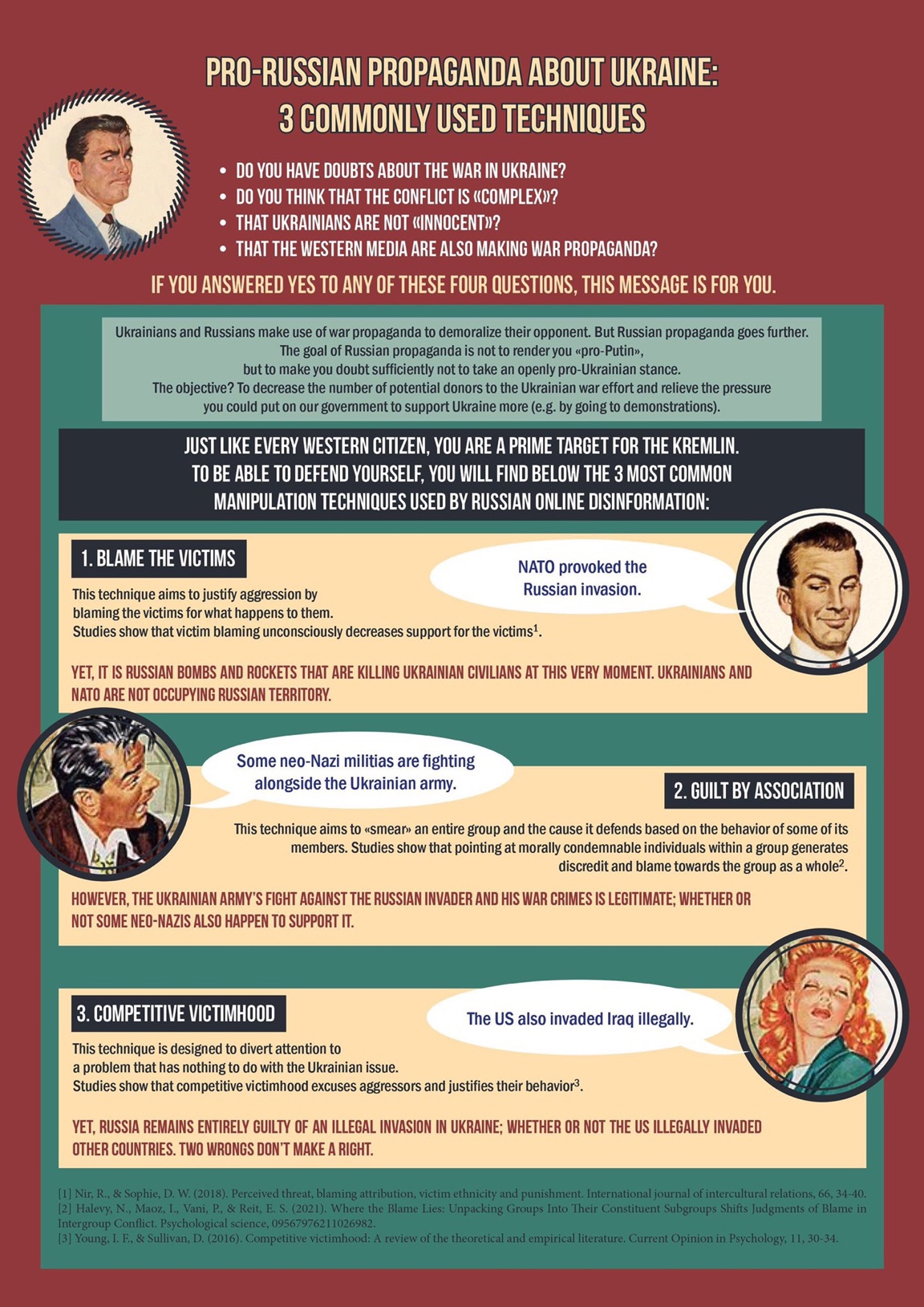
Pro Publica warns about the fake news and doctored videos that are circulating on the Internet. While some are pro-Ukrainian, most are designed to support Putin’s narrative. The famous Russian troll farm that was active on behalf of Trump in 2016, ProPublica says, is now busily creating phony “fact checks” and disinformation.
It begins:
On March 3, Daniil Bezsonov, an official with the pro-Russian separatist region of Ukraine that styles itself as the Donetsk People’s Republic, tweeted a video that he said revealed “How Ukrainian fakes are made.”
The clip showed two juxtaposed videos of a huge explosion in an urban area. Russian-language captions claimed that one video had been circulated by Ukrainian propagandists who said it showed a Russian missile strike in Kharkiv, the country’s second-largest city.
But, as captions in the second video explained, the footage actually showed a deadly arms depot explosion in the same area back in 2017. The message was clear: Don’t trust footage of supposed Russian missile strikes. Ukrainians are spreading lies about what’s really going on, and pro-Russian groups are debunking them. (Bezsonov did not respond to questions from ProPublica.)
In another post, ProPublica reports that the Russian troll farm is branding current events happening in Ukraine as “fake” and “Ukrainian propaganda.” The same sources are creating phony videos and branding them as Ukrainian propaganda. Experts say a recent wave of pro-Putin disinformation is consistent with the work of Russia’s Internet Research Agency, a network of paid trolls who attempted to influence the 2016 presidential election...
The pro-Putin network included roughly 60 Twitter accounts, over 100 on TikTok, and at least seven on Instagram, according to the analysis and removals by the platforms. Linvill and Warren said the Twitter accounts share strong connections with a set of hundreds of accounts they identified a year ago as likely being run by the IRA. Twitter removed nearly all of those accounts. It did not attribute them to the IRA...
The most successful accounts were on TikTok, where a set of roughly a dozen analyzed by Clemson researchers and ProPublica racked up more than 250 million views and over 8 million likes with posts that promoted Russian government statements, mocked President Joe Biden and shared fake Russian fact-checking videos that were revealed by ProPublica and Clemson researchers earlier this week. On Twitter, they attacked jailed Russian opposition leader Alexei Navalny and blamed the West for preventing Russian athletes from competing under the Russian flag in the Olympics...
The Internet Research Agency is a private company owned by Yevgeny Prigozhin, a Russian entrepreneur known as “Putin’s Chef.” Prigozhin is linked to a sprawling empire ranging from catering services to the military mercenary company Wagner Group, which was reportedly tasked with assassinating President Volodymyr Zelenskyy. The IRA launched in St. Petersburg in 2013 by hiring young internet-savvy people to post on blogs, discussion forums and social media to promote Putin’s agenda to a domestic audience. After being exposed for its efforts to influence the 2016 U.S. election, the IRA attempted to outsource some of its English-language operations to Ghana ahead of 2020. Efforts to reach Prigozhin were unsuccessful.
But it never stopped its core work of influencing Russian-speaking audiences. The IRA is part of a sprawling domestic state propaganda operation whose current impact can be seen by the number of Russians who refuse to believe that an invasion has happened, while asserting that Ukrainians are being held hostage by a Nazi coup.

 Diane Ravitch's blog