Jim Sleeper is a lecturer in political science at Yale and an author. He wrote the following post in 2018, when the horrors of the Trump regime were fresh. It is still relevant.

Donald J. Trump isn’t a Nazi, although his father came close. It’s true that historical analogies between Trump’s policies and Hitler’s are often facile, and sometimes dangerously misleading. But here’s one that I’m not inclined to shrug off.

During a long stay in Berlin in 2009, I went often to the Grunewald railway station to have my coffee. It’s a picturesque little station, built in the 1899, fronted by a cobblestone square and surrounded by splendid, well-preserved villas of that period.

It’s also the point from which more than 50,000 Berlin Jews were shipped to concentration camps, a few hundred a week, from 1942 to 1945. At the station’s Track 17, a steel strip along the platform edge records, in raised letters, each week’s shipment of several hundred “Juden” to Theresienstadt, Minsk, Riga, Kaunas, Łódź and, later, directly to Auschwitz and other death camps.

It’s hard for most Americans, especially those of us whose parents fought in World War II, to imagine that people who boarded the trains had no idea of what lay ahead. Yet, although Jews had been vilified and some attacked on the streets since 1938, some things remained unthinkable to Berlin Jews, most of whom had been middle-class, law-abiding citizens since birth. They showed up at station on the appointed dates, children and luggage in tow, for what they’d been told would be deportation to resettlement and work centers. At worst, they expected something like what Japanese-Americans experienced in internment camps on our own West Coast during the same war.

Under the watchful eyes of German police, they took their seats in ordinary passenger coaches for many of these departures. Only later, far beyond Berlin, were they transferred to box cars. Some time after that, postcards they hadn’t written were sent to relatives or acquaintances whom they’d listed with the authorities, assuring them that all was well in their new locations.

One day in April of 2009, as I sipped my coffee at the Grunewald station alongside retirees in their 70s and near a beer-garden where younger Germans also overlooked the square, three police cars swept in and officers leapt out, commanding us, “Don’t Move.” Then approximately 45 young military officers in formal parade dress descended from a tourist bus. Their uniforms were attractive, but alien—clearly not German. As they milled about, one of the men seated near me asked a police officer, “Was is das?”

“Israelischen,” he answered. They were Israeli army officers.

A silence descended upon the square like nothing I’d ever felt, so thick you could have cut it with a knife. Not another word was spoken, but I thought that I sensed three dimensions in the quiet all around me. The first was straight out of Close Encounters of the Third Kind: “They’re here. They’ve come.” The second was of admiration, or at least respect, for these vibrant young officers, stunning negations of the image of “Juden” that some of these older men must have remembered from their infancy. The third dimension, I sensed from the tightened body language around me, carried a flicker of resentment at having to be reminded, instead of being left to sip one’s coffee in peace.

A black car with tinted windows ascended a ramp toward Track 17. The Israeli officers fell into formation and followed. They’d come to lay a wreath on Track 17 on Yom Ha’Shoah—Holocaust Remembrance Day. Ironically, I hadn’t remembered the day myself.

I recount this now because some Americans remind me of Berlin Jews who didn’t think the unthinkable when they should have. After watching the Trump administration tear apart weeping parents and children—on the initiative of its senior policy adviser, Stephen Miller, who’s Jewish—I’m thinking that although Trump has now found it politically expedient to halt the practice, more than a few of my fellow Americans were thinking, “Well, they deserve it, unlike me, a law-abiding citizen, and a veteran.”

Those Berlin Jews had been law-abiding citizens, too, at least until 1935, and more than a few were military veterans: Some 12,000 of the Jews who had served in the German military had fallen in World War I. In an irony beyond ironies, it was a Jewish lieutenant, Hugo Gutmann, who secured an Iron Cross, First Class, for a 29-year-old corporal under his command, Adolph Hitler.

We now know that German veterans of that war, Jews and non-Jews alike, were lied to and sent into harm’s way for no good reason. So were soldiers in the Nazi Wehrmacht 25 years later, whom my father, a corporal in the U.S. Army Combat Engineers, was ordered to supervise as prisoners as his 277th battalion clanked across northern Germany, because he spoke Yiddish, which is closely related to German.

He did it with mix of grief and revulsion. One day, when his battalion commandeered a Nazi-friendly baron’s estate in the town of Hohne, my father and others scouted a cottage behind the mansion and found a white-haired, well-spoken man who said he was a caretaker but whom the G.I.’s suspected was closer to the missing baron. As some of them prodded him down the hill toward the mansion, jabbing him roughly with their rifle barrels, my father said, suddenly, almost instinctively, “Cut that out.”

“Why? You should enjoy this Sleeper, you’re a Jew.”

“Cut it out, I said.” He had no illusions about Nazism. But he was a young American, emancipated from his ancestors’ European hell, and he thought he was fighting for a world better than one in which the tables of unjust power are merely turned, a world where justice—dare one say, “due process”?—is stronger than revenge.

Watching the fires that Trump is stoking week in, week out, I wonder when his supporters and enablers will see that the unthinkable could happen to them. I’m not inclined to alarmism, but what if, a couple of years from now, veterans who say they fought for an America where people are free to speak their minds decide to speak their own minds in ways Trump doesn’t like? How far might this admirer of Vladimir Putin go against Americans he thinks are his enemies? He’s already said that he wants to tighten libel laws; his ICE agents have developed arrest-and-detention tactics that a craven Congress would let him expand with the stroke of a pen; municipal police forces are more militarized than ever before.

Yes, historical analogies are risky. But, sipping coffee overlooking the Grunewald station’s charming cobblestone square, you’d never imagine what happened there if you hadn’t been told.
Paul Bonner, who recently retired as a principal in Alabama, wrote the following comment as part of a discussion of administering NAEP to kindergartners.

He wrote:

One of the experiences that made me aware that my time with public education was coming to an end was when our district began testing kindergartners. I would walk into kindergarten classrooms and watch students struggle and often cry over the inability to navigate iPads. I would leave those classrooms shaken to the core. The students who could work with the devices were not making decisions about correct answers but through simply getting the program to move from question to question. Almost none of these students could understand what the test was asking them to do. This angered me significantly because what we were focusing on ignored the activities that were needed to build an actual foundational developmental standard. No focus on gross and fine motor skill development or social and emotional growth. No test below third grade will give us meaningful understanding of what children actually know and that really is beside the point. The poor quality of most of the tests I have seen keep us from understanding what those form third grade through twelve understand! What we are doing to children, or being asked to do, is criminal and a denial of how the brain can get to a point of meaningful inquiry. The fact that people who have no experience with child development and have done no meaningful study of the early brain, provides further evidence that our society and polity has no appreciation for the professional approach required to raise children to become successful adults. It just seems to be getting worse. I am absolutely appalled to see another presidential administration and the plethora of state governments that refuse to see the damage they are doing. This predatory capitalism that has so infected education, and all of governance, just might result in the same effect led poisoning had on Rome.

Mercedes Schneider writes that it is literally impossible to ban a book that is easily available on the Internet. The school board of McMinn County, Tennessee, voted unanimously to ban a Pulitzer-prize winning graphic novel about the Holocaust called MAUS.

But, she points out, students can find it for free on the Internet.

Furthermore, banning a book is a sure fire way to motivate students to want to read it. They might want to see for themselves the awful words “God Damn” or see nude mice.

Schneider writes:

If parents want to control what their children read, they might consider refocusing their school-district, book-banning attention toward controlling content on their children’s iPhones, iPads, and other electronic devices. As of this writing, three of Art Speigelman’s Maus book series are rated, 2, 3, and 7 on Amazon’s best sellers

In response to the ban, a Knoxville, Tennessee, comic book store is giving away free copies of Maus to students who wish to read the book.

As it stands, readers can also do what my colleague’s son did with Orwell’s Nineteen Eighty-four: Read it online for free. Here’s the first in the series: Maus: A Survivor’s Tale (1986).

(Note that the above text is available on Internet Archive, which is involved in a June 2020 lawsuit brought forth by several publishers. Internet Archive maintains it offers the books under “fair use.”)

Book bans backfire: they increase sales. And they encourage students to seek them out and read them. School boards should not embarrass themselves by acting as censors.

The Guardian in the U.K. reports on a study finding that parents in England are unhappy with the past three decades of “school choice.” By contrast, parents in Scotland are satisfied with their local public schools.

Three decades of school choice in England has left parents feeling more “cynical, fatalistic and disempowered” than their peers in other parts of the UK, according to new research.

A study comparing parents in England, where families can name up to six state schools for their children to attend, with those in Scotland, where children are generally assigned to local state schools, found Scottish families were still more likely to be satisfied with the outcome.

While 75% of parents in England said they had enough choice of schools, 76% of those in Scotland said the same, despite their lack of explicit choices within the admissions process.

Parents in England were more likely to express frustration and disempowerment, with several calling the current school choice policies an “illusion”, in surveys and interviews conducted for the research published in the Journal of Social Policy.

Aveek Bhattacharya, the chief economist at the Social Market Foundation and the author of the paper, said: “This research adds to the growing evidence that school choice policies have failed to bring the benefits they were supposed to.

“For all the emphasis that policymakers in England have put on increasing choice, parents south of the border are no happier with their lot than their Scottish counterparts. Indeed, many are disenchanted and dismayed.

“These findings show that parents offered a range of options for their children’s school are no happier than parents who have less choice about education.”

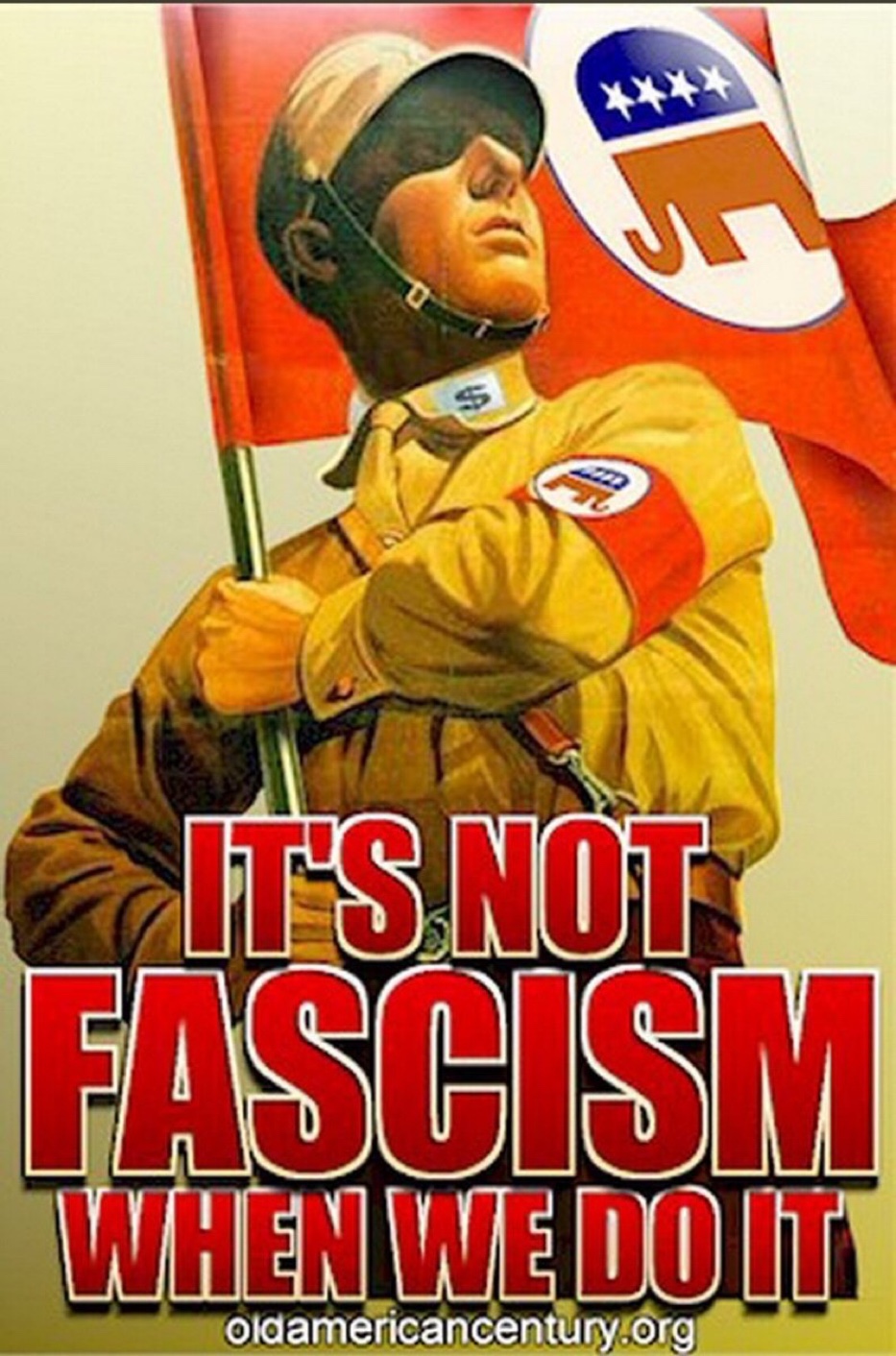
The current Republican Party has reverted to the ace card it held in the 1950s: its followers refer to every government program as socialism. SOCIALISM!! This one word is supposed to terrify everyone into fearing that government is about to take away their freedoms. Those politicians who do this should be asked if they are willing to abandon their own right to Social Security and Medicare. One of their favorite targets in recent years is public education. They are trying to persuade the public that their local public schools are socialism. This is nonsense. The following opinion piece by Janet Ward appeared in the Concord Monitor.

A few years ago at a gathering in my town, a fiery speaker said that our government is reaching into our pockets through taxation in order to steal our hard-earned money to pay for programs that are simply giveaways to growing numbers of the “undeserving.” This is not true.

This lie has been created because the former president, the moneyed interests who support him, and the inventors and funders of the “Big Lie” regarding our free and fair 2021 election are painfully aware that the people they wrongly label as the “undeserving” have the right and the power to vote.

Let us be clear. The former president and his supporters are convinced that our democracy itself poses an existential threat to their way of life. They would prefer a plutocracy, a government controlled by the wealthy.

In our democracy, we, you and I, govern ourselves through representation by legitimately elected legislators. Social programs exist because we the people believe that these programs are necessary and appropriate and that such programs, like our public schools, contribute to the common good, to the well-being of our entire society. But an insidious revolution, decades in the making, is bearing terrible fruit.

The long-standing belief that public schools benefit our entire society has been intentionally and successfully undermined through a decades-long strategy organized and executed by such entities as the State Policy Network and the American Legislative Exchange Council (ALEC) which provides templates of legislation to Republican lawmakers in every state to achieve such things as the dismantling of public education. But why target public schools?

Last year the Republican majority in our New Hampshire Legislature voted to approve a school voucher program. It is now legal for public tax dollars to be used to pay for private, religious or home-schooling programs over which we taxpayers have virtually no oversight. When asked why they supported school vouchers, Republican legislators, most of whom had been educated in public schools, said that they believed New Hampshire public school students were being brainwashed by teachers’ unions to believe in socialism. This is not true.

Good government is not socialism. Socialism is a system of government in which the government owns the means of production. Our country is not socialist. It is a capitalist country where individuals or corporations own the means of production and where decisions regarding prices, production and the distribution of goods are based on competition in a free market….

What will happen if Big Lies are allowed to prevail? Our democracy will be destroyed. The perpetrators of these lies will become the governors of our nation, and the dreams of Americans like Jefferson, Madison and Lincoln will die.

The death of our democracy will happen soon, on our watch, unless each of us uses the powerful weapon that our democracy has provided to us — our vote. Remove the liars and manipulators from office. Vote to restore our democracy.

The Network for Public Education posted this article by Mark Perna, which originally appeared in Forbes.

Mark C. Perna: Why Education Is About To Reach A Crisis Of Epic Proportions

If you missed this widely shared article the first time it was burning around the internet, here’s a chance to catch up. This piece by Mark C. Perna for Forbes lays out just how bad the current crisis is.

In order to reach and teach students effectively, teachers must forge a human connection with them. Today’s younger generations simply will not move forward in their education and career journey without that connection. This is a non-negotiable; it’s just who they are.

The vast majority of teachers truly want to forge that meaningful connection with students. In fact, for many it was the driving force behind their decision to enter the profession. But, understaffed and overworked as they are, many simply have no time to show students that they see, hear, and care about them. Survival mode—where many teachers have lived for the past two years—doesn’t allow much room for relationship building.

This creates a vicious cycle. Students aren’t performing, so more burdens are placed on teachers to help students hit the mark, thus decreasing teachers’ time and bandwidth to forge a human connection with students that is the basis for all learning. Teachers’ legs are cut out from under them, yet they’re still expected to carry their students across the finish line. It’s a gridlock.

What’s the fallout of all this burnout and lack of connection? We’ll see significant drops in three vital areas:

A drop in young people entering the profession, a drop in education quality, and a drop in graduation rates are three problems Perna predicts. Follow this link to read the whole piece.

You can view the post at this link : https://networkforpubliceducation.org/blog-content/mark-c-perna-why-education-is-about-to-reach-a-crisis-of-epic-proportions/

———-

Anthony Faiola writes in the Washington Post that a Russian invasion of Ukraine would cause global disruption of food and fuel supplies.

More than 100,000 Russian troops are massed near Ukraine amid a flurry of diplomatic efforts to defuse the prospect of conflict. Should peace not prevail, western-gazing Ukrainians would pay the highest price. But in a worst-case scenario, the cost of a major Russian invasion of Ukraine — one of the world’s largest grain exporters — could ripple across the globe, driving up already surging food prices and increasing the risk of social unrest well beyond Eastern Europe.

As tensions mount, one focus of economic concern is the global impact of extreme Western sanctions on Russia — a major exporter of agricultural goods, metals and fuel, particularly to Western Europe and China. Should the crisis escalate to the point of triggering staggering sanctions, the blow could spike prices and worsen global supply chain woes by tightening markets for commodities including natural gas and metals such as nickel, copper and platinum used in the manufacturing of everything from cars to spacecrafts.

Yet perhaps just as crucially, a major Russian incursion would also affect the flow of goods from Ukraine, the world’s fourth-largest supplier of wheat and corn. A major disruption of Ukrainian exports — especially in conjunction with any interruption in even larger Russian grain exports — could pile onto a global inflationary cycle that in many countries is already the worst in decades.

Concern is especially focused on fuel and food. Last year, global food prices surged 28.1 percent to their highest level in a decade, according to the United Nation’s food agency. Worries of war have already driven U.S. corn futures to their highest levels since June and sent wheat futures to two-month highs before a recent easing.

Over the past 20 years, bountiful Ukrainian harvests boosted the country’s role as a global breadbasket. Some of its biggest clients are economically battered, war-torn or otherwise fragile states in the Middle East and Africa, including Yemen, Lebanon and Libya, where grain shortages or cost surges could not only deepen misery but churn up unpredictable social consequences.

The world waits to see what Putin wants and commands.

The Washington Post reports that more than half the school districts in Virginia are defying Governor Youngkin’s order to eliminate mask mandates.

Youngkin boasted on a conservative radio program that only a small percentage of districts were not complying with his belief that masks should be optional.

But a Washington Post analysis shows that the majority of Virginia public school districts — enrolling more than two-thirds of the state’s students — have opted to disobey Youngkin’s mask-optional order. As of Wednesday, two days after the order was supposed to take effect, 69 districts, or 53 percent, are still requiring masks for all students inside schools. Cumulatively, those districts enroll 846,483 students, or about 67 percent of the state’s public school student population. The divide falls along partisan lines, although not perfectly: Almost every district that opted to make masks optional is in a locality that voted for Youngkin in the 2021 gubernatorial election.

The widespread defiance suggests Youngkin will have enormous difficulty in enforcing his mask-optional mandate, which is already the subject of two lawsuits: one from parents in Chesapeake, and one from seven school boards that oversee some of the state’s largest, most prominent school districts. A hearing on the second suit is scheduled for next week. Youngkin has said he will use every tool at his disposal to carry out his order as those cases wind through the court system, and his spokeswoman did not rule out disciplining disobedient districts by yanking their state funding…

Frederick Hess, a senior fellow and director of education policy at the right-leaning American Enterprise Institute, said he thinks Youngkin should stay the course on his masking policies, while vigorously fighting back against the two lawsuits challenging the executive order.

If parents prioritize the health and safety of their children, they will tell them to wear a mask in school and wherever groups of people congregate.

You may recall that a Texas state legislator named Matt Krause released a list of some 850 books that he thought should be removed from school libraries. Even public libraries are under pressure to clear their shelves of the books that Krause identified. The books are about race, racism, sex education, anything related to LGBT, student legal rights, and gender.

This link includes the full list of books that Krause wants to ban.

Yesterday, Christopher Tackett (@cjtackett) tweeted that the book purge has begun in his district.

He wrote:

Today in Granbury ISD, at the High School library, they came with a hand cart and carried away multiple boxes of books tagged with “Krause’s List”.

They can do this because the board voted 7-0 on Monday to change district policy allowing books to be removed prior to a review.

He wrote that students, parents, and teachers protested to the school board but their voices were ignored. The superintendent pushed for the purge and ridiculed the opponents as “gaslighters and radicals.”

Some excellent comments from outside Texas. This one from Hugh G. Merriman:

The parallels are chilling…

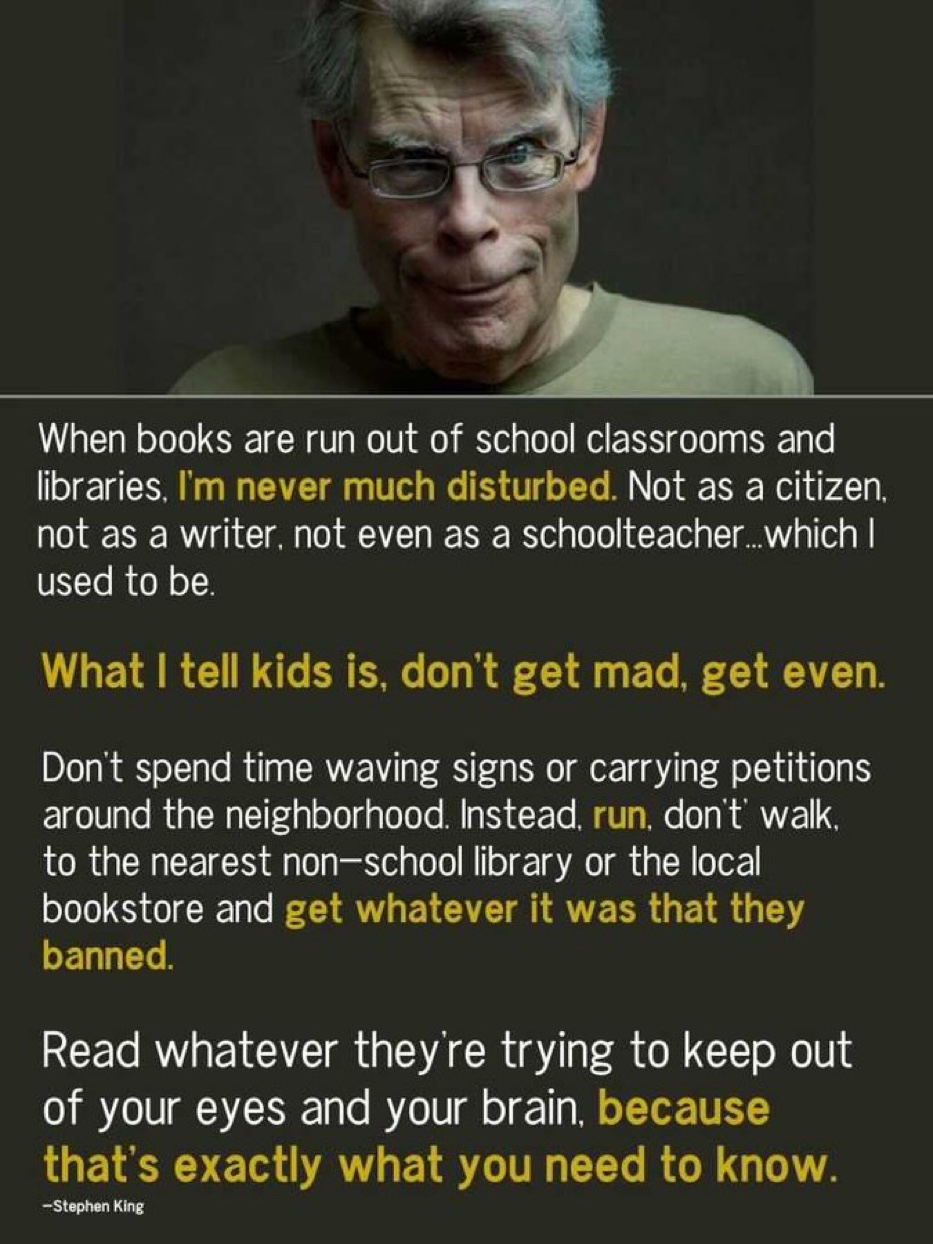
And this advice, quoted from Stephen King:

I disagree with the opening line in the King quote. I am very much disturbed when books are banned from schools and school libraries. Next, they will pull them from the public library, and not many students can afford to buy the banned books. Protest, wave signs, speak up. Be loud. Make noise.

The school board in McMinn County, Tennessee, voted 10-0 to ban the Pulitzer-Prize winning graphic novel Maus from its schools. Board members complained about unacceptable language (“God damn”) and nudity (nude mice). The book by Art Spiegelman is about his father’s brutal experiences during the Holocaust. Presumably, the board wants the story of genocide told in a pleasant, inoffensive way.

Teachers in the district testified on behalf of the book.

The members of the school board heard from English language arts instructional supervisors about why the book was being used in the curriculum, the meeting minutes show.

Board member Tony Allman took issue with how the content would be redacted, and added, “We don’t need to enable or somewhat promote this stuff. It shows people hanging, it shows them killing kids, why does the educational system promote this kind of stuff? It is not wise or healthy,” according to the meeting minutes.

In response, instructional supervisor Julie Goodin countered, “I was a history teacher, and there is nothing pretty about the Holocaust, and, for me, this was a great way to depict a horrific time in history,” the meeting minutes say.

“Mr. Spiegelman did his very best to depict his mother passing away, and we are almost 80 years away. It’s hard for this generation. These kids don’t even know 9/11. They were not even born. For me, this was his way to convey the message,” Goodin continued.Black parents say movement to ban critical race theory is ruining their children’s education

Melasawn Knight, another instructional supervisor, echoed Goodin’s stance that the graphic novel depicts history as it happened, the meeting minutes indicate.

“People did hang from trees, people did commit suicide and people were killed, over six million were murdered,” Knight said.

“I think the author is portraying that because it is a true story about his father that lived through that. He is trying to portray that the best he can with the language that he chooses that would relate to that time, maybe to help people who haven’t been in that aspect in time to actually relate to the horrors of it.

“Is the language objectionable? Sure. I think that is how he uses that language to portray that,” Knight said.

It is not possible to teach the history of the Holocaust without acknowledging organize brutality, savagery, mass murder, and sadism. Teaching the history honestly is no doubt offensive to Nazis, but one imagines they are not a significant bloc in McMinn County. If the school board wants to protect students against the reality of the Holocaust, what are teachers allowed to say about slavery, Jim Crow, lynchings, and the KKK?