A 33-year-old woman insinuated herself into the inner circle at Mar-A-Lago, posing as a member of the famed Rothschild family. She used fake identity papers. She played golf with Trump and Lindsay Graham. At the least, the story shows how lax was security at Trump’s resort. At worst, why was she there?

For a time, Anna de Rothschild boasted of her family roots to the European banking dynasty, donning designer clothes, a Rolex watch, and driving a $170,000 black Mercedes-Benz SUV.

She talked about developing a sprawling luxury housing project on Emerald Bay in the Bahamas, a high-rise hotel in Monaco, and a Formula One race track in Miami, say people who knew her.

A pivotal moment for the woman who was fluent in several languages took place last year when she was invited to Mar-a-Lago, where she mingled with former President Donald Trump’s supporters and showed up the next day for a golf outing with Mr. Trump and Sen. Lindsey Graham among other political luminaries….

A year before the FBI’s spectacular raid of the former president’s seaside home, the woman whose real name is Inna Yashchyshyn, a Russian-speaking immigrant from Ukraine, made several trips into the estate posing as a member of the famous family while making inroads with some of the former president’s key supporters.

The ability of Ms. Yashchyshyn — the daughter of an Illinois truck driver — to bypass the security at Mr. Trump’s club demonstrates the ease with which someone with a fake identity and shadowy background can get into a facility that’s one of America’s power centers and the epicenter of Republican Party politics.

Why was she there? Who paid for her car and clothing? How did she get a fake passport?

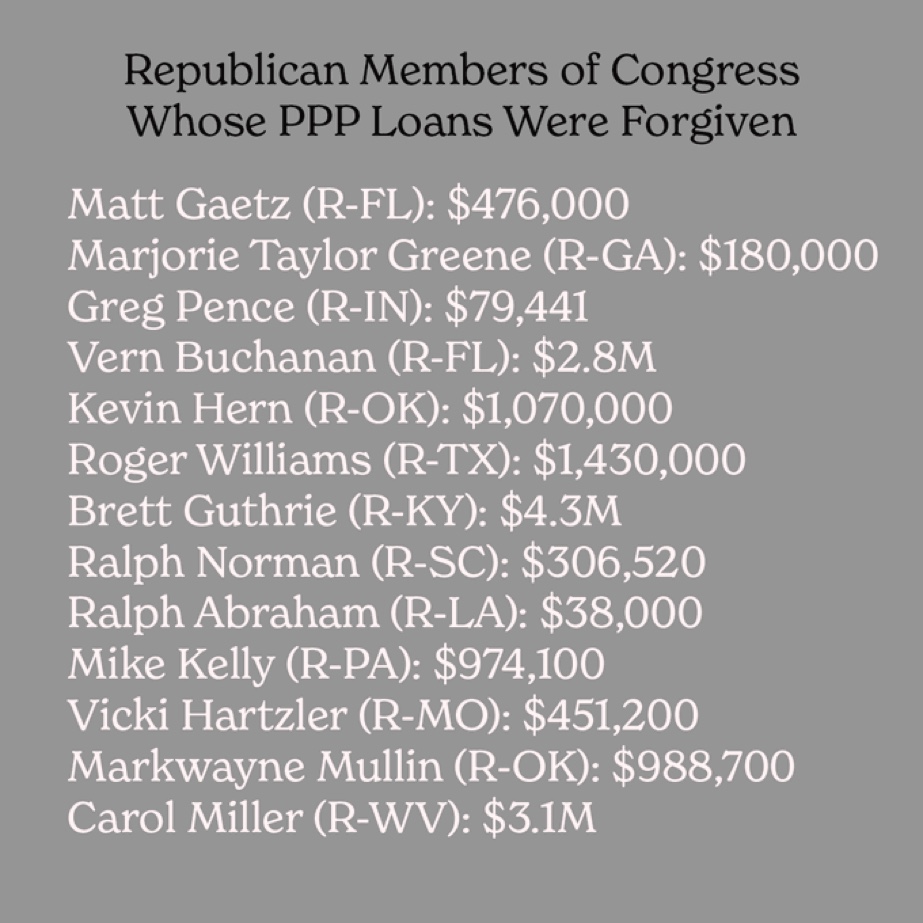
A number of Republicans received Paycheck Protection Program loans, which were forgiven.

The White House tweeted a response to Republican Congressman Vern Buchanan of Florida, who complained about debt relief for college students. He received a Payroll Protection Program loan from the federal government of $2.3 million. The loan was forgiven.

@WhiteHouse

Congressman Vern Buchanan had over $2.3 million in PPP loans forgiven.

Buchanan had tweeted:

@VernBuchanan

“As a blue-collar kid who worked his way through college, I know firsthand the sacrifices people make to receive an education. Biden’s reckless, unilateral student loan giveaway is unfair to the 87 percent of Americans without student loan debt and those who played by the rules.”

So it’s okay for the federal government to give Congressman Buchanan $2.3 million, which he doesn’t have to pay back, but not to help college kids drowning in debt with a student loan forgiveness of $10,000-20,000?

Republican Mike Kelly of Pennsylvania complained on Twitter:

Asking plumbers and carpenters to pay off the loans of Wall Street advisors and lawyers isn’t just unfair. It’s also bad policy.

Yeah, all those millions of kids who got student loans are rich now, right?

@WhiteHouse tweeted:

Congressman Mike Kelly had $987,237 in PPP loans forgiven.

But that’s not all:

Marjorie Taylor Greene was one of many Republicans complaining about President Biden’s decision to forgive $10,000-20,000 of debt that college students owe for taking out federal loans to finance their education.

The White House released a response: Rep. Marjorie Taylor Greene applied for and received a federal Paycheck Protection Program loan of more than $180,000. The loan was forgiven.

Unlike college students who had a debt of $10,000 forgiven, her debt of $180,000 was forgiven. And she complains about them! That’s called chutzpah.

Alternet reports:

Highlighting the hypocrisy of Greene and other Republicans claiming it’s unfair to have loans forgiven at taxpayer expense, the White House also posted to Twitter that U.S. Rep. Matt Gaetz (R-FL), U.S. Rep. Mike Kelly (R-PA), U.S. Rep. Vern Buchanan (R-FL), and other Republicans attacking the administration for its student loan forgiveness program, had massive PPP loans forgiven….

According to ProPublica, Rep. Greene’s family construction business took out a PPP loan on April 10, 2020, for $182,300. In total, including interest, the federal government forgave her and her family’s loan totaling $183,504.

The PPP loans, also known as the Paycheck Protection Program, originated under President Donald Trump and was facilitated via the Small Business Administration. The were $800 billion in PPP loans made, according to NBC News.

Watchdogs estimate billions in fraudulent PPP loans were forgiven.

Republicans are outraged that Biden is forgiving the student loan debt of millions of borrowers by $10,000-20,000. They have denounced loan forgiveness as “socialism,” a “big government giveaway,” and worse.

They are on the wrong side of history and politics.

I can tell you from the two years I worked in the U.S. Department of Education that there is a student loan industry that has a powerful lobby. They want student debt to be as high as possible and they want the rates to be as high as possible. Biden’s decision is very disappointing to their lobbyists.

Zachary D. Carter writes in Slate that there is a long history of forgiving debt. This is a terrific article. I urge you to read it.

He begins:

In 1920, the world’s most famous economist, John Maynard Keynes, was digging through old books on the economy of the ancient world, when he discovered something startling. All his life he had been taught that civilization depended on ironclad financial certainty. Without a stable currency and dependable debt contracts, commerce could not exist. Governments that meddled in such matters were thought to be asking for social chaos.

But the documents he perused on Ancient Greece, Rome, Babylon, Assyria, and Persia showed him something else entirely. Throughout history, political leaders had abolished debts and managed the value of their currencies—another way to revise debts—as routine matters of government policy. Keynes was electrified. A year earlier, he had staked his reputation on a call to cancel the largest debts the world had ever seen—those accrued by the governments of Europe during World War I. If these debts were not cleared, Keynes had argued, the international trading system would break down, leading to misery and another war. Predictably, the financial establishments on two continents responded to this apparent heresy with alarm. Now Keynes had discovered precedent for his ideas — thousands of years’ worth, from Hammurabi in ancient Babylon to Solon of Athens.

[As a side note, the Treaty of Versailles imposed massive debt on Germany. Had that debt been forgiven, there might have been no World War II.]

Indeed, debt relief has always been the handmaiden of debt itself. In the United States we have a formal legal process for eliminating nearly all forms of debt: bankruptcy. When debts become unbearable, people file for bankruptcy to have them discharged in court. In the 15 years preceding the pandemic, more than 14.3 million people filed for bankruptcy, and in the decade prior to the pandemic, more than 20,000 businesses filed for bankruptcy every year, with a high water mark of 60,837 in 2009. Debts are discharged every day in the United States, and have been for decades.

Indeed, debt relief has always been the handmaiden of debt itself. In the United States we have a formal legal process for eliminating nearly all forms of debt: bankruptcy. When debts become unbearable, people file for bankruptcy to have them discharged in court. In the 15 years preceding the pandemic, more than 14.3 million people filed for bankruptcy, and in the decade prior to the pandemic, more than 20,000 businesses filed for bankruptcy every year, with a high water mark of 60,837 in 2009. Debts are discharged every day in the United States, and have been for decades.

Not that you would know from the apocalyptic conservative outrage emanating from social media and cable television this week. When President Joe Biden announced his new student loan relief program on Wednesday, Senate Majority Leader Mitch McConnell decried it as “socialism” and Utah Sen. Mitt Romney called it a naked attempt to “bribe the voters.” Reason magazine’s Robby Soave declared it a “fuck you to every financially responsible person in the country.” These reactions belie centuries if not millennia of economic history.

Capitalism would collapse without debt relief systems. Businesses get in trouble all the time—both good businesses that would work fine without a few onerous debt deals, and bad businesses that need to be liquidated or restructured. Sometimes bad things just happen. People get divorced. They get injured and are overwhelmed by medical bills. They get laid off. They have to pay for a parent’s funeral or care for children with special needs. And yeah, some people just don’t know how to manage their money and buy things they can’t afford. But we do not consign such people to never-ending financial servitude as a result of unforeseen circumstances, or even totally reckless spending habits. We have a formal process to eliminate debts and start over, with a reasonable chance of living a healthy financial life.

But not for students who borrow money to attend college. In 2005, Congress passed a law that made it next to impossible to discharge almost any form of student debt. Even the most creative consumer lawyers estimate that only about $50 billion—less than 3 percent of the $1.75 trillion in outstanding student debt—had the potential to be wiped away, but only if students could persuade a court that they had been egregiously wronged, by say, non-accredited programs or institutions that didn’t actually offer degrees.

Biden’s new student debt relief program exists because student debt is currently ineligible for the ordinary process that Americans use for extinguishing excessive debts….

Nor are the recipients of Biden’s aid particularly wealthy. The plan flatly excludes anyone who makes more than $125,000 a year from participation. According to an analysis by the University of Pennsylvania’s Penn Wharton Budget Model, about half of the money will go to borrowers in the bottom half of the income spectrum, with only 2.5 percent of folks breaking into the top 10 percent receiving relief. The median personal income in the United States—the 50 percent line—is $35,800. This makes sense once we consider the actual demographics of the typical American college student, who is not an Ivy Leaguer bound for the 1 percent. About 40 percent of all undergraduate students attend community colleges, about one-third of whom take out student loans to help pay for their education. The average community college borrowergraduating with more than $13,000 in debt. There are also racial disparities in student debt: According to a Brookings Institute analysis, Black borrowers shoulder roughly double the amount of debt to attend college that white borrowers do.


Carol Burris is a retired high school principal and executive director of the Network for Public Education.

It has been a bad year for the charter school industry’s trade association, the National Alliance for Public Charter Schools (NAPCS). Their bitter campaign last spring to fight regulatory reform of the federal Charter Schools Program used the slogan “Back Off” to intimidate the President and Secretary Cardona. In the end, it was ineffective in stopping the regulations. While they claimed to achieve a few concessions, most of those related to issues that never existed in the first place. I estimate NAPCS spent upwards of one million dollars on the campaign, which included television ads.

As Republicans embrace school choice with the transparent motive of destroying community-governed public schools, Democrats have “backed off,” but not in the way NAPCS wanted. The latest poll by Ed Next, a pro-charter organization, found that only 10% of Democrats strongly support charters. Over twice as many Dems strongly oppose them. And overall support, even lukewarm support, for charters is only 38%.

And so, in desperation, NAPCS recently published a report entitled “Never Going Back” based on a poll they conducted. Its transparent purpose is to convince Democrats that not giving full-throated support to charters will cost them re-election in November.

Their poll data, however, is so profoundly flawed that it cannot be taken seriously. Frankly, it is an embarrassment for an organization that used to serve as the “go-to place” for information about charter schools.

Here is why.

First, NAPCS does not give full access to its survey questions and the possible responses from which respondents could choose.

We have no idea what the full array of survey questions was and what choices respondents had to pick from. This is critically important to allow the full expression of opinion. To illustrate, I provide a link to the full 2022 poll results presented by school choice advocacy organization, Ed Next.

While that survey has its own bias problems, it uses a full Likert scale to allow respondents to provide a nuanced response. Did NAPCS do the same? We don’t know. But given their outlier results, which I will discuss in greater detail later, it is doubtful.

Second, they oversampled parents of students in charter schools.

According to their report, 13% of respondents were charter school parents. But using their own figures from their 2021 report, Voting with Their Feet, only 7.7% of all students in either a public or charter school were charter school students. And that percentage excludes the number of students in private or homeschool settings, which means the percentage of all charter school students is likely lower than 7% of all American K-12 students. Although the percentage of families with a child in a charter school may be higher or lower than the number of students, a six percentage point difference is not credible. Such inflation, however, would undoubtedly skew responses in a pro-charter way.

It should also be noted that during this past year, public school enrollment increased from last year (although it is still down from pre-pandemic levels), and as we showed in this report, charter enrollment 2021-2022 is down; thus, the oversampling is worse than I described above.

Third, an examination of other polling data proves the fix is in.

Reliable polling results will differ by a few percentage points. For example, Ed Next’s recent poll reported that 52% of respondents give their community’s public schools a grade of A or B, while the recently released poll by PDK says that 54% give the two top grades–a record high. Results are aligned. Dramatic differences in polls taken closely in time raise alarms regarding the poll’s veracity.

Now let’s examine the NAPCS and Ed Next’s results on the question of school choice.

NAPCS reports that between 58% and 65% of parents strongly agree that parents should have school choice. Ed Next asks a nearly identical question—“Do you support or oppose school choice?” However, their percentage of parents who strongly agree is only 21%, a dramatic difference of about 40 percentage points.

Much like the school choice question, the NAPCS’ questions regarding support for charter schools are wildly out of sync with the Ed Next poll.

According to Ed Next, 51% of all parents somewhat or strongly support charter schools.

Yet NAPCS incredibly claims that 84% of parents (not interested in sending their own child to a charter school) support charter schools, and 77% of parents want more charter schools in their area. These results, in light of Ed Next’s data, defy logic.

 Much like NAPCS’s underreporting of charter schools run for profit, which we demonstrated in this report, NAPCS cherry-picks data to present charters in a favorable light. I guess one might argue that as a trade organization they are doing their job. Even so, their latest report is beyond the pale and does not deserve the attention of either the press or candidates this fall. And it further damages NAPCS’s already tarnished brand.

Charlie Crist, the Democratic candidate for governor of Florida, will choose Karla Hernandez-Mats as his running mate, according to the Miami Herald. She is the president of the Miami-Dade teachers’ union. She is also a wonderful person. She is articulate and super-smart. I met her in Miami in February 2020 when I had an event to promote Slaying Goliath at Miami’s famous bookstore “Books & Books.” Karla interviewed me, and she was terrific.

Help Charlie Crist and Karla Hernandez-Mats defeat DeSantis, the man who censors books, bans discussions of racism and gender, opposes women’s right to an abortion, and wants to destroy public schools in Florida.

Help Florida join the 21st century!

Charlie Crist, the Democratic Party’s candidate for governor, has selected the head of Miami-Dade County’s teachers union as his running mate to take on Gov. Ron DeSantis in the fall, the Miami Herald has confirmed. Three sources briefed on Crist’s decision confirmed the choice of Karla Hernandez-Mats, which was first reported by CBSMiami. The Crist campaign declined to confirm the news. An announcement is expected Saturday.

Read more at: https://www.miamiherald.com/article264963034.html#storylink=cpy

Blake Masters is the Republican candidate opposing incumbent Democratic Senator Mark Kelly in Arizona. Masters is closely allied with misogynistic billionaire Peter Thiel.

On his campaign website, he declared that was completely opposed to abortion at any stage of pregnancy, with no exceptions. He said he was “100% pro-life.” He called Roe v. Wade a “horrible” decision.

He called for “a federal personhood law (ideally a Constitutional amendment) that recognizes that unborn babies are human beings that may not be killed.”

But then came the election in Kansas, where Republican women joined with Democrats to block an effort to remove the right to an abortion from the state constitution.

Now, reports the Arizona Republic, Masters has softened the language on his website to pretend to be a moderate on abortion. In other words, he is trying to pull a Kavanaugh, pretending that he is not what he is.

He removed the reference to being “100% pro-life.” He claims to support reasonable limits on abortion, no longer completely opposed to it. The Roe decision is now described as “bad,” not “horrible.” He now claims to support Arizona’s ban on abortion after 15 weeks of pregnancy.

The Masters campaign did not immediately elaborate on the website changes. He launched a digital ad Thursday addressing abortion, in which he says, “Most people support commonsense regulation around abortion.”

Kelly has supported federal abortion rights and blasted the Supreme Court’s ruling doing away with them.

He said about the Dobbs’ decision overturning Roe v. Wade:

“Today’s decision is a giant step backward for our country. Women deserve the right to make their own decisions about abortion. It is just wrong that the next generation of women will have fewer freedoms than my grandmother did,” he said in a written statement.

“In Arizona, there are already restrictive bans on the books that will take rights away from Arizona women, without exceptions even in the case of rape or incest. I know that this decision and these laws are leaving many Arizonans frustrated and scared. This is an all-hands-on-deck moment. I am resolved to defend and protect the right of Arizona women to make their own health care decisions.”

Masters has called Kelly an extremist for defending a right that existed for nearly half a century.

As Masters tries to rewrite his own history, will the women of Arizona be fooled?

Dahlia Lithwick, writing in Slate, makes three important points about the ongoing controversy over abortion and the Supreme Court’s overturning of Roe v. Wade. The anti-abortion movement is not satisfied because they want more than a decision that allows some states to offer abortions.

First, their real goal is a national ban on abortion and a declaration that a fetus has all the rights of a person. They want fetal personhood, in every state.

Second, since the Dobbs’ decision reversing Roe, large numbers of Republicans have expressed their opposition to the decision.

Third, post-Dobbs, expect to read frequent stories about women who died because they were denied an abortion; about women forced to carry dead fetuses for the full term of pregnancy; of children forced to give birth because they are “too immature” to have an abortion.

The only good news in this tragic turn of events is that Republicans who support abortion extremists may face a backlash.

She writes:

It’s being called “Roevember,” a reckoning around women’s rights and fundamental liberties that hasn’t been witnessed since the shaggy-haired days of the ERA. As Jeremy Stahl noted just last week, recent polling seems to show that women are pretty affirmatively pissed off about Roe v. Wade being overturned, and it’s affecting a set of key Senate races, in addition to down-ballot contests around the country. Mark Joseph Stern and I wrote recently that there is virtually no other way to assess the beatdown Kansas voters recently unleashed upon an amendment that would have removed abortion rights from their state constitution than as a repudiation of the Supreme Court’s recent Dobbs intervention, and a promise that even in ruby red states, and even among ruby red voters, only a tiny minority of female voters would endorse forcing teen girls to carry pregnancies to term. After Dobbs came down at the end of June, Kansas reported a 1,038 percent increase in voter registrations that week alone, compared just with the week before.

Yes, even Republican women get abortions. Even conservative women get abortions. Having had the “right” to an abortion and control of their bodies for almost half a century, many women will find it hard to give up their reproductive rights.

The latest Phi Delta Kappa poll about education was released, and it shows the damage that so-called reformers have done to the teaching profession.

On the one hand, public esteem for public schools is high. But most parents do not want their children to become teachers. Thanks, Bill Gates. Thanks, National Council on Teacher Quality. Thanks, TFA. Thanks, Michelle Rhee. Thanks, TeachPlus. Thanks, Educators4Excellence. Thanks, Walton family. Thanks, Ron DeSantis. So many to thank for smearing a great and noble profession.

Americans’ ratings of their community’s public schools reached a new high dating back 48 years in this year’s PDK Poll of the Public’s Attitudes Toward the Public Schools, while fewer than ever expressed interest in having their child work as a public school teacher.

Results of the 54th annual PDK Poll tell a tale of conflicted views of public schools — local ratings are at nearly a five-decade high and a majority have trust and confidence in teachers, yet there’s wide recognition that the challenges they face make their jobs broadly undesirable.

Just 37% of respondents in the national, random-sample survey would want a child of theirs to become a public school teacher in their community. That’s fewer than have said so in a similar question asked 13 times in PDK polls since 1969. It compares with 46% in 2018, a high of 75% in 1969, and a long-term average of 60%.

The reasons for this reluctance are varied: Among the 62% who would not want their child to take up teaching, 29% cite poor pay and benefits; 26%, the difficulties, demands, and stress of the job; 23%, a lack of respect or being valued; and 21%, a variety of other shortcomings. Just among public school parents, slightly more, 38%, cite poor compensation.

This is the case even as 54% of all adults give an A or B grade to the public schools in their community, the highest percentage numerically in PDK polls since 1974, up 10 points since the question was last asked in 2019. The previous high was 53% in 2013; the long-term average, 44%.

Nancy Flanagan is a retired educator who taugh in the schools of Michigan for many years. Her post was reprinted by the Network for Public Education.

She writes:

We need more teachers.

Good teachers. Well-trained and seasoned teachers. Teachers who are in it for the long haul.

Many of the articles floating around about the teacher shortage focus on data—What percentage of teachers really quit, when the data is impenetrably murky at best? And how does that compare with other professions?

In other words, how bad is it? Really?

These articles often miss the truth: Some districts will get through the teacher shortage OK. And most districts will suffer on a sliding scale of disruption and frustration, from calling on teachers to give up their prep time to putting unqualified bodies in classrooms for a whole year, sometimes even expecting the real teachers to keep an eye on the newbies.

The shortage will look different everyplace, but one point is universal: it’s not getting better.

Teachers are not just retiring and leaving for good. They’re part of the great occupational heave happening because of the COVID pandemic—people looking for better jobs, demanding more pay, in a tight labor market.

Public schools are now competing to hire smart and dedicated young people who want to be professionally paid and supported, especially in their early careers. When you’ve got student loans, higher starting pay is a big deal. And loan forgiveness if you teach for a specified number of years might make a huge difference.

Before anybody starts telling us how to make more teachers, as fast and cheaply as possible, to prevent “learning loss,” we should think about Peter Greene’s cynical but spot-on assessment of the underlying goals of folks pushing for a New Concept of who can teach:

Once you’ve filled classrooms with untrained non-professionals, you can cut pay like a hot knife through cheap margarine. It’s really a two-fer–you both erode the power of teachers unions and your Teacher Lite staff cost you less, boosting your profit margin for the education-flavored business that you started to grab some of those sweet, sweet tax dollars. And as an added bonus, filling up public schools with a Teacher Lite staff means you can keep taxes low (why hand over your hard-earned money just to educate Those Peoples’ children).

Several states (and Florida springs to mind here) almost seem to be competing for the best ways to reduce public school teacher quality, thus reducing public school quality in the process. In addition to offering full-time, teacher-of-record jobs to folks without college degrees, they’re trying to brainwash the ones they already have by offering them $700 to be, well, voluntarily indoctrinated about another New Concept around what the Founders really meant in the Constitution.

Attention MUST turn to an overhaul of how we recruit, train and sustain a teaching force.

All three are important—and have been so for decades. We’ve been talking about improving the teacher force, from selection of candidates to effective professional learning, for decades. As Ann Lutz Fernandez notes, in an outstanding piece at the Hechinger Report, there is a surfeit of bad ideas for re-building the teacher workforce, and not enough coherent, over-time plans to put well-prepared teachers into classrooms, and keep them there.

I have worked on a number of projects to assist beginning teachers using alternative routes into teaching. And while there are problems, there’s something to be said for teaching as a second (or fourth) career,with the right candidates and pre-conceptions, and the right professional learning.

That professional learning has to include a college degree, and field experience. Many high-profile charters advertise the percentage of students who are accepted into colleges. There’s been a longtime push to mandate challenging, college-prep courses at public high schools, and send larger numbers of students to post-secondary education.

Teachers need to be credentialed to demand respect from the education community, plain and simple, no matter what Ron DeSantis says. It’s past 50 years since bachelors degrees were the required norm for teachers in all states. Backing away from that is egregiously foolish—and almost certainly politically motivated.

If we were serious about making more *good* teachers, we’d need two core resources: money and time. Money to effect a significant nationwide boost in salaries, loan forgiveness programs, student teaching stipends, scholarships, plus the development of more alternate-entry and Masters in Teaching programs that include both coursework and an authentic, mentored student teaching experience.

This would also take time—but it absolutely could be done. Would-be teachers should have to invest some skin in the game—not because traditionally trained teachers had to jump through hoops, but because teaching involves commitment to an important mission. Done well, it’s professional work. We can argue about teacher preparation programs, but nobody should be going into a classroom, alone, without training and support. It’s bad for everyone—teachers, communities and especially kids.

What are we going to do in the meantime?

Alternative routes have sprung up all over the country, some unworthy, others better. All are stopgaps, but some of those teachers will continue to grow and excel in the classroom. And I agree with Michael Rice, MI State Superintendent of Schools:

“If the question is whether we have a teacher that is certified through (an alternative route) or have Mikey from the curb teaching a child — a person who has no experience whatsoever and is simply an adult substituting in a classroom for a long period of time because there isn’t a math teacher, there isn’t a social studies teacher, there isn’t a science teacher — the teacher that is developed through an alternative route program or expedited program is going to be preferable.”

It’s worth mentioning that this shortage has been visible, coming down the road, for years. The pandemic and that great occupational upheaval have merely brought it into focus.

It’s past time to get the teacher pipeline under control. This will take good policy.