ProPublica estimated the number of children who will die–of starvation or lack of medical care–because DOGE closed down USAID. The deaths of hundreds of thousands of children, in addition to their families, are the direct result of the shuttering foreign aid. These lives don’t matter to Trump and Musk; they are not white. Musk is a well-known pro-catalyst; he thinks women must have more babies. He himself now has 14 children, by different mothers. But he seems to care only about white babies.
Here is a portion of their report:
For weeks, some of the federal government’s foremost authorities on global health have repeatedly warned Secretary of State Marco Rubio and other leaders about the coming death toll if they carried out the Trump administration’s plan to end nearly all U.S. foreign aid around the world.
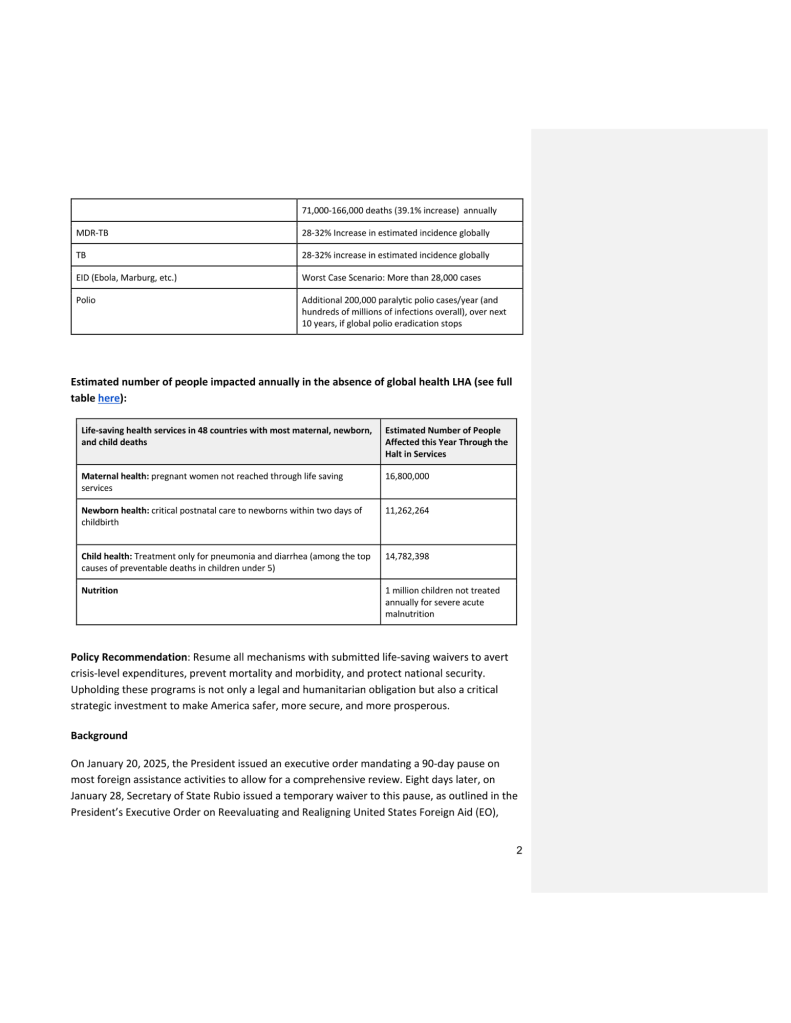
In their clearest accounting yet, top officials have estimated the casualties: One million children will not be treated for severe acute malnutrition. Up to 166,000 people will die from malaria. New cases of tuberculosis will go up by 30%. Two hundred thousand more children will be paralyzed by polio over the next decade.
Instead of acting on the repeated warnings, top administration officials, including the State Department’s director of foreign assistance, Peter Marocco, thwarted their own experts’ efforts to keep the U.S. Agency for International Development’s most vital programs up and running, according to internal memos and estimates compiled by global health leaders at the agency and obtained by ProPublica.
President Donald Trump’s political appointees, along with billionaire Elon Musk’s Department of Government Efficiency, pressed ahead with their plan to dismantle USAID by ignoring and impeding staff who tried to protect lifesaving operations — even as the administration publicly insisted that those programs remained online — according to the memos and interviews with government officials.
During exchanges outlined in one of the memos, a DOGE engineer emailed staff and said they were not allowed to review the programs they were canceling. At another point, USAID’s then-deputy chief of staff, Joel Borkert, told agency personnel to take a “draconian” approach to approving waivers.
The explosive memos — which include summaries of email exchanges and top-level meetings inside USAID, as well as internal agency research — were sent by Nicholas Enrich, acting assistant administrator for global health. ProPublica also obtained detailed breakdowns of lifesaving programs managed by the bureau and the projected impact of cutting them. Enrich was placed on leave Sunday.
Enrich told The New York Times he released the memos, which multiple other officials contributed to, after learning he was being placed on leave, as thousands of others at the agency have been. The memos were circulated to the staff and obtained by ProPublica.
The documents identify several key senior policymakers behind the scenes while also puncturing the administration’s claims of a careful, deliberative review of USAID programming. The records also represent the government’s most explicit concerns to date memorialized by a senior official from inside Trump’s administration.
The State Department, USAID and Elon Musk did not respond to questions about this story. Rubio and Marocco did not respond to a request for an interview.
Since the inauguration, Rubio, Musk and Marocco have taken dramatic steps to incapacitate USAID, the largest foreign aid donor in the world, by firing its employees and halting operations. The global health bureau was one of the first parts of the agency targeted for mass layoffs.
Then, last week, they abruptly cancelled 10,000 foreign aid projects, which account for 90% of USAID’s humanitarian operations and about half of the State Department’s. Lifesaving programs that were still operating around the world were forced to close down immediately.
How do you sleep at night, when you know that your actions were responsible for the deaths of hundreds of thousands of children? And their parents?
The New York Times story that was linked in the story gave more details:
The Trump administration’s decision to withdraw foreign aid and dismantle the U.S. Agency for International Development is likely to cause enormous human suffering, according to estimates by the agency itself. Among them:
up to 18 million additional cases of malaria per year, and as many as 166,000 additional deaths;
200,000 children paralyzed with polio annually, and hundreds of millions of infections;
one million children not treated for severe acute malnutrition, which is often fatal, each year;
more than 28,000 new cases of such infectious diseases as Ebola and Marburg every year.
Those stark projections were laid out in a series of memos by Nicholas Enrich, acting assistant administrator for global health at U.S.A.I.D., which were obtained by The New York Times. Mr. Enrich was placed on administrative leave on Sunday.
This was the opening of Enrich’s bold memo, as reprinted in the New York Times:
Takeaway: The temporary pause on foreign aid and delays in approving lifesaving humanitarian assistance (LHA) for global health will lead to increased death and disability, accelerate global disease spread, contribute to destabilizing fragile regions, and heightened security risks-directly endangering American national security, economic stability, and public health. If the pause leads to permanent contract terminations, the $7.7B in resources appropriated by Congress are no longer be used to support these lifesaving global health programs, which could potentially result in wasted resources. The impacts on mortality and morbidity are summarized in the tables below. While the Foreign Assistance Review is set to take place in the coming weeks, it is important to recognize that a mechanism-by-mechanism approach may overlook the broader impact of these programs across global health program areas. This includes missed opportunities to enhance efficiency and cost-effectiveness within LHA program areas.
Marco Rubio, how do you feel about the deaths of so many people? Does it trouble you? Can you look in the mirror in the morning without seeing a murderer reflected back to you?
We know that Trump and Musk don’t care. What about you, Mr. Rubio?
Julian Vasquez Heilig is a scholar of diversity, equity and inclusion. His blog is called Cloaking Inequity. He was Provost at Western Michigan State University. He recently stepped down to further his scholarship and advocacy as a professor. Julian is a founding member of the board of the Network for Public Education.
In yet another attempt to weaponize the federal government against diversity, equity, and inclusion (DEI) efforts in education, the U.S. Department of Education—at the urging of Moms for Liberty and other far-right extremist groups—has launched the “Stop DEI Portal” (https://enddei.ed.gov).
This taxpayer-funded snitch line is designed to invite anonymous complaints against public schools, colleges, and universities that are actively working to create inclusive and equitable environments for all students. Their goal? To stoke fear, intimidate educators, and dismantle efforts to address racial, gender, and socioeconomic inequities in education.
Let’s be clear: this is not about stopping discrimination—it’s about silencing efforts to eliminate it.
But here’s the thing: if this portal is truly meant to address discrimination, then let’s make sure it serves that purpose.
Let’s Turn the Tables: Report REAL Discrimination
If the Department of Education wants reports of discrimination, let’s give them exactly that. But let’s report real, documented cases of discrimination—the kind that actually harms students and families every single day, especially in underregulated charter and voucher-funded schools.
Here’s what they don’t want reported, but what we should be flooding their portal with:
1. Discrimination Against Students with Disabilities
• Many charter and voucher schools systematically exclude students with disabilities, either by refusing to provide necessary accommodations or pushing them out with discriminatory discipline policies.
• Special education students in voucher programs often lose their federal protections under the Individuals with Disabilities Education Act (IDEA) when they transfer to private schools.
• Some schools refuse to admit students who require additional supports, effectively segregating students with disabilities from their peers.
📌 If you or someone you know has experienced this, report it here: https://enddei.ed.gov
2. Discrimination Against LGBTQ+ Students
• In some states, charter and private schools receiving taxpayer-funded vouchers have explicit policies that allow them to deny admission to LGBTQ+ students or expel them for their identity.
• LGBTQ+ students often face harassment, deadnaming, misgendering, and bullying—sometimes by school officials—without intervention.
• Books and curriculum that acknowledge LGBTQ+ history and experiences are being banned, erasing the existence of LGBTQ+ students and families from the classroom.
📌 If you’ve seen LGBTQ+ students being targeted or erased, report it here: https://enddei.ed.gov
3. Racial Discrimination and Segregation in Schools
• Many charter and private schools resegregate students by race and income, creating de facto segregation that mirrors the Jim Crow era.
• Black and Brown students face harsher disciplinary actions than their white peers for the same behaviors.
• AP African American Studies, ethnic studies courses, and other curriculum that acknowledges systemic racism are being banned or watered down, denying students an accurate understanding of history.
📌 If you have evidence of racial discrimination in schools, report it here: https://enddei.ed.gov
4. Discrimination Against Low-Income Students
• Voucher programs siphon public dollars away from neighborhood schools, making it harder for low-income students to access well-funded, high-quality education.
• Private voucher schools are not required to provide free or reduced-price lunch programs, effectively shutting out students who rely on school meals.
• School choice programs increase economic segregation, allowing affluent families to access better resources while leaving lower-income students in underfunded public schools.
📌 If you know of schools pushing out or underfunding low-income students, report it here: https://enddei.ed.gov
Weaponizing the Portal Against Its Own Purpose
The Stop DEI Portal is not about protecting students—it’s about political theater and furthering a radical agenda to dismantle public education.
Conservative groups like Moms for Liberty, the Heritage Foundation, and other well-funded organizations have pushed for Project 2025, a policy plan designed to eliminate federal civil rights protections, dismantle DEI initiatives, and privatize public education.
They want to create a parallel education system where only privileged, wealthy families benefit—while marginalized students are left behind.
What You Can Do Right Now
✅ Step 1: Submit REAL complaints to the Stop DEI Portal
Visit https://enddei.ed.gov and report discrimination against students with disabilities, LGBTQ+ students, students of color, and low-income students.
✅ Step 2: Share this far and wide
Encourage educators, parents, and students to flood the portal with real discrimination complaints.
✅ Step 3: Support organizations fighting back
Groups like Our Schools Our Democracy (OSOD) and the Network for Public Education (NPE) are exposing the harms of privatization and the discriminatory practices of charter and voucher schools.
✅ Step 4: Stay engaged in the fight to protect public education
The NPE/NPE Action Conference on April 5-6 in Columbus, Ohio is bringing together educators, advocates, and policymakers to discuss how to defend public schools and stop the Project 2025 playbook. I’ll be there.
There’s no time to sit on the sidelines. The Stop DEI Portal is just the beginning of a much larger battle. If we don’t fight back now, the next generation will inherit an education system built on exclusion, discrimination, and privatization.
Let’s make sure the truth is louder than deception.
The Department of Education asked for tips about schools that continued to promote DEI (diversity, equity, and inclusion), and trolls jammed the inbox.
Last Thursday, the Trump Administration announced it would partner with M4L to launch EndDEI.ed.gov, allowing visitors to submit a form to report any “divisive ideologies and indoctrination” within K-12 schools. The press announcement about the website’s launch called school DEI initiatives “illegal discriminatory practices at institutions of learning.”
Critics touted the website as a snitch line, with Professor Michael Mann of the University of Pennsylvania commenting on Bluesky, “I believe Hitler had a program like this…”
The website’s form allows people to submit their email address, the name of the school or school district they want to report, and its ZIP code. It also includes a text entry field enabling people to describe what they’re reporting in less than 450 words, and also a file uploader for images less than 10 MB.
Anyone who has been on the internet long enough could guess how this turned out. It did not take long for people to begin spamming the submission form with memes and other messages ridiculing the government.
One social media user made reports about the Hogwarts School of Witchcraft and Wizardry, the fictional school of magic featured in the Harry Potter children’s book series.
I reported Hogwarts, Florida extension, for letting in muggles, and Prof. Rowling for being an all-around terrible person. Seems only fair. Note they don’t verify email addresses, so you can use Draco’s. Hypothetically.
One social media user said they disguised a plotline from an X-Men movie as a genuine report. X-Men is a science-fiction comic book superhero series set at Professor Xavier’s School for Gifted Youngsters. Its storylines often involve children being kidnapped or sent on dangerous adventures….
Another suggested reporting Elon Musk — the transphobic South African billionaire who has overseen the destruction of federal agencies under Trump — and calling Musk a “DEI hire.” Others suggested using the White House’s ZIP code to report infractions….
One Bluesky user found a major error in the form. Because it counts words instead of characters for its 450-word limit, anyone can override the word limit by avoiding using spaces. As such, one could send entire movie scripts or fan fiction as long as it was condensed into one extremely long word….
Another suggested that they would use this workaround to submit the entire text of My Immortal, a Harry Potter-based fan fiction that was published in serial format between 2006 and 2007….
People also made use of the file upload option in various ways.
Some suggested using the file upload option for more malicious practices, including sending zip bombs, distributed denial-of-service (DDoS) attacks, and other malicious cyber crimes meant to overwhelm computer systems and disable their processing ability.
Of course, the submission of any malicious files on a gov website could be viewed as an attempted cyber attack with serious legal consequences. Other social media users urged individuals outside the U.S. to use a virtual private network (VPN) when submitting a report to help falsely alter their computer’s geo-location data, making their submissions appear more authentic….
PinkNews reported that the “snitch line” website” had shut down. However, it remained online as of the morning of Tuesday, March 4.
The U.S. Department of Education has followed civil rights law since the Department was created in 1979 and began operating in 1980. Its Office for Civil Rights investigates complaints of discrimination against students based on their race, gender, ethnic origin, or disability status.
The Trump administration has flipped the meaning of discrimination and now invites the public to report any examples of “diversity, equity, and inclusion” that they suspect or see. Is it Orwellian? Yes. What was once considered laudable is now labeled as dangerous.
Educators are expected to avoid acknowledging the existence and reality of diversity. They are expected to oppose “equity,” which means that everyone is treated fairly. They must stand up against “inclusion,” that is, welcoming all into activities.
Here is their “tip line,” which you are supposed to call.
U.S. Department of Education Launches “End DEI” Portal
U.S. Department of Education Launches “End DEI” Portal
WASHINGTON – Today, the U.S. Department of Education launched EndDEI.Ed.Gov, a public portal for parents, students, teachers, and the broader community to submit reports of discrimination based on race or sex in publicly-funded K-12 schools.
The secure portal allows parents to provide an email address, the name of the student’s school or school district, and details of the concerning practices. The Department of Education will use submissions as a guide to identify potential areas for investigation.
“For years, parents have been begging schools to focus on teaching their kids practical skills like reading, writing, and math, instead of pushing critical theory, rogue sex education and divisive ideologies—but their concerns have been brushed off, mocked, or shut down entirely,” said Tiffany Justice, Co-Founder of Moms for Liberty. “Parents, now is the time that you share the receipts of the betrayal that has happened in our public schools. This webpage demonstrates that President Trump’s Department of Education is putting power back in the hands of parents.”
The Office of Communications and Outreach works with national, state, and local educational agencies, programs, and organizations to empower parents and families with information and resources to help them be full partners in their child’s programmatic, education and academic progress.
Contributors: OCO Editorial Team.
Note: This document contains information about and from public and private entities and organizations for the reader’s information. Inclusion does not constitute an endorsement by the U.S. Department of Education of any entity or organization or the products or services offered, or views expressed. This publication also contains hyperlinks and URLs created and maintained by outside organizations. They are provided for the reader’s convenience; however, the Department is not responsible for the accuracy of this information.
If you’re having trouble reading this message, click here
I didn’t watch Trump last night. The combination of his face, his voice, and his lies is intolerable. I get nausea and a headache. And my soul hurts. I have always loved this country. I am a patriot. And he is destroying it.
With a modesty we have come to expect of him, President Donald Trump informed Congress on Tuesday night that he had already ushered in “the greatest and most successful era in the history of our country.” He told the assembled lawmakers that he “accomplished more in 43 days than most administrations accomplished in four or eight years.”
Armed with a portfolio of fabricated statistics, Trump judged that “the first month of our presidency is the most successful in the history of our nation — and what makes it even more impressive is that you know who No. 2 is? George Washington.”
Republican lawmakers laughed, whooped and cheered.
Usually, such talk from Trump is just bravado. But let us give credit where it is due: Trump has made history. In fact, it’s not much of an exaggeration to say that, over the course of the last five days, he has set the United States back 100 years.
Trump on Monday implemented the largest tariff increase since 1930, abruptly reversing an era of liberalized trade that has prevailed since the end of the Second World War. He launched this trade war just three days after dealing an equally severe blow to the postwar security order that has maintained prosperity and freedom for 80 years. Trump’s ambush of Ukrainian President Volodymyr Zelensky in the Oval Office, followed by the cessation of U.S. military aid to the outgunned ally, has left allies reeling and Moscow exulting. The Kremlin’s spokesman proclaimed that Trump is “rapidly changing all foreign policy configurations” in a way that “largely aligns with our vision.”
And our erstwhile friends? “The United States launched a trade war against Canada, its closest partner and ally, their closest friend,” Canadian Prime Minister Justin Trudeau said on Tuesday. “At the same time, they’re talking about working positively with Russia, appeasing Vladimir Putin: a lying, murderous dictator. Make that make sense.”
It only makes sense if, against all evidence, you believe, as Trump apparently does, that Americans were better off 95 years ago than they are today.
We’re apparently going to have to re-learn that lesson the hard way. The blizzard of executive orders that Trump has issued, though constitutionally alarming, can be rescinded by a future president. Elon Musk’s wanton sabotage of federal agencies and the federal workforce, though hugely damaging, can be repaired over time. But there is no easy fix for Trump’s smashing of the security and trade arrangements that have kept us safe and free for generations. “We’re certainly not in the postwar world anymore,” Douglas Irwin, a Dartmouth College economist and fellow at the Peterson Institute for International Economics, tells me. He calculates that Trump’s hike in tariffs is the largest since the Smoot-Hawley Tariff Act of 1930 accelerated the nation’s slide into the Great Depression. And Trump’s current tariffs, which in Irwin’s calculation affect imports worth about 4.8 percent of gross domestic product, will have an even greater impact on the economy than did Smoot-Hawley, which affected imports worth 1.4 percent of GDP, and the McKinley administration’s tariffs during the 1890s, which affected imports worth 2.7 percent of GDP (and which also were followed by a prolonged depression).
Irwin figures the current tariffs “are likely to be much more disruptive” than those historical cases because the U.S. economy is much more dependent now on “intermediate goods” — meaning materials such as auto parts, needed by American businesses to make finished goods. Trump has brought the average tariff on total imports to 10 percent, a level not seen since 1943, in Irwin’s analysis.
Late Tuesday, after stocks plunged for a second day, Commerce Secretary Howard Lutnick appeared to signal a retreat, saying the administration would “probably” announce Wednesday that it was meeting Canada and Mexico “in the middle some way.” Yet even if Trump were quickly to abandon the trade war he just launched, the effects will probably be long-lasting, because he has upended the gradual liberalization of trade that has been underway since 1932.
Trump, in imposing 25 percent tariffs on Canada and Mexico, has violated the spirit, if not the letter, of the U.S.-Mexico-Canada Agreement he negotiated during his first term. “So, going forward, what country would ever sign a trade agreement with the United States knowing that we can find some sort of excuse that’s outside the agreement to raise the tariffs?” Irwin asks. Instead, he expects a return of the “corrupt process” that existed before the 1930s in which tariffs remain on the books and businesses try to curry favor (in this case, with Trump) to win exemptions.
Inevitably, the retaliation has already begun. Canada is imposing 25 percent tariffs on $155 billion of American goods — and the premier of Ontario, vowing to “go back twice as hard” at the United States, is slapping a 25 percent tariff on electricity going to the United States, while threatening to cut the lights off entirely. China is imposing tariffs of up to 15 percent on U.S. imports and banning some exports. Mexican President Claudia Sheinbaum, calling Trump’s justification for the tariffs “offensive, defamatory and groundless,” has said she would announce her country’s retaliation plans this weekend.
And Trump keeps escalating. After Trudeau said on Tuesday that Trump wants “a total collapse of the Canadian economy, because that will make it easier to annex us,” Trump mocked “Governor Trudeau” on social media and vowed that “when he puts on a Retaliatory Tariff on the U.S., our Reciprocal Tariff will immediately increase by a like amount!”
The Dow Jones Industrial Average shed more than 1,300 points. Inflation forecasts are increasing (the free-trading Peterson Institute says Trump’s tariffs will cost the typical American household $1,200 per year). Retailers such as Target and Best Buy are warning about higher prices. The Atlanta Fed’s model of real GDP growth, which a month ago saw 2.3 percent growth in the first quarter, now sees a contraction in the first quarter of 2.8 percent. And Trump is threatening to hit more countries with more tariffs, on metals, cars, farm products and more, in the coming weeks.
During his first term, Trump tweeted that “trade wars are good, and easy to win” — but he had the good sense not to test this in a major way. Now, we all get to experience what actually happens when we launch one.
Trump’s moves to dismantle the trade architecture of the last century is all the more destabilizing because he is simultaneously moving to knock down the alliances that maintained security for most of that same period. As The Post’s Francesca Ebel reported from Moscow, Putin’s government sees Trump’s humiliation of Zelensky as a “huge gift” that furthered Russia’s ambitions of dividing the West. Former Russian president Dmitry Medvedev called it a “proper slap down” of “the insolent pig” Zelensky. Hungary’s repressive leader, Viktor Orban, also celebrated: “Thank you, Mr. President!”
And while Trump blames the victim for Russia’s full-scale invasion of Ukraine, China is growing bolder in its desire to take Taiwan. Hong Kong’s South China Morning Post quoted analysts calling the Trump-Zelensky rift part of a “systemic reordering” of geopolitics in which “Beijing was positioned to capitalize on the ‘rapid disintegration of the West’ that legitimizes ‘Beijing’s vision for a post-American world order.’”
As the authoritarians celebrate, freedom’s defenders weep. Lech Walesa, the celebrated champion of Polish democracy, joined other former political prisoners in a letter to Trump expressing “horror and disgust” at the American president’s treatment of Zelensky, saying they were “terrified by the fact that the atmosphere in the Oval Office during this conversation reminded us of the one we remember well from interrogations by the Security Service and from courtrooms in communist courts.”
Democratic leaders across Europe, and across the world, spoke up in defense of Ukraine. “We must never confuse aggressor and victim in this terrible war,” wrote incoming German chancellor Friedrich Merz. Now, these democratic leaders must contemplate rebuilding what Trump has destroyed. “Today,” European Commission Vice President Kaja Kallas wrote on the day of Trump’s betrayal of Ukraine, “it became clear that the free world needs a new leader.” In the House chamber on Tuesday night, there was little sign of the United States that until now has led the free world.
Republicans, once the party of free trade, applauded Trump’s vows to impose tariffs — or additional tariffs — on Canada, Mexico, the European Union, China, India, Brazil and South Korea. “We’ve been ripped off by nearly every country on Earth, and we will not let that happen any longer,” he said. As for the pain his trade policies are already causing, he said: “There’ll be a little disturbance, but we’re okay with that. It won’t be much.” Trump spoke — repeatedly — about his election victory, about the “radical left lunatics” who prosecuted him, and about his culture-war battles against transgender Americans and against “diversity, equity and inclusion.” With taunts and nonsense claims (more than 1 million people over age 150 receiving Social Security!), he goaded the Democrats, who answered him with messages (“False,” “No Kings Live Here”) on signs and on T-shirts. When Al Green, a 77-year-old Democratic lawmaker from Texas, waved his walking cane and shouted at Trump that he had “no mandate to cut Medicaid,” Republican leaders, who allowed members of their party to shout “bulls—” at President Joe Biden from the House floor, called in the sergeant at arms to evict him. It took nearly an hour for Trump to talk about trade. He didn’t get to Ukraine until nearly an hour and 20 minutes into his speech, and then it was to level the false claim that Ukraine had taken $350 billion from the United States, “like taking candy from a baby,” while Europe spent only $100 billion on Ukraine — dramatically overstating the U.S. contribution and understating Europe’s. “Do you want to keep it going for another five years?” he said, looking at the Democrats. “Pocahontas says yes,” Trump added, referring contemptuously to Sen. Elizabeth Warren (D-Massachusetts). At this, Vice President JD Vance chortled — and the Republican side, once the home of proud internationalists, responded with derision, cheers and applause. And so collapses the architecture of freedom and prosperity: with a lie, a taunt and a guffaw.
Tonight, at 9 pm Eastern Time—which is to say, 5 am Wednesday Moscow Time—Co-President Trump will deliver the first State of the Union Address of the Redux. Congressional Democrats must protest this speech like the fate of the nation depends on it—because it does.
The time for traditional party politics has passed. No more “norms.” No more butter knives to gunfights. No more tone-deaf tweets. No more pathetic capitulation. No more infuriating appeals for donations from what’s left of Kamala Harris’s team. We cannot allow Chuck Schumer, Hakeem Jeffries, the anonymous new DNC chair, and the husk of Joe Biden to Merrick Garland our democracy into oblivion.
The Dems must become a true opposition party. Now. Today. A true opposition party recognizes that the real enemy of the people is sitting in the Oval Office, watching a little kid wipe boogers on the Resolute Desk. Since January 20th, Trump and Co-President Elon Musk have quickly consolidated power, causing all sorts of chaos and pain. This will continue until they have transformed this country into the Russian-style oligarchy of their despotic dreams.
They. Want. To. Hurt. Us. And we must stop them. All of us.
The nation is in urgent need of Washington generals—and not the kind who get beat up every night by the Harlem Globetrotters. Kamala Harris must snap out of her post-election funk and reboot the Joyous Warrior. Barack Obama must step away from his Hollywood party circuit and get his manicured hands dirty; Michelle Obama hates this crap, and I don’t blame her, but we need her help now. George W. Bush needs to put down the paintbrush and take up the mantle. Bill and Hillary need to come to the front. Mitt Romney? This ain’t the moment for dressage. Step away from your Dutch warmblood, mount the Warhorse, and ride in with the cavalry.
Since Election Day, the Democrats as a party have been rudderless, weak, and frustratingly out of touch. Chuck Schumer, Hakeem Jeffries, and the party leadership have been slow to recognize the threat. Hint: look at what Alexandria Ocasio-Cortez and Jasmine Crockett have been doing, and do that! Or better yet, step down and put them in charge! If the Dems can’t sort this out, and fast, to hell with them. If we have to galvanize behind Liz Cheney, fine, great, let’s do it. We can bicker about policy positions and party planks after the dragon is slain. Right now, we need a leader who isn’t a pusillanimous piece of shit.
On Monday, AOC asked:
Alexandria Ocasio-Cortez @aoc.bsky.social
If you were in Congress, what would you do for the State of the Union? What do you think Dems should do?
All members of Congress who oppose Trump—Democrats, Independents, and whatever Republicans haven’t capitulated—should come to the Capitol at the appointed time. They should have with them a laminated print of that infamous photo from Helsinki, where Trump follows behind Putin subserviently. They should tape the photo to the back of the chair. And as soon as Trump begins to speak, they should all walk noisily out, so that the cameras pan to empty chairs and scores of copies of that embarrassing photo. I wouldn’t object to a crisp “Pu-tin sucks!” chant.
Then, every member of Congress who opposes Trump should repair to his or her office and do a livestream, giving the same speech: a real State of the Union (or State of the Oblast, as it were). This way, every single opposition leader is doing must-see counter-programming simultaneously, to drown out Donald’s hateful lies.
This is what I think they should say:
My fellow Americans, good evening.
What is the state of the Union? Co-President Donald Trump will tell you the state of the Union is strong, but he’s lying, as usual.
Unlike Trump, I’m not going to lie to you. The state of the Union is precarious. It’s precarious and it’s perilous. We are hanging on by a thread. Our democracy is on life support—and Co-President Elon Musk wants to pull the plug and call it “efficiency.”
The Trump/Musk agenda represents a clear and present danger to the people of this country. This threat transcends party politics—like 9/11, like the JFK assassination, like Pearl Harbor. I am speaking to you now not as a Democrat, but as a member of the opposition.
I oppose cuts to Medicare, Medicaid, and Social Security.
I oppose the suicidal tariff war Donald has begun with our neighbors, Canada and Mexico.
I oppose the country descending into dictatorship.
I oppose an unelected, unconfirmed South African weirdo—who can’t be bothered to take off his baseball cap while presiding at their first Cabinet meeting—being granted godlike powers to cut funding, kill programs, and fire hardworking Americans—all at the whim of some half-ass algorithm slapped together by the teenage boys who comprise the workforce at the illegal shadow operation he calls DOGE.
I oppose rudeness, cruelty, and lack of respect.
Above all, I oppose the new world order Donald and Elon have created, where they do whatever they can to help that butcher and war criminal, Vladimir Putin.
My fellow Americans, this is the greatest country on earth—the greatest country that ever existed. And I refuse to allow the United States of America to turn into a vassal state of the Russian Empire. The occupant of the White House should be the Leader of the Free World, not some third-rate tyrant’s sidekick.
Donald has consistently denied his long ties to the Kremlin. “Russia Russia Russia,” he says mockingly, whenever some new revelation comes out about something involving him and Moscow. He has ridiculed anyone who suggests he is Putin’s puppet—as Hillary Clinton did, you may recall, in that debate back in 2016, right around the time the U.S. Intelligence Community warned that the Kremlin was attempting to interfere in the election on Trump’s behalf. Later, in Helsinki, Trump would side with Putin over our intelligence professionals!
He claims the Mueller investigation was a “witch hunt.” Same with Volume 5 of the Senate Intelligence Committee’s Report on Russian Interference in the 2016 Presidential Election. Even Marco Rubio, Trump’s groveling Secretary of State, signed off on that, admitting the Trump/Russia relationship. It wasn’t a witch hunt, you see. Donald doeshave lots of ties to the Kremlin. And, as he made abundantly clear in Friday’s Oval Office debacle, he is indeed Putin’s puppet.
Putin’s puppet: That sounds like the sort of insult Donald likes to hurl as his opponents, but I don’t mean it as an insult. I mean it as a statement of fact. Trump has thrown in with Putin. He has taken up Moscow’s position regarding the invasion of Ukraine. He has parroted Kremlin talking points about President Zelenskyy.
You don’t have to believe me; you can look it up yourself. This is why so many people were so upset about the abhorrent way Donald and JD behaved at that meeting. People know: that’s not how American leaders are supposed to act!
On Friday, Donald told President Zelenskyy that he didn’t have the cards to play. When he said that, he put his own cards on the table. And now, incredibly, the United States of America is overtly, eagerly sucking up to Moscow. Why? So Co-President Elon Musk and the other new American oligarchs can make even more money—by stealing it from you and me.
Putin regards the United States as an enemy of Russia—as he should. Because he’s certainly our enemy—even if a lot of Americans haven’t quite realized it.
We are now finding out what it means when the President and Co-President are Putin’s puppets. Donald and Elon are charting the course the Kremlin wants for America. They want us broke. They want us sick. They want us stupid. They want us fighting each other. And they want us to leave the rest of the world alone.
Over the first two months of his second term, Donald and Co-President Musk have worked hard to give their whoremaster Vladimir Putin what he wants. So has Speaker Johnson, most of the Republicans in Congress, and the entire Trump Cabinet.
Let me explain what that means, in real terms.
They want us broke. That means they want a recession, a depression, economic tumult. They want mass unemployment. They want the stock market to collapse. They want us to go broke struggling to pay our bills. Have you read the contents of the austerity budget Speaker Johnson wants to pass? Trump and Musk will cut $2 trillion from things like Medicare, Medicaid, SNAP, and other social welfare programs that Americans of allpolitical persuasions depend on. This will be to pay for tax cuts—which aren’t really tax cuts, because the American oligarch class doesn’t pay taxes like you and me. This is going to be mass theft on the grandest possible scale. This is stealing. You’ve heard of robbing Peter to pay Paul? This is robbing Grandma to pay Elon. The result of this will be financial hardship for most Americans—just what Putin wants.
They want us sick. There is a measles epidemic now in Texas. It’s spreading. This is the result of a massive, decades-old Kremlin disinformation campaign around vaccines. RFK, Jr., who has done more to push this Kremlin lie than any other person on earth, is now in charge of our national health systems. He’s antivax. You know who isn’t antivax? Putin. Putin and Rupert Murdoch, who owns Fox News and the New York Post and the Wall Street Journal, love their vaccines. Rupert was one of the first people on earth to get the covid vaccine. They know vaccines work—but they want you to think they don’t. RFK also wants to cut funding for cancer research and pandemic preparedness. He wants to get rid of SSRIs, which are incredible drugs that help millions of Americans who struggle with their mental health. Why? Because RFK’s job is to make us all sick—which is what Putin wants.
They want us stupid. Donald put the Department of Education in the hands of the head of a professional wrestling organization. Let me say that again: Donald put the Department of Education in the hands of the head of a professional wrestling organization. And she’s going to cut funding, if not kill the department entirely. They say they want to empower the states to decide how our children are being educated, but that’s just the cover story. All this will do is make our schools exponentially worse. Which is what Putin wants—it doesn’t help Russia if Americans are inventing things, and bringing new technology to the world.
They want us fighting each other, and they want us isolated from the rest of the world. Pete Hegseth, the drunken Fox News host who is somehow our Secretary of Defense, ordered Cyber Command to stand down its defenses against Russia. Why would he do that, if not to please Putin? Tulsi Gabbard ordered mass firings at the NSA, our largest and most important intelligence gathering agency. Why would she do that, if not to please Putin? JD Vance, the pompous imbecile who is a heartbeat away from the presidency, is on an anti-diplomacy tour, insulting all of our longtime allies—the leaders of Western democracies. Why would he do that, if not to please Putin?
This is what it looks like when a Kremlin puppet dictator is in the White House. This is why Hillary Clinton, and James Comey, and James Clapper, and Christopher Steele, and Pete Strzok, and Adam Schiff, and Nancy Pelosi, and Bob Mueller, and Jack Smith worked so hard to expose Donald Trump for what he is.
The message failed. The warning was ignored. And what is happening now, right now, is the result. The chaos, the cruelty, the ignorance, the rudeness, the lack of fundamental human decency, the fear and dread—that is the result.
We have Putin puppets in charge of our country. We are being led by full-on traitors: Donald Trump and Elon Musk, JD Vance and Mike Johnson.
None of those people care about you or your family; if they did, they would occasionally do something to help you. None of them care about what’s good for the United States; if they did, they wouldn’t be trying to burn it down. And none of them care about democracy; if they did, they would not be establishing a Trump/Musk dictatorship, modeled on the philosophy of the Unabomber. I’m not kidding—read the Unabomber Manifesto!
Maybe you think I’m crazy. Maybe you don’t believe me. Maybe you think I’m just trying to score cheap political points. Sooner or later—sooner, probably—it will become obvious to even the most zealous Trump supporter: Change is coming, my friends, and unless you’re one of the new oligarchs, you’re not going to like it.
Ignore me at your peril. Peril. Peril.
The state of the Union is perilous. And we must recognize the threat, and oppose it with every fiber of our beings, and with every means at our disposal. If we don’t, we will dishonor the memory of Abraham Lincoln. If we don’t, a government of the people, by the people, and for the people shall indeed perish from the earth.
God bless you, and God save America.
…or something to that effect. These motherfuckers have all but announced their plans to steal our Social Security. If you can’t message on that, hang up the spikes.
Or, if the Dems can’t manage something so sophisticated, offer an alternate broadcast—Manning Cam, but for the State of the Union. Have AOC and Jasmine live-stream themselves watching the SOTU, so they can fact-check and mock Donald while he’s speaking. I would certainly watch that.
And as for the rest of us? The course is clear: DON’T WATCH THE SOTU. Deny Donald the ratings he desperately craves.
If the Dems don’t offer suitable counter-programming, I’ve set my State of the Oblast speech to run tonight at 9 pm ET:
Or, if you prefer to ignore the whole shit-show—I don’t blame you!—turn on the telly and flip to TNT, where there’s an NBA doubleheader beginning at 7:30: First, Steph Curry and the Golden State Warriors are at Madison Square Garden to take on Jalen Brunson and the New York Knicks. (Go, New York, go, New York, go!) And then, the L.A. Clippers are in Phoenix to play Kevin Durant and the Suns. Remember: keeping the television tuned to a different station hurts Donald’s precious ratings.
There it is. Those are my proposals.
And if we see clips of Jeffries and Schumer and the others just sitting there as Trump rants and raves, looking solemn, clapping softly, normalizing the fascist takeover, we know damned well what that means: craven, cowardly, poltroonish surrender, of the most shameful kind, before the fight has even really begun.
Then we’ll know for sure the Democrats, like the Republicans, are dead as a political party.
Ukrainian President Zelensky offered a path to peace, trying to mend the rupture with the U.S. He rejected the previous deal presented by Trump because it was negotiated by the U.S. and Russia, without the participation of Ukraine, and it contained no security guarantees, no protection for Ukraine if Putin decided to renew the war.
President Volodymyr Zelensky of Ukraine on Tuesday offered a course of action that he said could end the war, while trying to assure the Trump administration that his government was dedicated to peace.
“Our meeting in Washington, at the White House on Friday, did not go the way it was supposed to be,” Mr. Zelensky wrote on X. “It is regrettable that it happened this way. It is time to make things right.”
The Ukrainian leader said he was ready to release Russian prisoners of war, stop long-range drone and missile strikes aimed at Russian targets, and declare a truce at sea immediately — moves that he said would help establish a pathway to peace.
Only, however, “if Russia will do the same,” he added.
Mr. Zelensky’s proposal seemed clearly designed to shift the burden for ending the war onto Russia, which launched its invasion three years ago. The White House has claimed that the Ukrainian leader is the main obstacle to peace.
In his post, Mr. Zelensky offered effusive praise for American support, noting specifically “the moment when things changed when President Trump provided Ukraine with Javelins.”
“We are grateful for this,” he wrote. “Ukraine is ready to come to the negotiating table as soon as possible to bring lasting peace closer,” he added. “My team and I stand ready to work under President Trump’s strong leadership to get a peace that lasts.”
There was no immediate reaction from the Kremlin to Mr. Zelensky’s proposal. Despite the ferocity of the fighting, President Vladimir V. Putin of Russia has shown a willingness to do side deals with Ukraine. The two countries have conducted numerous prisoner-of-war exchanges, and Russia and Ukraine had been set to participate in talks in Qatar last August about halting strikes on each other’s energy infrastructure. Moscow pulled out of the meeting after Ukraine’s incursion into Russia’s Kursk region.
In recent weeks, however, Mr. Putin has offered no hint of being willing to de-escalate the war before winning major concessions from the West and Ukraine — like ruling out Ukrainian NATO membership, reducing the alliance’s footprint in Europe, limiting the size of Ukraine’s military, and giving Russia influence over Ukraine’s domestic politics.
“There is no evidence that Russia would be prepared to accept a deal, and what that would be,” said Malcolm Chalmers, deputy director general of the Royal United Services Institute, a research group in London. He said the decision by the United States to pause military aid would only encourage Putin to ask for more — including Ukrainian demilitarization and neutrality.”
Mr. Zelensky sought to strike a careful balance in his statement. Aware of Mr. Trump’s stated desire to get a quick deal, he said Ukraine was “ready to work fast to end the war.”
At the same time, he suggested a staged process, similar to an idea raised by the French government, that could start immediately.
“We are ready to work fast to end the war, and the first stages could be the release of prisoners and truce in the sky — ban on missiles, long-ranged drones, bombs on energy and other civilian infrastructure — and truce in the sea immediately, if Russia will do the same,” he wrote. “Then we want to move very fast through all next stages and to work with the US to agree a strong final deal.”
The article goes on to expressions of dismay by Ukrainians who are disappointed that it was their strongest ally, the U.S., that betrayed them.
Former entertainment entrepreneur Linda McMahon is now U.S. Secretary of Education. She released her first statement, reiterating Trump’s attacks on “diversity, equity, and inclusion,” as well as “gender ideology” (I.e. recognizing the existence of ONLY the male-female binary and not recognizing those who are LGBT, such as Secretary of the Treasury Scott Bessent, who is openly gay).
McMahon’s views are closely aligned with those of Moms for Liberty. Check out the website of the America First Policy Forum, where McMahon was chair of the board.
This statement was released by the department’s press office.
When I took the oath of office as Secretary of Education, I accepted responsibility for overseeing the U.S. Department of Education and those who work here. But more importantly, I took responsibility for supporting over 100 million American children and college students who are counting on their education to create opportunity and prepare them for a rewarding career.
I want to do right by both.
As you are all aware, President Trump nominated me to take the lead on one of his most momentous campaign promises to families. My vision is aligned with the President’s: to send education back to the states and empower all parents to choose an excellent education for their children. As a mother and grandmother, I know there is nobody more qualified than a parent to make educational decisions for their children. I also started my career studying to be a teacher, and as a Connecticut Board of Education member and college trustee, I have long held that teaching is the most noble of professions. As a businesswoman, I know the power of education to prepare workers for fulfilling careers.
American education can be the greatest in the world. It ought not to be corrupted by political ideologies, special interests, and unjust discrimination. Parents, teachers, and students alike deserve better.
After President Trump’s inauguration last month, he steadily signed a slate of executive orders to keep his promises: combatting critical race theory, DEI, gender ideology, discrimination in admissions, promoting school choice for every child, and restoring patriotic education and civics. He has also been focused on eliminating waste, red tape, and harmful programs in the federal government. The Department of Education’s role in this new era of accountability is to restore the rightful role of state oversight in education and to end the overreach from Washington.
This restoration will profoundly impact staff, budgets, and agency operations here at the Department. In coming months, we will partner with Congress and other federal agencies to determine the best path forward to fulfill the expectations of the President and the American people. We will eliminate unnecessary bureaucracy so that our colleges, K-12 schools, students, and teachers can innovate and thrive.
This review of our programs is long overdue. The Department of Education is not working as intended. Since its establishment in 1980, taxpayers have entrusted the department with over $1 trillion, yet student outcomes have consistently languished. Millions of young Americans are trapped in failing schools, subjected to radical anti-American ideology, or saddled with college debt for a degree that has not provided a meaningful return on their investment. Teachers are leaving the profession in droves after just a few years—and citing red tape as one of their primary reasons.
The reality of our education system is stark, and the American people have elected President Trump to make significant changes in Washington. Our job is to respect the will of the American people and the President they elected, who has tasked us with accomplishing the elimination of bureaucratic bloat here at the Department of Education—a momentous final mission—quickly and responsibly.
As I’ve learned many times throughout my career, disruption leads to innovation and gets results. We must start thinking about our final mission at the department as an overhaul—a last chance to restore the culture of liberty and excellence that made American education great. Changing the status quo can be daunting. But every staff member of this Department should be enthusiastic about any change that will benefit students.
True change does not happen overnight—especially the historic overhaul of a federal agency. Over the coming months, as we work hard to carry out the President’s directives, we will focus on a positive vision for what American education can be.
These are our convictions:
Parents are the primary decision makers in their children’s education.
Taxpayer-funded education should refocus on meaningful learning in math, reading, science, and history—not divisive DEI programs and gender ideology.
Postsecondary education should be a path to a well-paying career aligned with workforce needs.
Removing red tape and bureaucratic barriers will empower parents to make the best educational choices for their children. An effective transfer of educational oversight to the states will mean more autonomy for local communities. Teachers, too, will benefit from less micromanagement in the classroom—enabling them to get back to basics.
I hope each of you will embrace this vision going forward and use these convictions as a guide for conscientious and pragmatic action. The elimination of bureaucracy should free us, not limit us, in our pursuit of these goals. I want to invite all employees to join us in this historic final mission on behalf of all students, with the same dedication and excellence that you have brought to your careers as public servants.
This is our opportunity to perform one final, unforgettable public service to future generations of students. I hope you will join me in ensuring that when our final mission is complete, we will all be able to say that we left American education freer, stronger, and with more hope for the future.
During his Senate confirmation hearings, Robert F. Kennedy Jr. tried to downplay his decades-long reputation as an opponent of vaccines. He even persuaded a Republican physician, Senator Bill Cassidy of Louisiana, that he would be guided by science, not his ideology. Why Senators believe nominees who try to disown their past is a mystery.
Dr. Paul Offit is a pediatrician who specializes in communicable diseases, vaccine research, and immunology. He teaches at the University of Pennsylvania. In this piece, he chastises RFK Jr. for his indifference to the death of a child because of his failure to get vaccinated.
On February 26, 2025, a school-aged child in West Texas died from measles. This marked the first child death in the US from the disease since 2003. The death was part of a larger outbreak in this Mennonite community that included 146 people, 20 of whom were hospitalized. The outbreak wasn’t an isolated event. Additional cases of measles had been reported in Alaska, California, Georgia, Kentucky, New Jersey, New Mexico, New York City, and Rhode Island. Measles is a winter-spring disease. We still have at least three months to go before the end of a typical measles season.
At a White House meeting on February 27th, the newly installed Secretary of Health and Human Services, Robert F. Kennedy Jr., responded to the events in Texas. Failing to immediately acknowledge the tragedy of a preventable death, he said that “measles outbreaks are not unusual” and that they happen every year. In truth, measles had been eliminated from the United States by 2000. At that time, due to a high level of population immunity, the virus wasn’t transmitted from one American child to another even after people with measles from other countries entered the United States. Unfortunately, owing to unfounded fears about measles vaccine safety, a critical percentage of parents have now chosen not to vaccinate their children, dropping immunization rates below the level required for herd immunity.
RFK Jr. also tried to dismiss the nearly two dozen hospitalizations in West Texas by claiming that they were “mainly for quarantine,” when in fact children were hospitalized for severe measles pneumonia. RFK Jr. apparently doesn’t understand that children exposed to measles are quarantined at home, not in the hospital. Indeed, the last place you would want to quarantine a child would be in a hospital filled with a vulnerable population of children, many of whom are particularly susceptible to the disease.
RFK Jr.’s dismissal of the Texas outbreak as “nothing to see here” was even more disheartening in that perhaps no one has contributed more to the perception that the measles-mumps-rubella (MMR) vaccine is dangerous than him. For 20 years, he and his organization, Children’s Health Defense, has claimed that the MMR vaccine causes autismdespite studies showing that it doesn’t.
The West Texas measles outbreak wasn’t RFK Jr.’s first experience with a Mennonite community. On July 31, 2021, in the middle of the Covid pandemic, RFK Jr. stood in front of 1,500 people in Lancaster County, Pennsylvania, home to one of the largest Mennonite communities in the United States, and talked about his experiences with measles as a child. The transcript from his talk later surfaced:
He said that “the cure for measles is chicken soup and vitamin A.” In other words, measles is no big deal. Two years earlier, RFK Jr. had traveled to Samoa before an outbreak of measles that had caused 5,600 cases and 83 deaths, mostly in children less than four years old. Despite this experience, he was still capable of dismissing the disease as a trivial, harmless infection of children.
RFK Jr.’s comments at the White House the day after the measles death were most remarkable for what he didn’t say. He didn’t say that the death was especially tragic because it was entirely preventable. And he didn’t say loudly and clearly that under-vaccinated communities in the United States needed to get vaccinated to avoid a similar tragedy. And that they needed to do it soon. This wasn’t surprising. For RFK Jr. to have spoken forcefully about the importance of vaccines in the face of a growing epidemic would have gone against everything that he had said and done for the last 20 years.
Anti-vaccine activists don’t change their stripes. Even when they’re given the enormous responsibility of protecting the nation’s children.






 Diane Ravitch's blog