The definition of insanity: funding an experimental education program, discovering that it failed, then funding it some more and expecting different results.

Another definition of insanity: funding a voucher program that depresses student achievement, then demanding more voucher funds so more students can fall behind.

Why fund failure?

Despite Poor Academic Results Groups Sue to Grow Private School Voucher Program

A few weeks ago a pro-school privatization organization, Institute for Justice, announced a lawsuit against the State of Nevada over the impact of AB 458 to private school vouchers recipients, scholarship granting organizations and businesses receiving tax incentives.

Though pro-voucher advocates are framing the suit as “saving vouchers,” in reality, the voucher program did not lose funding. The controversy over some students losing their scholarships is actually the result of a single scholarship granting organization interpreting a law passed this legislative session (AB 458) differently than all other scholarship organizations. Certain families who went through this organization for their voucher funds were the only ones whose funds were not renewed, leaving those students in limbo as the law’s purpose is clarified by the State.

To be clear, AB 458 did NOT cancel funding for the voucher program but only ended the requirement that funding for the controversial program grow by 10% each year. Given that growth in public education funding often struggles just  to keep up with inflation (approximately 2%), automatically growing a voucher program with scant accountability and poor results just doesn’t make sense.

Businesses are also suing on the claim that they would not be able to increase their contributions to vouchers because there is no increase in tax incentives. However ,they could choose to continue supporting private school tuition through donations without having to receive any incentive if it’s a cause that they deem so critical.

Ultimately, the courts will decide if the legal argument holds water, but the policy and evidence behind limiting the program’s growth is sound.

Voucher programs don’t work – both in Nevada and nationwide. The latest results from the Nevada Department of Education showed that more voucher recipient scores decreased than increased year-to-year, mirroring similar trends across the nation. For example, Louisiana has seen consistent abysmal results – with voucher recipients performing worse and numerous private schools fraught with poor school ratings, fraud, and cheating scandals.

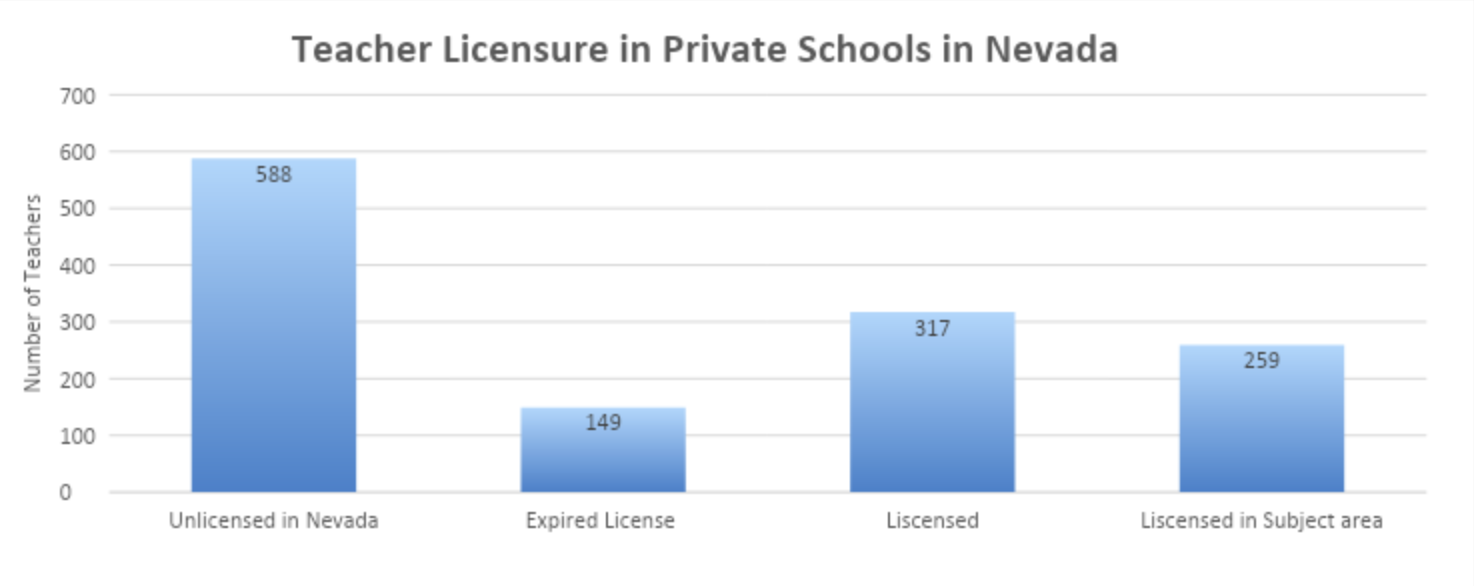
Lack of accountability in voucher programs has continued to raise red flags. Nevada private schools have no requirement that their teachers be licensed. An analysis by ENN found that of the schools that made the information available, less than 50 percent of teachers were ever credentialed in the state of Nevada, while some schools had no staff with Nevada licenses.

A look at the number of teachers who are licensed at private schools that have Opportunity Scholarship students enrolled. **This chart only includes data from schools who make staff information publicly available. Numbers exclude theology teachers and support staff.**

And the overwhelming lack of accountability – uniform testing, treatment of students with unique needs (private schools are less likely to accept students with an IEP), anti-discrimination, and other issues closely monitored in our public schools – means poor outcomes and underqualified staff may only be the tip of the iceberg.  North Carolina, for example, is grappling with testing issues, discrimination against LGBTQ students, and questionable academic content (with one popular textbook claiming the KKK was fighting to protect morality and slaves were treated well by their slave owners). One can argue that teacher quality, curriculum, or treatment of students is the prerogative of these schools because they are private, but if private schools are now operating using public taxpayer dollars, we must demand more.

Ultimately efforts would be better spent advocating for increased dollars for our public schools to ensure all our students have access to a quality education regardless of religion, sexual preference, gender, race or income.


To learn more about national efforts to fight private school vouchers, check out the new Public Funds Public Schools campaign supported by Education Law Center, Southern Poverty Law Center and the SPLC Action Fund.


About Educate Nevada Now
The Rogers Foundation, a Nevada leader in support of public education, joined with local, state and national partners to launch Educate Nevada Now (ENN) in 2015. The organization is committed to school finance reform and improved educational opportunities and outcomes for all Nevada public school children, especially English language learners, gifted and talented students, students with disabilities or other special needs, and low-income students.

More information about ENN can be found at www.educatenevadanow.com
###


Audrey Watters writes a brilliant blog about Ed-tech and its misadventures. It is called HEWN, or Hack Education Weekly Newsletter.

She wrote a post recently about what happened when a tech investor tweeted that he refused to invest in AltSchool because it was a truly bad idea. AltSchool raised $174 million to demonstrate that the solutions to the problems of education were embedded in technology. Investors included Mark Zuckerberg, Laurene Powell  Jobs, Peter Thiel, Pierre Omidyar, and other big players in the “reinvent school” sector.

Watters commented on an article in The New York Times written by Nellie Bowles, one of the most insightful journalists at the Times. Bowles wrote about the shunning of Jason Palmer, a venture capitalist., because of a tweet criticizing AltSchool. 

Palmer tweeted:

$174M lessons here. We passed on @Altschool multiple times, mainly because disrupting school was a terrible strategy, but also b/c founders didn’t understand is all about partnering w/existing districts, schools and educators (not just “product”) https://www.sfchronicle.com/business/article/AltSchool-s-out-Zuckerberg-backed-startup-that-14058785.php …

I would say that Jason Palmer is one smart guy. He understands that disrupting an institution you know nothing about is inherently a dumb idea.

AltSchool was created by Max Ventilla, a Google techie, and it was a failure, despite a plethora of positive articles in the national media predicting that it would “reinvent” school as we know it.

As Bowles wrote, Silicon Valley was outraged by Palmer’s tweet. How dare he criticize a failed start-up! She says that he eventually made amends for daring to speak truth.

Audrey Watters thinks the problem in the Ed-tech world runs deeper than enforced conformity and silence cling of dissent.

She writes:

To a certain extent, I think Bowles misses the point of the whole dust-up. The danger isn’t only that many people are afraid to challenge the orthodoxy. The danger is that many do not really think all that differently. Many in Silicon Valley (and more broadly those working in science and tech and in elite university labs) believe they’re all The Very Smartest Men, and if nothing else, they’ve convinced themselves to that end. Sugar Daddy Science.

There’s a whole other set of truths that Bowles never touches upon in her quest to talk about the demand for good Silicon Valley manners in order to get to be in good Silicon Valley company. See, Sugar Daddy Science is bad science. And Jason Palmer was absolutely right. AltSchool was a terrible idea. It was obviously a bad investment. Its founder had no idea how to design or run a school. He had no experience in education — just connections to a powerful network of investors who similarly had no damn clue and wouldn’t have known the right questions to ask if someone printed them out in cheery, bubble-balloon lettering. It’s offensive that AltSchool raised almost $175 million. It’s offensive that so many ed-tech journalists carried the company’s water, touting its innovative and disruptive potential. I care much less that we were all supposed to be nice about the startup. I care that this was a startup — like far too many in ed-tech — that, with its normalizing of surveillance, was poised to hurt kids…Without a grounding in theory or knowledge or ethics or care, the Silicon Valley machine rewards stupid and dangerous ideas, propping up and propped up by ridiculous, self-serving men. There won’t ever be a reckoning if we’re nice.

You do have to wonder why Silicon Valley is so quick to shout from the rooftops about any perceived failures in education yet resist any honest accounting of their own failures. Remember the infamous TIME magazine cover called “Rotten Apples,”  which declared that Silicon Valley had found the answer to “fixing” schools? Firing teachers whose students don’t get high test scores. That was about the Vergara lawsuit in California, funded by a tech billionaire to eliminate teacher tenure on the absurd theory that poor kids have low test scores because their teachers have tenure. “Absurd” because teachers in high-performing districts are more likely to have tenure than those in low-performing districts,where teacher turnover is higher. Fortunately, the Vergara case was thrown out, along with copycat suits in other states.


Every year since 2014, Democrats who fervently support the privatization of public schools have gathered at a conference they pretentiously call “Camp Philos.”

https://campphilos.org/

Check the agenda of meetings present and past.

There you will see the lineup of Democrats who sneer at public schools and look on public school teachers with contempt.

These are the Democrats who support the DeVos agenda of disrupting and privatizing public schools.

They are meeting again this year, and they will slap each other on the back for supporting school closures, charter schools, high-stakes testing, evaluating teachers by the test scores of their students, and hiring inexperienced teachers.

They have the chutzpah to call themselves “stakeholders,” although none of them are teachers, parents of public school students, or have any stake in the public schools that enroll 85-90% of all American students. Exactly what do they have a “stake” in?


The Denver school Board is up for grabs, and a battle looms between progressives supporting public schools and a slate controlled by Stand for Children, Democrats for Education Reform, and groups controlled by Wall Street and billionaires. The “reformers” support school closures, disruption, charter schools, and high-stakes testing. The powerful, who control the board, say that any challenge to their total power is “divisive.”

Denver Public Schools at a crossroads: 3 new board members will help decide district’s direction

The Denver Public Schools board will welcome three new members next year, but voters will have to decide whether it also has a new direction.

Board president Anne Rowe, who represents District 1, and at-large member Allegra “Happy” Haynes are term-limited, and District 5 representative Lisa Flores opted not to run again. Each of the three open seats seat has attracted three candidates.

A vocal group of teachers and activists are looking to “flip” the board, putting the majority that has favored tactics such as closing poor-performing schools and opening new charters into the minority. Two current members of the nine-person board have been skeptical of the so-called “reform” movement, though votes don’t always break down along ideological lines.

Fundraising numbers suggests that candidates aligned with the current majority on the reform side may not go easily, however.

Wendy Howell, deputy director of the Colorado Working Families Party, said the overriding issue is reducing corporate influence in education. The party hasn’t released its endorsements yet, but Howell is been active in the online Flip the Board community, which is attempting to turn energy from February’s DPS teachers strike into a political force.

Charter schools started with good intentions, but they’ve become a way to privatize public education services without improving students’ results, Howell said. Districts also have had to add extra administrative staff to deal with compliance issues for different types of schools, which diverts money from classrooms, she said.

“We want to get Wall Street out of our school board,” she said.

The flip community supports candidates who want to pause the development of new charter schools and to examine other ways of improving education, Howell said. They also want to see new board members take a critical look at DPS’ finances, she said.

“This experiment (with reform) has gotten out of control,” she said.

The Denver Classroom Teachers Association has endorsed candidates who aligned themselves with the Flip the Board movement: Tay Anderson, Scott Baldermann and Brad Laurvick. Students for Education Reform and Stand for Children have backed candidates who gravitate toward the reform side: Alexis Menocal Harrigan, Diana Romero Campbell and Tony Curcio.

Now look at the rhetoric of the privatizers. Only they care about children. They have been in total control for years and accomplished nothing other than disruption of schools, communities, and families. But they will call upon their billionaire funders to keep the disruption gang in power. Questioning their failure is “divisive.”

Krista Spurgin, executive director of Colorado Stand for Children, said the emphasis on flip versus reform candidates is “divisive,” and that the focus should be on working together to improve education. The parent volunteer committee that made the endorsement decisions wasn’t focused on ideology, but on whether candidates had a record of commitment to have students reading by third grade and on-track to graduate high school, she said.

“It’s about them having the experience and the knowledge to make improvements for families,” she said. “They also have the ability to push the district to improve.”

The candidates they endorsed also support school choice, which is valuable to parents, and giving schools autonomy to figure out what will work for their kids, Spurgin said.

Christian Esperias, national director of campaign strategy of Students for Education Reform, said the questions their student leaders considered when making their endorsement decisions weren’t focused on issues like charter schools and school closures, but on how candidates would close the opportunity gap for underserved groups like students of color and low-income kids. They also looked for candidates who support higher pay for teachers, he said.

“I would frame it as putting kids first versus focusing on the bureaucracy and the special interests,” he said.

Krista Spurgin, executive director of Colorado Stand for Children, said the emphasis on flip versus reform candidates is “divisive,” and that the focus should be on working together to improve education. The parent volunteer committee that made the endorsement decisions wasn’t focused on ideology, but on whether candidates had a record of commitment to have students reading by third grade and on-track to graduate high school, she said.

“It’s about them having the experience and the knowledge to make improvements for families,” she said. “They also have the ability to push the district to improve.”

The candidates they endorsed also support school choice, which is valuable to parents, and giving schools autonomy to figure out what will work for their kids, Spurgin said.

Christian Esperias, national director of campaign strategy of Students for Education Reform, said the questions their student leaders considered when making their endorsement decisions weren’t focused on issues like charter schools and school closures, but on how candidates would close the opportunity gap for underserved groups like students of color and low-income kids. They also looked for candidates who support higher pay for teachers, he said.

“I would frame it as putting kids first versus focusing on the bureaucracy and the special interests,” he said.


Assistant U.S.  Secretary of Education Scott Stump traveled to Arizona to celebrate the success of charter schools, and he did so at a public magnet school!

This top education official insisted that Tucson’s University High is a charter school.

When he was corrected by a reporter after his news conference, he continued to insist that the public high school was a charter school.

Like his boss, Betsy DeVos, Mr. Stump is on an “Education Freedom Tour” to point out the great achievements of every school that is not a public school.

That is the U.S. Department of Education’s “back to school” message: Abandon public schools.

Never mind that Arizona has what is possibly the most corrupt charter industry in the nation (excepting Florida).

Never mind that Arizona is the only state that legally allows for-profit charters (the others ban for-profit charters but allow for-profit managers to operate nonprofit charters).

Never mind that Arizona charter law permits nepotism and conflicts of interest among members of the board and the management company.

In Arizona, corruption is legal.

Never mind that Betsy DeVos and the Koch brothers poured millions into elected Governor Doug Ducey and a rightwing legislature.

To enter University High, students must pass an entrance exam, so of course the school has high test scores.

But it is not a charter school.

It is a public school, governed by the elected Tucson school board. Unlike a private charter school, it is fully accountable and transparent to the public, not to a private board.


This is one of the best of Jan Resseger’s many brilliant posts.

In it, she quotes a surprising source, who explains the importance, centrality, and  necessity of public schools as anchors of their communities.

As you may have guessed, I am a huge admirer of this insightful, wise woman.

Please print this out, email it, tweet it, put it on Facebook, share it with your friends.

I never quote a post in full. I want you to go to the source and add page views to the author. This is an exception because I can’t find a word to cut.

She writes:

The 2019-2020 school year is now underway, and in an ironic twist, in a business journal, the academic dean of the college of education at the for-profit University of Phoenix has penned a beautiful reflection on the meaning of public education. Dean Pam Roggeman understands the meaning for families and for communities of their public schools.

Roggeman writes: “This early fall, I’d like to honor the millions of parents who…  send their kids to school for the first time. Critics, possibly a bit removed from their neighborhood public schools, at times try to paint public education as a nameless, faceless bureaucratic institution that is riddled with faults. And like many other institutions, our public schools do have flaws. However, those of us rooted in our communities, with or without school-age kids, do not see our schools as faceless institutions. Rather, we associate our schools with our child’s talented teacher, or the principal greeting kids at the door, or the coach waiting for kids to be picked up after practice, or the mom who became this fall’s crossing guard, or the front office staff who commiserate with us as we deliver the forgotten lunch, and… also with the friendly bus-driver who will not move that bus until every child is safely seated. We rely on and embrace our neighborhood public schools as a community enterprise on which we deeply depend.”

Roggeman defines the reason public schools are one of our society’s best opportunities for establishing systemic justice for children: public schools are required by law to serve the needs and protect the rights of all children: “(T)here is one thing that our American public schools do better than any other schools in the country or even in the world: our public schools commit to addressing the needs of every single child. Our public schools are open to ALL children, without prejudice or pause. Our schools attempt to educate EVERYBODY. American students are students who are gifted, students with disabilities, students who need advanced placement, students who have experienced trauma, students who are learning English, students who are hungry, affluent students, students who live in poverty, students who are anxious, and students who are curious.”

Reading Roggeman’s reflection on public education as an essential civic institution caused me to dig out a Resolution for the Common Good, passed by the 25th General Synod of the United Church of Christ more than a decade ago, when I was working in the justice ministries of that mainline Protestant denomination. The resolution was passed unanimously in 2005, in the midst of a decade when an ethos of individualism was accelerating.

The values defined in the introduction to the resolution mesh with Roggeman’s consideration of public schools as the essence of community: “The Twenty-fifth General Synod calls upon all settings of the United Church of Christ to uphold the common good as a foundational ideal in the United States, rejects the notion that government is more unwieldy or inefficient than other democratic institutions, and reaffirms the obligation of citizens to share through taxes the financial responsibility for public services that benefit all citizens, especially those who are vulnerable, to work for more equitable public institutions, and to support regulations that protect society and the environment.”

The introduction of the resolution continues: “A just and good society balances individualism with the needs of the community. In the past quarter century our society has lost this ethical balance. Our nation has moved too far in the direction of promoting individual self interest at the expense of community responsibility. The result has been an abandonment of the common good. While some may suggest that the sum total of individual choices will automatically constitute the common good, there is no evidence that choices based on self interest will protect the vulnerable or provide the safeguards and services needed by the whole population. While as a matter of justice and morality we strive always to expand the individual rights guaranteed by our government for those who have lacked rights, we also affirm our commitment to vibrant communities and recognize the importance of government for providing public services on behalf of the community… The church must speak today about the public space where political processes are the way that we organize our common life, allocate our resources, and tackle our shared problems. Politics is about the values we honor, the dollars we allocate, and the process we follow so that we can live together with some measure of justice, order and peace.”

Recognizing “significant on-going efforts to privatize education, health care, and natural resources, and to reduce revenues collected through taxes as a strategy for reducing dependency on government services,” the delegates resolved “that the United Church of Christ in all its settings will work to make our culture reflect the following values:

  • that societies and nations are judged by the way they care for their most vulnerable citizens;
  • that government policy and services are central to serving the common good;
  • that the sum total of individual choices in any private marketplace does not necessarily constitute the public good;
  • that paying taxes for government services is a civic responsibility of individuals and businesses;
  • that the tax code should be progressive, with the heaviest burden on those with the greatest financial means; (and)
  • that the integrity of creation and the health and sustainability of ecological systems is the necessary foundation for the well-being of all people and all living things for all time.”

Since that resolution passed in 2005, we have watched an explosion of economic inequality, the defunding and privatization of public institutions including K-12 public education, the defunding of social programs; the growth of privatized and unregulated charter schools, the abuse of power by those who have been amassing the profits, and the abandonment of policies to protect the environment.

A just and good society balances the rights of the individual with the needs of the community. I believe that the majority of Americans embrace these values.  I wonder how we have allowed our society stray so far.


Trump took action today to prevent California from having fuel standards tougher than those of the federal government. This is a Republican who doesn’t believe in local or state control or in the Environmental Protection Agency l, created by President Nixon.

Conservatives conserve. Trump destroys and despoils.

https://www.latimes.com/environment/story/2019-09-17/trump-revokes-california-environmental-authority-auto-deal

President Trump is expected to revoke a decades-old rule that empowers California to set tougher car pollution standards than those required by the federal government — putting the state and the U.S. Environmental Protection Agency on a path to years of fighting in court.

The EPA had no official comment on the plan, which has been in the works for much of the last three years and is expected to be announced while Trump is in California for a campaign fundraising trip.

Politico Education reports that Secretary Betsy DeVos and her political appointees are fanning out across the country to promote charters, vouchers, and educational “freedom” from public schools. She will be in Indiana and Ohio, which already have vouchers and charters, most of which are low-performing.

Under DeVos, the official  mission of the U.S. Department of Education is to destroy and privatize public schools.


DEVOS HEADS TO INDIANA, OHIO: The Education secretary begins Day 2 of the Trump administration’s “back to school” tour with stops in Indiana and Ohio today.

— DeVos will visit Purdue Polytechnic High School, a public charter school in Indianapolis, in the morning where she’ll meet with students and faculty and tour STEM classes, according to the department. The administration said the school is a good example of an approach to education that breaks down the silos among K-12 and higher education and businesses.

— In the afternoon, DeVos will head to Cleveland. She’ll tour the Great Lakes Science Center and a specialized high school, MC2STEM High School, which is part of the Cleveland Metropolitan School District. DeVos will then visit EDWINS Leadership and Restaurant Institute, “where formerly incarcerated individuals are given the tools they need to transition home, including the opportunity to learn a skilled and in-demand trade in the culinary arts,” the department said.

— Several other top Education Department officials are also fanning out across the country today as part of the administration’s nationwide tour to promote its “rethink school” agenda.

— Deputy Education Secretary Mick Zais will be in Montana. He’ll tour schools and meet with officials in Pryor and Billings along with Montana Superintendent of Public Instruction Elsie Arntzen.

— Johnny Collett, assistant secretary for special education and rehabilitative services, will head to Missouri. He’ll tour an elementary school in Belton and meet with students and faculty at the University of Missouri-Kansas City.

— Scott Stump, the assistant secretary for career, technical, and adult education, will be in New Mexico. He’ll tour a high school in Albuquerque in the morning and Santa Fe Community College in the afternoon.

Please register before it is too late!

Don’t be left out! Register now and take advantage of the Early Bird reduced rate to our 6th National Conference: Neighborhood Public Schools: The Heart of Our Communities, which will take place March 28-29 in Philadelphia.

Make sure you reserve your spot soon. We are limited to only 500 registrations this year, and availability will go quickly. Early Bird registration opened September 1 and many tickets have already been sold! Our Early Bird special rate is good only until October 1 for the first 100 registrations only. To get that rate, use this special code: NPEAction2020EB when you register.

After you sign up for the conference, be sure to register for a reduced rate room ($169) at our conference hotel. Our rooms will go fast!

To reserve your hotel room click here;.

Peter Greene demonstrates here (yet again) that there is nothing that money cannot buy (and corrupt). Now it is Sesame Street (although as he points out, HBO already bought Sesame Street). Is there anything not for sale?

Open the link and read the whole sorry story.

If you haven’t been paying particularly close attention, you may have missed the Chan-Zuckerberg Initiative slowly inserting its hyper-wealthy proboscis into a hundred different corners of modern life, using its not-quite-philanthropy LLC model to follow in the Gatesian footprints of wealthy technocrats who want to appoint themselves the unelected heads of oh-so-many sectors.

One of those sectors is, of course, education. Their latest bold new initiative is being trumpeted in People, where it is getting exactly the fluffy uncritical reception one might expect, which is too bad, because there’s plenty to be critical of.

The tech mogul, 35, and pediatrician’s philanthropic organization, the Chan Zuckerberg Initiative, is working in conjunction with The Primary School and Sesame Workshop to help fund a “new curriculum” that aims to “integrate social emotional learning into early childhood literacy lessons,” according to a press release.

The Primary School is out in Palo Alto, “expanding the boundaries of traditional education.” It is the elementary school that Chan co-founded in 2016 to bring together issues in education and pediatrics. They have all sorts of business style leadershippositions like “director of talent” and “director of strategic initiatives” and the teaching staff seems to be made of a few “lead teachers” and a whole lot of “associate teachers.” Their CEO comes from the NewSchool Venture Fund and Aspire. Their “director of innovation and learning” spent two whole years in Teach for America. The school’s principal once founded a charter school and stayed with it for five years. Of the lead teachers a little more than half have actual teaching backgrounds, while the rest are TFA or other “non-traditional” approaches to the field. I admittedly didn’t check every single one, but a spot check of the associate teachers turned up zero with actual teaching backgrounds.

In short, it’s very new, very reform, very Palo Alto-y, and yet, wonder of wonders, the folks at the Sesame Workshop, “the global nonprofit behind Sesame Street and so much more” and who have been at this for fifty years (longer, I’m betting, than virtually every staff person at The Primary School has been alive)– those folks feel an urge to team up with The Primary School.