Archives for category: Walton Foundation

Joanne Barkan has written several brilliant essays about the billionaires who use their philanthropies to undermine democracy and public education.

This is one of her best.

She writes:

“For a dozen years, big philanthropy has been funding a massive crusade to remake public education for low-income and minority children in the image of the private sector. If schools were run like businesses competing in the market—so the argument goes—the achievement gap that separates poor and minority students from middle-class and affluent students would disappear. The Bill and Melinda Gates Foundation, the Eli and Edythe Broad Foundation, and the Walton Family Foundation have taken the lead, but other mega-foundations have joined in to underwrite the self-proclaimed “education reform movement.” Some of them are the Laura and John Arnold, Anschutz, Annie E. Casey, Michael and Susan Dell, William and Flora Hewlett, and Joyce foundations.

“Each year big philanthropy channels about $1 billion to “ed reform.” This might look like a drop in the bucket compared to the $525 billion or so that taxpayers spend on K–12 education annually. But discretionary spending—spending beyond what covers ordinary running costs—is where policy is shaped and changed. The mega-foundations use their grants as leverage: they give money to grantees who agree to adopt the foundations’ pet policies. Resource-starved states and school districts feel compelled to say yes to millions of dollars even when many strings are attached or they consider the policies unwise. They are often in desperate straits.

“Most critiques of big philanthropy’s current role in public education focus on the poor quality of the reforms and their negative effects on schooling—on who controls schools, how classroom time is spent, how learning is measured, and how teachers and principals are evaluated. The harsh criticism is justified. But to examine the effect of big philanthropy’s ed-reform work on democracy and civil society requires a different focus. Have the voices of “stakeholders”—students, their parents and families, educators, and citizens who support public education—been strengthened or weakened? Has their involvement in public decision-making increased or decreased? Has their grassroots activity been encouraged or stifled? Are politicians more or less responsive to them? Is the press more or less free to inform them? According to these measures, big philanthropy’s involvement has undoubtedly undermined democracy and civil society.

“The best way to show this is to describe how mega-foundations actually operate on the ground and how the public has responded. What follows are reports on a surreptitious campaign to generate support for a foundation’s teaching reforms, a project to create bogus grassroots activity to increase the number of privately managed charter schools, the effort to exert influence by making grant money contingent on a specific person remaining in a specific public office, and the practice of paying the salaries of public officials hired to implement ed reforms.

“You Can’t Fool All of the People All of the Time

“The combination of aggressive style, controversial programs, and abundant money has led some mega-foundations into the world of “astroturfing.” This is political activity designed to appear unsolicited and rooted in a local community without actually being so. Well-financed astroturfing suffocates authentic grassroots activity by defining an issue and occupying the space for organizing. In addition, when astroturfers confront grassroots opposition, the astroturfers have an overwhelming advantage because of their resources. Sometimes, however, a backlash flares up when community members realize that paid outsiders are behind a supposedly local campaign.”

Barkan describes the Parent Trigger Law, which was financed by billionaires to enable low-income parents to take control of their schools and turn it over to a charter operator. The money was used to send organizers into low-income communities, create discord, and persuade parents to sign petitions. “The process was bound to divide communities, and it was open to abuse and outside manipulation. But most important, the law destroyed the democratic nature of public education. This year’s parents don’t have the right to close down a public school or give it away to a private company any more than this year’s users of a public park can decide to pave it over or name a private company to run it with tax dollars (see Diane Ravitch, Reign of Error, 2013). Voters—directly or through their elected officials—decide on and pay for public institutions in a democracy.”

In retrospect, Parent Trigger was a bust. Seven years and many millions of dollars later, only one or two schools were charterized. And there have been no studies of whether it made a difference. The billionaires did get a hardworking Mexican-American principal fired, and almost every member of her staff left with her in protest. What a waste.

Barkan writes that the most grievous misdeed of the billionaires is their assault on democracy. If they can’t get what they want through normal channels, they use their resources to buy what they want.

“Philanthropies risk losing their tax-exempt status if they donate directly to candidates for public office, so some foundations have tried other ways to ensure they have the people they want in key posts.

“The Los Angeles–based Broad Foundation stipulated in the contract for a $430,000 grant to New Jersey’s Board of Education that Governor Chris Christie remain in office. As the Star-Ledger reported (December 13, 2012), the Newark-based Education Law Center had forced the release of the contract through the state’s Open Public Records Act. For the center’s executive director, David Sciarra, “It is a foundation driving public educational policy that should be set by the Legislature.” The Broad Foundation’s senior communications director responded, “[W]e consider the presence of strong leaders to be important when we hand over our dollars.”

“The foundation sector will fight reform ferociously—as it has in the past. When asked to forgo some influence or contribute more in taxes, the altruistic impulse stalls.

“The keep-Chris-Christie clause was not the first time a staffing prerequisite was discovered in a grant contract with a public entity. In 2010 Washington, D.C. schools chancellor Michelle Rhee negotiated promises for $64.5 million in grants from the Broad, Walton, Robertson, and Arnold foundations. Rhee planned to use part of the money to finance a proposed five-year, 21.6 percent increase in teachers’ base salary. In exchange she demanded that the union give her more control over evaluating and firing teachers and allow bonus pay for teachers who raised student test scores.

“In March 2010 the foundations sent separate letters to Rhee stating that they reserved the right to withdraw their money if she left. They also required that the teachers ratify the proposed contract (Washington Post, April 28, 2010). Critics challenged not only the heavy-handed intrusion into an acrimonious contract negotiation but also the legality of the stipulation on Rhee: hadn’t she negotiated a grant deal that served her own employment interests? The teachers ratified the contract, but the extremely unpopular Rhee resigned in October 2010 after Mayor Adrian Fenty, who had hired her, lost the Democratic mayoral primary. By that time, much of the grant money had been spent, and the new schools chancellor kept Rhee’s policies.

“Private foundations have used another tactic to exert influence on the Los Angeles Unified School District: they paid the salaries of more than a dozen senior staffers. According to the Los Angeles Times (December 16, 2009), the privately financed “public” employees worked on such ed-reform projects as new systems to evaluate teachers and collect immense amounts of data on students. Much of the money came from the Wasserman Foundation ($4.4 million) and the Walton Family Foundation ($1.2 million); Ford and Hewlett made smaller grants. The Broad Foundation covered the $160,000 salary of Matt Hill to run the district’s Public School Choice program, which turned so-called low-performing and new schools over to private operators. Hill had worked in Black & Decker’s business development group before he went through one of the Broad Foundation’s uncertified programs to train new education administrators. A Times editorial on January 12, 2010 asked, sensibly, “At what point do financial gifts begin reshaping public decision-making to fit a private agenda?…Even the best-intentioned gifts have a way of shifting behavior. Educators and the public, not individual philanthropists, should set the agenda for schools.”

The Plutocrats want to abolish public control of public education. They have sponsored one failed “reform” after another.

They never learn.
Edward Johnson is an advocate for high quality public schools for all children. He lives in Atlanta. He has studied the works of G. Edwards Deming, who understood that you don’t blame frontline workers for problems with the system. If things go wrong, fix the system.

He wrote the following letter to Rev. Diane Daugherty about the absurdity of “choice” as a fix for the system (see her letter after his). In fact, “choice” is an abdication of responsibility by those who have the power to fix the system. They turn problems over to the market and hope for the best, ignoring the well-documented fact that the market deepens pre-existing inequities.

Of course, anyone who thinks that the Walton family, the DeVos family, Trump, ALEC, and other plutocrats are committed to civil rights and equity is either hopelessly naive or on their payroll.

He writes:


Rev. Diane Daugherty,

Thank you for lending your voice to the matter. Interestingly, one may take your understanding as a key aspect of the law research paper Opt-Out Education: School Choice as Racial Subordination, by Osamudia R. James, currently Vice Dean, University of Miami School of Law.

Atlanta superintendent Meria Carstarphen, Atlanta school board members, and BOOK, including especially its supporters UNCF and Andrew Young Foundation, would do well to learn from Vice Dean James’ paper.

But it may be unreasonable to expect any of them would. For example, this AJC article makes clear the superintendent, arguably Atlanta school choice proponents’ leader, holds an unshakable mindset fixated on commercializing public education in Atlanta by transforming it from a systemic public good into disparate private consumer goods, à la KIPP and others. So transformed, and unlikely to have resulted in improved schools, parents as consumers may then choose a school for their child just as they would choose a McDonald’s Happy Meal for the child. So goes the superintendent’s reasoning.

The pushback that arose in response to the superintendent’s profane conflation of consumerism and public education prompted school choice advocate Robert Holland to rise in her defense, with an attempt to say what the superintendent really meant to say. Holland, at the conservative and libertarian public policy think tank The Heartland Institute, blogged “The School Choice Generation Wants a Full Educational Menu.”

The Atlanta superintendent, school board, and BOOK would also do well to take from their partner and supporter, Walton Family Foundation, a lesson about how consumerism’s choice really works. Last week, the AJC and other media reported that, “based on a number of factors, including financial performance,” the Waltons made the decision to close their Lithonia Sam’s Club at Stonecrest. Was the store’s consumer community consulted or otherwise involved beforehand? Nope. Did the store’s consumer community have a choice? Nope. Now that once consumer community fears the Waltons have put upon it more problematic, if not new, food desert they did not “choose.”

The lesson, then, is who, in consumerism’s commercialized world, truly has choice and who truly does not.

Diane Ravitch offers an excerpt from Vice Dean James’ paper that amplifies the lesson (my emphases):

“James advocates for limitations on school choice ‘to prevent the disastrous social consequences–the abandonment of the public school system, to particularly deleterious consequence for poor and minority schoolchildren and their families–that occur as the collective result of individual, albeit rational, decisions. I also advocate for limitations on school choice in an attempt to encourage individuals to consider their obligations to children not their own, but part of their community all the same….The actual impact of school choice cannot be ignored. Given the radicalized realities of the current education system, choice is not ultimately used to broaden options or agency for minority parents. Rather, school choice is used to sanitize inequality in the school system; given sufficient choices, the state and its residents are exempted from addressing the sources of unequal educational opportunities for poor and minority students. States promote agency even as the subjects supposedly exercising that agency are disabled. Experience makes clear that school choice simply should not form an integral or foundational aspect of education reform policy. Rather, the focus should be on improving public schooling for all students such that all members of society can exercise genuine agency, initially facilitated by quality primary and secondary education. Ultimately, improving public education begins with preventing its abandonment.’”


This is Dr. Daugherty’s letter to the Atlanta Board of Education:


From: Diane Dougherty [mailto:doughertyadd@gmail.com]
Sent: Wednesday, January 17, 2018 8:01 PM
To: EdJohnsonAfQPE <edwjohnson@aol.com>
Cc: AfQPE@aol.com; bamos@atlantapublicschools.us; cbriscoe_brown@atlanta.k12.ga.us; epcollins@atlantapublicschools.us; jesteves@atlantapublicschools.us; lgrant@atlantapublicschools.us; nmeister@atlantapublicschools.us; pierre.gaither@atlanta.k12.ga.us; mjcarstarphen@atlanta.k12.ga.us; annwcramer@gmail.com; Erika Y. Mitchell <eymitchell@gmail.com>; Kandis Wood <kandiswood@gmail.com>; Michelle Olympiadis <michelle.olympiadis@gmail.com>; education@naacpatlanta.org; president@naacpatlanta.org; info@bookatl.org; david.mitchell@bookatl.org; Naomi.Shelton@uncf.org; sekou.biddle@uncf.org; cmeadows@morehouse.edu; mbinderman@geears.org
Subject: Re: BOOK and newly installed Atlanta Board of Education Members

BOOK seems to promote better outcomes outside any effort to make existing public education better. Their methodology seems to create parallel academic structures diminishing schools that need an infusion of structures and funds. To me their short term efforts will not evolve into a sustainable plan 30 years from now. Without any data that supports their perceived “Better Outcomes, BOOK’S emphasis on School Choice has proven a poor strategy in decimated African American schools in Tennessee, Michigan and Louisiana….in spite of billions spent…why would there be improved outcomes here if it has not worked there? Rev. Diane Dougherty

Diane Dougherty, ARCWP

Avondale Estates, GA 30002

678-918-1945

doughertyadd@gmail.com


The Waltons are a singular American family. Not exactly like you or me, to be sure. They are, according to Forbes, the richest family in America, with a net worth of $140 billion or more.

They were recently praised by Trump for raising the minimum wage for their 1 million workers to $11 an hour. On the same day, however, they closed down 63 Sam’s Club warehouse stores, putting more than 11,000 people out of work without notice.

I wish any member of the Walton family would try to live for a month on only $11 an hour wages. However, since they are all heirs to their great fortune, it’s likely that none ever held a paying job where they had to show up every day.

Here is an article about them that appeared on the Walton Foundation blog.

While other billionaires have pledged to give away most of their money to charity, the Waltons decline to join them. They know money is power. Also, it means you never have to go to work.

Their primary takeover target is education.

“The largest chunk of the foundation’s retooled and accelerated giving plan — $1 billion over the next five years — will go to education. While family members still evangelize about the benefits of “school choice” for struggling families, they’ve fought enough battles over the past two decades to determine that simply providing parents a slate of options among traditional public schools, charter schools, and private institutions isn’t enough to improve student achievement.

“For school choice to succeed, the Waltons concluded, the foundation has to move beyond making start-up grants for charters and focus more on building a constituency of supporters in local school districts.”

Typically, that means they have to actually buy elections, although the article doesn’t put it quire like that.

Their passion is charter schools. This is a handy way to bust unions and advance the privatization of public education. The Waltons claim to have started one of every charter schools in the U.S.

“Some critics have complained that the Waltons have donated a relatively small percentage of their enormous wealth to charity. Still, their giving is so substantial in terms of raw dollars that other critics contend it gives them too much influence over public policy. In response, the family has sought safe havens: school districts where there are plenty of skilled teachers and administrators excited about new educational models. In those places, the foundation has courted local officials open to charter schools operating alongside traditional neighborhood schools.

“The new approach means the foundation will exit cities where charters have been a tough sell, including Phoenix, Chicago, and Albany, N.Y. Its roster of 13 target areas now includes New Orleans, Oakland, and San Antonio, where charters are seen as ripe for success.”

See, they just sit around and decide how to privatize the public schools in your community. Arkansas is one of the poorest states in the nation. Couldn’t they just concentrate on raising up the families in their own backyard?

As this article by Matt Barnum in Chalkbeat shows, Kansas City did not want to hand its public schools over to the corporate reform movement, and it kicked out the privatizers a few years ago.

But the privatizers are back, with a new name, and a local native-born leader touting the virtues of the “portfolio model” and a “common enrollment application” for public schools and charter schools. The new approach is funded by the privatization-loving Walton Family Foundation and the Kauffman Foundation. OneApp, the common enrollment system is intended to confuse parents about the differences between public schools and charter schools, and give the appearance that they are the same. They are not. Charter schools choose their students; public schools do not. Charter schools may close without warning; public schools do not. Charter schools are not willing to take the students with the greatest needs; public schools are required to do so.

And so far, many education leaders in Kansas City seem to have fallen for the “portfolio model,” which is a stealth way of importing privatization.

The Kansas City superintendent, Mark Befell, is approaching the new bait warily. But the stars are aligning to put Kansas City into the grasp of the privatizers.

Bedell, the district superintendent, says that SchoolSmart may be too focused on creating new schools and expanding successful ones at the expense of helping existing, low-performing schools.

“I think the only concern that I have is their initial focus has been primarily on schools that are emerging, schools that are high performing,” he said. “You want to really move an urban school system like ours, you have a larger share of your schools that are low performing, we need to put resources in those schools.”

But, Bedell said, “Fortunately, [Sufi] listened to that and [SchoolSmart] provided support for me and some of my schools that have been struggling.”

SchoolSmart KC has also promoted the idea of a common enrollment system for district and charter schools.

“Participation in common, unified enrollment systems must also be required so that all families have equal access to schools,” Sufi said in recent testimony to the Missouri state legislature. “Such a system will also promote equity where our least advantaged families have equal access to quality options.”

Bedell is skeptical of this idea.

“Nope, not interested in it,” he said flatly, saying that he believed some charter schools were selectively enrolling and pushing out certain students, which made it difficult to build a positive relationship between the two sectors.

“One of the things that we’re looking to do is go and visit some of the other cities — Denver, Indianapolis, Camden — where the [district–charter] partnerships are working well,” said Bedell. Incidentally, those are three cities often promoted by advocates of the portfolio model.

Meanwhile, some remain wary of who is funding SchoolSmart. In addition to local philanthropies, SchoolSmart identifies the Walton Foundation as one of its core investors. Sufi said Hall, Kaufman, and Walton had together made a 10-year funding commitment of over $50 million.

“Philanthropy can have its own agenda too — that’s OK, there’s nothing wrong with that, but I think everybody just needs to be aware,” said Wolfsie, the Kansas City school board member. “Funders, they have a say what [SchoolSmart KC’s] strategic direction probably will be — otherwise they may not fund.”

If history and experience are guides, charter schools will take the best students, and leave the rest for public schools, which have even fewer resources to educate them.

Both the Walton and Kauffman foundations have been strong supporters of charter schools; Kauffman even founded its own (high-performing) charter school in Kansas City.

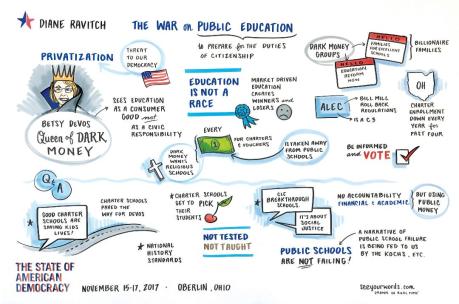
Some readers have asked for a copy of the speech that was so beautifully illustrated by the graphic posted earlier today.

I didn’t have a speech. I made notes and used them as talking points, on which I elaborated. When some in the audience (composed of progressives) insisted that charter schools were saving lives, I should have pointed out that the single biggest funder of charters is the anti-Union Walton Family Foundation, which is known for low wages and resistance to workers’ rights. About 95% of charters are non-union. The best kind of social justice that could be done by the Waltons is to pay their one million employees $15 an hour and allow them to unionize, in the stores and the charters they fund.

Here are my talking points.

“War on public sector.

“Take any public sector activity and google it with the word “privatization.”
Police, firefighters, prisons,hospitals, libraries, parks, schools—and what we once thought of as public is either privatized or under threat of privatization.

“Powerful movement—some driven by profit, some by libertarian ideology—seeks to shrink the public sector and monetize it.

“My area of specialization is education.

“There is today a full court press to privatize public education.

“How many in this room went to public schools?

“The fundamental purpose of public schools is to develop citizens, to sustain our democracy. To prepare young people to assume the duties of citizenship, to vote wisely, to understand issues, and to sit on juries.

“Our current obsession with standardized testing has corrupted the purpose of schooling. Clinton, Bush, Obama. We are now locked into a marketization approach to education: Testing, Accountability, competition, Choice. This is market-driven education, with winners and losers.

“The Bush program: NCLB. The same children were left behind.
THE Obama program: Race to the Top. Same as NCLB. Where is the top? Education is not a race.

“Test scores are fundamentally a reflection of family income and education. They are now cynically used by rightwing politicians to declare schools to be failures and set them up for privatization.

“Public education is one of the foundation elements of our democracy.
The movement to privatize public schools is a threat to democracy.

“Education Policy today is decided not by deliberation and debate but by big money.

“The Queen of Dark Money in education is now Secretary of Education.

“Betsy DeVos sees education as a Consumer good, not a civic responsibility
She has Compared choosing a school to choosing an Uber or choosing which food truck to buy lunch from. These are trivial choices, consumer choices. They are not public goods.
She really doesn’t understand the role of the public school in a community, as part of our democracy

“Dark Money, major philanthropies, and Wall Street billionaires have collaborated in attacking democratic control of schools. They have encouraged State takeovers, Charters, Vouchers. Private management. Mayoral control.

“Goals:

“School Choice, which promotes segregation by race and social class
Get rid of unions
Attacks on teaching profession.

“Venture philanthropies back Privatization: Gates, Broad, Walton, Arnold Foundation, Fisher Foundation, the Helmsley Foundation, the Wasserman Foundation, the Bloomberg Foundation, Dell Foundation, Jonathan Sackler, many more

“Dark Money funneled to state and local elections— by such groups as: Education Reform Now, Stand for Children, Families for Excellent Schools, Democrats for Education Reform, the Koch brothers, the DeVos family, the Walton family. All have the same goal: Privatization.

“Half the states now have vouchers for private schools, enacted by the legislature, despite the fact that vouchers have always been defeated in state referenda.

“Betsy DeVos paid for a voucher referendum in Michigan in 2000. It was defeated overwhelmingly. So Michigan went for unbridled Choice with charter schools, no district lines. 80% of the charters in Michigan operate for profit, more than any other state. Michigan’s standing on national tests dropped from the middle of the pack, to the bottom, between 2003 and 2013. Detroit is overrun with charters yet it continues to be the lowest scoring district in the nation.

“Milwaukee has public schools, charters, and vouchers, and all three sectors are low performing.

“Demand for vouchers is actually very low: Indiana, only 3% use them, less in Louisiana. Only 6% in charters. Yet every dollar for vouchers and charters is taken away from the schools that educate the great majority of children.

“Katherine Stewart in the current American Prospect: “Proselytizers and Profiteers.” Religious extremists in the voucher movement made “useful idiots of the charter movement.” Community public schools replaced by Corporate charter chains. Some of the biggest charter chains are owned and run by evangelicals and fundamentalists.

“The real Dark Money wants vouchers, religious schools, homeschooling, charters, anything but public schools.

“DeVos, American Federation for Children
Koch brothers, Americans for Prosperity (Libre Initiative) (AZ referendum)
ALEC— model legislation for charters, vouchers, ending certification, breaking unions.

“Public schools struggle where there is high poverty.

“Income inequality is the scourge of our society.

“Privatizing public schools won’t solve poverty.

“Hopeful signs:

*Virginia election: pro-public schools, many of the winning candidates are teachers

*Douglas County, CO, rebuff to vouchers

*upcoming referendum in AZ on vouchers, which Koch brothers want to knock off the ballot

*In 20 State referenda, vouchers have lost every single time.

*support for charters dropped from 51% to 39% in the past year, among both Democrats and Republicans, largely in response to scandals, prosecutions, and also NAACP criticism of charters.

“The origin of school choice was in segregated states fighting the Brown decision.

“Betsy DeVos is such a polarizing figure that she reminds us of the importance of public schools.”

This fabulous graphic is a summary of my speech at the conference on “The State of American Democracy,” identified by the acronym SAD. The conference was sponsored by Oberlin College at the college in Oberlin, Ohio, and it will be held with different participants in three other locations over the next several months. I spoke about the “War on Public Education.” In my talk, I forgot to mention that more than 90-95% of charters are non-union, and that their primary sponsor is the Walton Family Foundation, which is anti-union. That was an important omission in an audience that is mostly comprised of progressives. Jonathan Alter, who is very knowledgeable about national politics, leapt up to defend charter schools and objected to being lumped in with the DeVos agenda, which includes both charter schools and vouchers; Jon loves KIPP. I cited Katherine Stewart, who said in her article in “The American Prospect” that religious extremists had made “useful idiots” of the charter movement.

Early in my talk, I asked how many of those in the room had gone to public schools, and about 90% of the 300 or so people raised their hands. That included the new President of Oberlin College, Carmen Twillie Ambar, who graduated from public schools in Little Rock, Arkansas. She is the first African American female president of this historic college.

This is the wonderful graphic that was created as I spoke, by a brilliant artist, Jo Byrne (seeyourwords.com):

devos

Politico reports that a key position at the U.S. Department of Education will go to one of the nation’s most outspoken opponents of public schools, Jim Blew. Blew has long experience at the charter-loving, union-hating Walton Family Foundation and served as president of Michelle Rhee’s public school-bashing Students First. The position he is slated to assume is the policymaking arm of the department. It is supposed to be a nonpartisan, expert role, judging the efficacy of Department initiatives. It might as well be abolished because we already know that school choice, charters, vouchers, union-bashing, and inexperienced teachers will be the policies of this administration.

“TRUMP TO NOMINATE JIM BLEW FOR ED SPOT: Jim Blew, director of the education advocacy group Student Success California, is Trump’s pick to become the Education Department’s assistant secretary of the Office of Planning, Evaluation and Policy Development. POLITICO reported he was the frontrunner in July. The administration announced late Thursday that the president plans to formally nominate him for the role. The announcement touted Blew’s experience as the former president of Students First, a national advocacy organization founded by former D.C. Public Schools Chancellor Michelle Rhee. It also said that for more than a decade, he was a key adviser to the Walton family, serving as director of K-12 reform investments for the Walton Family Foundation.”

Time for a friendly puff piece from Inside Philanthropy about one of the nation’s most malevolent foundations: The Walton Family Foundation.

Walton has two goals: privatizing education and eliminating teachers’ unions.

It pledged to spend $1 billion to achieve those aims.

It subsidizes many mainstream media, even NPR and Education Week, to make sure that it gets favorable coverage for its nefarious goals.

And now, Inside Philanthropy reports that the Waltons have decided to plunk a couple of million dollars down in New York City and spread the wealth so that some of it goes to traditional antagonists, like Teachers College, Columbia University.

Who funds Inside Philanthropy? I can’t tell from its website. I did notice an earlier article about the Waltons, which claimed that individual members of the Walton family were reaching out to what appear to be liberal organizations, like the Center for American Progress. The writer didn’t even think to ask whether the Walton family members were purchasing the voices and independence of those groups they subsidize.

The Waltons noticed the research about the importance of economic and social integration so they have decided to open seven new charter schools in New York City that will lure in middle-class kids. Thus, in the name of integration, they can both promote privatization of public dollars and do their union-busting at the same time. Why should only poor kids go to charters? Think of the possibilities as Walton millions open charters for middle-class kids too!

Give them points for cleverness.

The Waltons earned their place on this blog’s Wall of Shame, and there is no reason to see anything coming from a family of billionaires that fights unions in their own stores and fights paying a minimum wage and subsidizes the evil American Legislative Exchange Council (ALEC), which is devoted to destroying democracy.

In 1957, Central High School in Little Rock, Arkansas, accepted nine black students, while white parents jeered and protested. President Dwight D. Eisenhower sent in the 101st Airborne to safeguard the students and to carry out the order of a federal judge.

That was sixty years ago.

How much has changed? Now Little Rock’s public schools are segregated again. At the behest of the Walton Family (which owns Arkansas), the public schools were taken over by the state. The man in charge is not, never was, an educator. The ostensible reason for the takeover was that six of the city’s 48 schools were “failing.” Since then, three of the 48 schools have been closed. More are on the chopping block, including schools with a long and honorable history.

Barclay Key, a historian at the University of Arkansas at Little Rock, writes the sad story of the past sixty years here. (What! The Walton family forgot to buy the history department!)

It appears that the Walton family wants to turn Little Rock into the next New Orleans, the next Memphis. It wants to wipe out public schools and replace them with charters. It wants to silence the voice of local citizens and give them no role in determining the future of their schools.

Key writes:

The two most striking parallels between the past and present are the insistence by white leaders that they know what is best for Black families and students and the recurrent role that local white business leaders play in undermining the public school system and prioritizing their prerogatives for the city…

Sixty years ago Little Rock epitomized desegregation struggles in the South, but the city now follows a path worn by New Orleans, Memphis, and other cities wracked by the proliferation of charter schools. Like they have over the past sixty years, politicians and business leaders presume to know what is best for public schools, and their decisions reflect a preoccupation with the latest trends in business rather than research-based pedagogy. The replacement for the elected board, state education commissioner Johnny Key, was appointed by the new Republican Governor Asa Hutchinson despite having no experience as an educator. Key appointed a superintendent who was generally trusted by the city’s white elites, but that superintendent was promptly replaced when he openly criticized the inefficiency of expanding charter schools in a district that has been gradually losing students for years. With the exception of reconstituting one school, the state made no substantive changes at the distressed schools.

“Reflections of Progress” will serve as the theme for the sixtieth anniversary of the desegregation crisis. Things have certainly changed, but the standard is too low if we measure progress by events that unfolded in 1957. Reflecting on progress since 1967 would be more appropriate and sobering. White men again make all decisions for the school district. They act with the support of the Chamber of Commerce and, today, the Walton charter school lobby controlled by the state’s powerful Walton family. Since the state takeover, many of the same bureaucrats have their six-figure salaries. Many of the same children cannot read. Little Rock periodically commemorates the 1957 controversy, but it constantly relives 1967.

The Walton Family Foundation is engraved on this blog’s Wall of Shame. It doesn’t stand alone, but it has a place of pre-eminence on a wall that lists those who have used their money and power to betray democracy, public schools, and the American dream.

Sixty years ago, President Dwight D. Eisenhower sent in the 101st Airborne to protect the brave black children who dared to integrate the public schools of Little Rock.

The students withstood taunts, jeers, even stones. They persisted, with the dream and hope of one day having a school system that welcomed all children.

Now, Little Rock activist Anika Whitfield writes, Little Rock is under attack again.

Now it is the Walton family and other billionaires who are intent to closing public schools, opening privately managed charter schools, and dominating black and brown children.

Like many major metropolitan cities in the United States, Little Rock is experiencing the evils of unfounded and manufactured fear about black and brown children that translates beyond white flight (as we experienced soon after the Brown vs. Board of Education in Topeka, Kansas ruling in 1954) and into a calculated systemic effort by U.S. billionaires, like the Walton Family ― who are natives of Arkansas ― to create a new form of discrimination: charter (private-public) schools and voucher systems. And, as they have been successful in doing so in many vulnerable cities like Detroit, Chicago, New Orleans and Philadelphia, they have also been successful in increasing their prison industrial system to meet the demands of their calculated systems of racism and classism. Together, these systems have been intentionally created to fester more criminal activity in the very neighborhoods and communities that are now absent of public schools.

The Waltons engineered a state takeover of the Little Rock school district. Their hand-picked managers have closed schools in black and brown communities.

If they get their way, public education in Little Rock will be a memory.

We won’t even remember why those brave children fought to integrate the public schools in 1957. Because there won’t be any public schools.

Racism comes in many forms.