Archives for category: Vouchers


Cory Booker was recently interviewed by the Washington Post, and he was asked about his past support for vouchers and his friendship with Betsy DeVos. 

He insisted that he turned against vouchers in 2006, and he barely remembered any connection to DeVos. When someone asked if he had flown to Michigan in 2000 at the request of Dick and Betsy DeVos to support their voucher referendum, he at first denied it, then when shown a tape, he said he didn’t remember it.

He opposed DeVos’ nomination to be Secretary of Education in 2017.

DeVos’s allies are stunned by what they call his turnabout. They view Booker’s effort to distance himself from her and her agenda as a betrayal. 

Now that it is politically inconvenient, he has distanced himself from the issue and those who helped launch his political career,” said William E. Oberndorf, who was chairman of the American Education Reform Council when DeVos and Booker were on the board. “Cory once told me that his father used to say to him, ‘Never forget the girl who brought you to the dance.’ I can only conclude that Cory not only forgot one of the girls who brought him to the dance, he missed his . . . moment to stand up for an issue he always said he believed in.” 

Booker’s advocacy for vouchers won him the financial support of conservative Republicans who were delighted to see a black Democratic Mayor supporting their cause.

Booker’s political career took off as a parade of wealthy philanthropists, hedge fund managers and others who supported DeVos’s “school choice” viewpoint poured money into his campaigns and pet projects. 

In 2000, with their voucher referendum on the ballot, the DeVos family invited Booker to debate the legislative director of the ACLU. She kept a tape of the debate and shared it with the Post. The voucher proposal went down to a crushing defeat by 3-1.

In September 2000, Booker delivered a blistering pro-voucher speech to the Manhattan Institute, a conservative policy group. 

Booker’s 2006 race for mayor of Newark won the support of many conservative Republicans. He proposed tuition tax credits (a form of voucher) and went all-in for charters.

When he ran for the Senate in 2014 in a special election, he was helped by Jared Kushner and Ivanka Trump, who held a fundraiser for him.

As recently as May 2016, Booker appeared again before the group that DeVos chaired, the American Federation for Children. After DeVos delivered a speech defending herself against attacks from Democrats, Oberndorf warmly introduced Booker, praising his commitment to school choice.

Booker spoke proudly about the growing number of students in Newark’s charter schools, saying, “This mission of this organization is the mission of our nation. . . . I have been involved with this organization for 10 years and I have seen the sacred honor of those here.” 

As Booker finished his speech, the audience gave him a standing ovation. To DeVos and her allies, it seemed that Booker was still firmly in the fold, according to Oberndorf. 

But a year later, he opposed DeVos’ nomination.

Booker’s vote shattered his career-long alliance with DeVos and stunned her supporters. 

“Cory gained a great deal of political support thanks to his association with Betsy and other supporters,” said Mitchell, the president of the American Education Reform Council when Booker and DeVos were board members. “His abandonment of school choice and of Betsy makes it clear that his professed commitment to the issue and his friendship with her were fueled by political ambition, not principle.” 

Betsy helped to fund his political career. But it was no longer convenient to be her friend.


Nancy Bailey calls out Secretary of Education Betsy DeVos for talking about “education freedom” at the same time that she is doing everything within her power to snuff it out.

Betsy DeVos’s Education Freedom: It’s Anything But


All it took to make American education “great again” was two-and-a-half years of Donald Trump and Betsy DeVos.

So saith Betsy DeVos to the Mackinac Republican Leadership Conference in Michigan. 

DeVos vigorously defended charter schools, especially in Detroit, even though most Detroit charters underperform Detroit public schools and are run as profit-making businesses.

DeVos opened Saturday’s program at the Mackinac Republican Leadership Conference by celebrating her mission to spread education freedom across the country. The Michigan native slammed teacher unions and Democratic primary candidates for offering a vision for the education system that will produce worse outcomes for students and cost taxpayers trillions of dollars.

DeVos said she is solely focused on doing what’s best for students, though she has been a frequent target of Democrats running to oppose President Donald Trump in 2020. She said Democrats who criticize the proliferation of charter schools ignores their results and falsely claim they are the “enemy of the people.”

“You’ll hear repeatedly that public charter schools are bad,” DeVos told Republicans Saturday. “The truth is they are the best thing to ever happen to Detroit students.”


The New York Times Magazine published a heart-breaking photo essay about the abandonment of schools in Puerto Rico, first because of its debt crisis, then because of federal privatization policy after hurricanes in 2017.

The Island has been strangled by financiers, then raped by DeVos-style policies, and the public schools were the victims.

The writer was Jonathan M. Katz.

It begins:

During the blazing summer of 2019, Puerto Rico was in tumult. Thousands of the islands’ residents marched shoulder to shoulderthrough cities. They sang, danced and demanded the ouster of the commonwealth’s negligent governor, Ricardo Rosselló — and, with him, the federal control board that holds economic power over the United States’ oldest remaining colony in the Americas.

The crowd’s ire was fueled in part by a sense of absence. Away from the echoing drums, down forgotten streets and across green mountains, the islands are emptying. Decades of abuse, austerity, corruption and now the ravages of climate change have triggered an exodus of people and money. As the summer wet season gives way to the wary hurricane watch of an ever-warmer fall, no evidence of this decline is more powerful than the islands’ hundreds of abandoned schools.

The photographer Diana Zeyneb Alhindawi and I spent weeks touring these monuments to neglect. Books and blackboards rotted in the humidity. Stray dogs made their beds beneath teachers’ desks. Some of the buildings had been left to addicts and thieves. In others, neighbors had refashioned empty classrooms into stables for horses, rabbits and pigs. Even in schools that remain in use, mold creeps, roofs are torn and gymnasiums sag like wet shoe boxes. Landslide-prone slopes loom, unrestrained, behind buildings filled with students….

Carlos Conde Marín School

Location: Carolina

Carlos Conde Marín was closed at the end of the 2016-17 school year despite protests from the community. As with many schools closed during the tenure of the former education secretary of Puerto Rico, Julia Keleher, the shuttering was sudden and swift. School materials were left to the elements, stray animals or anyone passing by. The school is seen here in May 2019, after the building was vandalized and also heavily damaged in Hurricane Maria. Gym buildings (directly above) were hit particularly hard because of their lightweight walls and roofs.

The hurricanes weren’t the beginning of the story, though. The disasters compounded a social and economic calamity that has been brewing for over a century. It arguably began in 1898, when United States forces invaded Puerto Rico, then a colony of Spain, during the Spanish-American War. Before the war, Spain had grudgingly granted Puerto Rico limited home rule, an attempt to forestall an independence movement. But with the advent of American rule, Puerto Rico fell deeper into colonial status. The islands’ people could not elect their own governor until 1947. They still cannot vote for president and have no voting representation in Congress.

Puerto Rico’s economy grew for decades, thanks to a series of tax breaks for companies from the mainland. Washington allowed the territorial government to borrow money by issuing tax-exempt municipal bonds and repay them with the rising revenues. When the last of those tax breaks ended in 2006, the economy stalled, leaving its government overleveraged and with few options. The commonwealth’s leaders began issuing riskier bonds that may have circumvented constitutional protections. Major lenders including UBS, Citigroup, Goldman Sachs, JP Morgan and Santander have since been sued multiple times — some have settled — for underwriting them. In 2015, with $120 billion in bond obligations and unfunded pensions, the governor was forced to declare that Puerto Rico would stop making many debt payments.

Under an agreement signed by President Obama, Puerto Rico gained protection from lawsuits. In exchange, its economy fell under the control of a seven-member Financial Oversight and Management Board with offices in New York and San Juan. Instead of forgiving Puerto Rico’s debt, the board implemented a strict austerity regime, which has grown steadily more draconian.

Ramón Valle Seda Elementary School

Location: Mayagüez

After Ramón Valle Seda Elementary School, near downtown Mayagüez, was closed in 2016, neighbors began using it as a stable and an animal sanctuary. Police and education-department officials have tried repeatedly to kick out the animals. But the parents and children using the building want official permission, saying that will keep it from turning into a drug haven like the closed school across the street. This horse was taking a break from the sun in May 2019. Its name means ‘‘hurricane’’ in Spanish.

Theodore Roosevelt School

Location: Mayagüez

The Theodore Roosevelt School opened in 1900, two years after Puerto Rico was occupied by the United States, as the first U.S.-style high school in the western city Mayagüez. The school was renamed on the occasion of a visit by Roosevelt, who played a leading role in annexing the islands during the 1898 war with Spain. It later became an elementary school. It was ordered closed in 2018 and converted into a depot for books and equipment from other shuttered schools in the area.

Don Ignacio Dicupe González Elementary School

Location: Lares

Nature is reclaiming the classrooms at Ignacio Dicupe González Elementary School in Lares, in the mountains of western Puerto Rico, seen here in April 2019. Lares is known as the cradle of Puerto Rican independence for its role in an 1868 uprising against Spain and still proudly flies the revolutionary flag. But it has lost nearly a quarter of its population in the last decade, one of the highest percentages of any municipality. The school, which closed right before the hurricanes, sits in an almost monastic silence; the only sounds the songs of birds in a red flamboyant tree in the courtyard and the occasional blast of reggaeton from a passing car.

As conditions worsened, the trickle of people leaving for the mainland turned into a flood. Between 2009 and 2017, the population declined 12 percent, from 3.9 million to 3.4 million, according to the Center for Puerto Rican Studies at Hunter College. The “Great Depression of Puerto Rico” had begun, José Caraballo-Cueto, an economist and associate professor at the University of Puerto Rico-Cayey, told me. “We have to acknowledge that the stock of human capital is decreasing,” he said.

The appointment of Julia Keleher as the Island’s Secretary of Education was a disaster. She fully agreed with the Trump administration’s determination to implement privatization with charters and vouchers. She was Betsy DeVos Without the billions.

Soon after taking office in 2017, Rosselló brought Julia Keleher, the founder of a small Washington education consultancy, to take over the fragile school system. Keleher, who is from the Philadelphia area, had a reputation as an expert at winning government grants. Indeed, her firm had recently obtained a $231,000 contract with the department she was about to head.

Keleher quickly embarked on a two-pronged mission to overhaul the school system. She pushed for the creation of semi-privatized charter schools and private-school vouchers. At the same time, she shut down hundreds of still-functioning public schools. Defending her actions, she later said: “Somebody had to be the responsible adult in the room.” Keleher, who is white, also likened the fury she received from Puerto Rican parents and the islands’ well-organized teachers’ union to the experience of being a racial minority…

At the end of the 2016-17 school year, Keleher ordered 183 schools shuttered, according to the Asociación de Maestros de Puerto Rico, the territory’s teachers’ union and Keleher’s most implacable foe…An estimated 160,000 more Puerto Ricans — another 5 percent of the population — have left since the storm. Keleher took the opportunity to further shrink the school system: Of the roughly 1,100 public schools left in Puerto Rico at the time of the storms, more than 250 simply didn’t open again. Most of those abandoned were elementary or middle schools. Some children who remained have since been forced to travel longer distances to attend classes, sometimes on dangerous mountain roads…

The territorial education department was promised $589 million in federal aid to reopen damaged schools, but as of March had received only 4 percent of the money; the rest expires at the end of April 2020. A United States Department of Education inspector general found that Keleher’s department lacked effective controls to prevent “fraud, waste and abuse.” Backlash from parents and the teachers’ union finally forced Keleher to resign in April. Three months later, she was arrested by the F.B.I. in Washington and charged with conspiring to steer contracts to associates at another consulting firm. She pleaded not guilty; the case is proceeding.

During her time in office, Keleher was paid $250,000 a year, while most Puerto Rican’s were living in dire conditions. She will stand trial for steering contracts to favored firms.

The tragedy documented in the Times’ photo essay is the abandonment and destruction of the Island’s schools at the same time that the chief education official was intent on privatizing the schools in service to austerity.

The parents and teachers cared about the children. The U.S. government and the now-deposed government of Puerto Rico did not.


The definition of insanity: funding an experimental education program, discovering that it failed, then funding it some more and expecting different results.

Another definition of insanity: funding a voucher program that depresses student achievement, then demanding more voucher funds so more students can fall behind.

Why fund failure?

Despite Poor Academic Results Groups Sue to Grow Private School Voucher Program

A few weeks ago a pro-school privatization organization, Institute for Justice, announced a lawsuit against the State of Nevada over the impact of AB 458 to private school vouchers recipients, scholarship granting organizations and businesses receiving tax incentives.

Though pro-voucher advocates are framing the suit as “saving vouchers,” in reality, the voucher program did not lose funding. The controversy over some students losing their scholarships is actually the result of a single scholarship granting organization interpreting a law passed this legislative session (AB 458) differently than all other scholarship organizations. Certain families who went through this organization for their voucher funds were the only ones whose funds were not renewed, leaving those students in limbo as the law’s purpose is clarified by the State.

To be clear, AB 458 did NOT cancel funding for the voucher program but only ended the requirement that funding for the controversial program grow by 10% each year. Given that growth in public education funding often struggles just  to keep up with inflation (approximately 2%), automatically growing a voucher program with scant accountability and poor results just doesn’t make sense.

Businesses are also suing on the claim that they would not be able to increase their contributions to vouchers because there is no increase in tax incentives. However ,they could choose to continue supporting private school tuition through donations without having to receive any incentive if it’s a cause that they deem so critical.

Ultimately, the courts will decide if the legal argument holds water, but the policy and evidence behind limiting the program’s growth is sound.

Voucher programs don’t work – both in Nevada and nationwide. The latest results from the Nevada Department of Education showed that more voucher recipient scores decreased than increased year-to-year, mirroring similar trends across the nation. For example, Louisiana has seen consistent abysmal results – with voucher recipients performing worse and numerous private schools fraught with poor school ratings, fraud, and cheating scandals.

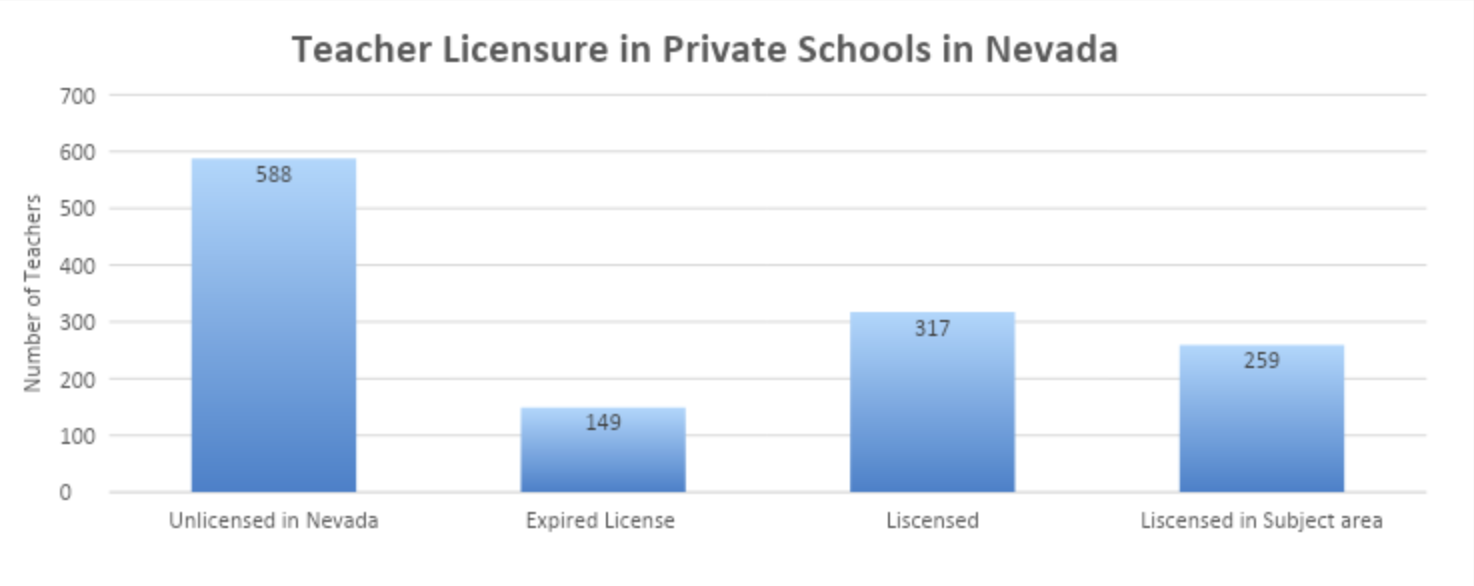
Lack of accountability in voucher programs has continued to raise red flags. Nevada private schools have no requirement that their teachers be licensed. An analysis by ENN found that of the schools that made the information available, less than 50 percent of teachers were ever credentialed in the state of Nevada, while some schools had no staff with Nevada licenses.

A look at the number of teachers who are licensed at private schools that have Opportunity Scholarship students enrolled. **This chart only includes data from schools who make staff information publicly available. Numbers exclude theology teachers and support staff.**

And the overwhelming lack of accountability – uniform testing, treatment of students with unique needs (private schools are less likely to accept students with an IEP), anti-discrimination, and other issues closely monitored in our public schools – means poor outcomes and underqualified staff may only be the tip of the iceberg.  North Carolina, for example, is grappling with testing issues, discrimination against LGBTQ students, and questionable academic content (with one popular textbook claiming the KKK was fighting to protect morality and slaves were treated well by their slave owners). One can argue that teacher quality, curriculum, or treatment of students is the prerogative of these schools because they are private, but if private schools are now operating using public taxpayer dollars, we must demand more.

Ultimately efforts would be better spent advocating for increased dollars for our public schools to ensure all our students have access to a quality education regardless of religion, sexual preference, gender, race or income.


To learn more about national efforts to fight private school vouchers, check out the new Public Funds Public Schools campaign supported by Education Law Center, Southern Poverty Law Center and the SPLC Action Fund.


About Educate Nevada Now
The Rogers Foundation, a Nevada leader in support of public education, joined with local, state and national partners to launch Educate Nevada Now (ENN) in 2015. The organization is committed to school finance reform and improved educational opportunities and outcomes for all Nevada public school children, especially English language learners, gifted and talented students, students with disabilities or other special needs, and low-income students.

More information about ENN can be found at www.educatenevadanow.com
###

Politico Education reports that Secretary Betsy DeVos and her political appointees are fanning out across the country to promote charters, vouchers, and educational “freedom” from public schools. She will be in Indiana and Ohio, which already have vouchers and charters, most of which are low-performing.

Under DeVos, the official  mission of the U.S. Department of Education is to destroy and privatize public schools.


DEVOS HEADS TO INDIANA, OHIO: The Education secretary begins Day 2 of the Trump administration’s “back to school” tour with stops in Indiana and Ohio today.

— DeVos will visit Purdue Polytechnic High School, a public charter school in Indianapolis, in the morning where she’ll meet with students and faculty and tour STEM classes, according to the department. The administration said the school is a good example of an approach to education that breaks down the silos among K-12 and higher education and businesses.

— In the afternoon, DeVos will head to Cleveland. She’ll tour the Great Lakes Science Center and a specialized high school, MC2STEM High School, which is part of the Cleveland Metropolitan School District. DeVos will then visit EDWINS Leadership and Restaurant Institute, “where formerly incarcerated individuals are given the tools they need to transition home, including the opportunity to learn a skilled and in-demand trade in the culinary arts,” the department said.

— Several other top Education Department officials are also fanning out across the country today as part of the administration’s nationwide tour to promote its “rethink school” agenda.

— Deputy Education Secretary Mick Zais will be in Montana. He’ll tour schools and meet with officials in Pryor and Billings along with Montana Superintendent of Public Instruction Elsie Arntzen.

— Johnny Collett, assistant secretary for special education and rehabilitative services, will head to Missouri. He’ll tour an elementary school in Belton and meet with students and faculty at the University of Missouri-Kansas City.

— Scott Stump, the assistant secretary for career, technical, and adult education, will be in New Mexico. He’ll tour a high school in Albuquerque in the morning and Santa Fe Community College in the afternoon.


Patents in Wisconsin are furious that Betsy DeVos  came to their state to tout vouchers while ignoring the vast majority of students, who are enrolled in public schools.

Heather DuBois Bourenane, the Executive Director of the Wisconsin Public Education Network, says that the state has had vouchers for 30 years with unimpressive results.

http://www.wisconsinnetwork.org/blog/devos-response?fbclid=IwAR0WLbV1JfjCJP_IhBw88AaCnHfe8NhvkbFzzU1q-TbhPh9dTcuN8dDntSU

Despite pressure from rightwingers like Scott Walker and DeVos, Wisconsin parents prefer their public schools.

Betsy should just go away.

Feeling the backlash in a big way, Jeb Bush’s “Chiefs for Change” issued a call to end the “Toxic Rhetoric” about school choice, especially charters. 

Chiefs for Change are strong proponents of privatization. Here are the current members. Is your superintendent a “Chief for Change” who wants to divert money from public schools to the Betsy DeVos agenda of school choice?

They say:

Recent attempts to halt or severely limit school choice—including legislative debates over caps or moratoriums for charter schools—are misguided at best. Effective mechanisms of school choice—those that ensure quality, accountability, equitable access, and equitable funding—provide opportunities that our students need and deserve. 

Families with financial means in America have always been able to choose the school that is best for their child, by moving to a certain part of town or by sending their children to private schools. But most American families do not have that opportunity. The school in their neighborhood may fall short in meeting their child’s needs in any number of ways—but they’re stuck. 

Our nation’s history of redlining to separate both housing and schooling based on race and income, along with local zoning ordinances that restrict and confine affordable housing, alongside the recent wave of “school district secessions” by higher-income neighborhoods, have compounded the problem. Our nation’s children often live in neighborhoods just a short distance from each other but worlds apart in terms of school quality. This is unacceptable. Every child deserves school options where they will learn and thrive. 

That is why today we are calling on policymakers across the nation to end the destructive debates over public charter schools. Proposed caps and moratoriums allow policymakers to abdicate their responsibility to thoughtfully regulate new and innovative public school options: like banning cars rather than mandating seatbelts. They are a false solution to a solvable problem. 

The backlash against school choice, the demand to halt charter expansion, comes from an outraged public that supports their community public schools.

Only 6% of the students in the U.S. attend charter schools, most of which perform no better than or much worse than public schools. An even smaller number of students use vouchers, even when they are easily available, and the research increasingly converges on the conclusion that students who use vouchers are harmed by attending voucher schools.

The claim that poor kids should get “the same” access to elite private schools as rich kids is absurd. Rich parents pay $40,000-50,000 or more for schools like Lakeside in Seattle or Sidwell Friends in D.C. The typical voucher is worth about $5,000, maybe as much as $7,000, which gets poor kids into religious schools that lack certified teachers, not into Lakeside or Sidwell or their equivalent.

Perhaps Chiefs for Change should advocate for for housing vouchers worth $1 million or more so that poor families can afford to live in the best suburban neighborhoods where “families with financial means” live.

But don’t hold your breath waiting for that to happen.

What this press release really means is that the advocates of privatization know that the public is turning against them.

That’s good news.

The public wants to invest its tax dollars in strong, equitable public schools that meet the needs of all students, not in ineffective charters or vouchers that divert money from community public schools.

Bill Phillis of the Adequacy and Equity Coalition of Ohio fears that the Supreme Court’s conservative majority, to which Trump added two religious zealots, is on the verge of eliminating the separation of church and state. This would be a huge victory for Betsy DeVos, ALEC, and the anti-government crusaders of the Right. Some states—such as Ohio, Indiana, and Florida— have already decided to ignore their state constitutions, to fund religious schools with vouchers.

The irony is that vouchers are a lose-lose proposition. The public schools—attended by nearly 90% of all pupils—lose finding, lay off teachers, cut programs. The children take away a voucher worth $5,000-$7,000 and get a worse education than their public school peers.

Bill Phillis writes:

The U.S. Supreme Court is moving toward the concept of forcing states to fund private religious schools on the same basis as public schools
 
The so-called Blaine Amendments in the constitutions of 39 states prohibit the states from funding private religious schools. Pages 235 through 238 of the Ninth Edition of American Public School Law by Kern Alexander and M. David Alexander provide a succinct and thoughtful review of the background and implication of President Grant’s proposed amendment introduced by U.S. House Speaker James G. Blaine after the Civil War.
 
U.S. Secretary of Education Betsy DeVos has been heard to say that the constitutional provisions prohibiting the states from funding private religious schools are rooted in bigotry. She may have picked up on Justice Clarence Thomas’ assertions in Mitchell v Helms that if states don’t provide funds to religious schools they are manifesting hostility toward religion. Further Thomas asserted that the state’s constitutional provisions were subtle devices to deprive Catholic schools of public money; thus a manifestation of anti-Catholic bigotry.
 
The James G. Blaine family was Catholic. A close cousin established the Holy Cross Sisters. Neither he nor President Grant demonstrated any anti-Catholic biases. They were just attempting to unify the country after the Civil War. Grant believed the key to unity was a “common school education.”
 
The Blaine Amendment which merely prohibited public funds from flowing to religious schools, passed the House but failed in the U.S. Senate. Subsequently many states adopted constitutional amendments that accomplished the intent of President Grant’s proposal.
 
These “Blaine” provisions in the state constitutions are in accord with the first sentence in the Bill of Rights, “Congress shall make no law respecting an establishment of religion or prohibiting the free exercise thereof, …” There is no contradiction between the states’ constitutional provisions and the Bill of Rights; however, of late, the U.S. Supreme Court, contrary to earlier decisions, is advancing a different constitutional philosophy in Agostini (1997), Mitchell (2000), Zelman (2002), Davey (2004), and Trinity Lutheran (2017), all of which permit Congress and states to provide public funds to religious institutions and schools.
 
The U.S. Supreme Court has agreed to hear the Montana case in which the high court in Montana ruled against vouchers on the basis of its constitution’s prohibitions. If the Court rules against Montana, the “Blaine” amendments in the 39 states could be rendered invalid.
 
Montana’s constitutional prohibition of public funding to religious schools and other religious institutions is among the most stringent “no-aid clauses” in the nation. Article X section 6 states:
(1)   The legislature, counties, cities, towns, school districts, and public corporations shall not make any direct or indirect appropriation or payment from any public fund or monies, or any grant of lands or other property for any sectarian purpose or to aid any church, school, academy, seminary, college, university, or other literary or scientific institution, controlled in whole or in part by any church, sect or denomination.
(2)   This section shall not apply to funds from federal sources provided to the state for the express purpose of distribution to non-public education.
Notwithstanding the stringent nature of Montana’s “no aid” provision, a ruling against the Montana decision would affect states that have less stringent constitutional measures.

Arthur Camins insists that voters should stand by their principles in the 2020 elections.

https://www.dailykos.com/story/2019/9/6/1883805/-Fight-for-First-Principles

In 2020, let’s elect people who don’t temper and undermine first principles like high-quality universal education and health care, with a soul- and hope-crushing, “But let’s be realistic about what’s achievable.” Don’t start with the workaround. Start with the energizing principles and fight for them.

Since this is an education blog, we will keep track of where candidates stand on “high-quality universal education.”

We will listen to what they say about charters and vouchers and what they don’t say. We will assume that some will attempt to deceive us by denouncing only “for-profit” charters. Only one state allows for-profit charters—Arizona—yet many states have nonprofit charters operated by for-profit EMOs.

What about corporate charter chains that take over what were once public schools? What about Gulen charters, part of a shadowy network that imports Turkish teachers and relies on corporate boards led by Turkish men?

We will also pay close attention to whether candidates express their views about the reign of high-stakes testing imposed by No Child Left Behind, Race to the Top, and Every Student Succeeds Act. The billions expended on testing have enriched the corporations that sell them, but harm children and the quality of education.

We will be watching, and NPE Action is maintaining a score card on the candidates.

NPE Action 2020 Presidential Candidates Project