Archives for category: Vouchers

Stuart Egan is an National Board Certified Teacher in North Carolina. He writes here about the horrible policies imposed on public schools in North Carolina since Tea Party Republicans took over the state’s General Assembly.

North Carolina was once considered the most progressive state in the South, for its dedication to improving public schools and honoring fine teachers. It had the highest proportion of National Board Certified teachers in the nation.

But then the Tea Party arrived in 2010 with an ALEC agenda of disruption and destruction.

Egan writes:

When the GOP won control of both houses in the North Carolina General Assembly in the elections of 2010, it was the first time that the Republicans had that sort of power since 1896. Add to that the election of Pat McCrory as governor in 2012, and the GOP has been able to run through multiple pieces of legislation that have literally changed a once progressive state into one of regression. From the Voter ID law to HB2 to fast tracking fracking to neglecting coal ash pools, the powers that-now-be have furthered an agenda that has simply been exclusionary, discriminatory, and narrow-minded.

And nowhere is that more evident than the treatment of public education.

Make no mistake. The GOP-led General Assembly has been using a deliberate playbook that other states have seen implemented in various ways. Look at Ohio and New Orleans and their for-profit charter school implementation. Look at New York State and the Opt-Out Movement against standardized testing.  Look at Florida and its Jeb Bush school grading system. In fact, look anywhere in the country and you will see a variety of “reform” movements that are not really meant to “reform” public schools, but rather re-form public schools in an image of a profit making enterprise that excludes the very students, teachers, and communities that rely on the public schools to help as the Rev. William Barber would say “create the public.”

North Carolina’s situation may be no different than what other states are experiencing, but how our politicians have proceeded in their attempt to dismantle public education is worth exploring.

Specifically, the last nine-year period in North Carolina has been a calculated attempt at undermining public schools with over twenty different actions that have been deliberately crafted and executed along three different fronts: actions against teachers, actions against public schools, and actions to deceive the public.

Read on to learn about the calculated and vicious attack on public schools and their teachers. This is a record of shame that undermines the public good.

Former superintendent Tom Dunn wrote a blistering critique of federal and state interventions into education that were lies, all lies.

And the promises and lies continue despite the failure of all the previous promises.

He writes:

As a former school superintendent, one of my most important, difficult, and frustrating responsibilities was trying to stay abreast of state and federal laws governing education. It was during this time that I had my eyes opened to how politics at the state and federal level really works. Suffice it to say that what I learned was disturbing.

First of all, to this day, the sheer number of proposed and/or passed bills makes the task of staying current nearly impossible. I imagine this is a political strategy meant to keep people as confused and overwhelmed as possible. The number of laws that made no sense and were sold to the public with misinformation and lies was staggering.

I felt perpetually conflicted about being forced to implement mandates that were, frankly, bad for kids. The irony is how often the very politicians who denounce bullying use their power to beat adults into submission with their ill-conceived laws. In education, they do this through threats of financial penalty against districts that dare disobey them, by threatening the professional licensure of educators who don’t do as they are told, and/or through character assassination of those who dare question them.

For at least three decades, politicians have claimed their goal has been to close the achievement gap between children who are successful in school and those who are not, and, by their own admission, their laws haven’t worked. They have failed while wasting billions of our tax dollars.

In the early 1990’s, politicians told us that if they could force all schools to follow the same academic standards, the achievement gap would be eliminated. But, the gap still exists.

Similarly, politicians promised us that forcing kids to take state approved tests, with schools, teachers, and principals being “held accountable” for their students’ performance, the achievement gap would be eliminated. But, the gap still exists.

The public was also assured that if laws were enacted “guaranteeing” that every child must achieve a politically determined level of achievement, all children would be successful. But, the gap still exists.

They lied, because none of these factors are primarily responsible for the gap.

One of their most egregious lies has been that the lack of competition in public education has been the culprit. People pushing this narrative actually pretended as if competition didn’t already exist. But, of course, it did through private and home school options, not to mention other opportunities, such as boarding schools. But, that fact interfered with their narrative, so they ignored it.

We were told that just a little more competition would generate new, more successful learning environments in which kids who were failing could flourish. It would also, we were assured, force the public schools to improve.

Early on, this expansion of competition was in the form of charter schools. Politicians told us kids deserved them, because they would no longer be “trapped” in poor public schools. Of course, they failed to mention that many of these charter schools were owned by large campaign contributors who were becoming quite wealthy on the backs of our neediest kids.

These same politicians remained strangely silent when the test data that they worship clearly showed that kids were often leaving higher performing public schools to attend lower performing charter schools. In other words, what they said would happen wasn’t happening.

But, ignoring that fact, politicians continued to expand school choice options to allow parents to use tax dollars to attend private schools. This was done through the Education Choice Scholarship (EdChoice) Program. The Ohio Department of Education web site claims that EdChoice “provides students from underperforming public schools the opportunity to attend participating private schools.”

The problem with this justification is that it isn’t true. The criteria for “underperforming” is written in such a way that even the highest performing public schools can be defined as such. In other words, the law allows parents to use tax dollars to fund their children’s private school education while “escaping” very high performing schools. This exact scenario has occurred in one of the top scoring school districts in the state, the Solon Schools.

At last, in Ohio, a fearless truth-teller, fed up with lies and empty promises.

Angie Sullivan teaches in a Title 1 elementary school in Carson County, Nevada. She teaches the children who were left behind.

She sent this post to every legislator in Nevada:

A small group of vocal teachers, parents, and activists have been publicly concerned about national public school privatization for two decades.  
 
Diane Ravitch is the leader of that pack.  
 
Her new book is coming out soon.  
 
Her last books included characters who are national culprits in destroying American Public Schools.  Some have come from my state of Nevada.  
 
Reform was meant to change a system of education that needed to change.  Still needs change. Admittedly we need to improve.  No one argues against that.  Teachers have always been willing to improve.  
 
This reform was not ever meant to improve.  
 
Change came.   The wrong kind.  
 
Big bad horrific and public school destroying change came.   
 
It was bad change bought by corporations who do not love children, will not love children, and seek money even if harm comes to children. 
 
Wrecking ball.  
 
National level well funded and crushing. 
 
Reformers will not use the data – they supposedly worshipped – to admit – they were wrong. 
 
Devastatingly wrong. 
 
Wrong in ways that were really destructive over two generations.   Destroying the central fabric of America – attacking our local public schools.  Kids were warehoused in experiments.  Kids without teachers.   Kids hooked up to innovations that made money but did not educated.  
Billions spent on reforms:  disruption, return on investment, testing, take over, turnaround, triggering, attacking teachers, standardization, score chasing has barely moved American Students on the NAEP Assessments.  
 
The data is back. 
Business reformers failed.   Return on investment was zero.  
 
Reform has been successful at systematically privatizing huge amounts of education cash.  It has segregated.  It has devastated.  It has destroyed public school communities.  And disenfranchised students are further behind than ever before. 
 
The teachers were crushed and millions left. 
 
This expensive business-type reform did not improve education.  
 
Unfortunately, the folks driving reform were not teachers – nor were they interested in authentic education.   Billionaires who were successful in business took over.  They bought the top levels of government and spread cash from the top down.  Both parties.   Anyone with power.   And policy makers and leadership sold out hard. Money taken from public schools to be spent on scams and fads. 
Billions wasted.   
 
Money and people who chase dollars should never be in charge of education policy.  Neoliberals and corporations who hide from liability will never create the synergy, caring, and community building that teachers can do in a school building. 
 
Now the billionaires know – public school teachers will fight.  Activists will engage.  Those who love children will activate. 
 
Take that Goliath.
 
A band of loud people who care – will fight with any small stone we can find. 
We are not scared – because we are right.  
 
Time for policy makers and leadership to buy a book.  
 
O God hear the words of my mouth – hold us in Your Hand because we are small against those seeking to harm kids.  
 
The Teacher,
Angie Sullivan. 


Jennifer Berkshire writes in The Nation about the quandary of Democratic candidates. For years, charter schools had bipartisan support. Clinton and Obama both supported charter schools, and joined with Republicans to expand the federal Charter Schools Program, which is now the single biggest source of funding for charter schools at $440 million annually (the second biggest source is the Walton Family Foundation).

Then came the Trump administration and Betsy DeVos, with their full-throated advocacy for school choice, including vouchers. In red states like Ohio, voucher programs are exploding, and Democrats are pushing back against school choice. They are also pushing back against charter schools, as we saw in Kentucky and Virginia, where pro-public education governors were elected.

Meanwhile, the current crop of Democratic candidates are weaving and bobbing. Sanders and Warren have come out against charter schools and privatization. Other candidates are trying to thread the needle, not fully rejecting charter schools, but opposing “for-profit” charter schools (which are legal only in Arizona, but are found in almost every state with charters that are managed by for-profit EMO managers).

Berkshire begins:

When seven of the Democratic presidential candidates descended on Pittsburgh recently for a day-long forum on public education, one of Pennsylvania’s unlikeliest new political stars was on hand to greet them. Working Families Party candidate Kendra Brooks, a black single mom from North Philly, won an at-large seat on the Philadelphia City Council this fall, stunning the political establishment. At the heart of Brooks’s insurgent campaign was her resistance to Philadelphia’s two-decade-long experiment with school privatization, including the explosion of charter schools and the mass closure of neighborhood schools. “If we as community members don’t commit to this public institution that we fought so hard for generations ago, we’re going to lose control of it,” says Brooks.

Her message resonated with Philly’s voters, and thrilled the audience of teachers and activists who were on hand in Pittsburgh to hear a long list of presidential hopefuls weigh in on the future of the country’s schools. But just outside of the convention center, on a rain-slicked plaza, the resistance to the Democrats’ leftward swing on education was on vivid display. Over 100 charter school parents, part of the same school choice network that disrupted an Elizabeth Warren campaign event last month, came armed with a message of their own: Black Democrats support charter schools.

Welcome to the Democrats’ school choice wars. For the last three decades, charter schools have attracted bipartisan love, amassing an unlikely—and unwieldy—amalgam of supporters along the way: GOP free marketeers, civil rights advocates, ‘third way’ Democrats, and hedge fund billionaires. But in an era of fierce political partisanship, that coalition is now unraveling.

Progressive Democrats recognize that charters are a step towards vouchers and are fully a part of the DeVos crusade to eliminate public schools. We will watch to see what happens to the other candidates.

And we will also watch as DeVos hands out yet another $440 million to corporate charter chains, charter advocacy organizations, and even to states that don’t want the money (see New Hampshire and Michigan, both of which said they did not want more money for charter schools).

We now know that the core constituency for charters and vouchers are Wall Street financiers, hedge fund managers, billionaires, libertarians, right-wingers, ALEC, and the far-right. Where do Democrats fit into this coalition?


Perhaps you have been confused by the proliferation of organizations that claim to be all about fixing schools and teachers. Perhaps you can’t figure out who is who in the galaxy of billionaire-funded world of fake reformers.

Buy this reference book! It names names! It is the glossary you have been waiting for!

EDSPEAK AND DOUBLETALK: A Glossary to Decipher Hypocrisy and Save Public Schooling.

It was written by Nancy Bailey and me. It is published by Teachers College Press. Not only does it have a definitive deconstruction of reform blarney and baloney, but it will be continuously updated online as the billionaires spin out new AstroTurf groups and impose new fads and terrible ideas on the schools and the teaching profession.

Confession: Nancy and I have never met face to face. We met by reading each other’s commentaries about the fraudulent language now current in education. We emailed. I invited her to help me rewrite “Edspeak,” a now dated and obsolete glossary that I had published in 2006. She threw herself and her deep classroom experience into the task. I was the beneficiary of her wisdom and her keen eye for phoniness.

All of the royalties from the sale of the book will be donated to the Network for Public Education. Nancy and I look forward to meeting at the NPE conference in Philadelphia in late March.

Thomas Ultican, retired teacher of advanced mathematics and physics in California, has written the first review of my new book SLAYING GOLIATH: THE PASSIONATE RESISTANCE TO PRIVATIZATION AND THE FIGHT TO SAVE AMERICA’S SCHOOLS.

He liked it!

He calls it “spiritually uplifting” and describes it (accurately) as a “fight to save the commons.”

Enjoy!

The distinguished education researcher Gene Glass reads this blog and occasionally comments. Yesterday I quoted a short statement by Margaret Raymond, director of CREDO, the Walton-funded evaluator of charter schools, who stated publicly that markets don’t work well in schooling. We can speculate on why markets don’t work: parents don’t have enough information, information is distorted by marketing and propaganda, test scores are the wrong information, etc. If you believe that society has a fundamental obligation to provide good schools for all children, the market is the worst delivery mechanism because it exacerbates inequity. The one thing the market can never do is produce equality of educational opportunity.

Gene Glass responded to the post with this comment:

Wikipedia describes Kenneth Ewart Boulding as “… an economist, educator, peace activist, poet, religious mystic, devoted Quaker, systems scientist, and interdisciplinary philosopher. “ Indeed, Ken Boulding was all of those things and many more. At the University of Michigan in the 1950-60s, he founded the General Systems society with Ludwig von Bertalanffy. Born in Liverpool in 1910, he was educated at Oxford (Masters degree).

His textbook, Economic Analysis (1941) was virtually the introduction to Keynesianism to American academics. He never obtained a doctorate, though surely he never felt the want of one due to the many honorary doctorates he received. In his long career, he served as president of the Amer. Econ. Assoc. and the AAAS, among other organizations. He died in Boulder in 1993.

I was very lucky to be situated at the University of Colorado when Boulding left Michigan in 1967 to join the Economic Department at Boulder. I had joined the faculty there in 1966. Within a few years the word spread that this new fellow in Economics was someone to listen to. Twice, in the early 1970s, I sat through his undergraduate course in General Systems. The undergraduates had no idea how lucky they were; I was enthralled. Boulding was a Liverpudlian, and that coupled with a pronounced stammer made listening to him lecture extremely demanding. But somehow the effort produced greater concentration. I can recall so many of the things he said though more than 40 years have passed. “”The invention of the correlation coefficient was the greatest disaster of the 19th century, for it permitted the subtitution of arithmetic for thinking.”

From 1969 through 1971, I was editing the Review of Educational Research for the American Educational Research Association (AERA). In the office, I enjoyed a few small privileges in connection with the 1971 Annual Meeting. For one, I could invite a speaker to address the assembled conventioneers. I invited Boulding. An expanded version of his talk was published in the Review of Educational Research (Vol. 42, No. 1, 1972, pp. 129-143). I have never read anything else by an economist addressing schooling that equals it.

Here is the merest sampling of what he wrote:

Schools may be financed directly out of school taxes, in which case the school system itself is the taxing authority and there is no intermediary, or they may be financed by grants from other taxing authorities, such as states or cities. In any case, the persons who receive the product-whether this is knowledge, skill, custodial care, or certification-are not the people who pay for it. This divorce between the recipient of the product and the payer of the bills is perhaps the major element in the peculiar situation of the industry that may lead to pathological results. (pp. 134-135)

Boulding originated the notion of the “grants economy” in which A grants a payment to B who delivers a service or product to C. Of course, this turned on its head the paradigm used by most economists, who imagine C paying B for services or products. When Boulding referred to this grants economy underlying schooling as leading to “pathological results,” he was referring to the fact that the schooling industry is “not normal,” i.e. does not follow the course of classical economic models. In the years ensuing since Boulding’s early forays into this notion, the grants economy has become increasingly important to understanding a nation’s economy.

Boulding was considered a bit of a rebel. David Latzko wrote of Boulding that “The narrow bounds of the economics discipline could not contain his interests and talents.” Perhaps this accounts for why many traditional economists have not followed him where reality leads. Perhaps this is why Dr. Margaret Raymond could pronounce so recently that “And it’s the only industry/sector [schooling]where the market mechanism just doesn’t work.” In fact, the “market mechanism” fails to work in many sectors.

But back to Dr. Raymond. Margaret Raymond is the head of the Hoover Institution’s Center for Research on Educational Outcomes. As key researcher in charge of the first big CREDO study of charter schools that dropped on the charter school lobby with a big thud: charter schools no better than old fashion public schools, some good, some really bad. And then more recently, CREDO under Raymond’s direction conducted a study of charter schools in Ohio, a locale that has known its problems attempting to keep charter schools out of the newspapers and their operators out of jail. What did this second CREDO charter school study find? Charter schools in Ohio are a mess.

All of this bad news for the charter school folks caused Dr. Raymond to go before the Cleveland Club and confess thusly:

“This is one of the big insights for me. I actually am kind of a pro-market kinda girl. But it doesn’t seem to work in a choice environment for education. I’ve studied competitive markets for much of my career. That’s my academic focus for my work. And it’s the only industry/sector [schooling] where the market mechanism just doesn’t work.”

Of course, it is positively absurd to think that schooling is the only “industry” in which free markets just don’t work. And Dr. Raymond didn’t give up entirely on the free market ideology for education — she would probably have to find a professional home outside the Hoover Institution if she did. She went on to tell the Cleveland Club that more transparency and information for parents will probably do the trick.

Frankly parents have not been really well educated in the mechanisms of choice.… I think the policy environment really needs to focus on creating much more information and transparency about performance than we’ve had for the 20 years of the charter school movement.

So parents just aren’t smart enough to be trusted to make choices in a free market of schooling, and they need more information, like test scores, I presume. I’ll leave Dr. Raymond at this point, and recommend that she and her associates at the Hoover Institution spend a little more time with Kenneth Boulding’s writings.


It has not been a good year for vouchers. The research continues to show that they don’t “save poor kids from failing schools.” They are in fact more likely to cause their academic performance to decline.

Pastors for Texas Children has led the effort to block vouchers in Texas and SOS Arizona led the effort to block voucher expansion in Arizona.

Voucher advocates (Koch-funded) are coming back with new legislation for 2020, and Arizona SOS has pledged to beat them again.

There are heroes among us.


December 2019
PRIVATE SCHOOL VOUCHERS: AN UNSUCCESSFUL EFFORT TO OVERTURN THE WILL OF VOTERS IN ARIZONA AND GROWING SUBURBAN OPPOSITION IN TEXAS
This is the third in our series, Private School Vouchers: Analysis of 2019 State Legislative Sessions. Read the first and second parts.
In 2017, the Arizona Legislature passed, and the Republican Governor, Doug Ducey, signed, a bill expanding the state’s existing Education Savings Account (ESA) voucher program. The legislation created one of the most expansive voucher programs in the nation, opening the existing ESA voucher, first established in 2011, to all students statewide. The program had been limited to students with disabilities, several Native American Tribes, and students in “low-performing” public schools.
Shortly after the bill’s passage, public school advocates collected more than 111,000 signatures to put an initiative on the ballot to overturn the ESA voucher expansion. In November 2018, Arizonans voted against the voucher expansionby an overwhelming margin: 65% to 35%. Following the vote, Beth Lewis, co-founder of Save our Schools Arizona, the grassroots group that led the effort to collect signatures, said, ”This result sends a message to the state and the nation that Arizona supports public education, not privatization schemes that hurt our children and our communities.”
However, just a few months after the public referendum, during the 2019 legislative session, Republican lawmakers introduced a number of bills to again expand the ESA voucher program. These bills would have added new student eligibility categories, including families below a certain income threshold and students who are victims of crimes or harassment. Two of these bills passed the relevant committees but were not considered by the full House or Senate. The remaining bills were not taken up at all.
While the proposed private school voucher bills did not pass in 2019, Arizona demonstrates that public school supporters can never assume their work is done, even when the public has resoundingly spoken against privatization. A day after the defeat of the expanded voucher program at the ballot box, voucher advocates publicly redoubled their efforts to expand the ESA program.
In Texas, where a Democrat has not been elected statewide since 1994, every bill introduced in the Legislature to establish a private school voucher program has failed to become law. As in several other conservative states, a bipartisan coalition of Democrats and rural Republican legislators in Texas has consistently opposed these bills. However, unlike many of these other states, more suburban Republican legislators are joining the opposition to vouchers, preferring to focus on funding for public schools.
In the 2018 election, Democrats picked up a number of seats in the suburbs of the state’s large cities, including those previously held by several strong voucher proponents. Additionally, during primary elections, several pro-voucher legislators lost to candidates who were more supportive of public education. As the head of the Texas American Federation of Teachers, Louis Malfaro, said, “….almost categorically the Republicans who ran as friends of public education prevailed over those who said we need more school choice, we need more vouchers, so I don’t see appetite on either side of the aisle.”
During the 2019 legislative session, Republican leaders, including the governor, notably did not include private school vouchers among their education priorities. Perhaps in response to electoral losses in the suburbs and a lack of support for vouchers, legislative leaders emphasized improving the state’s public school financing system instead.
Read Parts 1 and 2.
Acknowledgements
Many thanks to Jason Unger for compiling the research and drafting this series on 2019 legislative sessions.
Press Contact:
Sharon Krengel
Policy and Outreach Director
Education Law Center
60 Park Place, Suite 300
Newark, NJ 07102
973-624-1815, ext. 24

Mercedes Schneider writes here about Betsy DeVos and her not-innovative idea of a “backpack full of cash.”

Betsy used the metaphor to refer snidely to a disguised voucher. It is a common metaphor among rightwing advocates of privatization. Betsy didn’t realize she was using the title of a popular documentary, shown in hundreds of communities across the country as a warning about privatization.

(If you want to book a screening of Backpack Full of Cash, go to the website.)

The film-makers, Sarah Mondale and Vera Aronow, borrowed the term from choice advocate Jeanne Allen of the Center for Education Reform, who has dreamed for years about defunding public schools by strapping the child’s cash in a backpack and sending the child to a charter school, religious school, cyber charter or home school, the less regulated the better. Anything will do for the backpack of cash except a public school.

Betsy didn’t know the etymology of the term but loved the idea of taking money away from public schools and giving it to any entrepreneur or grifter who wanted it.

Read the post to learn the not-sad fate of the rightwing’s favorite bad idea.

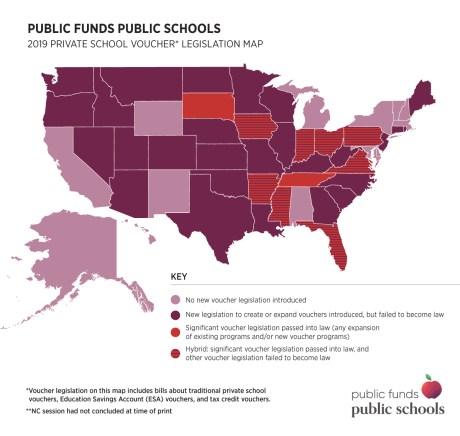
The Education Law Center created this graphic and explanatory information about the battle to keep public funds in public schools. The graphic shows the state of the voucher movement and identifies which states have advanced or repelled efforts to privatize public funding to religious and private schools via vouchers. It is heartening to see the number of states that rejected voucher legislation, especially when such legislation was defeated by a coalition of rural Republican legislators and urban Democratic legislators, as was the case in Texas and Arkansas. Thanks to all those who are joining forces to keep public funds in public schools.

pic1pic2

PRIVATE SCHOOL VOUCHERS: ANALYSIS OF 2019 STATE LEGISLATIVE SESSIONS
For a larger version and a text description of this map with a list of the states in each category, click ​here​.
In anticipation of states’ 2020 legislative sessions, this is the first in a series about the fate of private school voucher proposals during 2019 sessions.
Introduction
Despite the continued promotion of school privatization by U.S. Education Secretary Betsy DeVos, as well as support from a number of governors, legislatures, and well-funded advocacy organizations across the country, only two states enacted new private school voucher programs during their 2019 legislative sessions. Although some states expanded existing voucher programs, most passed no voucher legislation at all, and the majority of those that did made small-scale changes.
2019 Legislative Session Highlights:
  • Bipartisan majorities in Georgia, Kentucky, and West Virginia rejected voucher proposals supported by those states’ newly elected governors.
  • Although 22 states have full Republican control, only Florida and Tennessee were able to pass legislation creating new voucher programs in votes largely along party lines.
  • In Nevada, just a few years after the nation’s most expansive Education Savings Account (ESA) voucher law was passed, a new governor signed a bill repealing the program, which had never been implemented.
2019 Legislative Session Lowlights:
  • Tennessee passed a new private school voucher program, though it is limited to two counties.
  • Florida added yet another voucher program to the state’s existing voucher system.
  • Other states increased funding for their previously enacted programs, including Indiana and Iowa.
State Actions in Brief:
Arkansas
For the second consecutive legislative session, rural Republican lawmakers teamed with Democrats in a bipartisan effort to defeat legislation that would have created new school voucher programs. Proposals for a tax credit voucher and a traditional voucher were defeated. Although eligibility for the state’s existing ESA vouchers was modestly expanded, a bill passed requiring a biennial study that will provide lawmakers with important information to analyze how public funds are being spent in that program.
Arizona
Months after voters overwhelmingly rejected the 2017 expansion of the state’s ESA voucher program, legislators introduced a number of bills to again expand the program. Two of these bills passed out of relevant committees but were not taken up by the House or Senate. The remaining expansion bills did not advance, and a bill that slows the growth of tax credit vouchers passed into law.
Diverting public money to private education starves public schools of vital resources and does not lead to improved academic outcomes. For information about various types of private school voucher programs, visit the Public Funds Public Schools website. The PFPS website also highlights a wide range of research showing that private school voucher programs are an ineffective and harmful use of public funds.
Florida
Governor Ron DeSantis (R) signed Florida’s latest private school voucher plan, the “Family Empowerment Scholarship Program,” into law. This program will divert an estimated $130 million to private schools over the authorized period and will make vouchers available to middle class families earning up to $80,000 a year.
Georgia
Despite a new Republican governor who supports private school vouchers, voucher legislation failed in the State Senate. Six of the 13 Republican senators who represent rural areas of the state voted against the bill.
Indiana
Governor Eric Holcomb (R) signed legislation to increase funding for Indiana’s existing tax credit voucher program by almost 15% over the next two years. The legislation also increases the voucher amount for eligible families.
Iowa
Governor Kim Reynolds (R) signed legislation to increase the cap for Iowa’s existing tax credit voucher program by $2 million over the next two years. A bill to establish an ESA voucher was not considered by the full legislature.
Kentucky
Mobilization at the state capitol by educators standing up for public schools and several days of school sickout closures led to the defeat of legislation to create a tax credit voucher program. The Republican majority did not bring the bill up for a vote.
Louisiana
In Louisiana, a bill creating a “reading voucher” for public school students to use for private tutoring and other private uses passed the House but did not make it out of the Senate Finance Committee.
Mississippi
A bill to expand the state’s limited ESA voucher program was not voted on in the Republican-led House Education Committee. However, as the session was ending, the Lieutenant Governor included $2 million in new ESA funding in a bill to fund state construction projects.
Missouri
Bills to create a tax-credit-funded ESA voucher program were not acted upon before the legislative deadline.
Nevada
Governor Steve Sisolak (D) signed a bill formally repealing the state’s ESA voucher program first passed in 2015, and subsequently struck down by the Nevada Supreme Court. Additionally, a number of bills to create ESA vouchers for students deemed “victims of bullying” failed to advance in the legislature.
North Dakota
A bill that would have authorized a “school choice” study, including of ESA vouchers, passed in the House of Representatives but failed in the Senate.
Pennsylvania
Governor Tom Wolf (D) vetoed a major expansion of the state’s tax credit voucher program passed by the Republican-led legislature. The bill would have nearly doubled the amount that could be diverted to the program, included automatic annual expansions, and significantly raised the income limit for participating families.
South Carolina
Two bills were introduced in the legislature to establish an ESA voucher for students with disabilities. Both were referred to their chamber’s education committee, with no action taken by the legislature.
Tennessee
Governor Bill Lee (R) signed a law to establish an ESA voucher program. Concessions were made to rural Republican legislators in order to pass the bill, including limiting the program to the state’s two largest school districts and capping it at 15,000 students per year.
Texas
State leadership, including Republican legislators and the governor, did not include vouchers among their education priorities in 2019. In response to electoral losses in the suburbs and a lack of support for vouchers, legislative leaders emphasized improving the state’s public school financing system instead.
West Virginia
After a nine-day teachers’ strike in 2018, educators went on strike again, closing all but one of the state’s 55 county public school districts, to protest bills to allow charter schools and to create an ESA voucher program. The voucher bill did not pass during the regular session. Vouchers were again considered, but the program did not pass, during a special session on education legislation.
Resources
Acknowledgements
Many thanks to Jason Unger for compiling the research and drafting this series on 2019 legislative sessions.
Press Contact:
Sharon Krengel
Policy and Outreach Director
Education Law Center
973-624-1815, ext. 24