Archives for category: Vouchers

If you live in Missouri, get active to stop this dangerous effort to destroy your public schools!

Dear Friend,

If you love your public schools you need to drop what you are doing and get to work.

There is only one intent of Senate Bill 55–to destroy public education in Missouri. It was pushed through the Senate Education Committee early this morning and may go to the Senate floor for a vote as early as next week. 

1. Call your state senators NOW and ask them to support public schools by OPPOSING Senate Bill 55. You can find your Senator and their phone number by going here

2. Click here and send an email in opposition to Senate Bill 55 NOW.

3. Share this link with friends and family who live in the statehttps://actionnetwork.org/letters/oppose-senate-bill-55/

Below is the notice we just received from the Missouri School Boards Association information that provides background on the bill.

“The Senate Education Committee jammed through a mega bill on Thursday that will be heard on the Senate floor soon. Senate Bills 23 and 25 started out creating voucher schemes and expanding charter schools but were loaded up on SB 55 at the last minute with a long list of provisions hostile to public education that have never even had a public hearing. The bill now includes:

  • School Board Member Recall: Requires an election to recall a school board member if a petition is submitted signed by at least 25% of the number of voters in the last school board election.
  • Education Scholarship Account/Vouchers:Creates up to $100 million in tax credits for donations to an organization that gives out scholarships for students to attend a home school or private school – including for-profit virtual schools.
  • Charter School Expansion: Authorizes charter schools to be opened in an additional 61 school districts located in Jackson, Jefferson, St. Charles, and St. Louis counties or in cities of 30,000 or more and allows charters opened in provisionally and unaccredited districts to remain open even after the school district regains accreditation.
  • Turning MOCAP into Virtual Charter Schools: Allows students enrolling in MOCAP full time to apply directly to the vendor and cuts the resident school district and professional educators out of the process.
  • Home school students allowed to participate in MSHSAA activities. Districts are prohibited from belonging to MSHSAA unless home schooled students are allowed to participate in district athletics and activities governed by MSHSAA.
  • Limiting State Board of Education: Restricts members of the state board of education to serve only one full term.”

Read more on these issues here.

Please send your email, make your calls and thank you for all you do. 

Carol Burris

Executive Director

Network for Public Education

Rebecca Klein, education editor of Huffington Post, reviewed the textbooks written for and used in Christian schools and found that they repeated the lies of Trump and the far-right. Because of vouchers, many of these Christian schools receive public funds.

Klein wrote:

Christian textbooks used in thousands of schools around the country teach that President Barack Obama helped spur destructive Black Lives Matter protests, that the Democrats’ choice of 2016 nominee Hillary Clinton reflected their focus on identity politics, and that President Donald Trump is the “fighter” Republicans want, a HuffPost analysis has found.

The analysis, which focused on three popular textbooks from two major publishers of Christian educational materials ― Abeka and BJU Press ― looked at how the books teach the Trump era of politics. We found that all three are characterized by a skewed version of history and a sense that the country is experiencing an urgent moral decline that can only be fixed by conservative Christian policies. Language used in the books overlaps with the rhetoric of Christian nationalism, often with overtones of nativism, militarism and racism as well. 

Scholars say textbooks like these, with their alternate versions of history and emphasis on Christian national identity, represent one small part of the conditions that lead to events like last week’s riot at the U.S. Capitol, an episode that was permeated with the symbols of Christian nationalism. Before storming the Capitol, some groups prayed in the name of Jesus and asked for divine protection. They flew Christian and “Jesus 2020” flags and pointed to Trump’s presidency as the will of God. The linkage between Christian beliefs and the violent attack on Congress has since pushed evangelical leaders to confront their own relationship with Trump and their support for the rioters...

Representatives from BJU Press and Abeka did not respond to inquiries about how many schools use their products. However, a 2017 HuffPost investigation found that about one-third of Christian schools participating in private school choice programs used a curriculum created by these two publishers or a similar company called Accelerated Christian Education, amounting to around 2,400 schools. The number of schools using these company’s products that do not participate in a voucher program likely amounts to thousands more. (Voucher programs allow students to use taxpayer funds to attend private schools.) 

HuffPost’s previous investigation of these textbooks found that they also dismiss evolution as junk science, characterize Nelson Mandela as a “marxist agitator” who helped drive South Africa to “radical affirmative action,” and suggest that Satan hatched the idea of modern psychology. Many of the schools that use these books also ban LGBTQ students and families, and the books repeatedly condemn homosexuality. At one point in an Abeka textbook, slavery is described in purely economic terms, saying that “slaves seemed to be better investments than indentured servants.”

“I absolutely thought of these textbooks when watching what played out last week,” Wellman said. “It’s the anti-science culture, anti-elite, the identification of Christianity with military culture.”


John Thompson, historian and retired teacher in Oklahoma, reviews historian Jack Schneider and journalist Jennifer Berkshire’s A Wolf at the Schoolhouse Door. Schneider and Berkshire have collaborated on podcasts called “Have You Heard.”

Thompson writes:

The first 2/3rds of A Wolf at the Schoolhouse Door, by Jack Schneider and Jennifer Berkshire, is an excellent history of attacks on public education. It taught me a lot; the first lesson I learned is that I was too stuck in the 2010s and was wrong to accept the common view of Secretary of Education Betsy DeVos as a “joke” and a “political naif.” The last 1/3rd left me breathless as Schneider’s and Berkshire’s warnings sunk in.

A Wolf at the Schoolhouse Door starts with an acknowledgement that DeVos isn’t the architect of the emerging school privatization tactics. That “radical agenda” has been decades in the making. But she represents a new assault on public education values. As Schneider and Berkshire note, accountability-driven, charter-driven, corporate reform were bad enough but they wanted to transform, not destroy public education. They wanted “some form” of public schools. DeVos’ wrecking ball treats all public schools as targets for commercialization. 

Schneider and Berkshire do not minimize the long history of attacks on our education system which took off after the Reagan administration’s A Nation at Risk blamed schools for “a rising tide of mediocrity that threatens our very future as a Nation.” They stress, however, that it was a part of Reagan’s belief that our public schools and government, overall, were failing, and how it propelled a larger attack on public institutions.

Forty years later, free marketers are driving a four-point assault. They contend that “Education is a personal good, not a collective one,” and “schools belong in the domain of the Free Market, not the Government.” According to this anti-union philosophy, it is the “consumers” who should pay for schooling.

The roots of this agenda lie in the use of private school vouchers that began as an anti-desegregation tool. Because of “consumer psychology,” the scarcity of private schools sent the message that they were more valuable than neighborhood schools. But, neither private schools nor charter schools made good on their promise to deliver more value to families. Similarly, Right to Work legislation and the Janus vs AFSCME ruling have damaged but not destroyed collective bargaining.

Neither did online instruction allow the for-profit Edison schools or, more recently, for-profit virtual education charter chains to defeat traditional schools. Despite their huge investments in advertising spin, these chains produced disappointing outputs. For instance, DeVos claimed that virtual schools in Ohio, Nevada, and Oklahoma had grad rates approaching 100%. In reality, their results were “abysmal.”

To take one example, the Oklahoma Virtual Charter Academy had a 40 percent cohort graduation rate, not the 91 percent DeVos claimed. It received a D on the Oklahoma A-to-F Report Card for 2015-16. Also, in 2015, a Stanford study of 200 online charters found that students lost 72 days per year of learning in reading and 180 in math in a 180-day year.

Such dismal results prompted more calls for regulations for choice schools. Rather than accept more oversight, free marketers doubled down on the position that parents are the only regulators. To meet that goal, they borrowed the roadmap for Higher Education for-profits, adopting the tactics that failed educationally but made them a lot of money.

So, Schneider and Berkshire borrow the phrase “Lower Ed” from Tressie Cottom  as they explain how privatizers patterned their movement after Higher Ed where 10 percent of students attended for-profit institutions. Their profits came from the only part of public or Higher Education that could produce big savings, reducing expenditures on teaching. This meant that since the mid-1970s tenure-track faculty dropped by ½, as tenured faculty dropped by 26 percent. Consequently, part-time teachers increased by 70 percent.

Moreover, by 2010, for-profit colleges and universities employed 35,000 persons. They spent $4.2 billion or 22.7 percent of all revenue on marketing and recruiting. 

In other words, the market principles of the “gig economy” are starting to drive the radical “personalized” education model that would replace “government schools.” Savings would begin with the “Uberization” of teaching.  A glimpse of the future, where the value of a teaching career is undermined, can be found on the “Shared Economy Jobs” section of JobMonkey where education has its own “niche.” Teachers could expect to be paid about $15 per hour.

And that leads the system of “Education, a la Carte,” which affluent families need not embrace but that could become a norm for disadvantaged students. What is advertised as “personalization” is actually “unbundling” of curriculum. Algorithms would help students choose courses or information or skills and teachers (who “could be downsized to tech support”) that students think they need.

Worse, this “edvertising” is full of “emotional appeals, questionable claims, and lofty promises.” Its “Brand Pioneers” started with elite schools’ self-promotion and it led to charters adopting the “Borrowing Prestige” dynamic where the implicit message is that charters share the supposed excellence of private schools. And then, charters like Success Academy took the “brand identity” promotions a step further, spent $1,000 per student on marketing SA logo on You-Tube, Twitter, Instagram, baby onesies, and headphones.

Schneider and Berkshire also described the KIPP “Brand Guidelines” video which compares the charter chain to Target, which wouldn’t represent its business differently in different cities. So, it says that every conversation a KIPP teacher has about the school is “a touch point for KIPP’s brand.”

Similar edvertising techniques include the exaggerated size of waiting lists for enrolling in charter chains. Their marketing role is sending the message, “Look how many people can’t get in.”  Charters have even engaged in “market cannibalism,” for instance issuing gift cards for enrolling children in the school.

Worse, demographic trends mean that the competition between choice schools and traditional schools will become even more intense as the percentage of school age children declines, For instance, 80 percent of new households in Denver since 2009 didn’t have children. And even though corporate reformers and DeVos-style free marketers have failed to improve education, their marketing experts have shown an amazing ability to win consumers over.

So, here’s Schneider’s and Berkshire’s “Future Forecast:”

The Future Will Be Ad-Filled;

The Future Will Be Emotionally Manipulated;

The Future Will Be Micro-Targeted;

The Future Will Have Deep Pockets;

The Future Will Tell You What You Want.
I reviewed three books in the New York Review of Books, which seemed to me to be complementary.

Together they offer a fresh interpretation of the history of public education and of school choice.

The choice zealots would have you believe that they want to “save poor kids from failing public schools,” but the history of school choice tells a very different story. School choice began as the rallying cry of Southern segregationists, determined to prevent desegregation and integration of their schools.

School choice was their response to the Brown Decision of 1954.

The states of the South passed law after law shifting public funds to private schools, so that white students could avoid going to school with black children.

Libertarian economist Milton Friedman published an essay in 1955 on “The Role of Government in Education” in which he argued for vouchers and school choice. He said that under his approach, whites could go to school with whites, blacks could go to school with blacks, and anyone who wanted a mixed-race school could make that choice. Given the state of racism in the South, his formula would have been translated by white Senators, Governors, and legislatures as a formula to maintain racial segregation forever. They loved his ideas, and they adopted his rhetoric.

The best way to remove the cobwebs in your mind, the ones planted by libertarian propaganda, is to read the three books reviewed here:

Katharine Stewart: The Power Worshippers: Inside the Dangerous Rise of Religious Nationalism

Steve Suitts: Overturning Brown: The Segregationist Legacy of the Modern School Choice Movement

Derek W. Black: Schoolhouse Burning: Public Education and the Assault on American Democracy

The nonpartisan, independent organization called “In the Public Interest” reports on efforts to privatize public services. Its education newsletter is called “Cashing In on Kids.”

Here is its latest updates on the DeVos education agenda:

Welcome to Cashing in on Kids, an email newsletter for people fed up with the privatization of America’s public schools—produced by In the Public Interest.

Not a subscriber? Sign up. And make sure to like us on Facebook and follow us on Twitter.

Sure, Betsy DeVos resigned. But, as Marianna Islam, director of programs and advocacy for the Schott Foundation, says, “Betsy Devos has not really left until all of her harmful policies are overturned and policies that advance racial equity are put into place.” Retweet this

And now other news…

Which federal agency has funded more charter school facilities than any other? The U.S. Department of Agriculture. At least according to Chicago-based Wert-Berater, LLC, the self-described “leading” company in facilitating the charter school industry’s lucrative real estate sector by providing “feasibility studies.” WBOC

Is the charter school industry on the skids? Journalist Jeff Bryant looks at the charter school industry’s rate, particularly in North Carolina. “Much of the rationale for the perceived need for charter schools often seems to boil down to marketing.” AlterNet

Pro-charter money goes to California governor recall effort. The right-wing charter school backer, John Kruger, has given $500,000 to an effort to recall California Gov. Gavin Newsom (D). GV Wire

Georgia lawmakers eye vouchers. Georgia state lawmakers will be taking up the issue of private school vouchers in their new session. “Proponents could limit efforts to expanding Georgia’s current special needs scholarship program benefitting students with disabilities. A similar bill passed the Senate last year but failed in the House.” AP

Texas too. A voucher bill has been introduced into the Texas legislature. “Do we really have time to rehash this?” tweeted Charles Luke of the Coalition for Public Schools. “The legislature has only voted vouchers down repeatedly for 25 years!”

New Hampshire takes the money. New Hampshire’s governor and executive council have accepted controversial funding for the expansion of charter schools in the state. In Depth NH

Following the money. Pennsylvania’s online charter schools have used federal COVID-19 relief funds to purchase technology and cleaning supplies and send Target gift cards and phones to families. The Times-Tribune

And the good news…

Local Indiana council supports charter school ban. Indiana’s Gary City Council has unanimously backed a resolution calling for a moratorium on new charter schools in support of state legislation being introduced by a local lawmaker. Chicago Tribune

Pennsylvania school district speaks out. School district officials in Pennsylvania’s Schuylkill County have spoken out on charter school funding. “Recently the United States Department of Education awarded a five-year $30 million grant to Pennsylvania Brick and Mortar Charter Schools to increase their academic success. All the while, many Pennsylvania Public Schools are cutting programs in order to continue to pay for charter school costs, some even becoming financially distressed due to this burden.” Skook News

Larry Cuban turned his blog over to retired Swedish teacher Sara Hjelm, a reader of his blog, who took the opportunity to warn American readers about the dangers of the free-market reforms adopted in Sweden.

Sweden adopted the “reforms” in 1992, allowing families to choose any school, public or private, and send their child there with his/her taxpayer dollars. It is the “backpack full of cash” theory behind the demand for school choice, as advocated here by Betsy DeVos and Jeanne Allen of the Center for Education Reform. The voucher system has led to a growing industry of private, for-profit schools, called “free schools.” Two of the companies that run “free schools” are listed on the stock exchange. They are comparable to our charter schools.

Hjelm writes:

The huge private for profit school companies exist on all these levels, competing for student vouchers. Largest part is in the upper secondary where more than 30% of students today attend such a free school. By cherry-picking “easy” students through aggressive marketing to parents (we offer good behavior, academic excellence, high grades, etc.) they attract students that are more or less self going and enable a profit for shareholders or owner consortiums by keeping wages low, having large groups, substituting some teaching for on-line learning, employing teachers from abroad on short term contracts and more hours of teaching, etc. 

As a result real student achievements and school climate are mediocre, about the same as in municipal schools and with a considerable grade inflation to that according to PISA and national tests. Students from municipal upper secondary schools have a slightly lower grade point average than students from free upper secondary schools, but still generally show higher performance and less dropouts during the first year of higher education.

There are also plenty of examples of parents told that their child does not really fit in, that the support needed is not available and they should seek a more suitable school. With a queue system for admission on compulsory level, where you can put your baby in line at birth, they keep all groups filled. And being private businesses they only have to share whatever follow up data they choose due to international business and stock market legislation of secrecy. If a school is not as profitable as expected it can simply close down with short notice or apply for bankruptcy when as much monetary resources as possible have been moved somewhere else in the organization. Stranded students are the municipality’s responsibility. The risk is minimal. At least for now.

She recognizes the important role of venture capital in the expansion of the publicly-subsidized “free schools,” and notes that it has led to persistent cost-cutting.

What matters most in this free-market system, she concludes, is profit, not education, not students.

This is a very worthwhile read.

Nancy Bailey is hopeful that 2021 will bring a new agenda for public schools and their students and teachers.

All are worried about the pandemic and whether there will be the resources to protect students and staff.

There will surely be a teacher shortage due to the numbers of teachers who felt threatened by returning to school when it was not safe, as well as the necessity to reduce class sizes to make social distancing a reality.

The need for social justice should be high on the agenda, and it has nothing to do with vouchers and school choice.

Students with disabilities have been seriously affected by the pandemic and need extra instruction and resources.

The pandemic threw a harsh light on the condition of school infrastructure. Many states have not invested in school facilities. Will they?

The arts were dropped in many schools during the disastrous reign of NCLB and Race to the Top. Today they are needed more than ever.

What will become of assessment? Will the new Secretary follow those who think that testing produces equity? Or will he listen to teachers and parents? Twenty years of federally mandated testing produced a static status quo, locking the neediest students into their place in the social hierarchy and denying them equality of educational opportunity.

Steve Hinnefeld warns that Republican legislators in Indiana are laying the groundwork to expand the state’s failed voucher program. The research on vouchers in many states has been consistent: Students who use vouchers fall behind their peers in public schools. Those who continue to push vouchers are either ideologues, religious zealots, or paid to do so. We know that they don’t help students. Increasingly the students who take vouchers already attend religious schools or planned to, and they are getting public money to pay private tuition.

Indiana legislators like to fund failure.

Don’t be surprised if lawmakers try to expand Indiana’s already generous private school voucher program in 2021. They’re signaling their intention with the issues surveys they send to constituents.

At least eight House Republicans include this question in their surveys, which are posted on their internet sites: “Do you support increasing the income eligibility for Indiana’s CHOICE scholarships, giving more low- and middle-income families the option to send their children to the school that best meets their needs?”

Note that the question contains a falsehood. Increasing the income eligibility for vouchers, officially labeled Choice Scholarships, won’t change anything for low-income families. They already meet income qualifications for the program, which provides state funding for private school tuition.

Under current law, students can qualify for vouchers if their family income is less than 150% of the threshold for reduced-price school meals. They remain eligible if their family income rises to 200% of the reduced-meal level. For a family of five, that’s $113,516, two times Indiana’s median household income.

In other words, low-income families and many middle-income families already meet the income requirements. According to the 2019-20 Indiana Department of Education voucher report, a quarter of voucher recipients came from families that made over $75,000 and 7% made over $100,000.

The suggestion in the survey that vouchers let families choose schools that meet their children’s “needs” is also questionable. Surveys have found that many voucher parents choose private schools primarily because they provide religious training, not because their children have unique needs. Research has shown that voucher students who leave public schools for private schools typically fall behind academically.

As a new year begins, and as a new administration prepares to take charge of the U.S. government, our fight to support and improve public education goes on.

The Network for Public Education is and will continue to be the single largest voluntary group advocating on behalf of public schools. We had humble beginnings, starting with a bank account of a couple of thousand dollars and a board of enthusiastic parents and educators. We now have a full-time executive director (Carol Burris) who is helped by three amazing part-time workers.

We are not like the City Fund, which opened its doors in 2018 with $200 million in the bank (thanks to billionaire John Arnold and billionaire Reed Hastings). The City Fund exists to push high-stakes testing and to destroy community-based, democratically-controlled public schools. It has no members; we have about 350,000 who work with us. The “reformers” have tons of money and malevolent intentions.

Last year, we issued two bombshell reports that showed the failure of the federal Charter Schools Program, which doles out $440 million every year, mostly to corporate charter chains. We discovered and documented–using U.S. Department of Education data–that about 35-40 percent of the federally funded charters either never opened or closed not long after opening. They are the day lilies of American education, and they waste money that should go to support under-resourced public schools.

We published a report about the 1,200 or so charters that double-dipped into CARES funds intended to save small businesses. The charters, whose funding from public sources, never ceased, collected from $1-2 Billion from the Paycheck Protection Program. All of the data are available in public sources, but you have to know where to look to see that some very savvy charters and charter lobbyists cleared huge sums of PPP money (some collected $1 million or more) while public schools each collected only about $134,500.

We will continue to support real public schools, the kind that are publicly accountable to public officials. We will push the Biden administration to regulate or eliminate the federal Charter Schools Program and stop funding failure. We will fight against high-stakes testing and the misuse of standardized tests.

We will demand a suspension of federally mandated testing this spring and turn our energies toward removing the federal mandate for annual testing, which has manifestly failed to provide equity or excellence. We will remind the public that tests do not reduce achievement gaps; they are measures, not remedies. Mainly, they measure family income. Why waste hundreds of millions of dollars measuring family income?

Yes, knowledge is power, and we generate the knowledge you need to fight for public schools as the democratic institution that they are.

We welcome your financial support. Whatever you want to give, we are grateful.

Please donate here.

Whether you can afford $5, $20, $50, $100 or more, please give.

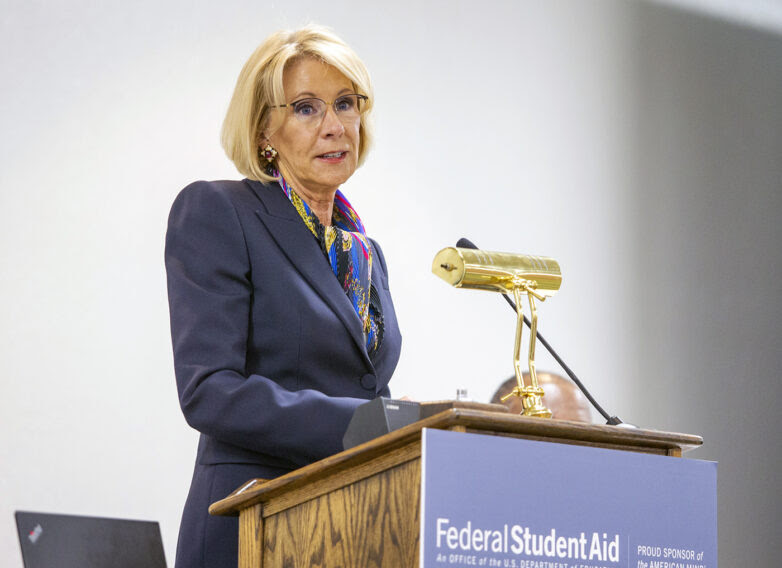
Rick Hess conducts an “exit interview” with Betsy DeVos, which was published at Education Week. Rick is a fellow at the conservative American Enterprise Institute, which is funded in part by DeVos.

DeVos came to Washington to destroy public education, and she failed. She bitterly dismisses the “entrenched interests” and bureaucrats who frustrated her ambitions to turn billions of public dollars over to religious and private schools and to extinguish teachers’ unions altogether. During her confirmation, she was unable to answer direct questions about education policy, and she was ultimately confirmed only when Vice-President Pence cast a tie-breaking vote. This had never happened before. In poll after poll, DeVos was characterized as the most unpopular member of Trump’s Cabinet. She did her best to skewer the Department’s Office of Civil Rights, to abandon college students who were defrauded by for-profit colleges, to divert COVID funding to elite private schools. Fortunately, most of the changes–maybe all of them–will be reversed by the Biden administration. Here is a fun fact that DeVos doesn’t mention: She is right that the number of voucher programs has grown, but she fails to point out that fewer than 1% of American students use vouchers. Nor does she mention that most independent voucher studies find that students in voucher schools are worse off than their peers in public schools. When a 2017 evaluation of the voucher program in D.C. reported that the students in voucher schools actually lost ground, DeVos didn’t care. She said: “When school choice policies are fully implemented, there should not be differences in achievement among the various types of schools.” Nonetheless, in this exit interview, DeVos continues to promote voucher propaganda, and Hess doesn’t challenge her.

Here is an excerpt:

Rick: Back in 2017, your confirmation process was remarkably contentious. Looking back, what did you take from that and how did it affect your approach to the role?

Secretary DeVos: It confirmed my belief that entrenched interests were going to do their best to protect the status quo, their power, and their jobs no matter what. It gave me a clear-eyed look at the uphill battle I knew we would face as we pivoted the federal focus away from adults’ interests to what’s best for kids.

Rick: You came to your position as an outsider—how has that mattered?

DeVos: Like I’ve said before, I didn’t know all the things you “can’t do.” So I came in with fresh eyes and a laser focus on rethinking the way we approach all aspects of work at the department.

Rick: What surprised you most about the job?

DeVos: A couple of things. First, that the bureaucracy is even more bureaucratic than any of us could have ever imagined, and it takes longer to get anything done than I could have ever imagined. Second, seeing firsthand just how difficult it is for people in Washington to see beyond what is and imagine what could be. Third, and importantly, I am consistently inspired by what parents will do for their kids’ educations. I’ve met single mothers driving Uber in addition to holding two other jobs just so their children can learn in schools that work for them. I’ve met parents who didn’t wait for permission to home school their children nor did they wait for their schools to open this past spring, establishing their own learning pods and microschools so their children could continue learning. I suppose I’m not surprised by the ingenuity of America’s parents, but I am inspired by them and their students.

Rick: For you, what’s one anecdote that really captures what it’s like to be secretary of education?

DeVos: I remember talking with a group of young African American students in a school where they were benefiting from the Milwaukee voucher program and looking outside at a sea of middle-aged white protestors who apparently thought those students didn’t deserve that opportunity. I think that’s a pretty good microcosm of what my experience in office was like.

Rick: What was the most useful preparation you had to be secretary?

DeVos: I’ve dedicated more than 30 years of my life to fighting for students, starting in my community, then throughout Michigan and in states across the country. I know what parents want and need for their children’s educations because I am one and because I’ve fought alongside them to have the same choices and opportunities for their kids that I had for mine. People also forget this is ultimately a management job, not a teaching job. Among other things, you run one of the nation’s largest banks. Having actually led large organizations was very important preparation.

Rick: If you had to point to just one, what’s the single data point that really illuminates your thinking about American education?

DeVos: Half of lower-income 4th graders are below-basic readers, according to the most recent Nation’s Report Card. If the system is failing to teach the most basic of skills to the most vulnerable of students, how can anyone defend it? Worse yet, for the past quarter century, there has been no meaningful change in test scores, yet as taxpayers, we spend more and more for education each year. And by too many measures, these gaps are even widening. Perhaps the largest gap is between American students and their international peers. We’re not in the top 10—in anything. That’s not because our students aren’t capable; it’s because “the system” is culpable for failing them. And, if I could point to a couple more data points, there are currently millions of kids on charter school wait lists, and 3 out of 4 parents who say, if given the opportunity, they would choose a different school than their assigned one for their child. Parents are making clear what they think the solution is to the system’s failures.

Rick: What’s one thing that advocates and reformers should understand about federal education policy which they may not already?

DeVos: It needs your voices. Reformers rightly focus on the states, which are in control of education, but ignoring Washington comes with peril. Remember, a different president and secretary most certainly would have implemented the Every Student Succeeds Act in significantly more controlling ways.

Rick: What would you regard as your most significant accomplishment in office?

DeVos: Hands down, it’s changing the national conversation around what K-12 education can and should be. The concept of school choice is more popular across racial, ethnic, and political lines than ever before. I’m also proud of the team’s work on the historic Title IX rule which codified into law protections for all students.

Rick: And what would you say is your biggest regret?

DeVos: In four years, we set out to change the course set by the past 40 years of the department’s history. Though we’ve made remarkable progress, as long as there are students stuck in schools that do not meet their needs, the work is not yet done. I believe that all children have unlimited potential and promise, and so every single one of them deserves the opportunity to find their educational fit. I regret that we didn’t push harder and earlier in the term.

Rick: Throughout your tenure, your emphasis has been on expanding educational choice for students and families. How would you evaluate your record on this score?

DeVos: My team and I have worked very hard to advance education freedom—or school choice, as most know it. This idea, which President Trump rightly calls “the civil rights issue of our time,” is on the march across the country. Students in more states have more opportunities to pursue the education that’s right for them today than when I first took office. Consider the bold expansions in North Carolina, Florida, West Virginia, Tennessee, and even in Illinois. Right here in D.C., participation in the school choice program is now 50 percent higher than it was four years ago, and there is still massive unmet demand. We’ve changed the conversation at the federal level, too. Our proposal for Education Freedom Scholarships is the most ambitious in the nation’s history, and now there are more than 120 co-sponsors in Congress and more than 50 Senators who voted for Sen. McConnell’s COVID relief package who are helping us champion the idea.