Archives for category: Vouchers


I was part of a heated debate including Emma Brown of the Washington Post, Randi Weingarten of the AFT, and Matt Frendewey of Betsy DeVos’s American Federation for Children.


Emma played it straight. The sparks flew when Matt attacked Randi and me, and both of came at him from different directions.


The DeVos line is that she really cares about kids, and no one else does.

Kristen Rizga, a perceptive reporter for Mother Jones, has been writing about education for several years. Her book Mission High was an excellent portrait of a San Francisco that was labeled as “failing” even though its students were not failing and its staff was dedicated.


In this fascinating article, she describes the sheltered life of billionaire heiress Betsy DeVos and the unusual community that nurtured her world-view. She also reviews the charitable donations made by the foundations of Betsy Devos and her husband, as well as of her parents’  foundation, where Betsy was an officer. (She said in the Senate hearing that she was not involved in her mother’s foundation, but did not acknowledge that she was an officer of the foundation for many years until recently.)


Although the DeVoses have rarely commented on how their religious views affect their philanthropy and political activism, their spending speaks volumes. Mother Jones has analyzed the Dick and Betsy DeVos Family Foundation’s tax filings from 2000 to 2014, as well as the 2001 to 2014 filings from her parents’ charitable organization, the Edgar and Elsa Prince Foundation. (Betsy DeVos was vice president of the Prince Foundation during those years.) During that period, the DeVoses spent nearly $100 million in philanthropic giving, and the Princes spent $70 million. While Dick and Betsy DeVos have donated large amounts to hospitals, health research, and arts organizations, these records show an overwhelming emphasis on funding Christian schools and evangelical missions and conservative, free-market think tanks, like the Acton Institute and the Mackinac Center, that want to shrink the public sector in every sphere, including education.


The couple’s philanthropic record makes clear that they view choice and competition as the best mechanism to improve America’s education system. Overall, their foundation gave $5.2 million from 1999 to 2014 to charter schools, which are funded by taxpayers but governed by appointed boards and often run by private companies with varying degrees of oversight by state institutions. Some $4.8 million went to a small school they founded, the West Michigan Aviation Academy. (Flying is one of Dick’s passions.) Their next biggest beneficiary, New Urban Learning—an operator that dropped its charter after teachers began to unionize—received $350,000; big-name charter operators Success Academy and KIPP Foundation received $25,000 and $500, respectively.
Meanwhile, when it comes to traditional public schools run by the districts and accountable to democratically elected school boards—the ones that 86 percent of American students attend—the DeVoses were far less generous: Less than 1 percent of their funding ($59,750) went to support these schools. (To be fair, few philanthropists donate directly to underfunded public school districts.)


But the DeVoses’ foundation giving shows the couple’s clearest preference is for Christian private schools. In a 2013 interview with Philanthropy Magazine, Betsy DeVos said that while charters are “a very valid choice,” they “take a while to start up and get operating. Meanwhile, there are very good non-public schools, hanging on by a shoestring, that can begin taking students today.” From 1999 to 2014, the Dick and Betsy DeVos Family Foundation gave out $2,396,525 to the Grand Rapids Christian High School Association, $652,000 to the Ada Christian School, and $458,000 to Holland Christian Schools. All told, their foundation contributed $8.6 million to private religious schools—a reflection of the DeVoses’ lifelong dedication to building “God’s Kingdom” through education…..


And here is one of their favorite causes: the fight against same-sex marriage (which DeVos denied before the Senate committee):


• Focus on the Family: Both the DeVoses and the Princes have been key supporters of Focus on the Family, which was founded by the influential evangelical leader James Dobson. In a 2002 radio broadcast, Dobson called on parents in some states to pull their kids out of public schools, calling the curriculum “godless and immoral” and suggesting that Christian teachers should also leave public schools: “I couldn’t be in an organization that’s supporting that kind of anti-Christian nonsense.” Dobson also has distributed a set of history lessons that argue that “separating Christianity from government is virtually impossible and would result in unthinkable damage to the nation and its people.” The Dick and Betsy DeVos Family Foundation gave $275,000 to Focus on the Family from 1999 to 2001 but hasn’t donated since; it gave an additional $35,760 to the group’s Michigan and DC affiliates from 2001 to 2010. The Prince Foundation donated $5.2 million to Focus on the Family and $275,000 to its Michigan affiliate from 2001 to 2014. (It also gave $6.1 million to the Family Research Council, which has fought against same-sex marriage and anti-bullying programs—and is listed as an “anti-LGBT hate group” by the Southern Poverty Law Center. The FRC used to be a division of Focus on the Family before it became an independent nonprofit, with Dobson serving on its board, in 1992.)


And here is the key to DeVos’s love for charter schools: they are the gateway to opening the door to school choice that includes religious schools (her true passion). Once the public is accustomed to the idea that school choice is a “right,” then everything is possible, even direct public funding of religious schools:


Which brings us back to Michigan, “school choice,” charter schools, and vouchers. Betsy DeVos has spent at least two decades pushing vouchers—i.e., public funding to pay for private and religious schools—to the center of the Republican Party’s education agenda, thanks in large part to the Mackinac Center for Public Policy, a Michigan-based think tank.


In the mid-’90s, Mackinac leadership suggested a long-term strategy on how to make the unpopular voucher policies more palatable for mainstream America. Its then-senior vice president, Joseph Overton, developed what became known as the Overton Window, a theory of how a policy initially considered extreme might over time be normalized through gradual shifts in public opinion. Education policies were placed on a liberal-conservative continuum, with the far left representing “Compulsory indoctrination in government schools” and the far right, “No government schools.”


Charter schools became the main tool of voucher advocates to introduce school choice to public school supporters, with the aim to nudge public opinion closer to supporting tax credits to pay for private schools. Since about 80 percent of American students outside the public system attend religious schools, “universal choice”—or allowing taxpayer money to follow individual students to any private or public school—could eventually mean financing thousands of Christian schools.
 

The Washington Post has some great reporters who cover education as well as the excellent “Answer Sheet” blog of Valerie Strauss.


But its editorial board has been consistently, flagrantly wrong about education for years. During the disastrous tenure of Michelle Rhee as chancellor of the D.C. public schools, the editorial board defended Rhee vociferously. They cheered as she tried to fire her way to success, they ignored the national reports of cheating, they didn’t read the sharp reporting of their gifted staff.


And now get this: the editorial board says that one of the positive proposals from Trump is privatization of public education. 


What? Send federal funding to every religious school and promote the spread of corporate for-profit schooling? Will every religious school and charter school be subject to all the mandates that accompany federal funding?


Apparently the Washington Post editorial board thinks that all public schools in the nation are just like those in DC. And incidentally, the federal evaluations of the D.C. Voucher program have shown no gains in test scores as compared to the public schools.


I am willing to bet that there is not a single public school parent on the Washington Post editorial board.

The prepared remarks of Betsy DeVos were released, and Daniel Katz analyzes them here.


DeVos knows very little, maybe nothing, about the public schools of America. She thinks that parents long to send their children to religious schools, for-profit charter schools, cybercharters, anyplace but a local public school.


She never mentions the failure of the school choice policies she has inflicted on Michigan. Michigan has seen its NAEP performance drop steadily–sometimes sharply–since the spread of DeVos ideas. Since 2003, Michigan scores on NAEP have declined from the middle of the pack among states to the bottom third. Detroit is awash in charters, and it is still in desperate trouble as public dollars shift to private management. The Detroit charters are no better than the public schools.


But she doesn’t mention any of that. She just talks about the wonders of choice. It worked for her and her family. Why shouldn’t all children have the same choices as the DeVos family?


When you figure that out, I have a bridge a few blocks from where I live that I want to sell you.

Sara Stevenson is the librarian at the O. Henry Middle School in Austin, Texas. She is a prolific writer and is published in the letters column of the Wall Street Journal more than anyone in the world, always refuting their free-market claims about schools. In this post, she attempts to debunk the case for choice, specifically, vouchers.


Stevenson writes:


One must ask about the motive for the school choice movement. Public education in this nation is an operation costing about $600 billion annually. Do these private, charter, cyber and home schools want to open their arms to public school students in a gesture of inclusion, or are they after the money? The amount allotted for private vouchers is almost always less than the private school tuition, so which families will be able to make up the difference? Will private schools relax admission requirements that make their schools exclusive, or will they drop them to be accessible for all? Furthermore, home schools currently run under zero accountability. What is to prevent a home-schooling parent from taking the voucher money and using it to buy a new computer for the family?


And then there are the repercussions. Every dollar taken from public schools and given to a charter, private, home or cyber school burdens the operational costs for public schools. In addition, with government money comes government accountability. Do all these private and religious schools, hoping for vouchers, want to submit their students to the battery of STAAR tests as well as the A-F grading scores that public schools must undergo? When the state is still spending $339 less per pupil than before the draconian budget cuts in 2011, won’t public schools suffer further from siphoned funds?

Today, the U.S. Senate Health, Education, Labor, and Pensions Committee will consider the nomination of Betsy DeVos as U.S. Secretary of Education. DeVos and her family have devoted many millions of dollars to destroying public schools and turning the clock back by more than a century. She wants the government to pay tuition at religious schools, voucher schools, for-profit schools, any alternative to public schools is her goal.


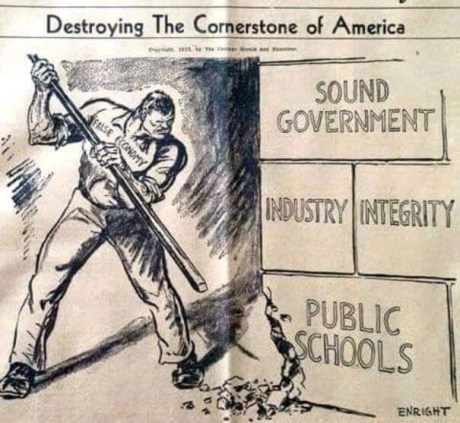
American public education is one of the essential institutions of our democratic society. The guarantee to everyone in this country that they could attend a free public school was a hard-fought victory. First, it required persuading the public to tax themselves to pay for schools for the children of the community. Second, it required separating the schools from religious institutions, which had long been the source of education. Third, it meant expanding access to all: to boys and girls, to children of all races and cultures, to children whose first language was not English, and to children with disabilities.


None of of these changes came easily.


And the struggle to provide good schools is ongoing, since so many states base school funding on property taxes, which privileges those who are already advantaged.


DeVos is ignorant of the history of public education in America and the role of public schools in our society. Her hostility to public schools should disqualify her from consideration for this position.


img_3801


Nina Rees thinks Betsy DeVos is a great choice for US Secretary of Education. She would. She is the president and CEO of the National Alliance for “Public” Charter Schools and like DeVos, is devoted to privatization of community public schools.


I first met Nina when she worked for Vice President Dick Cheney as his education advisor. Before that, she worked for the extremely conservative Heritage Foundation. She subsequently worked for ex-felon Michael Milken, when he was entering the education industry.


What you will learn from her article:


The U.S. Department of Education has spent $3 billion on privately managed charter schools, through the administrations of Bill Clinton, George W. Bush and Barack Obama.


What you will will NOT learn from this article:


That charter schools and vouchers have NOT improved education.


That education in Michigan has suffered because of DeVos’ zeal for the unregulated free market.


That the destruction of democratic public education is a crime against children, families, and our society.


That NO high-performing nation in the world has turned public funding for schools over to the free market.


The Texas legislature is starting a new session and once again Lt. Gov. Dan Patrick (former rightwing talk show host) will lead a fight for vouchers.


Once again, legislators from rural and urban districts–Republicans and Democrats–will combine to defend their community’s public schools. This year, the state launched the failed policy of giving every school a single letter grade, and now educators realize that these measures are invalid and are setting them up for privatization.


Imagine if your child came home from school with a report card and it contained only a single letter grade. As a parent, you would be furious. No child is only one dimension; no child can be reduced to an  or B or C or D or F. How much more absurd it is to attach a single letter grade to a complex institution like a school, staffed by many people, and subject to decisions made by the superintendent, the state education department, and the legislature.


Educators in North Texas see that the letter grades stigmatize their schools, damage their communities, and are intended to create demand for vouchers. There is zero validity, zero research, zero evidence for letter grades for schools.


“With the new legislative session starting Tuesday, educators from 60 North Texas districts united Monday to fight school vouchers and a new statewide grading system they say serves only to vilify public schools.
Frustration among school leaders has been mounting since provisional A-F grades were released Friday.
On Monday, area superintendents and trustees gathered in Garland to tell lawmakers that the grading system is flawed and that they are worried it is just a gimmick to get support for school vouchers or similar options.


“Lt. Gov. Dan Patrick has said school choice, which could include voucher-like tax credits or similar options, is among his top priorities for this session so families have the ability to leave failing schools.
But the area’s school leaders said such efforts would only siphon money from public schools and hurt children most in need because they don’t have the transportation and other means to take advantage of such options. Only affluent families, many of whom aren’t in public schools now, would benefit, they said.
“This is subsidies for the rich. … A equals affluent. F equals free and reduced,” Terrell ISD Superintendent Micheal French said, referring to the likelihood of poor students remaining in struggling schools that would be labeled failures.


“The provisional grades released last week were a first look at the state’s new school accountability system that takes effect in 2018. Lawmakers required the Texas Education Agency to release a sneak peek of how schools would have scored, just before they returned to Austin for the legislative session.
“That timing only reinforced educators’ fears that the new A-F system is politically motivated.
“Monday’s group represented 60 of the 80 districts in the TEA’s Region X, which includes Collin, Dallas, Ellis, Kaufman and Rockwall among its 10 counties. Combined, the districts represent 15.5 percent of Texas’ public school students.”


Pastors for Texas Children–an extraordinary group of religious leaders from across the state–is in the thick of the fight on behalf of public schools, fighting vouchers.


‪https://tcf.org/content/commentary/second-class-students-vouchers-exclude/‬


Kimberly Quick of The Century Foundation describes the many exclusionary policies of North Carolina’s voucher schools.


Here is a sampling:


Conservative education reformers have aggressively marketed the expansion of K–12 private school voucher programs as a method to increase access to educational options. Their arguments begin to break down, however, when asking the questions, Access for whom? And to what?


The types of voucher-centered school choice schemes promoted by both President-elect Trump and Betsy DeVos, his nominee for U.S. Secretary of Education (ED), like most programs in education policy, are administered by states and localities. Trump’s open denigration of the Department of Education’s civil rights and standards oversight functions further indicate that a DeVos ED will place few stipulations on how states receiving federal funds for vouchers must design and implement those programs.


Some of those voucher programs might look something like the highly discriminatory North Carolina Opportunity Scholarship Act. Established by the state legislature in 2013, the program offers low-income and working-class families state-funded tuition scholarships to private schools of up to $4,200. In some ways, the Opportunity Scholarship might seem innocuous. Private schools receiving state funds are required to test scholarship recipients (though notably not with state tests for direct comparison, and there is virtually no obligation for public disclosure), and most students must have spent time in public schools prior to private school enrollment to be eligible—conditions that are missing in other programs in states like Indiana and Wisconsin. But even the quickest examination of the types of schools taking taxpayer money reveals that state dollars are, in actuality, too often funding discrimination.


An overwhelming number of the more than 400 private schools registered in the program are religiously affiliated. Although a divided U.S. Supreme Court ruled that vouchers used for religious school attendance do not violate the establishment clause, the primary issue with North Carolina’s program is not that the schools themselves are religious, but that too many condition admission and retention on dogmatic adherence to specific religious doctrine, usually excluding those who are LGBTQ or come from non-churchgoing families.

 
Religious and LGBTQ Discrimination


Alamance Christian School (ACS) received $121,132 in public voucher funds during the 2015–2016 academic year, all while maintaining an official, publically available admissions policy that explicitly bars all faiths outside of Christianity, along with children from families that are “Catholic, Mormon, Jehovah’s Witness, Seventh Day Adventist, Christian Science” and more. To confirm that they are from the “right” type of Christian family, children seeking admission must produce a pastoral reference. Then, before enrolling, all middle and high school students are expected to sign a commitment form pledging to refrain from “homosexual/bisexual behaviors, or any other biblical violation of the unique roles of males and females.”


And ACS is not some random oversight, a school hiding out within the list of eligibles despite a uniquely restrictive profile. Instead, it reflects the biases of several other schools that are partially funded by the dollars of taxpayers, some of whom aren’t allowed to send their children to those very institutions. For instance, one of the schools receiving the most public money, Fayetteville Christian School (receiving more than $285,000 in 2015–2016) has near identical restrictions, requiring regular church attendance of applicants and parents, issuing the following statement on their website:


“The student and at least one parent with whom the student resides must be in full agreement with the FCS Statement of Faith and have received Jesus Christ as their Savior. In addition, the parent and student must regularly fellowship in a local faith based, Bible believing church. Accordingly, FCS will not admit families that belong to or express faith in non-Christian religions such as, but not limited to: Mormons (LDS Church), Jehovah’s Witnesses, Muslims (Islam), non-Messianic Jews, Hindus, Buddhists, etc. Accordingly, FCS will not admit families that engage in illegal drug use, sexual promiscuity, homosexuality (LGBT) or other behaviors that Scripture defines as deviate and perverted. Once admitted, if the student or parent/guardian with whom the student resides becomes involved in any of the above activities it will be grounds for dismissal of the student/family from the school. (Also see pages 9 and 28 of the Student Handbook)”


At Raleigh Christian Academy, which collected about $233,000 in state money through the voucher program, the administration mandates that “no young man do anything which might detract from his masculinity,” calling anything other than that narrowly and vaguely defined masculine ideal “an abomination before God.” The school also reminds its female students that “Satan desires to take away from a lady’s feminine qualities.” Not only are the identities of gender non-conforming and other LGBTQ students under attack in many “Opportunity” schools, these students—along with straight student whose families fail to conform to specific religious doctrine—have abridged options, even as their parents pay tax dollars to a state that rubber stamps their exclusion.


Read on for more reasons to keep the unwanted out.


Will DeVos require non-discrinatory admissions to religious schools? Don’t count on it.

Last spring, Salon published an article by Kali Holloway about Campbell Brown and her transition from news anchor to “education reformer” and “charter propagandist.” The article was posted before California’s highest court threw out the Vergara case, whose plaintiffs claimed that teacher tenure was racially discriminatory. It also was posted before a judge in Minnesota tossed out Campbell Brown’s copycat effort to kill teacher tenure in that state.


Nonetheless, the article accurately depicts Campbell Brown’s contempt for public schools, teachers unions, and teachers. Facebook announced that it plans to hire her as its face to the news media. It is important to know her low opinion of public education, a basic democratic institution, and the people who work to educate our children. As the article shows, Brown did not want to disclose the funders of her website, The 74, claiming that they might be harassed (as if!).


The article says The 74 is funded by: The Dick and Betsy DeVos Family Foundation, Bloomberg Philanthropies, Jonathan Sackler (of OxyContin producer Purdue Pharma) and the Walton Family Foundation.