Scott Tomlinson, opinion writer for The Houston Chronicle, predicts that MAGA voters, especially in Texas, are soon to have an unwelcome surprise, thanks to the DOGE commission of Elon and Vivek. They voted for deep budget cuts. They voted to downsize the federal government, aka the “Deep State.”
He writes:
President-elect Donald Trump’s coalition splintered over visas for specially skilled workers in recent weeks, which turned especially ugly on Twitter, now known as X.
Elon Musk told critics of the program, including Steve Bannon and Tucker Carlson, to “Take a big step back and FUCK YOURSELF in the face. I will go to war on this issue the likes of which you cannot possibly comprehend.”
Solving the immigration crisis is relatively easy compared to balancing the budget, which Musk is supposed to be focusing on. When Trump voters find out what must be cut or whose taxes must rise to stop deficit spending, they’ll start grabbing pitchforks.
U.S. politicians from both parties have unintentionally experimented with the global economy. By running up huge deficits, they tested Modern Monetary Theory, an idea put forward by the left.
MMT was a hot topic during the Obama administration, with proponents arguing that economic powerhouses like the United States don’t have to worry about deficits. Governments can print as much money as they want through borrowing as long as inflation doesn’t rise.
Conventional macroeconomic theory recommends governments spend money, cut taxes and raise deficits during recessions. When the economy grows, governments should spend less, raise taxes and build surpluses. Governments should act as economic shock absorbers. We’re good at spending but not taxing.
Musk promises to cut federal spending by a third, or $2 trillion. The Texas Legislature ranks 10th in the nation for dependency on the federal government to pay for state spending, according to economists at Wallet Hub.
Imagine what would happen to Texas if the Legislature had to come up with $30 billion to make up for federal spending cuts?
Every dollar the federal government spends has a champion somewhere. If Musk tries to cut popular programs, the backlash over H1-B visas will seem like a walk in the park.
Blogger “That’s Another Fine Mess” predicts trouble ahead for Team Trump. They are already squabbling because Trump insisted he would stop immigration but quickly backed down when Musk and Vivek said they needed highly skilled foreigners because no American was qualified. This is an excerpt. Open the link to read it all.
He writes:
The first year of Felon34 2.0 will be more shambolic than the first year of Felon 1.0, regardless of how many of the Felon’s idiots claim the benefit of four years of experience. Felon34 and his loyalists will take power better prepared to implement a number of malicious ideas, but will make less progress and create more chaos than they did in 2017 for two simple reasons:
First, because their added experience of preparedness will be swamped by their much greater arrogance, leading them to shed guardrails, fall into obvious traps, and overreach. We’ve seen it already on every major issue that has come up over this past month.
Second, because they’ll be inheriting the country at a somewhat less-stable equilibrium than they did last time: highly prosperous, but with less room to maneuver without generating inflation or triggering a recession. The market went through its longest period of decline since 1978 two weeks ago. With the uncertainty about whether Felon34 will be able to mount his mass deportation – and the effect that will have on the economy if he pulls off even a portion of it – added to his insane threats against Panama, Canada and Greenland; his plan to slap tariffs on the rest of the world; and his general insanity – the market will respond. The market does not like uncertainty. Felon34 sees his main job as keeping the market up – to support his billionaire owners and to flim-flam the flimflammables – and he is going to quickly run into the problem that he cannot please the droolers and the market simultaneously. He knows if he fucks the market he’s screwed, and if he doesn’t deliver the promises he made at his hatealongs he’s also screwed.
My prediction: Fire and fury. By this time next year it will be “a tale told by an idiot, signifying nothing.” Felon34 is the most determined moron in US political history. And then in January 2026, the mid-term campaign begins.
The MAGA Civil War will continue in 2025. Former George W. Bush Campaign Manager Stuart Stevens, who is now a Democrat, says that people should not ignore the fact Steve Bannon turned on Elmo: “Bannon is a guy who has defined himself as a thug, and thugs must do thuggish things. I think Musk has no idea what he’s getting into when he gets in a fight with Bannon over this.” Stevens then explained that if Bannon is ever able to turn Trump against Musk as he’s trying to do, that could be a big problem for Elmo: “There’s been reporting that Musk was not a student when he got a visa, and when he made his application for naturalization he put false information on that document. That is grounds for revoking citizenship. It happens all the time. One reason why Musk is so obsessed with immigration is because he knows this. I wouldn’t bet against Steve Bannon.”
Former Trump Press Secretary Sean Spicer posted a poll on X which asked if Republicans agreed with Musk on the H-1B visas or if they agreed with Steve Bannon on it. He got over 92,000 votes, with 67% siding with Bannon over Musk.
Elmo continued his purge and punishments of right-wing accounts who disagreed with him on this. White nationalist talk show host Stew Peters (758,000 followers): “Elon Musk is STEALING money from my subscribers and LYING to them. This morning I woke up to find that he removed my blue check mark and canceled my ability to have subscribers. My subscribers were told that I canceled my subscription service and they would not be refunded for the next two weeks in which they’ve already paid X for, but which won’t allow me to provide them content. This is intentional deceit and theft.”
White nationalist Nick Fuentes: “Today X appears to have un-verified 5 more prominent critics of the H-1B program. Their checkmarks were taken, subs were refunded, and character limit reduced. This is now overt political censorship. This comes after the Project Groyper brand account and all of its affiliates were suspended last week.”
My prediction: I agree with Stuart Stevens that one should not bet against Bannon. He knows how to fight like this and Elmo doesn’t. If Bannon’s side ever gets the goods on Elmo’s immigration and naturalization, expect Elmo to be in deep shit and Felon34 will abandon him.
In closing, this is the gang – as Jeff Tiedrich described them – who could screw up a fuck in a brothel. As I like to say, they’re the people who flunked the IQ test low enough to qualify for membership in MAGA. They’re the Broken Toys who never learned to work and play well with others. Over the past three weeks – before they’re even in office – they have screwed the pooch and munched the lunch. They couldn’t pass the bill they had to pass without Democrats, and Democrats aren’t going to pull their chestnuts out of the fire next time. They have till the middle of the month to fix the debt ceiling and they can’t elect a speaker. There’s going to be nobody there next Monday to accept the vote count of the electoral college. The odds are good the stupid sonofabitch can’t get sworn into office, in which case, the position goes to the Speaker – of which there is none. Assuming they find a way through this mess, they have twelve months to do all the things they have to put through Congress – with a one-vote margin. Their leader is Donald Trump – who bankrupted a casino!
They’re going to be throwing their best friend through a window, and they’ll be tripping when they try to pull their pants on and falling against the dresser and knocking themselves out.
We’re the side who won the Civil War and beat the Nazis and smashed the Japanese.
Heather Cox Richardson recalls the days of bipartisan consensus around the goals of liberal democracy, in which government protected the rights of individuals. By today’s MAGA standards, President Dwight D. Eisenhower would be considered a dangerous leftwinger.
Cas Mudde, a political scientist who specializes in extremism and democracy, observed yesterday on Bluesky that “the fight against the far right is secondary to the fight to strengthen liberal democracy.” That’s a smart observation.
During World War II, when the United States led the defense of democracy against fascism, and after it, when the U.S. stood against communism, members of both major political parties celebrated American liberal democracy. Democratic presidents Franklin Delano Roosevelt and Harry Truman and Republican president Dwight D. Eisenhower made it a point to emphasize the importance of the rule of law and people’s right to choose their government, as well as how much more effectively democracies managed their economies and how much fairer those economies were than those in which authoritarians and their cronies pocketed most of a country’s wealth.
Those mid-twentieth-century presidents helped to construct a “liberal consensus” in which Americans rallied behind a democratic government that regulated business, provided a basic social safety net, promoted infrastructure, and protected civil rights. That government was so widely popular that political scientists in the 1960s posited that politicians should stop trying to court voters by defending its broadly accepted principles. Instead, they should put together coalitions of interest groups that could win elections.
As traditional Republicans and Democrats moved away from a defense of democracy, the power to define the U.S. government fell to a small faction of “Movement Conservatives” who were determined to undermine the liberal consensus. Big-business Republicans who hated regulations and taxes joined with racist former Democrats and patriarchal white evangelicals who wanted to reinforce traditional race and gender hierarchies to insist that the government had grown far too big and was crushing individual Americans.
In their telling, a government that prevented businessmen from abusing their workers, made sure widows and orphans didn’t have to eat from garbage cans, built the interstate highways, and enforced equal rights was destroying the individualism that made America great, and they argued that such a government was a small step from communism. They looked at government protection of equal rights for racial, ethnic, gender, and religious minorities, as well as women, and argued that those protections both cost tax dollars to pay for the bureaucrats who enforced equal rights and undermined a man’s ability to act as he wished in his place of business, in society, and in his home. The government of the liberal consensus was, they claimed, a redistribution of wealth from hardworking taxpayers—usually white and male—to undeserving marginalized Americans.
When voters elected Ronald Reagan in 1980, the Movement Conservatives’ image of the American government became more and more prevalent, although Americans never stopped liking the reality of the post–World War II government that served the needs of ordinary Americans. That image fed forty years of cuts to the post–World War II government, including sweeping cuts to regulations and to taxes on the wealthy and on corporations, always with the argument that a large government was destroying American individualism.
It was this image of government as a behemoth undermining individual Americans that Donald Trump rode to the presidency in 2016 with his promises to “drain the swamp” of Washington, D.C., and it is this image that is leading Trump voters to cheer on billionaires Elon Musk and Vivek Ramaswamy as they vow to cut services on which Americans depend in order to cut regulations and taxes once again for the very wealthy and corporations.
But that image of the American government is not the one on which the nation was founded.
Liberal democracy was the product of a moment in the 1600s in which European thinkers rethought old ideas about human society to emphasize the importance of the individual and his (it was almost always a “him” in those days) rights. Men like John Locke rejected the idea that God had appointed kings and noblemen to rule over subjects by virtue of their family lineage, and began to explore the idea that since government was a social compact to enable men to live together in peace, it should rest not on birth or wealth or religion, all of which were arbitrary, but on natural laws that men could figure out through their own experiences.
The Founders of what would become the United States rested their philosophy on an idea that came from Locke’s observations: that individuals had the right to freedom, or “liberty,” including the right to consent to the government under which they lived. “We hold these truths to be self-evident,” Thomas Jefferson wrote, “that all men are created equal, that they are endowed by their Creator with certain unalienable Rights, that among these are Life, Liberty and the pursuit of Happiness,” and that “to secure these rights, governments are instituted among men, deriving their just powers from the consent of the governed.”
In the early years of the American nation, defending the rights of individuals meant keeping the government small so that it could not crush a man through taxation or involuntary service to the government or arbitrary restrictions. The Bill of Rights—the first ten amendments to the Constitution—explicitly prohibited the government from engaging in actions that would hamper individual freedom.
But in the middle of the nineteenth century, Republican president Abraham Lincoln began the process of adjusting American liberalism to the conditions of the modern world. While the Founders had focused on protecting individual rights from an overreaching government, Lincoln realized that maintaining the rights of individuals required government action.
To protect individual opportunity, Lincoln argued, the government must work to guarantee that all men—not just rich white men—were equal before the law and had equal access to resources, including education. To keep the rich from taking over the nation, he said, the government must keep the economic playing field between rich and poor level, dramatically expand opportunity, and develop the economy.
Under Lincoln, Republicans reenvisioned liberalism. They reworked the Founders’ initial stand against a strong government, memorialized by the Framers in the Bill of Rights, into an active government designed to protect individuals by guaranteeing equal access to resources and equality before the law for white men and Black men alike. They enlisted the power of the federal government to turn the ideas of the Declaration of Independence into reality.
Under Republican president Theodore Roosevelt, progressives at the turn of the twentieth century would continue this reworking of American liberalism to address the extraordinary concentrations of wealth and power made possible by industrialization. In that era, corrupt industrialists increased their profits by abusing their workers, adulterating milk with formaldehyde and painting candies with lead paint, dumping toxic waste into neighborhoods, and paying legislators to let them do whatever they wished.
Those concerned about the survival of liberal democracy worried that individuals were not actually free when their lives were controlled by the corporations that poisoned their food and water while making it impossible for individuals to get an education or make enough money ever to become independent.
To restore the rights of individuals, progressives of both parties reversed the idea that liberalism required a small government. They insisted that individuals needed a big government to protect them from the excesses and powerful industrialists of the modern world. Under the new governmental system that Theodore Roosevelt pioneered, the government cleaned up the sewage systems and tenements in cities, protected public lands, invested in public health and education, raised taxes, and called for universal health insurance, all to protect the ability of individuals to live freely without being crushed by outside influences.
Reformers sought, as Roosevelt said, to return to “an economic system under which each man shall be guaranteed the opportunity to show the best that there is in him.”
It is that system of government’s protection of the individual in the face of the stresses of the modern world that Franklin Delano Roosevelt, Harry Truman, Dwight Eisenhower, and the presidents who followed them until 1981 embraced. The post–World War II liberal consensus was the American recognition that protecting the rights of individuals in the modern era required not a weak government but a strong one.
When Movement Conservatives convinced followers to redefine “liberal” as an epithet rather than a reflection of the nation’s quest to defend the rights of individuals—which was quite deliberate—they undermined the central principle of the United States of America. In its place, they resurrected the ideology of the world the American Founders rejected, a world in which an impoverished majority suffers under the rule of a powerful few.
Jan Resseger is a social justice warrior in Ohio who writes deeply researched observations on national and Ohio issues. She reviews here the Trump administration’s plans to roll back the civil rights protections for vulnerable students.
It is disgusting that Donald Trump’s election campaign set out to create the myth that the nation’s public schools are widespread settings for “woke” indoctrination. Good educators seek to make all students welcome and engaged. They are not pushing critical race theory to make school kids to feel guilty about our nation’s history, despite that our society has not always lived up to its proclaimed ideals. Neither are teachers and school counselors pushing kids to become gay or transgender. In fact Trump’s plea for reducing “woke” policy covers a more cynical plan to reduce the protection of the civil rights of racial minority and gay, lesbian and transgender students. Racism and homophobia seem to be at the center of both President-elect Trump’s re-election campaign and also the policies prescribed in Project 2025, which many believe has served as the handbook to Donald Trump’s educational priorities.
Education Week‘s Alyson Klein describes the public school policies in Trump’s recent campaign: “For months on the campaign trail, President-elect Donald Trump pledged to take money from school districts that teach critical race theory, champion a version of American history he sees as unpatriotic, or promote supportive policies and instructional practices for transgender students. In fact, Trump said he would sign an executive order on his very first day back in office to that effect. ‘We are going to cut federal funding for any school pushing critical race theory, transgender insanity, and other inappropriate racial, sexual or political content onto the shoulders of our children,’ Trump said at a July campaign event in Minnesota.”
In fact President-elect Trump’s policies go much deeper than merely cleansing the schools of policies he believes offend his supporters. By proposing to eliminate the U.S. Department of Education, to remove some of the civil rights protections for vulnerable students, and to move responsibilities of its Office for Civil Rights to the Department of Justice, the President-elect has proposed turning back our nation’s progress in protecting the educational opportunity and safety of extremely vulnerable groups of children. Klein explains that Trump’s policies are based on a false understanding what the Office for Civil Rights does, why its work is important, and how today’s civil rights investigations of schools usually work. The Education Department’s Office for Civil Rights (OCR) receives complaints, processes them, and then works with school districts to reform policy:
“OCR doesn’t just yank money from school districts. Instead, the loss of federal funding is just one—very rare—possible conclusion of a lengthy, detailed process that typically unfolds over the course of years. The office receives complaints from students, staff members, parents, or other community members alleging that a school or district has violated a key civil rights law—commonly Title VI of the Civil rights Act, Title IX of the Education Amendments of 1972, and the Individuals with Disabilities Education Act (IDEA). The department then investigates the claim and decides whether the school has indeed run afoul of the law. If so, the school or district could technically risk losing a portion of federal funding. But school districts seldom see their money revoked. Instead, OCR works to help them comply with civil rights laws… For instance, in 2010, OCR concluded that instruction of English learners in the Los Angeles Unified School District was grossly inadequate, prompting a reimagining of district practice.”
The Leadership Conference on Civil and Human Rights adds: “Project 2025 proposes that the Departments of Education and Justice… should enforce civil rights laws only in the courts, eliminating important administrative tools to address discrimination. The overwhelming majority of complaints of discrimination in schools are handled through administrative enforcement by… (the Department of Education’s) Office for Civil Rights… Without this process, fewer students would see schools and districts change their policies to prevent further discrimination, and fewer schools would have examples of how to comply with the law.” The Leadership Conference also reminds us that Project 2025 has also proposed to eliminate “disparate impact” as a standard. This means that it wouldn’t constitute a violation if, for example, a school district has engaged in a pattern of disparate school discipline policies for children of different races.
The National Education Policy Center has released a series of short, accessible interviews with academic researchers who explore the history and implications of education proposals in this year’s Trump campaign and Project 2025. Two of these short briefs explore the civil rights issues in Trump’s proposals relating to, first, preventing homophobia at school, and second confronting racism.
In the first, Protections against Sexual Orientation and Gender Identity Discrimination in Schools: The Federal Role, University of Colorado, Boulder professor, Elizabeth Meyer explains the history of the federal government’s role in protecting students’ civil rights around sexual orientation and gender identity: “The Federal Government got officially involved in this issue… in 2010 when the Office for Civil Rights (OCR) issued Title IX guidance… that explicitly included LGBT students as entitled to protection from discrimination. The guidance prohibited forms of bullying and harassment that are ‘gender-based’ or related to ‘stereotypical notions of masculinity and femininity’… The goal has been primarily to address anti-LGBTQ+ violence in schools and ensure sexual and gender minority youth are able to access educational opportunities… Starting in 2017, under the Trump administration that approach changed, as the guidance documents mentioned above were rescinded and official statements were issued refusing to hear complaints about anti-transgender discrimination in schools… This backslide in legal protections for LGBTQ+ people ended in 2021 whcn President Biden issued his Executive Order…. Yet these protections are currently only symbolic in much of the country, since their implementation is being halted by injunctions affecting students in 26 states.”
Meyer concludes: “The ways the RNC and Project 2025 frame their approach to gender and sexuality diversity goes against what has been well-established in the research literature… Under the (previous) Trump administration, school climate declined for LGBTQ+ youth, and this is likely to recur during a second Trump presidency.”
In the second short civil rights brief, The Elections and Issues Around Racial and Ethnic Diversity, Kevin Lawrence Henry, Jr., an associate professor in the Department of Educational Leadership & Policy Analysis at the University of Wisconsin, Madison, examines the Trump campaign and Project 2025 proposals from the point of view of racial justice: “(F)ederal educational provisions and regulations that are concerned with the enforcement of civil rights protections can positively impact the educational lives of students. For instance, the U.S. Department of Education’s Office for Civil Rights enforces a variety of consent decrees, ranging from ensuring desegregation within school districts, to improving multilingual learner instruction, to addressing racial discrimination in student discipline… (Federal initiatives such as President Obama’s efforts to address discipline disparities that disproportionately impact Black and Latinx students is noteworthy. Federal guidance, interventions, and oversight that address racial inequity attends to institutional and organizational realities that stymie and limit educational opportunity, and in doing so gives meaning to educational equity and the unreached promises of a multiracial democracy.”
Henry continues: “Nevertheless, these initiatives are fragile…. During Donald Trump’s administration, movement away from race-conscious remedies for racism-caused harms intensified. For instance, the Trump administration rescinded Obama-era guidance on the reduction of suspensions and expulsions. Additionally, the Trump administration reduced the federal emphasis on enforcing Title VI protections for English Language Learners… and decreased Office of Civil Rights investigations into systemic discrimination… We need policies that explicitly aim to redress and counteract institutional and structural racism.”
Henry concludes: “Project 2025 and the RNC platform completely abandon a vision of a pluralistic, multicultural democracy. Focused on deregulation and the expansion of privatized education (which has historically been used to evade civil rights efforts and currently reproduces systemic racial inequity), these policy statements would significantly curtail and constrain regulatory civil rights enforcement in K-12 and higher education settings. Moreover, Project 2025 calls for the elimination of Head Start… (and) calls for rescinding the equity provision within the Individuals with Disabilities Education Act (IDEA), which specially aims to evaluate and address racial disproportionality in special education. Project 2025 calls for the redistribution of Title I funds (over $18 billion) as deregulated block grants to states, and then for the phasing out of these funds.. over a 10-year period… Project 2025 calls for the prosecution of entities committed to diversity, equity, and inclusion (DEI). This would be a fundamental disavowing of educational justice.”
The attack on public education embodied in the President-elect’s education plans is directed at federal policies, programs, and regulations designed to protect the most vulnerable among the roughly 50 million students served by public schools. Trump’s campaign and other politicians, however, have turned discussion of these complex policies that shape public education across the nation’s 13,318 public school districts into an attack on the public schools themselves and the teachers who work with our students. I believe that teachers’ work with students is not political. The goal is to make students feel authentically welcome so that they are able to learn.
Kids bring who they are to school, and it is responsibility of school staff to make each student feel included. Schools must also ensure that all students are physically safe, and safe from meanness and bullying. The late Mike Rose, a fine writer and a teacher of future teachers, reflected on what shapes a student’s experience of school: “We need to pay attention to the experience of school.” (Why School?, p. 34) “I’m especially interested in what opportunity feels like… What is the experience of opportunity? Certainly one feels a sense of possibility, of hope. But it is hope made concrete, specific, hope embedded in tools, or practices, or sequences of things to do—pathways to a goal. And all this takes place with people who interact with you in ways that affirm your hope.” (Why School?, p. 14)
Donald Trump was quick to release a statement about the deadly terrorist attack in New Orleans. He said that the attacker was an immigrant, proving that his anti-immigrant warnings were right. He rushed to judgment.
“When I said that the criminals coming in are far worse than the criminals we have in our country, that statement was constantly refuted by Democrats and the Fake News Media, but it turned out to be true,” Trump posted on Truth Social Wednesday morning. “The crime rate in our country is at a level that nobody has ever seen before.”
But he was wrong. The perpetrator of the attack was born in Beaumont, Texas, and lived in Houston. Apparently he is also a military veteran.
Something went horribly wrong to turn this man into a mass murderer, but he was not an immigrant.
Records show Jabbar was born in Texas. Misinformation circulated on social media that Jabbar was an immigrant or had crossed the U.S. Mexico border, including from President-elect Donald Trump on his Truth Social account.
“Sham,” as his classmates knew him, graduated from Beaumont’s Central High School in 2001. He was born and raised in Beaumont.
Grant Savoy, who was photographed with Jabbar in the 2001 high school yearbook, said the two took a couple classes together. He didn’t know him very well, as the high school had about 300 students that graduation year, but Savoy described Jabbar as “quiet.”
“He … didn’t seem like this guy I’m hearing about,” Savoy said. “But that was over 20 years ago, so I don’t know what life (has) done to him.”
Jabbar graduated from Georgia State University with a degree in computer information systems, the college confirmed.
Former federal prosecutor Joyce Vance explains in plain English the latest court case that Trump lost.
His lawyers appealed a decision awarding E. Jean Carroll $5 million, claiming that the trial judge erred by allowing admission of evidence about previous accusations of sexual assault by other women, as well as the infamous “Access Hollywood” tape.
The U.S. Court of Appeals for the Second Circuit rejected Trump’s appeal.
After I read the post below, I asked a friend who is a lawyer whether Trump could evade accountability by pardoning himself, and she replied, “No, the President can pardon only criminal convictions, and this is a civil conviction.”
After an inexplicable delay, the Second Circuit Court of Appeals issued its opinion, affirming the jury verdict in the first of E. Jean Carroll’s two defamation cases to go to trial against Donald Trump (for those of you who followed closely, you’ll recall this was actually “Carroll II,” the second of the cases Carroll filed, but it made it to trial first for reasons discussed here.)
At the start of it’s 79 page opinion, the court recites that “after a nine-day trial, a jury found that plaintiff-appellee E. Jean Carroll was sexually abused by defendant-appellant Donald J. Trump at the Bergdorf Goodman department store in Manhattan in 1996. The jury also found that Mr. Trump defamed her in statements he made in 2022. The jury awarded Ms. Carroll a total of $5 million in compensatory and punitive damages.”
The Second Circuit’s decision today does not involve the other case, where Carroll was awarded $83.3 million by a second jury. That happened in large part because Trump, after losing the first go-round, was simply incapable of letting it drop and continued to defame Carroll, including in a CNN town hall the day after the $5 million verdict.
The most important part first: The court ruled in Carroll’s favor, finding that Trump failed to show that the trial court committed errors that entitled him to a new trial. This is the final word in the Second Circuit’s view. Trump can ask the full court to rehear the case en banc, which it is unlikely to do. Or, he can petition the Supreme Court for certiorari review. But the Supreme Court doesn’t have to take the case and, in fact, it would be surprising if it did.
If that topline from the case is enough for you, stop here. But if you want more, I’ve read the entire opinion, and I have some hot takes for you. Yes, it’s a lot of legalese, but I think you’ll find it worth your time. (And if you’re done here, do skip down five paragraphs and read the two starting with “In it’s recitation of the case,” because whether it’s intentional or not, the court has something to say about why E. Jean Carroll didn’t come forward for years.)
Keep in mind that as the court is careful to say, in an appeal like this, it’s required to view the evidence in the light most favorable to the plaintiff—that’s E. Jean Carroll—so the legal assumption the court proceeds with is that her version of the facts is accurate. This is the legal device used in an appeal of this nature: the Court of Appeals is evaluating the verdict and whether it can stand, assuming Carroll’s version of events, which the jury accepted, is true. Even with that in mind, the court’s recitation and evaluation of the evidence is a timely reminder of who the next president of the United States that is worth reviewing, even if you’re already thoroughly disgusted.
This appeal is primarily about whether the trial court erred when it admitted certain types of evidence at trial (see below), and in our legal system, those decisions are committed to the sound discretion of the trial judge and are only reversed if there is an abuse of that discretion. The Court of Appeals put it this way, “We accord ‘great deference’ to a district court, however, in ruling ‘as to the relevancy and unfair prejudice of proffered evidence, mindful that it sees the witnesses, the parties, the jurors, and the attorneys, and is thus in a superior position to evaluate the likely impact of the evidence.’” It is the trial court’s unique opportunity to eyeball the evidence and the witnesses during trial that puts it in the best position to make these calls.
Trump complained that Judge Kaplan improperly admitted certain types of evidence at trial. The Court of Appeals found there was no abuse of discretion and affirmed the verdict and award of damages to E. Jean Carroll.
There is nothing unique or novel in this case beyond the identity of the defendant. There is nothing to take it beyond the realm of the thousands of cases where decisions made by the courts of appeals across the country stand as a final decision every year. This decision should be the end of this case. If the Supreme does decide to take it, that, even in this era, would be a shocking abuse and indication of special treatment for Trump.
It takes four Justices votes for the Court to agree to hear a case. Of the 7,000-8,000 cert petitions filed each term, the Court typically hears about 80 of them. Fact based questions about whether a trial judge abused their discretion in admitting evidence that demonstrates intent, motive, pattern of behavior, and so forth—evidence that is frequently used in cases—typically doesn’t rise to that level.
In its recitation of the facts of the case, the court seems to grasp something that Donald Trump never did, and that society at large often misses. Trump claimed Carroll made the whole thing up, that she wouldn’t have waited so long to tell the story if it was true. Of course, Carroll did tell two of her closest friends at the time, but she never went to the police. One of her friends had cautioned her: Trump was too powerful; it would end her career. It’s an all too familiar story for women.
Here is the court’s take: “While conducting interviews for a book that she was writing in 2017, the accounts of assaults perpetrated by Harvey Weinstein came to light and received nationwide attention. As a consequence of the many women who came forward to report their experiences of sexual assault, Ms. Carroll finally decided to share more broadly what Mr. Trump had done to her in 1996.” Me too was a watershed moment for so many women. It was for E. Jean Carroll too. In an era where women have faced taunts of “your body, my choice” in the wake of the election, we might want to stay focused on what women have gained—and lost—in recent American history.
In discussing the trial judge’s decision to permit Carroll’s lawyer to put on evidence of other alleged sexual assaults committed by Trump, the Court of Appeals writes, “Rules 413 and 415 permit a jury to consider evidence of a different sexual assault ‘precisely to show that a defendant has a pattern or propensity for committing sexual assault.’” They continue, “Congress ‘considered knowledge that the defendant has committed [sexual assault] on other occasions to be critical in assessing the relative plausibility of sexual assault claims and accurately deciding cases that would otherwise become unresolvable swearing matches.’ … ‘[T]he practical effect of Rule 413 [and Rules 414 and 415] is to create a presumption that evidence of prior sexual assaults is relevant and probative’ in cases based on sexual assault.”
A trial judge has the ability to prevent a jury from hearing evidence of prior sexual assaults if the value of the evidence in proving the plaintiff’s case is outweighed by undue prejudice to the defendant. That doesn’t mean that any prejudice is enough to keep the evidence out—all good evidence offered at trial is prejudicial, in the sense that it helps prove that one of the parties did or said something that they are being sued for. The question is whether there is unfair prejudice.
The court relates the evidence Carroll’s lawyers used at trial and concludes that all of it was properly admitted:
Jessica Leeds was assaulted on an airplane by Trump in 1978 or 1979 after he had a flight attendant invite her to come sit with him in first class. Leeds testified, “he was trying to kiss me, he was trying to pull me towards him. He was grabbing my breasts, he was — it’s like he had 40 zillion hands, and it was a tussling match between the two of us. And it was when he started putting his hand up my skirt that that kind of gave me a jolt of strength, and I managed to wiggle out of the seat and I went storming back to my seat in the coach.” Leeds acknowledged the groping and patting women frequently endured in that era, but testified, “when somebody starts to put their hand up your skirt, you know they’re serious and this is not good.”
Natasha Stoynoff testified that, in December 2005, she was areporter for People magazine on assignment at Mar-a-Lago to do a story about Trump and Melania’s one-year anniversary and the birth of Barron Trump. Donald Trump took Stoynoff to a room where he said he wanted to show her a painting. She testified, “I hear the door shut behind me. And by the time I turn around, he has his hands on my shoulders and he pushes me against the wall and starts kissing me, holding me against the wall.” Trump was interrupted when his Butler walked in, but he told Stoynoff afterward that they were going to have “an affair” and told her to remember what his second wife, Marla Maples, had said about him, “best sex she has ever had.”
The infamous Access Hollywood tape was played twice for the jury. In the recording, Mr. Trump states that he “moved on” a woman named Nancy “like a bitch” and “did try and fuck her.” The first block below is what Trump says in the tape, as related by the court. The second one is Trump’s deposition testimony about it (the same deposition where he misidentified a photo of Carroll at the time as one of his second wife, Maples):
Here’s what the court has to say about this evidence adding up to show a pattern of sexual assault by Trump: “In each of the three encounters [Leeds, Stoynoff, and Carroll], Mr. Trump engaged in an ordinary conversation with a woman he barely knew, then abruptly lunged at her in a semi-public place and proceeded to kiss and forcefully touch her without her consent. The acts are sufficiently similar to show a pattern or ‘recurring modus operandi.’ … Moreover, the [Access Hollywood] tape was ‘directly corroborative’ of the testimony of Ms. Carroll, Ms. Leeds, and Ms. Stoynoff as to the pattern of behavior each allegedly experienced, and ‘the matter corroborated’ was one of the most ‘significant’ in the case — whether the assault of Ms. Carroll actually occurred.” On the question of undue prejudice, the court concludes, “we also find that the other act evidence was not unfairly prejudicial, as the incidents in question were ‘no more sensational or disturbing’ than the acts that Ms. Carroll alleged Mr. Trump to have committed against her.” The jury was entitled to hear all of this evidence against Trump.
Trump also objects to areas the trial judge didn’t permit his lawyers to go into in front of the jury, including why she never DNA tested her decades-old dress and why she didn’t file a police report. Using the same standard, the Court of Appeals concluded the trial judge did not abuse his discretion when he excluded this evidence.
So there you have it. The next president of the United States of America. A timely reminder.
As I’m writing this, the opinion is still only available on Pacer, the U.S. Court’s ridiculously expensive documents system. Unfortunately, that means I can’t link to it now, but I’ll update as soon as it’s available publicly. Taxpayers fund the courts, and they are well-funded. There is no reason the document system shouldn’t be available free of charge to everyone—open courts, and all that.
Trump created an advisory group called the “Department of Government Efficiency,” led by Elon Musk and Vivek Ramaswamy. It is an advisory commission, not a “department.” It has no official mandate. Musk claims it will cut the federal budget by $2 trillion, though he hasn’t said whether that’s a cut in by the annual budget or a cut over years.
Musk has billions in federal contracts, so his participation in this exercise raises questions about his conflicts of interest and whether he will injure his competitors.
Three ethics experts wrote an article for MSNBC about the conflicted role that Musk has. They are: Virginia Canter, chief anticorruption counsel, State Democracy Defenders Fund, Richard W. Painter, MSNBC Columnist and Gabe Lezra, policy director for State Democracy Defenders Fund.
The so-called “Department of Government Efficiency” is officially a mere advisory commission. But DOGE is nevertheless poised to help restructure the federal government and perhaps upend decades of regulation of everything from vehicle safety to space exploration. Co-chair Elon Musk is one of the most politically powerful private citizens in the country, as evidenced by his role in the recent budget crisis in Washington. Through his wealth and his ownership of X, he has enormous influence over President-elect Donald Trump, lawmakers in Congress and the national narrative.
Musk’s clout and his role as DOGE co-chair are even more significant given the billions of dollars in federal contracts held by his various companies and the array of federal agencies that regulate those companies. Americans are entitled to know about his communications and activities with the federal government before he and Trump go about overhauling it. That’s why our organization, the State Democracy Defenders Fund, has begun our inquiry into DOGE by filing Freedom of Information Act requests across the federal government.
As leaders of a federal advisory committee, Musk and his co-chair, Vivek Ramaswamy, plan to serve as “outside volunteers, not federal officials or employees. As such, they will not be bound by conflict-of-interest law binding federal employees. But the Federal Advisory Committee Act of 1972 says that such groups must operate with transparency and allow public participation. Our inquiry about Musk’s interests before the federal government is part of the transparency that is required for DOGE to instill public confidence rather than sow distrust.
In announcing the creation of DOGE, Trump wrote that the commission would pave the way for his administration to “dismantle Government Bureaucracy, slash excess regulations, cut wasteful expenditures, and restructure Federal Agencies.” Musk’s companies receive billions of dollars in government contracts. DOGE’s broad mandatecould give Musk vast sway over the very same agencies that administer those contracts, as well as agencies investigating his companies.
The possible conflicts of interest are too many to enumerate. The “de facto monopoly” that Musk’s aerospace company SpaceX has on rocket launches should raise flags at the Federal Trade Commission — an agency that is already in Musk’s crosshairs. Even minor changes in an agency’s enforcement priorities or procurement policies could cost — or make — Musk tens or even hundreds of millions of dollars. And given the sheer array of Musk-owned companies, decisions affecting competitors are almost inevitable. Earlier this month, Ramaswamy said that DOGE is already looking at a Department of Energy loan to one of Tesla’s rivals, Rivian Automotive.
The mere appearance of conflict in government can quickly undermine the public’s confidence in its government.
A series of press reports indicate that Musk and Ramaswamy have already begun work on DOGE: They’ve been meeting with government officials, developing DOGE’s priorities and targets, and recruiting other technology executives to join the department. They’ve even launched a podcast. Musk has solicited applications on X (formerly Twitter) to join DOGE, with applicants expected to put in 80-hour weeks doing “tedious work…& compensation is zero.”
That is why we are beginning our investigation now, a month before the beginning of the new Trump administration. Presidential transitions have extensive contacts with the agencies the new administration will be taking over. If Musk, Ramaswamy or their agents are beginning to work on projects that could benefit them, the public must know.
The mere appearance of conflict in government can quickly undermine the public’s confidence in its government. Absent strong ethics controls and adequate oversight mechanisms, Musk’s participation in regulatory and other executive policy decisions could lead Americans to question whether his recommendations are truly in their interest — or in his financial interest.
If DOGE’s work has indeed begun, transparency must begin as well. Its leaders’ and agents’ communications with federal agencies are obviously in the public interest. They offer the first glimpse into how Musk and Ramaswamy may use DOGE to attempt to restructure the government — and the extent to which those plans may benefit DOGE’s leaders. Without these records, the public will remain in the dark as Musk and Ramaswamy begin this project, and will therefore not be able to assess whether DOGE will serve the nation — or the interests of a privileged few.
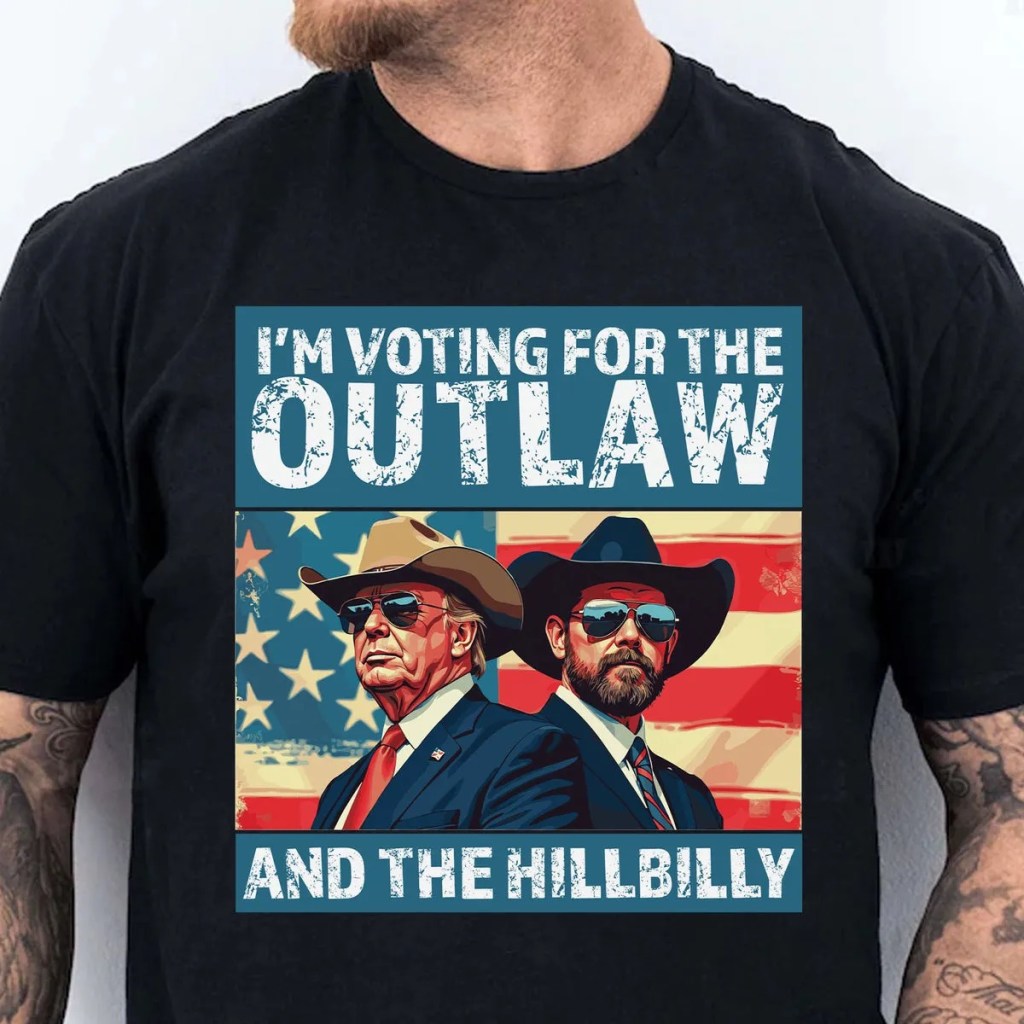
In the post at 9 a.m today, Joyce Vance included a photo of a T-shirt of Trump and Vance, billed as “the Outlaw and the Hillbilly.” Now, that’s clever marketing!
An Outlaw is often an admirable figure in westerns. He’s a folk hero. He’s the guy who goes up against the Establishment. He’s the Sundance Kid, he’s Robin Hood, he’s the handsome guy who gets the girl, he’s a lot of characters who live on the fringes of society and stand up for the little guy.
This is not Donald Trump. He is reverse Robin Hood. He steals from the poor and fattens the bank accounts of the rich. He doesn’t defend the helpless damsel, he sexually asssults her, then laughs about it and defames her. He does not stand outside society on its fringes, he owns the biggest, gaudiest mansion and installs solid gold toilet seats. Far from being handsome and buff, he is an obese old man with thinning hair and sagging jowls. He is a coward who dodged the draft five times yet pretends to be a tough guy.
As for J.D. Vance, he was once a hillbilly but that was long, long ago. Now he plays a hillbilly. He is a graduate of Yale Law School who made millions of dollars in the financial sector, where his patron was Peter Thiel, the woman-hating billionaire.
Not an Outlaw! Just a womanizing convicted felon who is a superb liar, braggart, and bully.
Not a Hillbilly! Just another far-cat who attached himself to super-rich patrons.
Trump passed one piece of legislation in his first term: a big tax cut for his billionaire buddies, corporations, and himself.
We know what his priorities are. Ego. Money. Power. Control.
He’s already forgotten about the people who voted for him. They can’t do anything for him any more. He won’t lower the price of food or gasoline or home insurance. He might take away their Social Security or Medicaid. He might cut programs they rely on.
He will take care of the people rich enough to belong to Mar-a-Lago.
Joyce Vance is a veteran federal prosecutor; she was the U.S. Attorney for the Northern district of Alabama from 2009-2017. She writes a blog called “Civil Discourse with Joyce Vance.” She usually writes about the law, the justice system, and Trump’s efforts to avoid accountability for his misdeeds. But in this post, she addresses the root cause of his appeal: low-information voters who are hoodwinked by his lies and believe he will fight for them. Ha. Not funny.
She writes:
It’s no wonder that Project 2025 calls for putting an end to the Department of Education. Trump’s electoral success depended on so-called low-information voters, members of the electorate who couldn’t or didn’t distinguish between the tough talk and tough guy image the candidate portrayed and the reality of the policies that come with his win. That’s often true for MAGA candidates, who are inexplicably able to attract the voters who are harmed by the policies they subsequently pass, as with tax cuts for the extremely wealthy and the working-class voters who didn’t benefit from them, but made them possible.
The Washington Post had this story today about the hopes of low-income voters who went for Trump in 2024, like a single mom who said she sometimes has to choose between buying toilet paper and milk and told reporters, “He is more attuned to the needs of everyone instead of just the rich … I think he knows it’s the poor people that got him elected, so I think Trump is going to do more to help us.” So far, that’s not looking good.
This very predictable reporting about voters suffering from buyers’ remorse is emerging even before Trump takes office. These people hope he won’t do exactly what he said he would during the campaign and has been focused on during his transition with programs like the Department of Government Efficiency, Elon Musk’s DOGE—cut government spending that they depend on. Whether it’s low-income people, mixed-status immigrant families, people who rely on Social Security, or parents with immune-compromised kids who rely on immunized classrooms, people voted against their own self-interest and are now facing that reality.
There are no do-overs in presidential elections. Successful disinformation campaigns or campaigns where image trumps consequences have lasting effects.
But spin, or disinformation—however you want to characterize it—designed to redirect voters away from focusing on bad facts about candidates can work, and this past election proved it. This T-shirt ad that the algorithm fed me earlier this week is an example of how Trump’s criminal conviction was sold to voters: the mythical outlaw, not the corrupt criminal. It’s hard to believe Americans fell for that, but they did, giving Trump a pass and letting him cultivate an image that was one step further out there than Sarah Palin’s maverick.
Voters who lack the backbone of a solid education in civics can be manipulated. That takes us to Trump’s plans for the Department of Education.
Stepping on education and staunching the flow of information is a key goal for any authoritarian. Remember when Trump told an evangelical group during the campaign that if they voted in 2024 it would be the last time they had to vote? That’s something that Americans, hopefully, will not fall for, because the 2026 midterms will be key. If guardrails are going to be rebuilt, that’s where an important part of it will happen. And while we’re all burned out from the last election, this next one will matter; we will need to reengage, because a big Democratic win could staunch the bleeding from unfettered acquiescence by the legislative branch to Trump, who currently commands majorities in both chambers. That means the provision of accurate information and accurate analysis of that information to voters who will put it to use is important. But what does that look like in a country that voted for Trump?
One thing that is clear from the ease with which Trump seems to have stripped so many voters of their common sense is the need to restore civics education in this country. That’s a long-term plan and a big topic that we need to take on over time, but it’s not too early for us to begin to think about what we can do in the coming year ahead of the midterms. For one thing, if it’s right for you, even if it’s a stretch, consider running or seeking appointment to a school board. Republicans got the jump on Democrats in this arena. It’s time to catch up. Or, if that’s not in your lane, make the time to show up at school board meetings and demand civics education in our schools. Progress in this area will take time, but we can all set a good example and encourage people around us to do a better job of understanding what matters in government. Ironically, if 2017 is any indication, people caught off guard (although who knows how) by some of the worst excesses Trump is likely to engage in will be ready to be better informed and reengage in democracy. Capturing that moment will be important.
One of the goals of Project 2025 is terminating the Department of Education. There is growing Republican support for that plan at the state level by leaders who want to restore state control (much like conservatives sought restoration of abortion policy to the hands of red state officials in Dobbs). Enter Trump’s nominee to head the Department, Linda McMahon, who ran the Small Business Administration (SBA) for him from 2017 to 2019.
Trump’s appointment of the professional wrestling magnate has drawn little comment as the media has focused on Matt Gaetz, Pete Hegseth, and others. Suffice it to say she does not appear to possess much of a background in public education. She was on the Connecticut Board of Education for one year, but there has been reporting she received that appointment after lying about having a degree in education. When that report came to light while McMahon was running, unsuccessfully, for a Connecticut Senate seat, she said that “she mistakenly thought her degree was in education because she did a semester of student teaching, and that she had written to the governor’s office the previous year to correct the error after another newspaper noticed the mistake.” (I, too, did some student teaching in college, but I was always clear my degree was in political science and international relations.)
McMahon is a longtime Trump ally and financial backer, apparently key qualifications for the job. After two years at the SBA, she stepped aside to run Trump’s America First Action PAC. Other qualifications: Yahoo News reported that “Donald Trump’s nominee for education secretary was once pile-driven by a 7ft wrestler and feigned being drugged unconscious while her husband cheated on her.” Yahoo went on to recount that “Mr. Trump served as a sponsor and host for WWE events in Atlantic City in the late 1980s and years later appeared in the ring himself, when he took a razor to the head of Ms. McMahon’s scandal-ridden husband, Vince, as the wrestling boss wailed. In 2013, WWE inducted Mr. Trump into its hall of fame.”
The National Education Association ran an editorial opposing McMahon’s confirmation. They called her “unqualified” and wrote that she “spent years pushing policies that would defund and destroy public schools.” That sounds like a good fit if your agenda involves destroying the Department of Education. Start at the top.
NEA President Becky Pringle said, “McMahon’s only mission is to eliminate the Department of Education and take away taxpayer dollars from public schools, where 90% of students – and 95% of students with disabilities – learn, and give them to unaccountable and discriminatory private schools.”
So while we begin to think about ways to repair democracy, medium-term goals like winning midterm elections, and long-term goals like restoring civics education, spare a moment for some short-term plans: write to your senators about McMahon’s nomination. It’s flying largely under the radar screen, and it should not be. Do not obey in advance, and do not make it easy for Trump to destroy democratic institutions like the Department of Education with the complicity of your state and federal elected officials. We have a lot of work to do when it comes to public education. We have to insist that free, publicly funded, high-quality education is available to every child. Our engagement as citizens is everything. Let’s get to work.
Allison Gill is a Navy veteran, a comedian, a podcaster, and a blogger. Her blog “Mueller, She Wrote,” was launched at the beginning of that long-ago investigation of Trump’s connections to Russia. This post appeared on her blog:
I’m not a lawyer, but usually, when the Supreme Court hears a case, they are supposed to rule on that specific case. Yet somehow, in two crucial cases about holding Donald Trump accountable for insurrection, the corrupt court went out of its way to decide on questions not before it, and create “a rule for the ages,” as Neil Gorsuch put it during oral arguments this past spring.
The first bomb they dropped to destroy accountability for Trump was their ruling overturning the Colorado Supreme Court on Section 3 of the 14th Amendment. The justices decided 9-0 that Colorado could not keep a federal candidate off the state ballot – but a 5-4 majority took it a step further by deciding that Section 3 of the 14th amendment is not self-executing; meaning Congress has to first pass legislation disqualifying Trump. An idea so wrong that even Amy Coney Barrett joined the liberal justices and objected to that part of the ruling in her concurrence.
The second bomb they dropped was the immunity ruling. Not only did they grant Trump presumptive immunity in the case before them, but they granted all presidents presumptive immunity, and took it a step further by disqualifying official acts from being used as evidence to prosecute unofficial acts.
But that’s not all! Rather than deciding which acts in the Trump case were subject to immunity, they kicked it back down to the lower court, teeing up a second interlocutory appeal on whatever the lower court ruled. That effectively added another year to the delay. Additionally, it would give the corrupt court another swing at the DoJ case on the second appeal, where I imagine they’d rip it apart once and for all. When all was said and done, they decided that they themselves would be the ultimate arbiter of rulings on official acts for criminal presidents while adding ridiculously long pre-trial appeals to the process.
That’s nothing compared to the official acts evidence part of the ruling. Again – so bad and so wrong that Amy Coney Barrett joined the liberal justices to disagree. The gist is this: let’s say you want to prosecute a president after he leaves office for accepting a million dollar bribe in exchange for an ambassadorship. And let’s say you have emails between the president and the potential ambassador explicitly stating “I will give you this ambassadorship in exchange for a million dollars.” This Supreme Court ruling says you can’t mention the appointment of the ambassador (the quo) while trying to prosecute the bribe (the quid). Absolutely bonkers.
These two rulings are the reason we can’t have nice things. That and Mitch McConnell failing to convict Trump of Insurrection after his impeachment. These decisions are the reasons Trump has not been held accountable. All because a bought-and-paid-for supreme court, funded by dark money with corporate interests before the court, needed to protect Trump from prosecution and accountability.
Were it not for the immunity ruling, Donald would have faced trial for his role in the insurrection in March of 2024. Would a conviction have made a difference in the election given he was already a 34-count convicted felon? I don’t know, but we would have had a trial were it not for the Supreme Court. The immunity ruling also contained a permission slip from Clarence Thomas in his concurrence for Aileen Cannon to dismiss the documents case, opining apropos of NOTHING that Jack Smith was probably appointed and funded improperly.
POOF. Both DoJ trials were scrapped from the pre-election calendar. But even if Trump had lost the election, there’d be a second interlocutory appeal of Judge Chutkan’s immunity determinations that would have gone all the way back up to the Supreme Court – adding at least a year to the trial calendar. Would the corrupt court have left Judge Chutkan’s ruling in place, allowing the case to go to trial? If you believe that, I have a luxury motor coach to sell you.
People have been trying to convince me that if Trump were indicted sooner, he would have gone to trial before the election and wouldn’t have been re-elected. For that to be true, you’d have to convince me that the dark money funded oligarchs on the Supreme Court would have been cool one time and allowed the trial to happen. You’d also have to convince me that people are fine electing a man convicted of 34 felonies, but not a man convicted of 38 felonies. I have my doubts.
Regardless, I will forever blame the billionaire-funded Supreme Court. They are part of the oligarchy, and were installed to dismantle democracy.



 Diane Ravitch's blog