This is an excerpt from Heather Cox Richardson’s latest dispatch. The beginning, which I skipped, is about other countries’ holding important men accountable: former Prince Andrew, for his association with Jeffrey Epstein; and the former President of South Korea, who was sentenced to life in prison, for leading an insurrection to take control of the government.
There’s an implicit lesson here about accountability and lack thereof. None of the powerful men who are named in the Epstein Files have been prosecuted in this country. The Department of Justice redacted many or most of their names to be sure they would not be held to account. Those who led the insurrection of 2021 were never held accountable. Its foot soldiers were tried and convicted, but have since been pardoned by the leader of the insurrection.
The part that I thought you would find interesting are the latest examples of Trump’s vaingloriouness.
Today Trump’s Commission of Fine Arts swore in two new members, including Chamberlain Harris, Trump’s 26-year-old executive assistant, who has no experience in the arts. Then the commission, now entirely made up of Trump appointees, approved Trump’s plans for a ballroom where the East Wing of the White House used to stand, although the chair did note that public comments about the project were over 99% negative.
According to CNN’s Sunlen Serfaty, Harris said the White House is the “greatest house in [the] world. We want this to be the greatest ballroom in the world.” Trump says the ballroom is being funded by private donations through the Trust for the National Mall, which is not required to disclose its donors.
Today workers hung a banner with a giant portrait of Trump on the Department of Justice building.
On Air Force One as Trump traveled to Georgia this afternoon for a speech on the economy, Peter Doocy of the Fox News Channel asked Trump about the arrest of Mountbatten-Windsor. “Do you think people in this country at some point, associates of Jeffrey Epstein, will wind up in handcuffs, too?”
Trump answered: “Well, you know I’m the expert in a way, because I’ve been totally exonerated. It’s very nice, I can actually speak about it very nicely. I think it’s a shame. I think it’s very sad. I think it’s so bad for the royal family. It’s very, very sad to me. It’s a very sad thing. When I see that, it’s a very sad thing. To see it, and to see what’s going on with his brother, who’s obviously coming to our country very soon and he’s a fantastic man. King. So I think it’s a very sad thing. It’s really interesting ‘cause nobody used to speak about Epstein when he was alive, but now they speak. But I’m the one that can talk about it because I’ve been totally exonerated. I did nothing. In fact, the opposite—he was against me. He was fighting me in the election, which I just found out from the last three million pages of documents.”
In fact, Trump has not been exonerated.
When he got to Georgia, Trump’s economic message was that “I’ve won affordability.” More to the point was his focus on his Big Lie that he won the 2020 election and that Congress must pass the Safeguard American Voter Eligibility (SAVE) America Act to secure elections. In fact, in solving a nonexistent problem, the law dramatically restricts voting. Republicans in the House have already passed it. If the Senate passes it, Trump told an audience in Rome, Georgia, “We’ll never lose a race. For 50 years, we won’t lose a race.”
Why did she say he was not exonerated? She may have been referring to this case or to the many photos of Epstein and Trump together, in some photos with young girls.
Just when you thought that you had heard “the worst decision” by the Trump regime, the one that will hurt people the most, along comes another. Trump is well known for denying climate change. Just days ago, his Environmental Protection Agency announced that it would no longer regulate the discharge of deadly gases. Perhaps it should change its name to the Environmental Pollution Agency.
But here comes another scientific reverse, possibly tied not to ideology, but to politics.
A leading American research lab is slated to lose its critical supercomputing facility, according to a letter released Thursday by the National Science Foundation.
The computing center, which is slated to be turned over to an unspecified third party, runs weather and climate research models and is used by about 1,500 researchers from over 500 universities around the country. The work done on this supercomputer benefits the American people by leading to more accurate forecasts of extreme weather and climate events, aircraft turbulence and more.
The problem with spinning off the computing center away from the research center is that it could disrupt access to high performance computing. Muchas with AI, high power computing is essential for simulating weather and climate and for evaluating the accuracy of new forecast models, which eventually end up contributing to what Americans see in the weather apps each day…
Some Colorado officials view the move as part of a retribution campaign being waged by the White House that is designed to pressure Colorado Governor Jared Polis, a Democrat, into granting clemency to Tina Peters, a former county election clerk who was convicted in a 2020 election-related data breach scheme. Peters is a prominent 2020 election denier.
“I will commit to not firing anybody who’s doing their job.”
“I support vaccines. I support the childhood schedule.”
“My approach to HHS, as I said before…, is radical transparency.”
“I’m pro-good science.”
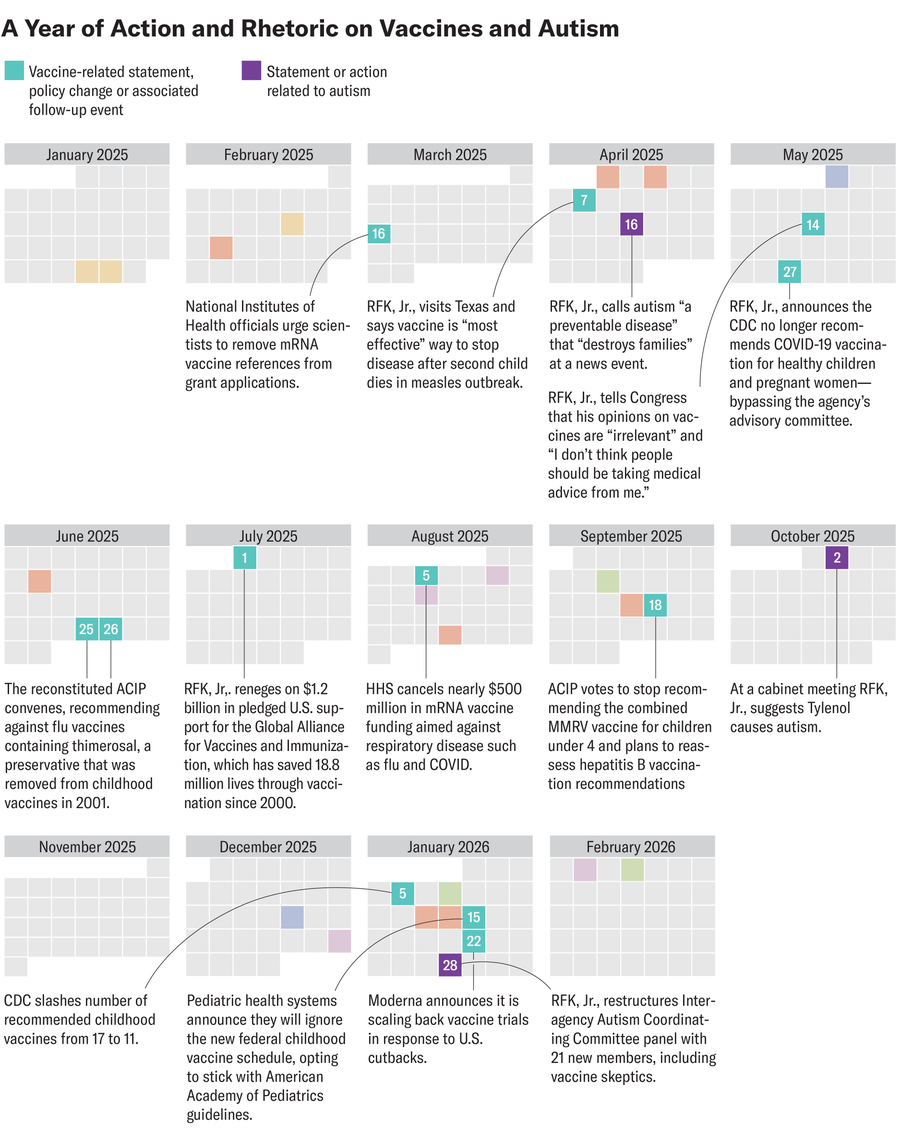
Health experts say Kennedy has made sweeping reversals on these statements. His HHS tenure has seen the U.S. childhood vaccine program reduce the number of recommended shots to protect against 11 diseases instead of 17, thousands of public servants (many of them scientists) have been fired, standard-setting scientific practices at the Centers for Disease Control and Prevention, Food and Drug Administration and National Institutes of Health have been replaced with “gold-standard” dictates that scientists call dishonest, and judges have blocked funding cuts as illegal. Kennedy and HHS officials did not respond to requests for comment.…”
The secretary has spoken broadly about his goals this year to Congress and the public. In September, before a Senate panel, he described his “big-picture” mission as “enacting a once-in-a-generation shift from a sick care system to a true health care system that tackles the root causes of chronic disease.” His “Make America Healthy Again” (MAHA) agenda, now wedded to President Donald Trump’s “Make America Great Again” movement, puts Kennedy atop a new, unorthodox American political coalition. It unites a partisan distrust of science with a deep-rooted skepticism of medicine and the food industry. Roughly four in 10 parents are supporters of the MAHA movement, according to a KFF survey.
“Who can argue with the foundational goal of ‘Making America Healthier Again’? We want parents to want healthier lives for their children,” says Washington University in St. Louis School of Public Health dean Sandro Galea, author of the book Within Reason: A Liberal Public Health for an Illiberal Time. Many of the goals of the MAHA movement—including increasing stalled U.S. life expectancies, bettering childhood health and addressing overmedicalization—are shared by public health experts.
“It would be great to see MAHA be a force for good,” Galea says. “But some of its ideas, frankly, will end up hurting people.” Notably, Kennedy’s decisions on vaccines will inevitably lead to outbreaks, Galea says, and the return of preventable infectious diseases such as measles. “We really haven’t seen an HHS tenure like this in our lifetimes.”
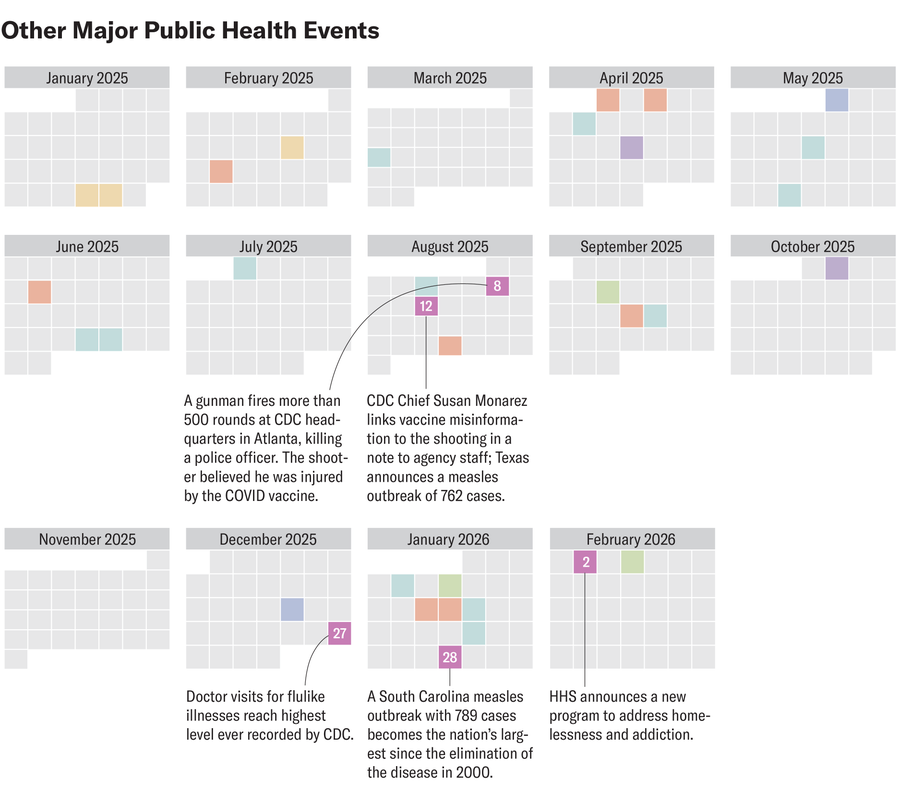
HHS is largely the national social insurance arm of the U.S., with a sideline in medical research and public health. It oversees the massive Social Security, Medicare and Medicaid programs, as well as the FDA, CDC and NIH. In many ways, the colossal agency today continues to function as normal: Social Security checks, Supplemental Security Income or both still lands in nearly 75 million mailboxes every month, one in five Americans receives Medicaid coverage, and the Affordable Care Act that the department administers still covers more than 24 million people nationwide despite Trump administration cuts to health insurance and food assistance. On February 2 Kennedy announced a $100 million pilot program to fund outreach, medical treatment and other support for homeless people and those with substance use disorders in eight cities—in the kind of bipartisan response to the overdose crisis long sought in the public health world.
This kind of tumult is now standard fare at HHS. In his first year, Kennedy fired his own handpicked CDC chief, linked Tylenol to autism with little evidence and urged farmers to let bird flu “run through” their flocks (an idea that could blow chicken prices skyward and spur spread of the virus, experts say). All told, the agency lost more than 17,000 civil servants through firings and resignations in 2025—including many scientific leaders at the FDA, CDC and NIH. An HHS spokesperson defended Kennedy’s cuts to “bloated bureaucracies that were long overdue” to ProPublica in August.
In the September Senate hearing, Kennedy accused one critical lawmaker of “crazy talk” and took out his phone and began scrolling through it while another spoke. “We’re denying people vaccine,” said senator Bill Cassidy of Louisiana, the physician chair of the Senate health committee. “You’re wrong,” Kennedy replied to Cassidy, who provided a crucial Republican vote last February for Kennedy’s confirmation.
Kennedy “comes across as a privileged rich guy with an air of entitlement,” says American Public Health Association executive director Georges Benjamin, whose organization called for Kennedy to resign in April after the mass layoffs at the CDC, FDA and other health agencies. “He’s completely in over his head at this job, has no experience, no training in areas of health he’s affecting and is causing a lot of harm.”
VACCINES
Kennedy has a long history of vaccine opposition. He joined the board of the antivaccine nonprofit Children’s Health Defense in 2015, when it was known as the World Mercury Project (and resigned from his position as chairman in 2024); the organization led numerous lawsuits against vaccine makers. The move from environmental lawyer to antivaccine activist turned out to be well timed for postpandemic politics; attacking COVID vaccines wooed Republican voters. At his confirmation hearing, Kennedy refused to disavow links between vaccines and autism, a favorite theory of outfits spurring vaccine hesitancyamong parents, though numerous studies have found no connection. “News reports have claimed that I am antivaccine or anti-industry,” Kennedy said at his confirmation hearing. “I am neither; I am pro-safety.” What Kennedy meant then by safety has since become clear, Benjamin says: his own judgment.
The FDA’s top vaccine official, Peter Marks, resigned in March, writing of Kennedy, “truth and transparency are not desired by the secretary, but rather he wishes subservient confirmation of his misinformation and lies.” During the pandemic, Marks had famously withstood political pressure to approve COVID shots without safety testing. Now he is out. An HHS official told NPR that Marks “has no place at FDA” because of his opposition to the secretary “restoring science to its golden standard and promoting radical transparency” at the agency.
Kennedy later claimed Monarez had told him she wasn’t “trustworthy”; in Senate testimony, she denied doing so. “The question before us is whether we will keep faith with our children and grandchildren—ensuring they remain safe from the diseases we fought so hard to defeat: polio, measles, diphtheria, whooping cough and many others,” Monarez said at the September 17 Senate hearing. “Undoing that progress would not only be reckless—it would betray every family that trusts us to protect their health.”
In December Kennedy’s reconstituted vaccine panel voted to stop recommending that all newborns be vaccinated for hepatitis B, a disease that contributed to the deaths of 1.1 million people worldwide in 2022. HHS next reduced the number of U.S. childhood vaccine shots so that they protected against 11 diseases instead of 17, basing the decision on the rules of Denmark, a country with a relatively small and homogenous population and publicly funded health care for all. Most recently, the chair of the vaccine panel, a cardiologist, told POLITICO that its focus this year will be on examining vaccine side effects rather than on its longstanding mission of gauging vaccine effectiveness.
WELLNESS
“I walk through the airports today…, and I see these kids that are just overburdened with mitochondrial challenges,” Kennedy said in August at a Texas “Make America Healthy Again” state-law-signing ceremony. Ashish Jha, formerly the Biden administration’s pandemic response czar, called this airport diagnosis “wacky, flat-earth voodoo stuff” on X (formerly Twitter).
“I think what we’re seeing is a mutual partnership between RFK, Jr., and what he says he values and the existing MAHA values and ideals,” says Mariah L Wellman of Michigan State University, a wellness industry scholar. Kennedy’s rhetoric reflects a common ground with influencers like Means, she adds. “I absolutely think there are deep ties between how the wellness industry exists [and] is talked about on social media right now and RFK, Jr.’s beliefs.”
In May, at a Senate Finance Committee hearing, Kennedy called for an end to genetic research on the causes of autism, instead suggesting that “environmental toxins” were the source. Kennedy often claims there that there is an autism “epidemic,” but improved diagnosis largely explains the recent rise in cases.
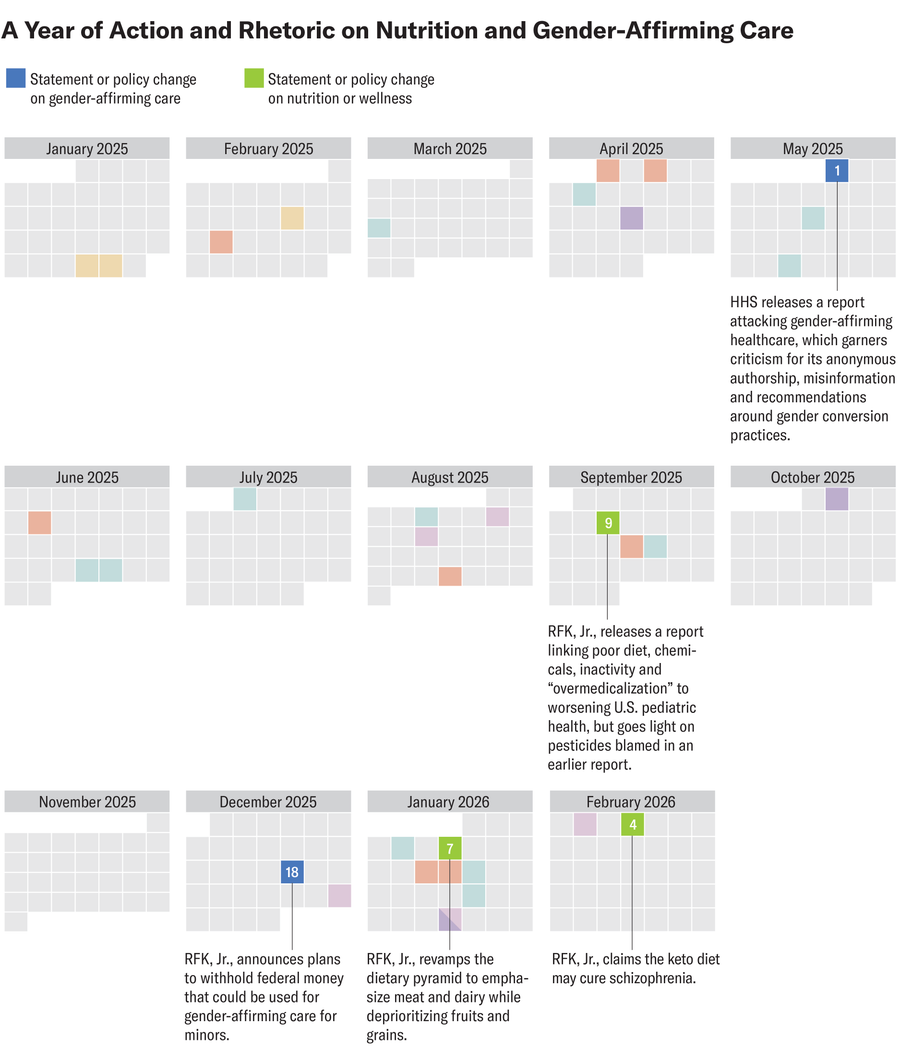
A MAHA commission report released by HHS in September reflected the movement’s signature mixture of concern over real problems, such as rising childhood obesity and illness, with Kennedy’s “pet peeves and half-baked science that doesn’t really get at the root causes of poor health in children,” says Peter Lurie of the Center for Science in the Public Interest. Alongside calls for research on cell-phone-signaleffects on health and vaccine injuries, the report went light on investigating pesticides and the food industry, disappointing some environmental figures.
In September Kennedy joined Trump in suggesting that Tylenol use during pregnancy causes autism—another belief taken up by the wellness industry—based on weak evidence. Scientists, however, say that if the medicine is linked with autism—a connection that’s not yet clear—it could be the fevers and infections the Tylenol was meant to address, and not the pills themselves, that drives increased autism risk. Nevertheless, HHS started the process for an FDA warning to be added to the pain reliever’s label.
The recommendations fit a pattern of Kennedy’s, Benjamin says. “I see him as a sort of environmental purist of sorts,” he says, rejecting medicine just as he once opposed pollution as an environmental lawyer. Fatty “real” foods, even if they are linked to heart disease, look less threatening to a worldview shaped by fears of something “artificial” causing harm, even if (unnatural) prescription drugs such as statins actually reduce the risk of heart disease. “He is an advocate, and he sees the world as a place for advocacy, not [for] the balanced perspective of a scientist or physician,” Benjamin says.
Antidepressants and heart disease medications are now in MAHA’s sights. Kennedy has claimed that medications such as these are overprescribed as a result of what he says is corruption that has affected medical studies—a charge that echoes his environmental movement rhetoric.
POLITICS
“Don’t you want a president that is going to make America healthy again?” Kennedy said at an August 23, 2024, campaign rally in Glendale, Ariz., in which he endorsed Trump. At the event, as Trump was introducing Kennedy to his supporters, he announced his intention to release the assassination files of Kennedy’s uncle John F. Kennedy…
“RFK, Jr., certainly has his own goals and ideology that overlap with Trump’s and are also distinct,” says Pamela Herd of the University of Michigan’s Gerald R. Ford School of Public Policy. “But at the end of the day, it is the Trump administration, and he will be limited to what it is, or isn’t, comfortable with.”
At a December campaign rally-style briefing from the first-floor stage of HHS’s headquarters at the Hubert H. Humphrey Building in Washington, D.C., Kennedy announced sweeping plans to restrict gender-affirming care for U.S. minors. Kennedy recognized political activists and conservative politicians in his opening remarks. Gender-affirming care has not been a historical preoccupation of Kennedy or the wellness industry but rather one “where the [Republican] party sees an advantage,” POLITICO observed.
“I think the MAHA and MAGA [movements] are intersecting circles in a Venn Diagram,” says political scientist David Lewis of Vanderbilt University. Right now, the two movements form a political coalition held together by Trump, he says.
Overall, the most significant effect of Kennedy’s tenure at HHS, Herd says, is his firing of scientific leaders and replacing expertise with political activism, most notably in upending the childhood vaccine schedule. The politicization genie won’t easily go back in the bottle, she says. “I think this this is a much more kind of radical change and one that’s difficult to pull back.”
MAHA and MAGA are now inextricably linked. In February Kennedy spoke at the right-wing Heritage Foundation’s event “One Year of Making America Healthy Again,” attended by political activists and Senator Tommy Tuberville. There Tony Lyons, president of the political group MAHA Action, described the group’s commitment to backing Republican candidates endorsed by Trump, a sign that the political coalition forged in the 2024 election will hold into the midterms. “It’s a joy to work for [Trump],” Kennedy said onstage. “He lets me do stuff that I don’t think anybody else would ever let me do.”
DAN VERGANO is senior editor, Washington, D.C., at Scientific American. He has previously written for Grid News, BuzzFeed News, National Geographic and USA Today. He ischair of the New Horizons committee for the Council for the Advancement of Science Writing and a journalism award judge for both the American Association for the Advancement of Science and the U.S. National Academies of Sciences, Engineering, and Medicine.
It’s Time to Stand Up for Science
If you enjoyed this article, I’d like to ask for your support. Scientific American has served as an advocate for science and industry for 180 years, and right now may be the most critical moment in that two-century history.
I’ve been a Scientific American subscriber since I was 12 years old, and it helped shape the way I look at the world. SciAm always educates and delights me, and inspires a sense of awe for our vast, beautiful universe. I hope it does that for you, too.
If you subscribe to Scientific American, you help ensure that our coverage is centered on meaningful research and discovery; that we have the resources to report on the decisions that threaten labs across the U.S.; and that we support both budding and working scientists at a time when the value of science itself too often goes unrecognized.
President Trump claims to be deeply concerned about anti-Semitism and discrimination against whites, both here and abroad. But he is persistently indifferent to racism directed towards people of color. He is keen to aid whites who suffer because of government programs intended to help people of color (DEI), but blind to historic and persistent racism directed at people who are Black and brown.
Trump’s racism showed when he nominated a man named Jeffrey Carl to be assistant secretary of state for international organization affairs, Carl had served as a deputy assistant secretary of the interior in the first Trump administration. He has sterling academic credentials. But even some Republicans are unnerved by his views about race.
Carl is committed to the importance of protecting white identity. At his senate confirmation hearings, he explained his concerns about “white erasure.”
The New York Times reported, “After nervously rambling about white food and Black food, white music and Black music and white worship styles, Mr. Carl told the Senate Foreign Relations Committee that a loss of a dominant white culture is weakening the country. That notion has become an intellectual framework animating much of what has been described as the New Right.“
Carl is “a proponent of ‘national conservatism,’ a movement that holds that American society lost its moorings when it drifted from a core power structure centered on the Christian white men who founded the nation and instead embraced diversity, multiculturalism and feminism…”
Mr. Carl has argued that white people should organize as a group to protect their rights.
“White Americans are increasingly second-class citizens in a country their ancestors founded and in which, until recently, they were the overwhelming majority of the population,” he writes in his 2024 book, “The Unprotected Class: How Anti-White Racism Is Tearing America Apart…”
Mr. Carl has also espoused the Great Replacement Theory, the notion that Western elites, sometimes manipulated by Jews, want to “replace” white Americans with nonwhite immigrants.
Carl openly espouses views that are far out of the mainstream, although his confirmation might redefine the “mainstream.”
Civil rights organizations oppose Carl’s nomination. At the close of the Senate hearings, Republican Senator John Curtis of Utah said that he would not support Carl’s nomination.
We will keep an eye on this nomination to gauge the Republican party’s stance on the issues that Carl raises.
A blogger who calls himself “This Will Hold” wrote a startling post about Jeffrey Epstein’s Zorro Ranch in New Mexico. The sprawling ranch was bought by a Trump ally. Unlike Epstein’s other properties, Zorro Ranch was never searched by the FBI. Why not?
In 2023, four years after Jeffrey Epstein suspiciously died in federal custody, one of the most controversial properties in modern criminal history quietly changed hands.
Zorro Ranch, Epstein’s sprawling New Mexico estate in southern Santa Fe County, was sold to San Rafael Ranch LLC, a limited liability company created just one month before the purchase. The final sale price has not been publicly disclosed. The property was originally listed for $27.5 million before the price was reduced to $18 million.
Public records have revealed that San Rafael Ranch LLC is tied to the family of Don Huffines, a Trump-aligned former Texas state senator and current candidate for Texas Comptroller. Tax protest filings obtained through a public records request list Huffines’ wife as an owner of the ranch and son Colin Huffines, as manager.
According to the Santa Fe New Mexican, in those filings the family sought to reduce the property’s taxable valuation to approximately $13.4 million, citing the “notoriety” of the estate as a factor affecting its value.
What remains less clear is why Zorro Ranch—unlike Epstein’s other properties—was never subjected to a federal search.
The Allegations That Should Have Triggered an Excavation
In November 2019, months after Epstein’s arrest and death, the U.S. Department of Justice documented an email that, if credible, should have required immediate forensic action.
The email, included in newly released DOJ files, was sent from an encrypted ProtonMail account by someone identifying themselves as “a former staff at the Zorro.” The sender attached six videos of sexual abuse by Jeffrey Epstein and alleged that “two foreign girls were buried on orders of Jeffrey and Madam G” in the hills outside Zorro Ranch.
The email claimed the girls “died by strangulation during rough, fetish sex.”
“Madam G” is widely understood to refer to Ghislaine Maxwell, who is currently serving a 20-year federal sentence for sex trafficking. It’s noted that one of the videos is a suicide attempt confession from a girl in the Bay Area.
A note on another of the videos: 7 mins 31 secs underage girl (Matthew Mellon video).
Matthew Mellon, yet another billionaire in the Epstein class, dined with Donald Trump in March of 2018 before flying to Mexico in April to check into a rehabilitation clinic. But the 54-year-old banking heir never made it to the treatment facility—according to one report, Mellon was experimenting with ayahuasca, a hallucinogenic drink, and died from a heart attack after taking it.
Matthew Mellon isn’t the first member of the Mellon family to appear in the Epstein files. As we previously reported, Paul Mellon showed up on Epstein’s flight logs—and Timothy Mellon, his son, donated $126 million to Trump’s 2024 campaign. Perhaps to protect the family name?
The allegations in the email—involving sex crimes against minors and claims that girls were buried on the property—remain unsubstantiated, which is not surprising given that the ranch was never subjected to a forensic search.
How Thoroughly the Other Properties Were Searched
The absence becomes more striking when compared to the aggressive and highly visible searches conducted elsewhere.
The contrast is stark.
Across nearly two decades—from the original Palm Beach investigation through the 2019 federal case—Epstein’s other properties were searched extensively.
Palm Beach Mansion
Epstein’s waterfront Palm Beach estate was the epicenter of the original criminal investigation that began in 2005.
Palm Beach Police conducted a months-long investigation that included:
Computers and records were seized as part of international cooperation efforts. The federal investigative net extended across state lines and international borders.
And stopped at the state lines of New Mexico.
The Property at the Center of the Silence
The estate spans nearly 8,000 acres of high desert terrain, plus an additional 1,200 acres leased from the State of New Mexico. It includes:
A private airstrip
Multiple residences and guest houses
Remote hills and open desert land
Secure entry structures
DOJ files include photographs labeled “Zorro Aug 2002,” showing unidentified young women with their faces redacted at the ranch. Flight logs show hundreds of trips to the ranch over two decades and survivor testimony places abuse there.
In August 2019, multiple survivors addressed the court during a hearing against Jeffrey Epstein before the case was dismissed following his death.
Chauntae Davies testified that she was flown to Zorro Ranch both on a commercial flight and on Epstein’s private plane on at least two occasions. She stated that she was raped both times.
Virginia Roberts Giuffre alleged in a lawsuit—later settled—that she was trafficked to the ranch as a minor. In her memoir, she recalled that Epstein brought in “foreign girls who couldn’t communicate in English,” and that “Epstein laughed about the fact they couldn’t really communicate, saying that they are the ‘easiest’ girls to get along with.”
As scrutiny of Epstein intensified, the ranch itself drew attention. In August 2018, Zorro Ranch was burglarized. A gun safe reportedly containing 30–40 firearms was removed.
According to reports at the time, the perimeter fence had been cut, and the intruders appeared to know the precise location of the safe. In addition to the weapons, a small number of antique lamps were also taken.
Several structures can be seen in aerial photo and video of the property, including what appears to be an industrial-grade landfill. In 2019 an FBI tip from a retired New Mexico State Police officer who lived near the ranch reported a newly constructed “suspicious barn” with what appeared to be a “sally port” (double-door entry system used in prisons) and a chimney.
He was “concerned the property could potentially have an incinerator concealed within the barn.”
A crematorium?
Individually, each detail might have explanation—but collectively, they form a series of investigative leads.
None resulted in a forensic search.
Political Proximity
Epstein purchased Zorro Ranch in 1993 from former New Mexico Governor Bruce King. His son, Gary King, later served as New Mexico’s Attorney General.
The late Governor Bill Richardson appears on Epstein flight logs, in victim depositions, and in DOJ communications referencing the ranch. And internal DOJ emails show Epstein’s continued communication with Richardson following his 2008 Florida conviction.
Virginia Giuffre, who sued Maxwell for defamation, provided photos of herself at the ranch in a 2015 court document. Giuffre said that Epstein trafficked her to powerful men at the ranch, including the late Bill Richardson, who served as New Mexico governor from 2003 to 2011.
After his 2008 conviction, Epstein was not required to register as a sex offender in New Mexico and the state continued leasing him public land attached to the ranch.
These are documented facts.
Does Epstein’s proximity to political elites explain the absence of a federal search?
When federal authorities brought excavation equipment to Little St. James and catalogued evidence floor by floor in Manhattan, why was nearly 8,000 acres of New Mexico desert left untouched?
If nothing is there, a search would settle it.
If something is there, the land holds the answer.
For now, Zorro Ranch remains the only major Epstein property tied to survivor testimony that has never been publicly examined with the same rigor.
And that distinction continues to raise questions.
We have long known that Donald Trump despises science. We also know that he refuses to accept the science concerning climate change. Yesterday, Trump accepted an award as the “Champion of Coal.” He wants to turn the clock back a century. He will go down in history for his willful ignorance and for the harm he has unleashed on the public.
*The Trump administration has repealed the 2009 endangerment finding on greenhouse gases, eliminating the foundation of much of U.S. climate policy.
*The decision reverses decades of environmental progress despite overwhelming scientific evidence and opposition from health experts, environmental groups, 50 cities and 17 states.
*Experts warn the repeal will increase pollution, respiratory disease and planet-warming emissions over the coming decades.
The Trump administration on Thursday reversed the U.S. government’s longstanding scientific assertion that planet-heating pollution seriously threatens Americans, erasing a foundational piece of the country’s efforts to address climate change.
The repeal of the 2009 endangerment finding — a conclusion based on decades of science that carbon dioxide and other greenhouse gases endanger public health and welfare — represents one of the biggest environmental rollbacks in U.S. history, and the latest in a series of actions by President Trump to scrap policies and regulations designed to curb the use of fossil fuels and accelerate the transition to clean energy.
The administration on Thursday also repealed all federal regulations governing vehicle emissions.
Experts and scientists condemned the action. The Environmental Protection Network — a bipartisan group of more than 700 former staff and appointees at the Environmental Protection Agency — described it as “unprecedented and dangerous.”
“This move is a fundamental betrayal of EPA’s responsibility to protect human health,” said Joseph Goffman, former assistant administrator of the EPA Office of Air and Radiation. “It is legally indefensible, morally bankrupt and completely untethered from the scientific record.”
Independent researchers around the world have long concluded that greenhouse gases released by the burning of gasoline, diesel and other fossil fuels are warming the planet and worsening weather disasters.
Jamelle Bouie, a columnist for The NewYork Times,writes here about a question that has puzzled many observers: what motivates Trump? Some would say he ran the first time out of sheer egoism and the second time to stay out of jail. Or, he ran the first time because of his innate competitiveness and the second time because he figured out how to monetize the Oval Office.
Bouie has a different take.
He wrote:
What motivates Trump?
Not what motivates Trumpism, whatever that is. Not what motivates his MAGA supporters. Not what motivates the infrequent and marginal voters who delivered him his victories in 2016 and 2024.
No. What specifically motivates Donald J. Trump? What brought him into national politics? What drives him as a national political figure?
His allies say a love of country, but this is betrayed by his indifference to the nation’s ideals, traditions and symbols. It is unclear whether Trump has even read the Constitution, and there’s no evidence that he understands its history and significance to the nation he leads. (It would be unfair to ask whether he’s read the Declaration of Independence — we all know he hasn’t.)
The best way to understand the president’s motivations is to find him at his most unfiltered, which is to say, on social media, late at night. And Thursday night, Trump posted a video to his Truth Social account that depicted President Barack Obama and Michelle Obama as apes. The clip, which runs for roughly a minute and shows the Obamas at the end, is set to “The Lion Sleeps Tonight.”
I try to avoid superlatives in my writing, but there is simply no question that this is the most flagrant display of presidential racism since Woodrow Wilson screened D.W. Griffith’s “The Birth of a Nation” in the White House in 1915. And for a sense of the racism of Griffith’s film, recall that it both reinvigorated the Ku Klux Klan and gave the organization its modern iconography.
I doubt that Trump’s video — less a creative product than half-baked agitprop — will have the same effect. But it carries many of the same messages. It uses an old white supremacist trope to denigrate the Obamas and, by extension, every American who shares their racial background. It presents people of African descent as little removed from beasts, an insult used to great effect in “The Birth of a Nation,” as you can see in this clip from the film.
Initially, the White House defended the video as a joke. “This is from an internet meme video depicting President Trump as the King of the Jungle and Democrats as characters from the Lion King,” Karoline Leavitt, the press secretary, said. “Please stop the fake outrage and report on something today that actually matters to the American public.”
But then Republicans began to speak out. “Praying it was fake because it’s the most racist thing I’ve seen out of this White House,” Senator Tim Scott of South Carolina, the only Black Republican in the Senate and the head of the National Republican Senatorial Committee, posted online.
Representative Mike Lawler, an otherwise stalwart Trump ally, said the video was “wrong and incredibly offensive.” Representative Michael Turner of Ohio decried the “racist images” as “offensive, heart breaking and unacceptable.”
Here, I should probably note that Barack and Michelle Obama are among the most popular political figures in the United States. Trump, on the other hand, is barely treading water with the public, and majorities of Americans say the country is headed in the wrong direction. It makes sense, then, that some Republicans would use this as an opportunity to distance themselves from an unpopular incumbent.
Let’s walk back to where we started. What motivates Trump? The answer is simple: racism. You might also say ego and raw self-interest, but the two are connected. Racism, among other things, is a kind of chauvinism, a belief in one’s inherent superiority, based on nothing other than a meaningless accident of birth. It’s an ideology that papers over feelings of inadequacy, that tells you that — no matter what you have or have not accomplished in your life — you’re still better than someone, some group.
Let’s suppose you’re the spoiled son of a self-made man. Let’s suppose that, despite your flash and bravado, you’ve failed at virtually everything you’ve tried. You’re the laughingstock of polite society, a punchline for the privileged. You think you’re superior enough to be the president of the United States — the highest honor in your country — but the actual president is a man of humble origins, a minority of the kind your family didn’t even rent to when you were in the landlord business. And he is claiming power that rightfully belongs to you. He’s even mocking you, ridiculing you for all the world to see.
For years, a cottage industry of political observers has contorted itself to obscure and occlude the obvious. That regardless of what others see in him, Trump’s entire political career — from his embrace of birtherism to his hatred of birthright citizenship — cannot be understood outside the context of his bitter, deep-seated racism.
Trump is not profound. He has been the same person this whole time. The question is why so many others have refused to see what he has never bothered to hide.
The New York Times reported that Trump is peddling access to him for $1 million and more as part of the nation’s 250th anniversary. I have posted a link to a gift article so you can read it in full.
President Trump’s allies are offering access to him and other perks to donors who give at least $1 million to a new group supporting flashy initiatives he is planning around the nation’s 250th birthday, according to documents and interviews.
The group, Freedom 250, is threatening to overshadow years of plans meant to reach the broadest cross section of Americans for semiquincentennial celebrations. They are now taking on a Trumpian flare, replete with marble and machismo.
But Freedom 250 has also emerged as another vehicle, akin to the White House ballroom project, through which people and companies with interests before the Trump administration can make tax-deductible donations to gain access to, and seek favor with, a president who has maintained a keen interest in fund-raising, and a willingness to use the levers of government power to reward financial supporters..
Several of Freedom 250’s planned events and monuments lack obvious connections to the Boston Tea Party, the signing of the Declaration of Independence or other seminal moments in the nation’s founding. Rather, they are tailored to Mr. Trump’s political agenda and his penchant for spectacle, personal branding and legacy. They include the construction of an arch overlooking Washington, an IndyCar racethrough the nation’s capital, a national prayer event and an Ultimate Fighting Championship match on the White House lawn to coincide with the president’s 80th birthday.
Meredith O’Rourke, the president’s top fund-raiser, is amassing private donations for Freedom 250. Her team is circulating a solicitation, obtained by The New York Times, offering “bespoke packages” for donors.
While there are inconsistencies in the solicitation language, the detailed breakdowns of packages for donors indicate that those who give $1 million or more will get invitations to a “private Freedom 250 thank you reception” hosted by Mr. Trump, with a “historic photo opportunity.” Those who give $2.5 million or more also are being offered speaking roles at an event in Washington on July 4.
There is no end to the possibilities for selling access to Trump.
The Fifth Circuit Court of Apoeals ruled in favor of Trump’s deportation policy, even for immigrants who had committed no crimes and lived in this country for decades. In a split decision, 2-1, the Court gave Trump a victory in his efforts to remove immigrants.
A federal appeals court Friday night backed the Trump administration’s policy to lock up the vast majority of people it is seeking to deport without offering a chance for bond, even if they have no criminal records and have resided in the country for decades.
A divided three-judge panel of the 5th Circuit Court of Appeals concluded that the administration’s view — a reversal of every administration’s position for the last 30 years — is the correct interpretation of the federal government’s power to detain people targeted for deportation.
“That prior Administrations decided to use less than their full enforcement authority … does not mean they lacked the authority to do more,” Judge Edith Jones, a Reagan appointee, wrote for the 2-1 majority.
The matter could soon be headed for Supreme Court consideration.
Immigration and Customs Enforcement adopted a new view of the law in July, prompting an explosion of arrests and detentions — and a flood of lawsuits from detainees who argued that they were illegally locked up without due process.
The vast majority of judges across the country have rejected the administration’s approach. A POLITICO review of thousands of ICE detention cases found that at least 360 judges rejected the expanded detention strategy — in more than 3,000 cases — while just 27 backed it in about 130 cases.
Jones was joined in the decision by Judge Kyle Duncan, a Trump appointee. Judge Dana Douglas, a Biden appointee, said in a dissent that the panel’s view would require the detention of as many as 2 million immigrants residing in the United States without bond — “some of them the spouses, mothers, fathers, and grandparents of American citizens.”
So, it seems that the brutal tactics of ICE have won approval by the Fifth Circuit Court of Apoeals. The masked men may continue to break into homes, smash car window, and handcuff their prey, without due process, even though most of those they arrest have not committed crimes, and some are American citizens. It’s not the “worst of the worst” that Trump is deporting but people who are gainfully employed, who contribute to their communities, and who are good neighbors. Their “crime” is that they have not been able to master the maze of attaining citizenship.
Several years back, I employed a handyman who was very responsible and efficient. He was from Guatemala. He was very active in the local Catholic Church. He was a good worker on construction jobs, and his employer paid him $25 an hour. He did not have papers. I called an immigration lawyer and asked if I could help Jose get papers. He said “the only way you can help him get papers is to marry him. There is no other way.”
The problem was that I was married already, and so was Jose. Two years ago, Jose went home to Guatemala. His timing was excellent.



 Diane Ravitch's blog