Archives for category: Trump

Heather Cox Richardson is an American historian at Boston College. I enjoy reading her views, which are always well-informed.

She writes:

December 30, 2021

Heather Cox RichardsonDec 31

On January 6, insurrectionists trying to overturn the results of the 2020 presidential election stormed the U.S. Capitol and sent our lawmakers into hiding. Since President Joe Biden took office on January 20, just two weeks after the attack, we have been engaged in a great struggle between those trying to restore our democracy and those determined to undermine it. 

Biden committed to restoring our democracy after the strains it had endured. When he took office, we were in the midst of a global pandemic whose official death toll in the U.S. was at 407,000. Our economy was in tatters, our foreign alliances weakened, and our government under siege by insurrectionists, some of whom were lawmakers themselves.

In his inaugural address, Biden implored Americans to come together to face these crises. He recalled the Civil War, the Great Depression, the World Wars, and the attacks of 9/11, noting that “[i]n each of these moments, enough of us came together to carry all of us forward.” “It’s time for boldness, for there is so much to do,” he said. He asked Americans to “write an American story of hope, not fear… [a] story that tells ages yet to come that we answered the call of history…. That democracy and hope, truth and justice, did not die on our watch but thrived.”

Later that day, he headed to the Oval Office. “I thought there’s no time to wait. Get to work immediately,” he said.

Rather than permitting the Trump Republicans who were still insisting Trump had won the election to frame the national conversation, Biden and Vice President Kamala Harris, as well as the Democrats in Congress, ignored them and set out to prove that our government can work for ordinary Americans.

Biden vowed to overcome Covid, trying to rally Republicans to join Democrats behind a “war” on the global pandemic. The Trump team had refused to confer during the transition period with the Biden team, who discovered that the previous administration had never had a plan for federal delivery of covid vaccines, simply planning to give them to the states and then let the cash-strapped states figure out how to get them into arms. “What we’re inheriting is so much worse than we could have imagined,” Biden’s coronavirus response coordinator, Jeff Zients, said to reporters on January 21.

Biden immediately invoked the Defense Production Act, bought more vaccines, worked with states to establish vaccine sites and transportation to them, and established vaccine centers in pharmacies across the country. As vaccination rates climbed, he vowed to make sure that 70% of the U.S. adult population would have one vaccine shot and 160 million U.S. adults would be fully vaccinated by July 4th.

At the same time, the Democrats undertook to repair the economy, badly damaged by the pandemic. In March, without a single Republican vote, they passed the $1.9 trillion American Rescue Plan to jump-start the economy by putting money into the pockets of ordinary Americans. It worked. The new law cut child poverty in half by putting $66 billion into 36 million households. It expanded access to the Affordable Care Act, enabling more than 4.6 million Americans who were not previously insured to get healthcare coverage, bringing the total covered to a record 13.6 million.

As vaccinated people started to venture out again, this support for consumers bolstered U.S. companies, which by the end of the year were showing profit margins higher than they have been since 1950, at 15%. Companies reduced their debt, which translated to a strong stock market. In February, Biden’s first month in office, the jobless rate was 6.2%; by December it had dropped to 4.2%. This means that 4.1 million jobs were created in the Biden administration’s first year, more than were created in the 12 years of the Trump and George W. Bush administrations combined.

In November, Congress passed a $1.2 trillion infrastructure bill that will repair bridges and roads and get broadband to places that still don’t have it, and negotiations continue on a larger infrastructure package that will support child care and elder care, as well as education and measures to address climate change.

Bloomberg and the Wall Street Journal report that U.S. economic output jumped more than 7% in the last three months of 2021. Overall growth for 2021 should be about 6%, and economists predict growth of around 4% in 2022—the highest numbers the U.S. has seen in decades. China’s growth in the same period will be 4%, and the eurozone (the member countries of the European Union that use the euro) will grow at 2%. The U.S. is “outperforming the world by the biggest margin in the 21st century,” wrote Matthew A. Winkler in Bloomberg, “and with good reason: America’s economy improved more in Joe Biden’s first 12 months than any president during the past 50 years….”

With more experience in foreign affairs than any president since George H. W. Bush, Biden set out to rebuild our strained alliances and modernize the war on terror. On January 20, he took steps to rejoin the World Health Organization and the Paris Climate Accords, which his predecessor had rejected. Secretary of State Antony Blinken emphasized that Biden’s leadership team believed foreign and domestic policy to be profoundly linked. They promised to support democracy at home and abroad to combat the authoritarianism rising around the world.

“The more we and other democracies can show the world that we can deliver, not only for our people, but also for each other, the more we can refute the lie that authoritarian countries love to tell, that theirs is the better way to meet people’s fundamental needs and hopes. It’s on us to prove them wrong,” Blinken said.

Biden and Blinken increased the use of sanctions against those suspected of funding terrorism. Declaring it vital to national security to stop corruption in order to prevent illicit money from undermining democracies, Biden convened a Summit for Democracy, where leaders from more than 110 countries discussed how best to combat authoritarianism and corruption, and to protect human rights.

Biden began to shift American foreign policy most noticeably by withdrawing from the nation’s twenty-year war in Afghanistan. He inherited the previous president’s February 2020 deal with the Taliban to withdraw U.S. forces from Afghanistan by May 1, 2021, so long as the Taliban did not kill any more Americans. By the time Biden took office, the U.S. had withdrawn all but 2500 troops from the country.

He could either go back on Trump’s agreement—meaning the Taliban would again begin attacking U.S. service people, forcing the U.S. to pour in troops and sustain casualties—or get out of what had become a meandering, expensive, unpopular war, one that Biden himself had wanted to leave since the Obama administration.

In April, Biden said he would honor the agreement he had inherited from Trump, beginning, not ending, the troop withdrawal on May 1. He said he would have everyone out by September 11, the 20th anniversary of the al-Qaeda attacks that took us there in the first place. (He later adjusted that to August 31.) He promised to evacuate the country “responsibly, deliberately, and safely” and assured Americans that the U.S. had “trained and equipped a standing force of over 300,000 Afghan personnel” who would “continue to fight valiantly, on behalf of the Afghans, at great cost.”

Instead, the Afghan army crumbled as the U.S began to pull its remaining troops out in July. By mid-August, the Taliban had taken control of the capital, Kabul, and the leaders of the Afghan government fled, abandoning the country to chaos. People rushed to the airport to escape and seven Afghans died, either crushed in the crowds or killed when they fell from planes to which they had clung in hopes of getting out. Then, on August 26, two explosions outside the Kabul airport killed at least 60 Afghan civilians and 13 U.S. troops. More than 100 Afghans and 15 U.S. service members were wounded.

In the aftermath, the U.S. military conducted the largest human airlift in U.S. history, moving more than 100,000 people without further casualties, and on August 30, Major General Chris Donahue, commander of the U.S. Army 82nd Airborne Division, boarded a cargo plane at Kabul airport, and the U.S. war in Afghanistan was over. (Evacuations have continued on planes chartered by other countries.)

With the end of that war, Biden has focused on using financial pressure and alliances rather than military might to achieve foreign policy goals. He has worked with North Atlantic Treaty Organization (NATO) allies to counter increasing aggression from Russian president Vladimir Putin, strengthening NATO, while suggesting publicly that further Russian incursions into Ukraine will have serious financial repercussions.

In any ordinary time, Biden’s demonstration that democracy can work for ordinary people in three major areas would have been an astonishing success.

But these are not ordinary times.

Biden and the Democrats have had to face an opposition that is working to undermine the government. Even after the January 6 attack on the Capitol, 147 Republican members of Congress voted to challenge at least one of the certified state electoral votes, propping up the Big Lie that Trump won the 2020 presidential election. Many of them continue to plug that lie, convincing 68% of Republicans that Biden is an illegitimate president.

This lie has justified the passage in 19 Republican-dominated states of 33 new laws to suppress voting or to take the counting of votes out of the hands of non-partisan officials altogether and turn that process over to Republicans.

Republicans have stoked opposition to the Democrats by feeding the culture wars, skipping negotiations on the American Rescue Plan, for example, to complain that the toymaker Hasbro was introducing a gender-neutral Potato Head toy, and that the estate of Dr. Seuss was ceasing publication of some of his lesser-known books that bore racist pictures or themes. They created a firestorm over Critical Race Theory, an advanced legal theory, insisting that it, and the teaching of issues of race in the schools, was teaching white children to hate themselves.

Most notably, though, as Biden’s coronavirus vaccination program appeared to be meeting his ambitious goals, Republicans suggested that government vaccine outreach was overreach, pushing the government into people’s lives. Vaccination rates began to drop off, and Biden’s July 4 goal went unmet just as the more contagious Delta variant began to rage across the country.

In July, Biden required federal workers and contractors to be vaccinated; in November, the administration said that workers at businesses with more than 100 employees and health care workers must be vaccinated or frequently tested.

Rejecting the vaccine became a badge of opposition to the Biden administration. By early December, fewer than 10% of adult Democrats were unvaccinated, compared with 40% of Republicans. This means that Republicans are three times more likely than Democrats to die of Covid, and as the new Omicron variant rages across the country, Republicans are blaming Biden for not stopping the pandemic. Covid has now killed more than 800,000 Americans.

While Biden and the Democrats have made many missteps this year—missing that the Afghan government would collapse, hitting an Afghan family in a drone strike, underplaying Covid testing, prioritizing infrastructure over voting rights—the Democrats’ biggest miscalculation might well be refusing to address the disinformation of the Republicans directly in order to promote bipartisanship and move the country forward together.

With the lies of Trump Republicans largely unchallenged by Democratic lawmakers or the media, Republicans have swung almost entirely into the Trump camp. The former president has worked to purge from the state and national party anyone he considers insufficiently loyal to him, and his closest supporters have become so extreme that they are openly supporting authoritarianism and talking of Democrats as “vermin.”

Some are talking about a “national divorce,” which observers have interpreted as a call for secession, like the Confederates tried in 1860. But in fact, Trump Republicans do not want to form their own country. Rather, they want to cement minority rule in this one, keeping themselves in power over the will of the majority.

It seems that in some ways we are ending 2021 as we began it. Although Biden and the Democrats have indeed demonstrated that our government, properly run, can work for the people to combat a deadly pandemic, create a booming economy, and stop unpopular wars, that same authoritarian minority that tried to overturn the 2020 election on January 6 is more deeply entrenched than it was a year ago.

And yet, as we move into 2022, the ground is shifting. The House Select Committee to Investigate the January 6th Attack on the U.S. Capitol is starting to show what it has learned from the testimony of more than 300 witnesses and a review of more than 35,000 documents. The fact that those closest to Trump are refusing to testify suggests that the hearings in the new year will be compelling and will help people to understand just how close we came to an authoritarian takeover last January.

And then, as soon as the Senate resumes work in the new year, it will take up measures to restore the voting rights and election integrity Republican legislatures have stripped away, giving back to the people the power to guard against such an authoritarian coup happening again.

It looks like 2022 is going to be a choppy ride, but its outcome is in our hands. As Congressman John Lewis (D-GA), who was beaten almost to death in his quest to protect the right to vote, wrote to us when he passed: “Democracy is not a state. It is an act, and each generation must do its part.”

Notes:

https://khn.org/morning-breakout/covid-deaths-skew-higher-than-ever-in-red-states/

The “vermin” and “national divorce” quotations are tweets from Representative Marjorie Taylor Greene (R-GA) but I didn’t want to spread them on social media. They were retweeted by several other Republicans.

Michael Hiltzik, a superb columnist for the Los Angeles Times, says farewell to “the stupidest year in American history. “ (Again, I violate copyright law by posting this column. I appeal to the good graces of the wonderful L.A. Times. If they object, I will delete the post.)

My one criticism of his incisive critique is that he nearly ignores the astonishing, unprecedented attack on the U.S. Capitol by insurrectionists on January 6, 2021, a day that will live in infamy, a day that a sitting President urged his supporters to overturn the election he lost, a day that the Capitol was breached and ransacked by hundreds or thousands of Trump supporters, who proceeded to attack scores of law officers defending the Constitutional transfer of power and hundreds of legislators. Hundreds of those legislators—all Republicans—soon became defenders and apologists for the insurrectionists who besieged them. It doesn’t get stupider than that.

Hiltzik writes:

One year ago, we were looking forward to a safer and sounder 2021.

The Food and Drug Administration had granted emergency authorization to the Pfizer-BioNTech and Moderna vaccines against COVID-19.

A new presidential administration was poised to take office in the next month, armed with a commitment to bring together a nation cleaved by four years of divisive policymaking.

Instead of unity and immunity, this year has brought us stupidity and insanity on an unimaginable scale. In the categories of public health, education policy, fiscal policy and investment options, we appear to have taken leave of our collective senses.

Certainly there are other years or periods in which stupidity or heedlessness brought civilization in general close to eradication.

Consider 1914, when most of Europe dived hellbent to war for no discernible reason. (Read Barbara Tuchman’s book “The Guns of August” for the full horrific picture.) The Dark Ages were a period benighted by scientific ignorance.

Some individual countries and national leaders stand out for tempting fate, to their and their citizens’ misfortune. Britain in 1938 under Neville Chamberlain. Russia’s warmongering with Japan in 1904-1905. Louis Napoleon poking a stick into the Prussian bear’s cage in 1870-1871. Saddam Hussein invading Kuwait in 1990.

The perpetrators of some of these errors might assert in their defense that they were brought low by circumstances they didn’t know at the time.

But America in 2021 can’t plead that it didn’t know. Didn’t know that vaccines representing stupendous scientific achievements were the solution to the COVID-19 pandemic?

It was not to be.

Didn’t know that Donald Trump wasn’t joking when he demanded that government officials overturn a fair presidential election? Didn’t know that bitcoin, NFTs, SPACs and meme stocks were destined, even designed, to take unwary investors to the cleaners?

Of course we knew, and know. We don’t seem to care.

In reviewing the most intellectually demoralizing events of 2021, I’ll leave aside a few discrete outbursts of asininity.

So I won’t go into detail about the conservative movement’s lionizing of Kyle Rittenhouse, the self-confessed but acquitted killer of two unarmed men at a protest rally in Kenosha, Wis. Or the openly antisemitic ravings by former President Trump. Or the ugly, dishonest attacks that forced the withdrawal of Saule Omarova, one of the most qualified nominees for a federal banking regulatory job in memory.

Or the shameful behavior of congressional Republicans, who cowered in safety during the Jan. 6 insurrection, pleading with Trump to help quell the riot, only to claim ever since that the violence of the crowd was no big deal.

Or the posting of Christmas cards by politicians showing their families hoisting assault weapons, as Rep. Thomas Massie (R-Ky.) did just four days after a gunman killed four students at a Michigan high school. He was followed by Rep. Lauren Boebert (R-Colo.).

Instead, we’ll focus on a few of the bigger pictures. So, as Virgil said to Dante before guiding him into the Inferno, “Let us descend now into the blind world.”

COVID-19

The pandemic is surely the focus of the most obtuse and ignorant public reactions and state and local policy responses to any crisis in American history. It’s as if the grown-ups have all been beamed up, and we are left in the hands of people like Florida Gov. Ron DeSantis. (I am paraphrasing a line from the great pandemic movie “Together.”)

In any rational world, the refusal or failure by some 50 million adult Americans to take a vaccine of known efficacy against a deadly disease would be inexplicable. But this is not a rational world, and the situation is even worse.

Vaccine refusal is seen in many benighted corners of the United States not merely as the exercise of personal choice for personal reasons but as a means of showing moral superiority over the vaccinated.

A conservative critic of anti-pandemic measures writing from rural southwest Michigan for the Atlantic bragged absurdly and selfishly, “I am now closer to most of my fellow Americans than the people, almost absurdly overrepresented in media and elite institutions, who are still genuinely concerned about this virus.”

The author may think he’s remote from virus concerns, but that’s not the case at a hospital visited by CNN in Lansing, Mich., which can’t be much more than 100 miles from his location and where “the latest COVID-19 surge is as bad as healthcare workers there have seen.”

How did it come to pass that Americans, who almost uniformly are inoculated against at least a half-dozen serious diseases in childhood, chose this moment to refuse a spectacularly effective shot against one of the most dangerous diseases to arise in their lifetimes, out of pure ignorance?

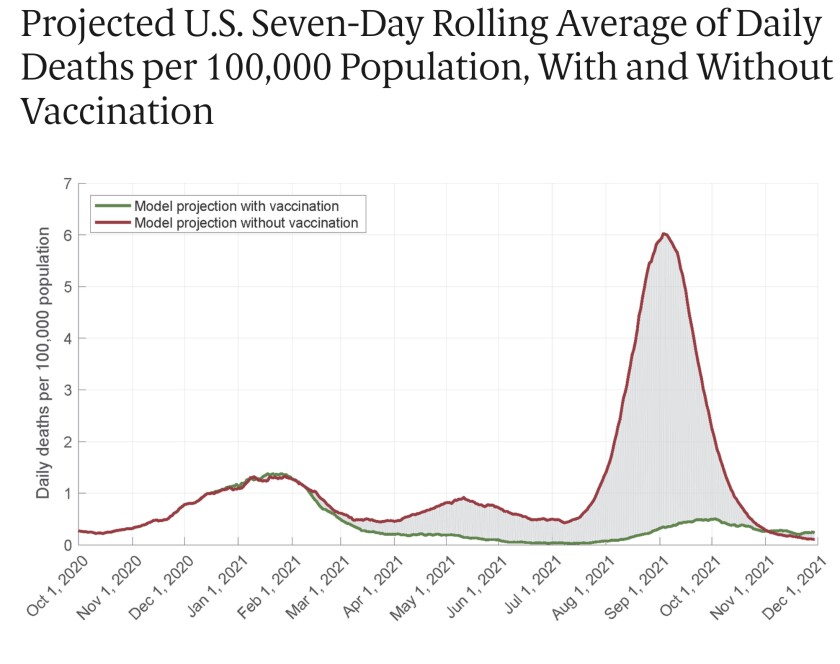
Its effectiveness is scarcely disputable: The Commonwealth Fund estimates that the vaccine averted about 1.1 million American deaths from COVID-19 and more than 10.3 million hospitalizations this year.

A chart showing COVID-19 deaths

The Commonwealth Fund estimates that the U.S. would have experienced more than 1.1 million additional deaths from COVID-19 if not for the vaccines.(Commonwealth Fund)

The answer lies in politics.

Trump drew the line first, dismissing social distancing steps and refusing to speak up for vaccination. He established these steps as partisan choices, and his political acolytes followed him over the cliff.

DeSantis has been a leader in this descent into the Inferno. He’s chosen to make Dr. Anthony Fauci, head of the National Institute of Allergy and Infectious Diseases and America’s most respected authority on the pandemic, a target of partisan calumny. He’s appointed a vaccine doubter as his state’s top public health official.

What is the outcome? Florida currently ranks eighth-worst among states in its COVID-19 death rate, with more than 62,000 Floridians having perished from the virus. Of the seven states with worse records, six are red states like Florida.

Corporate America has not showered itself in glory. On Dec. 18, Boeing announced that it was dropping its requirement that all U.S. employees be vaccinated. Its explanation was that a federal judge had blocked the enforcement of a federal executive order that employees of government contractors be vaccinated.

This is absurd. Nothing in the ruling required Boeing to drop its requirement. The company announced its step back just as the Omicron variant was about to produce a surge in infections. The pusillanimity of American corporations on this subject continues to astound. (The Times, which is owned by a physician and biomedical entrepreneur, is requiring all employees to be fully vaccinated by Jan. 31.)

To its credit, on Dec. 17 the Biden White House issued an uncompromising warning about the dangers of remaining unvaccinated.

“For the unvaccinated, you’re looking at a winter of severe illness and death for yourselves, your families and the hospitals you may soon overwhelm,” White House Chief of Staff Ron Klain said. “So, our message to every American is clear…. Wear a mask in public indoor settings. Get vaccinated, get your kids vaccinated, and get a booster shot when you’re eligible.”

Investment follies

In May, I asked whether we were experiencing a peak in investment absurdity. The examples then were bitcoin, dogecoin and nonfungible tokens (NFTs), as well as meme stocks, the prices of which were not tied to sober reflections about their issuers’ business prospects but to internet-fueled speculation.

Assets like these, which are priced in accordance with the “greater fool” theory (they have no intrinsic value beyond what you can cadge from a bigger fool than yourself), have only proliferated since then. Or perhaps it’s only the absurdity that has ballooned.

NFTs, for instance, are tradable digital files that confer no ownership to anything but the digital file, which may be an image of an object that is actually owned by someone else. Someone has parodied the NFT market by purporting to sell NFTs of images of individual Olive Garden restaurants, but it’s the kind of parody that gets at the essential truth of the target.

You don’t get to own the restaurant or the photo. You don’t get a discount on menu items or a guarantee that the photo is even accurate. You supposedly get to own something on the Non-fungible Olive Garden Metaverse, whatever that is, and you can try to find a greater fool to sell it to.

NFTs generally don’t confer ownership of the underlying asset or even the digital representation of the asset. The market doesn’t exist for any reason except to produce activity to suck in greater fools.

The best clue that there’s something hinky about these markets is that the Trump family is going all in. A purported media company started by Donald Trump, for instance, is merging with a special purpose acquisition company, or SPAC.

As I reported, the deal promptly came under the scrutiny of financial regulators. In any case, no discernible business plan of any substance has emerged for the Trump company. People appear to have invested because of his name.

Now Melania Trump has gotten into the act, hawking NFTs of paintings of her eyes—”an amulet to inspire,” the pitch says, though obviously you don’t get to own the eyes or even the original watercolor.

Software developer Stephen Diehl, an established skeptic of these things, writes that we are entering upon “a hustler’s paradise … where the market now provides a financial token game for every meme, every celebrity, every political movement, and every bit of art and culture.” The old saw applies about how if you’re looking around the poker table and can’t identify the mark, it’s you.

Inflation and Build Back Better

Republicans and conservatives have never cottoned to spending on programs that assist the middle and working class. President Biden’s Build Back Better program was destined to get their backs up.

How could they attack a program that provides for universal prekindergarten education, assistance with child care, caps on the price of drugs such as insulin and better access to healthcare? Simple: Raise the old bugaboo of inflation.

That’s been the approach of Sen. Joe Manchin III (D-W.Va.), who recently announced — via Fox News, of course — that he couldn’t support the plan in any way. He’s since backed off a bit from his adamantine opposition, but the core of his position was concern that the measure would add to inflation.

As we’ve reported, that’s just wrong. Not even former Treasury Secretary Lawrence Summers, who sounded an inflation alarm about the pandemic relief package enacted this year, thinks it applies to this measure. The provisions of Build Back Better are paid for and represent investments in the economy, so they’re anything but inflationary.

Indeed, Wall Street views Manchin’s resistance as an economic negative. According to MarketWatch, Goldman Sachs cut its growth forecast for the first quarter of next year to 2% from 3%, for the second quarter to 3% from 3.5% and for the third quarter to 2.75% from 3%.

That’s not counting the direct impact of Build Back Better on Manchin’s own state, which is among the poorest in the nation and one in which government programs are crucial. That’s well understood on the ground: The United Mine Workers union publicly urged Manchin to reconsider his opposition to a program that would have “a meaningful impact on our members, their families, and their communities.”

Much more happened in 2021 that prompts one to hold head in hands. To be fair, however, there were also glimmers of hope.

Biden on Dec. 21 announced steps to strengthen the country’s response to the Omicron variant, including mobilizing troops to help staff overwhelmed hospitals, opening thousands of vaccine sites and sending 500 million free testing kits to households. The Build Back Better plan is not entirely dead, and a revival effort will start in January.

Whether 2022 will be less stupid and insane than 2021 won’t be known until we can view it in a rearview mirror 12 months from now. We can only hope.

The Washington Post reports a concerted effort by Trump faithful to increase their base in the House of Representatives by challenging moderate Republicans. As a result of tedictricting, the number of highly concentrated conservative districts has increased. Joe Kent, running in Washington State, believes that the insurrectionists who stormed the Capitol on January 6, 2021, are “patriots.”

The defiant far-right acolytes of former president Trump in the House Republican caucus have embarked on a targeted campaign ahead of the midterm elections to expand their ranks — and extend their power — on Capitol Hill.

The effort, backed by Trump and guided by House members such as Marjorie Taylor Greene (R-Ga.) and Madison Cawthorn (R-N.C.), is part of a broader push by followers of the “Make America Great Again” movement to purge the GOP of those not deemed loyal to the former president and his false claims that the 2020 election was rigged in favor of Joe Biden.

Former Army Green Beret Joe Kent is running for a U.S. House seat in Washington state held by another Republican, Rep. Jaime Herrera Beutler, who voted to impeach Trump over his role in the events of Jan. 6 at the Capitol.

Kent said he has little interest in fighting with Democrats if he makes it to Congress. Instead, he wants to force Republicans into tough votes, starting with articles of impeachment against President Biden and a full congressional inquiry into the 2020 presidential election, which he says was stolen from Trump.

“A lot of it will be shaming Republicans,” Kent said. “I need to be going after the people in the Republican Party who want to go back to go-along-to-get-along. It’s put up or shut up.”

The goal, organizers of the effort say, is to supersize the MAGA group in the House from its current loose membership of about a half dozen — and give it the heft that, combined with its close alliance with Trump, would put it in a position to wield significant influence should Republicans win the House majority.

Key to the strategy is to coalesce MAGA-movement support around certain candidates running in Republican primaries in heavily pro-Trump congressional districts where the primary victor is all but assured to win the seat in November. That effort is being bolstered by redistricting, as state lawmakers draw districts even more partisan than the current lines.

In 2020, Trump won 45 districts by more than 15 percentage points. Under new maps already finalized in more than a dozen states, he would have won 78 districts by that margin, according to a Post analysis.

“We should be gaining MAGA seats,” Boris Epshteyn, a Trump ally, said on a recent episode of the radio show hosted by former Trump strategist Stephen K. Bannon. “It’s not just about ‘let’s add some Republican seats,’ it’s about ‘let’s add MAGA strongholds.’ ”

Trump critics warn that a stronger MAGA wing in Congress threatens democracy.

“We’re looking at a nihilistic Mad Max hellscape. It will be all about the show of 2024 to bring Donald Trump back into power. … They will impeach Biden, they will impeach Harris, they will kill everything,” said Rick Wilson, a longtime Republican strategist who is sharply critical of Trump.

If the MAGA crowd succeeds, one of our two major political parties will be controlled by unscrupulous, cynical, anti-democratic forces whose goals are power and greed, fueled by racism, xenophobia, anti-Semitism, and fear of the other.

In an interview with disgraced ex-FOX News pundit Bill O’Reilly, Trump admitted that he was fully vaccinated and had received the booster as well. O’Reilly too is vaccinated.

Former President Donald Trump said he received a Covid-19 booster shot, revealing the news to former Fox News host Bill O’Reilly on Sunday during one of their “History Tour” live events.

O’Reilly also confirmed he received a booster shot, though neither said which one they received. null

The crowd began to boo Trump after he said he had gotten his booster shot, though the former president discouraged the jeers.

When the New York Times’ Maggie Haberman asked a Trump spokesperson why he changed his message on the vaccine and boosters, she received a handwritten note, signed “Donald.“ The first four words were underlined, according to the photo Haberman posted on Twitter.

“Must tell the truth — and very proud to have produced the 3 vaccines so quickly — million of lives saved worldwide — Best wishes Donald,” the note said.

While there has been opposition to vaccinations among some conservatives — just 60 percent of Republicans are vaccinated, compared to 91 percent of Democrats, according to The New York Times — Trump has touted his administration’s role in developing the vaccine…

While Trump reiterated his opposition to vaccine mandates, he said to his supporters that when they doubt the vaccine’s efficacy and safety, “you’re playing right into their hands.”

(The Pfizer vaccine was not funded by Operation Warp Speed.)

Nonetheless, Trump’s admission that he has received three shots might persuade some of his followers to take the shots, and that’s good for everyone. Maybe he realized that a disproportionate number of Trumpers were refusing the vaccine and putting their lives at risk. The more people refuse the shots, the longer the pandemic will go on and on.

The Arizona Republic conducted an intensive investigation of the effort by the Trump campaign and discovered some fascinating details.

Rusty Bowers was talking on his cellphone to Karen Fann after church services on the Sunday before Thanksgiving, looking ahead to another hectic week.

It was Nov. 22, 2020. The counting was done and Joe Biden led Donald Trump by a razor-thin margin, but the presidential election results in Arizona still had not been certified.

The state’s House speaker and Senate president have a bond that stretches back decades, forged by family friendships. This time, the two Republicans conferred about something that surprised them both.

Fann told Bowers that the president’s allies had called her repeatedly. They wanted to get her involved in a plan to help deliver an election result more to his liking.

By then, it was clear to most that Trump had lost his reelection bid for the White House and that Arizona had helped elect Biden.

Seconds after Bowers hung up with Fann, and while he still sat parked in his driveway in the driver’s seat of his Toyota Prius, the dashboard on his car lit up.

Bowers had a phone call. It was the White House.

Trump and Giuliani wanted Bowers to help ensure President-elect Biden’s 10,457-vote win in Arizona would not be formalized a week later. They told him “there’s a way we could help the president” and Arizona had a “unique law” that allowed the Legislature to choose its electors, rather than voters, he recalled.

“That’s the first I’ve heard of that one,” a skeptical Bowers told them. He told the men he needed proof to back up their claims: “I don’t make these kinds of decisions just willy-nilly. You’ve got to talk to my lawyers. And I’ve got some good lawyers.”

Bowers told them he supported Trump, voted for Trump and campaigned for him, too. What he would not do is break the law for him.

“You are giving me nothing but conjecture and asking me to break my oath and commit to doing something I cannot do because I swore I wouldn’t. I will follow the Constitution,” he told the men.

Trump, who was gregarious throughout much of the call but quiet during that exchange, told Bowers he understood.

Trump told Bowers, “We’re just trying to investigate.”

Giuliani repeatedly assured Bowers he would send the evidence to attorneys at the state House of Representatives.

The evidence never arrived, Bowers told The Arizona Republic.

But Fann proceeded with the ballot review Trump wanted.

Why did this scene unfold in Arizona?

This is how Arizona plunged into a fog of conspiracies, riven with partisanship and targeted by opportunists from across the country.

Trump led the effort to undermine the results after some projected Arizona to slip to Democrat Joe Biden.

The state was one of two targeted by congressional Republicans on Jan. 6 who were willing to disenfranchise millions of voters in a brash legal experiment that would have redefined the election-certification process.

And even before Trump left the White House, Fann put in motion a ballot review.

Of the swing states, Arizona perhaps was the most susceptible to an election challenge.

Biden’s margin of victory in Arizona was the smallest of any state he won. State government was in Republican hands, providing plenty of potential allies, from the governor to the leaders of the state Legislature to the Maricopa County Board of Supervisors.

Trump, who viewed the focus on Russian interference in the 2016 election as an effort to delegitimize his victory, now heaped doubt on Biden’s win. But Trump’s loyal base didn’t see how tenuous his hold on Arizona had grown. While Trump evinced confidence at rallies, behind the scenes his campaign team knew the state was up for grabs.

Trump’s push to challenge the election results in Arizona provided balm for a man unwilling to accept defeat. It also sowed lingering doubt that would fuel an attack from people all over the country on the state’s election systems.

Many Republicans quickly joined Trump’s unfounded accusations of fraud, some more forcefully than others. A few, such as Bowers and Gov. Doug Ducey, resisted the public and political pressure to get behind the narrative of a stolen election.

One Arizona member of Congress participated in protests outside Maricopa County’s election facilities even as ballots were being counted; three GOP members of Congress from Arizona later voted to set aside the state’s election results.

The circuslike atmosphere drew Trump die-hards, election conspiracy theorists and far-right media that simultaneously created buzz and fed off it.

It raised cash for Republicans and doubts for voters, threatening public confidence in elections here and elsewhere.

Interviews with dozens of people connected with the drama at the Arizona Legislature and the Veterans Memorial Coliseum in Phoenix, where the ballots were examined for months, make this much clear: The spectacle that unfolded here was a partisan obsession pushed by Trump’s close allies and made possible by just a handful of people in Arizona.

It didn’t have to happen this way.

Before Fann ordered the ballot review, for several days in December, Bowers, Fann and the Republican chair of the Maricopa County Board of Supervisors, Clint Hickman, tried to reach a deal for a joint audit conducted by an accredited firm.

Over four months, The Republic examined a trove of text messages, emails and court records, many made public after suing the state for access. Reporters spoke to decision-makers, consultants, staff, contractors, campaign aides and others tied to the review of the presidential and U.S. Senate races. Some talked on the record about their experiences, while others spoke on the condition they not be identified in order to speak candidly about private conversations.

The Republic uncovered efforts to circumvent the popular vote to engineer an illegitimate Trump victory. Once the results were certified, Trump and his allies shifted to a campaign to pressure local Republicans to overturn election results from voters who were using an early ballot system largely shaped over decades by their own party.

Trump, Giuliani, Fann and others who helped bring about the ballot review did not respond to repeated requests to discuss their recollections of the events leading to the review.

Bowers shared his story for the first time over three interviews totaling nearly six hours. The interviews took place by phone, in his office suite, and on the patio of a Cracker Barrel in the East Valley, where he verified key dates from his red leather-bound journal.

Like most of Arizona, the speaker watched the scenes unfold from the periphery as Fann steered the Senate into a probe led by the Florida-based Cyber Ninjas, a company with no prior experience in election reviews that is run by a man who publicly stated the election was tainted by fraud.

Fann has not yet explained her U-turn from favoring an accredited audit to authorizing a review led by partisans. Those who know her and did speak said she sought to quell Republican anger over Trump’s loss and could not resist the pressure campaign from his allies.

Early on, Bowers remembered offering her a stark assessment: Some of Trump’s most ardent supporters in the GOP-controlled Legislature viewed Trump’s election grievances as political opportunity.

“Karen, this is about trophies,” he said he told her. “This is about trophies on the wall — that individual members want to be able to say, ‘I forced them to do this.’”

Before the Veterans Memorial Coliseum became the proving ground for conservative conspiracies, it was the location of a rally at perhaps the high-water mark of Trump’s presidency.

The economy was in the final days of the longest expansion in U.S. history. Coronavirus seemed like a foreign problem in a faraway land. Bernie Sanders, the independent senator from Vermont who described himself as a democratic socialist, had won the New Hampshire primary the week before. Biden finished fifth.

Trump’s approval rating was inching upward after his acquittal in his first impeachment trial.

So it was on Feb. 19, 2020, when Trump strode onstage to a near-capacity crowd at the coliseum. Like most of his campaign events, it seemed to mix the noise of a rock concert, the passion of a religious revival and the sideshow elements of a carnival.

Two supporters carried Ervin Julian, a 100-year-old World War II veteran, down the coliseum’s steep stairs to a front-row seat on stage behind Trump and in front of the boisterous crowd. 

One of the men carrying Julian wore a shirt that said “We are Q” on the front and “17 WWG1WGA” on the back. It is a phrase adopted by the QAnon conspiracy movement that stands for “Where We Go 1 We Go All.”

One by one, Ducey, all four of the state’s Republicans in Congress, Fann, Bowers and Kelli Ward, the state Republican Party chairwoman, took the stage as Trump praised the state’s GOP team.

“With your help, we are going to defeat the radical socialist Democrats,” Trump said early on. “We have the best economy, the most-prosperous country that we’ve ever had and the most powerful military anywhere in the world.”

Trump’s 82-minute, triumphal speech left his supporters delighted and his campaign confident that he was well positioned to again win a state he had narrowly carried in 2016, when he defeated Democrat Hillary Clinton by 91,234 votes.

Trump’s victory that year extended Arizona’s run of wins for Republicans in presidential races. The GOP won 16 of 17 presidential contests in the state beginning in 1952.

Trump’s electrifying optimism, shared by thousands of his supporters inside the coliseum, seemed rooted in political inevitability. In hindsight, Trump’s prospects began dimming almost immediately after that rally.

Less than a month after Trump’s speech, Biden took control of his party’s nomination, pitting Trump against the candidate best positioned to win Arizona and the one Trump worried about most. The coronavirus soon exploded into a pandemic that locked Americans inside their homes, upended the political agenda and brought a sudden end to a decade-long run of economic growth.

The state’s presidential preference election on March 17 and the rapidly worsening health crisis raised the first real concerns about voting and election management in Arizona, and they largely came from Democrats.  

By then, COVID-19 was beginning to spark fear across the country, and the White House had called for a 15-day national quarantine to halt the virus. Democrats moved their final presidential debate to Washington, D.C., from Phoenix because of the widening crisis.

Sinema sent Hobbs a link to a Twitter post by a political website that said polling sites could be hazardous during a pandemic. At the time, little was known about the virus and its spread. Some feared shared items, such as pens, could help spread the coronavirus.

“File a request to the Az Supreme Court ASAP asking you (to) postpone,” Sinema texted. “This is what Ohio just … Did. You can file a special action right now.”  

“Who is this,” Hobbs responded in a text.

“Kyrsten. I would file a special action NOW. We do not want to be the state that violated the 15 day effort to stop the virus. The governor has been very slow to move on every precaution. That is his choice, I guess. But you do not have to be like that. You can do what needs to be done. I am going to say the election should be postponed publicly very soon.”

Hobbs responded, “Understood.”

Maricopa County Recorder Adrian Fontes, a Democrat, wanted to mail ballots to every voter in the primary because of the coronavirus. 

Neither change happened, but for Republicans, who didn’t have a primary election, both ideas raised concerns about voting.

The GOP-dominated Maricopa County Board of Supervisors had taken greater responsibility for management from Fontes in 2019, especially on Election Day operations and emergency issues. But the state’s far-right figures didn’t view board members as reliable allies if there was to be a battle over results.

Meanwhile, Trump had his own worries in Arizona. 

In May 2020, the president held a meeting in the Roosevelt Room in the White House to discuss the state of play in Arizona.

Trump was worried that Sen. Martha McSally, R-Ariz., was losing to challenger Mark Kelly and could “drag” him down as well, those familiar with the discussion said. The president wondered whether the GOP should run someone other than the incumbent against Kelly, the well-known retired astronaut. Then-Senate Majority Leader Mitch McConnell, R-Ky., who had joined the discussion, made it clear he stood by McSally.

The GOP ticket had other worries, too.

On July 1, Vice President Mike Pence flew to Phoenix to assure the public that Arizona would have enough ventilators to manage the rising COVID-19 caseload.

Privately, Pence had other matters on his mind. 

Away from the news cameras, inside a conference room in the Lincoln J. Ragsdale Executive Terminal at the Phoenix airport, Pence asked how the campaign was preparing for November.

“What is your plan for absentee early voting? Are you guys ready for any of the changes that would come of COVID?” Pence asked, according to someone familiar with the conversation. 

People on hand told the vice president that 80% of Arizona’s electorate routinely vote by mail. It startled Pence, who was following up on concerns Trump had raised because other states, such as Georgia, Michigan and Pennsylvania, were expanding mail-based voting because of the pandemic.

Election officials in key 2020 swing states made significant changes to their election systems. For example, Nevada sent every registered voter a mail-in ballot for its summer primary. Several Pennsylvania counties, including those in the Democratic-heavy Philadelphia area, extended the postmark deadline for that state’s August primary. 

Pence learned Arizona has signature verification and other security provisions in place. 

Arizona Republicans assured Pence they were “comfortable” with the state’s early voting system and would “keep our eye on Adrian Fontes.”

Ducey expounded on voting in Arizona during an Aug. 5 public appearance at the White House, with Trump at his side, to discuss their management of the pandemic. Trump groused about mailing ballots to voters in Nevada. Ducey defended the widespread practice in his state.

When the cameras were gone, Trump seemed pleased with the governor’s answer. The president exuberantly asked Ducey if his state needed any additional help. 

But the August primary created more anxiety for Republicans. Democratic turnout matched the GOP’s, and after Trump’s attacks on mail-in voting, many Republicans held onto their ballots until the last moment before dropping them off at the polls.

One GOP figure said the daily mailed-in returns of Republican early votes had “fallen off a cliff.” Trump’s team on the ground in Arizona was alarmed. 

Trump always had another, unique problem in Arizona that would cost him: his feud with the late Sen. John McCain, R-Ariz.

McCain forged a bond with Arizona voters over his almost 36 years in office. He won all 11 House, Senate and presidential races he ran in the state. In 2016, McCain received more votes in Arizona than Trump did.

Trump’s broadsides against McCain, extending even after his death, didn’t matter to most Republican voters. But they did matter to some, and in a close race, it had an outsized impact.

Beginning in the early days of his presidential run in 2015 and continuing into the final months of the 2020 election, Trump attacked McCain in personal terms. 

The attacks cost Trump support among women, moderate Republicans and independent voters who respected McCain and found the attacks unpresidential.

For more than a year ahead of the election, political pollsters and experts warned that Trump was in danger of losing Arizona, in part as support eroded among these key constituencies, especially in parts of Phoenix and its suburbs where the late senator had dominated his races.

Despite the warnings, Trump kept up the attacks.

At one point, Trump personally asked Ducey to help keep the senator’s widow, Cindy McCain, neutral in the race, people familiar with the request said.

A person close to Cindy McCain said the governor never asked her to withhold an endorsement in the race. A spokesman for the governor would not characterize Ducey’s conversations with McCain, saying they were private.

Though Trump’s campaign hoped “to keep her on the sidelines,” they sensed she was “moving in the wrong direction,” someone familiar with the strategy recalled. “And that’s going to be a problem for us.”

In September, The Atlantic magazine published a story citing unnamed sources that said Trump complained when flags were lowered in observance of McCain’s death in 2018.

“What the (expletive) are we doing that for? Guy was a (expletive) loser,” Trump said, according to The Atlantic.

The president denied The Atlantic’s story, although other media outlets substantiated some of the remarks attributed to Trump.

Trump responded with a tweet saying, “Never a fan of John. Cindy can have Sleepy Joe!”

Democrats followed her announcement with an ad blitz that put her words on screens across the country, especially in Arizona.

The Arizona Republican Party later censured Cindy McCain.

In a series of Saturday video conferences from their homes in the final weeks before the election, Ducey and his team advised top staffers in Trump’s campaign to maximize their visits to the battleground state with appearances outside of Phoenix.

Trump and Pence visited eight cities other than Phoenix in the final month in an effort to build a rural firewall. 

Ducey’s team suggested Trump call into country radio shows and talk about how his policies affect their jobs, their pocketbooks and their families. 

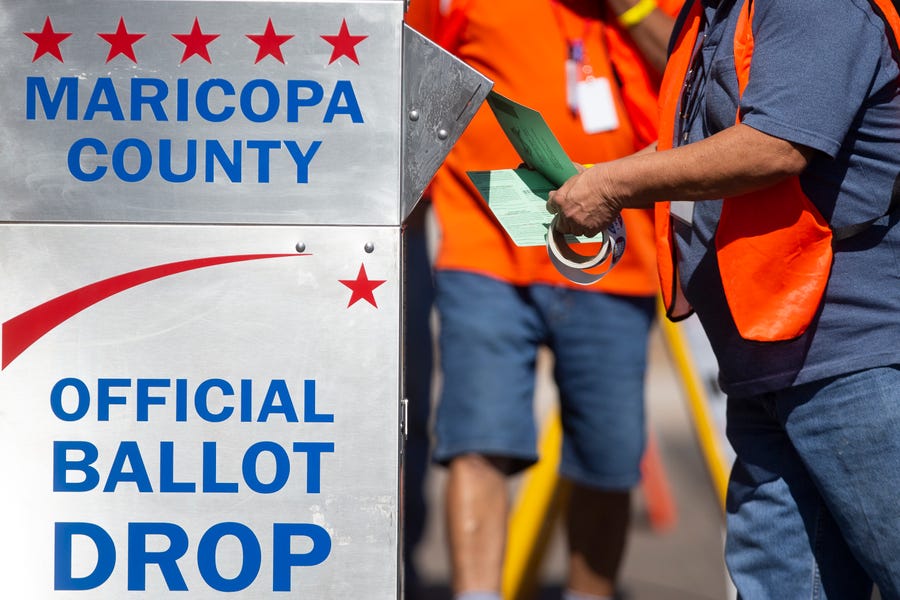
One person familiar with the calls said Trump’s political team knew “Arizona was going to be tough.” Election workers drop ballots into a ballot dropbox at the Maricopa County Elections office at 510 S. Third Ave. in Phoenix on Oct. 16, 2020.Arizona counts its mailed-in ballots first, and fewer Republicans sent in early ballots in 2020, instead dropping them off at the polls.Thomas Hawthorne/The Republic
While Trump, Pence and their surrogates zipped in and out of Arizona to try to shore up support, Biden and his running mate, Kamala Harris, barely visited.

The GOP campaign rallies left Republicans fired up about their prospects — and poorly prepared for an election loss.

Hours after the polls closed on Election Day, Fox News made an aggressive, but ultimately correct, call that Biden had won Arizona. Four hours later, The Associated Press followed suit. 

Arizona was the first state projected to fall from Trump’s winning 2016 coalition, and it raised the specter of further losses in states such as Wisconsin, Michigan and Pennsylvania. All of those states, plus Georgia, eventually did flip to Biden, but it wasn’t immediately clear that would happen.

Trump responded to the quick Arizona call in an overnight news conference from the East Room of the White House that effectively gave license to his supporters to cast the election as stolen.

“This is a fraud on the American public,” Trump said at 2:30 a.m. Nov. 4 to a cheering crowd. “Frankly, we did win this election. … So our goal now is to ensure the integrity for the good of this nation.”

The president said he wanted “all voting to stop” and said his campaign would be headed to the U.S. Supreme Court.

Instead, the Trump campaign leaned heavily on officials at Fox News, hoping to undo their Arizona projection. In the days after the quick call, Ducey’s 2018 deputy campaign manager walked conservative host Sean Hannity and two senior executives with Fox News through scenarios that indicated why the state remained within Trump’s reach. The Ducey aide gave a similar briefing to the Trump campaign.

While Trump could not fathom how periodic updates could shift the race so dramatically in Arizona, campaign insiders were long accustomed to close races and results that changed over days as ballots were counted.

Arizona counts its mailed-in ballots first, and fewer Republicans sent in early ballots in 2020, instead dropping them off at the polls. Those votes were tabulated last, after Election Day voters’ tallies.

In 2018, Sinema won her Senate seat after six days of counting. In 2016, U.S. Rep. Andy Biggs, R-Ariz., won his first primary election by 16 votes after a recount shifted only a few dozen votes over 17 days.

After the quick call for Biden in Arizona on Nov. 3, raucous protesters gathered outside the building where Maricopa County officials counted ballots.

By then, some Trump supporters suggested — falsely — that election officials provided them Sharpie pens that could bleed through their ballots and eliminate their votes. It was a conspiracy theory amplified in conservative circles, including by Eric Trump, the president’s son.

For people like Fontes and Maricopa County Sheriff Paul Penzone, also a Democrat, it was not a moment to explain the intricacies of ballot markings; they feared violence.

Dozens of people — some clearly carrying firearms — swarmed the parking lot area outside the county’s election offices.

Mindful of the deadly clash in 2017 in Charlottesville, Virginia, Penzone put several armed response teams inside the building and had dozens of other deputies in the area on standby “to protect the systems, the ballots, the people — everything in there.”

Fontes, the county recorder, called it a necessary response to a charged situation. At one point, the angry crowd pulled an election worker into their unprotected area.

“This person literally had to get physically wrestled away from a group of them and pulled back into the building,” Fontes remembered. “It was in my head that there would be casualties. It was in my head that we would have to be cleaning blood out of the warehouse because they were ready, they were armed. … They came to assault my staff.”

Protests went on for days, with U.S. Rep. Paul Gosar, R-Ariz., fueling accusations of a stolen election. Alex Jones, a conspiracy monger who called the 2012 massacre of children at an elementary school in Connecticut a “giant hoax,” used a megaphone to exhort protesters to maintain their fight for Trump.

The Sheriff’s Office has spent an estimated $1.2 million on law enforcement efforts tied to the election and ballot review, including on demonstrations and protection efforts. The tab may not yet be final.

While Trump signaled the beginning of a drawn-out fight in the hours after the election, McSally, the Republican candidate for the U.S. Senate, all but disappeared from public view.

McSally didn’t formally concede her race for days, but by Nov. 9, several of her key campaign staff were vacationing in Mexico. She wound up losing to Kelly by 78,806 votes.

When the presidential ballots were fully counted on Nov. 14, just 10,457 votes — fewer than the number of people who fit in the coliseum — separated Biden from Trump. The 0.3 percentage point difference made it the tightest presidential race in state history.

Unpredictable: A pandemic and the president’s anti-mail-in ballot rhetoric turned the conventional wisdom about Arizona votes upside-down

It was a bitter disappointment, but it wasn’t a complete loss for Republicans.

The GOP maintained its hold on the Statehouse, and Arizona’s four Republicans in Congress were reelected. Republicans accepted those results, made in the same election that delivered Trump’s loss.

But Republicans loyal to Trump could not accept his defeat.

Along with daily protests at the Capitol, thousands of emails, voicemails and text messages were left for Arizona officials in the days following the election.David Wallace/The RepubliTrump supporters across the country bombarded Arizona election officials and lawmakers with staggering numbers of emails, voicemails and text messages.

Like Trump, many voters could not reconcile the energy of his campaign with the quick call for Biden and the ever-tightening margins in Arizona. Democratic gains in traditionally red Maricopa County fueled suspicions that Trump’s loss owed more to cheating rather than his limited appeal.

State Rep. Shawnna Bolick, R-Phoenix, said she received 57,000 emails in the first two months after the election — and still gets some.

At one point early on, Bowers’ secretary told him the office received more than 20,000 emails and 10,000 voicemails each day. After receiving 9,000 text messages at one point, now-Sen. Paul Boyer, R-Glendale, got another phone number.

The messages often maintained fraud tainted the election, and Democrats and their allies were covering it up. Many were vulgar; some were threatening.

“It is criminal for state legislators to certify a fraudulent election,” one message to Bowers said.

“Rusty is going to prison,” another email said. “80,000,000 patriots will make sure of this.”

“Fix this mess of an election now, do NOT let the people who committed obvious fraud, intimidation, threaten & lie & who did Not win into our Whitehouse,” read another.

The din included more than just Trump supporters, lawmakers said.

“In all of my time in office, I’ve never seen the magnitude or type of people telling me their concerns about the election,” said state Sen. J.D. Mesnard, R-Chandler. 

“Many of them have been from far-off places,” said House Majority Leader Ben Toma, R-Peoria. “It’s safe to say there’s been a ton of pressure to do something.” 

One thing that set Arizona apart from other close states was the trajectory of the race.

In Georgia, Michigan, Pennsylvania and Wisconsin, Biden staged come-from-behind victories. Trump drew closer in Arizona’s initial count before falling short.

Trump and Giuliani zeroed in on people in Arizona who could still make a push.

It wouldn’t be Ducey, who had shown little interest in raising doubts about the election. And it wouldn’t be Hobbs, the Democratic secretary of state, who defended it on national television.

The president and his lawyer targeted Bowers and Fann, the Republican heads of the Legislature. 

The weekend before Thanksgiving, a top White House aide called around, looking for cellphone numbers for both.

Those close to Fann said she felt squeezed by the most conservative members in her caucus. She was preparing for the holidays and didn’t want to discuss the election. She seemed to want to put off talking to the president and his surrogates. 

When the White House came calling, Fann needed a strategy. 

“What are we going to do? … They’re putting pressure on me — the national folks want to have fact-finding committees to find out about the fraud in Arizona,” Bowers remembered Fann saying. “She said, ‘They’re trying to get in touch with me and we’ve got to make sure we’re on the same page.’”Arizona Senate President Karen Fann stands on the floor of the Senate at the Arizona State Capitol in Phoenix on Monday, May 27, 2019.Both Arizona House Speaker Rusty Bowers (top) and Arizona Senate President Karen Fann were in the Trump team crosshairs.Thomas Hawthorne/The Republic

They never had a chance. Right after he hung up the phone with Fann, Bowers received the call from Trump and Giuliani while sitting in his Prius.

By itself, the call was memorable for Bowers. It became amusingly so when he needed to search the small screen on his cellphone to find his lawyer’s contact information for the president. 

A natural raconteur, Bowers joked to Trump and Giuliani he might have a story for his grandkids one day: that he accidentally hung up on the president.

“Trump just busted out laughing,” Bowers remembered. “He said, ‘That’s funny.’”

Then Bowers really did accidentally hang up.

The White House called him back, and Bowers and Giuliani shared a laugh. 

Bowers needed some levity. 

While Arizona’s election stirred national passions, Bowers, 69, was privately tending to his dying daughter. Her liver was failing, and she was rejected for an organ transplant. 

Inside his house, and later in a hospital, Bowers saw his daughter’s life slipping away.

Bowers documented the eventful period, as he routinely does, in his handwritten journal through pages and pages of tight cursive writing. It is a distinctive practice for a man with many interests.

Bowers’ weathered face betrays his love of the outdoors, but perhaps his greatest passion is art. He paints and has sold sculptures. At least once, Bowers passed time in the often-mundane setting of the Legislature by building a miniature pinewood derby car for his grandson on his desk during breaks. 

Bowers’ call with Trump and Giuliani revealed two of his more obvious traits: Bowers can be pleasant, but he’s no pushover.

“Rusty is a cowboy,” said one Capitol insider, in a reference to his independent nature.

Fann, 67, grew up in Prescott, one of Arizona’s most conservative areas. Decades ago, she started a transportation business that puts up guardrails to keep motorists safe. 

She was elected to municipal government around the Prescott area where politicking didn’t overshadow problem-solving. 

‘What’s happened to Karen?’ Election audit puts spotlight on Senate president after decades in office

She brought political pragmatism to a legislative seat at the Statehouse, where she has served for a decade, the past two terms as president of the Senate.

Fann, too, has a life outside politics. She likes to golf and cook. She is known to bring homemade pies to friends and is part of a dinner club. 

Her agreeable nature often leaves her in the middle of the warring factions of her Republican caucus.

Her confidants at the Statehouse include lobbyists from both political camps who have worked with her for years. Her philosophy on the job is “‘We’re in this thing together, we’ve got to pick up the trash, we’ve got to do it, let’s work together, let’s figure things out,’” one Democratic lobbyist friend said. 

If the ballot review sometimes felt like a political crucible, it also gave Fann a national political identity

But at the Statehouse, she had one goal: retain her role as Senate president. Unlike Bowers, who won his leadership post despite the misgivings of his party’s far-right members, Fann owed her position to the more conservative members of her chamber. 

Her friend, former state Sen. Steve Pierce, R-Prescott, a relative moderate, lost his title as Senate president after the 2012 elections to then-Sen. Andy Biggs and spent four lonely years out of power. Her friends say it was a loss Fann didn’t want to repeat.

Includes information from Arizona Republic reporter Mary Jo Pitzl.
Jeff Bryant reports on a frightening phenomenon: the notorious and violent Proud Boys are targeting public schools.

He begins:

When violent insurrectionists stormed the U.S. Capitol on January 6 to attempt to overturn the result of the 2020 presidential election, some of the rioters were members of the Proud Boys, a far-right group prone to street brawling and pro-Western, anti-Muslim, and misogynistic rhetoric.

The insurrectionists were thwarted, but now extremist groups—including the Proud Boys—are aiming their threats and violence at a new target: public schools.

In Orange County, North Carolina, the Proud Boys and other white nationalist groups have begun showing up at high school football games and school board meetings, “protesting the district’s COVID-19 and LGBTQ+ policies.” Their intimidating language, apparel, and physical gestures prompted officials to hire extra security and pass a resolution opposing “incidents of hostile and racist behavior,” according to a report in the News and Observer.

The resolution charged that the rightwing agitators had “shouted racist and homophobic slurs at students” and included “emails from teachers and students who describe how unsafe they feel being around the Proud Boys.”

A local radio station quoted Orange County board chairwoman Hillary MacKenzie describing a recent meeting of the board where “there were two men in Proud Boys shirts and hats . . . one wore a stocking over his face . . . the other one told our board during public comment that someone should tie rocks around our necks, and we should throw ourselves in a river.”

Similar occurrences from around the country seem to indicate that the Proud Boys’ targeting of public schools is a coordinated, nationwide effort, suggesting a direct line from the group’s involvement in the January 6 insurrection to its current participation in the wave of protests at public schools and school board meetings.

Trump is a sore loser. Will we ever see the last of him?

It seems he’ll be with us forever, his legacy revealed by the stories that his former aides tell about what they saw during his four madcap years.

The latest is contained in a story in The New York Times. It seems that the famous xenophobe Stephen Miller cooked up a campaign season plan to close the border by stationing 250,000 troops there. Trump loved the idea. It would show that he’s a tough guy and would achieve his goal of ending immigration on our southern border.

But Defense Secretary Mark Esper shot down the idea. He thought it was “outrageous.” A quarter million troops was “more than half the active U.S. Army, and a sixth of all American forces — to the southern border in what would have been the largest use of the military inside the United States since the Civil War.”

The idea was batted around but Secretary Esper was adamantly opposed. Trump and his minions also considered a proposal to send troops into Mexico to hunt down members of drug cartels, but backed when they became persuaded that it would be considered an act of war to send our military across the border of another country, uninvited.

After a brief but contentious confrontation with Mr. Miller in the Oval Office, Mr. Esper ended consideration of the idea at the Pentagon.

Mr. Trump’s obsession with the southern border was already well known by that time. He had demanded a wall with flesh-piercing spikes, repeatedly mused about a moat filled with alligators, and asked about shooting migrants in the leg as they crossed the border. His aides considered a heat-ray that would make migrants’ skin feel hot.

Around the same time that officials considered the huge deployment to the American side of the border with Mexico, Mr. Trump also pressed his top aides to send forces into Mexico itself to hunt drug cartels, much like American commandos have tracked and killed terrorists in Afghanistan or Pakistan, the officials said.

Mr. Trump hesitated only after aides suggested that to most of the world, military raids inside Mexico could look like the United States was committing an act of war against one of its closest allies, which is also its biggest trading partner, the officials said…

But taken together, the ideas under discussion that spring underscore the Trump administration’s view of the armed forces as a tool of the presidency that could be wielded on behalf of Mr. Trump’s domestic political agenda in an election year…

Wiser heads than Trump or Miller recognized how unhinged these proposals were:

If Mr. Trump had gone through with the troop deployment, it would have represented a force two and a half times the size of the 100,000 American troops in Afghanistan at the height of the 20-year war in that country. It would have also dwarfed the American presence in Iraq during the war there: The maximum number of troops in Iraq at any time was about 170,000.

It is unclear how the Defense Department could have managed such a deployment. The U.S. Army has about 481,000 active-duty soldiers, but many are already deployed around the world, as are thousands of Marines, airmen and other troops. Sending 250,000 troops to the border — much of which crosses difficult, undeveloped lands — would also have required an enormous logistical effort to house and feed the troops.

In the original version of this post, i said that Nixon told the press when he resigbed, ”You wont have Nixon to kick around anymore.” Tom Ultican caught my error. Nixon said this when he lost the California governor’s race in 1962.

In the race for governor of Virginia, Republicans have focused their campaign on hot-button issues like banning “critical race theory” from the schools, opposing mask mandates, and taking a stand against tiny numbers of transgender students. Republicans have also argued that parents should be able to determine what teachers are allowed to teach and to ban books that they don’t like. And of course, they support school choice. In short, the Republican candidate has decided to base his campaign on “culture war” issues, offering no proposals to improve the schools.

In contrast, the Democratic candidate Terry McAuliffe has promised to raise teachers’ salaries, expand pre-K, and protect students from the virus. He has also taken a stand against parents dictating what should be taught, instead leaving those decisions to teachers. In these times, he has shown that principle and courage are possible when running for high political office, which is why he was endorsed by the Network for Public Education Action. We will learn on November 2 whether principle and courage can beat rank opportunism.

Lisa Lerer wrote in the New York Times about how unusual it is to have a statewide race centered on education. .

WINCHESTER, Va. — …From fights over evolution to desegregation to prayer, education battles have been a staple of the country’s divisive cultural issues for decades. But not quite like this.

After months of closed classrooms and lost learning time, Republicans in Virginia are making the schools the focus of their final push to capture the governor’s office, hoping to rally conservatives around both their frustrations over mask mandates and mandatory vaccinations and their fears of what their children are being taught.

Vocal groups of parents, some led by Republican activists, are organizing against school curriculums, opposing public-health measures and calling for recalls of school board members. And Mr. Youngkin, a former private equity executive, has capitalized, seizing on conservatives’ concerns about instruction on race and the rights of transgender children to argue that Democrats want to come between parents and their children’s education.

Mr. Youngkin’s attacks have forced Terry McAuliffe, the Democratic former governor trying to win back his old job, onto the defensive, and have thrust the ordinarily local issues surrounding schools into the middle of a rancorous nationwide shouting match.

The Virginia race offers an early electoral test of that conservative energy.

A victory by Mr. Youngkin would mark the first statewide win for Republicans in a dozen years and likely trigger a political panic within the Democratic Party about its prospects in next year’s midterm elections. Some Republican officials and strategists liken the surge of activism to the Tea Party, the anti-government movement that helped them win control of the House in 2010 and unleashed a revival of outrage politics that would define their party for the next decade.

“There’s just so much focus on the schools, and it’s visceral,” said John Whitbeck, a former chairman of the Republican Party of Virginia from Loudoun County, where acrimonious school board meetings have led to arrests, death threats and constant airtime on conservative media. “It’s not like, ‘Oh, I’m against the debt ceiling.’ This is like, ‘You’re destroying our children’s education.’ And, look, angry people vote.”

Polling in recent weeks has shown a tight race, with Democrats less enthusiastic than Republicans about voting. Mr. McAuliffe, who was barred from seeking re-election in 2017 by Virginia law, is faring worse in the fast-growing, voter-rich Northern Virginia suburbs than Gov. Ralph Northam, a Democrat, did when he won four years ago, according to some surveys.

Mr. Youngkin’s focus on schools may not resonate as strongly with the broader electorate.

Measures such as mask and vaccine mandates are cutting differently in the governor’s race in more liberal New Jersey and are overwhelmingly popular among Virginia’s independents and Democrats. Critical race theory — an advanced academic concept generally not introduced until college — is not part of classroom teaching in Virginia and many voters say they do not know enough about it to have an opinion.

And turning schools into a cultural war zone by railing against equity initiatives, books with sexual content and public health measures avoids tackling issues like budget cuts and the other thornier problems facing American education.

But in an off-year election, when both sides anticipate a sharp falloff in voting, victory may hinge on which candidate can best motivate their base. Mr. Youngkin and his strategists believe that in the fights roiling schools they have discovered the rare issue that can galvanize their voters, even in places that are shifting the state to the left.

Frustration with education is an issue that unites Republicans, energizing moderates eager to ensure their children remain in school as well as conservatives who see a liberal plot to indoctrinate their children with the belief that white people are inherently racist.

“The former governor is saying, ‘Hey I’ll decide how to teach your kids, not you’ — that’s really the issue driving this,” said John Fredericks, who led Donald Trump’s Virginia campaign last year. “Glenn Youngkin is the candidate that’s been able to straddle both sides of the party. And so far he’s given us just enough where we can enthusiastically vote for the guy.”

Republicans have centered much of their closing argument around a statement by Mr. McAuliffe in last month’s debate.

The comment came after Mr. Youngkin attacked Mr. McAuliffe over his 2017 veto of a bill permitting parents to opt out of allowing their children to study material deemed sexually explicit. The dispute was prompted by a mother who objected to her son, a high school senior, reading literary classics including Toni Morrison’s “Beloved.”

Mr. McAuliffe shot back that he did not believe “parents should be telling schools what they should teach.” In the weeks since, he’s stood by those remarks, saying that the state Board of Education and local school boards should determine what is taught in the classroom.

But Mr. Youngkin and Republicans, stripping the quotation from its context, have turned the footage into the core of their argument that Mr. McAuliffe would side with government over parents.

Video of the remark was featured in a flurry of digital ads and a statewide television commercial accusing Mr. McAuliffe of going “on the attack against parents.” Mr. Youngkin’s team began scheduling “Parents Matter” rallies in exurban counties, as they actively courted parent activist groups.

And Mr. Youngkin has also voiced support for Byron Tanner Cross, a physical education teacher in Loudoun County. Mr. Cross was suspended after announcing at a school board meeting that he would not address transgender students by their preferred pronouns because of his Christian faith.

At a campaign rally last week in Winchester, a small town in the Shenandoah Valley in one of the fast-growing exurb counties around Washington, Mr. Youngkin made little mention of Mr. Trump, vaccines or the coronavirus. Instead, he repeatedly invoked issues around schools as top priorities.

He drew some of the loudest applause from the overwhelmingly white audience when he promised to ban critical race theory on his first day in office and vowed that schools would never be closed again.

“This is what big government means for Terry McAuliffe. He not only wants to stand between you and your children. He wants to make government a tool to silence us,” Mr. Youngkin told the crowd of nearly 200 people at a farm stand. “This is no longer a campaign. This is a movement. It’s a movement led by parents.”

Mr. McAuliffe has dismissed the outrage surrounding critical race theory as “racist” and “a dog whistle.” He supports mask and vaccine mandates for students, teachers and school staff. (Mr. Youngkin says he encourages Virginians to get vaccinated against the coronavirus but does not support mandates.)

But there are signs that Democrats sense danger.

Mr. McAuliffe’s campaign has returned to highlighting his education proposals to undercut any argument that Mr. Youngkin could be stronger on the issue, promising to invest $2 billion in education, raise teacher pay, expand pre-K programs and invest in broadband access for students. On Friday, Mr. McAuliffe released an ad saying that Mr. Youngkin would cut billions of dollars in education funding and bring “Donald Trump and Betsy DeVos’s education policies to Virginia.”

The parent organizations in Virginia say they are nonpartisan and more focused on school board elections than national politics. But many are led by Republican activists, raise funds from Republican Party donors and are helped by conservative think tanks such as the Heritage Foundation, which has held briefings to discuss model legislation to block critical race theory. Last month, the Republican National Committee ran ads attacking “fascist mask mandates” and highlighting video clips of angry parents yelling at school board members.

Paul Waldman is on the staff of the Washington Post. In this excerpt of his column, he says that Trump zealots will refuse to believe what the police officers said about the events of January 6. Nor will Trump devotees in the Congress be moved. The police officers saved their lives on that day, but they won’t heed what they testified. The Republican members of Congress were there as rioters plundered the U.S. Capitol and threatened the lives of Speaker Nancy Pelosi and Vice President Mike Pence. Only a thin blue line separated the mob and the esteemed members of Congress, who were only a few feet apart as they scurried to their hiding places. Yet still they say things like, “It was a normal tourist crowd,” or “it was a peaceful protest.” And they have response when Trump expresses his admiration and love for the mob that beat up police officers, shattered windows, and broke down doors in their absurd effort to reverse the election results.

Waldman writes:

There are people who believe that the moon landing never happened, that the astronauts in the footage all the world saw were actually bouncing around on a soundstage hidden away somewhere. But they aren’t making our laws, they aren’t invited on TV to discuss their perspective, and they don’t have the ability to influence millions.


Yet there are people who deny the truth of what happened in Washington on Jan. 6, despite all the video, all the contemporaneous reports, all the guilty pleas, and all the testimony. And they have a lot more power.


Tuesday’s first hearing of the select House committee investigating the insurrection, with vivid testimony from four police officers who stood against a mob of President Donald Trump’s supporters overrunning the Capitol in an attempt to overturn a presidential election, should put at least some questions about that day to rest.

Still recovering from their physical and mental injuries, the officers seemed particularly incensed that the truth of what happened that day is denied by so many on the right, from Trump himself on down.
“To me, it’s insulting, just demoralizing because of everything that we did to prevent everyone in the Capitol from getting hurt,” said Capitol Police Sgt. Aquilino Gonell about the effort to minimize what happened that day, including by Trump. (“It was a loving crowd,” the former president told Post reporters Carol Leonnig and Philip Rucker, “There was a lot of love. I’ve heard that from everybody.”)

Gonnell also addressed the various conspiracy theories propagated by some very high-profile figures on the right, claiming that the insurrection might have been a false-flag operation. “It was not antifa,” he said. “It was not Black Lives Matter. It was not the FBI. It was his supporters that he sent them over to the Capitol that day.”
“The indifference shown to my colleagues is disgraceful,” said D.C. police officer Michael Fanone, slamming his fist on the table. “Nothing, truly nothing, has prepared me to address those elected members of our government who continue to deny the events of that day.”

That denial takes various forms. Some, like Trump, assert that the riot was no big deal (“By and large it was peaceful protest,” said Republican Sen. Ron Johnson of Wisconsin). Others say that, while it was certainly bad, it doesn’t have anything to do with any larger political forces and should be put behind us.

But the truth is that there was nothing isolated about the event. Those rioters came to Washington at Trump’s behest. They assaulted the seat of our government in an effort to prevent the final certification of an American presidential election. And to this day, most of the GOP continues to stoke the fires of racial resentment and contempt for the democracy that made it possible.

One of the few exceptions in the Republican Party, Rep. Adam Kinzinger (Ill.) dispatched the bad-faith argument so many in his party made that any investigation of Jan. 6 should also spend time talking about protests last summer against police misconduct, during which violence broke out:

“Some have concocted a counternarrative to discredit this process on the grounds that we didn’t launch a similar investigation into the urban riots and looting last summer. Mr. Chairman, I was called on to serve during the summer riots as an Air National Guardsman. I condemn those riots and the destruction of property that resulted. But not once did I ever feel that the future of self-governance was threatened like I did on January 6. There is a difference between breaking the law and rejecting the rule of law, between a crime, even grave crimes, and a coup.


That is the heart of what made January 6 so threatening: Not just the physical violence, but the assault on the American system.

The hearings about the January 6 storming of the U.S. Capitol opened with testimony by four police officers who were beaten and brutalized by the pro-Trump mob, trying to stop the certification of the election of President Biden.

This story appeared in USA Today.

The officers’ accounts provided a dramatic opening for the House select committee investigating the Jan. 6 Capitol attack, when Trump’s fanatical supporters tried to stop the certification of Joe Biden’s 2020 election win.

“Here are highlights from their testimony.

“Capitol Police Sgt. Aquilino Gonell

“An Army veteran, Gonell said his experience during the insurrection was more terrifying than serving in Iraq, where he had to conduct supply missions on roads laced with improvised explosive devices.

“Nothing in my experience in the Army or as a law enforcement officer prepared me for what we confronted on Jan. 6,” he told the panel, recounting hand-to-hand combat with the rioters that likened to a “medieval” battle.

“I did not recognize my fellow citizens,” Gonell said. One rioter, he said, “shouted that I —an Army veteran and a police officer — should be executed.”

“As he and his fellow officers were punched, kicked and sprayed with chemicals, “I could feel myself losing oxygen and recall thinking to myself, ‘This is how I’m going to die’,” Gonell said.

“Six months after the riot, Gonell said he is still recovering from injuries.”

DC Metro officer Michael Fanone

Fanone, who nearly died on Jan. 6, has emerged as one of the most outspoken enforcement officials in the wake of the Capitol riot, during which he was beaten unconscious and suffered a heart attack.

In the months since Jan. 6, he has lobbied Congress to create a bipartisan, independent commission to probe the riot and lashed Republicans for downplaying the attack.

At Tuesday’s hearing, he moved into the spotlight once again.

“As I was swarmed by a violent mob, they ripped off my badge, they grabbed and stripped me of my radio, they seized a munition that was secured to my body,” Fanone recalled. “They began to beat me with their fists and what felt like hard metal objects.”

At one point during the riot, Fanone was pulled from a line of police by a rioter who shouted “I got one!”

As he was beaten, he heard a rioter shout to “Get his gun! Kill him with his own weapon.”

” … I was electrocuted again and again and again with a taser. I’m sure I was screaming but I don’t think I could even hear my own voice,” he recounted.

“I have kids,” he responded in a plea for his life.

“I still hear those words in my head today,” Fanone told lawmakers.

An unconscious Fanone was later driven by another injured officer to a nearby hospital, where he was told he suffered a heart attack and multiple life-threatening injuries. He now suffers from post-traumatic stress disorder.

“I thought I had seen it all, many times over,” Fanone said. “Yet what I witnessed and experience on Jan. 6, 2021, was unlike anything I had ever seen, anything I had ever experienced or could have imagined in my country.”

U.S. Capitol Police officer Harry Dunn

U.S. Capitol Police Officer Harry Dunn recounted how pro-Trump protestors continued to swell at the side of the Capitol all morning on Jan. 6 before becoming violent after thousands had assembled.

Rioters chanted “Stop the steal!,” clinging to the false claim that Trump was still the true elected leader of the country. When Dunn said that he’d voted for Biden and inquired if his vote didn’t matter, the already hostile crowd became irate.

“One woman in a pink ‘MAGA’ shirt yelled, “You hear that, guys, this (N-word) voted for Joe Biden!” he remembered.

“No one had ever called me a (N-word) while wearing my Capitol Police uniform,” Dunn testified.

Dunn also recounted how the aftermath of the day had been a “blur” to him. At one point he broke down in despair in the Capitol rotunda and asked how the attack was even possible, he said.

In the months since the attack, Dunn has said he’s been in support groups for his mental health to deal with the trauma of the attack, declaring that “there’s absolutely nothing wrong” with seeking help. Two Capitol police officers have died by suicide in the months since the attack.

Dunn also directly addressed the rioters and insurrectionists who were at the Capitol that day, saying “democracy went on that night and still continues to this day… you all tried to disrupt democracy, and you all failed.”

DC Metro Police officer Daniel Hodges

Hodges said rioters bashed his head, kicked him in the chest, and sprayed him with a chemical irritant during the riot, among other assaults.

One attacker told him he would “die on your knees.”

During one scuffle, a rioter tried to take Hodges’ baton and another kicked him in the chest and moved his mask over his eyes, leaving him temporarily blind while under attack.

While at his post as rioters began to assemble, he saw people in the crowd in tactical gear, wearing ballistic vests, helmets and goggles, appearing “to be prepared for much more than listening to politicians speak at a park,” he recalled.

“Terrorists were breaking apart the middle fencing and bike racks and the individual pieces, presumably to use weapons,” Hodges told the committee.

In the haze, Hodges said he remembers seeing the “thin blue line flag, a symbol of support for law enforcement” being carried by the rioters who then attacked the very officers they claimed to support. Hodges was told he was “on the wrong team” by one of the attackers.

As he was being gassed and having his head smashed, Hodges recounted screaming for help until fellow officers were able to save him from the attackers.