Valerie Strauss, veteran education writer at the Washington Post, interviewed me about my new book SLAYING GOLIATH.
Her questions get to the heart of the book. I hope you will read the exchange.
Valerie Strauss, veteran education writer at the Washington Post, interviewed me about my new book SLAYING GOLIATH.
Her questions get to the heart of the book. I hope you will read the exchange.
Today is “pub day,” as they say in the trade.
I started writing SLAYING GOLIATH in February 2018 as I watched and read news reports about the teachers’ strike in West Virginia.
I watched in awe as every school in the state was closed by every superintendent so that teachers were technically not breaking the law that prevents them from striking.
I watched in amazement as teachers and support staff assembled in the state capitol, decked in red T-shirts, carrying homemade signs, and declaring their allegiance to #55Strong, a reference to the 55 school districts in the state.
I saw them stand together proudly and defiantly, insisting on fair wages and decent working conditions.
I realized as #Red4Ed spread from state to state that something fundamental had changed in the national narrative about education.
The media were no longer talking about “bad teachers” and “failing schools,” but were actually listening to the voices of those who worked in the schools.
In January 2019, I marched in the rain with teachers of the UTLA in Los Angeles.
And I saw the national narrative change.
I read stories about how poorly teachers were paid instead of blaming them for low test scores.
Suddenly the press woke up to the massive neglect and underinvestment in education that was creating a teacher shortage.
Demoralization was replaced by jubilation as teachers realized that they were not merely passive bystanders but could take charge of their destiny.
Many teachers ran for office. Some won and joined their state legislature.
I began to see the world in a different light.
I looked at the latest NAEP scores and read the lamentations about flat scores for a decade (that was before the release of the 2019 scores, which confirmed that the needle had not moved on test scores despite billions spent on testing).
So many changes were happening, and suddenly I realized that the so-called reformers were on the defensive. They knew that none of their promises had come through. They were on a power trip with no expectation anymore of “closing the achievement gap” (which is a built-in feature of standardized tests, which are normed on a bell curve that never closes). No more expectation that charter schools were miraculous. I began checking and realized that the number of new charter schools was almost equaled by the number of charter schools that were closing.
Something new and different was in the air: Hope!
Arne Duncan wrote an op-ed in the Washington Post saying that “some people claim that reform is failing, don’t believe them.” Then I knew it was all over.
I knew that the “reform” project was nothing more than a Disruption movement. It had succeeded at nothing.
Yet it was the Status Quo.
And this behemoth had the nerve to claim it was opposed to the “status quo.”
The behemoth–Goliath– controls all the levers of power. It controls federal policy, it is steered by billionaires, it has the allegiance of hedge fund managers, Wall Street, Silicon Valley, and a long list of foundations. One of my sons, a writer, read an early version of the manuscript, and he said there were too many names in the chapter about the Disruption Movement. I explained the importance and necessity of naming names. Every one of them was documented.
Arrayed against this daunting assemblage of the rich and powerful were parents, educators, students, people who wanted to protect what belongs to the public and keep it out of the hands of corporations and entrepreneurs.
I decided to tell the story of the Resistance and to zoom in on some of the heroes. There was Jitu Brown in Chicago, who led a hunger strike of a dozen people on lawn chairs and forced Rahm Emanuel to capitulate. There were Leonie Haimson Rachael Stickland, who organized other parents and defeated Bill Gates and his $100 million project called inBloom, which was all set to gather personally identifiable student data and store it in a cloud managed by Amazon. There were the valiant and creative members of the Providence Student Union, who employed political theater to stop the state from using a standardized test as a graduation requirement. There was Jesse Hagopian and the brave teachers at Garfield High School in Seattle, who refused to administer a useless test, risking their jobs. There were the parents, students, and activists in Douglass County, Colorado, who fought year after year until they ousted a far-right board that wanted to be first in the nation to offer vouchers for religious schools. There are individuals, like Ed Johnson in Atlanta, who keeps telling the school board how to approach reform as a system rather than as an opportunity to punish people. There were many more, and many that I did not have space to include.
Goliath is not dead yet. But he is propped up solely by the power of money. Goliath has no ideas, no strategies, no plans that have not already been tried and failed.
I loved writing the book. I wrote it to give hope and encouragement to all the Davids still fighting to preserve and improve public schools and the teaching profession.
Goliath will always have more money. But take heart: Goliath may be standing but he will not be there forever. Every act of resistance adds up. Goliath stumbled. He will fall.
Even billionaires and oligarch tire of pouring millions and millions into failure after failure after failure.
Please give a copy of SLAYING GOLIATH to school board members and legislators. Give a copy to your local editorial writer.
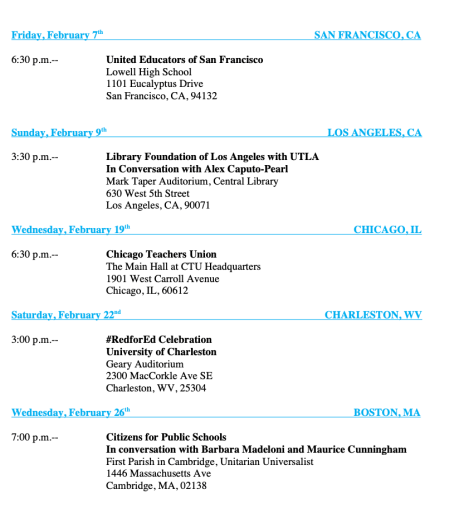
On my book tour, I will be in Charleston, West Virginia, on February 22 to celebrate the second anniversary of the historic West Virginia teachers’ strike.
And I will personally thank them for changing the national narrative!
In thinking back over the past decade, Peter Greene realized that Michelle Rhee was one of its defining figures.
For a time, she was everywhere. The media loved her stern and angry visage. She graced the cover of TIME and NEWSWEEK. She appeared on the Oprah show, NBC’s Education Nation, “Waiting for Superman.” And then she was gone.
For years, she was the face of the “reform” movement, a crusader set on busting unions, firing teachers and principals, and leading the way to nirvana. At one point, she boldly predicted that she would turn the public schools of D.C. into the best in the nation. After Mayor Adrian Fenty lost his race in 2010, Rhee stepped down as chancellor of the D.C.schools and launched StudentsFirst, which was anti-union, pro-testing, pro-Charter, and pro-voucher. Then it disappeared, never having raised the $1 billion she predicted.
Now the face of that same movement is Betsy DeVos, and the media doesn’t love her the way they loved Rhee, even though their goals are identical.
Like many of the big names in education disruption in the oughts, Rhee skated on sheer chutzpah. There was no good reason for her to believe that she knew what the heck she was doing, but she was by-God certain that her outsider “expertise” was right and that all she needed to create success was the unbridled freedom to exert her will.
And in 2010, it was working. The media loved her and, more significantly, treated her like a go-to authority on all educational issues. They fell all over themselves to grab the privilege of printing the next glowing description of the empress’s newest clothes. She was more than once packaged as the pro-reform counterpart of Diane Ravitch (though one thing that Rhee carefully and consistently avoided was any sort of head to head debate with actual education experts).
For the first part of the decade, it kept working. Students First became a powerhouse lobbying group, pushing hard for the end of teacher job protections. She was in 2011’s reform agitprop film Waiting for Superman. LinkedIN dubbed her an expert influencer. She spoke out in favor of Common Core and related testing. A breathless and loving bio was published about her in 2011; in 2013 she published a book of her own. She had successfully parleyed her DC job into a national platform.
2014 seemed like peak Rhee. I actually decided to stop mentioning her by name; I felt guilty about increasing her already-prodigious footprint. She seemed unstoppable, and yet by 2014 we knew that the TFA miracle classrooms, the DC miracle, the TNTP boondoggle, the StudentsFirst failures (far short of 1 million or $1 billion). Rhee was the Kim Kardashian of ed reform, the popular spokesmodel who did not have one actual success to her name. She was increasingly dogged by her controversies.
And then, in the fall of 2014, Michelle Rhee simply evaporated from the ed scene.
Greene traces the trajectory of her rise and fall in this post. What a spectacular rise it was, what an inglorious fall.
The parade has passed by, and she is no longer its leader. She is not even in it.
When I read Gary Rubinstein’s review of SLAYING GOLIATH: THE PASSIONATE RESISTANCE TO PRIVATIZATION AND THE FIGHT TO SAVE AMERICA’S PUBLIC SCHOOLS, it literally took my breath away.
Gary read the book with care.
I can’t summarize what he said.
Please read what he wrote.
I can only say that I have long admired his candor, his fearless integrity, and his insistence on accuracy.
To get praise from someone with such high standards is indeed an honor for me.
This post by Peter Greene appeared in Forbes, where he is now a regular contributor, explaining the real world of education to non-educators.
It is Greene’s perceptive review of SLAYING GOLIATH, which will be officially published on January 21.
To my delight, he describes this blog as “the Rick’s Cafe” of the Resistance to what is wrongly termed “reform,” but which I have renamed Disruption. Call it what it is.
He goes straight to the heart of the book:
This is the story of the last decade of public education in this country. It’s a far-ranging story that covers every corner of the nation and dozens of different issues. It’s the story of people with great power and people who would seem at first glance to have no power at all. Ravitch is telling a saga here that is broad in scope and rich in detail. Up until now, nobody has managed to capture the full breadth and depth of the battle over the next direction for U.S. public education, but Ravitch renders the complex and multi-character clear and comprehensible without sacrificing the full scope of what’s been happening.
Ravitch details how the folks she dubs the Disruptors first codified their ideas into law with No Child Left Behind and went on to push a vision of a test-and-punish regime, privately owned and operated schools, and circumventing democratic processes. The disruption movement has given us charter schools, high stakes testing, and the de-professionalization of teaching. It has used the real problems of inequity and underserved communities to justify false solutions….
Fans of education reform will undoubtedly disagree with some of Ravitch’s conclusions and analysis. That’s fine. What’s history without some debate. This book still provides the most complete, compact, detail-filled narrative of what has been happening to U.S. education since the Reagan administration release A Nation At Risk.
Thousands of teachers in Florida are rallying at the state capitol today to demand higher wages and better working conditions. The Republican-dominated legislature has been handing out public monies to charter schools and for voucher programs, but ignoring the public schools that enroll 85% of the state’s students. Several of the key legislators are related to charter operators. Conflicts of interest are not a problem in Florida. The State Commissioner of Education Richard Corcoran–former Speaker of the House–is married to a charter operator.
Bernie Sanders wrote a message of support to the teachers who are speaking out. It appeared in the Sun Sentinel.
Every Democratic candidate should heed Senator Sanders’ advice (except, of course, billionaire Michael Bloomberg, who wants more privatization, merit pay, and larger class sizes).
This week, tens of thousands of teachers from across Florida are rallying outside the state capitol to demand real support for their public schools. They are taking this action despite the outrageous threats from Republican officials to fire them just for standing up for their students. These educators are part of a massive nationwide movement, from Maine to California, that’s fighting back against years of underfunding, privatization, and draconian high-stakes testing. I am proud to stand with them in this struggle.
Florida educators have good reason to be angry. Their pay is among the lowest in the nation and far too many support staff live below the poverty line. Gov. Ron DeSantis and his fellow Republicans have refused to increase pay for veteran teachers, and yet just last year, they gave corporations half a trillion dollars in tax breaks. As a result, large numbers of teachers are leaving the profession and this year, more than 300,000 children entered classrooms without a full-time teacher.
The indignities and stresses of high stakes testing are another reason teachers are quitting in droves. Like in other states, educators are being made to teach to the test and schools are being forced to sacrifice important subjects like arts education. But in Florida, children are required to take their first standardized test within 30 days of beginning kindergarten and Governor DeSantis wants to extend harsh accountability requirements to preschoolers. That’s not only absurd, it’s also pointless given that testing such young children in this way does not yield reliable results.
Florida’s Republican leaders are also forcing children with severe cognitive disabilities to take standardized tests. This is downright abusive. In one case, the state required the teacher of a critically ill boy with cerebral palsy to regularly document his medical condition. They did not stop even when he lay in a coma on his deathbed. Sadly, the list of such horror stories in the state of Florida goes on and on.
Florida is ground zero of a school privatization movement intent on destroying public education. It has the largest private school voucher program in the country, and each year almost $1 billion in state money goes to private instead of public schools. These private schools operate with little to no accountability and in many cases their students’ math and reading skills have declined.
Moreover, almost half of the charter schools in the state are run by for-profit corporations. These schools perform no better than traditional public schools, yet they still benefit from public support. Between 2006 and 2014, more than a third of the Florida charter schools that received federal funding — almost $35 million — have either closed or never opened to begin with.
It is long past time we put an end to these attacks on public education. Under my Thurgood Marshall Plan, taxpayer money will be used to invest in our teachers and students, and not in corporate welfare. We will establish a national minimum salary of $60,000 for educators; triple funding for Title I schools; and strengthen the Individuals with Disabilities in Education Act (IDEA) by ensuring that the federal government provides 50 percent of the support for students with special needs. We will combat privatization by eliminating school voucher programs and placing a moratorium on the expansion of charter schools. And we will put an end to high-stakes testing once and for all.
Betsy DeVos and her billionaire friends in the Walton and Koch families do not want any of this to happen. If it were up to them, we would continue to give corporations trillions of dollars in tax breaks and starve our public education system of the resources it needs to be the best in the world.
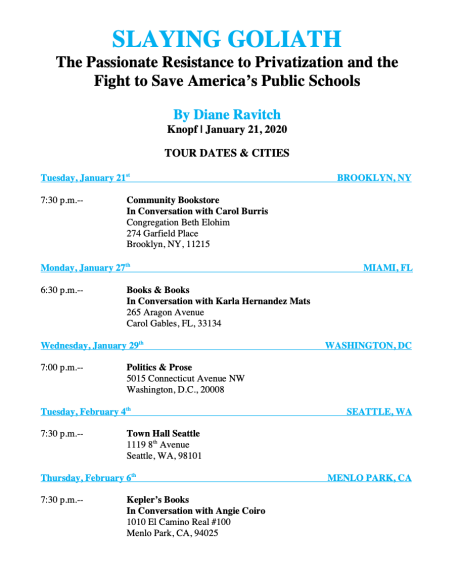
This is the current (and evolving) list of my speaking engagements in connection with the publication of my new book: SLAYING GOLIATH: THE PASSIONATE RESISTANCE TO PRIVATIZATION AND THE FIGHT TO SAVE AMERICA’S PUBLIC SCHOOLS.
I am trying not to wear myself out. Ten years ago, I hopped from city to city like a mountain goat.
But now I am 81 years old, and my knees are worn out. I have to pace myself.
Come out and say hello if you are in one of these cities.
SLAYING GOLIATH is a pro-public education, pro-teacher, pro-social justice, pro-common-good book. It is a book meant to give hope and encouragement to those who stand up to the billionaires and fight the status quo of choice and high-stakes testing. It contains inspiring stories of parents, students, teachers, and civil rights activists who took action against the powerful and won. At some of these events, the bookstore charges a modest fee to cover its expenses. Most are free.
The New York State Board of Regents received a grant of $100,000 from the Gates Foundation to hire a consultant to evaluate its testing illness. The Regents hired Achieve, an organization devoted to standardized testing and it’s proliferation. In addition, Achieve was deeply involved in the development of the Common Core.
After hearing outrage from constituents, the Regents broke ties with Achieve and replaced them with California-based consultant WestEd.
Daniel Koretz is one of the leading authorities on testing in the United States. A professor at Harvard University, he has written two important books about testing–its uses and misuses.
The first was Measuring Up: What Educational Testing Really Tells Us.
His latest is The Testing Charade: Pretending to Make Schools Better.
He wrote:
In December, we received more bad news about the achievement of American students: Our 15-year-olds made no significant progress in math and reading on PISA, the largest of the international tests. This followed on the heels of a new report from our National Assessment of Educational Progress (NAEP), which showed no real progress in reading or math for fourth or eighth grade students for the past decade, and longer for reading.
The routine debate is underway about how bad this news is, but such arguments mostly miss a core lesson: America’s school reform movement has plainly failed. It’s time to face up to this failure and think about new approaches for improving education.
The routine debate is underway about how bad this news is, but such arguments mostly miss a core lesson: America’s school reform movement has plainly failed.
There have been numerous reforms over the past two decades, but at the heart of them are efforts to pressure educators to raise test scores. The idea is deceptively simple. Tests measure important things we want students to learn. Hold educators accountable for raising scores, and they will teach kids more. And by focusing accountability on low-scoring groups — most often by setting uniform targets via state or federal laws, such as No Child Left Behind and the Every Student Succeeds Act — we will close achievement gaps.
Unfortunately, this concept has turned out to be more simplistic than simple, and it hasn’t worked. Even though the primary focus has been reading and math tests, reading hasn’t improved. Test-based accountability has contributed to math gains among younger students, but these improvements ended a decade ago, were achieved in part by taking time away from other subjects, and don’t persist until students graduate from school, making them of questionable value. The effort to improve equity has also failed.
As I showed decades ago, the gap between racial and ethnic minorities and non-minority students started to narrow before the rush into test-based accountability, but that progress has ground to a halt in recent years. At the same time, as Sean Reardon at Stanford University has shown, the gap between rich and poor students has widened on a variety of independent tests. The gap between high- and low-scoring students overall has also recently grown larger.
“Reform” that involves mandating high-stakes testing is a farce. Some politicians have claimed that the way to make kids smarter is to test them more frequently and to make the tests harder and harder. Koretz says this is nonsense. I say that the politicians should be required to take and pass the tests they mandate for helpless students.
It is good to have our concerns and doubts about the pernicious effects of high-stakes testing confirmed by one of the nation’s leading testing experts.
Presidential candidate Bernie Sanders was one of the few members of the U.S. Senate to vote against No Child Left Behind when it was approved by Congress in 2001.
Today is the anniversary of the signing of that law.
In this article in USA Today, Sanders calls for an end to the NCLB mandate, which remained in place through Race to the Top and the Every Students Succeeds Act of 2015 (Every student succeeds is another way of saying “no child left behind.”)
He writes:
Wednesday marks 18 years since the signing into law of No Child Left Behind, one of the worst pieces of legislation in our nation’s history. In December 2001, I voted against NCLB because it was as clear to me then, as it is now, that so-called school choice and high-stakes standardized testing would not improve our schools or enhance our children’s ability to learn. We do not need an education system in which kids are simply taught to take tests. We need a system in which kids learn and grow in a holistic manner.
Under NCLB, standardized tests were utilized to hold public schools and teachers “accountable” for student outcomes. As a result, some schools that underperformed were closed and their teachers and unions blamed.
The long-term effects of this approach have been disastrous. NCLB perpetuated the myth of public schools and teachers as failing, which opened the door for the spread of school voucher programs and charter schools that we have today. Some of these charter schools are operated by for-profits; many of them are nonunion and are not publicly accountable.
One error here: 90% of charters are non-union, not “many.” That is why charters have the enthusiastic support of right-wingers like the Waltons, DeVos, Koch, and other billionaires (see Slaying Goliath for a comprehensive list of the billionaires, foundations, and corporations that support testing and charters)

 Diane Ravitch's blog