Archives for category: Standardized Testing

Tom Ultican switched from a career in high tech to teaching high school physics and math in San Diego.

After much reflection, he has concluded that AP classes should be eliminated.

Read his article and see if you agree.

“What if the education reform ideology is wrong? What if the ideology of reform was based on an incorrect understanding of developmentally appropriate pedagogy? In a 2006 hearing before the senate Health, Education, Labor and Pensions committee, Assistant Secretary of Education, Henry Johnson testified, “We believe that the Advanced Placement program offers a proven, scalable approach to raising expectations and increasing rigor in America’s high schools, particularly those with high concentrations of low-income students that typically do not offer such curricula.” What if that belief is ill-founded?

“I taught AP physics and what a treat that was for me. I always had the highest performing students in the high school. This year both the salutatorian and the valedictorian were in my class. It was way more interesting than teaching a concepts oriented class in physics designed for the general student. Of course, I enjoyed teaching AP Physics to the school’s elite students, however, I perceived a dark side. The more I pondered it, the more I concluded that the AP and IB programs were developmentally inappropriate…

“AP stands for advanced placement. It is a product of College Board, the testing giant that produces the SAT tests. College Board is organized as a “non-profit” but it has hundreds of employees making six and seven figure incomes. AP is being heavily promoted by technology companies, politicians and other corporations. There is a push to make AP the leader in curricular development and teacher training. AP employs the teach to the test strategy of pedagogy.

“The National Math and Science Initiative (NMSI) is now putting pressure towards the expansion of AP courses in high schools across the nation. A teacher in the Sweetwater Union High School District wrote me this week saying teachers are under heavy pressure to participate in NMSI/AP sponsored training and AP class promotion.

“Both AP and IB, allow students to earn college credits that are accepted by most universities. But is it developmentally appropriate? Are we harming students?…

“There are many factors that would improve education and they are well known; smaller class sizes, integrated schools, well maintained modern facilities and teachers certificated in the subjects they teach are four such positive reforms. Surprisingly, increasing rigor and driving expectations down to younger students are counter-productive.

“Kindergarteners should receive lessons such as don’t eat the clay and it’s not nice to pull hair. Academics are developmentally inappropriate and likely unhealthy for them. Teaching Newton’s laws of motion and principles of algebra in fourth grade will surely cause more harm than good. The nine-year-old brain is not ready for symbolic reasoning. And, teenagers are dealing with natural biological stress; they need a safe low stress environment for healthy development. Rigor and high stakes testing is the wrong recipe.

“It is time to rethink AP and roll it back.”
Many years back, I wrote an essay about the poor track record of those who purport to know the jobs of the future. I looked back at predictions made by great minds over the 20th century, and they were all wrong. We don’t seem to have a magic crystal ball.Just the other day, a neighbor asked me to advise his daughter, a high school student, about how to prepare for the future. We haven’t met yet, but when we do, I will urge her to get a solid liberal arts education, to immerse herself in literature, history, and delve deeply into her interests.

Ann Cronin, who has been a teacher, administrator, and all-round accomplished educator in Connecticut, uses this post to offer advice about how to prepare for an unknown future. She calls it “a toolkit for the future.”

The most important preparation is to develop as thinkers and learners.

Here are three practical ways that teachers can do that:

“Teach students to question.
“Teach students to write essays that explore questions of importance to them.
“Teach students to write essays about how they came to know what they know.”

She observes:

“The Common Core State Standards do not ask students to think in these ways. They are falsely marketed as being about critical thinking; those standards do not give students the learning and thinking skills needed for the future. Also, no standardized test in the United States assesses questioning, collaborating, creative thinking, or learning to learn skills. Every minute of class time given to preparing students for those tests takes students away from what they really need to learn.

“The future is almost upon us; it is just about here. It’s time to give students what they need. Invite them to question, to explore possibilities, to imagine solutions, to grow and change as thinkers, and to fall in love with learning. Then sit back and watch where they take us. It will be better than we now know.”

A daily reader and commenter who calls him/herself LeftCoastTeacher left the following comment:

I’m off topic, sorry, but I am excited.

Congratulate my students! I have just been able to Opt Out all my English classes from taking the SBAC Interim Assessments. I work in a district with criminals on the board and their deform appointees in administration, so the entire district is being forced to take the computer-based interim assessments made by the Smarter (dumber) (un)Balanced Assessment (not) Consortium (conspiracy), or SBAC. You know those interim tests are just a stepping stone toward Competency Based data collection taking over instruction time completely.

In California, schools and districts are required to inform parents of their right to Opt Out of state tests. So, I went to admin and asked for the form letter to parents before Back to School Night so I could ‘make sure parents are informed of their rights’. Admin said, Gulp. There was some back and forth about whether state law was in play for tests required by the district versus by the federal government. I insisted that California parents always have the right to have their children receive instruction instead of standardized testing, and always have the right to refuse having their children forced to sign in to a website that collects testing data.

I am being granted a waiver Out of the SBAC IAB’s. I get to instead design and implement my own formative assessments. We are going to read — together — some great, whole fiction and poetry (on paper), and write some essays about what we read. On paper. With pens. We will discuss the results — together — and learn from the experience. I won. My students won.

In this post, Valerie Strauss interviews Daniel Koretz of Harvard University about his new book The Testing Charade: Pretending to Make Schools Better.

I just finished reading the book, which is a devastating critique of the current “reform” movement because of its reliance on standardized testing. Koretz is not anti-testing or even anti-standardized testing. He is upset by the misuse of standardized testing. He says that it was completely predictable that putting high stakes on tests would lead to score inflation, gaming the system, and cheating (I said the same things in The Death and Life of the Great American School System in chapter 8, about the false promise of accountability). He says that the so-called reform movement has been completely misled by its obsession with high stakes. Consequently, none of the gains that it claims can be trusted. He also lambastes the deeply flawed Common Core state standards, which presumes the value of having a single standard for all students regardless of their different ambitions, abilities, and interests.

I intend to review the book at a later date, and I will express both my admiration for the book and my concerns about the position Koretz takes about the value of standardized testing under the “right” circumstances. I appreciate the fact that he demolishes the “reform” movement and its alleged but nonexistent gains.

I don’t agree with him about the value of standardized tests. Remove the high stakes and they have a limited purpose. Unfortunately, as he points out, the “reformers” see test-based accountability as the heart and soul of their movement. If they can’t use tests to punish students, teachers, principals, and schools, then what is the point?

But for me, the current obsession with standardized testing is pernicious for other reasons. It reduces learning to multiple choice questions and answers. It rewards test-taking skills more than thinking skills. It punishes divergent thinking.

I could go on, but I will save it for a review.

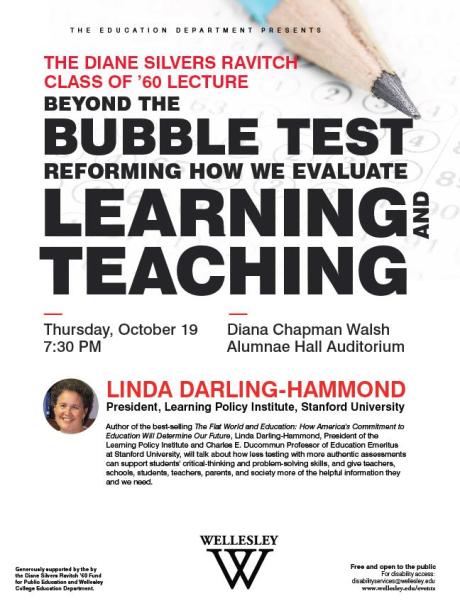
If you live within driving distance of Wellesley, Massachusetts, I hope you plan to attend Linda Darling-Hammond’s lecture on October 19.

I endowed an annual lecture series to bring the best thinking about education to the campus. The program will be live-streamed and available on videotape afterwards so it reaches the maximum number of people. So, if you live far from the Boston-Wellesley hub, you will have a chance to see and hear the lecture. Pasi Sahlberg gave the Ravitch lecture last year. With the collaboration of Professor Barbara Beatty of the Wellesley Department of Educarion, we will select the best thinkers in education each year.

This is my personal gift to my alma mater. My gift also includes funding for student research and internships.

After my death, there will be a Ravitch Professorship in the Department of Education devoted to Education and the Common Good.

For now, enjoy listening to one of the nation’s most thoughtful educators.

thumbnail

David Coleman led the creation of the Common Core, which has been mired in controversy since it was released.

Now he is president of the College Board, where he oversaw the redesign of the SAT. Confusion reigns.

The good news is that nearly 1,000 colleges and universities are now test-optional, meaning students don’t have to take the SAT or the ACT to apply. The word is out than the students’ four-year grade-point-average is a better predictor of college performance than a standardized test.

What next for David Coleman?

Joanne Yatvin is now retired. She has been a teacher, principal, and superintendent, as well as President of the National Council of Teachers of English. She is a literacy specialist.

Allons Enfants de la Patrie

Arise Children of Our Country

During the last quarter of the 20th century powerful American politicians decided that human learning was a fixed process in which all healthy young people could and should acquire a specific body of knowledge, information, and skills over a fixed period of time. With that belief, the low scores of American students on international tests were a hard pill for politicians to swallow.

They concluded that those scores were the fault of our schools and their teachers, also parents who were shirking their responsibility to demand the best from their children. American students of all social backgrounds were growing up lazy, ignorant, and unprepared to be the competent adult workers, leaders, creators, and patriots they were meant to be.

Although there is no research evidence to confirm such beliefs about American students’ laziness or the ineffectiveness of our schools, public education has operated on those assumptions continually through the actions of Congress, the Department of Education, and state legislatures. Those bodies have also used public humiliation and punishment of students, teachers, school principals, unions and—indirectly—parents to prevent any resistance from gaining ground.

Thus far, all efforts to reverse the current concept of education and create a humane and reasonable foundation for our public schools have failed. Recently, we believed that the new federal law, ESSA, would return authority to states and their communities, but that belief was crushed by the Department of Education with its rejection of any state plans aimed to serve students’ needs and interests rather than raise test scores and improve graduation rates.

From my perspective, as the mother of four children who were public school students in far better times, and also as a teacher and school principal back then; there is only one possible solution. We must have a widespread public rebellion against the current system. Parents should refuse to have their children participate in high stakes testing and demand age-appropriate standards for all grades. Communities need to re-shape their public schools to fit the needs of their students; and state officials must fight any moves by the Federal government to punish schools for non-compliance.

We have wasted more than twenty years trying out the beliefs and programs ordered by powerful, but know-nothing politicians. For the sake of our children and our country we must take back public education and allow it to grow through wisdom and humanity.

The link was left off. It is here.

Valerie Strauss reports on an important new study by a group at Stanford University led by historian Sam Wineburg.

NAEP supporters say that the tests are able to measure skills that other standardized tests can’t: problem solving, critical thinking, etc. But this post takes issue with that notion. It was written by three Stanford University academics who are part of the Stanford History Education Group: Sam Wineburg, Mark Smith and Joel Breakstone.

Wineburg, an education and history professor in the Graduate School of Education, is the founder and executive director of the Stanford History Education Group and Stanford’s PhD program in education history. His research interests include assessment, civic education and literacy. Smith, a former high school social studies in Iowa, Texas and California, is the group’s director of assessment; his research is focused on K-12 history assessment, particularly on issues of validity and generalizability. And Breakstone, a former high school history teacher in Vermont, directs the Stanford History Education Group. His research focuses on how teachers use assessment data to form instruction.

The National Assessment of Educational Progress is considered the “gold standard” of education testing because it is the only national longitudinal measure that goes back to 1970; no one can practice for it; no one knows which students will take the test; no single student takes the entire test; samples of students in every state take portions of the tests.

But when it comes to standardized testing, there is no gold standard. It is all dross, especially now that almost all standardized tests are delivered online. Online testing is popular because it is cheap and supposedly fast. But online testing by its nature allows no room for demonstrating thoughtfulness or for divergent thinking or for creative responses. It is the enemy of critical thinking.

Wineburg’s group tried to determine whether NAEP actually tested critical thinking, and they found that it did not.

But what would happen [they asked] if instead of grading the kids, we graded the test makers? How? By evaluating the claims they make about what their tests actually measure.

For example, in history, NAEP claims to test not only names and dates, but critical thinking — what it calls “Historical Analysis and Interpretation.” Such questions require students to “explain points of view,” “weigh and judge different views of the past,” and “develop sound generalizations and defend these generalizations with persuasive arguments.” In college, students demonstrate these skills by writing analytical essays in which they have to put facts into context. NAEP, however, claims it can measure such skills using traditional multiple-choice questions.

We wanted to test this claim. We administered a set of Historical Analysis and Interpretation questions from NAEP’s 2010 12th-grade exam to high school students who had passed the Advanced Placement (AP) exam in U.S. History (with a score of 3 or above). We tracked students’ thinking by having them verbalize their thoughts as they solved the questions.

What we learned shocked us.

In a study that appears in the forthcoming American Educational Research Journal, we show that in 108 cases (27 students answering four different items), there was not a single instance in which students’ thinking resembled anything close to “Historical Analysis and Interpretation.” Instead, drawing on canny test-taking strategies, students typically did an end run around historical content to arrive at their answers.

Their analysis is fascinating.

It is past time that we relinquished our obsession with standardized testing.

Despite the failure of No Child Left Behind and Race to the Top, despite the cruel pressures of this approach on very young children, the New York State Board of Regents is set to adopt a punitive plan (to meet the requirements of the new “Every Student Succeeds Act”). Common sense and concern for education values appears to have disappeared from Albany.

Cruelest of all: the state will retain the absurd Common Core standards for the littlest children, K-2 (with a new name, of course).

Districts with high numbers of opt outs will be punished.

Here is the summary in Newsday, by John Hildebrand, showing how little impact parent activism has had on the Board of Regents. Sorry to note, the state teachers’ union applauds these retrograde decisions. (Postscript: I hear the state teachers’ union is discussing their position, so the quote in this article may not be the last word.P

“ALBANY — Sweeping new objectives for school districts and students, with potential effects on controversial state tests and academic standards, are on the state Board of Regents agenda at its first meeting since classes resumed for the 2017-18 academic year.

“The 17-member educational policy board on Monday will tackle the issue of regulating districts as it works toward agreement on enforcement of the revamped federal law called the Every Student Succeeds Act, or ESSA. New York, like many other states, must submit its enforcement plan to the U.S. Department of Education by Sept. 18 for final approval.

“A 200-page draft plan, under review since May, would regulate schools on a range of objectives important to Long Island.

“Those include steps to discourage students from boycotting state tests — a movement that last spring swept up about 19 percent of more than 1 million students statewide in grades three through eight eligible to take the exams. That included about 90,000 students in Nassau and Suffolk counties, more than 50 percent of the region’s test-takers in those grades.

“Later on Monday, the Regents are scheduled to approve new academic standards, formerly known as Common Core and recently renamed as Next Generation Learning standards. The detailed guidelines — 1,048 standards in English and 450 in math — encompass classroom lessons from preschool through 12th grade statewide.

“The actions, while distinct from one another, are largely intended to settle controversies over student testing and school accountability that began rocking the state more than seven years ago. Though disagreements continue, policy experts said the Regents’ upcoming actions could set the state’s educational course for years to come.

“They’re kind of like cornerstone initiatives,” said Robert Lowry, deputy director of the New York State Council of School Superintendents and a veteran observer of Albany politics. “The standards define what students are supposed to learn, and ESSA defines how schools will be held accountable for teaching students.”

“Highlights of proposals the Regents are expected to consider include:

“School districts that don’t meet federal requirements for student participation in testing — and that includes all but a handful of districts on the Island — would have to draft plans for improvement. Systems that don’t improve would face potential intervention by a regional BOCES district or the state.

“The goal for high school graduation rates would eventually rise to 95 percent statewide, from a current level of slightly more than 80 percent. State education officials have not decided how diploma requirements might be revised to make that reachable.

“In rating school districts’ academic performance, greater recognition would be given to students who score well on college-level exams sponsored by the Advanced Placement program and by International Baccalaureate.

“For some districts, that could help balance out low performance by other students on the state’s own grade-level tests.

“Greater weight also would be given for student improvement, or “growth,” on state tests, as opposed to recognizing only the percentage of students who reach proficiency level. This reflects the intent of the Every Student Succeeds Act, signed into law in 2015 by President Barack Obama, which was to provide states with greater flexibility in regulating schools than was possible under the former federal law known as No Child Left Behind.

“Questions linger over whether the proposals will have an effect on stemming the test-refusal movement, especially on the Island.

“Jeanette Deutermann of North Bellmore, chief organizer of the Long Island Opt Out network, predicted that test boycotts in the region will continue unabated as long as the state sticks with academic standards that she and many other parents believe place too much stress on students.

“Deutermann pointed especially to standards in the earliest grades.

“Pre-kindergarten standards say all students should write their numerals to five,” she said. “Some kids are just learning how to hold a pencil.”

“At the state level, education leaders credit the Regents’ leadership and Education Commissioner MaryEllen Elia for listening to their concerns and quieting debate over tests and related issues. Statewide, the percentage of those opting out of the spring English and math exams was down 2 percentage points from 2016.

“New York State United Teachers, a statewide union umbrella group that once fiercely opposed federal and state efforts to tie test results to teacher performance evaluations, recently expressed support for much of the state’s plan to enforce ESSA.

“Overall, it’s reasonable and rational,” said Andy Pallotta, president of the 600,000-member NYSUT organization, during an interview on WCNY-FM, an upstate public radio station. “I think we’re on the way.”

This is a really good piece of investigative writing by Alina Tugend on the value of Advanced Placement courses. It doesn’t answer the question posed in the headline of this post but it supplies valuable information and poses the right questions.

I was interviewed and what really bothers me about the demand for “AP for All” is the implicit assumption that taking a rigorous course and failing the exam will improve educational opportunity. As I say in the article, if this is the goal of the College Board, why not offer the test for free? It is easy to forget that the College Board is a business, not a charity.

There are other ways to reduce the achievement gaps instead of putting kids in a class where the reading level is far beyond their reach and they are near certain to fail.

Although AP was originally designed for elite high schools, some of them have dropped it because their own classes are equally demanding. And some elite college don’t give credit for AP courses.

So the strongest claim of the College Board these days is that their tests supply equity. No standardized test has ever increased equity. They are designed not to. If your primary interest is civil rights, fight for funding and desegregation, not a better standardized test.