Archives for category: School Choice

The National Center for the Study of Privatization in Education at Teachers College, Columbia University, recently released a major study of segregation and charter schools by Dr. Helen Ladd and Muvzana Turaeva of Duke University.

Dr. Samuel Abrams introduced it here.

The issue of school choice and segregation has been central to education policy debates for decades. In his initial argument for vouchers, published in 1955, Milton Friedman conceded that segregationists stood to employ vouchers to enroll their children in all-white private schools instead of public schools mandated to integrate a year earlier by Brown v. Board of Education. But to Friedman, the answer was not regulation but moral suasion. Friedman’s opinion was rendered technically moot in 1976 by Runyon v. McCrary, which barred private schools from making admissions decisions based on race, yet it nevertheless indicated a fundamental problem with systems of school choice.

With the introduction of charter schools in the early 1990s, commentators raised concerns about school location, inadequate transportation, contracts mandating significant parental involvement, and shared parental proclivities as implicit mechanisms or pathways to segregation. In “Parental Preferences for Charter Schools in North Carolina: Implications for Racial Segregation and Isolation,” Helen F. Ladd and Mavzuna Turaeva add substantially to the literature validating these concerns.

Using data for the nearly 11,000 North Carolina families who transferred their children from traditional public schools to charter schools in 2015-16, Ladd and Turaeva document that the migration of white, though not minority, switchers from traditional public schools to charter schools increased segregation. “We find that by switching to charter schools that are whiter than the traditional public schools they leave behind,” they write, “white switchers contribute to racial segregation across schools.” At the elementary level, 67 percent of white switchers enrolled in charter schools with lower shares of minority students; at the middle-school level, 72 percent of white switchers did so.

To buttress their analysis, Ladd and Turaeva employ a conditional logit model to estimate revealed preferences. To infer parental preferences by race as well as socioeconomic status, Ladd and Turaeva use five criteria to define the value of charter schools for parents: racial composition; proximity; academic achievement; availability of transportation and lunch; and mission. Ladd and Turaeva conclude that with these dimensions considered together, it is clear that white parents disproportionately favored white charter schools and exhibited a pronounced aversion to significantly minority charter schools.

With this working paper, Ladd, a professor emerita of public policy and economics at Duke University, and Turaeva, a doctoral candidate in public policy (with a specialization in economics) at Duke as well as a research associate at the Duke Center for Analysis of Longitudinal Data in Education Research, build on research Ladd did with Charles Clotfelter and John Holbein for an article published by Education Finance and Policy in 2017 on growing segregation across the charter sector in North Carolina from 1999 to 2012. In addition, Ladd and Turaeva’s analysis complements a 2019 NCSPE working paper on charter schools in Kansas City by Patrick Denice, Michael DeArmond, and Matthew Carr, who found a disproportionate number of white students transferring from traditional public schools to new charter schools from 2011 to 2015.

Lucid, rigorous, and supported with eight tables of telling data, this study advances our understanding of school choice and raises important questions about how choice systems should be designed.

Samuel E. Abrams
Director, NCSPE
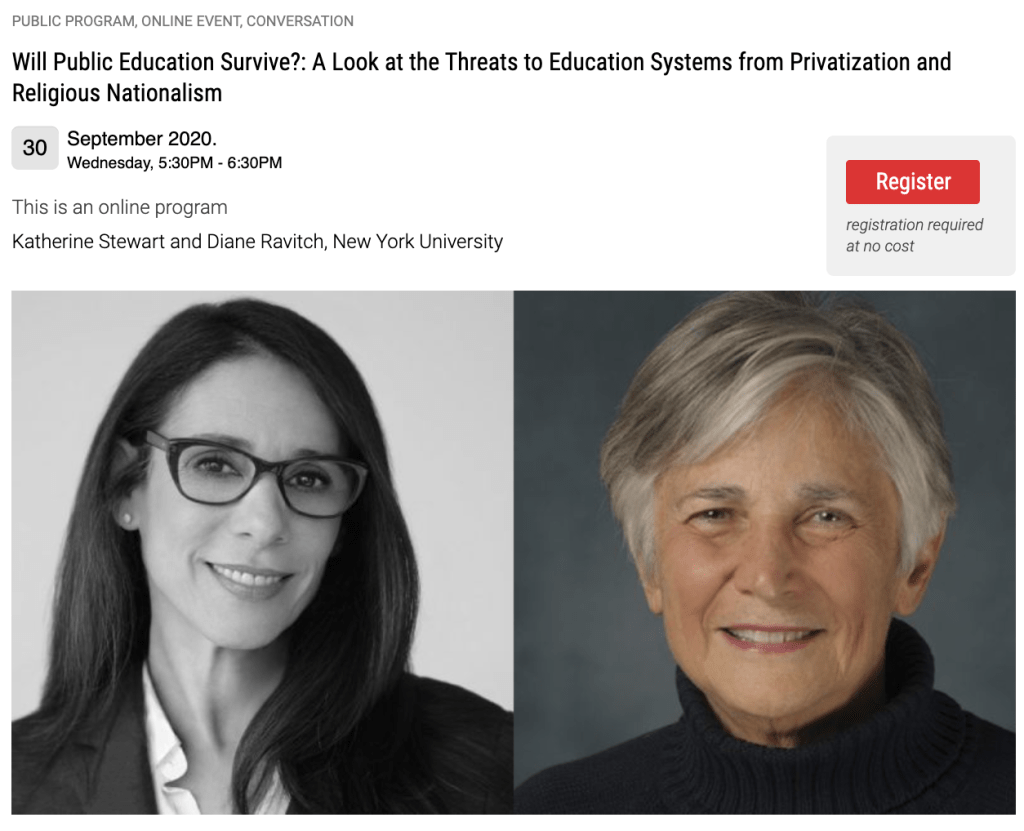
[intro]

The rise of the Religious Right has coincided with the privatization movement in public schools. While some may feel that this is coincidental, there is reason to believe there is a directly causal relationship between these two factors. Two scholars, from different disciplines, will discuss how their work comes together to help explain the history and current state of efforts to diminish, if not dismantle, the American public education system. Katherine Stewart has written on the rise and increasing power of the Religious Right in her book The Power Worshipers. She will be joined by Diane Ravitch who has written extensively on education and, in her recent book Slaying Goliath, explores the history of the school privatization movement and the efforts to oppose it.

Please note, this is an online event held on the video conference platform, Zoom. Registrants will receive an email with links to join the program.

Link to register: https://18308a.blackbaudhosting.com/18308a/Will-Public-Education-Survive-A-Look-at-the-Threats-to-Education-Systems-from-Privatization–Reli

Jan Resseger read Derek Black’s new book–a history of American public education by a constitutional lawyer–and loved it.

I read Black’s book and interviewed him on a Zoom about the book. I too loved it. Black makes clear that public education is the central American tradition, an idea envisioned by the Founding Fathers and realized over decades as an engine of our democracy. In a multicultural, diverse society, public schools bring students together from many backgrounds, to live and learn together.

Her review begins:

Derek Black’s stunning new book, School House Burning: Public Education and the Assault on American Democracy, threads together a history that has rarely been collected in one volume. Black, a professor of constitutional law at the University of South Carolina, presents the history of an idea first articulated in the Northwest Ordinances of 1785 and 1787, threatened again and again throughout our nation’s history but persistently revived and reanimated: that a system of public education is the one institution most essential for our democratic society. And, while the specific language defining a public education as each child’s fundamental right is absent from the U.S. Constitution, the guarantee of that right is embedded in the nation’s other founding documents, in the history of Reconstruction that followed the Civil War, in the second Reconstruction during the Civil Rights Movement, and in every one of the state constitutions.

Today’s post will skim the history as Derek Black presents it; on Wednesday, this blog will explore how Black believes both public education and democracy are threatened today.

While the U.S. Constitution never formally names public education as the nation’s fundamental and necessary institution, the provision for public education is the centerpiece of the Northwest Ordinances of 1785 and 1787: “The Ordinances, and education’s role in them, however, cannot be so easily dismissed. The Northwest Ordinance of 1787 is one of the most significant legal documents in our nation’s history and the current United States Code treats it as such… In many important ways, the history and effect of the Constitution and the Ordinances are inseparable. First, the documents were passed by many of the same people… Second, the Northwest Ordinance’s substance is a constitutional charter of sorts. Practically speaking, it established the foundational structure for the nation to grow and organize itself for the next two centuries. Precise rules for dividing up the land, developing the nation’s vast territories, and detailing the path that these territories would follow to become states are not the work of everyday legislation. They are the work of a national charter.” (Schoolhouse Burning, pp. 64-65). “The 1785 Ordinance specified how every square inch of the territories would be divided into counties and towns. Every new town had to set aside one-ninth of its land and one-third of its natural resources for the financial support of education. And every town had to reserve one of its lots for the operation of a public school.” (Schoolhouse Burning, p. 62) The Northwest Ordinances named the urgent purpose of public education and prescribed a means of funding the schools.

Jumping way ahead to the early 1970s, after President Richard Nixon replaced Chief Justice Earl Warren with Chief Justice Warren Burger and the U.S. Supreme Court moved away from the principles embodied in Brown v. Board of Education, Black describes the significance of San Antonio v. Rodriguez, the U.S. Supreme Court case which declared that because the U.S. Constitution itself does not explicitly protect the right to public education, public schooling is not a fundamental right. Black believes the founding documents should be read to include the Northwest Ordinances and that the fundamental role of education is further affirmed through our nation’s troubled history: “(I)f you asked modern legal scholars whether education is a fundamental right protected by the federal Constitution, they would tell you no, and they would be correct in one sense. The United States Supreme Court (in a 5-4 decision) refused to recognize education as a fundamental right in 1972, reasoning that the Constitution neither explicitly nor implicitly protects education. The Court feared that nothing distinguished education from the various other things that are important in life, like food and shelter. The foregoing history, however, reveals that education is far different than anything else government might offer its citizens (other than the right to vote). The nation’s very concept of government is premised on an educated citizenry. From its infancy, the United States has sought to distinguish itself with education. More particularly, education has been the tool though which the nation has sought to perfect its democratic ideas.” (Schoolhouse Burning, p. 133)

And she continues:

I hope you will read Derek Black’s new book, for these comments merely skim the surface of his fascinating history of the American idea of public education. As he concludes his history, Black summarizes the book’s thesis: “The foregoing principles—the right to an adequate and equal education, making education the state’s absolute and foremost duty, requiring states to exert the necessary effort (financial or otherwise) to provide quality educational access, placing education above normal politics, and expecting courts to serve as a check—are all in the service of something larger: the original idea that education is the foundation of our constitutional democracy. Education is the means by which citizens preserve their other rights. Education gives citizens the tools they need to hold their political leaders accountable… Democracy simply does not work well without educated citizens.” (Schoolhouse Burning, p. 224) Black reminds us, however: “The founders articulated educational goals not with any certainty that they would spring into reality simply by writing them down, but in the hope that we might one day live into them.” (Schoolhouse Burning, p 71)

Link corrected!

In case you missed our Zoom conversation, this is the link to my discussion with Steve Suitts about his new book about the segregationist origins of “school choice.”

His book is “Overturning Brown: The Segregationist Legacy of the Modern School Choice Movement.”

Betsy DeVos lost the biggest fight of her tenure as Secretary of Education. Federal judges consistently rejected her legally binding rule requiring states to give private schools a share of the $13 billion Congress allocated for public schools and for needy students in private schools. DeVos wanted private schools to get a share of the federal money without regard to the need of their students. The judges said no.

After fighting for her position, DeVos admitted defeat and decided not to appeal the court decisions.

Some states have already given federal funds to private schools, using DeVos’ formula, and it is not clear whether that money will be clawed back.

Charter schools also received a share of the $13 billion in CARES funds, which they qualified for as “public schools.” Many charter and private schools also applied for and received millions of dollars from the Paycheck Protection Program (public schools were not eligible for PPP). A study by Good Jobs Inc. determined that charter and private schools obtained SIX TIMES as much federal relief money as public schools.

Have you ever wondered what really goes on in the courtroom? Would you like to have a front-row seat as lawyers argue for and against vouchers before the South Carolina Supreme Court?

Here is your chance.

Tonight at 7:30 pm EST, I’m having a Zoom conversation with University of South Carolina professor Derek Black. He will talk about his new book, Schoolhouse Burning: Public Education and the Assault on American Democracy, and about the case discussed in this video.

Please sign up here and join us. It’s like a seat in a graduate seminar in vouchers and school choice, offered by a top-notch constitutional lawyer.

I will be Zooming with Derek Black on September 23 at 7 pm EST.

The information about signing up is here.

If you have ever debated with friends about school choice, you will want to hear Derek Black.

In his engaging history of public education, Derek shows that the Founding Fathers intended to create public schools, not a system of publicly funded private and religious schools.

It is an important book that you should read. But first, take this opportunity to meet the author.

Please join us.

The discussion is sponsored by the Network for Public Education.

Please join me on September 23 at 7 pm EST as I talk with Derek Black about his terrific new book, Schoolhouse Burning: Public Education and the Assault on American Democracy. The discussion is sponsored by the Network for Public Education. Derek Black is a professor of law at the University of South Carolina who specializes in civil rights law. Hos excellent scholarship demonstrates that the Founding Fathers wanted a free and universal public school system for the new nation. Those now attacking it are vandals!

Please sign up and join the discussion between Steve Suitts and me on Zoom on Wednesday September 16. We will be talking about Steve’s new book Overturning Brown: The Segregationist Legacy of the Modern School Choice Movement. You will be amazed to learn of the true history of school choice. It is definitely not the “civil rights issue of our time,” as Trump and DeVos claim.

Steve has been involved in civil rights work throughout his career. He was founding director of the Alabama Civil Liberties Union; executive director of the Southern Regional Council; and vice president of the Southern Education Foundation. He is also the author of a biography of Hugo Black, a member of the U.S. Supreme Court Justice who played a large role in history.

You can sign up here.

Steve and I will talk for an hour, and then we will open the floor for your questions.


PUBLIC SCHOOL ADVOCATES URGE ARKANSAS LEGISLATURE TO END BROKEN VOUCHER PROGRAM

In a letter sent to Arkansas legislative leaders last week, Public Funds Public Schools, along with other state and national organizations, urged the Arkansas General Assembly to end the state’s harmful and inequitable private school voucher program. The letter highlights alarming information revealed in the recently released biennial report on the “Succeed Scholarship Program,” Arkansas’ voucher program for students with disabilities and students in the foster care system.

The letter was signed by leading advocates for Arkansas students and families, including Arkansas Advocates for Children and Families, Arkansas Citizens First Congress, the Arkansas Public Policy Panel, and Arkansas-based philanthropic and education leader Dr. Sybil Jordan Hampton. In addition to PFPS, several regional and national education advocacy groups also signed on, including Education Law Center and SPLC Action Fund (which collaborate on PFPS), and the Southern Education Foundation.

“The 2020 Report illustrates in detail the glaring deficiencies in Succeed Vouchers’ ability to improve academic outcomes and promote equity and access for historically – and currently – marginalized students. It also illustrates the profound difficulties in ensuring appropriate oversight of this publicly-funded program,” the letter notes.

The State’s 2020 Report, which was mandated by bipartisan legislation passed in 2019, also underscores the lack of data necessary to evaluate the academic effects of the Succeed Vouchers, noting that “meaningful comparative data regarding student performance based on the assessment scores private schools provide is hindered by several factors.” The academic outcome information that was collected, however, shows low test scores for the majority of voucher recipients. This failing is consistent with research demonstrating the ineffectiveness of private school voucher programs across the country in improving students’ academic outcomes.

The 2020 Report also exposes inequitable enrollment statistics, troubling data inconsistencies, and little accountability for the public funds spent on the voucher program.

Key findings include:

* There are significant gaps in data on the racial demographics of voucher students. Of those for whom data was available, there are significant racial disparities: 5% of voucher students were Latinx, 12% were Black, and 78% were White. Students with disabilities in Arkansas public schools, on the other hand, are 11% Latinx, 23% Black, and 61% White.

*Due to participating private schools’ inconsistent reporting and data collection standards, the Free or Reduced Price Lunch (FRPL) status of 44% of participating students is unreported. Of available data, just 30% of voucher students were eligible for FRPL, while 60% of Arkansas public school students are eligible.

*Only three-quarters of participating private schools are accredited, while a quarter are on some type of path to accreditation. Thus, schools participating in the voucher program are receiving taxpayer dollars without completing a rigorous accreditation process, let alone being held to the same accountability and reporting standards as public schools.

*Nearly 20% of voucher students have left their private schools, for reasons including dismissal, inability to pay tuition amounts not covered by their voucher, and lack of access to transportation.

The letter to Arkansas lawmakers notes that, as more resources are needed to meet students’ needs due to COVID-19, the impact of the pandemic on Arkansas’ education budget will be over $2 billion for the next fiscal year, making it more urgent than ever to focus limited public funds on effective, research-based programs that meet the needs of Arkansas’ public school students, who are the vast majority of Arkansas schoolchildren. Instead of diverting millions to an ineffective and inequitable voucher program, the letter urges legislators to “redirect those public funds to the public school system in order to improve educational opportunity for students with disabilities, foster care students, and students from low-income families.”

Press Contact:
Sharon Krengel
Policy and Outreach Director
Education Law Center
60 Park Place, Suite 300
Newark, NJ 07102
973-624-1815, ext. 24
skrengel@edlawcenter.org