Donald Trump has done many things that are unprecedented. He is the first President to be impeached twice. He is the first convicted felon to be elected President. He is the first President to encourage a violent insurrection to overturn the election that he lost.
So many firsts.
But this one takes the cake. It’s the biggest grift of all. It’s the definition of chutzpah.
In the 250 years of this nation’s history, no President has ever sued the government for damages to his reputation.
NBC News reported:
The lawsuit, filed Thursday at a federal courthouse in Miami, says Trump is suing in his personal capacity, not as president. The other plaintiffs include two of Trump’s sons — Donald Trump Jr. and Eric Trump — and the Trump Organization.
“Defendants have caused Plaintiffs reputational and financial harm, public embarrassment, unfairly tarnished their business reputations, portrayed them in a false light, and negatively affected President Trump, and the other Plaintiffs’ public standing,” the complaint says.
The Treasury and IRS did not immediately respond to requests for comment Thursday night.
A former IRS contractor, Charles Littlejohn, was sentenced to five years in prison in 2024 after he pleaded guilty the year before to leaking Trump’s tax records to The New York Times. The Times published exclusive reporting in 2020 that showed Trump had paid only $750 in federal income taxes in 2016 and 2017.
Trump is also suing the Justice Department for $230 million its investigations of his role in the January 6 insurrection and his withholding of documents.
How vigorously do you think Treasury Secretary Scott Bessent and Attorney General Pam Bondi will fight their boss in court?
Would taxpayers have standing to sue to oppose any settlement?
The Houston Chronicle exposed a scandal involving Houston’s state-appointed Superintendent Mike Miles.
The Chronicle reported:
State-appointed Houston ISD Superintendent Mike Miles played a central role early in negotiations for a nearly $1 million contract between a Texas charter school network and a for-profit Colorado consulting firm, according to records obtained by the Houston Chronicle.
Miles used his private Gmail during those talks, emails show, sending a proposal with the consulting firm’s cost breakdowns; flagging a major price increase; and directing where contract documents should be sent.
The firm’s services — plus the free use of HISD’s curriculum and training by Miles himself — were intended to help the charter system replicate HISD’s controversial reforms and turn around several of its struggling campuses.
The mystery behind the scandal is why anyone would want to adopt Mike Miles’ top-down scripted curriculum. Its main effect is to drive away students and teachers. Test scores are up, to be sure. Miles’ greatest accomplishment seems to be raising a cohort of trained seals with higher scores who have never experienced love of learning.
Many powerful people have a vested interest in making sure that the public never sees what and who is in the Epstein files. Democrats, Republicans, powerful corporate leaders. They prefer to keep the files under lock and key.
But didn’t Congress just pass a law requiring the release of those files? Didn’t Trump sign the legislation? Even though no legislation was needed, because Trump always had the power to release the files.
Everyone imagines a government cover-up as a team of men in suits throwing files into a furnace.
That’s fiction. The real cover-up is boring. It’s procedural. It’s legal. And it works. The United States doesn’t destroy evidence. It manufactures delays. It fabricates uncertainty. It deploys exemptions instead of fire. The truth isn’t burned. It’s redacted. And the machinery that performs this ritual — the system that is right now digesting the Epstein files — is something I’m calling: The Redaction Engine. Once you understand this machine, the Transparency Act stops looking like a win and starts looking like a transmission belt feeding secrets into a shredder that no one touches by hand.
The Architecture of Obscurity FOIA was sold as a “Right to Know” law. What Congress actually built is a filtration system — and one that agencies quickly learned how to weaponize. Inside the FOIA framework sits a set of exemptions that function like hardware components in an industrial shredder. The Redaction Engine uses them as gears. According to the technical audit in The Redaction Engine: National Security Information Control Architectures , the most powerful of these gears are: Exemption 1 — The National Security Black Hole Everything “classified” stays sealed. But classification isn’t an objective fact — it’s a prediction. The law only requires a “reasonable expectation” of harm. Speculation becomes legal justification. Courts almost never challenge it. They review whether the stamp was applied correctly — not whether the classification itself is absurd. That is not oversight. That is choreography. Exemption 3 — The Files That Don’t Exist This one is an entire legal universe. Statutes like the CIA Information Act let agencies designate “Operational Files” that don’t even have to be searched. They can legally pretend an entire category of documents has left the physical plane. The public can’t request what the government asserts is not real. Exemption 5 — The “Embarrassment Privilege” The “Deliberative Process” clause was meant to protect drafts and brainstorming. Instead, agencies use it to hide:
*evidence of wrongdoing
*internal dissent
*contradictory analysis
-*early warnings that were ignored
It’s the single most abused exemption in the system. And then there’s the Mosaic Theory. This is the government’s favorite intellectual cheat code. It says: Even harmless information must be hidden, because it might complete a larger secret picture. Meaning they can withhold anything, because everything is theoretically meaningful. This is the neural network of the Redaction Engine. A legal philosophy that transforms silence into law.
2. The “Active Investigation” Loophole
If the national-security exemptions are the shield, Exemption 7(A) is the sword. This single exemption — explained in The Active Investigation Shield in Federal Information Law — is the most devastating transparency-killer in the entire system. It says the government can withhold any record if releasing it could reasonably be expected to interfere with an enforcement proceeding. Notice that phrase again: Could. Reasonably. Be expected. Before 1986, the government had to prove disclosure would interfere. Then Congress changed one word — and agencies gained the power to hide anything under the logic of “maybe.”
This birthed the most sinister creature in federal information law:
3. The Zombie Investigation.
An investigation that:
*is technically open
*is not being actively worked
*has no timeline
*and can remain “pending” for decades
Jimmy Hoffa’s file?
Withheld for twenty years because “new leads could theoretically emerge.”
This is not oversight.
This is a loophole weaponized into a vault.
Once an investigation is declared “active,” the Redaction Engine locks the file indefinitely.
At this point, open the link and read the rest for yourselves!
During his campaign, Trump was outspoken about his determination to eliminate the U.S. Department of Education. He blamed the Department for imposing DEI ideology on the nation’s schools, for teaching students “to hate America,” to indoctrinate students to believe whatever he opposes. He even blamed the Department for low test scores.
Never once did he acknowledge that federal law prohibits any federal official from influencing curriculum or instructional materials.
The vast majority of employees of the Department are career civil servants who manage grants, process applications, oversee procurements, and perform necessary tasks to maintain the flow of federal funds to states, school districts, and schools. They have nothing whatever to do with curriculum or test scores.
Trump’s ultimate goal is to withdraw federal funding from public schools. The purpose of federal funding, when the Elementary and Secondary Act was first passed in 1965, was equity, specifically, raising education spending in the poorest states.
To cover the Supreme Court these days is to catalogue its lawlessness. The conservative justices’ latest decision in McMahon v. New York allows the president to effectively demolish the Department of Education—a Cabinet-level department that was created by Congress, given duties and responsibilities by Congress, and funded by Congress to carry them out.
Secretary of Education Linda McMahon, a pro-wrestling promoter and sexual-abuse lawsuit defendant, made no secret of her goals after taking up her current job. In a speech in March, she declared that the department was to carry out its “final mission”: executing a mandate from President Donald Trump to shutter the department and transfer some of its functions to other agencies. Project 2025, the administration’s de facto policy blueprint, also said the department “should be eliminated.”
A week after taking up her post, McMahon put that plan into action by ordering a “reduction in force,” or RIF, of roughly half of the agency’s employees. The state of New York and other plaintiffs sued McMahon to stop the RIF by arguing that it was a back-door means to end the department’s statutory responsibilities by eliminating the staff responsible for carrying them out.
This was not particularly difficult for the plaintiffs to prove: Trump administration officials publicly described the RIF as part of the “final mission” in alignment with an executive order that directed McMahon to “take all necessary steps to facilitate the closure of the Department of Education” while also “ensuring the effective and uninterrupted delivery of services, programs, and benefits on which Americans rely”—two obviously contradictory goals.
Unsurprisingly, a federal district-court judge granted the plaintiffs a temporary restraining order shortly thereafter. The lower court concluded from the record that the RIF’s actual goal was to “effectively dismantle the Department without an authorizing statute.” When the Trump administration appealed that restraining order to the Supreme Court, it pled ignorance. The district court, the Trump Justice Department argued, “[lacked] jurisdiction to second-guess the executive [branch]’s internal management decisions” and that the order was about “streamlining” the department.
“The government has been crystal clear in acknowledging that only Congress can eliminate the Department of Education,” Solicitor General D. John Sauer told the justices in his filing. “And the government has acknowledged the need to retain sufficient staff to continue fulfilling statutorily mandated functions and has kept the personnel that, in its judgment, are necessary for those tasks. The challenged RIF is fully consistent with that approach.”
The Supreme Court’s conservative majority was gullible enough to believe that. As with almost any other shadow-docket ruling, the court did not bother to explain itself. It fell to Justice Sonia Sotomayor, writing in dissent alongside Justices Elena Kagan and Ketanji Brown Jackson, to explain the gravity of the court’s error. For one thing, Sotomayor noted that black-letter federal law prohibits the Trump administration from doing exactly what it says it is doing.
Congress has prohibited the Secretary of Education from “aboli[shing] organizational entities established” in the Department’s organic statute. 20 U. S. C. §3473(a)(2). As for statutory entities “transferred to the Department,” the Secretary may only “consolidate, alter, or discontinue” a subset of entities specifically identified, after providing Congress with 90 days’ advance notice and a “statement of the action proposed . . . and the facts and circumstances relied upon in support of such proposed action.”
She also emphasized the damage that would result from the court’s decision. “Lifting the district court’s injunction will unleash untold harm, delaying or denying educational opportunities and leaving students to suffer from discrimination, sexual assault, and other civil rights violations without the federal resources Congress intended,” she explained. “The majority apparently deems it more important to free the Government from paying employees it had no right to fire than to avert these very real harms while the litigation continues….”
Ford contrasts this decision with SCOTUS refusal to allow Biden to forgive student debt during a national emergency–the COVID pandemic.
To sum up: In Robertsworld, a Democratic president can’t use a federal law that lets the Department of Education “waive and modify” student loans during a national emergency—in this particular case, the COVID-19 pandemic—because Congress was too vague about it for the chief justice’s liking. (The trick here is to selectively treat broad statutes as vague ones.) But when Congress says, “Hey, we’re going to create a bunch of programs for the executive branch to carry out, we’re going to house them in the Department of Education, and we’re also going to create strict limits on how you can reorganize them,” those laws are…merely advisory for Republican presidents, I guess?
The theme of this Supreme Court, he concludes, is lawlessness. Trump can break laws with impunity, anticipating that this Court will approve.
What about the rule of law? A casualty of the Trump regime.
Donald Trump is so panicked by what is contained in the Trump-Epstein files that he’s now slamming his own followers demanding its release, calling them “stupid” and “weaklings.” Whine as he may, Trump has lost control of the narrative given a new poll released Wednesday which found nearly 70% of Americans believe the Trump regime has engaged in a cover up of the Epstein files–including 59% of Trump supporters. At the very least it appears that Trump knew Jeffrey Epstein was involved in sex ring where children were raped yet did nothing to stop that evil. But Trump’s actions could be worse than that.
However, lost in the discussion is that Trump’s current Attorney General Pam Bondi was Florida’s Attorney General from 2011 to 2019 in the very state that was ground zero for Epstein raping and trafficking children. Why didn’t she investigate and prosecute Epstein for these heinous crimes committed in Florida?!
Taking a quick step back, Epstein received in 2008 the “deal of a lifetime” from local Florida prosecutors and George W. Bush’s Department of Justice. At the time, Bush’s DOJ had identified 36 underage girls who were victims of Epstein. But they offered the well-connected Epstein a deal to plead guilty to just two prostitution charges in state court. He was then sentenced to 18 months in jail–which he served in a private wing of the Palm Beach County jail where he was allowed daily work release. In addition, Bush’s DOJ agreed not to prosecute him for federal crimes. Worse, Epstein’s victims were not even told of the deal in advance so they could object.
After Epstein’s release from jail in 2009, Epstein returned to his lavish lifestyle and was able to “continue his abuse of minors”—a point made in a 2020 report by Trump’s own DOJ after Epstein died in the custody of the Trump administration. So again, why didn’t Bondi investigate Epstein for his crimes while she was AG from 2011 to 2019?!
Trump denies that he wrote the note. He is suing Rupert Murdoch and The Wall Street Journal for $10 billion for publishing the story, which he says is fake. This open break between Trump and Murdoch may have interesting consequences, since Murdoch s FOX News is Trump’s biggest cheering section.
Ellie Leonard writes:
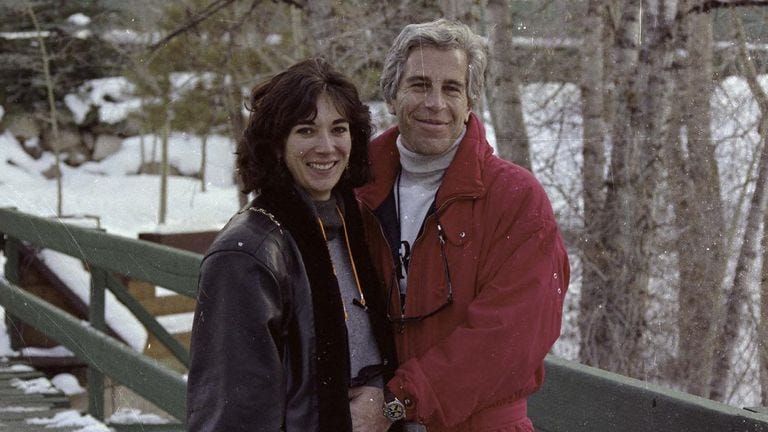
Long before we knew the story of Jeffrey Epstein, a young Ghislaine Maxwell was coming of age in the 53-bedroom home of her father, Robert Maxwell, a British media proprietor and politician. He named his luxury yacht after the little girl, the “Lady Ghislaine,” but spent most of his time buying and selling businesses like MacMillan and Pergamon Press, and flying back and forth to Headington Hill in Oxford on his helicopter. Ghislaine would later say that she had a “difficult, traumatic childhood with an overbearing, narcissistic, and demanding father…(that) made [her] vulnerable to Epstein.” But despite being a billionaire, Robert Maxwell had a lot of debt, (having “plundered hundreds of millions of pounds from his companies’ pension funds) and in 1991 his body was discovered floating in the Atlantic Ocean. The newspapers said he had apparently fallen overboard from the “Lady Ghislaine,” but Ghislaine never believed the stories.
“One thing I am sure about is that he did not commit suicide. I think he was murdered.” – Ghislaine Maxwell, Hello! Magazine, 1997
She would meet Jeffrey Epstein for the first time just a few months later. And despite the bad taste her father left, she found common ground with the young millionaire financier.
It is unclear how long Maxwell dated Epstein, though there is evidence to indicate it was from about 1992 to 1997. However, due to the nature of Epstein’s “extracurricular” activities and business dealings, those lines may be blurred. In a 2003 Vanity Fair article Epstein claimed that Maxwell was his “best friend,” indicating that, at least on paper, they were no longer together. But he stated that although she wasn’t on his payroll, she “organized much of [his] life,” and that when a relationship is over, the girlfriend “moves up, not down,” to friendship status.
Open the link to keep reading and to view the drawing at the center of Trump’s $20 billion lawsuit against Murdoch.
Last night, I read the story in the Wall Street Journal that was breaking news. The WSJ, owned by Rupert Murdoch, had somehow obtained a leather-bound book presented to Jeffrey Epstein for his 50th birthday. In it was a “bawdy” note from Donald Trump that hinted at their common interests.
At a time when other media outlets are hesitating and capitulating, Rupert Murdoch and the Wall Street Journal just stood up to President Trumpand scooped one of the biggest political stories of the summer. The print headline on Page One today reads “Trump’s Bawdy Letter to Epstein Was in 50th Birthday Album.” It is, of course, the most-read article on the Journal’s website.
And yet… Murdoch’s Fox News has not mentioned the story once.So let me take a stab at answering all the questions I’m getting about the media mogul and his role.
Murdoch, age 94, wants to have it both ways. He wants to be a newsman (that’s how he sees himself) but also needs to be a businessman. He wants a muscular Journal breaking big stories but he also needs Fox News to keep printing money for his family and other shareholders.
It’s been readily apparent for years that Fox succeeds when it is The Trump Show. So Fox does what it does, ignores what it ignores. But Murdoch, who has always cared most of all about old-fashioned newspapers, derives satisfaction and a sense of power from the Journal.
We wrote all about the operatic relationship between Murdoch and Trump in this CNN.com story overnight. I think this quote is quite telling: “Rupert loves to poke the president in the eye once in a while,” an executive who has worked with him closely told me.
Trump: I’m going to ‘sue his ass off’
Trump is, of course, taking this very personally. “I told Rupert Murdoch it was a Scam, that he shouldn’t print this Fake Story. But he did, and now I’m going to sue his ass off, and that of his third rate newspaper,” he wrote on Truth Social.
Trump’s post confirmed rumors that had been swirling in political and media circles for two days: namely, that the White House was trying to kill a damaging WSJ story. Trump said he personally spoke with both Murdoch and WSJ editor Emma Tucker.
As for a lawsuit, well… we’ll see, but no suit will take this story off the internet. The timeline is worth revisiting here. The WSJ approached Trump for comment on Tuesday. Trump derided the Epstein scandal as a “hoax” on Wednesday.
As I said on “The Source with Kaitlan Collins” last night, his well-trodden “hoax” talking point was a direct response to his concern about the looming WSJ report. Trump uses the word “hoax” to shut down conversation and discourage critical thinking; to tell his supporters to just ignore something altogether. TBD on whether it’ll work this time.
>> Inside Dow Jones HQ: After the story landed, Journal staffers expressed pride in their colleagues and in the publication for running the report despite the president’s attempt to squash it. There’s a real sense that publishing was an act of bravery…
>> BTW, WSJ has no comment on the lawsuit threat. Trump seems empowered by his settlements with Paramount and other media companies…
****************************************
Not part of Stelter’s commentary:
The note from Donald to Jeffrey:
The typewritten note was an imaginary conversation between Donald and Jeffrey, inside the outline of a naked woman.
“Voice Over: There must be more to life than having everything,” the note began.
Donald: Yes, there is, but I won’t tell you what it is.
Jeffrey: Nor will I, since I also know what it is.
Donald: We have certain things in common, Jeffrey.
Jeffrey: Yes, we do, come to think of it.
Donald: Enigmas never age, have you noticed that?
Jeffrey: As a matter of fact, it was clear to me the last time I saw you.
Donald: A pal is a wonderful thing. Happy Birthday — and may every day be another wonderful secret.
DOGE (or DOGS, as I prefer to call them) just won the authority to see your most important personal data, thanks to the rightwing bloc of six on the SupremeCourt.,
The six Republicans on the Court claim to be conservatives. They are not. Some of the six claim to be “originalists,” ruling in accord with the wishes of the Founding Fathers. Nonsense.
Who are these people that Elon Musk left behind? No one knows for sure. Were they confirmed by the U.S. Senate? No. What are their credentials? No one knows for certain. What right do these shadowy people have to know our personal data? They are not a government agency. They are friends of Elon.
This decision gives open access to our records by shadowy figures whose purposes are hidden.
Are they building a data base for the next election? Will the data be used to blackmail people?
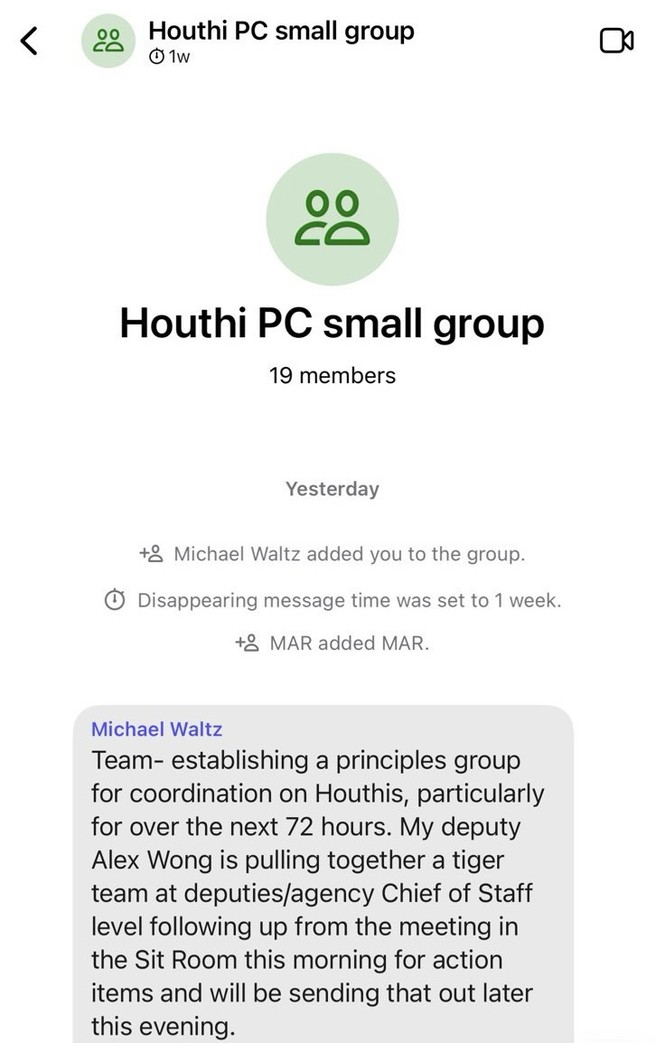
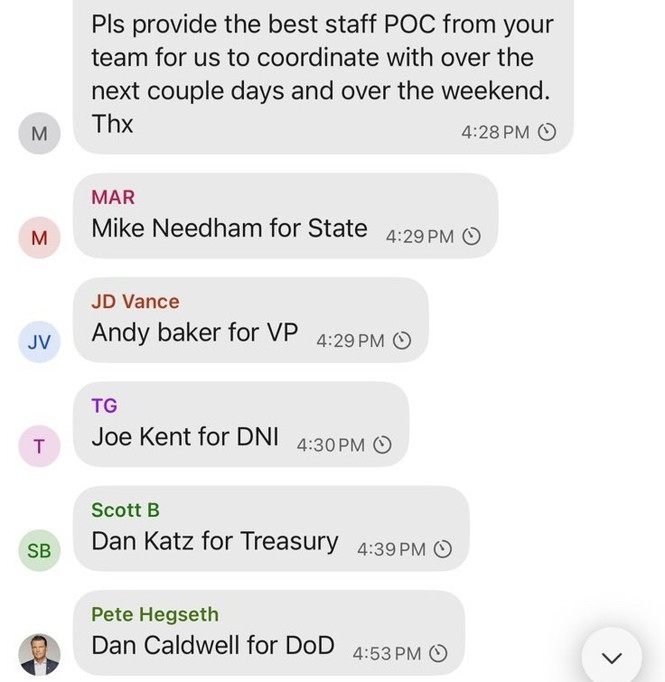
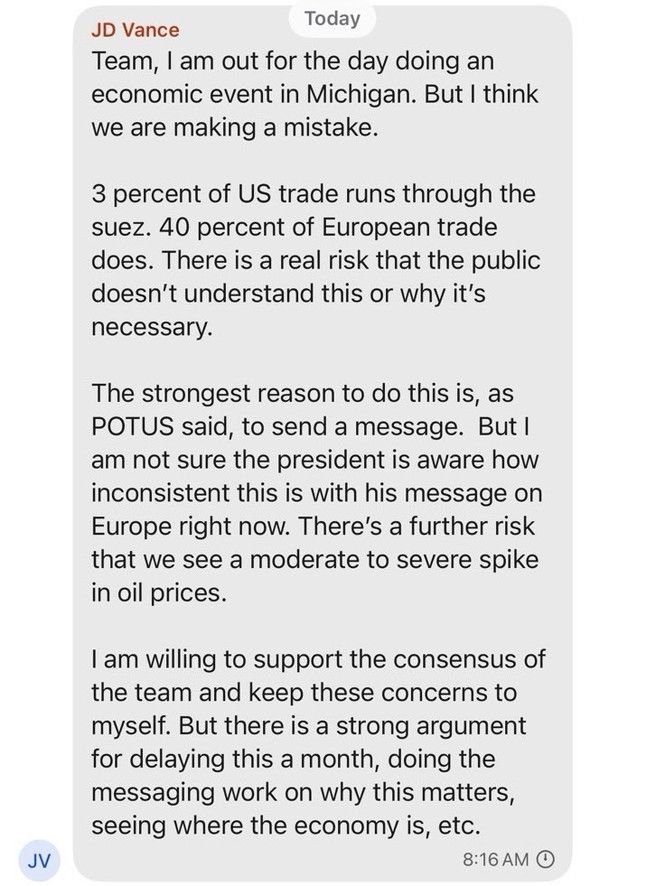
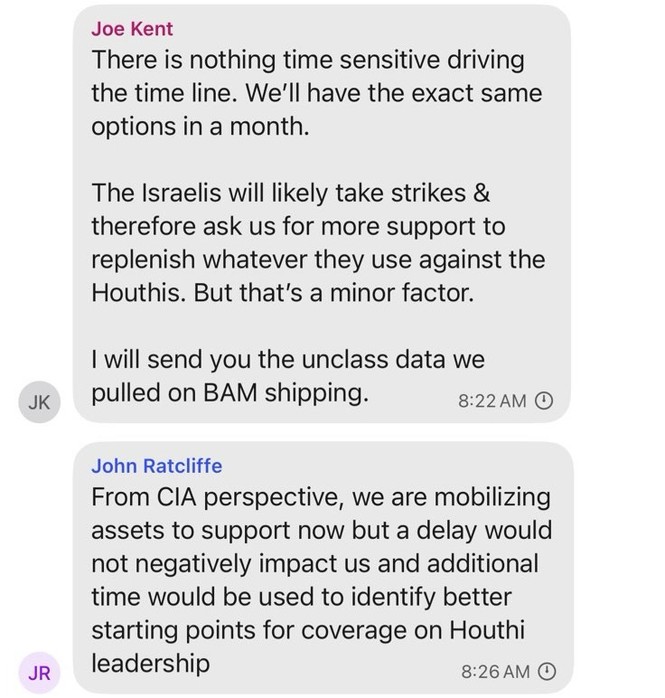
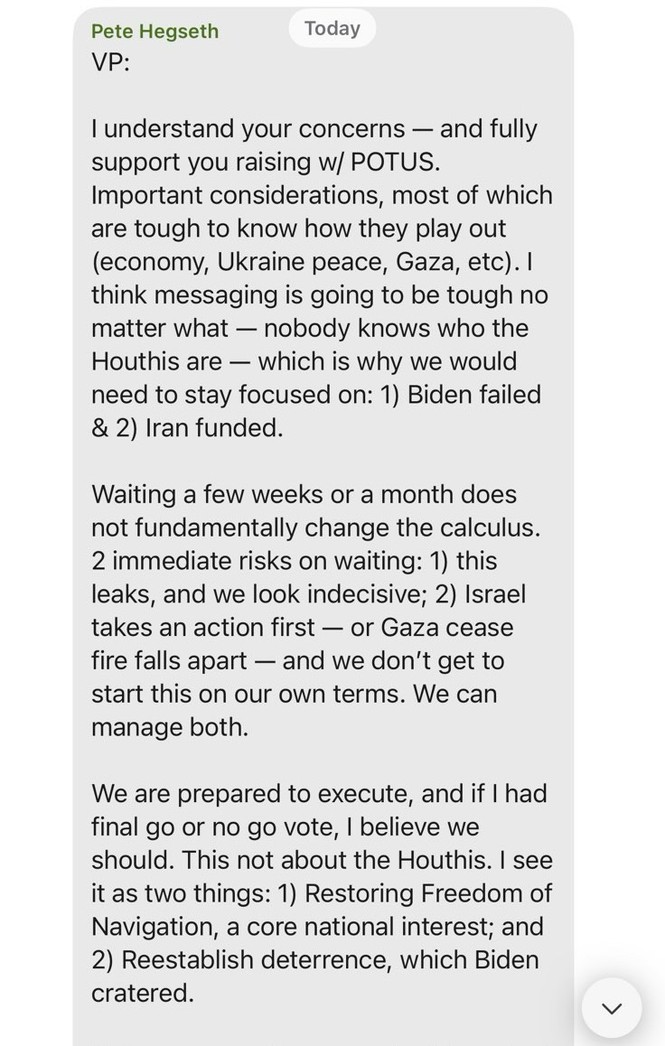
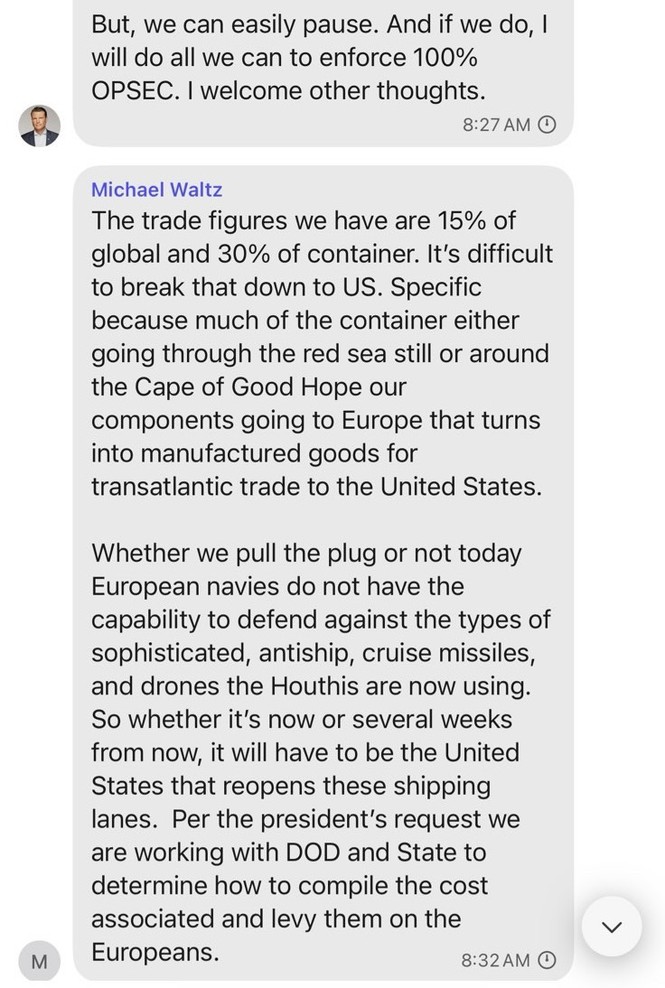
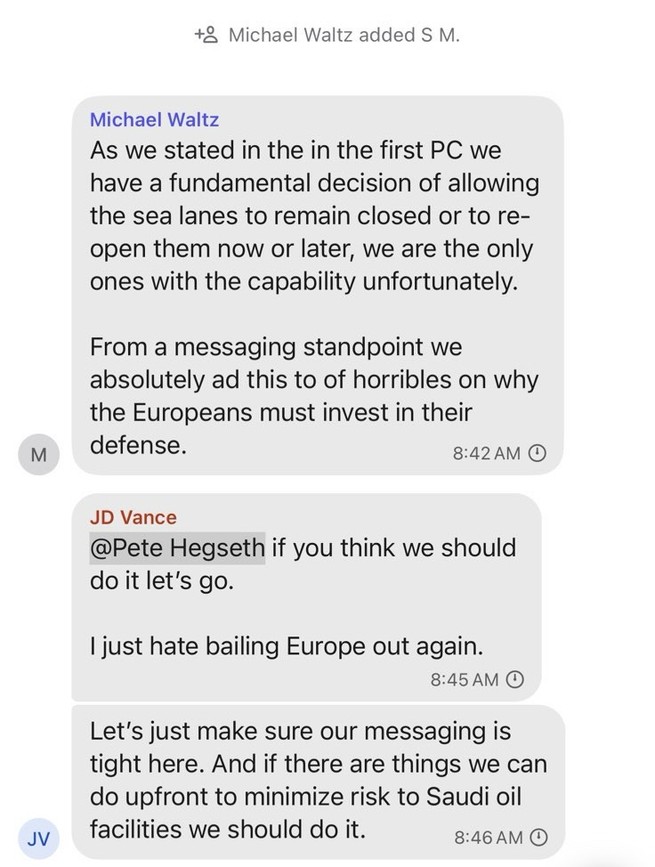
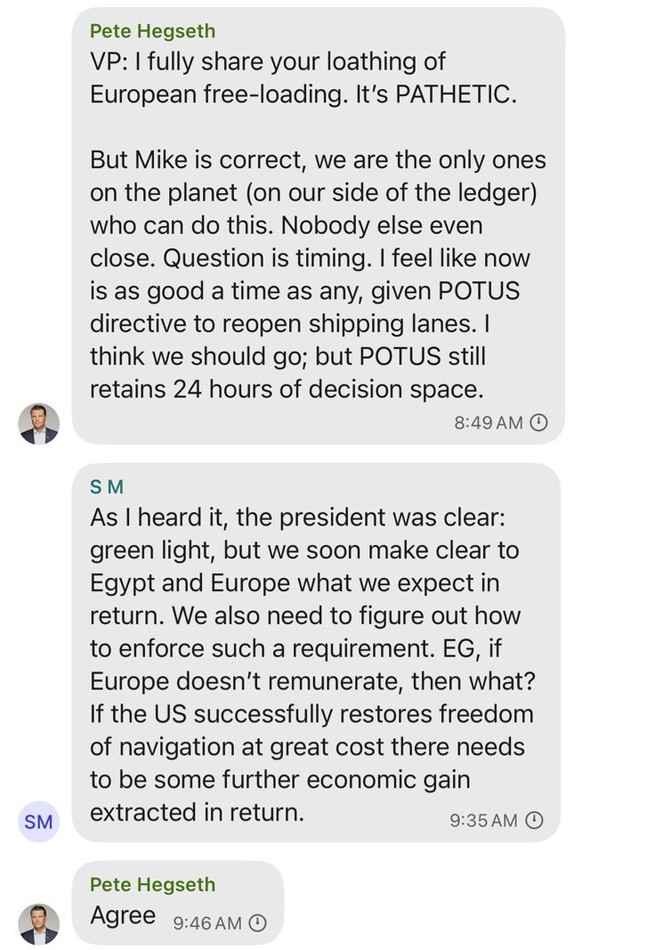
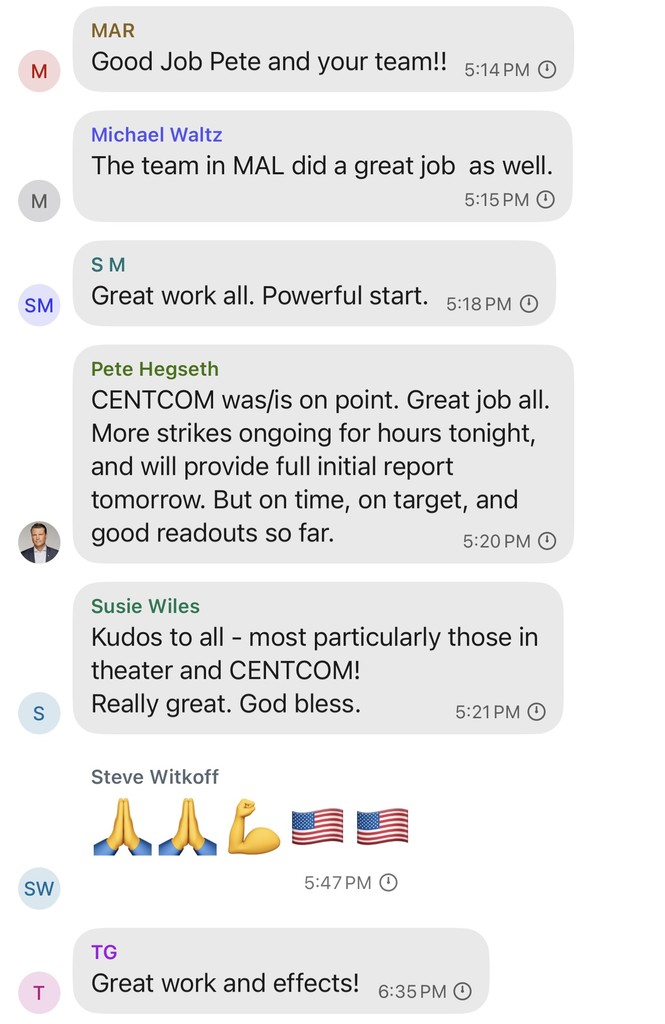
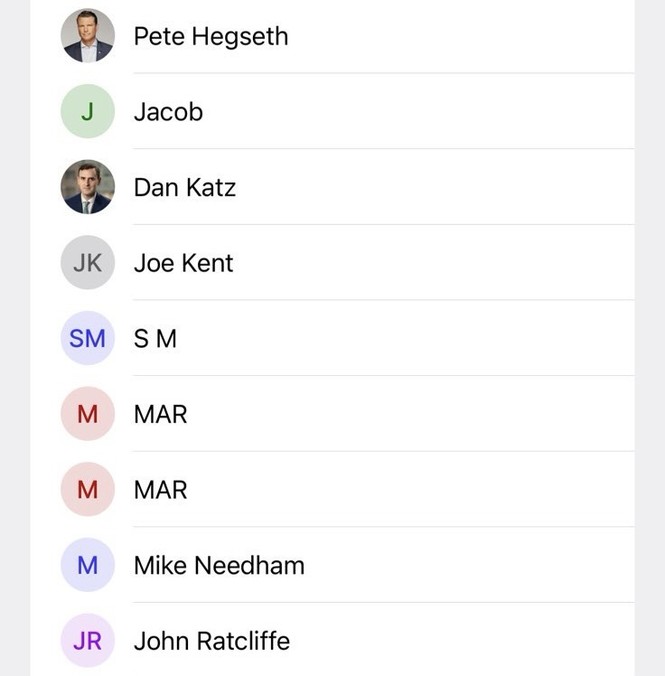
In the first big scandal of the Trump administration, the editor-in-chief of The Atlantic was invited to participate in a top-secret texting session about bombing the Houthis. Jeffrey Goldberg first thought it was a joke or a scam, but he joined the group and discovered it was real. He wrote about it in The Atlantic (“The Trump Administration Accidentally Texted Me It’s War Plans”), and the story went viral. But everyone involved other than Goldberg said that it was not a top-secret meeting, that no confidential information was discussed, and Pete Hegseth insulted Goldberg by suggesting he was lying. The messaging used an app called Signal, which disappears after a certain period of time and is not secure. One participant, Steve Witkoff, was in Russia at the time of the exchange.
So, about that Signal chat. On Monday, shortly after we published a story about a massive Trump-administration security breach, a reporter asked the secretary of defense, Pete Hegseth, why he had shared plans about a forthcoming attack on Yemen on the Signal messaging app. He answered, “Nobody was texting war plans. And that’s all I have to say about that.”
At a Senate hearing yesterday, the director of national intelligence, Tulsi Gabbard, and the director of the Central Intelligence Agency, John Ratcliffe, were both asked about the Signal chat, to which Jeffrey Goldberg, the editor in chief of The Atlantic, was inadvertently invited by National Security Adviser Michael Waltz. “There was no classified material that was shared in that Signal group,” Gabbard told members of the Senate Intelligence Committee.
Ratcliffe said much the same: “My communications, to be clear, in the Signal message group were entirely permissible and lawful and did not include classified information.”
President Donald Trump, asked yesterday afternoon about the same matter, said, “It wasn’t classified information.”
These statements presented us with a dilemma. In The Atlantic’sinitial story about the Signal chat—the “Houthi PC small group,” as it was named by Waltz—we withheld specific information related to weapons and to the timing of attacks that we found in certain texts. As a general rule, we do not publish information about military operations if that information could possibly jeopardize the lives of U.S. personnel. That is why we chose to characterize the nature of the information being shared, not specific details about the attacks.
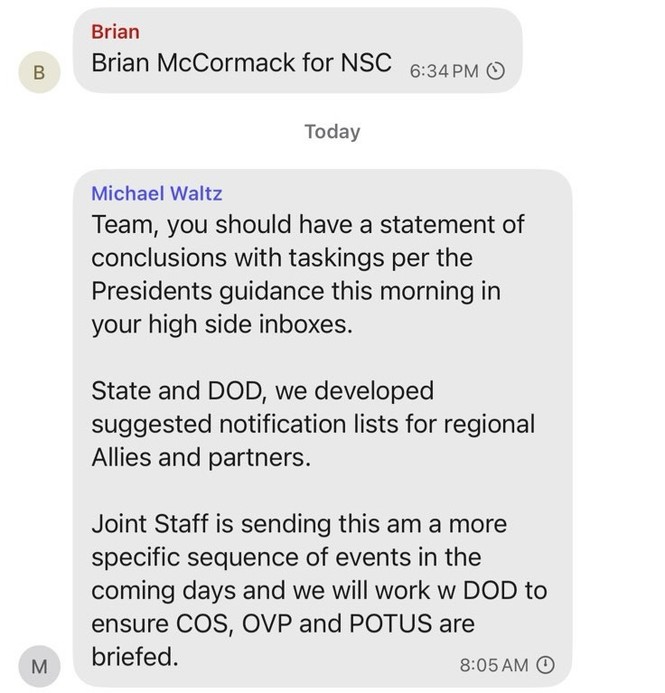
The statements by Hegseth, Gabbard, Ratcliffe, and Trump—combined with the assertions made by numerous administration officials that we are lying about the content of the Signal texts—have led us to believe that people should see the texts in order to reach their own conclusions. There is a clear public interest in disclosing the sort of information that Trump advisers included in nonsecure communications channels, especially because senior administration figures are attempting to downplay the significance of the messages that were shared.
Experts have repeatedly told us that use of a Signal chat for such sensitive discussions poses a threat to national security. As a case in point, Goldberg received information on the attacks two hours before the scheduled start of the bombing of Houthi positions. If this information—particularly the exact times American aircraft were taking off for Yemen—had fallen into the wrong hands in that crucial two-hour period, American pilots and other American personnel could have been exposed to even greater danger than they ordinarily would face. The Trump administration is arguing that the military information contained in these texts was not classified—as it typically would be—although the president has not explained how he reached this conclusion.
Yesterday, we asked officials across the Trump administration if they objected to us publishing the full texts. In emails to the Central Intelligence Agency, the Office of the Director of National Intelligence, the National Security Council, the Department of Defense, and the White House, we wrote, in part: “In light of statements today from multiple administration officials, including before the Senate Intelligence Committee, that the information in the Signal chain about the Houthi strike is not classified, and that it does not contain ‘war plans,’ The Atlantic is considering publishing the entirety of the Signal chain.”
We sent our first request for comment and feedback to national-security officials shortly after noon, and followed up in the evening after most failed to answer.
Late yesterday, White House Press Secretary Karoline Leavitt emailed a response: “As we have repeatedly stated, there was no classified information transmitted in the group chat. However, as the CIA Director and National Security Advisor have both expressed today, that does not mean we encourage the release of the conversation. This was intended to be a an [sic] internal and private deliberation amongst high-level senior staff and sensitive information was discussed. So for those reason [sic] — yes, we object to the release.” (The Leavitt statement did not address which elements of the texts the White House considered sensitive, or how, more than a week after the initial air strikes, their publication could have bearing on national security.)
A CIA spokesperson asked us to withhold the name of John Ratcliffe’s chief of staff, which Ratcliffe had shared in the Signal chain, because CIA intelligence officers are traditionally not publicly identified. Ratcliffe had testified earlier yesterday that the officer is not undercover and said it was “completely appropriate” to share their name in the Signal conversation. We will continue to withhold the name of the officer. Otherwise, the messages are unredacted.
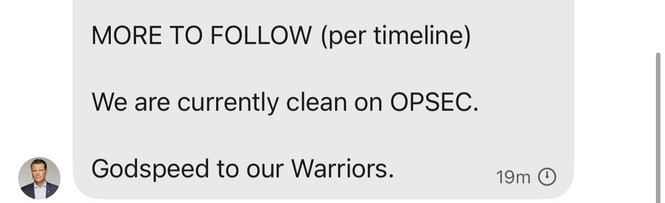
As we wrote on Monday, much of the conversation in the “Houthi PC small group” concerned the timing and rationale of attacks on the Houthis, and contained remarks by Trump-administration officials about the alleged shortcomings of America’s European allies. But on the day of the attack—Saturday, March 15—the discussion veered toward the operational.
At 11:44 a.m. eastern time, Hegseth posted in the chat, in all caps, “TEAM UPDATE:”
The text beneath this began, “TIME NOW (1144et): Weather is FAVORABLE. Just CONFIRMED w/CENTCOM we are a GO for mission launch.” Centcom, or Central Command, is the military’s combatant command for the Middle East. The Hegseth text continues:
“1215et: F-18s LAUNCH (1st strike package)”
“1345: ‘Trigger Based’ F-18 1st Strike Window Starts (Target Terrorist is @ his Known Location so SHOULD BE ON TIME – also, Strike Drones Launch (MQ-9s)”
Let us pause here for a moment to underscore a point. This Signal message shows that the U.S. secretary of defense texted a group that included a phone number unknown to him—Goldberg’s cellphone—at 11:44 a.m. This was 31 minutes before the first U.S. warplanes launched, and two hours and one minute before the beginning of a period in which a primary target, the Houthi “Target Terrorist,” was expected to be killed by these American aircraft. If this text had been received by someone hostile to American interests—or someone merely indiscreet, and with access to social media—the Houthis would have had time to prepare for what was meant to be a surprise attack on their strongholds. The consequences for American pilots could have been catastrophic.
The Hegseth text then continued:
“1410: More F-18s LAUNCH (2nd strike package)”
“1415: Strike Drones on Target (THIS IS WHEN THE FIRST BOMBS WILL DEFINITELY DROP, pending earlier ‘Trigger Based’ targets)”
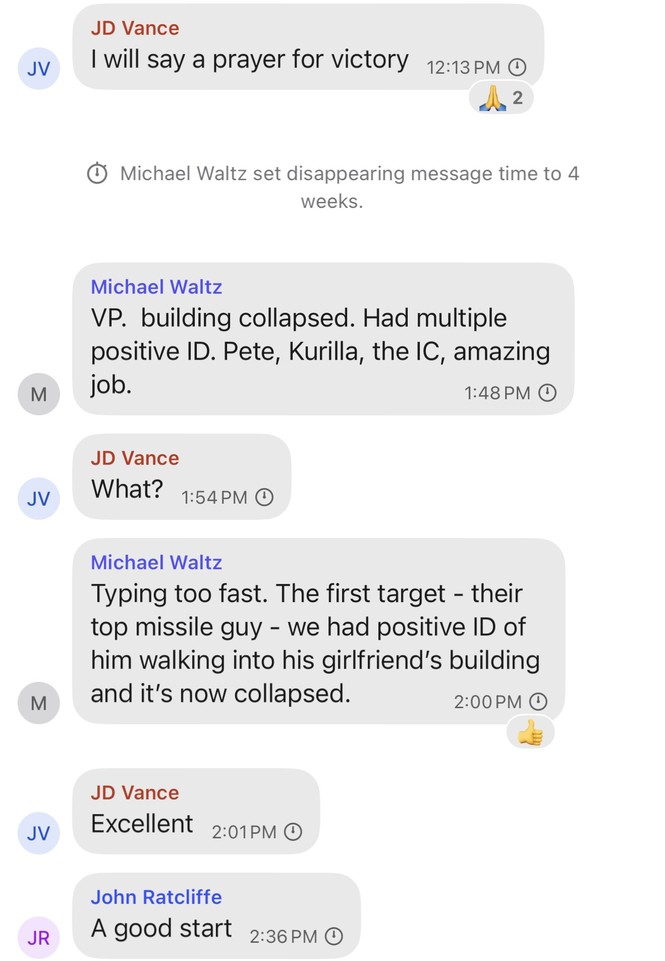
At 1:48 p.m., Waltz sent the following text, containing real-time intelligence about conditions at an attack site, apparently in Sanaa: “VP. Building collapsed. Had multiple positive ID. Pete, Kurilla, the IC, amazing job.” Waltz was referring here to Hegseth; General Michael E. Kurilla, the commander of Central Command; and the intelligence community, or IC. The reference to “multiple positive ID” suggests that U.S. intelligence had ascertained the identities of the Houthi target, or targets, using either human or technical assets.
Six minutes later, the vice president, apparently confused by Waltz’s message, wrote, “What?”
At 2 p.m., Waltz responded: “Typing too fast. The first target – their top missile guy – we had positive ID of him walking into his girlfriend’s building and it’s now collapsed.”
Vance responded a minute later: “Excellent.” Thirty-five minutes after that, Ratcliffe, the CIA director, wrote, “A good start,” which Waltz followed with a text containing a fist emoji, an American-flag emoji, and a fire emoji. The Houthi-run Yemeni health ministry reported that at least 53 people were killed in the strikes, a number that has not been independently verified.
Later that afternoon, Hegseth posted: “CENTCOM was/is on point.” Notably, he then told the group that attacks would be continuing. “Great job all. More strikes ongoing for hours tonight, and will provide full initial report tomorrow. But on time, on target, and good readouts so far.”
It is still unclear why a journalist was added to the text exchange. Waltz, who invited Goldberg into the Signal chat, said yesterday that he was investigating “how the heck he got into this room.”
All those who participated in the meeting lied.
Stupid, incompetent liars are in charge of our national security.
Carol Burris writes here about a charter scandal in South Carolina. Carol is the executive director of the Network for Public Education.
She writes:
Last week, an excellent investigative report on a for-profit-run charter chain appeared in South Carolina’s Post and Courier. Entitled How a Florida principal with a controversial history became a SC charter school kingpin, it was written by Hillary Flynn and Maura Turcotte. These reporters put extraordinary care and diligent research into the piece. I know because, over the course of a year, Flynn would call me from time to time for insight into the for-profit charter world. There is no transparency in South Carolina. You need FOIAs to determine which schools in the state are even run by for-profits. Here is a summary of what they found.
Pinnacle, a Florida for-profit corporation, has three charter schools in South Carolina.
Its creator and owner, Michael D’Angelo, is a former Florida charter school principal who was fired from a for-profit chain. He then moved to another charter, where he wrote himself reimbursement checks with no invoices and got fired again.
Undeterred by his previous failures, D’Angelo tried to open several charter schools in Florida. Despite being told he did “not have the competency to operate a charter school,” he found an accountant, created a for-profit charter management company, and headed to South Carolina to open Gray Collegiate Academy.
When Pinnacle’s school got into trouble with the South Carolina Public Charter School District for noncompliance, Pinnacle went shopping for a new authorizer for its charter school. A Christian college, Erskine College, stepped in. It later accused Pinnacle of fraud. Then, two Pinnacle Schools moved to another Christian College, Limestone College, for authorization. Authorizers receive substantial fees from the schools, a bonanza for cash-strapped colleges.
The process of authorizer shopping, a common practice in states like Ohio and Michigan with large for-profit sectors, is a glaring loophole in the system. The authorizer, who stands to gain substantial fees from the schools, can provide a new lease of life to a shady charter school. A South Carolina Senate bill aims to curb this practice, but it faces fierce opposition from the charter lobby. The National Alliance of Public Charter Schools even lobbied to ensure that states with multiple authorizers are privileged when getting big CSP grants, further exacerbating the issue of authorizer shopping.
Meanwhile, Pinnacle plans to open two more schools, serving as additional cash cows for D’Angelo and his friends.
You can read the excellent investigative reporting on Pinnacle here. While you must register with the paper to see it, it is not behind a paywall. Kudos to Flynn and Turcotte.





 Diane Ravitch's blog