Archives for category: San Diego


A judge in San Diego ordered two charter schools in the district to close in response to the school district’s complaint that they were operating without local authorization and could not be supervised. About 40,000 students attend Learn4Life centers statewide.

The Learn4Life charters are appealing the decision.

Judge David Danielsen on Monday granted a motion by San Diego Unified School District to close the two Learn4Life locations operating in the district’s boundaries: Diego Hills Central, a charter school authorized by Dehesa School District, and a resource center for San Diego Workforce Innovation High, a school authorized by Borrego Springs Unified School District. Neither of those schools have active locations in the districts that authorized them.

As Carol Burris reported in Charters and Consequences, the Learn4Life charters are storefronts where students meet a teacher once every 20 days. Their graduation rates are abysmal. Typically, they are authorized by small rural districts to operate in urban districts hundreds of miles away, where they operate without oversight. The authorizing district gets a commission for every student who enrolls.


The California Legislature is considering four bills to reform the state’s massive charter school industry (1,300 schools, mostly unregulated and unsupervised). One of the bills would prohibit school districts from authorizing charters in other districts. The following story is a classic example of rural school districts authorizing online charters in San Diego and Los Angeles, solely to get the commission attached to each student. In this case, the online charters were cash cows for their owners. [A personal aside: Last February, I was in Newport Beach, California, having breakfast at a hotel. The man at the next table was loudly discussing his schools with someone who was selling athletic services, $5 a student. When he got up to leave, I asked him if he was “in the charter school business.” He said, “Yes,” and said he owned 40 schools under six different corporate names. I asked him his name. He said, “Sean McManus.” I should have asked him to join us. He is one of the key figures in the following article.]

The San Diego Union-Tribune reports that eleven people connected to online charter schools have been indicted for “criminal charges of conspiracy, personal use of public money without legal authority, grand theft and financial conflict of interest.“

The online charters operate in San Diego and Los Angeles, but were authorized by other districts that get a slice of the revenues. This is one of the corrupt practices that have been rampant in California, where lax state law allows sharp operators to get public money and cheat students with no consequences. The Legislature is currently debating a proposal to stop allowing District A to authorize a charter in District B, a practice that is mercenary and predatory. Until now, the powerful California Charter Schools Association—enriched by billionaires like Reed Hastings and Eli Broad—has fought all accountability for charter schools.

At the center of the allegations are leaders of the charter school management corporation A3 Education, a Newport Beach corporation whose leaders control 13 charter schools across California, according to an indictment filed May 17.

A3’s chairman, Sean McManus, and president, Jason Schrock, essentially owned and operated the charter schools throughout California at the same time that A3 contracted with those schools, according to the indictment.

McManus and Schrock operated multiple businesses that charged their own charter schools millions of dollars for services. Then they channeled money from those businesses into their own charitable trust and personal bank accounts, according to the indictment.

A3 Education and the businesses affiliated with McManus and Schrock together have invoiced at least $83.3 million from the 13 charter schools, according to the indictment.

From the affiliated businesses, at least $8.18 million went into personal bank accounts, some in Australia, and into charitable trust accounts for McManus, Schrock and their wives, and $500,000 went to a family member of McManus, according to the indictment.

McManus and Schrock also used $1.6 million of A3 Education’s funds to buy a private residence for McManus in San Juan Capistrano, the indictment states.

Also according to the indictment, six people, including McManus and Schrock, conspired to collect state money for students who were listed as being enrolled in Valiant Charter Schools but were not receiving services.

The two Valiant schools will close permanently on June 30. Several thousand students will need to find new schools. The San Diego online charter was authorized by the Dehesa School District, and the one in Los Angeles was authorized by the Acton-Agua Dulce Unified School District.

The children were not assigned to teachers who have state-required professional certificates, the indictment said. The students were not in contact with the schools or provided with educational services during the summer months, as some of the co-conspirators claimed, according to the indictment…

Also indicted is Nancy Hauer, who is superintendent of Dehesa School District, which authorized several charter schools, including Valiant Academy of Southern California. The Dehesa district office did not immediately provide a comment Tuesday.

Also among the indicted is Steve Van Zant, a former Mountain Empire Unified superintendent who three years ago pleaded guilty to violating conflict-of-interest laws, after he brokered deals with charter schools to operate in other school districts, prosecutors said at the time.

Valiant Academy had 43 students two years ago, 726 last year, and 2,250 this year. It’s academic performance was so poor that even the California Charter School Association recommended that it be closed.

Betsy DeVos says that parents always know what’s best. Why were they enrolling their children in these failing “schools.”?
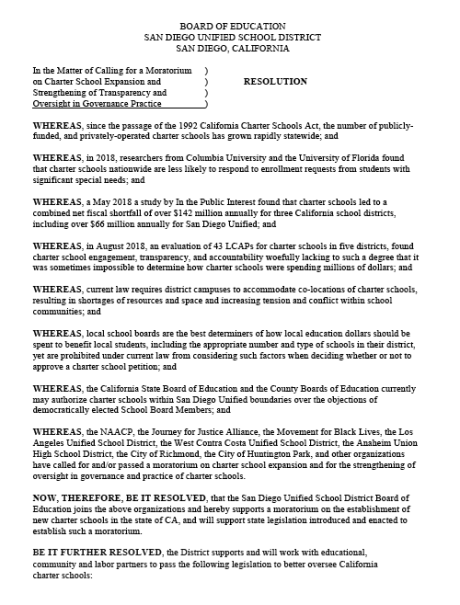
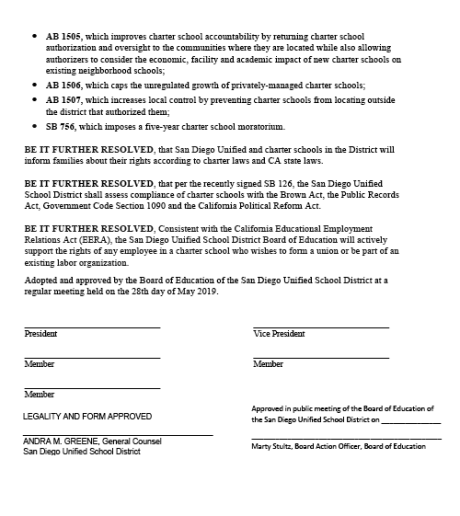


Last night, the elected Board of Education of the San Diego Unified School District passed a strong resolution endorsing four bills in the State Legislature that would impose discipline on the Wild West unregulated charter industry. The bills are described in the resolution. They would impose a moratorium on charter school expansion, revive local control, and increase oversight of charters. This resolution demonstrates that the board is willing to stand up to the rapacious charter industry.

Screen Shot 2019-05-28 at 5.40.05 PMScreen Shot 2019-05-28 at 5.40.16 PM


Carl Cohn is one of the most respected figures in American education. He is a problem solver who has been superintendent in several districts in California. He won many plaudits for his leadership in Long Beach. I met him when he was superintendent in San Diego, which was probably the first urban district to be subjected to a heavy, concentrated dose of what was called “reform,” in the late 1990s, early 2000s. Cohn was called in, to clean up the demoralization left behind by top-down leaders who arrived with a script. In my 2010 book The Death and Life of the Great American School System: How Testing and Choice Are Undermining Education, I devoted a chapter to the colossal failure of “reform” in SD. I interviewed Cohn and was pleasantly surprised by his candor and insight. Talking to him reassured me that my reactions were on target.

In this post, he urges the reform of California’s charter law.

He does not lay out a menu of what is needed, but he points to some genuine problems.

Note that one of the members of Tony Thurmond’s Task Force rejected Cohn’s request for some relief from the law.  That would be Margaret Fortune, Chair of the Board of the California Charter School Association, which lobbies to protect the status quo.


Is it a new day in California?

Too soon to know but there was one good sign today.

The State Board of Education, which in the past had approved charters that had been rejected by districts and then by counties, rejected the appeal by Thrive charter schools of San Diego for renewal. Superintendent Cindy Marten came with staff and data to show that Thrive was not doing well by children. In the past, the facts were not enough. Today, they were.

Today was Linda Darling-Hammond’s first meeting as chair of the state education board. She cares about facts, data, and students. Thrive lost.

This is what Tom Ultican wrote about Thrive last fall. 

Tom Ultican has written several articles about the Destroy Public Education Movement; this installment examines a failing charter chain in San Diego that continues to rake in big bucks.

The Thrive charter chain, he says, is a masterpiece of marketing, but a failure at education.

When the chain was launched, the San Diego Unified School District staff said it was not ready to open; the founders appealed and were rejected by the staff of the County Board of Education. The founders appealed to the State Board of Education, where its defective application was rubberstamped by Governor Jerry Brown’s pro-Charter State Board.

Ultican says that charter schools are supposed to perform at least as well as similar public schools or show improvement over time.

Thrive charter schools did not meet either benchmark. But that did not deter funders or founders.

They were shameless and kept growing their failing charter chain. And the money kept rolling in, to expand the failure to more children.

“Once she obtained the charter authorization from the SBE, money came. The known list of 2014 donations: Buzz Woolley’s Girard Foundation granted her $108,000; Gate’s Educause sent $254,500; Charter School Growth Fund kicked in $175,000 and the Broad Foundation delivered $150,000 for a total of $688,000. The next year, Broad gave another $50,000 and the New Schools Venture Fund pitched in $100,000. There is another $144,000 promised from Educause.

“Destroy public education (DPE) careers pay well. Tax records reveal that Nicole’s start up “non-profit” has been lucrative. Her pay: year one $122,301; year two $133,747 and year three $142,541. Her husband holds a senior management position at the CCSA which means DPE money flows his way as well.”

In 2017, the charter chain added another school, this one paid for by taxpayers, but with this addendum. The property belongs not to taxpayer who paid for it, but TO THE CHARTER OWNERS! How cool is that!

You will not be surprised to learn that the pro-privatization website “The 74,” is wild about Thrive. Nor will you be be surprised to discover that Thrive loves putting kids on computers and that one of its cheerleaders is Tom Vanderbilt Ark, a leading salesman for edtech.

Ultican reminds us that the Thrive charter chain calls itself “public schools,” but it is a private contractor that runs lucrative but failing schools. All that keeps them going is this formula:

“Bad schools like TPS survive because they are good at marketing; have deep pocketed benefactors and political allies.”

Thrive is not thriving.

Ultican says Thrive is evidence that California needs a moratorium on charter schools until lawmakers systematically root out fraud, self-dealing, waste, and abuse. That’ll be the day.

Tom Ultican continues his survey of the pernicious effects of charter school on public schools. In this post, he takes a look at San Diego, where he taught physics and advanced math for many years.

In many respects, San Diego is the best urban district in the nation. It’s a shame to see it carved apart by private operators. Due to the loss of funding to charters, San Diego had been forced to absorb deep budget cuts, which affects the quality of the majority of students.

Ultican writes:

“The California charter school law is doing serious harm to public schools. Few counties in the state have been more impacted by charter schools than San Diego County. This past school year 75,473 of the 508,169 publicly financed students enrolled in charter schools. In other words, 14.9% of San Diego’s students attended privatized schools and in the San Diego Unified School District, that percentage was greater than 17%.

“San Diego’s charter school students attended one of the county’s 129 active charter schools some of which will close their doors next year. In the past five years, more than one out six charter schools – a total of 27 schools – went out of business. This presents an additional financial burden to public schools because they must be ready to take in all students from failed charter schools at any time. Charter schools typically do not add students during a school year.

“When students from the public system exit to the privatized charter school system, the cost to the district schools is substantially more than just the loss of state daily attendance money. A recent study that Professor Gordon Lafer did for In The Public Interest is the third major report in five years to demonstrate this point. Professor Lafer noted:

“As the charter industry has grown, public officials across the country have become increasingly concerned with the sector’s impact on public school districts. A 2013 report from Moody’s Investors Service, for instance, warned that charter expansion threatened school districts’ viability in a growing number of cities, as ‘charter schools … pull students and revenues away from districts faster than the districts can reduce their costs.’ In response, a series of studies have been carried out by both academic scholars and consulting firms aimed at the same question that this report seeks to address. … in every case, studies found that charter growth has caused school districts to suffer much more in lost revenue than they are able to make up in reduced expenses—resulting in large net shortfalls for district students.”

Ultican goes on to note the shady operators that have been allowed to proliferate by the State Board of Education, which apparently is owned by the powerful charter lobby.

Perhaps this is the most egregious:

“The Altus Franchise

“Throughout 2017, Carol Burris, Executive Director of Network for Public Education (NPE), studied and wrote about California’s charter schools. In her culminating report, “Charters and Consequences,” she addressed the phenomena of the independent learning charter schools. Burris wrote,

“There are 225 independent learning charter schools comprising nearly 20% of all charters in California. In San Diego County alone there are 35, …. The 2014 graduation rate for all of the students enrolled in San Diego’s independent center charters, including the more successful home-school programs, was only 44%. (emphasis added – the SDUSD graduation rate was greater than 91%)

“Given the results, why are so many Independent Learning charter corporations springing up across the state? Unlike brick and mortar charters, independent learning centers are relatively easy to set up and run. They appeal to disadvantaged students who want to work and finish high school, dropouts who want to return to school, students who have emotional or physical health issues, homeschoolers, and teenagers who would prefer to not have to get up in the morning and go to school.”

“Carol did this research using the 2016-2017 school year data showing 35 independent learning center charters in San Diego. The 2017-2018 data shows that San Diego County has added five more independent learning charters for a total of 40 and that number does not reflect all the independent learning locations.

“Mary Bixby is San Diego’s pioneer of the strip mall charter school business. In 1994, her Charter School of San Diego was the first charter school in San Diego County. She puts children at computers running education software and her approximately 3200 students are making her wealthy. In 2015, the non-profit Mary founded paid her a total compensation of $340,810 and her daughter Tiffany Yandell received $135,947.”

This is madness.

Tom Ultican became a teacher of math and physics in San Diego after a career in Silicon Valley. He is retiring. He loves teaching.

He describes with precision the people who imposed bad ideas on the schools and messed them up. Maybe they meant well but their lack of knowledge or experience in the classroom led to naive and foolish and failed interventions, like Common Core and “turnaround,” with mad firings.

He writes:

“Standards based education is bad education theory. In the 1960’s Benjamin Bloom proposed mastery education in which instruction would be individualized and students would master certain skills before they moved ahead. By the 1970’s this idea had been married with B.F. Skinner’s behaviorist philosophy and teachers were given lists of discrete items for their students to master. The “reform” became derisively known as “seats and sheets.””

Tom says he is leaving the classroom. I hope there is a way to keep his kbowledge, experience, and wisdom engaged in educating the next generation.

Protestors blocked Betsy DeVos from entering a public middle school in DC.

Protesters block Betsy DeVos from entering public school in Washington
http://www.cnn.com/2017/02/10/politics/devos-protest-at-washington-school/index.html

I have mixed feelings about this.

On one hand, I was thinking of planning a “Betsy, bar the door” campaign, because of her well-documented contempt for public schools.

But I had breakfast on Tuesday with Cindy Marten, the dynamic superintendent of the San Diego public schools, and she told me about the wonderful accomplishments and spirit of teachers, principals, and students serving a very diverse enrollment. I told her she should invite DeVos to see the schools, see how they address the needs of English language learners and kids with disabilities.

Which is best?

How could she not be impressed by public schools that enroll all children? How could she not see that the district’ charter schools are draining resources, not improving the public schools?

Doors open to all. Even DeVos.

Foundations are tax-exempt because they are supposed to do good works on behalf of society. But more and more foundations are putting their vast, untaxed wealth into the national effort to undermine public education and to hand it over to entrepreneurs, amateurs, fast-buck operators, and religious institutions. Privatization does not promote the common good. Privatization is harmful to the commonweal.

Tom Ultican, a high school teacher of advanced math and physics, takes a look at the powerful San Diego Foundation. Sadly, most of its funding in education goes to nonpublic schools. Public schools seem to be an afterthought.

He writes:

San Diego Foundation was established in 1975 and has grown to almost $700 million in assets. It’s self-described purpose: “As one of the nation’s leading community foundations, The San Diego Foundation strives to improve San Diegans’ quality of life by creating equity and ensuring opportunities to be WELL (Work, Enjoy, Live & Learn).” In 2014, they gave over $10 million to educational endeavors. The following table illustrates the spending bias against public education.

Of that $10 million, only $373,000 went to public schools. That’s odd, because the overwhelming majority of children in San Diego attend the neglected public schools.

Another favorite recipient of San Diego Foundation funds is competency-based education. The goal of CBE is to put every child on a computer. We know from multiple studies that children learn best from human teachers who respond to them. Yet the San Diego Foundation has jumped on the Bandwagon to Nowhere.

And here is another strange pattern:

The largest single grant bestowed by the SD Foundation was $2,6 5 0,7 0 9 to the Jewish Community Foundation of San Diego. The JC Foundation had net assets at the end of 2014 of $171,593,990.

The Jewish Community Foundation spending on education follows a similar pattern as the San Diego Foundation. They spent $466,830 for groups working to privatize public education most of which went to TFA ($406,330). They also spent lavishly on private schools including $146,000 to La Jolla Country Day, a decidedly upscale K-12 private school.

By far the largest grant by the Jewish Community Foundation was the $25,817,228 bequeathed to University of California San Diego. A major patron of both the Jewish Community Foundation and UCSD is the Qualcomm founder and billionaire, Irwin Jacobs.

Three more grants from the Jewish Community Foundation were interesting. They gave Cornell University $5,511,000. They also gave the Goldman Sachs Philanthropy Fund $6,362,171. The Goldman Sachs fund asset total at the end of 2013 was $1,500,395,380. And the JC Foundation gave the SD Foundation $1,515,800. Why give money back? It is like the Charter School Growth Fund giving their benefactors from Walmart $15,000,000 in 2013. Why?

Why would any foundation give a donation to the Goldman Sachs fund, which has assets of $1.5 billion? Puzzling.