Archives for category: Resistance

Sarah Lahm writes here that teachers in St. Paul, Minnesota, are on the verge of striking to secure better funding for the public schools and their students.

In the early morning of February 26, a chill hung in the air as a line of teachers and school support staffers clad in bright red union hats, jackets or some combination thereof stood on a busy street corner outside of Highland Park Middle School in St. Paul, Minnesota.

As cars sped past, some with horns blaring in support, the teachers and school workers—who are members of the St. Paul Federation of Educators (SPFE)—hoisted signs proclaiming their willingness to fight on behalf of students.

SPFE represents more than 3,500 teachers, education assistants and school and community support staff members. Minnesota state law requires districts to negotiate with their unionized employees every two years, and the current round of contract talks between SPFE and the St. Paul Public Schools, under the leadership of Superintendent Joe Gothard, has been going on since last May.

Now, SPFE President Nick Faber says the union and the students and families they serve can no longer wait for Gothard and his team to step up and negotiate in good faith. On February 20, a majority of SPFE members voted to authorize a strike against the St. Paul Public Schools.

If an agreement between the union and the school district is not reached by March 10, thousands of SPFE members will walk off the job for the first time since 1946.

The key contract items SPFE is pushing for include fully staffed mental health teams in all schools, a greater investment in special education staffing and programming, and an increase in the number of multilingual staff members.

This puts the union squarely in line with other social justice-oriented labor movements that have been revived in recent years, as seen in events such as the teacher strikes in Chicago and Los Angeles in 2019. Like SPFE, the Chicago and Los Angeles unions also advocated for more than the typical bread-and-butter issues of union contracts, such as salary increases and seniority rights, and additionally pushed for better living and learning conditions for students.

MEDIA ADVISORY
March 2, 2020
Contact: Anna Bakalis, 213-305-9654

Los Angeles — The stakes are high in the LAUSD School board race to elect Patricia Castellanos in District 7, Scott Schmerelson in District 3, Jackie Goldberg in District 5 and George McKenna in District 1. As of Monday morning, the California Charter Schools Association PAC and billionaires like Bill Bloomfield, who sits on the CCSA PAC board, have funneled more than $6.2 million into the race against these candidates, making it the most expensive primary school board race in US history. They are spending $1 million every other day since last week.

“What our kids don’t need are billionaires spending $20,000 an hour every day to buy our school board election. Imagine if the millions they are spending against public education were redirected into our schools?” said UTLA President Alex Caputo-Pearl. “Our school libraries could be open five days a week. We could hire more nurses, counselors, mental health professionals and social workers and invest in ethnic studies, arts and music programs.”

UTLA members, parents and supporters are in final sprint to get out the vote for the March 3 election. See ads in today’s LA Times and La Opinion, attached.

Monday Media Availability
Teachers in support of Patricia Castellanos in District 7
When: Today, Monday March 2
Time: 4:30 – 6 PM
Who: UTLA President Alex Caputo-Pearl, teachers and supporters will be precinct walking, phone banking and texting for Castellanos. Interviews available in English and Spanish.
Location: 103 W Carson St. (Carson and Main Sts.) near Seafood City.
Onsite Contact: Mario Valenzuela, 213-447-3957

Flash mob with teachers in support of Scott Schmerelson in District 3
When: Today, Monday March 2
Time: 4-6 PM
Who: Teachers, parents and students lining the streets with signs, cars honking in support of Schmerleson. Interviews available in English and Spanish.
3 Intersection locations:
Tampa Ave. & Nordhoff St., Northridge (main site)
Ventura Blvd & Laurel Canyon Blvd., Sherman Oaks
Topanga Canyon & Victory Blvds., Canoga Park
What: Teachers holding signs, cars honking in support
Onsite Contact: Scott Mandel, 818-970-7445

Last week, I had a whirlwind visit to Chicago to talk about my new book. Fortunately before my flight to Charleston, West Virginia, I had time in the morning to visit Karen Lewis at an assisted living facility where the care is excellent.

Karen is a brilliant charismatic woman who taught science in the Chicago public schools for more than 20 years. In 2010, Karen led a faction of the Chicago Teachers Union called the Caucus of Rank and File Educators, which swept to victory in the union elections. She became president of the CTU. She was a strategic organizer who worked to build alliances with parent and community groups. In 2012, the CTU voted to strike. The legislature, egged on by Gates-funded Stand for Children, passed a law that they thought would make a strike impossible by requiring a vote of 75% of the membership. Karen and her team won the approval of about 90% of the members and led a successful strike that had the support of parents and communities because they understood that teachers were striking for their children.

Karen was an articulate and greatly admired visionary. She planned to run for mayor against Rahm Emanuel in 2015, and her own polling suggested that she would beat him handily.

Tragically, Karen was diagnosed with a brain tumor in October 2014. Since then, she has had a series of setbacks, including a stroke. Life is so unfair. Karen is only 66.

When I saw her, she was happy that I visited. As I expected, she is disabled and has limited mobility. But despite the terrible blows that life has dealt her, she is spirited, still has a sense of humor, and is interested in what’s happening in the world. I told her that wherever I go, people remember her as the Mother of the Resistance. They remember that she stood up to a bully and won. I showed her the photo of her in my book and told her that her legacy is there whenever teachers stand together and demand better conditions for teaching and learning. I told her she was the spark that lit the fire by her example and the powerful union she created. I told her she will never be forgotten.

She was a strong labor leader, a saucy woman who was fearless, wise, and funny.

I was glad I saw her but sad to see the tragedy she endured when she was at the peak of her promise. Her beloved husband John sees her every day and has been by her side through the best of times and the worst of times.

I wrote a note in the book I gave her. Simply, “Karen, I love you. Diane.”

Jan Resseger, tireless champion for social and economic justice, reflects on the fading reputation of the charter industry. The decision by the Trump administration to axe the federal Charter Schools Program (DeVos’s slush fund for corporate charter chains) is the latest affront to an industry that once was regarded as the great hope for innovation and effectiveness but got overwhelmed by scandals and profiteering.

Resseger credits the dramatic turn in the public reputation of the charter industry to the work of the Network for Public Education and its executive director Carol Burris.

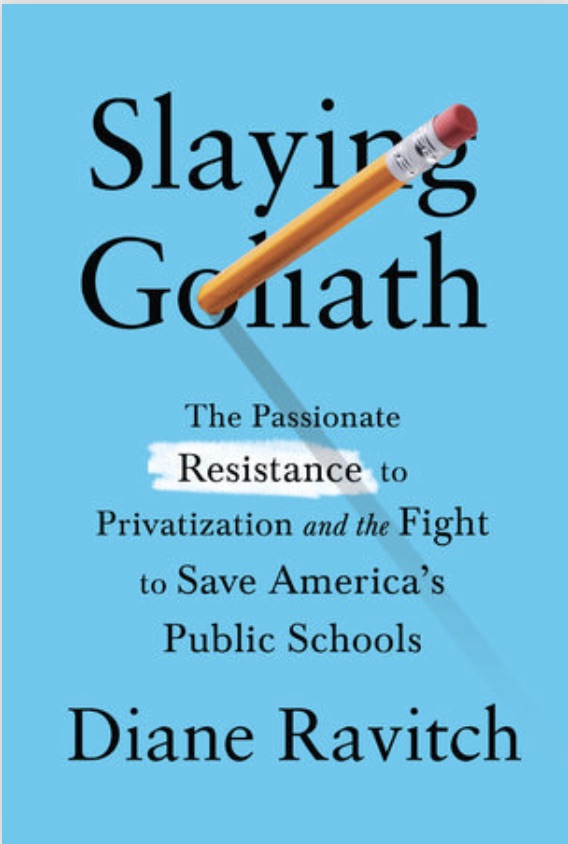
Burris brings to her work the experience of a veteran educator, a teacher and principal who spots scams quickly. Burris also has a rock solid sense of integrity that makes her unwilling to tolerate organizations that are designed to benefit the adults, not the students. She is the quintessential embodiment of the “David” I wrote about in my book SLAYING GOLIATH. She works with passion and dedication because of a sense of mission, not for love of money. She is a mortal threat to the Goliaths who wear the fake mantel of education reform. She can’t be bought and she can’t be stopped. Unlike the hirelings of Goliath, she really does work for the children, for whom she has worked all her life.

John Thompson, historian and retired teacher in Oklahoma, reviews SLAYING GOLIATH in two-parts.

This is part one. 

He begins:

Diane Ravitch’s Slaying Goliath: The Passionate Resistance to Privatization and the Fight to Save America’s Public Schools is the history of the rise and fall of corporate school reform, but it is much more. It isn’t that surprising that a scholar like Ravitch, like so many researchers and practitioners, predicted over a decade ago how data-driven, competition-driven “reform” would fail. Technocratic “reformers,” who Ravitch calls “Goliath,” started with a dubious hunch, that socio-engineering a “better teacher” could overcome poverty and inequality, and then ignored the science that explained why evaluating teachers based on test score growth would backfire.

It may be surprising that Ravitch, an academic who had once worked in the Education Department of President George H. W. Bush, and served on the board of the conservative Fordham Foundation, become the leader of the grass roots uprising of parents, students, and educators which she dubs the “Resistance.” But it soon became clear why Ravitch inspired and guided the Resistance. In contrast to Goliath, who “ignored decades of research” and assumed the worst of their opponents, Ravitch respected and listened to practitioners and patrons.

One big surprise, which is explained in Slaying Goliath, is how Ravitch presciently understood why output-driven, charter-driven reform devolved into “privatization.”  She had firsthand experience with the hubris of the Billionaires Boys Club, understanding the danger of their desire to hurriedly “scale up” transformational change. And being an accomplished scholar, she had insights into how top-down technocrats’ embrace of behaviorism in the tradition of Edward Thorndike and B.F. Skinner, led to their commitment to “rigidly prescribed conditioning via punishments and rewards.”

Ravitch was among the first experts to fully grasp how, “Behaviorists, and the Disrupters who mimic them today, lack appreciation for the value of divergent thinking, and the creative potential of variety. And they emphatically discount mere ‘feelings.’”

Ravitch witnessed how corporate reformers “admire disruptive innovation, because high-tech businesses do it, so it must be good.” Rather than take the time to heed the wisdom of those who had no choice but to become Resisters, Goliath’s contempt for those in the classroom drove an evolution from “creative destruction” to “Corporate Disruption.”

Disrupters were in such a rush that they used children as “guinea pigs in experiments whose negative results are clear.” But they “never admit failure,” and remain oblivious to the fact that “The outcome of disruption was disruption, not better education.”  And these billionaires not only continue to “fund a hobby injurious to the common good.” They’ve ramped up their assault on public education and its defenders, perpetuating a “direct assault on democracy.”

Ravitch predicts, “Historians will look back and wonder why so many wealthy people spent so much money in a vain attempt to disrupt and privatize public education and why they ignored income inequality and wealth inequality that were eating away at the vitals of American society.”

Thompson goes on to tell some of the important events in which I was a participant. Such as the decision within the first Bush administration to trash the infamous Sandia Report, which disputed the desperate findings of “A Nation at Risk.” And my discussions with Albert Shanker about what charter schools should be in the American system. He saw them as part of a school district, operating with the approval of their peers as collaborators, as R&D labs, not as competitors for funding and students. And my 2011 meeting at the Obama White House, when the top officials asked what I thought of  Common Core and I urged them to launch field trials; they rejected the idea out of hand.

And Thompson quickly understood that, unlike the Disrupters, who wanted to reinvent and disrupt the public schools, I listened to practitioners. I assumed they knew far more than I, and I was right about that. I understood the negative effects of NCLB and the Race to the Top because I saw them through the eyes of those who had to implement shoddy ideas.

Thompson concludes:

Ravitch observes that in contrast to the Resistance, “So as long as billionaires, hedge fund managers, and their allies are handing out money, there will be people lined up to take it. But their transactions cannot be confused with a social movement.” Moreover, “The most important lesson of the past few decades is that “Reform doesn’t mean reform. It means mass demoralization, chaos, and turmoil. Disruption does not produce better education.”

I’ll conclude this post with Ravitch’s words on the two dogmas that the Disruption movement relied on:

First, the benefits of standardization, and second, the power of markets. Their blind adherence to these principles has been disastrous in education.    These principles don’t work in schools for the same reasons they don’t work for families, churches, and other institutions that function primarily on the basis of human interactions, not profits and losses.

A few people in Los Angeles who think a great deal about education issues decided to launch a new website. They are real people who are not funded by billionaires Eli Broad, Reed Hastings, the Waltons, Bill Bloomfield, Michael Bloomberg, or Bull Gates. Imagine that!

Blogger Sara Roos writes an introduction:

Dears:

With this I am announcing the launch of the Los Angeles Education Examiner, a site for news about things-educational in LA and beyond.

Included on my blog, RedQueenInLA.com are two of LAEdEx’s first two new postings, attempting to stake out the reaches of our coverage. I am embarking on this effort with friend, neighbor and colleague Damien Newton of StreetsBlogLA.comfame. LA EdEx will be a non-profit, online news website covering the education beat in and around Los Angeles.

So please look here or at la-edex.org at these introductory pieces as we start exploring what it means to educate kids in LA, how their world is at once insular and intensely important within one’s own little family, while also being politically critical in a very big sense, a microscosm of all the whirlings of money, power, and social interactions beyond.

Thanks for your support by reading, forwarding and maybe even considering – gasp – contributing!

-Sara.

http://redqueeninla.com/2020/02/12/rqila-passes-a-marker-launching-the-los-angeles-education-examiner/
http://redqueeninla.com/2020/02/12/schools-reach-beyond-the-classroom/

http://la-edex.org/welcome-to-and-from-the-los-angeles-education-examiner/
http://la-edex.org/schools-reach-beyond-the-classroom/

Tonight (before the Oscars) I spoke at the Mark Taper Auditorium in the Los Angeles Central Library. It was a magnificent event, led by Alex Caputo-Pearl of the United Teachers of Los Angeles.

The library is an elegant building that has been renovated. The auditorium is gorgeous. The audience was wonderful.  The event was videotaped so I hope to post it here. I noticed that many big contributors to the privatization movement (Richard Riordan, Bill Gates) also contributed to the Public Library. Do you think they see a contradiction between supporting a great public library, free and accessible to all, while undermining public schools?

It was thrilling to be sponsored by UTLA. This is a union that is fully woke and fighting to save public education and make it far, far better.

First comes the March 3 election, where four seats on the LAUSD board are up for grabs. UTLA is vigorously supporting Jackie Goldberg, George McKenna, Scott Schmerelson and Patty Castellanos.

Then comes a major funding referendum next November where UTLA and other educators are asking voters of California to tax major corporations whose tax rates have not changed since 1978. The tax for the Communities and Schools defending would raise $12 Billion a year, half for social services for children, and half for schools.

UTLA boldly went on strike in January 2019. They have now purchased highway billboards to shame the corporate Privatizers. They are a brave and militant union.

I was thrilled to see so many LA friends and meet new ones, especially the East Side Hispanic parents who have created a neighborhood organization to fight privatization. I also enjoyed seeing our own commenter Left Coast Teacher, who is tall and very handsome. And it was great to see blogger Sara Roos (Red Queen in LA) and many more LA allies.

I love this union! They are truly leaders of the Resistance!


The young people of Florida offer hope.

Watch this!

‪Les Misérables Flash Mob – Orlando Shakespeare Theater https://youtu.be/Cn8PiqIXEjQ via @YouTube‬

Sorry to have missed this great story when Jan Resseger posted it. i happened to have been down and out with the flu. This is a story I wish I could include in SLAYING GOLIATH. The perpetrators returned to the scene of their crime and are shunned!

Jan Resseger writes:

Wisconsin and Ohio have the oldest school choice programs in the United States.  Milwaukee’s voucher program is 30 years old and the Cleveland Voucher Program is 24 years old.  Both states have expanded vouchers statewide beyond the two cities where they began. It ought to be a red flag that in these two states with the oldest programs, National School Choice Week may have been more contentious than anywhere else in the country.

National School Choice Week in Wisconsin

Last week Vice President Mike Pence and Education Secretary Betsy DeVos went to Madison, Wisconsin’s capital city, to honor National School Choice Week, a celebration of vouchers and charter schools that was established and is promoted every year by groups like the American Federation for Children—the group DeVos herself helped found and to which she has regularly donated generously—and Jeb Bush’s ExcelinEd.

Pence and DeVos were not welcomed by Wisconsin’s Democratic Governor Tony Evers, who skipped the event altogether. Before he was elected governor, Evers was the state’s Superintendent of Public Instruction, and before that he was a public school educator. Evers has devoted his career to leading and promoting the state’s public schools.

Neither Pence nor DeVos was welcomed by the Capital Times in Madison, which editorialized: “Pence parrots the talking points of the wealthy campaign donors he has always served…. That’s what Pence did Tuesday in Madison… Pence was promoting ongoing efforts to undermine public education with the usual cabal of billionaire-funded advocates for the agenda of the Trump-Pence administration’s ‘school choice’ agenda… Out-of-state billionaires like DeVos and politicians like Pence have for years targeted Wisconsin in their efforts to promote ‘school choice’ initiatives. They got traction when one of their lackeys, Republican Gov. Scott Walker, was in office. But Walker, a Pence crony, was swept out of office in 2018 by a supporter of public education, Democrat Tony Evers.”

The Capital Times‘ editorial board adds that this year, there has been pressure against school privatization in the city of Milwaukee itself: “(I)n the spring of 2019, critics of school choice and school privatization schemes swept school board elections in Milwaukee, the state’s largest city… Key to the pushback against the ‘school choice’ advocates was the activism of African American and Latino Milwaukeeans, and the determination of groups such as Black Leaders Organizing for Communities (BLOC) and Voces de la Frontera Action, Inc. to defend public education.”

On the very same day Pence and DeVos came to Madison to extol school choice, the Capital Times‘ Briana Reilly reportedthat State Representative, Jonathan Brostoff joined fellow Democratic lawmakers and public school advocates to reintroduce a bill that would phase out Wisconsin vouchers and reinstate a Student Achievement Guarantee in Education, to reduce public school class sizes and upgrade the curriculum in participating public schools.

Executive Director of the statewide Wisconsin Public Education Network, Heather DuBois Bourenane endorsed the Public Education Reinvestment Act being introduced. First she explained specific problems with private schools that receive vouchers: “They do not answer to a locally elected school board. They do not have to follow laws protecting students with disabilities. They do not have to follow the same stringent reporting and hiring requirements as public schools. They can use curriculum that is religious, unvetted and unscientific. They can—and frequently do—‘counsel out’ students who do not meet expectations, distorting the data on their performance and creating unfunded cost burdens for local public schools. This is unethical and we know it is wrong.”

As in other states, Wisconsin’s legislature has created “school choice” programs, but the same state legislature has neglected to pass the taxes that would fund the programs. In Wisconsin and other states, vouchers and charter schools have been funded at the expense of public schools. DuBois Bourenane described the fiscal disaster thrust on Wisconsin’s public schools by ever-expanding school vouchers: “Wisconsin is spending $351,180,390.29 this year to provide taxpayer funded tuition vouchers to 43,450 students at 317 schools, nearly 100 percent of which are religious schools. We know that nearly all of the students in the statewide program already attended these private schools… There are over 860,000 children whose parents choose to send them to the public schools that are the heart of our communities; public schools that accept, embrace, and proudly serve ALL students. Yet data from the Legislative Fiscal Bureau shows that even as the unaccountable voucher program has been recklessly expanded, our public schools have been increasingly underserved by the state. According to the Wisconsin Budget Project, ‘In 2021, the state will invest less in public school districts than it did in 2011…. In 2021, Wisconsin school districts will receive $75 million less in state aid than in 2011 in inflation-adjusted dollars.’”

National School Choice Week In Ohio

Tomorrow, February 1, parents are scheduled to begin claiming vouchers for Ohio’s EdChoice Voucher Program for the 2020-2021 school year, but as of this morning, nobody knows what the program will look like or how many students will be able to qualify.

As Jan has previously posted, Ohio’s legislators don’t care about the public schools that most students attend. They are obsessed with charters (most of which are failing) and vouchers (even though the only research on the Ohio program shows that it harms children, who lose ground in math and make no gains in reading).

But isn’t it wonderful to see the two big Goliaths—DeVos and Pence—get a chilly reception when they arrive in Madison  to celebrate School  Voice Week? I will save this for the next edition of SLAYING GOLIATH. The Resistance is winning in Wisconsin!

As the Beatles sang, “Money can’t buy you love.”


The Houston Chronicle reports that Trump will promote Ted Cruz’s school voucher plan, which aligns nicely with the DeVos “Education Freedom” vouchers.

Texas does not have vouchers, thanks to the concerted efforts of Pastors for Texas Children and a large number of local civic groups. Despite the fervent advocacy of top Republicans, a coalition of rural Republicans and urban Democrats have stopped the voucher push for several legislative sessions.

WASHINGTON — U.S. Sen. Ted Cruz visited the White House in December for a public discussion about school choice, and he pitched President Donald Trump face to face on legislation he has pushed for more than a year now with Education Secretary Betsy DeVos.

If and when we pass this, this will be the most significant federal civil rights victory of modern times,” Cruz said of the Education Freedom Scholarships the bill would create, providing billions of dollars in tax breaks for individuals and companies that donate to private school scholarship funds or help parents home-school their children.

“This is all about millions of kids — millions of inner-city kids, millions of African-American kids, millions of Hispanic kids, trapped right now, desperate for hope — and giving them scholarships,” the Texas Republican told Trump, who nodded in agreement. “There is nothing on the domestic front that I believe will have a longer lasting legacy in your presidency than if and when we get this done together.”

It appears Trump heard him loud and clear.

The president is expected to give the proposal a prime-time shoutout during his State of the Union address Tuesday, as he seeks his second term. Trump is expected to touch on the core planks of his re-election campaign — the economy, immigration and health care among them — with an emphasis on what he has done and wants to do for working families. School choice will be a central piece of that message, as the president plans to urge Congress to expand options for parents and students, administration officials say.

But how that message might be received in Texas is another matter. Despite the GOP majority in Austin, Texas lawmakers spent years battling over various voucher proposals with so little success that advocates gave up in 2019.

Thanks to Pastors for Texas Kids for supporting public schools with certified teachers and adequate resources.