The charter lobby has created a mythology that charter schools are more successful than public schools. As the study shows, the mythology is not true. What parent would choose a school that is likely to close in a few years?
Parents want to know if they can depend on a school being there not only when their children start but also when they finish. Based on a marketplace model with fewer regulations, the charter school sector is far more unstable than local public schools.
While the fate of each school cannot be predicted, we can show trends.
Doomed to Fail: An analysis of charter school closures from 1998-2022 uses data from the Common Core of Data, the primary database on non-private elementary and secondary education in the United States, to determine charter school closure rates and the number of students affected when closures occur. The report analyzes charter school closures from 2022 to 2024 to determine the reasons why schools close and how much notice families receive.
Charter schools come with no guarantees. And, as this report shows, in far too many cases, these schools were doomed to fail from the very start.
Here are some of the key findings of the report:
-By year five, 26% of charter schools have closed
-By year ten, nearly four in ten charters fail, rising to 55% by year twenty.
-More than one million students have now been stranded by charter closures
-Eight states have closure rates that exceed 45%.
-The inability to attract and retain students is the primary reason for failures.
-The second most frequent reason is fraud and gross mismanagement.
-Forty percent of closures are abrupt, giving insufficient warning.
-School operators, not authorizers, initiate the majority of closures (blowing a hole in the “accountability” myth..
The report includes some pretty startling examples of charter shutdowns during the last two years, exposing corruption, mismanagment, and operators who did not bother to tell parents the school would be closing until just before it happened. There is also a section written by Gary Rubenstein on the failure of the Tennessee Achievement District. The report can be found here and the Executive Summary here.
Scholars at Brown University and Stanford University recently released a study concluding that spending more on schools reduces child mortality.
The paper is titled “Priceless Benefits: Effects of School Spending on Child Mortality.”
The authors are: Emily Rauscher of Brown University; Greer Mellon, Postdoctoral Research Associate, Brown University; Susanna Loeb, Stanford University.
The authors’ summary:
The academic and economic benefits of school spending are well-established, but focusing on these outcomes may underestimate the full social benefits of school spending. Recent increases in U.S. child mortality are driven by injuries and raise questions about what types of social investments could reduce child deaths. We use close school district tax elections and negative binomial regression models to estimate effects of a quasi-random increase in school spending on county child mortality. We find consistent evidence that increased school spending from passing a tax election reduces child mortality.
Districts that narrowly passed a proposed tax increase spent an additional $243 per pupil, mostly on instruction and salaries, and had 4% lower child mortality after spending increased (6-10 years after the election). This increased spending also reduced child deaths of despair (due to drugs, alcohol, or suicide) by 5% and child deaths due to accidents or motor vehicle accidents by 7%. Estimates predicting potential mechanisms suggest that lower child mortality could partly reflect increases in the number of teachers and counselors, higher teacher salaries, and improved student engagement.
Suggested citation: Rauscher, Emily, Greer Mellon, and Susanna Loeb. (2024). Priceless Benefits: Effects of School Spending on Child Mortality. (EdWorkingPaper: 24-1008). Retrieved from Annenberg Institute at Brown University: https://doi.org/10.26300/s7t7-j992
Emily Rauscher Professor of Sociology Brown University Box 1916 Providence, RI 02912 emily_rauscher@brown.edu
Greer Mellon Postdoctoral Research Associate Population Studies and Training Center and Annenberg Institute Brown University greer_mellon@brown.edu
Susanna Loeb Professor of Education Stanford University 482 Galvez Mall Stanford, CA 94305 sloeb@stanford.edu
Jon Valant and Nicolas Zerbino of the prestigious nonpartisan Brookings Institution examined the Arizona voucher program and were surprised to find that it was a giveaway to the richest families in the state.
Voucher advocates did not like their findings and tried to discredit their analysis.
In May, we released a short Brookings report showing which families are most likely to get voucher funding through Arizona’s now-universal Empowerment Scholarship Account (ESA) program. The analysis isn’t complicated, and the results couldn’t be much clearer. A highly disproportionate share of Arizona’s ESA recipients come from the state’s wealthiest and most educated areas. That’s an important finding, even beyond Arizona, since this program is at the forefront of a wave of universal voucher initiatives that’s currently sweeping across red states (and some purple states). What happens with Arizona’s program could foreshadow what’s to come in many parts of the country.
These universal (or near-universal) programs are much more threatening to public education systems than the smaller, more targeted voucher programs that preceded them. They raise concerns about fundamental issues such as civil rights protections and the separation of church and state. Early research and reporting points to ballooning state budgets, wasteful spending, and tuition increases from opportunistic private schools. Meanwhile, hardly anything in the academic literature suggests that universal ESA programs will improve student performance. And yet, the push to remake the U.S. education system in the form of universal school voucher programs continues.
Having entered the fray with our own analysis of a universal ESA program, we’ve gotten a close look at the information environment surrounding these recent initiatives. Suffice to say, it isn’t healthy, at least if we hope for a functional policymaking process. A network of pro-voucher interest groups, think tanks, funders, and politicians are filling an information vacuum with misleading data, faulty or disingenuous arguments, and advocacy that masquerades as research.
Here, we’ll respond to four critiques we’ve heard from that crowd. Part of our goal is to show why their specific critiques of our work are baseless, misleading, or just kind of odd. In doing so, we also hope to illuminate how dangerous the information environment surrounding universal ESAs has become now that many state leaders are dragging their education systems into uncharted territory based on little more than ideology, political calculation, and a fingers-crossed hope that the voucher advocates aren’t leading them astray.
Here are the critiques:
Critique 1: We got our analysis wrong because someone else found something different
Our main results are probably best summarized by Figure 1, below, which appeared in our original post.
FIGURE 1
The Arizona ZCTAs (ZIP codes, basically) with the lowest poverty rates have the highest share of school-age children who received an ESA. The ZCTAs with the highest poverty rates have the lowest rates of ESA take-up. It’s an extremely straightforward analysis, and we provide a detailed description of what we did in the piece.
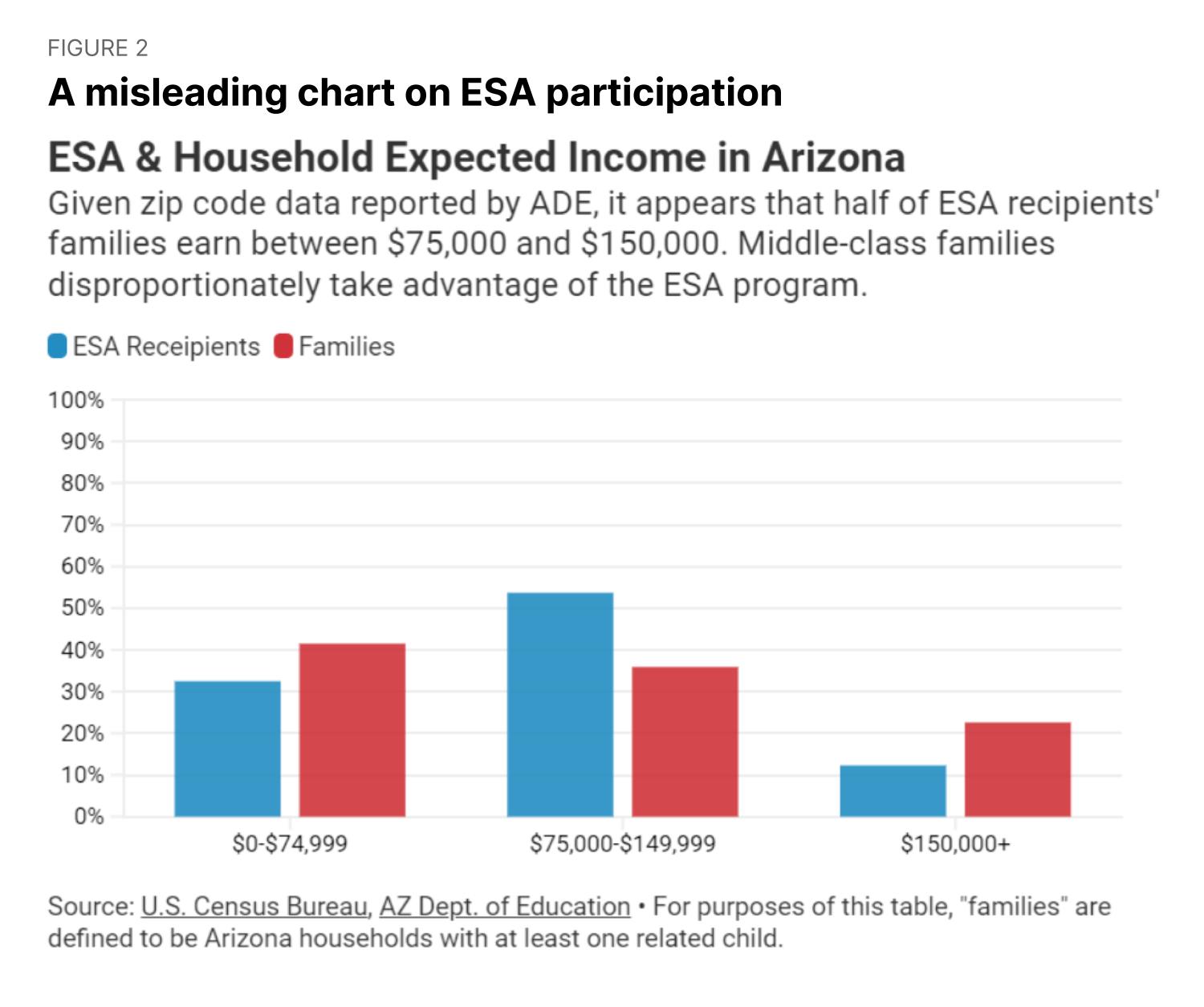
Before we published our post, an organization called the Common Sense Institute (CSI) of Arizona—a “non-partisan research organization” with several staff members from former governor Doug Ducey’s administration—looked into a similar question. CSI’s chart, below, tells a completely different story from our chart.
CSI makes it look like relatively few wealthy families in Arizona get ESAs. So, why the discrepancy?
It’s because CSI presented an apples-to-oranges comparison that’s bound to tell that story. The data issue is subtle, but they present ZIP code-level data for ESA recipients (blue bars, on the left) and household-level data for families (red bars, on the right). Many households in Arizona make $150,000 or more, so the far-right, red bar is quite tall. However, few ZIP codes have enough households earning more than $150,000 that the median household income rises above that threshold. As a result, many ESA recipients who earn more than $150,000 aren’t included in the $150,000+ category in this chart. Instead, these households—which earn more than $150,000 themselves but live in ZIP codes where the median income is below $150,000—are included in one of the other blue bars.
Maybe that’s an innocent mistake, but it’s certainly not an accurate representation of which Arizona residents are getting ESAs.
Critique 2: We didn’t place Arizona’s ESA program in the proper context of its other school choice programs
Education Next published an article from Jason Bedrick of the Heritage Foundation that accuses us of omitting key context that, if presented, would markedly change the takeaways from our analysis. Bedrick points out that Arizona’s universal ESA program exists alongside several tax-credit scholarship programs (true) and that families are prohibited from participating in the ESA and tax-credit scholarships simultaneously (also true). He then shares a few numbers, does some hand-waving, and concludes that our “fatally flawed” analysis is deeply misleading because of this omission.
Curiously, Bedrick doesn’t show the relative size of the ESA and tax-credit scholarship programs in Arizona. Here’s the obvious chart to illustrate that comparison—one that EdNext maybe could have requested before publishing yet another round of Heritage Foundation talking points on ESAs:
FIGURE 3
These tax-credit scholarship (TCS) programs are small relative to a large-and-growing universal ESA program that’s projected to exceed $900 million this year. On top of that, most TCS dollars are going to recipients above 185% of the federal poverty level—the threshold for reduced-price lunch eligibility. (One note: the most recent numbers available for the ESA program come from FY24, while the most recent numbers available for TCS programs come from FY23.)
In other words, this critique—which really isn’t about the universal ESA program we analyzed in the first place—doesn’t even point to context that meaningfully changes the interpretation of our data.
It’s important to emphasize, too, that our analysis was primarily about the high-income households that are obtaining a disproportionate share of Arizona’s ESAs. In that post, we tried to present data in the most straightforward, defensible way possible. If our goal had been to present the most damning data possible, there’s more we’d have said.
Here’s a doozy of an example. According to U.S. Census Bureau data, Arizona has 300 ZCTAs with at least 250 children under age 18. (The other 60 ZCTAs are smaller, which makes them difficult to analyze.) Of those 300 ZCTAs, the one with the single-highest take-up rate for ESAs (236 of every 1,000 children) is the one with the single-highest median household income (about $173,000).
Critique 3: Arizona’s ESA program is too new to assess who will participate
Maybe the most peculiar response we’ve seen is from Mike McShane of EdChoice, who published an op-ed in Forbes.
McShane appeals to Everett M. Rogers’ “diffusion of innovation” theory, which suggests that new technologies and ideas are adopted sequentially by different groups (from early adopters to laggards). McShane asserts that we should expect wealthier and more educated families to be the early adopters of a universal ESA program. He implores us to “think of the first people to own a personal computer, or a cell phone. They started with tech nerds and the wealthy, and eventually worked their way to everyone else.”
Let’s play a game of “one of these things is not like the others” with personal computers, cell phones, and a universal ESA program. Yes, we’d expect wealthier families to be the first to buy computers and cell phones. Those things cost a lot of money. A universal ESA program gives you money. We might expect poorer families—with fewer resources and potentially worse public-school options—to jump first at that opportunity. Even the usual dynamic of uneven information diffusion is complicated in this context, as the ESA program was available to families with children in low-rated schools long before it became universal.
Regardless, there’s reason for concern that vouchers will be more exclusively adopted by the wealthy over time. Jason Fontana and Jennifer Jennings studied the early implementation of a universal ESA account in Iowa. They found that private schools responded to ESA eligibility by increasing their tuition. If this response continues to play out, we might see desirable private schools becoming unaffordable to low-income families that cannot cover a growing gap between the value of their voucher and cost of enrollment. In the long term, this creates a risk of extreme stratification across the public and private sectors.
Chile may provide a glimpse of that potential future. In a 2006 paper in the “Journal of Public Economics”, Chang-Tai Hsieh and Miguel Urquiola analyzed a universal voucher program in Chile. They found suggestive evidence that “the main effect of unrestricted school choice was an exodus of ‘middle-class’ students from the public sector… [which] had a major effect on academic outcomes in the public sector.” These patterns, along with widening achievement gaps between rich and poor, led Chile to drastically modify that program.
Critique 4: We’re targeting ESA programs when the real villains are public schools
A fourth set of critiques presents more conceptual arguments about education reform. Perhaps the most data-infused of these comes from The Goldwater Institute, which notes that Arizona spends a great deal of money to “subsidize public school instruction” for wealthy families. It accuses us (and/or others) of a double standard in how we object to using government funds to pay for wealthy students’ private schooling but not public schooling.
We think this critique reveals just how far the rhetoric surrounding universal ESAs has drifted from Americans’ traditionally held views about education. Americans have long accepted—in fact, embraced—a double standard for public and private schools. Our public education system, with all its flaws, has been a foundational institution for supporting the country’s economic, social, and democratic well-being. Americans have found a rough consensus on how to approach K-12 education: provide free public schooling to everyone (including the wealthy!), allow families to pay for private education if they’d like to opt out of the public system, and maybe create a few opt-out opportunities via school choice policy for those unable to pay.
We’ve entered a period in which conservative lawmakers are confronted with legacy-defining decisions about whether to abandon that long tradition and embrace universal vouchers at the risk of kneecapping their states’ public education systems. Worse, they’re doing it in a polluted information environment that has plenty of loud voices but hardly any credible research to guide or support their decision-making. Now that a few states—including Arizona—have taken that risky leap of faith, the least we can ask of other state leaders is to wait and see what happens
Researcher Beth Zirbes, a teacher of advanced mathematics, used her skills to dissect a charter school study produced at Harvard. The study was reported by Paul Peterson in The Journal of School Choice; Peterson, like the Journal, is an outspoken advocate for charters and vouchers. The study claimed that charter schools outperform public schools, and that the charter schools in Alaska were best among all states.
The governor of Alaska cited the study as a reason to increase the number of charter schools.
When I first saw the results of the Harvard study concerning charter schools I was simultaneously unsurprised and skeptical. I was unsurprised as I have seen many very bright young students in my AP classes come from charter schools. I was skeptical as I suspected much of this performance could be attributed to the type of student who attends Alaska’s charter schools. As a comparative analysis of Alaska’s charter schools and neighborhood schools had not been done, I set out to do one myself.
To determine whether charter schools outperform neighborhood schools I looked at the performance of all schools on the 2018-2019 PEAKS ELA (English Language Arts) assessment from the Alaska Department of Early Childhood Education and Development’s (DEED) report card to the public, as this year was within the same time frame as the data from the Harvard study. The performance of each school is given under the “2018-2019 Performance Evaluation for Alaska’s Schools (PEAKS)” tab. I used the data on this page for every school in the state which allowed me to analyze test scores and demographic characteristics such as the proportion of the school who are economically disadvantaged, English language learners (ELL), and special education (SPED). Demographic characteristics are only given for the set of test-takers and thus all summaries and analyses are for students in grades 3-9 during the 2018-2019 school year. I also removed all correspondence schools from my dataset as these students were not included in the Harvard study, do not take NAEPs tests, and have very low participation rates on state tests. For my analysis on performance, I also restricted my dataset to include schools only in districts where charters are an option to ensure that the student populations were as similar as possible.
At first glance, it appears that charter schools are more successful than neighborhood schools. At charter schools 52.5% (1,866 out of 3,554) of students were proficient on the ELA assessment versus 40.1% (18,655 out of 46,574) of students at neighborhood schools. However, these differences could be explained by the differences in demographics of the student bodies at these schools. To rule this out as a potential issue, statisticians control for these variables in their mathematical models. We can then ask, do the charter schools outperform neighborhood schools that have similar characteristics? Or do charter schools do any better than we would expect, given their student populations? In short, the answer is no, they do not. When I fit a model which controlled for socioeconomic status alone, the type of school (charter versus neighborhood) was not significant. (For anyone who knows statistics, the p-value associated with type of school was 0.57. It wasn’t even close.) In summary, there is no evidence that charter schools outperform neighborhood schools in terms of ELA proficiency once we consider their socioeconomic make-up.
During my data exploration, I discovered that charter schools, on average, have very different student bodies than neighborhood schools. Charter schools have far fewer economically disadvantaged students, far fewer ELL students, and are comparable to neighborhood schools in terms of SPED populations. Here is a summary of how these populations differ for all Alaskan students in the relevant grades in all of Alaska’s brick and mortar schools for the 2018-2019 school year:
Neighborhood schools were 52.2% economically disadvantaged (30,780 out of 58,929 students) compared to 31.3% in charter schools (1,219 out of 3895 students).
Neighborhood schools were 15.5% ELL (9,150 out of 58,929 students) compared to 9.3% in charter schools (363 out of 3895 students).
Neighborhood schools were 16.3% SPED (9,162 out of 58,929 students) compared to 13.7% in charter schools (532 out of 3895 students).
However, these summaries are highly influenced by a few outliers and obscure some large discrepancies, especially in terms of the economically disadvantaged and ELL students.
Of the charter schools, 46.4% (13 out of 28) have economically disadvantaged rates below 20%, compared to just 3.5% of neighborhood schools (15 out of 426).
Only 10.7% of charter schools (3 out of 28) have ELL percentages above 10%, compared to 36.9% of neighborhood schools (157 out of 426).
Even if we did a comparison of charter schools and neighborhood schools and found that charter schools did better, we still cannot conclude charter schools are causing the performance difference we observe. A comparative study like this is an example of an observational study and because it is impossible to control for all confounding factors, such as parental involvement, we can’t conclude success is caused by the school type. To definitively conclude that charter schools were causing the observed difference in success compared to neighborhood schools we would have to randomly assign some students to go to a charter school and some students to go to neighborhood schools. After some time, we would then compare the results. Obviously, this is impractical as many charter schools do not have busing, require volunteer hours, can remove students for poor attendance, and some do not even have lunch services.
Before the state uses the results of the Harvard study to change the approval process for charter schools we need to understand if charters are better and, if so, why. So far, I have not seen convincing evidence that charter schools outperform neighborhood schools when we control for various student characteristics. I have an idea for further study which I believe should be completed before any changes to policy are made. We can examine the performance of students who got admitted to charter schools via the lottery to those who applied but did not get in and attended their neighborhood schools instead. The group who was admitted is likely similar to those who applied but were not. This would be as close to a randomized experiment as one could hope to have. From this one could determine whether various factors were causing differences in performance, such as class size and teaching methodology. Additionally, we could use results of such a study to determine which factors correlate with success and apply these strategies in all our schools. As more than 90% of the students at our in-person schools are in neighborhood schools, such reforms will be more wide-reaching than simply adding a few more charter schools.
The Center for Budget and Policy Priorities is a nonpartisan, nonprofit research organization in D.C. Its reports are widely respected. Earlier this week it released a scathing report about the damage that vouchers do to American education. Vouchers subsidize the tuition of 10% or less of students, mostly in religious schools, while defunding the schools that enroll nearly 90% of all students.
Joanna Lefebvre wrote for the Center:
During this year’s legislative sessions, at least one in three states are considering or have enacted school voucher expansions alongside broad, untargeted property tax cuts. Over half of states have already enacted deep personal and corporate income tax cuts in the last three years. These policies will result in under-resourced public schools, worse student outcomes, and, over time, weaker communities.
Research suggests property tax cuts result in disproportionately less funding for districts serving large numbers of students of color and that school funding matters more for these students’ life outcomes because of historical and systemic racial discrimination. States wishing to ensure a quality education for all children should instead invest in public schools, reject K-12 voucher programs, and pursue only targeted property tax relief.
Property tax cuts reduce funding for public education at its source. Revenue from local property taxes accounted for over 36 percent of public education funding in the 2020-2021 school year, the most recent year for which national data are available. States have a long history of weaponizing this policy design, using their property tax codes to limit education funding for Black and brown students. For example, California’s infamous 1978 Proposition 13, which limited property taxes to 1 percent of a home’s purchase price, passed with primary support from white property owners amid a campaign of thinly veiled racism and xenophobia about paying for “other” people’s children to go to school.
Vouchers Divert Money from Public Schools and Get Worse Academic Outcomes
K-12 vouchers also siphon funding away from public schools. Voucher programs can take many forms, but all use public dollars to subsidize private school tuition. Some voucher programs defund public education directly by siphoning off funding that otherwise would have gone to public schools. Others do so indirectly by reducing revenue available for all public services, including education.
Modern school vouchers have their roots in similar programs created after Brown v. Board of Educationto perpetuate segregation and exacerbate inequities. This vision can be seen in today’s programs, where most vouchers go to families with high incomes. Although data on the race and ethnicity of voucher recipients themselves is scarce, white students make up 65 percent of private school enrollment in the U.S. but only 45 percent of public school enrollment. Defunding public schools through vouchers and property tax cuts exacerbates inequities in educational outcomes, which often fall along lines of race and class due to the persisting effects of slavery and segregation.
A trend has emerged of states proposing or enacting school voucher programs while simultaneously cutting, limiting, or proposing to eliminate property taxes.Florida, Texas, and Idaho are leading examples of this trend.
Florida: This year, a Republican representative introduced a bill to study eliminating Florida’s property tax system. Property taxes generated $14 billion in the 2020-2021 school year (the most recent for which data are available), equivalent to almost 40 percent of Florida’s K-12 education funding. Meanwhile, the legislature passed a budget in early March that includes about $4 billion for private school vouchers, a significant portion of the $29 billion appropriated for K-12 education.
Texas: Last year, Governor Greg Abbott called two special legislative sessions and spent seven months lobbying lawmakers to pass a school voucher system without success. The voucher proposal would have cost Texas school districts up to $2.28 billion. However, the legislature approved over $18 billion worth of property tax cuts, with 66 percent of benefits accruing to families making more than $100,000, putting pressure on future education budgets.
Idaho: Last year, Idaho’s legislature passed property tax cuts totaling $355 million, equivalent to over half of property tax revenue for schools. Although some of this funding was replaced with general fund revenue to repair the state’s abysmal school facilities, the overall reduction in revenue jeopardizes the state’s long-term ability to fund education. Meanwhile, this year, the legislature tried and failed to pass a school voucher bill that would have cost the state over $170 million.
Broad property tax cuts and caps will not address housing affordability. Property values have risen by about 37 percent since the beginning of the COVID-19 pandemic, and some proponents of property tax cuts argue they will help make housing more affordable. However, most of the proposals being debated would do little to help while stripping resources from public education. Instead of broad property tax cuts or caps, states should adopt “circuit breaker” policies that respond to residents’ ability to pay without limiting revenue-raising capacity.
States should raise revenue equitably and invest in robust public schools. Research suggests the education attainment gap between children from low-income families and those from higher-income families can be eliminated with increased funding for public schools. Raising revenue to invest in public education and resisting calls to dismantle it through school vouchers and property tax cuts is critical to enabling thriving communities with broadly shared opportunity.
States are defunding public education by reducing revenue available for schools through property taxes and by diverting public dollars to private schools.
Since the beginning of the COVID pandemic in early 2020, there has been intense interest in how the pandemic started. Was it started by a leak of the virus from a dirty seafood market stall in China? Did it begin because the virus leaked from a research laboratory in Wuhan, China?
Republican elected officials in Washington became convinced that it began because the virus escaped from a lab in Wuhan, China, that researching dangerous viruses; that the lab was involved in gain-of-function research; that the research was funded by the United States; and that Dr. Anthony Fauci knew and must be held accountable.
In other words, a worldwide pandemic that caused millions of deaths was Dr. Fauci’s fault. They launched hearings yesterday at which Dr. Fauci was grilled.
Dr. Paul Offit is an infectious diseases specialist. He blogs at “Beyond the Noise” and recently wrote a book about COVID. He wrote the following post to explain what scientists know about these issues.
In the wake of some emails that recently came to light, the question of whether the United States government knowingly funded gain-of-function research at the Wuhan Institute of Virology has resurfaced. Does this new information prove the lab-leak theory?
First, what is “gain-of-function” research? Second, did gain-of-function research give birth to SARS-CoV-2 virus? One way to understand gain-of-function research is through the prism of rabies virus. People get rabies when they are bitten by a rabid animal. Once under the skin, the virus travels up the nerves and enters the brain, where it causes delirium, seizures, coma, and invariably death. Rabies is without question the deadliest infection of humans.
Now, imagine that a scientist engineers rabies virus so that, instead of being transmitted by animal bites, it is transmitted by small droplets from the nose and mouth, like the common cold. This new virus would be highly contagious and uniformly fatal. In the absence of an effective vaccine, it could eliminate humans from the face of the earth. The good news is that no one has tried to make rabies virus more contagious. But that doesn’t mean that it’s not possible or that no one would be willing to try. Indeed, in 2011, one experiment so frightened U.S. public health officials that within two years federal regulators made gain-of-function research illegal.
The worrisome experiment took place at the University of Wisconsin, Madison. Researchers took a strain of influenza virus found in birds and altered it to grow in ferrets (which, like humans, are mammals). In other words, these researchers had taken a strain of influenza virus that was limited to birds—to which no one in the world had immunity—and altered it so that it might cause disease in people. They had created a potential pandemic virus.
In 2016, three years before SARS-CoV-2 virus entered the human population, the lead researcher studying coronaviruses at the Wuhan Institute of Virology was Dr. Zheng-Li Shi. Her studies were funded in part by the United States government through EcoHealth. Dr. Shi was studying a coronavirus strain called WIV1 (Wuhan Institute of Virology-1): a bat coronavirus that could grow in monkey cells in the laboratory but didn’t cause disease in people. The WIV1 strain bears no resemblance to SARS-CoV-2. Dr. Shi wanted to see what would happen if she combined WIV1 with each of eight different bat coronaviruses that had been found in caves in and around Wuhan. None of the combination viruses that she created, however, were more dangerous than the strain she had started with (WIV1). None of them, like WIV1, could cause disease in people. Although Dr. Shi had performed gain-of-function studies that would have been illegal in the United States, she didn’t create a coronavirus strain that was dangerous to people.
So, while it was true that the United States government funded gain-of-function research at the Wuhan Institute of Virology, no function was gained. The recent seemingly endless posting of hidden emails and secret communications by government officials—all breathlessly claiming conspiracy and coverup—has, in the final analysis, been much to do about nothing.
Indeed, overwhelming evidence continues to support an animal-to-human spillover event that occurred in the western section of the Huanan Wholesale Seafood Market at the end of 2019. This is consistent with many other animal-to-human spillover events in history. Influenza virus (birds), human immunodeficiency virus (chimps), Ebola virus (bats), mpox (rodents), and the coronaviruses SARS-1 (bats) and MERS (bats) were all originally animal viruses. Indeed, about 60 percent of human viruses and bacteria have their origins in animals.
For a lengthy but complete discussion about why it is now clear that SARS-CoV-2 was an animal-to-human spillover event, you might want to check out a podcast calledDecoding the Gurus, which features evolutionary biologists Michael Worobey, Kristian Anderson, and Eddie Holmes.
Literacy doesn’t come in a box, we’ll never find our kids at the bottom of a curriculum package, and there can be no broad support for systemic change that excludes input from and support for teachers implementing these programs in classrooms with students.
(Two hands pull apart a book)
Exactly one year after the final episode of the podcast series that launched a thousand hot takes and opened the latest front of the post-pandemic Reading Wars, I finally dug into Emily Hanford’s Sold A Story from American Public Media. Six episodes later, I’m left with the ironic feeling that the podcast, and the narrative it tells, missed the point. My goal with this piece is to capture the questions and criticisms that I have not just about the narrative of Sold A Story but of the broader movement toward “The Science of Reading,” and bring in other evidence and perspectives that inform my own. I hope to make the case that “The Science of Reading” is not a useful label to describe the multiple goals of literacy; that investment in teacher professionalization is inoculation against being Sold A Story; and that the unproductive and divisive Reading Wars actually make it more difficult for us to think about how to cultivate literate kids. The podcast, and the Reading Wars it launched, disseminate an incomplete and oversimplified picture of a complex process that plasters over the gaps with feverish insistence.
Sold a Story is a podcast that investigates the ongoing Reading Wars between phonics, whole language, balanced literacy, and “The Science of Reading.” Throughout the series, listeners hear from teachers who felt betrayed by what school leaders, education celebrities, and publishers told them was the right way to teach, only to later learn they had been teaching in ways deemed ineffective. The story, as I heard it, was that teachers did their jobs to the best of their personal ability in exactly the ways incentivized by the system itself. In a disempowered profession, the approaches criticized in the series offered teachers a sense of aspirational community, opportunities for training and professional development, and the prestige of working with Ivy League researchers. Further, they came with material assets – massive classroom libraries and flexible seating options for students, for example – that did transform classroom spaces.
Without the critical toolkit and systemic support to evaluate claims of effectiveness, and lacking collective power to challenge the dictates of million dollar curriculum packages, teachers taught how they were instructed to teach using the resources they were required to use. And given the scarcity of educational resources at the disposal of most individual teachers, it’s easy to see why they embraced such a visible investment in reading instruction. Instead of seeing teachers in their relation to systemic forces – in their diminished roles as curriculum custodians – Hanford instead frames teachers who participated in these methods as having willingly bought into a cult of personality, singing songs and marching under the banners of Calkins and Clay; however, Hanford also comes up short in offering ways this story could have gone differently or will go differently in the future.
A key objective of Sold A Story is to communicate to listeners that “The Science of Reading” is the only valid, evidence-based way to teach kids to read and borders on calling other approaches a form of educational malpractice, inducing a unique pedagogical injury. In the wake of Sold A Story, “The Science of Reading” itself has been co-opted as a marketing and branding label. States and cities have passed laws requiring “The Science of Reading,” sending school leaders scrambling to purchase new programs and train teachers to comply with the new prescription.
In May 2023, the mayor of New York City announced “a tectonic shift” in reading instruction for NYC schools. The change required school leaders to choose from one of three pre-approved curriculum packages provided by three different publishing companies. First-year training for the new curriculum was estimated to cost $35 million, but “city officials declined to provide an estimate of the effort’s overall price tag, including the cost of purchasing materials.” NYC Schools also disbanded their in-house literacy coaching program over the summer to contract instead with outside companies to provide coaching. It’s hard not to conclude that the same publishing ecosystem that sold school leaders and policy-makers on the previous evidence-based reading curriculum – and that Hanford condemns in the podcast – is happy to meet their current needs in the marketplace. Meet the new boss, same as the old boss.
Now, months into the new school year and just weeks before Winter Break, how is the hurried rollout of the new reading curriculum going for NYC schools and teachers? One Brooklyn teacher told Chalkbeat they still hadn’t received the necessary training to use the new materials, “The general sentiment at my school is we’re being asked to start something without really knowing what it should look like, I feel like I’m improvising — and not based on the science of reading.” A third-grade teacher said phonics had not been the norm for her class, and that she hasn’t “received much training on how to deliver the highly regimented lessons.” Other teachers echo the sentiment of feeling rushed, hurried, and unprepared. One 30+ year veteran classroom teacher mentioned that she has “turned to Facebook groups when she has questions.” The chaotic back-and-forth was also recognized by many veteran teachers responding to the Chalkbeat piece on social media. One education and literacy coach commented, “I sometimes wonder how many curriculum variations I’ve seen in the last 3 decades – ’Here teachers [drops off boxed curriculum], now teach this way’ – hasn’t changed student outcomes across systems.”
Open the post to read Covington’s review of the research on phonics-based programs. No miracle. No impressive rise in test scores.
Most of my professional career has been devoted to debunking “miracles“ in education. Whole language was not a miracle cure. Neither is phonics.
Why not take the sensible route? Make sure that teachers know a variety of methods when they enter the profession. Let them do what they think is best for their students. Not following the fad of the day, but using their professional knowledge.
A group of scholars at Indiana University led by Christopher Lubienski developed a methodology for ranking organizations and individuals in the field of education.
It was disheartening to see that nine of the ten most influential organizations advocate for school privatization, for charter schools and vouchers. It was also disheartening to see that these nine organizations have revenues in the millions of dollars each year. They are heavily funded by rightwing organizations and billionaires.
It was exciting, however, to see that #3 on the list of the 10 most influential organizations was the Network for Public Education!
It also was the organization with the smallest budget!
Wow! Standing up for public schools without billionaire $$$!
Dr. Julian Vasquez Heilig is a noted scholar of charter schools, with experience as a parent of a charter school student and board member of a charter school. He is Provost and Vice-President for Academic Affairs at Western Michigan University. And, he is a founding board member of the Network for public Education!
Recently, Dr. Heilig testified before the House Committee on Education and the Workforce. He explained that the research on charters shows that they are no more successful than public schools, they close frequently, they have high teacher turnover, and they promote segregation. In addition, they exacerbate the problems of the public schools by choosing the students they want and diverting resources.
Dr. Heilig called for more accountability for charters and the need for democratic oversight.
The Republican majority of the Committee called three witnesses. The Democrats were allowed only one, and they chose Dr. Heilig.
They chose well. His testimony is succinct and excellent.
Good and Bad Teachers: So Many More of the Former,
So Many Fewer of the Latter
David C. Berliner
Arizona State University
A refereed journal article by colleagues1reported on a survey of adults, asking for their beliefs about “good teachers.” The respondents defined good teachers as those who “knew me, cared about me, and wanted me to do well; created interesting activities for us to do; praised me and other students for good grades and improvements; gave extra help or a challenge to students who needed or wanted it; covered a lot of material that was useful; and made learning relevant to me and my life.”
These respondents had little trouble recallingsuch teachers. Good teachers demonstrated caring and support, along with strong subjectmatter knowledge. They also estimated that more than two-thirds of their teachers were good or very good teachers, and they believed that only 12% of their teachers were bad or very bad.
With a different set of colleagues2, I studied what students said about their “bad teachers”. In that study we had access to 4.8 million ratings of teachers! Using a 100-point scale, 55% of our respondents gave a maximum rating of 100 (the best score), 75% gave a rating of 80 or more, and 89% gave a rating greater than 50 points. These data are compatible with other studies suggesting that America’s students are exposed to highpercentages of “good” teachers, and a lowpercentage of “bad” teachers.
From other research, Berliner estimated the number of “bad” teachers in the USA to be about 3%, with “bad” being generally and poorly defined. The well-respected Hechinger report, in 2014,reported that states such as Tennessee, Michigan, Georgia, Florida, and Pennsylvania, particularly in Pittsburgh, all provided estimates of “bad” teachers that were in this same low range. Danielson, who visited and coded hundreds of classrooms, estimated the “bad teacher” percentage to be around 6%. From those who are experienced classroom analysts, that seems to be on the high end of the estimates in the literature—though it is still a relatively low percentage.
Furthermore, in our study, when we analyzed the comments associated with teachers judged to be “bad,” we found that unanimity among the classmates of those who rated their teachers poorly was quite rare. Nevertheless, we did find a few classrooms where the unanimity and diversity of the charges leveled by students against their teachers made us think that a particular teacher should be dismissed immediately! However, for large numbers of teachers who were rated “incompetent” or “bad” by many of their students, we found other reviews (and sometimes many such reviews) of the same teacher that were positive. Further analysis showed why such disparate judgements made sense. For example, a teacher may be rated poorly because they have strict rules about how essays should be done andgrade them accordingly. And teachers’ who were quite strict about classroom behavior, or who gave out lots of homework, might also be rated low by some of their students. But for other students–say those who make few grammatical mistakes, those who don’t act out in classes, and those who do not find their homework burdensome, ratings of their teachers might be considerably higher. In our study, this seemed to explain why so many reviews of teachers by students were not uniformly either positive ornegative.
So, what do we know through research–not from publicity-seeking partisan news columnists, irate parents, or the public-school critics among the “Moms for Liberty? Research suggests wecan defend a general statement such as this:“Among America’s 3+ million public-schoolteachers, the numbers of genuinely “bad” public school teachers are quite small, while the numbers of “acceptable” and “good” public school teachers is quite large.” Furthermore, both the positive and negative characteristics of these teachers are recognized by adults long after they have experienced them. Given the relatively low pay, low prestige, difficulty of the work, and fairly regular abuse of teachers by some parents and newspapers, how lucky we are to have staff for the public-schools that are generally so well regarded.
2. Valcarcel, C., Holmes, J., Berliner, D. C., & Koerner, M. (2021). The value of student feedback in open forums: A natural analysis of descriptions of poorly rated teachers. Education Policy Analysis Archives, 29 (January – July), 79. https://doi.org/10.14507/epaa.29.6289