Journalist Florina Rodov taught for several years in a New York City public schools, but she was turned off by the testing craze and the paperwork. Then she heard about these remarkable new schools called “charter schools.” She heard they were academically superior, safe, free of the bureaucracy of public schools, and she applied to work in a charter school in Los Angeles. The principal told her that the school was like a family. It sounded wonderful.
But then her eyes were opened.
I soon realized there was a gulf between charter school hype and reality. Every day brought shocking and disturbing revelations: high attrition rates of students and teachers, dangerous working conditions, widespread suspensions, harassment of teachers, violations against students with disabilities, nepotism, and fraud. By the end of the school year, I vowed never to step foot in a charter school again, and to fight for the protection of public schools like never before.
On August 15, my first day of work, I dashed into the school’s newest home, a crumbling building on the campus of a public middle school in South Los Angeles. Greeting my colleagues, who were coughing due to the dust in the air, I realized most of us were new. It wasn’t just several people who had quit over the summer, but more than half the faculty — 8 out of 15 teachers. Among the highly qualified new hires were a seasoned calculus teacher; an experienced sixth grade humanities teacher; a physics instructor who’d previously taught college; an actor turned biology teacher; and a young and exuberant special education teacher.
When the old-timers trickled in, they told us there’d been attrition among the students, too: 202 of 270 hadn’t returned, and not all their seats had been filled. Because funding was tied to enrollment, the school was struggling financially.
Her first-person tell-all pulls the curtain away from the charter myth. On Twitter, Rodov describes herself as a “fierce advocate for public schools.” Read this article and you will understand why.
Ken Rice was an elected member of the Oakland Unified School District from 1997-2000. That was before the billionaire disrupters decided to take control of Oakland and turn it into their own petri dish for “reform” (i.e., privatization). Rice wrote the following description of the recent school board election, in which grassroots organizations stood together and beat the candidates of the out-of-district/out-of-state billionaires. He is a member of Educators for Democratic Schools (EDS), an Oakland-based organization composed primarily of retired public school teachers, administrators and school board members. When Ken Rice ran for school board, his race cost $12,000. Due to the intrusion of big money, grassroots groups are always outspent and usually overwhelmed. But Rice explains here how Oakland parents and educators fought back and won.
He writes:
Apparently Money Isn’t Always Everything–$300,000 Beats $900,000 In The Oakland School Board Elections!
“In nearly 20 years of privatization push into Oakland, this is the first time since 2003 that Oakland schools will be returned to local control by a school board that values and embraces authentic public education. Remaining hopeful for the future, and look forward to strengthening and improving Oakland’s schools.” ~ Diane Ravitch
The Oakland Unified School District (OUSD), the petri dish for school privatization for the past two decades, might have an answer. I ran and was elected to the Oakland school board and served one term (1997-2000). I raised $12,000. My opponent raised about the same amount. In those days the school board elections were neighborhood races funded by local supporters. There was no out of state money or PACs involved.
That began to change about ten years ago: huge donations from individuals and foundations began to pour into Oakland school board races. The money was funneled through the California Charter School Association and GO (Great Oakland Public Schools), a pro-charter organization. The money also came from Michael Bloomberg, the Walton Foundation, Eli Broad, Laurene Jobs (Steve Jobs’ widow), and several more. The goal was to elect a pro-charter, Board of Education. Unsurprisingly, the pro-charter organizations were successful.
The Oakland school board has approved about 65 charter school applications over the last twenty years–many of them in the last 12 years. Of those charters, about twenty have closed their doors—in some cases during the academic year, causing great dislocation to families who had to find another school for their children mid-year. OUSD now has 30% of its 50,000 students in charter schools—the highest percentage of students in charters of any school district in California.
What is surprising is what happened in the 2020 election. For the first time in memory no incumbents were running for any of the four of the seven school board seats up for election. Thus, there was a possibility of greatly changing the make-up of the school board, whose majority has opted for policies of charter school approval, school closures and lack of responsiveness to the greater Oakland educational community. This was an opportunity to flip the board . . . and flip it did!
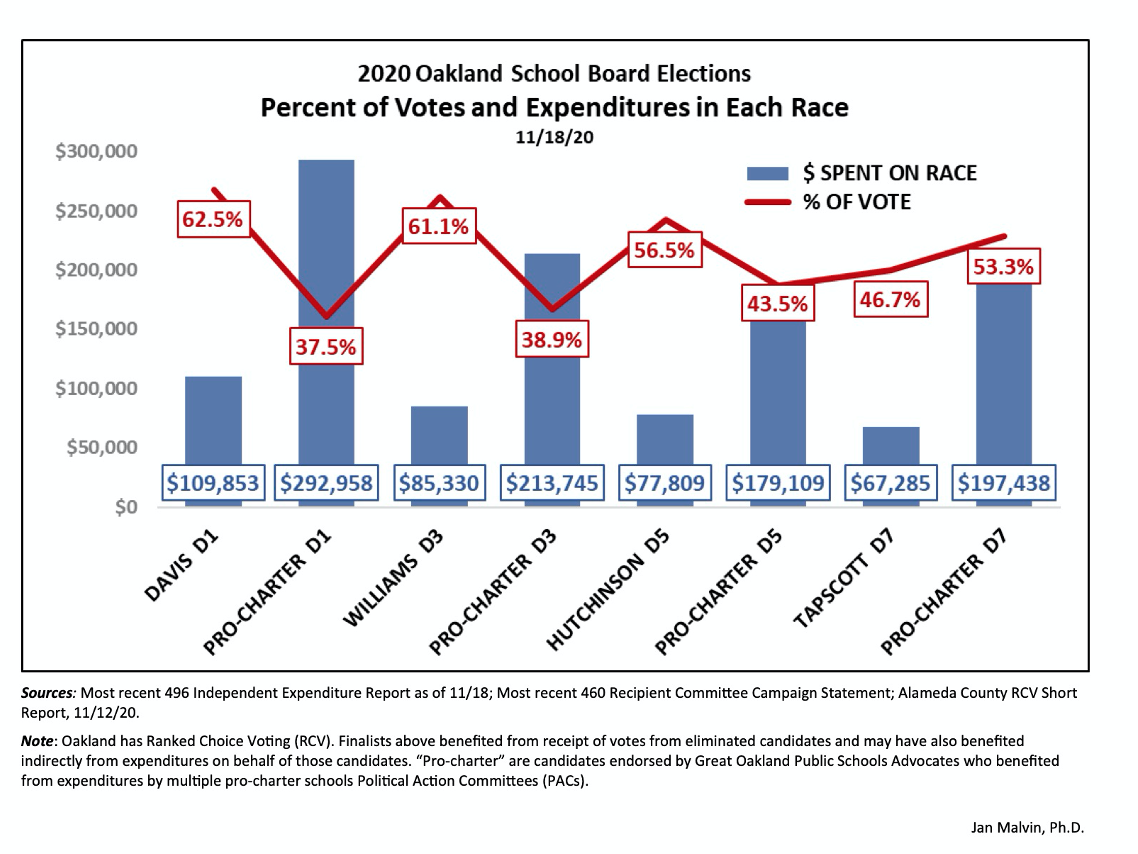
The charter community recognized this opportunity, and poured almost $900,000 into electing their candidates for the four open seats! Yet when the votes were counted, three of their four candidates lost.
Trying to understand how and why this happened can provide an insight into the educational landscape of not only Oakland, but urban cities nationally. While it might be early to know for certain why the charter candidates were defeated, we can make some educated guesses.
Strong Local Candidates
Two of the three candidates who won had deep Oakland roots. Two had been teachers (one in Oakland, one in San Francisco) and the other had worked in Oakland’s after school programs. Two had been community activists around school issues for years.
Oakland elections are calculated by ranked choice voting (RCV). When the RCV was tabulated, Sam Davis, the candidate in District 1 received 62% of the vote. Sam built a stellar campaign focused around school communities. He held zoom meetings with each school community in his district hosted by a combination of parents and teachers who worked in those schools. VanCedric Williams, in District 3, got 61%. VanCedric, a public school teacher for almost twenty years, had strong support from the teacher’s union as well as other unions. Mike Hutchinson in District 5 got 56%. Mike had run for the Board previously, networked with other education activists nationwide, and had built a reputation of challenging Board policies by going to Board meetings for years and reaching out on social media.
Backing of the Teacher’s Union
Last year, teachers in Oakland led a successful strike. The union’s ability to drum up enthusiasm with their members was one contributor to that success. Teachers recognized that if their future demands were to be met, they needed to have a responsive Board. Specifically, the current Board was considering a plan that would close up to 24 schools in Oakland, mostly in Brown and Black communities. At the same time, none of the 44 charter schools in Oakland were under threat of closure. Teachers made the connection between a charter friendly board and school closures of the public schools and were determined to change the direction of the district’s “blueprint”.
Teachers phone banked, texted, walked to drop off literature, and held zoom meetings in support of the three candidates who won. As Sam Davis noted, many voters tend to rely on their friends and neighbors who know something about the schools. The friends and neighbors were telling each other to vote for the candidates they trusted.
Backing of Other Groups: Building a Coalition
The three candidates were endorsed by the Democratic Party. This wasn’t an accident. Educational activists pushed the local democratic clubs to endorse candidates who would not be friendly to charters and wouldn’t owe their election to big money. These clubs, in turn, pushed the local Democratic party. In California the state Democratic party has taken a critical stance towards charter schools, and this was replicated locally. Organizers noticed that as people walked to the polls on election day, many of them carried the Democratic Party door hanger with them. Some of these candidates were also endorsed by :
The Alameda Central Labor Council
SEIU 1021
State Assemblyperson Rob Bonta
State Superintendent of Schools Tony Thurmond
Network for Public Education
Also, other community organizations like Educators for Democratic Schools, Democratic Socialists of America, and Wellstone Democratic Renewal Club helped to call, text, and walk precincts.
The Word is Out
You can fool some of the people all of the time but you can’t fool all of the people all of the time, or so Lincoln believed. Over time, the general public has begun to understand that there is an attempt to buy their votes. As I dropped off a flier at one home, a parent came to the door and asked, with hostility, “This isn’t the candidate who is getting all that money from Bloomberg, is it?” Several media sources reported on money from Bloomberg ($500,000 from Bloomberg alone!) and others pouring into Oakland.
After recovering from the astonishment that anyone would spend that kind of money for a school board election, voters became leery of candidates receiving those huge amounts of money. In District 1 where I live–and the charter candidate received nearly $300,000!–I found glossy fliers in my mailboxes more times than I could keep track of.
It is profoundly disturbing and a huge threat to our democracy that this big money trend has filtered down to local school board races. The Oakland community fought back against the billionaires’ spending advantage, and when the new board is seated in January, it will have a clear pro-public school majority. With appealing candidates and strong ground games, Oakland voters have shown that big money can be defeated. While Oakland will never go back to the days when a local neighborhood candidate spent only $12,000 to be elected, this recent victory over out of state billionaire bucks and their agenda sends a clear signal that our community will not be bought.
(Ken Rice is former OUSD board member, a member of Educators for Democratic Schools and currently has a daughter attending an OUSD school.)
The big battle this coming year in the Texas Legislature is about whether public agencies will be allowed to lobby for their interests. No one argues that private interests should be banned from advocating for what they want. Only public agencies—like public schools—would be banned because they use public money.
You can see where this is going. Supporters of public institutions would be gagged and censored, but promoters of privatization would be free to wine and dine legislators.
The issue, which has been dubbed “taxpayer-funded lobbying” by supporters and “community censorship” by its detractors, is a major divider between traditional Republicans — particularly those in rural areas who support public schools and their local county governments — and hard-line conservatives who see it as wasteful spending by local officials.
Local officials and the organizations that represent them — like the Texas Association for Counties, the Texas Municipal League and the Texas Association of School Boards — say such a lobbying ban would hurt local jurisdictions and make it more expensive for them to advocate for their constituents. They say the ban is nothing more than an effort to silence the voices of local officials.
Democrats and some Republicans banded together to block the bill last year. That vote resulted in House Speaker Dennis Bonnen and one of his top lieutenants, Rep. Dustin Burrows of Lubbock, meeting with conservative activist Michael Quinn Sullivan to target several fellow Republicans who voted against the bill.
Arch conservatives claim that cities, counties, public schools, and other public agencies should not be allowed to use taxpayer money to defend the public interest. Profiteers, buccaneers, entrepreneurs, and raiders of the public treasury would be allowed to lobby with no restraints.
Just one more loathsome effort to cripple the public interest by Governor Abbott and his allies.
DeVos has long argued that she puts students and families over institutions, but that appears to only apply to public institutions. Students who are not straight, not white, not Christian, and not without special needs—and their families—are on their own in a privatized education marketplace.
In the 1960s and 1970s, certain parts of the country responded to integration orders by setting up segregation academies—special private schools that let white folks keep their kids away from “those people’s” children. By setting up segregation academies, local boards could cut school taxes, leaving more money for white folks to pay academy tuition and less for the already-underfunded public schools. This system, in effect, shifted funds from public schools to private ones.
Not only can wealthy folks—and, in some cases, corporations—fund their favorite private school, but they can help starve the government at the same time.
The modern version of this is the tax credit scholarship programs. In these voucher-like programs, wealthy people can make a charitable contribution to a private school and count it against their tax liability. If they give $10,000, that’s $10,000 less that they must pay in taxes.
Not only can wealthy folks—and, in some cases, corporations—fund their favorite private school, but they can help starve the government at the same time.
So that’s Betsy DeVos’s vision for a future Voucherland.
For privately owned and operated schools (and particularly for the struggling Catholic school world), Voucherland is a place where they can finally get their hands on piles of taxpayer dollars, with their ability to operate as they wish unhampered by any rules and regulations.
For parents and students, Voucherland is a government that says, “Here’s your voucher. Good luck, caveat that emptor, and don’t look to us for any help.”
Greene reminds us that Betsy may be retiring to private life, but she will still be funding religious zealots for public office. And we will still have a Supreme Court dominated by conservatives who do not believe in a Wall of Separation between state and church.
The nonpartisan “In the Public Interest” keeps close watch on privatization across all sectors, including education. Corporate interests are preying on the public sector, looking to extract profit from our public dollars. Be vigilant! Sign up to receive newsletters from ITPI.
Students are flocking to poor-performing online charter schools, straining public school budgets.Superintendents in Pennsylvania are warning that increasing enrollment in online charter schools could strain already burdened public school budgets. “There will be public schools, school districts, in a lot of trouble financially,” said Jeff Groshek, superintendent of the Central Columbia School District. Fox 56
“Passionate voucher advocate” joins Tennessee executive branch. Tennessee Governor Bill Lee has hired Bill Dunn, a former state representative and passionate private school voucher advocate, to join his administration as a special advisor on education. Chalkbeat Tennessee
Charter school being built across from Florida public school. Jacksonville residents are angry about a charter school being built across the street from their public school. “It’s going to draw resources, funding, and it’s going to bring our student enrollment down, and it could very much possibly affect our teachers,” said Lisa Britt, PTA President at Alimacani Elementary School. News4Jax
Betsy DeVos’s “Voucherland” that could’ve been. Retired teacher and education writer Peter Greene gives us a glimpse of the dystopian future that lay in store for public education had Trump won the election. The Progressive
Some good news… At least some people want to help kids rather than cash in on them. Of the ten largest public bond measures on the ballot on Election Day, six were approved, including a $7 billion bond proposal for the Los Angeles Unified School District and nearly $3.5 billion for Dallas schools. WBAP
Welcome to Cashing in on Kids, a newsletter for people fighting to stop the privatization of America’s public schools—produced by In the Public Interest.
Not a subscriber? Sign up. And make sure to like us on Facebook and follow us on Twitter.
Derek W. Black is a professor of constitutional law who specializes in civil rights issues at the University of South Carolina. His recent book Schoolhouse Burning: Public Education and the Assault on American Democracy is a must-read.
Black writes here in an essay written for this blog about recent voucher cases in state courts:
This summer in Espinoza v. Montana Department of Revenue, the US Supreme Court struck down the provision in the Montana state constitution that prohibited aid to religious schools as a violation of free exercise of religion. Some public education advocates understandably feared the sky was falling. Voucher advocates hailed Espinoza as a “major win” and began strategizing how they might expand the decision and leverage it in other contexts. Most notably, the plan they envisioned would use Espinoza to force states to allow religious institutions to operate charter schools. If they achieved that, public education might not only be privatized, it might become religious.
Far less attention has been paid to the string of state constitutional victories striking down voucher programs and respecting states’ decision to limits on the use of public education funding. These decisions reinforce the notion that Espinoza is a narrow decision and ought to stay that way.
The first state case was in Tennessee. Lacking the votes for a statewide voucher package, the General Assembly adopted a program that made vouchers available in the state’s two largest locations—Memphis and Nashville—but nowhere else. Students in those districts could take the state and local per pupil expenditure that would have remained in the public schools and spend it at a private school.
Plaintiffs alleged this program violated a number of constitutional provisions, including the equal protection clause and the state’s obligation to provide for public education. Those two claims would have taken more factual development, but the trial court was able to easily and immediately strike down the voucher program on the state constitution’s “home rule” provision. That provision does not allow the general assembly to target individual jurisdictions in this way against their consent. The Tennessee Court of Appeal reached the same conclusion, affirming the lower courts’ decision to enjoin the program.
The second case in South Carolina involved Governor Henry McMasters’ decision to use federal emergency funds from the Coronavirus Aid, Relief, and Economic Security Act to create a private school tuition program. While the South Carolina Constitution explicitly prohibits using public funds “for the direct benefit of any religious or other private educational institution,” the Governor contended that the bar did not apply because he received the money from the federal government. In the alternative, he argued that students were the direct beneficiaries and private schools were only indirect beneficiaries.
The South Carolina Supreme Court rejected both arguments. The funds became public within in the meaning of the state constitution when the governor take receipt of them and decided how to spend them. And the fact the money moved directly from state government to the private schools resolved the second issue: In short, “the direct payment of the funds to the private schools is contrary to the framers’ intention not to grant public funds ‘outrightly’ to such institutions.”
The third case in Maine was the most complex. Maine’s constitution obligates it to provide public education to all students in the state, but some of its school districts do not operate high schools. In those districts, state law indicates the district may contract with either a nearby district that does operate a high school or an “approved” private school. To be approved, the private school must be nonsectarian. Plaintiffs claimed that this provision, like the rules in Espinoza, violated the First Amendment guarantee to free exercise of religion.
The First Circuit Court of Appeals, however, found that this case was distinct from Espinoza. Espinoza involved discrimination or animus against schools based on their “status” as religious schools. But Maine’s aim was not to discriminate against religious groups. Rather Maine’s aim was to prevent the “use” of public funds on religious ends. The non-discriminatory purpose was all the more evident in light of the fact that the state had not created a voucher program generally open to all. Rather, its program was designed to ensure that students in districts without a public high school still receive an education roughly equivalent to what they would have received had there been a public high school in the district. More succinctly, the state contracted with private schools solely to replace the public education opportunity missing in the district. In this context, the court found that the Free Exercise Clause does not force the state to accept religious instruction as a substitute for public education instruction.
A fourth case in now before the Michigan Supreme Court. A Michigan statute diverted $2.5 million per year from Michigan’s public schools “to reimburse actual costs incurred by nonpublic schools in complying with a health, safety, or welfare requirement mandated by a law or administrative rule of this state.” MCL 388.1752b(1). On its face, the statute is highly problematic because the Michigan Constitution provides that that “[n]o public monies or property shall be appropriated or paid . . . directly or indirectly to aid or maintain” any private school.
The Michigan Court of Appeals, however, reasoned that reimbursements to private schools do not violate the Michigan Constitution because they are for auxiliary services, not educational services. Plaintiffs’ counter that this argument is non-sensical. The plain language of the Michigan Constitution prohibits public funding for private schools, regardless of how the state funnels or frames it. The voters included this provision in the Michigan Constitution to ensure the general assembly did not take funds from public schools and redirect them elsewhere.
Regardless of what happens in Michigan, this developing line of cases suggests that state constitutions are more important to the future of private school voucher and tuition programs than Espinoza. State provisions that limit diversion of public funds to private schools remain in full force. The same is true of limits on the use of public funds for religious instruction as long as those limits are not motivated by religious animus. This distinction is particularly important in stopping the rationale in Espinoza’s from spilling over into charter school programs.
Rob Schofield of North Carolina Policy Watch lives in a state taken over by the Tea Party, who are intent on selling off whatever they can to private industry.
We have fallen victim to corporate propaganda and allowed the corporate foxes into our henhouses.
He has written a brilliant article about what we are losing as our public sector is diminished and privatized. Americans who are concerned about our culture and our society should join the fight against the privatization of everything.
Something strange happened in my neighborhood the other day. It was a warm and pleasant Thursday – the day on which a city sanitation truck arrives each week to empty the trash bins.
The truck just didn’t come.
A couple of days later, another equally strange thing occurred: Our postal carrier didn’t make it to our neighborhood.
There were no holidays that I’d missed and no readily discoverable public explanations for the lapses.
Of course, neither of these developments was completely unprecedented. In the past, during hurricanes and snowstorms, such services have occasionally been interrupted. And neither was a life and death matter. The trash truck finally arrived a few days later and our mailbox was fairly stuffed the next day.
My guess/fear was that COVID might have taken a toll on the local sanitation team. And we all know of the struggles the U.S. Postal Service has been enduring.
But, in both instances – modest and unexplained failures in two core public services that have been utterly reliable for decades – there was something disquieting and noteworthy.
There was a time in our country – not that long ago – in which top-notch public services and structures were not just taken for granted, but widely accepted as points of common civic pride. Almost all Americans knew of the U.S. Postal Service motto: “Neither snow nor rain nor heat nor gloom of night stays these couriers from the swift completion of their appointed rounds.”
Public schools and city halls often featured architecturally impressive buildings that served as important community hubs and gathering places. And public service employment – as a teacher, an employee of a state administrative agency, or yes, a postal worker or a trash truck driver – was widely viewed as an honorable and respectable middle-class career.
Today, it seems, our attitudes and expectations have been altered by a half-century of relentless and cynical messaging from conservative politicians, media outlets and think tanks that has helped set in motion a kind of vicious cycle.
First, government services and structures are demonized as inherently corrupt, inefficient and “the problem.”
Next, politicians demand that these structures and services operate “more efficiently” – “like a business” – so that taxes can be reduced.
After that – not surprisingly given the fact that most private businesses in a capitalist economy fail – numerous public structures and services (like schools, transportation, parks and even mail delivery and trash services) struggle to fulfill their missions.
After that, the whole cycle is repeated again and again until, at some point – especially in moments of crisis and extra stress like, say, a health pandemic – structures and services simply start to crumble and even fade away.
We’re witnessing this phenomenon play out right now in our public schools in North Carolina – particularly in some smaller and mid-sized counties, where the relentless pressure brought on by a decade of budget cuts, privatization (i.e. competition from voucher and charter schools that’s siphoning off families of means), and now the pandemic, is posing what amounts to an existential threat.
Last week, a former school board member in Granville County told Policy Watch education reporter Greg Childress that the public school system there has entered something akin to a death spiral in response to these pressures.
Meanwhile, in New Hanover County, a recent story in the Port City Daily paints a sobering, if familiar, portrait of how performance in that county’s system has been badly damaged by the resegregation that has followed in the wake of the county’s decision to, in effect, heed “market forces” – in this case, the demand of more affluent, mostly white families for “neighborhood schools.”
And so it goes for many other public structures and services as well.
From our torn and threadbare mental health system to our eviscerated environmental protection structures to our frequently overwhelmed courts, prisons and jails to our dog-eared parks and highway rest stops, the destructive cycle of reduced services and disinvestment continues to repeat itself.…
All we lack right at present is the awareness, imagination and will to make it happen.
Carol Burris wrote the following post. Marla Kilfoyle provided assistance. They asked me to add that there are dozens more exceptionally well qualified people who should be considered for this important post: they are career educators who believe in public education, not closing schools or privatization.
The media has been filled with speculation regarding Joe Biden’s pick for Secretary of Education. Given the attention that position received with Betsy De Vos at the helm, that is not a surprise.
In 2008, Linda Darling Hammond was pushed aside by DFER (Democrats for Education Reform) for Arne Duncan, with disastrous consequences for our public schools. Race to the Top was a disaster. New Orleans’ parents now have no choice but unstable charter schools. Too many of Chicago’s children no longer have a neighborhood school from the Race to the Top era when it was believed that you improved a school by closing it.
But the troubling, ineffective policies of the past have not gone away. Their banner is still being carried by deep-pocketed ed reformers who believe the best way to improve a school is to close it or turn it over to a private charter board.
Recently, DFER named its three preferred candidates for the U.S. Secretary of Education. DFER is a political action committee (PAC) associated with Education Reform Now, which, as Mercedes Schneider has shown, has ties to Betsy De Vos. DFER congratulated Betsy DeVos and her commitment to charter schools when Donald Trump appointed her. They are pro-testing and anti-union. DFER is no friend to public schools.
The DFER candidates belong to Jeb Bush’s Chiefs for Change, an organization that promotes Bush/Duncan education reform, as Jan Resseger describes here. “Chiefs for Change,” you support school choice, even if it drains resources from the public schools in your district, of which you are the steward. In their recent letter to President Biden, Chiefs for Change specifically asked for a continuance of the Federal Charter School Program, which has wasted approximately one billion dollars on charters that either never open or open and close. They also asked for the continuance of accountability systems (translate close schools based on test results) even as the pandemic rages.
We must chart a new course. We cannot afford to take a chance on another Secretary of Education who believes in the DFER/Chiefs for Change playbook.
We don’t have to settle. The bench of pro-public education talent is deep. Here are just a few of the outstanding leaders that come to mind who could lead the U.S. Department of Education. Marla Kilfoyle and I came up with the following list. There are many more.
Tony Thurmond is the State Superintendent of Public Instruction, California. Tony deeply believes in public schools. Prior to becoming his state’s education leader, he was a public school educator, social worker, and a public school parent. His personal story is both moving and compelling.
Betty Rosa dedicated most of her adult life to the students of New York City. She began her career as a bi-lingual paraprofessional in NYC schools, became a teacher, assistant principal, principal, superintendent, state chancellor, and now New York State’s interim commissioner.
Other outstanding superintendents include Joylynn Pruitt -Adams, the Superintendent of Oak Park and River Forest in Illinois, who is relentlessly determined to provide an excellent education to the district’s Black and Latinx high school students by eliminating low track classes, Mike Matsuda, Superintendent of Anaheim High School District and Cindy Marten, the superintendent of San Diego.
Two remarkable teachers with legislative experience who are strong advocates for public schools and public school students are former Teacher of the Year Congresswoman Jahana Hayes and former Arkansas state senator Joyce Elliot.
There is also outstanding talent in our public colleges. There are teachers and leaders like University of Kentucky College of Education Dean, Julian Vasquez Heilig, who would use research to inform policy decisions.
These are but a few of the dedicated public school advocates who would lead the Department in a new direction away from test and punish policies and school privatization. They are talented and experienced leaders who are dedicated to improving and keeping our public schools public and who realize that you don’t improve schools by shutting them down. Any DFER endorsed member of Chiefs for Change is steeped in the failed school reform movement and will further public school privatization through choice. They had their chance. That time has passed.
While Trump appointees are doing their best to impose their policies before January 20, a federal judge in California told Betsy DeVos in no equivocal terms by a federal judge that she cannot divert CARES money to private schools. The nation’s nearly 100,000 public schools received $13.2 billion in CARES funding, which they were required to share with charter schools and to private schools with low-income students. However, charter schools, religious schools, and private schools also qualified for billions more from the CARES Payroll Protection Program, which excluded public schools. DeVos initially tried to wedge private schools into the public schools’ $13.2 billion fund, even if the private schools had no low-income students. But three federal judges rejected her efforts. Now she is permanently enjoined.
LANSING, Mich — A judge has formally closed the case on U.S. Education Secretary Betsy DeVos’ efforts to rewrite a section of the Coronavirus Aid, Relief and Economic Security (CARES) Act that would have diverted $16 million in funding away from public schools in Michigan.
The lawsuit against DeVos was co-led by Michigan Attorney General Dana Nessel and California Attorney General Xavier Becerra. On Nov. 9, U.S. District Court Northern District of California Judge James Donato approved a permanent injunction, thus formally closing the case. He then entered a judgement in favor of all plaintiffs.
“This pandemic has greatly impacted students across the country. The CARES Act is imperative as it provides critical funding for our public schools and the resources teachers need to continue safely teaching our youth,” Nessel said. “This permanent injunction sends a clear message that the publicly funded CARES Act dollars should be used as Congress intended – to educate our public students, and not to serve the political agendas of a select few.”

 Diane Ravitch's blog