Archives for category: Privatization

The original idea behind charter schools was that they would help the neediest, most disadvantaged students, including those who were disengaged or failing in their public schools. Some charters have been criticized for selecting the most compliant students.

One charter chain stands out for ignoring the neediest, the poorest, the most disadvantaged: Great Hearts. This charter chain was repeatedly rebuffed by the Metro Nashville school board because it insisted on locating in a neighborhood where the population was white and middle class, with no transportation for kids from out of area.

Great Hearts is proud to reach out to the advantaged students and use government money to do so. 

Unlike other charters that try to prove they are serving needy children, Great Hearts enrolls a relatively high-end demographic. In their case, cherry-picking is a feature, not a bug.

The Mind Trust is funded by billionaires to advocate for privatization of public funds and public schools.

Now it is going after parents.

Of course, the best person to make the case to parents is an education entrepreneur.

Dear Friends,

I deeply believe that those most impacted by systemic injustice are also the people who are best positioned to lead the fight to create a more just and equitable society. This is one of the many reasons why we are so excited about the work our Education Entrepreneur Fellow Ashley Virden is leading to empower Indianapolis parents to create the changes they deem necessary to dramatically improve our education system.

Read on for more about a recent event that Ashley hosted and how you can support her. You will also find information on our most recent Education Tour and a call for applications for our fourth cohort of Relay National Principals Academy Fellowships.

With gratitude,

Brandon Brown

CEO

Education Entrepreneur Fellow Ashley Virden leads parent organizing meeting

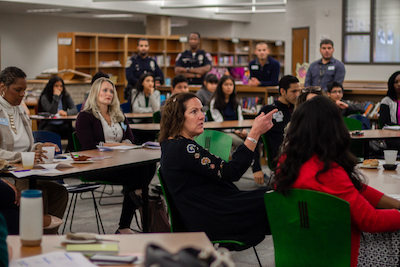
On November 7, our Education Entrepreneur Fellow Ashley Virden led a community meeting for parents looking to become more involved in their children’s education. She is developing an independent parent advocacy nonprofit that will empower parents to create necessary change for children and communities across Indianapolis.

Virden is specifically searching for a group of parents who are interested in receiving training in leadership, community organizing, and advocacy. If you or someone you know might be interested in supporting the work she is doing to uplift the voices of Indianapolis parents, please reach out to her at avirden@themindtrust.org.

“Parents deserve to have a voice in our city’s education system and in the schools our kids attend. I am excited to start building a community of empowered parents who want to be advocates for all students in Indianapolis.”

Ashley Virden, Education Entrepreneur Fellow

Education Tour series visits IPS Newcomer Program

On October 22, The Mind Trust hosted an Education Tour, formerly called Education Bus Tours, featuring IPS’ Newcomer Program. The Newcomer Program serves nearly 400 students in grades 3-9 who are new to the United States within the last year. Their students learn English alongside receiving core content instruction to prepare them for a successful transition to the school of their choice. In 2018-2019, the school served students from 33 countries, who spoke 22 different languages.

Now accepting applications for Relay’s National Principals Academy Fellowship

The Mind Trust is accepting applications for the fourth cohort of Indianapolis school leaders to participate in Relay Graduate School of Education’s National Principals Academy Fellowship, a nationally-recognized fellowship that provides school and school systems leaders with powerful instructional and cultural professional development. We are grateful to the Richard M. Fairbanks Foundation for a grant of $990,000 to help sponsor the next three cohorts fellows.

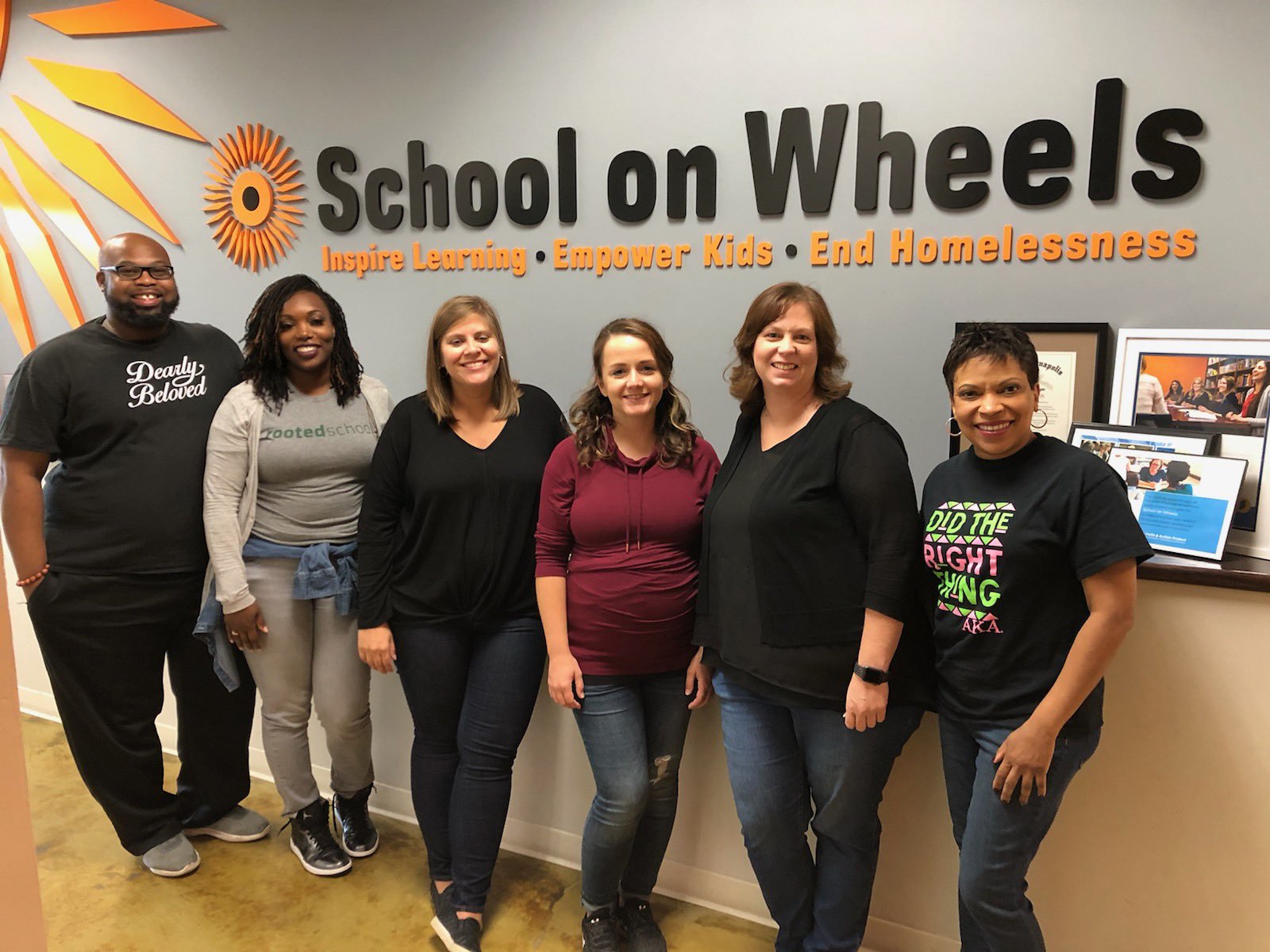
A few of our staff and Fellows volunteered at School on Wheels, filling backpacks with school supplies for students who utilize their programming. School on Wheels provides tutoring and wraparound academic support for hundreds of Indy children and families impacted by homelessness.
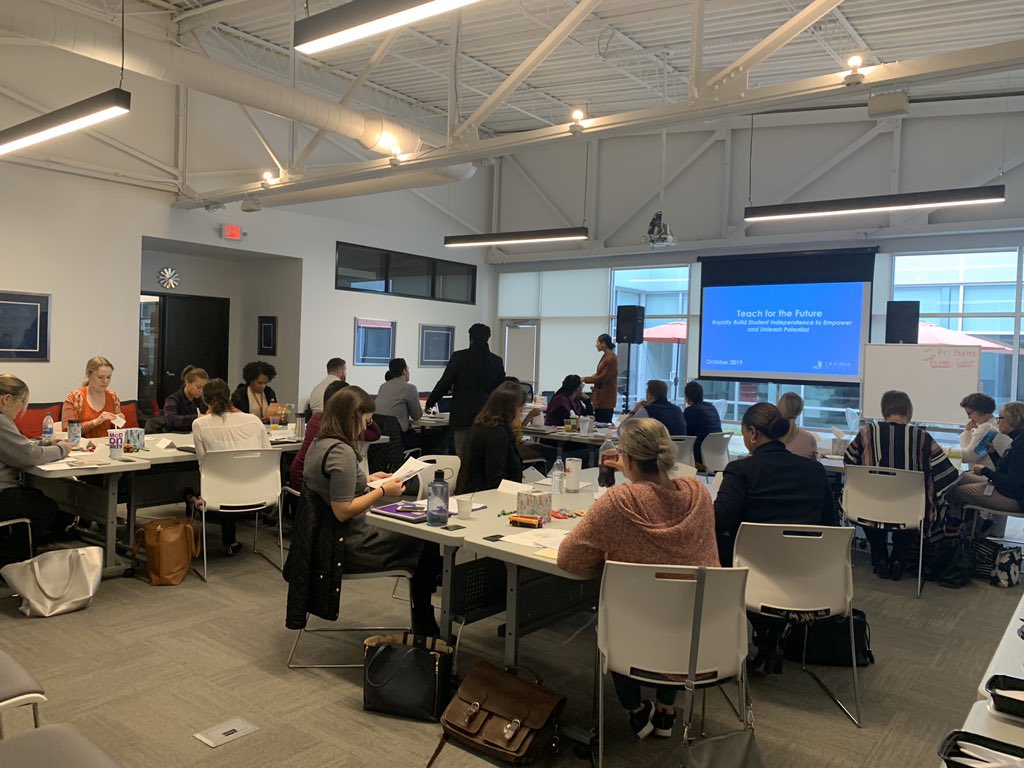
Our School Supports team partnered with the Lavinia Group to bring a literacy focused professional development to our Fellows and other Indianapolis school leaders. The training focused on building independence in reading to unleash student potential.

The Mind Trust In the News

10 new schools are seeking innovation partnership with IPS via Chalkbeat

Mind Trust Adds Lewis to Board via Inside Indiana Business

IPS Study Abroad Program To Relaunch As High School At Arlington via WFYI

New teacher residency program launches in Indy: ‘It will lead to a better retention’ via Fox 59

Church’s money management lessons lead to transformation in impoverished neighborhoodvia Faith & Leadership, Duke University

Schools were quick to downplay ILEARN results, but experts stand by the test. Here’s why.via Chalkbeat

The Mind Trust
1630 N. Meridian St., Suite 450  | Indianapolis, Indiana 46202
(317) 822-8102 | info@themindtrust.org

Follow Us on Social Media

Bill Phillis asks a reasonable question: Why should public schools in Ohio be required to take money from their budget to pay the transportation costs of charters and vouchers?


School district transportation costs increase with the expansion of vouchers and charter schools: North Olmsted Board of Education addressed the matter in a resolution
The North Olmsted Board of Education adopted a resolution on October 16 requesting the state to restrict a school district’s transportation obligation of charter and voucher students to school sites within the district.
The Ohio charter industry has successfully lobbied for increased tax funds to expand charters. The Ohio voucher lobby has gained multiplied millions for voucher expansion. Both charters and vouchers take funds, thus educational opportunities from school district students. Beyond the financial drain based on the number of students going to charter and voucher schools, districts are required to allocate more funds to transport charter and voucher students.
As state officials enact policies that extract school district funds to accommodate choice programs, they should adopt policies that compensate districts for those losses.
Educational programming in school districts should not be diminished by policies that force districts to operate costly, inefficient transportation systems.
William L. Phillis | Ohio Coalition for Equity & Adequacy of School Funding | 614.228.6540 | ohioeanda@sbcglobal.net| www.ohiocoalition.org


In this post, Jan Resseger challenges Cory Booker’s newly rediscovered support for privately managed charter schools. She says “that school choice privileges the few at the expense of the many.” That’s not quite right. If the charter school is staffed with inexperienced, under qualified teachers, if the charter is operated by grifters intent on profit, if the charter exercises harsh disciplines and has high suspension and dropout rates, if the charter lacks the financial stability to keep its doors open, then the children who enroll in them are by no means “privileged.” Instead they are marks, dupes, collateral damage.

She writes:

The essential point to remember about school choice—whether it is a system of private school tuition vouchers or privately operated but publicly funded charter schools—is that school choice privileges the few at the expense of the many.

The scale of the provision of K-12 education across our nation can best be achieved by the systemic, public provision of education. Rewarding social entrepreneurship in the startup of one charter school at a time cannot possibly serve the needs of the mass of our children and adolescents. In a new, September 2019 enrollment summary, the National Center for Education Statistics reports: “Between around 2000 and 2016, traditional public school… enrollment increased to 47.3 million (1 percent increase), charter school enrollment grew to 3.0 million students (from 0.4 million), and the number of homeschooled students nearly doubled to 1.7 million. Private school enrollment fell 4 percent, to 5.8 million students.”

Booker argues for well-regulated and high-performing charter schools. The problem he fails to acknowledge is that charter schools were established beginning in the mid-1990s by state legislatures smitten with the idea of innovation and experimentation. None of these legislatures, to my knowledge, provided adequate oversight of the academic quality of the schools, and none imposed protections to guarantee the stewardship of public tax dollars.  Malfeasance, corruption, and poor performance plague charter schools across the states. Charter schools have now been established by state law across 45 states where stories of outrageous fiscal and academic scandals fill local newspapers. The Network for Public Education tracks the myriad examples of outrageous fraud and mismanagement by charter schools. Because advocates for school privatization and the entrepreneurs in the for-profit charter management companies regularly donate generously to the political coffers of state legislators—the very people responsible for passing laws to regulate this out-of-control sector—adequate oversight has proven impossible.


In her latest post, Nancy Bailey draws a contrast between a summit of fake education leaders and the summit that actual teachers reach when they teach their students and fight for their students and their schools.

Bailey describes the pseudo summit taking place in San Diego, where people who have never taught discuss how to reinvent education for fun and profit.

Read her list at the end of her post. It is a who’s who of the Disruption Industry, assembled in one place to celebrate themselves and the damage they have done to schools, students, and teachers across the nation.


Bailey writes:

Today’s National Summit On Education Reform meeting is a nightmare for teachers and parents. It involves those who want to replace democratic public schools with technology, ending schools and teaching as we know it. They will have children sitting in front of screens for instruction in warehouse charters, or at home all day.

Most of these self-acclaimed experts have not struggled to teach in gritty, overcrowded classes. They have not wiped runny noses or dealt with the trauma that some children bring to school. They never had to work towards unproven curriculum standards through Common Core. Nor have they had to face the reforms that, ironically, they and their ilk created.

They blame teachers for what goes wrong in schools due to their own back ass policies, but they’ll step up and take credit for anything that goes right!

You won’t find them on the streets of their cities fighting for the needs of children and a profession that nurtures those children. These individuals are above all that.

Florida Governor Jeb Bush leads the summit. As an American citizen Bush has every right to speak out about schools, but he doesn’t have the right to own them. Bush, whose educational background is in real estate and Latin studies, has leveled accusations against schools without doing due diligence to help students. His 3rd grade retention plan is a failed idea, but no one seems to have the power to end it, so children still are hurt by it.

Bush has been against schools and teachers every step of the way. When he had the chance to improve class sizes in the 90s, he hated the idea so much he was caught saying he had a “devious plan to end it.” Think what it would have meant if he’d studied the issue and been supportive of teachers, even negotiated.

What if he’d said, we can’t afford to lower all classes, so let’s lower class size in K-3rd grade when children are learning to read. But Bush didn’t want that. Look at life in Florida and the country now, a mix of underfunded public schools and unproven charters, and vouchers to questionable schools.

Please open the link and read it to the end.

Almost 90% of American students attend public schools, subject to democratic control. 6% of American students are enrolled in privately managed charter schools. Under the leadership of Betsy DeVos, it is obvious that the promotion of both charters and vouchers is central to the education policy of the Trump administration.

Two Democratic senators who are candidates for president, Bernie Sanders and Elizabeth Warren, have released education plans that recommend an end to federal support for charter schools (currently $440 million), which DeVos has handed out to corporate charter chains like IDEA and KIPP.

Senator Cory Booker, having equivocated during the campaign about his previous zealous support for charters, vouchers, and Betsy DeVos, surprisingly reversed course and wrote an article in the New York Times, once again stating his support for charters.

Since Senator Booker is polling at less than 2% in the primaries, he may be looking past the election to restore his relationship with his funders, who love charter schools and were disappointed by his apparent defection from their cause.

Leonie Haimson writes here about Senator Booker’s curious use of the word “boogeyman” to belittle critics of charter schools.

She notes that reporters at the New York Times have also used that term to belittle charter critics. Then she googled and found that the same word has been used by charter defenders thousands of times.

Haimson points out that charters in NYC divert more than $2 billion each year from the public school system. That money might have been spent to meet crucial capital needs and to reduce class sizes.

Also, Senator Booker did not mention that the national NAACP passed a resolution in 2016 calling for a moratorium on charters.

There are many reasons to be critical of charters, including their diversion of funding from public schools, their private governance, their long and well-documented record of waste, fraud, and abuse.

To dismiss all criticism of charters as a fear of a boogeyman is cynical, to say the least, and serves only the interests of the charter industry.


You won’t want to miss this one!

The “nation’s leaders in education reform” (aka Disruption) are meeting in San Diego starting today. 

Watch the leaders of the privatization movement at work and play!

They will perhaps ponder why NAEP scores have been flat for a decade. They might discuss why the Democratic party and progressives have turned against charter schools and privatization.

Maybe there will be a panel to discuss the Network for Public Education’s devastating report Asleep at the Wheel, which showed that one-third of federally funded charters had closed their doors or never opened, wasting $1 billion in federal funding. Maybe there won’t be any mention of that embarrassing report.

Will there by any mention of the biggest charter scandal in the three decades of charterdom, the $50 million plus theft by charter operators in California? There should be, since 11 leaders of the A3 scam were indicted just this past spring in San Diego, where the conference is meeting!

Perhaps there will be a special tribute to their leader, Secretary of Education Betsy DeVos, who is shoveling federal money as fast as she can from the $440 million Charter Schools Program to corporate charter chains like IDEA and KIPP.

See who is sponsoring their convention: The Walton Family Foundation. Pearson. The NewSchool Venture Fund. The College Board. Yes Every Kid (Koch). Microsoft.

And many more.

One charter school in the Chester-Upland district in Pennsylvania enrolls 60% of the district’s elementary schools. It is owned by one of the richest men in the state, a lawyer who was Republican Tom Corbett’s biggest campaign donor. That charter school, the Chester Community Charter School, has asked the county to turn all of the district’s elementary students over to charters. 

CCCS is not just any charter. It has received special treatment, despite its poor performance.

More than 4,300 students in kindergarten through eighth grade are already enrolled in Chester Community Charter, which is managed by CSMI. The for-profit education management company was founded by Vahan Gureghian, a Gladwyne lawyer and major Republican donor. It manages another charter school in Atlantic City that was placed on probation by the New Jersey Department of Education this year. A third charter in Camden was previously closed due to poor academic performance. 

In an earlier post, I described how CCCS made a deal in 2017 to win authorization until 2026, which is an unprecedented extension for any charter. In that post, I noted:

Its test scores are very low. Only 16.7% were proficient in English language arts, compared to a state average of 63%. Only 7% were proficient in mathematics, compared to a state average of 45%.

By most metrics, this charter school is a failing school, yet it gets preferential treatment. The scores in the charter school are below those of the remaining public schools in the district.

CCCS promised not to open a high school if it received a new extension. The decision was made by the court-appointed receiver for the district, which had been pushed into near-bankruptcy by CCCS; the receiver had been treasurer for the Corbett campaign. Just a coincidence, no doubt.

The Chester-Upland school district was hammered by a court decision that requires it to send large payments for students with special needs who enroll in cyber charters, even though the cyber charters provide minimal or no services to those students; the cyber charters are a voracious aspect of the state’s landscape, gobbling up full funding while failing to produce any academic gains for students or to meet any state standards.

Brick-and-mortar CCCS is so aggressive that it buses in students from Philadelphia, little children who ride a bus 2-3 hours each way to attend a failing charter school.

This latest move will strip the Chester-Upland District of more funding, leaving it with only a high school.

The charters are akin to a vulture, hollowing out the district and drawing students to low-performing charters with promises.


A trio of activists on behalf of public schools wrote a blistering critique of the pending state takeover of the Houston Independent School District, based on the failure of ONE high school that has an unusually high proportion of students who are poor and have disabilities.

Zeph Capo is president of the Houston Federation of Teachers and Texas AFT, James Dixon is pastor of the Community of Faith Church in Houston and a vice president of the Houston Branch of the NAACP, and Hugo Mojica is president of LULAC Education Council #402.

They write:

Residents of this community are increasingly frustrated with the upheaval in the Houston Independent School District. As Houstonians who work directly with the educators, parents and students in the district, we don’t blame them. But something doesn’t add up in the state’s decision to take over HISD.

Houston schools have been on an improvement track for years — the district recently earned a B grade from the state — just two points away from an A. After years of struggle among legislators, administrators and educators to figure out how best to serve our kids, HISD should be celebrating our progress. But instead of cheering parents, educators and students, who came together and turned around the city’s schools, the state slapped our community in the face by announcing this punitive takeover of the entire district.

A byzantine Texas law enables the state to trigger a district takeover — all 283 Houston public schools — if just one school chronically underperforms. So instead of investing in that one school — Wheatley High School, in this case — and providing it the attention and resources it needs, Austin bureaucrats chose to scapegoat and punish the entire city. Given that Houston students just scored second in math and third in reading within their national peer group, HISD seems like it should be a model rather than a takeover target.

The writers might have also mentioned that Houston was the only city to win the Broad award for most improved urban district twice, an honor conferred by the Broad Foundation, which has the same worldview of disruption as the Texas State Board of Education and State Commissioner Mike Morath. Morath previously served on the Dallas board of education but he is not an educator. He is a software developer. He has no ideas about how to improve schools, nor has he ever improved a school.

The authors write:

This political power grab is the epitome of overreaching, but it also reflects an insidious, ongoing effort to deny black and brown communities the educational opportunities their kids deserve. It represents a classist, old-school view of public education that rewards the privileged few and ignores the difficult work that must be done to ensure schools are safe and welcoming and meet the needs of all kids, regardless of geography or demography.

What’s also incredibly disappointing is that this takeover comes on the heels of a democratic election, in which the community elected new school board members. If this untenable takeover proceeds, duly elected trustees won’t get a chance to take their seats, defying the will of the people and denying a voice for those elected to represent the needs of students.

Gov. Greg Abbott and Education Commissioner Mike Morath aren’t actually looking out for Houston’s kids. They want to privatize Texas’ largest school district through a charter scheme. If that happens, this plan will funnel money out of our traditional public schools and into for-profit alternatives. This recent election vote reflected the community’s mandate that Houston public schools continue to invest in evidence-based wraparound services, including health care, before- and after-school programs, and enhanced social and emotional services.

State officials would prefer to privatize rather than invest new resources in a major district that is facing challenges and doing well compared to other urban districts.

Yes, indeed, something stinks in Texas.

The state officials behind the takeover are vandals, disrupters, corrupters of democracy.

They should not be allowed to mess with the HISD.


LilSis (also known as the Public Accountability Project) pays careful attention to the networks and money behind nefarious efforts to destroy the public sector.

In this report, LilSis describes the corporate backers of school privatization against whom Little Rock teachers went on strike. The money behind this network of interlinking organizations and individuals is the Walton family, whose wealth clocked in at $163 Billion (that’s Billion with a B) in 2018.

LilSis writes:

A major backer of the anti-union, pro-charter agenda in Arkansas is the Walton family, whose foundation is a huge funder of the school privatization infrastructure that exists across the state. In addition to the Waltons, corporate elites from Murphy Oil, the Arkansas State Chamber of Commerce, the Arkansas Democrat Gazetteand others are backers of the school privatization efforts. These corporate interests are close to Governor Hutchinson, who supports their agenda, and they have close ties to the state Board of Education. In addition, they are also interlocked with a host of lobbyists and academics that push their agenda…

The Waltons are major advocate of charter schools nationally, and they carry out their school privatization agenda through their Walton Family Foundation, which showers hundreds of millions on pro-charter groups and schools. The foundation claims it has invested a whopping $407 million into pushing charter schools since 1997.According to a recent report put out by the Arkansas Education Association, the Waltons pump millions into propping up the state’s school privatization infrastructure – or what the report calls the “Arkansas’s School Privatization Empire.” 

It’s not just that the Waltons give big money to a few groups – it’s also that these groups then distribute that money to other organizations, lobbyists, consultants, and academics, creating a vast network of billionaire-funded activity to attack unionized teachers and push charter schools. 

For example, the Walton family Foundation gave $350,000 to the Arkansans for Education Reform Foundation (AERF) in 2017 – around 80% of all the contributions the organization took in that year. 

The AERF board includes other powerful funders and advocates of school privatization in the state, such as Claiborne Deming, the former CEO of Murphy Oil, a big backer of charter schools in Arkansas; William Dillard III, part of the Dilliard family that owns the Dilliard’s department stores; and Walter Hussman, publisher of the Arkansas Democrat-Gazette, the state’s flagship newspaper. Jim Walton is also on the board.

In addition to the $350,000 that the Walton donated to the AERF in 2017, Deming gave $60,000 and Dilliard III gave $10,000, while the National Christian Foundation gave $15,000, according the the group’s 2017 990 form.

AERF has in turn used the money it receives from the Walton billionaire fortune and other Arkansas elites to fund other school privatization efforts. For example, it gave $115,000 to Arkansas Learns, which describesitself as “the Voice of Business for excellent education options – including industry-relevant career pathways…” The CEO of Arkansas Learns, Gary Newton, is also the Executive Director of the AERF (for which he earned $189,639 in compensation in 2017). 

In turn, Arkansas Learns has the same board members as AERF, and Randy Zook, the CEO of the Arkansas Chamber of Commerce, whose wife Dianne Zook is on the state Board of Education that decided to end recognition of the Little Rock teachers’ union, is also a board member. Dianne Zook is also the aunt of Gary Newton.

What a cozy and mutually beneficial arrangement: The Waltons have a lot of money to hand out to achieve their goal of privatizing public schools and breaking unions, and the recipients take the money and carry out the Waltons’ wishes.

Any time you see a group called “XXXXXXX for Education Reform,” you can be sure it is committed to charter schools, union-busting, and privatization, and the odds are high that there is Walton money behind it.

The Waltons have claimed credit for subsidizing one of every four charter schools in the nation.

LilSis creates wonderful graphical depictions of networks.

Here is the LilSis graphic of the Little Rock school privatization network.