Archives for category: Privatization

Rachel Cohen writes here about the charter supporters backing Pete Buttigieg. 

Billionaire Reed Hastings held a fundraiser for Mayor Pete. Hastings, CEO of Netflix, has given millions to the California Charter Schools Association. He has said he looks forward to the day when there are no elected school boards. He likes schools run by corporate boards. He says they didn’t discuss charter schools, which is one of Hastings’ causes about which he is passionate.

Cohen writes:

Linda Lucy, who has served as the president of the South Bend teachers union since June 2018, told VICE she had never met with Pete Buttigieg, and had “nothing to add” about the union’s relationship with the mayor. “Politicians have hijacked the teaching profession in our public schools,” she said.

Buttigieg does appear to have made time for Heather Willey, one of Indiana’s top charter school lobbyists, who co-hosted a fundraiser for Buttigieg in Indianapolis on October 4, according to an invitation obtained by VICE.

Willey served on the board of the Institute for Quality Education, an Indiana school choice advocacy group, for years, and co-chairs her law firm’s “Charter School and School Innovation” group. In 2019, the Institute for Quality Education, Teach for America Indianapolis, and Charter Schools USA, Inc., a for-profit charter company, all listed Willey’s firm, Barnes & Thornburg LLP, as a hired lobbyist. According to her professional biography, Willey “has been intimately involved in the charter school and school reform movements since the inception of the laws in Indiana in 2001.” She did not return repeated requests for comment.

In Silicon Valley, meanwhile, Buttigieg has also had fundraisers with several prominent charter school supporters.

Satya Patel, a venture capitalist who formerly worked as a vice president of product at Twitter, co-hosted an event for Buttigieg in the Bay Area in late August. Between 2007 and 2017, Patel served on the board of KIPP Bay Area Schools, part of the nation’s largest charter school network, which has received tens of millions of dollars in federal grants. He did not return requests for comment.


The charter industry has lobbied for years to promote the idea that public schools and their teachers and teachers unions are uniquely responsible for denying educational opportunity to children of color. Ever since the propaganda film “Waiting for Superman,” produced by billionaire charter supporter (and rightwing evangelical zealot Philip Anschutz), the charter industry has promoted the claim that supporters of public schools are hostile to children of color while they—funded by billionaires like the Waltons, the Sacklers, the Koch brothers, the DeVos family, and every Republican governor—claim to be champions of civil rights.

”Malarkey!” says FAIR (Fairness and Accuracy in Reporting).

FAIR offers a “close reading” of media bias against public schools and demonstrates how the charter industry has deceptively labeled any opposition to charters as the work of teachers’ unions, never admitting that supporters of public schools include parents, grandparents, and graduates of public schools, as well as members of the public who understand the importance of public education in a democracy.

After thirty years of charter advocacy, only 6% of American students are enrolled in them.  In the only city that is all-charter, New Orleans, the only choice that is forbidden is a public school. This decision was not the result of a vote by the citizens of New Orleans, but a decision imposed by the white Republicans who control the State Legislature. Southern white Republicans are not typically perceived as concerned about the well-being of children of color.


Valerie Strauss reviews “Still Asleep at the Wheel” here.

She begins:

“More than 35 percent of charter schools funded by the federal Charter School Program (CSP) between 2006 and 2014 either never opened or were shut down, costing taxpayers more than half a billion dollars, according to a new report from an advocacy group that reviewed records of nearly 5,000 schools.

“The state with the most charter schools that never opened was Michigan, home to Education Secretary Betsy DeVos.

“The report, titled “Still Asleep at the Wheel,” said that 537 “ghost schools” never opened but received a total of more than $45.5 million in federal start-up funding. That was more than 11 percent of all the schools that received funding from CSP, which began giving grants in 1995.

”In Michigan, where the billionaire DeVos has been instrumental over several decades in creating a charter school sector, 72 charters that received CSP money never opened, at a total cost of some $7.7 million from 2006 to 2014. California was second, with 61 schools that failed to open but collectively received $8.36 million.
The Education Department did not respond to a query about the findings. DeVos has made expanding alternatives to school districts — including charters and programs that use public money for private and religious schools — her top priority as education secretary, and has said her metric for a state’s education success is how much they expand school “choice.”

”Casandra Ulbrich, president of the Michigan State Board of Education, said in an interview that she found the new report “extremely troubling.”


“It raises some very legitimate questions about a federal grant program that seems to have been operating for years and years with little oversight and very little accountability,” she said.”


Last spring, the Network for Public Education published a report on waste, fraud, and abuse in the federal Charter Schools Program. The report, called Asleep At the Wheel, documented the Department of Education’s failure to monitor the veracity or feasibility of applications for the program or to follow up on what happened to the money spent to launch new charter schools. It found that nearly $1 billion of federal dollars had been wasted on charters that either never opened or closed soon after opening.

Today, NPE released a new report that delves into what happened with federal money from the Charter Schools Program in the states. The findings were even more concerning than last spring’s report.
The new report is called Still Asleep At the Wheel.

An excerpt:

This report, Still Asleep at the Wheel: How the Federal Charter Schools Program Results in a Pileup of Fraud and Waste, takes up where our first report left off. In it, we provide detailed information, state by state, on how federal dollars were doled out to schools that no longer exist or never existed at all.

In 2015, the U.S. Department of Education (the Department) published a list of charter schools that received grants between the years of 2006 and 2014. Using that database of 4,829 schools, we meticulously determined which charters that received grants were still open, which had closed and which had never opened, resulting in state by state records of enormous waste. We examine the detailed spending records of some of Michigan’s ghost charter schools that received grants exceeding $100,000. We explain how money moves into the hands of for-profit management organizations and tell the stories of subgrantees that engaged in fraud—sometimes amounting to hundreds of millions of dollars—all beginning with funding from the federal Charter Schools Program.

Major findings of our research include the following:

Documented charter school closures and the waste of federal funds exceeds our first report’s estimations.
We believed that about 1,000 recipient charters were defunct. However, using the 2015 database (active grantees from 2006-2014), we identified 1,779 grantee schools that either never opened or had shut down. The number of non-operational recipients, across 25 years of the program is inevitably in the thousands.
In the first report, we estimated the fail- ure rate for recipient schools to be 30 percent. For schools listed in the database, however, our latest review found a failure rate of 37 percent.

It is impossible to document total waste for the entire 25 year program because the Department never required the states to report the names of funded schools until 2006. However, we have now documented $504,517,391 (28 percent of the total database amount) that was awarded to schools between 2006-2014 that never opened or that have closed. Applying that percentage to the total expenditures ($4.1 billion) of the CSP programs designed to create new schools, approximately $1.17 billion in federal funding has likely been spent on charters that either never opened, or that opened and have since shut down.

The disbursement of over one billion dollars during the program’s first decade was never monitored for its impact or results. There is no record of which schools received the funds.

From 1995 to 2005, enormous funds were pushed out to the states to distribute to schools via subgrants. Yet the Department has no complete record of which schools re- ceived funding during the program’s early years, because it never required the states to report the names of subgrantee schools or their status. The Department’s over- sight ended when the funds left Washington.

During the first decade of the program when states did not have to report where the money went, Florida, a state where nearly half of all charter schools are run by for-profit organizations, received four grants totaling $158,353,525. Michigan, where about 80 percent of all charters are run by for-profit management companies, received four grants totaling $64,608,912. California also received four grants, totaling $190,857,243.
Although the overall rate of failed charter projects was 37 percent, in some states the rate of failure was much higher.

Iowa and Kansas have the largest propor- tions of failed subgrantee charter schools. Eleven charter schools in Iowa received grants. Ten failed, wasting over $3.66 million. As of 2014, the database indicates that Kansas doled out $8.51 million to 29 schools. Twenty-two (76 percent) of those schools either never opened or are closed today–$6,389,964 of the $8.9 million was wasted.

States with a subgrantee failure rate exceeding 50 percent include: Delaware, Georgia, Hawaii, Iowa, Kansas, Maryland, Mississippi, Virginia and Washington (state). Mississippi had only one grantee and that school failed. Georgia had 75 failures, resulting in over 23 million federal dollars wasted.

The percentage of defunct charter school grantees in Florida was 37 percent ($34.2 million); the Michigan failure rate was over 44 percent ($21 million) and Lou- Asian’s failure rate was 46 percent ($25.5 million).
The most astounding loss, however, was California’s: nearly $103 million was awarded to charters that never opened or have shut down—37% failed.

Five hundred thirty-seven (537) schools list- ed in the database never opened at all. Many received over $100,000 in federal funds.

Since 2001, charter school entrepreneurs have been eligible to receive CSP grants before they have even identified an authorizer or submitted a detailed application to open a school. In total, we identified 28 states that had at least one charter school (537 schools in total) that never enrolled even one student for one day and yet had received federal funds. According to the CSP database, those schools received, or were due to receive when the database collection ended, a total of $45,546,552 million.

Topping the list was the state of Michigan where 72 never-opened schools received grants, most exceeding $100,000. Over $7.7 million was wasted. In California, we identified 61—with waste of $8.36 million.
Other states with large numbers of never- opened schools receiving CSP funds in- clude Arkansas (18), Florida (46) Illinois (20), Maryland (38), Massachusetts (17), New Jersey (23), Ohio (20), Oregon (40), Pennsylvania (41), South Carolina (34), Tennessee (43) and Wisconsin (15).

This report provides details on how several of these never-opened charters in Mi- chigan spent those federal funds.

Although Congress forbids for-profit opera- tors from directly receiving CSP grants, they still benefit by having their schools apply.

Although we could not identify every charter in the CSP database that was run by a for-profit management company, we were able to identify those run by the large for-profit chains including Academica, K12, National Heritage Academies, White Hat and Charter Schools USA. In total, we found 357 schools in the database run by major for-profit chains. These schools had received a total of $124,929,017 in federal CSP start-up funds. Unsurprisingly, most of this money flowed to for-profit run schools in Florida ($46,936,979) and Michigan ($26,452,927). Eighty-three (83) schools run by the Flor- ida-based, for-profit chain Academica received CSP grants, totaling $23,426,383.


Still Asleep at the Wheel also describes why so many charter schools fail, along with the stories of grantee schools that abruptly closed, sometimes with little or no notice to their students and families. Far too often those schools shut down due to corruption and fraud. Our report provides disturbing accounts of grifters and profiteers who took CSP and other taxpayer funds only to enrich themselves at the expense of the students they had promised to serve.

The staggering amount spent on schools that have closed or never opened, as well as those that have engaged in fraud, is nothing short of a national scandal. As public dollars are diverted from public schools, the students who attend their neighborhood schools have fewer resources. It is time to put on the brakes and chart a new course.

We were heartened that after the publication of our first report in March of 2019, the U.S. House of Representatives reduced funding for the CSP program for 2020. However, a small reduction is not sufficient to address the program’s structural flaws.

We therefore strongly recommend that Congress end appropriations for new charter school grants in the upcoming budget and continue funding only for obligated amounts to legitimate projects. Once those grants have been closed, we recommend that the CSP be ended and that charter schools continue to receive federal support only through other federal funding streams such as Title I and IDEA. Students, not charter school en- trepreneurs, should benefit from federal funds.

We also recommend thorough audits by Congress of previous grant awards, the establishment of regulations to ensure grant awards still under term are being responsibly carried out and that misspent money is returned to the federal coffers.


Three years ago, the pro-charter, pro-voucher Thomas B. Fordham Institute published a study of Ohio’s voucher program. The study, conducted by David Figlio and Krzysztof Karbownik of Northwestern University is called “Evaluation of Ohio’s EdChoice Scholarship Program: Selection, Competition, and Performance Effects.”

The study concluded that the voucher program was failing to improve student achievement.

It said in its conclusions:

There appears to be positive selection, as measured by prior academic performance and family advantage, among voucher-eligible students into private schools as part of the EdChoice program. Although a substantial majority of the students participating in the program, as well as their peers remaining in public schools, tend to be from low-income backgrounds, those students leaving for private schools under the program tend to be more advantaged and higher performing than their peers who were eligible to participate in the program but who remained in public schools…the evidence regarding the effects of EdChoice program suggests that while higher-performing students tend to leave public schools to attend private schools under the EdChoice program, the students who remain in the public schools—at least, those public schools that were comparatively high achieving—generally perform better on statewide tests as a consequence of EdChoice vouchers being available to students in a school. On the other hand, those students who leave these comparatively high-achieving public schools to go to private schools appear to perform worse than they would have had they remained in the public schools (which we estimate to have improved as a consequence of the introduction of EdChoice). Together, it appears that EdChoice has benefitted the majority of students, but the students who actually left the public schools—at least those on the margin of eligibility—perform worse on statewide tests. Although test performance is only one measure of educational success, these findings suggest that a detailed exploration of the possible causes of the negative test-score results (for instance, which private schools participate in the program, policies on school-grade retention, test-curriculum alignment, and the like) may be warranted.

Thus, the students eligible to leave with a voucher do better if they stay in public school; the students who use the voucher, who come from more advantaged backgrounds, do worse in school.

This is the only statewide evaluation of the Ohio EdChoice Program, and not what one would call a ringing endorsement since those who use the voucher do worse in school than those who stay in public school and don’t use the voucher.

Such research did not impress the Ohio legislature. Under the  prodding of State Senator Matt Huffman (R.-Lima), the state has expanded the voucher program, so that students in two-thirds of the districts across the state are now eligible to get state funding to attend a religious school.

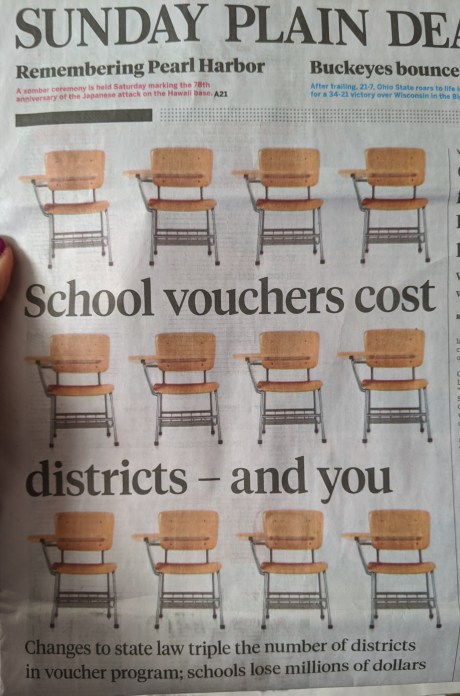
The Cleveland Plain-Dealer wrote that the voucher expansion will hit the budgets of school districts hard, districts that in the past were not part of the voucher program.

A year ago, no students in the Parma school district used Ohio’s main tuition voucher program to attend private schools.

This year, thanks to changes in state law, 359 students are using vouchers.

For families paying tuition to send their kids to Parma-area private Catholic schools like Padua or Holy Name, a $6,000 tax-funded voucher toward tuition is a huge help.

For the district, it’s a $2.1 million hit to the budget that impacts teachers, books and supplies for its schools.

Parma isn’t alone in facing new or increased costs to help students attend private schools. Changes to state law, have more than tripled the number of districts declared part of the voucher program, from 40 in 2018-19 to 139 this school year.

Next year, the program meant to help students escape being stuck in failing schools will grow further, to more than 400 districts, which represents more than two-thirds of the districts in the state.

Even Solon, always at the top of state test score rankings, has a school considered failing and whose students are now eligible for vouchers. Next year, add a school in each of the high-scoring Brecksville-Broadview Heights and Mayfield districts.

The change has school officials protesting and gathering to find ways to seek relief…

The use of vouchers within school districts is also increasing. The Cleveland Heights-University Heights schools saw 500 more students use vouchers this year than last year, mostly to attend Jewish schools. The district’s voucher bill increased by $3 million.

That change, said district Treasurer Scott Gainer, has the school board seeking a higher tax increase than planned this spring.

Shaker Heights Superintendent David Glasner, whose district is seeing a small bill this year, but faces a larger one next year, complained to the state school board last week about the hit that school district budgets are taking.

“There are school districts that are now expecting to lose millions of dollars in the course of one year as a result of the EdChoice [voucher] expansion,” Glasner said. “These are losses for which districts were unable to forecast or prepare.”

State Sen. Matt Huffman, one of the strongest supporters of vouchers in Ohio, said some of the rules are subtle and have changed a few times. But districts should have known, he said, and should be blaming themselves for not improving their schools…

Ohio has four “scholarship” or voucher programs that provide tax dollars to pay tuition at private schools, almost all of which are Christian schools. There is one program just for Cleveland, which was started in 1996, so Cleveland is not affected by the current changes.

The biggest is called EdChoice. Created in 2005 for students attending “underperforming” schools or who would be assigned to them, EdChoice has a student’s home district pay $4,650 toward tuition for kindergarten through eighth grade and $6,000 for private high schools.

Stephen Dyer, a former legislator in Ohio who writes a blog about education, called “BS” on Huffman’s claim that school districts should have known and should have been prepared.

Dyer says that the state rigged the grades and school report cards to produce failure and make more schools voucher-eligible.

This is where I call BS.

How can I do that? Simple: Over the last decade, the state report card grades upon which these new voucher building designations are being based have been deliberately and artificially deflated for the state’s school districts. And I’m increasingly convinced it was for this sole purpose: to ensure more districts and buildings are deemed “failing” by the state so more public money can be poured into private, mostly religious schools.

Don’t believe me?

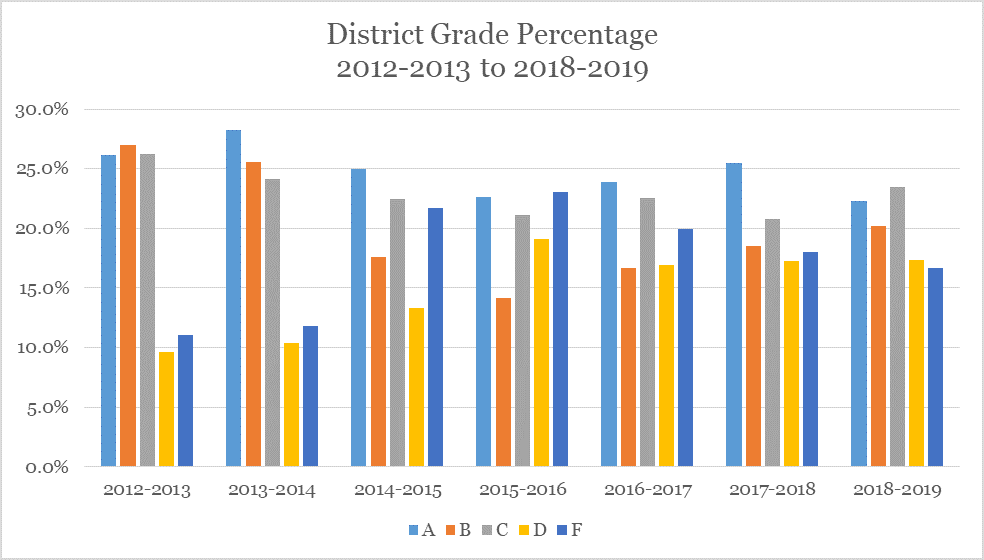
Look at school districts’ overall grade performance since the 2012-2013 school year — the first for the A-F state report card system.

Notice anything? Like a massive jump in D and F grades between 2013-2014 and 2014-2015?

Let me ask you a question: Does anyone — and I mean ANYONE — actually believe that between the 2013-2014 school year and the 2014-2015 school year school districts became more than twice as likely to “fail” kids?

Of course not.

This is a classic case of grade manipulation by state lawmakers. You’ll also notice a steady decline in the rate of Fs since the high point of 2015-2016. Why were these grades so much worse? Because the state kept changing standardized tests. So teachers and students had no idea what the testing expectations were. Since they’ve remained the same, you can see a steady and precipitous decline in the rate of F grades, though the percentages of D and F grades remain far higher than the 2012-2013 school year.

To add insult to injury, a study examing the test performance of students who take vouchers found they did worse on state tests after taking the voiucher than before … according to the pro-voucher Fordham Institute. But that doesn’t matter to Huffman, whose hero is apparently the Titanic captain who kept plowing ahead, damn the iceberg.

Anyway, here’s where Huffman struck gold for those who are taking a public subsidy to send their kids to private, mostly religious schools — only 2 out of the three years’ grades count to have your building designated “failing” from 2013-2014, 2017-2018 and 2018-2019. And once the building is eligible for vouchers, every student who gets a voucher gets to keep it forever, even if the public building becomes the highest-performing in the state…

But it’s all been a plan from the beginning:

1) Deliberately deflate district report card grades

2) Get as many buildings as possible eligible for vouchers

3) Market them like crazy to families in these districts so the rest of us taxpayers can subsidize their choices with our local tax dollars and/or fewer opportunities for our kids who remain in local school districts.

That’s not a district performance problem.

It’s Huffman’s plan.

****************************************

Last Saturday I was on Meryl Johnson’s radio show, based in Cleveland, where she was a teacher in the public schools for many years. Meryl is an elected member of the Ohio State Board of Education, and she is very concerned about the explosion of vouchers. She alerted me to this disaster. I pointed out that there is one possible silver lining. Until now, the suburban districts in Ohio could ignore vouchers and assume they affected only Ohio’s urban districts. Now the cost of vouchers will hit their school budgets and their taxes will  have to go up so that a few students can go to religious schools, where they are likely to get a worse education than the one offered in their local  public schools. Their own schools will now feel the pinch caused by vouchers. Maybe this is the wake-up call that is needed to create a statewide coalition to stop defunding the public schools that enroll the vast majority of students in the Buckeye State.

Meryl sent me a screen shot of the front page of the Cleveland Plain Dealer. Will this wake up the citizens of Ohio? Will they realize that they must raise their taxes to pay for vouchers for the small number who leave their public schools? Do they know that the students who leave for religious schools will lose ground academically?

IMG_20191208_113121


The state commissioner of Rhode Island has recommended a five-year renewal for a failing charter school.

The New England Laborers Construction and Career Academy has earned a one-star rating, the lowest possible ranking in the state’s school accountability system, for the past two years. Critics have long complained that charter schools are not held to the same standards as traditional public schools.

CRANSTON — The commissioner of education has recommended a five-year renewal for a charter school despite at least four years of failing academic achievement, low graduation rates and a poor track record for placing graduates in construction jobs.

The New England Laborers Construction and Career Academy, a statewide charter that draws mostly from Cranston, opened in 2002 to create a pathway for high school students interested in construction careers. It also offers a separate career strand called the World of Work, which allows students to explore other career options. The current enrollment is 175 students…

The laborers academy has earned a one-star rating, the lowest possible ranking in the state’s school accountability system, for the past two years. For the previous two years, it was listed as a “focus” school, meaning its performance merited substantial help from the Education Department.

Laborers academy students also performed poorly on the latest SATs, with less than 16% proficient in English and 0% proficient in math.

In 2018, not one student earned a state-approved credential for the construction industry.


Is Chester-Upland School District the frog in the boiling pot of water that is a warning to every other school district in the state of Pennsylvania?

The Chester Community Charter School is a subject of endless fascination. It has absorbed 70% of the elementary school students in the impoverished district of Chester-Upland in Pennsylvania. Its scores are low, lower even than the district schools. It is owned by an extremely wealthy suburban lawyer, who is a major campaign contributor to Republicans in the state. He receives a healthy profit every year from the charter school in Chester-Upland, despite the fact that the school is low-performing. Meanwhile, the school district has been in receivership since 2012, while the charter school is thriving. The district has been bankrupted by payments to the charter school and to cyber charters. That is the way the state law was written by charter-friendly Republicans in the Legislature.

The Chester-Upland School District is a majority-minority district: It is 18% white; 67% African American; 11% Hispanic; the remainder, other groups.

Peter Greene writes here about this district.

The school district is Chester Uplands, and they’ve been in the charter-related news before. Specifically, they were the poster child for how a careful gaming of the charter system in Pennsylvania could result in huge charter profits. As I wrote at the time:

The key is that while all CUSD students with special needs come with a hefty $40K for a charter school, they are not all created equal. Students on the autism spectrum are expensive to teach; they make up 8.4% of CUSD special ed student population, but only 2.1% at Chester Community Charter School, and a whopping 0% at Widener and Chester Community School of the Arts. Emotionally disturbed students are also costly; they make up 13.6 % of special ed at CUSD, 5.3% at Chester Community, and zero at the other two. Intellectual disabilities make up 11.6% for CUSD, 2.8% for CCCS, and zero for the others. 

Speech and language impaired, however, are pretty inexpensive to educate. CUSD carries 2.4% of the special ed population in this category, but the three charters carry 27.4%, 20.3% and 29.8%.

Back in 2015, this helped put CUSD in the astonishing position of giving more money to charter schools than it received from the state.

In 2015, the district made a deal to cut its payments to cyber charters (which are among the lowest performing schools in the state).

Greene writes:

In 2015 the district made a deal for charters to accept less money for students with special needs, but the cyber charters went to court to be exempted– and the court eventually agreed, giving CUSD a huge retroactive bill to pay cyber charters.

The district has long been attractive to worst of charter vultures. Not just the cybers, but for-profit management companies like CSMI, founded by the infamous Vahan Gureghian, charter school multimillionaire and generous GOP donor.

Currently, charters enroll about half of the 7,000 student district population. CSMI would like to have a larger piece of the pie and run all of the elementary education in Chester Uplands, and it has asked the court to hand them over (because the district itself has no say in this). CSMI runs some charters elsewhere, including a school in New Jersey that is the subject of a whistleblower lawsuit. The suit was filed by a former principal who says she was fired for making a fuss over CSMI’s policy of cutting corners to make a buck. Cutting corners didn’t just mean cutting services; it also meant falsifying records and misappropriating funds. Great company.

Open the post to see beautiful pictures of the charter owner’s gorgeous estate in Pennsylvania and his recently sold mansion in Palm Beach.

The lesson, says Greene, is that there is no real difference between for-profit and nonprofit charters. The Chester Community Charter School is “nonprofit.”

It is unclear how much money CSMI would make on the Chester Uplands deal because, as a private business, it doesn’t have to account for its financial activities– even though they are funded by trhe taxpayers. Do you see why, when someone like Cory Booker or Pete Buttigieg starts talking about how only for-profit charters are bad, they are just selling thinly sliced baloney. Chester Community Charter School is a non-profit school–that generates profits for the CSMI management company that runs it, and runs it like a business and not like a school.

The Inquirer quoted the CUSD school board president–his primary concern isn’t the charter takeover of the elementary schools as much as it is the inadequate funding from the state. “Ask them what they have done for 25 years in Chester Upland.” He has sort of a point, but the fact is that this non-weathy non-white district is in danger of losing all local control and voice.

This is what chartering as a tool of privatization looks like. Gut the public schools. Chase the students into profitable charters. Strip every last asset from the public school and strip all the power from the voters and taxpayers. Operate charters like businesses; every dollar you spend on students is a dollar you don’t get to keep. Make some guy a multimillionaire while stripping public education and democratic voice from the members of a poor community.

This chart comparing the charter school to the district’s four elementary and middle-schools was prepared by the Keystone State Education Coalition.

This chart summarizes the PA Dept. of Education’s Future Ready Index reports for the Chester Community Charter School (CCCS) and the four Chester Upland School District elementary/middle schools.


Indicator Name CCCS Main Street Stetser Sch of Arts Toby Farms
Percent Proficient or Advanced on ELA/Literature (All Student) 16.3 31 52.3 18.2 12.5
Percent Proficient or Advanced on Mathematics/Algebra 1 (All Student) 6.4 7.6 13.8 10.2 2.3
Percent Proficient or Advanced on Science/Biology (All Student) 22.8 36.7 59.5 59.6 13.7
Meeting Annual Academic Growth Expectations (PVAAS) ELA/Literature (All Student) 63 78 94 76 50
Meeting Annual Academic Growth Expectations (PVAAS) Mathematics/Algebra 1 (All Student) 78 100 77 81 54
Meeting Annual Academic Growth Expectations (PVAAS) Science/Biology (All Student) 50 69 70 97 50
Percent Advanced on ELA/Literature (All Student) 1.2 1.9 15.6 1.2 0.6
Percent Advanced on Mathematics/Algebra 1 (All Student) 1 0 1.8 3 0.6
Percent Advanced on Science/Biology (All Student) 2.8 8.3 16.2 7.7 0.9
Percent  English Language Growth and Attainment (All Student) 22.9 IS IS IS IS
Percent of Students with Regular Attendance (All Student) 48.7 59.2 59.8 53.4 42.1
Percent Grade 3 Reading (All Student) 14.5 24.4 37 20.7  DNA
Percent Grade 7 Mathematics (All Student) 6  DNA  DNA  DNA 1.7
Percent Grade 5, Grade 8, and/or Grade 11 Career Standards Benchmark (All Student) 98 98 98 98 98

Lawrence A. Feinberg of the Keystone State Education Coalition writes:

Flooding from Katrina precipitated the charterization of NOLA schools. Will a historical flood of campaign contributions do the same for Chester Upland SD? PA Department of Education Future Ready Index reports show that 3 of the 4 Chester Upland school district’s elementary/middle schools are outperforming the Chester Community Charter School. Why would the charter school operator want to charterize all the elementary schools in the district? There is no Right-to-Know requirement for private charter management companies like Vahan Gureghian’s CSMI, but the 990 for Chester Community Charter School for last year alone lists $18 million in management fees.


Andre Perry led a charter chain in New Orleans. He became disillusioned. As a black scholar, he questions the Walton-funded effort to portray black support for charters as monolithic, which it is not. 

Perry wrote in response to the controversy that occurred when pro-charter demonstrators disrupted a speech by Elizabeth Warren in Atlanta. He is aware of the white Republican money behind the demand for more charters.

He wrote:

Warren needs to learn from black voices — but the charter school movement is not ours to defend.

Organizations such as the charter school advocacy group Families for Excellent Schools have orchestrated statewide campaigns using dark money to influence state ballots to increase the number of charter schools, hiding who’s actually behind the movement. The Associated Press reported in December 2018 that an advocacy group that received $1.5 million from the Walton Family Foundation, one of the biggest funders of education reform, paid for 150, mostly black parents from Memphis to travel to Cincinnati two years prior to protest at a meeting of the NAACP. The parents sought to lobby against an NAACP proposal — which the organization passed despite the protests — to call for a moratorium on charter schools. They denied that the Walton Family Foundation asked them to carry out the protest.

This political season, black people cannot afford to be human shields for white leaders who don’t have the legitimacy to enter black communities on their own.

Perry notes that most Democratic candidates, notably Sanders and Warren, have abandoned charters.

He writes:

This reversal of position by Democrats is a sign that members of the party are listening to black communities….

Over the course of more than two decades, charter school expansion resulted in a significant loss in black-held jobs and a reduction in black political power in several black-majority cities. Black teachers were fired en masse in New Orleans, Washington D.C., and Newark, N.J., decimating the black middle class there.

Hundreds of millions of dollars directed towards electing pro-charter candidates ultimately empowered Republicans in many states. The pro-charter group Students First realized that its funding of Republican candidates had backfired. The association of the charter cause with the Republic party lead to the defeat of pro-charter proposals. Democratic voters showed they will not support movements that bolster the Republican Party — the same party that refuses to check Trump’s blatant racism. Democrats who support the idea of charter schools should make it clear to Republicansthat they will not tolerate a charter system that offers improved academic performance for some black students only by harming the communities in which those students live.

However, Democrat reformers developed a bad habit of accepting this Faustian bargain, and staying silent in red states on issues like jail expansion, cuts to higher education and attacks on organized labor because dissent ran the risk of slowing the proliferation of charters. Yes, black families want and need choice, but the current charter school movement is too tightly braided with Republican causes; a defense of one is a defense of the other.

To embrace charter schools in 2020 is to embrace Betsy DeVos, Donald Trump and other Republicans who stand to gain more politically from charter support than black communities have gained in jobs and educational benefits. Black kids lose when Democratic educational reformers act like Republicans.

Perry quotes the EdNext poll, noting that the publication is “pro-reform.” It is more accurate to acknowledge that EdNext (on whose board I once served) is a very conservative, pro-charter, pro-voucher publication funded by rightwing foundations. Frankly, polls about charters are worthless because most people admit when asked that they aren’t sure what a “charter school” is. If they don’t know what a charter school is, how can their view—positive or negative—signify anything?

Perry is right to point out that the Dark Money behind charters has a different agenda than most black parents. The Waltons and DeVos and their allies in ALEC want to bust teachers’ unions and privatize public schools. Perry is right to peer behind the curtain and see whose interest is served by the well-funded attacks on public schools.

He writes:

The funders of charter schools continuously put black parents and teachers in the position of fighting against their own interests. White-led philanthropy and education groups will eventually abandon public policy experiments when it is no longer popular, politically expedient or, in some cases, lucrative. For-profit charters are in education ostensibly for the money.

Some black charter leaders feel they must defend the schools because black children attend them. But we don’t need to fall into that trap. We can defend black children and workers without defending charter schools. Black people need systemic change. We can’t allow the cry for charters to drown out the demands for school financing reform, better work conditions, higher teacher pay, universal pre-K, free college, teachers’ training and recruitment programs, stronger labor protections and workforce housing initiatives.


Jennifer Berkshire and Jack Schneider reveal the secret ingredient to the success of the Resistance to privatization/portfolio district strategy in Denver in this podcast.

For years, Denver had been a feather in the cap of DFER and other advocates of privatization. Betsy DeVos lauded Denver for its commitment to school choice, although she was disappointed that it had not yet adopted vouchers. the Brookings Institution praised Denver for its deep commitment to choice.

Michael Bennett rose from Denver superintendent to the U.S. Senate and still touts his success as a school reformer.

But in the last school board election, the critics of school closings, portfolio strategies, and charter schools won the seats to control the board, to the amazement of everyone.

How did it happen?

Jennifer Berkshire wrote: It’s a fascinating and inspiring story. The movement to “flip the board” started in Denver’s Black community and was then taken up by teachers. But the most amazing part of the story may be how young people – the products of the Denver reform experiment – have risen up to demand change. I don’t think that’s what DFER envisioned! 

Listen to the podcast.

The Philadelphia Inquirer reported on a federal audit that had surprising findings.

A national audit of charter school management companies by the U.S. Department of Education has spotlighted an unnamed Chester City school where, auditors say, the CEO wrote checks to himself totaling $11 million without board approval.

The report by the Office of Inspector General did not accuse the CEO of wrongdoing, but offered its finding as an example of a conflict of interest and lack of financial controls that could make the schools vulnerable to fraud. The report cited similar issues at four unnamed Philadelphia charter schools…In the instance of the Chester school, federal auditors reported that the CEO of the management organization wrote checks to himself in 2008-09.

While the audit did not name the school, there is only one charter in Chester City – Chester Community Charter School…

The school, which has more than 3,000 K-8 students, is the largest brick-and-mortar charter in the state. The most recent annual report from the state Department of Education shows that the school had total revenue of $45.1 million in the fiscal year 2013.

Vahan H. Gureghian, a lawyer and entrepreneur who has been active in Republican politics, is the founder and CEO of CSMI Education Management, which manages Chester Community Charter School.

Auditor General Eugene De Pasquale repeatedly has criticized the ties between Chester Community and Gureghian’s firm….

In addition to Pennsylvania, the states where charter schools were reviewed were California, New York, Florida, Michigan, and Texas.Investigators found internal control weaknesses with charter management organizations at 22 of the 33 schools reviewed. They spotted 24 cases of conflicts of interest and transactions with related parties at 17 of the charter schools.