Archives for category: Privatization

Every blogger who has written about MSNBC’s Public Education Forum expressed gratitude that a big cable network paid attention to our most important democratic institution.

Nancy Bailey is angry about the issues that were ignored, the ones that threaten the future of students, teachers, and public education.

She is also streamed that the program was not on live TV. Public education not important enough for live TV? 50 million children are in public schools. They have parents. Quite an audience to overlook.

Good work, Nancy!

She writes (in part, read it all):

Candidates talked about making the wealthy pay their fair share of taxes to help schools, but no one mentioned Bill Gates, the Waltons, Eli Broad, Mark Zuckerberg or any of the corporate reformers who are taking control of public schools.

They didn’t mention Common Core or the failure of the initiatives funded by the Gates Foundation and taxpayers. Nor did they speak about portfolio schools, the latest corporate endeavor to push choice and charters.

No one mentioned using Social Impact Bonds or Pay for Success to profit off of public schools. See: “Wall Street’s new way of making money from public education — and why it’s a problem” by Valerie Strauss.

CEO Tom Steyer mentioned corporate influence towards the end, but it was brief, and no moderator attempted to explore what he said.

Ed-Tech

No one mentioned what might be the biggest threat to public education, the replacement of teachers and brick-and-mortar schools with technology.

Disruption was initially described by Clayton Christensen and Michael Horn in their book Disrupting Class: How Disruptive Innovation Will Change the Way the World Learns. This is seen as the revolution by those in business and the tech industry and is being played out in online charter schools like Summit and Rocketship. Summit also has an online virtual school.

Many students across the country get school vouchers to be used for substandard online instruction like K12 and Connections Academy.Preschoolers are subjected to unproven Waterford UPSTART.

The candidates might want to review Tultican’s “Ed Tech About Profits NOT Education.”

Wrench in the Gears is another blog good at describing the threat of technology.

Teach for America

Teach for America corps members with little training have taken over classrooms, and they run state departments of education!

Do Democratic candidates have Teach for America corps members as consultants on their campaigns? It’s troubling if they do. They should not be wooing teachers with professional degrees and experience while relying on TFA behind the scenes.

Other insidious reform groups are also about replacing education professionals. Relay Graduate School, The New Teacher Project, New Leaders are a few.

This needs to be addressed, sooner, not later.

Betsy DeVos et al.

I don’t know anyone who doesn’t enjoy hearing Democratic candidates say they’re going to boot Education Secretary Betsy DeVos out.

But President Obama had individuals from the Bill & Melinda Gates Foundation, and other corporate reform groups, working in the U.S. Department of Education. Arne Duncan was no friend to teachers or public schools.

So, while applause against DeVos are justifiable, now’s the time to address the role Democrats have played (and continue to play) in corporate school reform.

The fact is, many groups and individuals are working to end public education, who wear Democratic name tags. It’s imperative that Democratic candidates address this.
 

Jan Resseger shares her reactions to the Public Education Forum. She was heartened by what she saw and heard, as candidates recognized the need to increase investment in education. 

She invites you to watch the video if you missed the event.

IT WON’T BE OFFICIALLY PUBLISHED UNTIL JANUARY 21, BUT YOU CAN PRE-ORDER YOUR COPY FROM YOUR BOOKSELLER OR AN ONLINE BOOK DEALER (PLEASE PATRONIZE INDEPENDENT BOOKSTORES, IF YOU STILL HAVE ONE NEAR YOU!).

I PROMISE YOU WON’T BE DISAPPOINTED!

IF YOU COME TO THE ANNUAL MEETING OF THE NETWORK FOR PUBLIC EDUCATION IN PHILADELPHIA MARCH 28-29, I WILL PERSONALLY INSCRIBE YOUR COPY OF THE BOOK!


EDUCATION

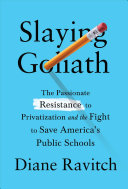
Slaying Goliath: The Passionate Resistance to Privatization and the Fight To Save America’s Public Schools

Knopf. Jan. 2020. 352p. ISBN 9780525655374. $27.95. ED
COPY ISBN

In this incisive, meticulously researched book, Ravitch (education, New York Univ.; The Death and Life of the Great American School) argues persuasively that the U.S. school privatization movement has resulted in poor test scores, the closure of public schools, and attacks on the teaching profession. Ravitch blames the so-called school reformers, whom she renames the disruptors, such as Bill Gates, Alice Walton, Michelle Rhee, Mark Zuckerberg, and Eli Broad, who spend millions to replace public schools with charter schools and private institutions that are run like businesses. Though disruptors view themselves as opposing the status quo, Ravitch contends that they are doing everything they can to maintain it. She devotes most of her book to the resisters, or the teachers, parents, and union leaders who have taken on the disruptors and are working to keep their local public schools open. Through this lens, Ravitch discusses the Common Core teaching standards, standardized testing, the Obama administration’s Race to the Top grant program, and Teach for America.

VERDICT This extensive analysis is required reading for anyone concerned about American education. [See Prepub Alert, 7/8/19.]

Charter enrollment declined in Utah for the first time in at least a decade, and no new charters opened.

Enrollment at Utah’s charter schools — which have seen explosive growth in the past as they’ve attempted to be “education’s disruptors” — declined this year for the first time in at least a decade.

The dip is largely unexpected but follows a particularly chaotic year for charters in the state. One was forced to close with millions in debts owed to overseas investors. Another filed for bankruptcy. A third was ordered to shut down after less than two years in operation…

In addition to some schools closing, no new charters opened this fall — which is also a first in the state for at least a decade, Peterson added, and likely contributed to the enrollment decline. Two or three were slated to enroll students in August but pushed back their starting dates over lease, land and building issues.

Royce Van Tassell, executive director of the Utah Association of Public Charter Schools, said the price of land has gone up in Utah and has put new charters in a challenging spot…

Van Tassell also pointed to the closure of the American International School of Utah, or AISU, for the dip. The Murray charter shut its doors in August in the face of mounting debts. The school owed the state and federal government nearly half a million dollars in misspent funds, according to an audit of its books.It also still faces potentially millions of dollars in other unspecified debt, according to its former spokesman, most of which was spent overseas. It’s likely that will never be repaid.

I was glad to see the reporter refer to charters as”disrupters,” which they are, and not as “reform,” which they are not.

Peter Greene writes here about Erica Green’s excellent coverage of Betsy DeVos’s testimony to Congress about student debt. 

He says you have to pay close attention to her words to understand that she is not greedy, she is not dumb;  she knows exactly what she is doing.

He writes:

“Here’s an absolutely DeVosian quote from the proceedings:

“I understand that some of you here just want to have blanket forgiveness for anyone who raises their hand and files a claim, but that simply is not right.

Ah yes– the smirk.

“This is DeVos– she knows what’s right, and she’s going to stand up for it. And’s what is right is that Those People shouldn’t be able to get away with not paying their debts. Those People should not be allowed to stiff their Betters. Because you know that Those People are probably lying about how badly they were hurt, anyway, because Those People are always trying to get things they don’t deserve. This “anyone who raises their hand and files a claim” characterization that DeVos has been using is such a flip way to dismiss the damage done by for-profit collges, an d here it matters what DeVos doesn’t say– she doesn’t say that there are people out there who played by the rules, tried to bootstrap themselves to a better life through education, and got fleeced, and we should provide those people some real relief. She has never seriously acknowledged that harm.

“But that takes us to the other DeVosian value that’s on display here.

“Ms. DeVos maintained that it was “probably the case” that Corinthian Colleges deceived students, but she also said she believed that the “prior administration basically forced schools like Corinthian out of business” with onerous financial restrictions. She rebuffed questions about an investigation by career staff, unveiled in January 2017 memos published by NPR on Wednesday, that concluded that Corinthian students deserved full loan forgiveness because they received no educational benefit.

“Businesses fleecing customers is not outrageous. What’s outrageous is government interfering with the operations and practices of businesses. There is an extra layer of irony here– the Obama administration actually was pretty damn slow to take any useful action against Corinthian, and even helped bail them out for a time, and any good Obama-bashing Trumpian might hammer that point home, but DeVos can’t see that because for her there is no greater sin than interfering with the operation of a business.

”She’s made variations of that point again and again, all the way back to the confirmation hearing when she couldn’t imagine any misbehavior that would prompt her, as a government official, to step in and say “Stop!” Businesses matter more than people.”


Michigan has been Betsy DeVos’ Petri dish for school choice for 20 years. The state theoretically has no for-profit charters but in reality, 80% of its charters are run by for-profit management companies.

Michigan also has the largest number of charters that received millions from the federal Charter Schools Program but never opened. These are “ghost schools.” Carol Burris identified them in the NPE report Asleep at the Wheel.

Reporter Allison Donahue investigated to see where the money went.

The study highlighted how the money was spent at four of Michigan’s “ghost schools”:  The Harris Academy, The Great Lakes Anchor Academy, Cultivating Growth and Warren Classical Academy.

Although the inspiration to open these charters differs from developer to developer, a common thread was found within these ghost schools’ invoices ─ for-profit consultants and education management organizations.

Betsy DeVos gave Michigan another $47 million to add more charters, but the state board of education rejected the grant. However the state attorney general said the state education Department was required to disperse the funds.

DeVos wants more charters-in Michigan, Alabama, New Hampshire, Texas, everywhere— and as the saying goes in D.C., she is shoveling the money out the door as fast as she can.

Needed or not, here come more charters!

Hello from Arkansas! Thank you for your continued coverage of the Walton-funded takeover efforts in LIttle Rock School District, and public education in Arkansas. I’ve been blogging about education policy & politics here for a little over a year, and really appreciate the times you have shared my work and the work of Dr. Anika Whitfield. You have really helped get Arkansas into the national spotlight!
 
I’m writing to ask for help getting a fundraising project off the ground. Alex Handfinger (a member of Grassroots Arkansas alongside Dr. Whitfield) and I have incorporated a public-benefit corporation to fund legal action against state mismanagement of the Little Rock School District. Together, we are the Education Defense League of Arkansas (EDLA.)
EDLA has recruited three passionate attorneys, so far. Each of our attorneys is a recognizable name in Arkansas: Matt Campbell — an established “good government” bulldog, Chris Burks — the brother of one of our State Board of Education members, and Amelia LaFont — a civil rights attorney who worked as a public education activist in New Orleans, fighting the same battles down there that are currently being fought up here. Each of these attorneys has cases already filed that we can consolidate and build into class-action cases against state mismanagement in LRSD.
EDLA-affiliated attorney Amy LaFont has filed a case in federal court under the First Amendment, The Rehabilitation Act of 1973, and the Arkansas Civil Rights Act, on behalf of two dedicated special education teachers, who advocated for students’ rights at Hamilton Alternative Learning Environment (ALE.)

“It is our understanding that there are many educators and employees who have experienced retaliation for advocating for students in LRSD. EDLA is joining LaFont, her clients, and her co-counselors, by providing financial and logistical support, to maximize the impact of this lawsuit.”

One step at a time, though. My job, right now, is to raise some money.
 
Since EDLA is a B-corp, we can offer donor anonymity — but we can’t offer tax writeoffs. Do you know anybody who would be interested in contributing on those terms? Here is a fundraising packet we’ve developed, explaining our strategies & needs in greater detail. https://www.eddefenseleague.org/strategies-and-needs.html Please consider sharing it with anybody you think might be able to contribute!
 
Thank you for your continued attention & support.
Sincerely,
Elizabeth Lyon-Ballay
Blogger at www.orchestrating-change.com
Mission Coordinator at eddefenseleague.org

There are many ways in which nonprofit charters make a profit. Most involve complex real estate transactions and such things as “triple net leases” which are hard for the public to understand. Such deals often involve a charter operator owning or leasing the real estate and renting it to the charter school at exorbitant rates, with the public footing the bill.

Michael Kohlhaas has discovered another ingenious way that allegedly nonprofit charter operators extract money from their operations. 

He describes the case of a charter operator in Los Angeles who sold his “receivables” soon after getting his charter.

Kohlhaas writes:

The idea is very simple. A charter school has guaranteed future income in the form of payments from the state. They sell those payments to a finance company at a discount.

The finance company also charges a transaction fee. So for instance, if a charter has enrollment worth $1,000,000 they might sell those future payments for $980,000 now, which is less 2%. That means that $20,000 of public money, meant to educate children, has just evaporated into some zillionaire’s pocket for no reason, with no social benefit, nothing.2

This is usury. Payday loans for putatively public institutions. It’s textbook predatory lending with the unique distinction that both the borrower and the lender are teaming up to prey on a third party, which is the public. And, as I said, none of this is theoretical. Excelencia Charter Academy actually did this last year, which was their first year in operation.

It was obviously part of the plan all along, because founder Ruben Alonzo began arranging the sale within six weeks of receiving his approval from LAUSD. Read the details in this email chain. And keep this story in mind next time some charter minion starts burbling on about putting kids first and the putative efficiency of the private sector. Their financial model includes skimming a percentage of public money for no reason other than to enrich their cronies. This, friends, is not what efficiency looks like.

The company that handled the transaction for Excelencia is called Charter Asset Management, and this is only one of the incredibly shady sounding services that they offer to charter schools. They’re also not alone in this business. Another such company, which also buys receivables, is Charter School Capital. This one is even shadier than the other, founded as it was by an actual charter school operator who then used it to buy the receivables from his own school, thus pocketing the transaction fees himself.

Kohlhaas used the state’s public records act to obtain a huge trove of emails sent by charter operators, and he has mined them for posts like this one.

This is a big difference between a public school and a charter school. Would it be legal for a public school principal to sell the “receivables” for his or her school? Of course not. She would be charged with a crime and sent to jail.


Arthur Goldstein, veteran NYC teacher, traveled to Pittsburgh for the Public Education Forum, which will be live-streamed by MSNBC.

Outside he sees a group of protestors from the charter industry, complaining that public schools get any notice at all. Six percent of America’s children are in charters. Almost 90% attend public schools.

Goldstein remembers the many events where the charter industry monopolized Oprah, NBC’s Education Nation, “Waiting for Superman,” etc. and no public supporters were invited as the speakers sneered about them.

Now the charter industry has Betsy DeVos, the nation’s top education official, singing their praises. So why protest a gathering where they have two spokesmen (Booker and Bennett) but are not the sole focus of attention?


Carol Burris, executive director of the Network for Public Education, responds here to critics of NPE’s “Asleep At the Wheel,” the landmark analysis of the deeply flawed federal Charter Schools Program and invites comments and criticisms.

NPE wants readers to scrutinize the report carefully. If there are any errors, we will promptly correct them.

She writes:

Examining a list of nearly 5000 charter schools to determine which were open, closed or never open was a difficult and tedious task. There is no common standard when it comes to state reporting on closed charter schools—some states give lists of closed schools. Others do not. Many states only give a list of currently opened schools. Even those lists are not often up to date and rarely indicate if the school’s name has changed.

 In the case of unopened charters that received federal CSP funds there is no list at all. We (myself along with two part-time staff, Darcie Cimarusti and Marla Kilfoyle), would hunt for school information on the internet if a school in the database was not on the open or closed list and had no NCES number. Some of the schools that never opened had shells of Facebook pages and odd commercial information that is meaningless, but nevertheless pops up.

And then there are charter name changes, takeovers, charters turning into public schools and other complications with which we had to contend. Often we needed to make a judgement as to whether or not the school was indeed the school that had received the grant. We did the best we could, realizing that there would be some errors. We promised we would correct any mistakes we made and we will.

 We also knew that school choice advocates and groups opposed to public education would attempt to discount our work by finding error as a means to convince policymakers to disregard the report.

 On December 12 William Flanders of the Wisconsin Institute for Law and Liberty (WILL), a right wing think tank that promotes vouchers and charter schools, and Jim Bender of  School Choice Wisconsin  did just that in their blog on Fordham. They claimed to have found ten schools on our list of 132 Wisconsin closed or never opened schools that were open. They said these were “glaring” errors and it was not an “honest” report and therefore the entire 40 plus page report should be discounted.

 Let’s go through those “ten glaring errors” (they actually list 11 schools) one by one. The first name in bold is the school they say is open. The second name in bold is the school on our list of closed schools. 

Banner Prep of Milwaukee—may indeed be open, but we listed the Banner School of Milwaukee, which according to the list of closed schools on the website of the Wisconsin  Department of Education closed in 2015.

 Class Act Yes that is open. But we do not have it on the list of closed schools.

Etude—Perhaps this is also a different school because the Etude School, which is the name we list, closed in 2011 according to the state list. The NCES number (551365002690) associated with the school that got the grant does not return a school when you search here.

 Island City Academy. That was our error and we will correct it. Island City Research Academy is closed. 

Jedi Virtual K12  We list Jedi Virtual High School as closed. According to the state list it closed in 2011. In 2007 it had 14 students. In 2018 it had 13. Jedi Virtual High School was awarded a $400,000 grant.

 Lincoln Inquiry School. If you pop in the NCES number of the school given the grant, (551668002180) up comes a public school—Lincoln Elementary. It may have once been a charter but the school that received the grant is now a public school.

 Mead Elementary School. According to the school closure list, it closed in 2008. The NCES number returns no school.

 Milwaukee College Prep 36th St. and College Prep North closed in 2016 according to the closed independent charter schools’ list. The first NCES number comes up as no school, the second did not have an NCES number when given the grant. They were independent charters. Milwaukee College Prep 38th St. got a grant but that is not on our closed list. Perhaps the authors got the streets confused.

 Hmong American Peace Academy the school listed by us as closed is HAPA/International Peace Academy. International Peace Academy closed in 2013. This may be a school merger, since the initials fit. If the merger occurred before they got the grant, we will take it off the closed schools list.

 Mc Kinley Academy received a grant and we do not list it as closed. We list McKinley Middle Charter School as closed. According to Wisconsin’s closed schools list. There is a Mc Kinley Middle School that closed in 2012 in one location, and another that closed in 2018. The search by NCES number (551236001631) results in no school coming up.  Mc Kinley Academy has a different NCES number (550861002701).

 You can find a list of closed independent charter schools and closed public schools (district charters are on the closed public schools list) at: 

https://dpi.wi.gov/cst/data-collections/school-directory/directory-data/published-data

 We will remove Island City Academy from our list of closed schools, and further research the school merger.

 We will continue to review our list and keep track of charter failures. We welcome corrections to our lists with documentation which can be sent to info@networkforpubliceducation.org.  We will periodically do updates adding and removing names as information becomes available.

 Here is the bottom line. The Department of Education should report to Congress and the public on its $4.1 billion dollars investment in charter schools by providing transparent listings of schools that never opened, schools that have closed and why those schools failed.  The public deserves transparency and accountability not only from charter schools, but from the program designed to start them. The data that is available, limited as it is, shows a clear and undeniable problem.