Archives for category: Philadelphia


Lisa Haver and Deborah Grill pose this question in an incisive article in the Philadelphia Inquirer. 

There was a national media flap when billionaire investor Stephen Schwarzman offered his alma mater in Abington, Pennsylvania, $25 million in exchange for renaming the school, putting his name over six entrances, and changing the curriculum to meet his demands. Ultimately, the board refused some but not all of his requirements.

Haver and Grill worked in the Philadelphia public schools. They say, “Welcome to our world,” where the Uber-rich have owned the public schools for years and run them into the ground.

”In November 2011, the state-imposed School Reform Commission (SRC), absent any public deliberation, approved a multimillion-dollar grant from the Bill and Melinda Gates Foundation. In return, the SRC agreed to several conditions, including yearly charter expansion, implementation of Common Core standards, more school “choice” and testing, and permanent school closures. No one elected Bill Gates, typically portrayed in the media as just a very generous rich guy, to make decisions about Philadelphia’s public schools. But his mandates have had devastating and lasting effects on the district, much more than renaming one school.”

No one elected Bill Gates. An unelected board outsourced control of the Philadelphia public schools to an unaccountable billionaire. Why? Money. No evidence. No research. No wisdom. Just money. Goal: Privatization. Means: Silence the public.

“Here in Philadelphia, the Gates Compact conferred authority upon the Philadelphia School Partnership (PSP) “to provide funding …to low-performing or developing schools.” PSP has since raised tens of millions from a stable of wealthy donors; most has gone to charter schools, in keeping with Gates’ pro-privatization ideology. PSP’s influence has grown in the last seven years: the group now funds and operates teacher and principal training programs, oversees a website rating all Philadelphia schools, and holds the district’s yearly high school fair. PSP’s money, like Schwarzman’s, always comes with strings attached, whether that means changing a school’s curriculum or a complete overhaul of faculty and staff, as its 2014 grant to two North Philadelphia schools mandated.”

The PSP meetings are closed to the public. Its board members are wealthy suburbanites.

There is something to be said for democracy. Why has Philadelphia prevented its citizens from having any role in the o ersight of the public schools? Could those who have a genuine stake in them do worse than the rich dilettantes who control them now?


After 20 years under state control, the citizens of Philadelphia were thrilled that state control was ending. At last, they thought, Philadelphia would have local control.

But the Mayor picks all the board members, and they were chosen behind closed doors, with no transparency.

Is this an improvement? The board members reflect charter school interests, corporate interests, and political ties.

Philadelphia continues to be the only district in the state without an elected board.

The mayor announced his board selections, which pointedly excluded any well-known education activists.

Mayor Kenney picks his starting nine for new Philly school board

Philadelphia is overrun with charter schools, the public schools have been sacked and depleted of resources, but another nine charters have applied to the School Reform Commission for approval.The SRC is in control until June 30, 2018, then control shifts to a board appointed by the Mayor. The people of Philadelphia deserve democratic control of their schools.

Here is the sponsor of two of the proposed charters:

ASPIRA wants to open two new charter schools, despite evidence that it has been unable to operate its existing charter schools without running deficits. The Charter Schools Office has found, among other irregularities, that ASPIRA uses money meant for the education of students at Stetson Middle and Olney High —both of which are former District-run schools— to guarantee loans that the organization took out to purchase other buildings offering different services. The SRC voted 4-1 on Thursday not to renew those charters, and it is making plans to return the schools to District control.

The company’s finances were further hurt by payouts from sexual harassment lawsuits against CEO Alfredo Calderon.

“The SRC continued to fund these Aspira schools despite serious allegations of fraud, ghost contractors for painting Olney high school, admitted misuse of taxpayer dollars, failure to make PSERS payments, and other serious financial transgressions,” Lisa Haver said during her public comment at the hearing. Haver is the co-founder of the Alliance for Public Schools (APPS), an activist group that considers itself a watchdog of the SRC and charter expansion. “After following the Aspira financial and academic scandals for over two years, it’s hard to believe that they believe they are in line to open more schools.”

Here is another applicant:

Franklin Towne, which currently runs a national blue-ribbon charter high school, is proposing to open its own middle school at 5301 Tacony St. in Frankford — in the same building as its high school. It would link Franklin Towne’s elementary school to its high school, acting as a feeder. The school would serve grades 6-8 and open in the 2019-20 school year at its maximum enrollment of 450 students.

“If granted, we would be able, capable, willing and anxious to open a middle school to better serve the students in the 19137 area,” said Patrick Field, chief academic officer of Franklin Towne.

Franklin Towne has a solid academic record at both its elementary school and its high school.

However, the company is also known for running schools where the vast majority of the student body is white — 71 percent at its high school and 86 percent at its elementary school.

When will Philadelphia commit to rebuilding and reviving its public schools, where most students are enrolled and where facilities have been stripped bare to support charters?

David Berliner, Regents Professor Emeritus at Arizona State University, and one of the natuon’s Most distinguished researchers of education, asked me to pass along his advice to the citizens of Philadelphia.

Dear Diane,

A few weeks ago, I was heartened by your column about the return of the public schools to the citizens of Philadelphia. Since then, I’ve been mulling over four things that I wish I could communicate to them. Perhaps you can do so if you think it appropriate. I don’t know the folks there.

First, it will be difficult for teachers to show that they can turn Philadelphia’s schools into higher-achieving institutions. Teachers may help their students become stronger and more engaged learners, but they probably won’t be able to demonstrate student learning in the way that most people understand it, namely, through higher standardized achievement test scores.

The education research community clearly knows what politicians and the media don’t fully grasp: teachers simply don’t account for much of the variance in standardized tests scores. A reasonable estimate is that teachers account for about 10 percent of the variance in standardized achievement test scores. Research also suggests that outside-of-school factors account for 6 times more of that variance! We even have a Philadelphia based study corroborating these estimates.

In a 2014 Educational Researcher article by Fattuzo, LeBoeuf, & Rouse, 10,000 achievement test scores from Philadelphia were examined. The researchers used two sets of variables as predictors of students’ standardized test scores. The first set were school-level demographic variables such as race, gender, and degree of economic disadvantage. These are the kind of variables that the Coleman Report first revealed as strong influences on standardized achievement test scores.

My own research, and that of many others, has repeatedly confirmed this truth. In Fattuzo et al. these kinds of variables predicted 63 percent of the between school variance, quite close to the usual estimate of 60 percent of variance accounted for by demographic variables in students’ achievement test scores. Their data, then, are similar to what was found across nations in PISA and PIRLs, and similar to what other researchers find when school-level demographic variables are put into regression equations to predict variance accounted for.

But what Fattuzo et al. also did was add student-level variables to their equations. For each student, they knew whether the child was pre-term or low birth weight, had inadequate prenatal care, had a mother who was a teen, had high lead exposure, had a report record of being maltreated, had ever been homeless, and had a mother with less than a high school degree. It wasn’t surprising that each of these variables was a negative predictor of achievement test scores, and similarly, it wasn’t surprising that all but one variable was a statistically significant predictor of the standardized achievement test scores.

When the conventionally used school-level demographic variables were combined with student-level variables into the same equation, something quite different was revealed. The between school variance in reading test scores increased from 63 percent to 77 percent of the variance accounted for in the students’ standardized test scores. This leaves us with the task of trying to estimate what accounts for the remaining 23 percent of the variance in these standardized achievement test scores. We can separate that remaining variance into variance accounted for by error in the measurement system (a reasonable estimate might be about 10 percent) and school effects that are independent of teacher effects (which may also reasonably be estimated to be about 10 percent). Now we can account for about 97% of the variance. So, what percent of the variance in student test scores remains for teachers to affect? The answer is clearly almost nothing!

This all suggests that the good citizens of Philadelphia will probably not find whatever important things teachers might be accomplishing in their classrooms reflected in the standardized test scores routinely used in Pennsylvania. Instead, they should now think about other credible ways to judge teacher effectiveness.

Second, it won’t be Philadelphia’s newly taken-over schools that demonstrate how to get greater achievement from the students they serve. Schools, like teachers, may also be doing great things. But as noted, they usually affect about 10 percent of the variance on standardized achievement tests. Given Philadelphia’s high poverty rates, the variables associated with poverty may well account for most of the variance in citywide test scores, leaving little variance for the schools to effect, similar to the teacher effects just discussed.

The third point addresses the obvious question, what then should we do to better understand how teachers and schools effect local student outcomes? Usually we measure this via a standardized achievement test score, but as noted, that is quite likely not to be adequate for those purposes.

Instead, let’s try something different, and use the funds ordinarily paid to a test publisher to train selected parents who, alongside school principals or teacher leaders, could routinely observe classrooms and assist in monitoring the quality of instruction. Parents, principals, and teacher leaders can better learn to evaluate the artifacts of teaching, among them teachers’ tests and students’ answers. Those classroom tests will show both teachers’ understanding of and instructional alignment with the desired curriculum (as evidenced in the test’s items). And those tests will also show the quality of teaching that curriculum (as evidenced in the students answers to the items).

These assessments can be conducted as informal observations, or can use some of the of the more systematic and frequently used observation scales, such as those found in Danielson’s and Pianta’s systems. Scriven’s duties-based evaluation approach is certainly worth trying. And Meier’s and Knoester’s recent book offers a half a dozen other ways to assess students and classroom practices that don’t rely on standardized achievement tests. The point is this: assessing the quality of teachers and schools can be done without using standardized achievement tests that are known to be highly insensitive to what teachers and schools accomplish.

My fourth bit of advice is directed at those who serve on the newly constituted school board. It’s to remember that education outcomes are the result of much more than education polices. The school board will not achieve their improvement targets until other city and state policies better address the needs of Philadelphia’s schoolchildren. Housing policies must be strengthened to eliminate segregation by race and income, and affordable housing is needed to minimize residential mobility, which impedes school achievement. Physical and behavioral health policies must be strengthened, and nurses, counselors, and social workers must be sufficiently resourced to ensure that students attend school daily and have the supports needed to fully engage in learning. Policies to assure food security are needed so students aren’t preoccupied with hunger, and fair wage policies can provide income security for working families overwhelmed by living in poverty. And so on.

Getting their schools back is good for democracy in the city that played center stage in the founding of our nation’s democracy. Getting those schools to function well enough so its students can take on the role of stewards of our democracy is a whole other matter. I hope this advice helps them to do just that.

David Berliner
This is a history of the fall and rise of public education in Philadelphia.

For years, the schools were the plaything of politicians, the business community, and civic leaders.

Failure after failure.

One disastrous experiment after another.

Many millions squandered on privatization.

Today, state control ends and a new chapter begins.

Big news!

Today state control of the schools officially ends.

A concerted effort by parents and citizens of Philadelphia ended the city’s long and disastrous trial of state control. Paul Vallas, the Edison Project, charters, a steady stream of efforts to privatize the schools and hand control over to someone else. Meanwhile, the public schools were stripped bare, to the bone.

The state-controlled School Reform Commission voted to disband itself after 16 years of running the public schools into the ground. The city now reverts to mayoral control, and the parent groups won’t rest until the city has an elected board.

Congratulations, Philadelphia!

Time to return democracy to the cradle of our democracy.

From the Alliance on November 2:

“Members of the Alliance for Philadelphia Public Schools celebrate the impending dissolution of the School Reform Commission. We thank Mayor Kenney and Council President Clarke for their leadership in bringing this state-imposed body to an end. State control of our schools has brought devastation to this city: precious funds have been diverted to non-public schools and over 30 neighborhood have seen their schools closed permanently.

“Since 2012, APPS members have attended every session of the SRC, including special meetings and Policy Committee meetings. We have spent those five years fighting and organizing against the reckless spending, lack of transparency and disregard for the public exhibited by the many iterations of the SRC. In 2014, APPS sued then-Chair Bill Green and the SRC in federal court for violating the public’s First Amendment rights when Green ordered the police to confiscate signs from members of the public—and won. The following year, we filed suit in Commonwealth Court to stop the SRC’s continual violations of the PA Sunshine Act. Our settlement resulted in significant changes in SRC policy, including posting the resolutions to be voted on two weeks before the meeting instead of only 72 hours, and allowing the public to speak on resolutions posted just before or during the meeting.

“We now have a unique opportunity to end the disenfranchisement of the people of Philadelphia. The stakeholders in our public school system—that is, every person who benefits from a thriving public school system—should have the same rights as those in every other district in the commonwealth to elect the officials who will be entrusted to represent them in matters of school governance.

“The dissolution of the SRC is not contingent on changing the City Charter. The Charter now provides for mayoral control, as it did before SRC. The Mayor can select an interim school board for a year, during which time the city should hold community forums, as it is presently doing for the Rebuild initiative, to hear from the people whose voices were shut out during the reign of the SRC about how best to create a truly representative body for the critical task of educating our children.

“Trading in one unelected, unaccountable board for another is not a progressive solution to the problems facing the district.”

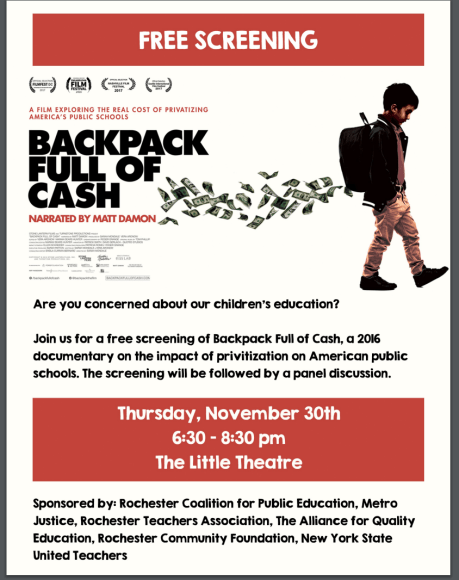
If you live anywhere near Rochester, New York, you will have the opportunity to see the amazing anti-privatization film, “Backpack Full of Cash.” Don’t miss it!

Screen Shot 2017-11-02 at 9.19.54 PM

Here is the current schedule for screenings of Backpack Full of Cash.

It is showing in Los Angeles next week.

This is your chance to see the controversial film about the rightwing corporate attack on our public schools.

Don’t miss it!

Screen Shot 2017-10-18 at 2.54.40 PM

Please save the date to join LAANE on Wednesday 11/8 at Occidental College for a free documentary film screening of Backpack Full of Cash, a film that explores the growing privatization of public schools and the resulting impact on America’s most vulnerable children.

As you may know, LAANE has been working with the Reclaim Our Schools LA coalition over the past two years to advocate for funding, accountability, and resources for every public school student in Los Angeles. We are excited to partner with Active Voice Lab to bring this film to Los Angeles and continue this crucial conversation. Following the film, we will host a Q&A session to answer questions and discuss opportunities to further raise awareness about issues facing our public schools in Los Angeles.

Narrated by Matt Damon, this feature-length documentary showcases Philadelphia, New Orleans, Nashville and other cities, taking viewers through the tumultuous 2013-14 school year and exposing the world of corporate-driven education “reform” where public education — starved of resources — hangs in the balance.

I hope you will join us for this event. Seating is limited so RSVP today.

Click here for more information about the film and to watch the trailer.

RSVP Here
In Solidarity,

Roxana Tynan
LAANE Executive Director

LAANE is a leading advocacy organization dedicated to building a new economy for all. Combining dynamic research, innovative public policy and the organizing of broad alliances, LAANE promotes a new economic approach based on good jobs, thriving communities, and a healthy environment.
Donate to support LAANE’s work!

Since 2001, Philadelphia’s public schools have been controlled by a “School Reform Commission” that has failed again and again to improve public education.

In this article, parent leaders call for a new vision for public schools.

They write:

“Over a year ago, we launched the Our City Our Schools campaign to end the 16-year-long failed experiment of the state-controlled School Reform Commission (SRC). The SRC was set up in 2001 in a supposed attempt to bring in more state funding, but instead led to dozens of school closures in black and brown neighborhoods, increased school privatization, failed for-profit consultants like Edison, and an austerity budget that has hurt students, parents, school staff, educators, and the city at large..

“Regaining local control is a huge step forward on the path toward true, democratically based community control of our schools.

“While we celebrate the mayor’s leadership, the question of how our schools will be governed is critical. For the last six months, Our City Our Schools and supporters have pushed for a transitional task force that could study successful school governance models and gather broad public input on what comes next — from an elected school board like those in the other 499 districts in Pennsylvania to the mayoral-controlled board of Philadelphia’s past…

“We can return a voice to the people who know our schools best. In ending the 16-year state takeover, we can define who are the true stakeholders of the Philadelphia schools. For too long, our schools have been treated like a business where decisions are made by people seeking to profit off of our children’s education. In this new era, we need to return power to the people who work, teach, and learn in neighborhood and charter schools every day, the parents who volunteer to fill budget gaps, and the community members who have supported their neighborhood schools for decades.

“We can end the era of conflicts of interests. The most important focus for any school board should be the thriving health of students, teachers, staff, and their schools. With local control and accountability, we can vet new board members for conflicts of interest and end backroom deals.

“Our next school board must push forward a progressive agenda for our schools. Our next school board must see quality education from locally based schools as a key racial and economic justice issue of our time. The SRC failed to stand up against a state legislature that continues to use our schools for its racist and privatizing agenda. Is the next school board ready to lead the fight for more equitable school funding across the state, for Philadelphia-based corporations and developers to pay their fair share toward our schools, and for an end to massive giveaways to private school managers?”

The dean of students at a Mastery Charter School in Philadelphia has been arrested and charged with statutory rape. He has been fired.

Omar Harrison, 42, of Cheltenham, Pa. was arrested on Wednesday. He was a dean of students at Mastery Charter’s Harrity Elementary School in the 5600 block of Christian Street in West Philadelphia.

Police say the victim was a 14-year-old 8th grade student.

The victim allegedly told investigators the incident happened at the end of the past school year after Harrison gave her a ride to a hotel in Tinicum Township near Philadelphia International Airport.

Officials from Master Charter Schools say the incident came to light on Friday after the victim’s mother came to the school to confront Harrison. The school was placed on lockdown for student safety, officials said, and no one was hurt.

Harrison has been fired from his position.

Did the charter give him a background check before hiring him? Did he have a previous criminal record? The answers to these questions are unknown. These are procedures that are customary in public schools.