Archives for category: Personal

Los Angeles has an important school board election coming up on March 5.

The esteemed school board President, Jackie Goldberg, is retiring, leaving her seat open in District 5.

Five candidates are running for the seat, and one stands out: Fidencio Gallardo.

Gallardo is an experienced educator who has worked in LAUSD for 35 years as a middle school English teacher (18 years), a high school English teacher (9 years), an assistant principal (3 years), an adult school teacher (3 years), and as a deputy to board member Jackie Goldberg for the past four years.

He is also the Mayor of Bell, California. And an Adjunct Professor of Curriculum and Instruction at Cal State, LA. Whew!

As you might surmise, he is a highly accomplished professional who has devoted his life to educating young people.

Gallardo has been endorsed by Jackie Goldberg, who is one of my personal heroes. I met Fidencio on a Zoom fundraiser where I offered my personal endorsement based on his stellar record.

And he was also endorsed by the Los Angeles Times, which interviewed all the candidates.

Here are a few excerpts:

Of the four candidates running, Gallardo articulates the clearest vision for improving student achievement and well-being in the wake of the pandemic. And his breadth of experience puts him the best position to actually get things done.

Gallardo said he plans to prioritize student literacy and achievement, which along with attendance, has suffered tremendously since the pandemic. He would continue the important work of greening school campuses that are asphalt-laden hot spots and detrimental to children’s health and learning.

His most recent teaching experience as an 11th-grade English Language Arts instructor at South Gate High School gives him insight into the best ways that the school board can allocate resources to help students struggling with reading.

Gallardo is appropriately critical of some decisions by district leaders in recent years. That includes Carvalho’s move to replace the successful Primary Promise program that helps elementary school students struggling with reading and math with a new program that includes middle school students, and the board’s 2021 decision to remove school police from campuses without a clear plan to keep students safe.

Gallardo said he will push for more unarmed school safety officers so that every campus has someone consistently responsible for keeping students safe, and for giving individual schools greater discretion over what type of safety personnel are on their campuses. It’s middle-ground positions like these, that seem reasonable but are at odds with UTLA, that could be a good indication of what to expect from Gallardo on the board.

He also wants to see more educational support for kids during their critical middle school years, including more one-on-one instruction.

Please vote for Fidencio Gallardo in District 5!

I discovered this post by a young Jewish woman about her reaction to the conflict in the Middle East. This was the post that helped me formulate my own views because I resonated with hers.

Rose Win is a blogger and digital nomad. She recently settled in Boulder, Colorado after two years of writing and traveling solo around the country. She grew up in Seattle and lived in Israel as a child and young adult. She shares here her reflections on the state of the war in Gaza.

She writes:

I wrote in my last post that I have been plagued by writer’s block. That is true, to an extent. There have been a lot of stories in the past couple of months I’ve wanted to write about. My parents came for Thanksgiving. Karina visited. I went back to San Marcos to see Kasey and Evie. I joined a rock climbing gym. I got deathly ill. One subject, however, has stood in my way like a giant, impenetrable barrier. War.

I can’t get past it. Everything else seems ridiculous, and trivial, and out of touch in comparison.

Specifically, I’m talking about the war in Gaza. I don’t know how many drafts I’ve written trying to cohere my thoughts, distill my feelings. My head swims and my heart aches, but I can’t find ethical, or intellectual, or emotional clarity. I keep getting stuck in a labyrinth of contradiction, locked between layers of devastation. So this post is a mishmash, a dumping, a meandering reflection of the competing and overlapping circles in my head.

The foundational layer of devastation, as I wrote before, is the sadistic slaughter of Jewish lives. The maiming, the raping, the abducting, the wholesale massacring. From there emerge the layers wrought by the world’s response. The mindboggling, Orwellian universe where murder becomes a “justified act of resistance,” where killers are “victims of oppression,” and rapists are “freedom fighters.” Or maybe they’re not rapists at all, because for some reason, violence against Jewish women isn’t believable. For some reason, Jewish women need to make their own pathetic hashtag to be heard: #MeTooUnlessYoureAJew.

There’s a new layer of consciousness: the sickening realization that the antisemitism of the 20th century never went away. It just lay dormant, hidden under the surface – waiting for the right opportunity to shapeshift and rear its ugly head. “The Jews are parasites living on other people’s lands. They deserve to die,” said the antisemites of the 20th century. “The Jews are occupiers of other people’s lands. They deserve to die,” say the antisemites of the 21st century.

There’s the hubris of the left which, using the lens of intersectionality, casts the war in racialized terms, white people oppressing brown people. Never mind that more than half of Israel’s Jews are “brown,” hailing from Arab counties that expelled, or, “ethnically cleansed” their Jewish populations in the late 1940s and 1950s following Israel’s creation.

Today’s liberal college campuses preach “language is violence.” Students police speech to minimize “harm.” Except speech against Jews. Because for some reason saying “genocide to Jews” is not violent, or hateful, or harmful. For some reason, chanting genocide to Jews is okay “depending on the context.”

I watch people condemn Israel for committing genocide against Palestinians. I’d like to know why Hamas’ charter, which, in no uncertain terms calls for the annihilation of the Jews and the establishment of an Islamist state in Israel, is not also condemned as genocidal? Why are the Palestinians seen as the rightful, indigenous inhabitants of the land when the Jews, whose presence predates the Palestinians, are not? Why is it that, in the aftermath of the Holocaust, the Jews were the world’s refugees, but following the creation of the state of Israel, they are the world’s most reviled colonizers? Why is a Jewish state with a Palestinian minority deemed racist, but a Palestinian state with a Jewish minority deemed righteous?

The questions seem simple. The answers are anything but. I want to defend Israel. I want to rage at the hypocrisy and blatant double standards. But I’m stopped. I can’t. Because look at Gaza. Neighborhoods razed to the ground. Wholesale cities decimated. Thousands and upon thousands of women and children dead. Eighty percent of the population displaced – facing polluted water, starvation, overcrowding, flooding, freezing, and rampant disease.

Israel told over a million people in northern Gaza to flee to the south. Then they bombed the south. “Gaza becomes a graveyard for children” reads one headline. “Nowhere is safe” says the next. Here’s another: “We have the right to live.”

I want to demand “ceasefire now!” because this level of humanitarian catastrophe is so breathtakingly horrific it’s hard to even fathom. Because this level of collective punishment cannot be justified. Because this destruction, this sheer loss of civilian life, cannot go on.

I want to demand “ceasefire now” because I despise Benjamin Netanyahu and the thugs and zealots that rule his repulsive right-wing government. Netanyahu is cut from the same cloth as Putin. He knows Israel holds him responsible for the attacks on Oct 7. The end of the war spells his demise. So, the war will wage on. Because narcissistic demagogues never willingly cede power.

I want to demand “ceasefire now.” But I haven’t.

Does a ceasefire mean Hamas will remilitarize – rearm and resume its genocidal charter to wipe out the Jews? Does a ceasefire leave Hamas’ sprawling tunnel system – built underneath hospitals, grocery stores, schools, universities, private homes, and graveyards – intact so they can infiltrate Israel and terrorize its citizens again? Does a ceasefire condemn the remaining 115 Israeli hostages to death? Does a ceasefire send a message to other Arab countries, waiting in the wings, that Israel is weak, and the Jewish state can be destroyed?

Are any of these questions justifiable? I don’t know. I don’t know.


When the world accuses Israel of being an apartheid state, I want to push back. Apartheid refers to the brutal system of institutionalized racial segregation in South Africa. Israel, albeit flawed, is a multi-ethnic, multi-racial, muti-cultural democratic state, where a fifth of the population isn’t Jewish yet has the same civil and legal rights as every other citizen.

But. That only rings true for those living within Israel’s green line – the 1949 armistice border. Following the war of 1967, Israel gained the Golan Heights from Syria, Gaza from Egypt, and the West Bank from Jordan. With the exception of Gaza, where Israel pulled out in 2005, those territories have been occupied ever since (though Israel, along with Egypt, maintained control over Gaza’s borders).

Israel’s occupation of the West Bank is illegal under international law. It never annexed the West Bank, because giving Palestinians Israeli citizenship would mean the end of Israel as a Jewish state. So one Israeli government after the next left Palestinians in stateless limbo, while sanctioning illegal Jewish settlement construction that zig-zagged through contiguous territory and punctured holes through the dream of Palestinian statehood. All the while Israel offered Jewish settlers – often messianic, often self-righteous, often violent – full rights of Israeli citizenship and subjected Palestinians to military rule.

So, yes, Israel can claim it’s the only pluralistic democracy in the Middle East. But also, no, it cannot.


In his book documenting bereaved families of the Palestinian-Israeli conflict, author Colum McCann talked about his decision to title his book Apeirogon:

“Apeirogon is a weird word, I know. An apeirogon can’t really be drawn, it can only be suggested… But I loved it from the moment I heard about it. The idea that it had an infinite number of sides was attractive to me because I knew it wasn’t a two-sided situation, that it wasn’t balanced.”

This is how I feel when I write and think about Israel. Sides upon sides upon sides upon sides. Overlapping truths. Overlapping contradictions. Questions without answers. Problems without solutions.

There’s a reason why I’ve written draft after draft after draft. Everywhere I turn I’m stuck. I want to take a stand, but every stand I take conflicts with another. That’s why I haven’t written. That’s why I must write.

I have been thinking for a long while about writing a post describing my views about the war in the Middle East. It’s not something I could toss off easily because my views are complicated.

As a Jew, I support Israel because I am painfully aware of the many centuries of Jew-hatred. My father’s father and mother fled Poland in the mid-19th century. All the Jews in their hometown (Lomza) were subsequently murdered by the Nazis. My mother and her immediate family (parents and sister) fled Bessarabia (now Moldova) in 1914 after a pogrom. Not one member of the families they left behind survived the Holocaust. Not one. Jews know in their bones that nowhere is truly safe from anti-Semitism.

After World War II, Israel became that one place where it was safe to be Jewish. A tiny speck of a nation but besieged by its neighbors, who were determined to destroy it on the first day of its existence. Surrounded by neighbors who did not believe it had the right to exist. Egypt and Jordan have made peace, and four others established diplomatic relations in 2020 (Morocco, the United Arab Emirates, Bahrain, and Sudan), but other Muslim nations have not. Saudi Arabia was about to recognize Israel before October 7. Hamas does not accept Israel’s right to exist: that’s the literal meaning of “from the river to the sea.”

I was in Berlin on October 7. It was a horrifying day as news of the atrocities filtered out. First reports said that 70 people had been murdered, then the numbers grew, as did stories of parents murdered in front of their children, entire families slaughtered, women brutally raped and murdered, grenades thrown into bomb shelters where people were hiding, homes burned with their occupants inside, hundreds of young people murdered at a dance concert, scores of people—elderly people, even babies—taken hostage. It got worse by the minute. The killers videotaped their atrocities and their joy as they murdered.

As I watched the reports on television, I learned that one of my grandsons was in Israel, visiting friends at a dive resort in Eilat where he had worked for two years as a marine photographer. I worried about him getting out safely, and he did, a week later. He told me that he had plans to go to the SuperNova concert but the friends who offered him a ride had a quarrel and broke up, so he didn’t go. Thank God.

Hamas lured Israel into a trap. Hamas expected massive retaliation and was willing to accept mass casualties of their people. Hamas not only blocked Saudi recognition but managed to put the Palestinian cause on the front pages and make themselves the victims, not the Israelis. Days after the Hamas attack, Timothy Snyder warned that acts of mass terror are a trap and warned Israel not to fall into it.

He wrote:

Terror can be a weapon of the weak, designed to get the strong to use their strength against themselves. Terrorists know what they are going to do, and have an idea what will follow. They mean to create an emotional situation where self-destructive action seems like the urgent and only choice.

When you have been terrorized, the argument that I am making seems absurd; the terrorists can seem to you to be raving beasts who just need punishment. Yet however horrible the crime, it usually does not bespeak a lack of planning. Usually part of the plan is to enrage.

Netanyahu took the bait.

I hold Hamas responsible for the egregious atrocities that ignited the war.

I hold Netanyahu responsible for ignoring multiple warnings of an imminent attack, including those from the unarmed young women in the IDF who served as observers (“spotters”) at the border and saw Hamas militants practicing for the assault (most of the spotters were murdered in the first wave of attacks).

I hold Netanyahu responsible for imagining that Hamas had become moderates as they collected hundreds of millions from friendly Arab nations. Hamas spent the money building elaborate tunnels and stockpiling weapons, not on building a good economy and public services for the people of Gaza.

I hold Netanyahu responsible for placating Hamas to prevent the creation of a Palestinian nation, which is the only just solution to the endless subjugation of Palestinians by Israel.

I hold Netanyahu responsible for encouraging Israelis to build settlements in the West Bank on land that should be part of a Palestinian state and treating those settlers as superior to the native Palestinians.

I hold Netanyahu responsible for the indiscriminate bombing of Gaza, which is killing thousands of innocent men, women, and children and reducing cities, towns, and communities to rubble. In the meantime, this ruthless campaign is making Israel a pariah state and endangering the remaining hostages.

Since October 7, I have subscribed to Haaretz and learned a great deal about the widespread antipathy towards Netanyahu. Most Israelis agree that Netanyahu must go. Close to 80% oppose him. I want him to resign or stand for election as soon as possible. I hope he is soon replaced by a leader devoted to pursuing peace with the Palestinians and a genuine two-state solution, as the UN envisioned 75 years ago. Genuine leadership would withdraw all the settlements from the West Bank, as they were withdrawn from Gaza in 2005. Genuine leadership would plan for a future of peace and prosperity for the region, not only for Israel.

The pursuit of peace requires both sides to negotiate in good faith. Spokesmen for Hamas have vowed to attack Israel again and again in the future. Hamas cannot be trusted to negotiate in good faith. They are terrorists and proud of it. No Israeli government can endure a terrorist regime on its borders. Other Arab nations will have to commit themselves to stopping Hamas terrorism. They must stop funding Hamas and collaborate to build a functional government for any new Palestinian state, a government that forswears terrorism and is committed to providing security, economic development, and public services for its people.

I stand with Israel. I oppose terrorism. I hope for a day when the Jewish state lives free of the fear of terrorism and of war, side by side with neighbors that respect its borders and that share in regional prosperity. If that day ever comes, the people of the Middle East will enjoy a new world of peace.

I know. I said I was taking off the weekend, but this post is an exception. I just read Peter Greene’s Thanksgiving message, and I can’t post it next week because it will be dated. Peter is a wonderful writer, and I think you will enjoy his reflections about gratitude.

For those who don’t know Peter, he retired after 39 years as an English teacher in Pennsylvania. He has two sets of children. The first set is from his first marriage, and they are adults. The second set, from his second marriage, are toddler twins. You will see a picture of them watching their first Macy’s Thanksgiving Day parade on television. I wouldn’t normally mention the personal details of Peter’s life but he refers to his twins as his “board of directors.”

Speaking of gratitude, I forgot to tell you something that fills me with gratitude. I have four grandsons, and one of them, who is in his late 20s, was in Eilat, Israel, on October 7. He was visiting friends at a dive resort where he worked a few years ago as a marine photographer. About 15 people from the staff went to the Supernova dance, about an hour away. He made plans to go but the couple who offered him a ride broke up the day before and decided not to go. Some of the young people from the resort who went to the dance were murdered. Thank whatever gods there be that he didn’t go. I’m so grateful for his safety.

Today is a day to take a break and reflect gratefully on the good people in our lives and on the reasons each of us has to be grateful. I’m grateful for my family and friends. I’m grateful for good health. I’m grateful to you for reading my blog and sharing your thoughts.

I started the blog in April 2012. In the years since then, I have never gone dark, even when I was traveling abroad, even when I was recovering from knee surgery in 2014, even when I was recovering from open heart surgery in 2021.

But today I’m planning to turn off the blog for the weekend. If anything momentous happens, I’ll sign on. Otherwise, keep sending in your comments and links, as I will read them all.

Enjoy your day and your weekend.

See you again on Monday, November 27 at 9 am EST.

Diane

We are in Passau. The water level on the Danube River is so low that we exited our ship from the top deck, which is not customary. The water level is so low that the ship can’t go to Nuremberg. Passau has experienced dramatic floods and droughts this year. A month ago, the lower part of the town was flooded. Not an unusual occurrence in this town. But only a month later, there is a drought and water levels are very low.

Passau is a beautifully preserved model of a 15th century town. The houses are low-rise. Only the churches rise above the skyline. The streets are paved with cobblestones.

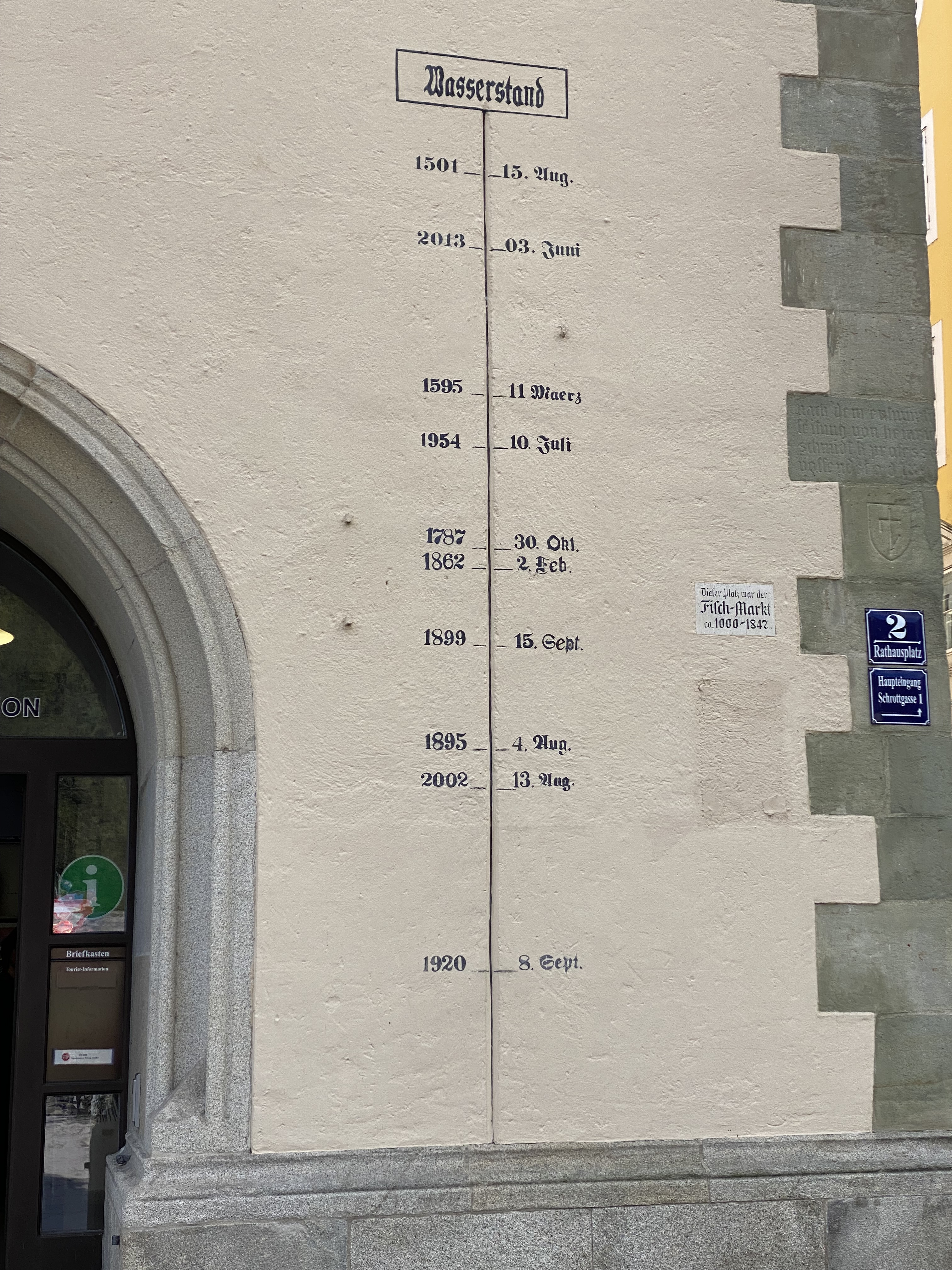
What you see in this photo is the high-water marks of historic floods. The marks are recorded on the City Hall, which fronts the Danube. You can see the marks in comparison to a lofty front door, about 10-12 feet high. The worst flood, it is believed, occurred in 1501. The second worst flood was in 2013, when the water level reached about 15′.

Our guide, a law student, said that all higher education in Germany is tuition-free. But you can’t be admitted without passing an exam. You pass more exams to check your progress. If you don’t pass the exam, you get booted out. Students who are committed to their education are likely to retain their places. Those who are not keeping up are at risk of being kicked out.

I learned that Germans put a high value on education. Parents can send their children to religious and private schools, but such schools must follow the same standards and curriculum as public schools. Home schooling is not permitted.

I asked about Jews in Passau, and our guide–a law student–said the Jews left Passau 500 years ago. Later, I googled and learned that in the fifteenth century, a petty thief confessed that he stole the Host and sold it to Jews. Ten Jews were accused of stabbing the Host until it bled. The Jews were tortured until they confessed, and they were put to death along with their accuser. In the aftermath, the synagogue and Jewish homes were burned. A few dozen Jews converted to Christianity, and the rest of the small Jewish community packed up and left Passau. https://www.jewishvirtuallibrary.org/passau

We visited the main church in town. It was stunning, a magnificent combination of gothic and baroque styles.

In the evening, back on our ship, an oompah band played, and it was delightful. I feel a keen sense of double identity, first, as an American enjoying their performance and singing along with familiar songs and polkas. (“I love to go a wandering, along the mountain track, and as I go, I love to sing, my knapsack on my back.”)

Yet as a Jew, I can’t help looking at these friendly, jovial faces and wondering whose grandfather was a Nazi. None of them? Maybe.

Mary says I’m obsessed with the Holocaust. I don’t think so. But to be in Germany and Austria is to be constantly reminded of the horrors that befell people whose only crime was to be Jewish.

Friday we visit the infamous Treblinka concentration camp in the Czech Republic. I will go there to honor the dead and to pray, “Never again.”

These are measures of how high the flood rose and the year in which it happened. The worst flood occurred in 1501. The second worst was 2013.

Our river cruise stopped in Linz (think Linzertorte, a busy industrial town, and we went by bus to Salzburg, the birthplace of Mozart. It is a beautifully preserved city, with a city center that has no autos, only bicycles and carriages. To call it spotlessly clean would be an understatement, although it’s full of tourists like us. Our guide was a charming woman who knew every last detail of “The Sound of Music.” She told us what the movie got right, what it got wrong. For example, when the Trapp family hikes off into the mountains to escape the Nazis, they were heading towards Germany! Oops, wrong direction. And of course, we had to see the beautiful church where Captain Trapp and Maria were “married.” Like so many churches in Austria, overflowing with beautiful ornamentation. We went to a beer garden for lunch, where we had weisswurst and beer. There are no high rises in the center, and the houses all look as though they were painted yesterday.

By the way, higher education is tuition-free in Austria and Germany but students must pass an exam to enroll.

Salzburg

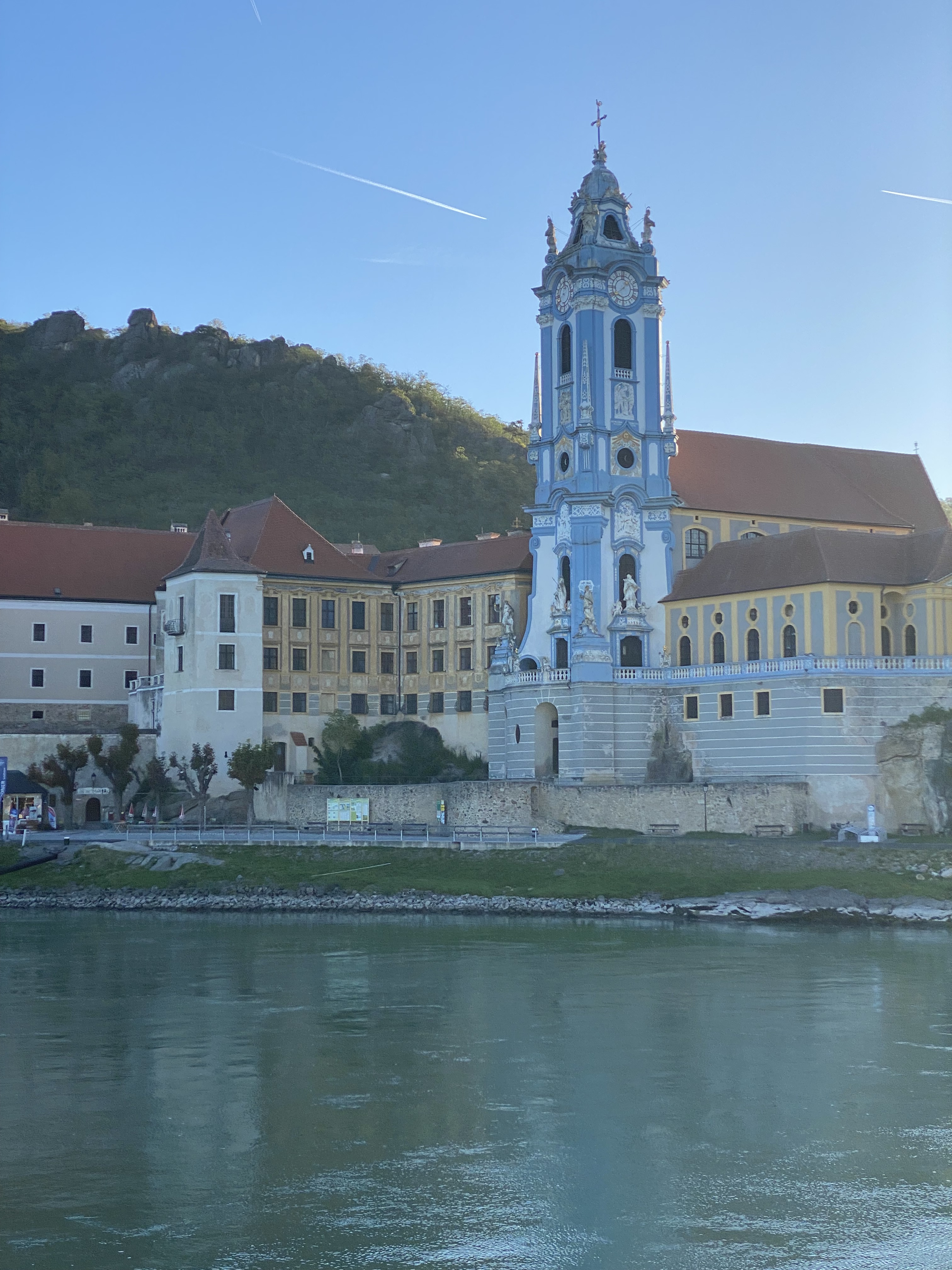
I have never been on the Danube before. We are on a river cruise that goes very slowly to interesting places in Austria and Germany. The photo here is Durnstein, a beautiful Austrian village. Here’s news: the Danube is not blue. It’s green. We expected cool weather but it has been 75-80 degrees every day (so far). Because of prolonged drought, our cruise will not make it to Nuremberg because the water levels are low. Today we went to Salzburg, which is a beautiful town with immaculate streets, beautiful churches, and lots of attention to native son Mozart.

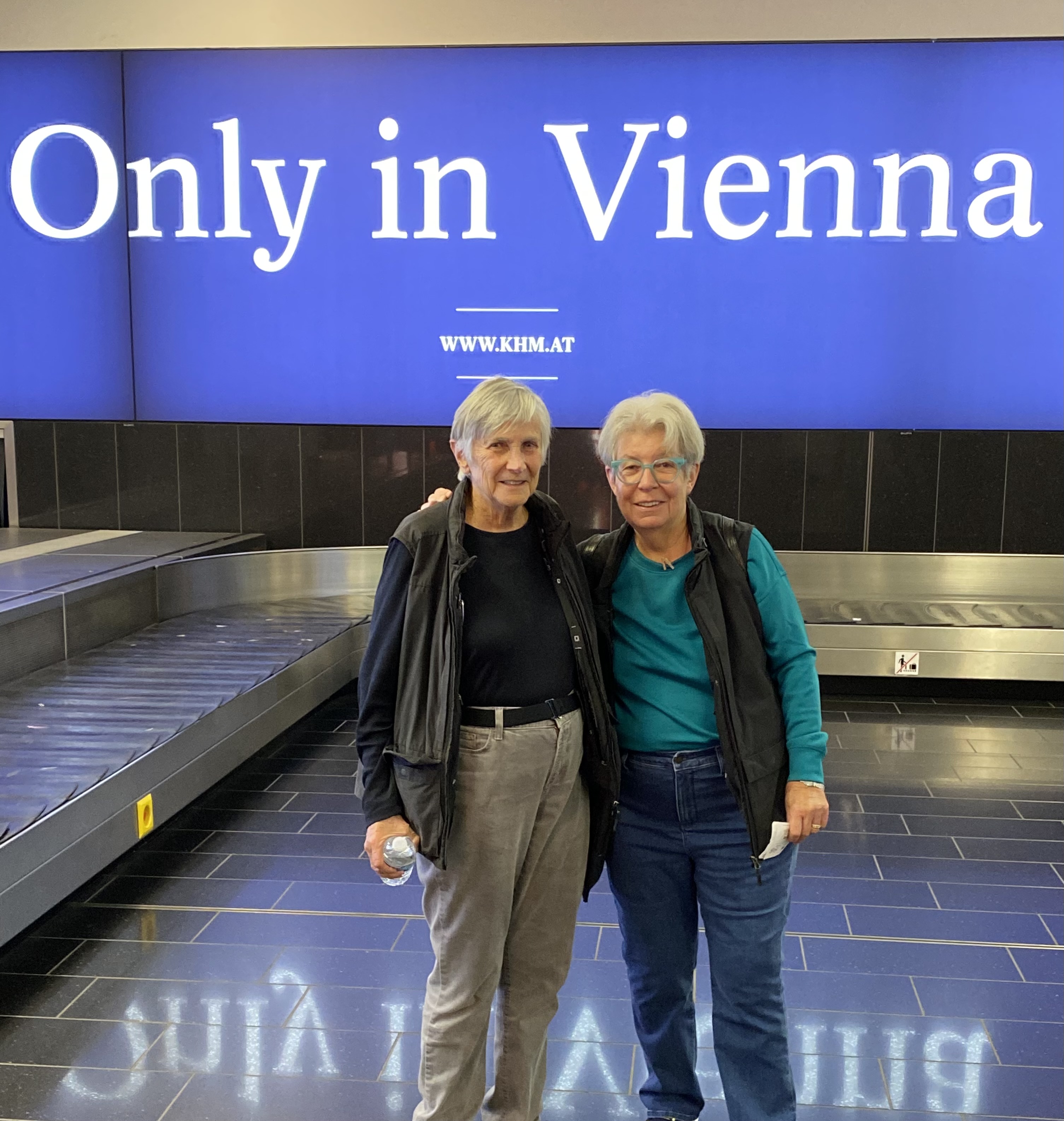
Hi! Just arrived in Vienna! 80 degrees here. The blogging will not be interrupted!

As longtime readers may recall, I started blogging in April 2012. At that time, I posted five times a day. Some days I posted even more frequently. Recently, I have reduced daily posts to three, with occasional increases for breaking news.

Starting today, I will post whatever I choose. Once, twice, three times. Or more. Or not at all.

Maybe nothing will change.

I don’t want to feel compelled to find something to fill a hole in the schedule.

As of this writing, the blog has had 40.8 million page views.

I have written more than 29,000 posts.

You have submitted nearly one million comments.

I will continue to read every comment.

Keep reading and commenting.