Archives for category: Ohio

Two years ago, the New York Times published a front-page story about the scandal of Ohio’s Electronic Classroom of Tomorrow (ECOT), which boasted “the largest graduation class in the nation” but also had the lowest graduation rate in the nation and referred to it as a “dropout factory.”

The article said ECOT was enriching its owner, not its students.

But while some students may not have found success at the school, the Electronic Classroom has richly rewarded private companies affiliated with its founder, William Lager, a software executive.

When students enroll in the Electronic Classroom or in other online charters, a proportion of the state money allotted for each pupil is redirected from traditional school districts to the cyberschools. At the Electronic Classroom, which Mr. Lager founded in 2000, the money has been used to help enrich for-profit companies that he leads. Those companies provide school services, including instructional materials and public relations.

For example, in the 2014 fiscal year, the last year for which federal tax filings were available, the school paid the companies associated with Mr. Lager nearly $23 million, or about one-fifth of the nearly $115 million in government funds it took in.

Dave Yost, the auditor for the state of Ohio, is running for State Attorney General. Recently, he has made much of his audits of the failed ECOT, which collected about $1 billion from taxpayers over its 18-year history but recently shut down when state audits revealed its inflated enrollments, and the state demanded repayment of $80 million.

The Democratic party of Ohio is calling out Yost for ignoring the ECOT scandals until this past year. Yost posted a “timeline” to show that he had been on top of the ECOT problem, but Democrats pointed out more than 20 omissions from Yost’s timeline.

Highlights from more than 20 omissions we identified:

*Yost’s timeline draws reporters’ attention to his 2015 and 2016 charter attendance audits. What it doesn’t say is Yost exempted ECOT and other e-schools from both efforts.
*Yost’s timeline does not include the three awards for bookkeeping the auditor gave the school.
*Yost’s timeline does not include the nearly $30,000 in campaign contributions he took from ECOT.

Innovation Ohio tweeted:

@innovationohio

As Dave Yost tries to mop up his disastrous handling of the ECOT scandal with his 7 years too late audit findings, see what he had to say just a couple years ago when he gave ECOT an ACCOUNTING AWARD for having “best practices in place” and having “no problems with the audit”

Betsy DeVos wants more ECOTs, more K12 Inc. online virtual charters. Study after study has shown that they are ineffective educationally but highly profitable. DeVos was an investor in K12 Inc., and probably divested when she became Secretary but whether or not she is an investor, she supports the online charter sector.


When I saw that the Thomas B. Fordham Institute was grading the education legacy of John Kasich, I knew we would not agree. Its report begins by crediting Kasich for copying Jeb Bush’s simple-minded letter grading for schools, which makes less sense than giving a single letter grade to a child. Kasich tried to wipe out collective bargaining but was rebuked by the public in a referendum. He has given free reign with little or no accountability to charter entrepreneurs and presided over scandal after scandal in the charter sector, currently, the $1 billion wasted by ECOT. He has been indifferent at best, but certainly hostile, to the very concept of public schools, whereas his state was once a leader in advocacy for excellent public schools. Like all rightwing Republicans, he pushed for vouchers, and Ohio has a voucher program for “poor kids trapped in failing schools.” Ironically, the Fordham Institute commissioned a study of Ohio’s voucher program, led by David Figlio of Northwestern University, which determined that students who enrolled in voucher schools fared worse than their peers who remained in public schools.

During the Republican primaries of 2016, Kasich posed as the “moderate” in the race, and compared to the others, maybe he was. My friends in New York couldn’t understand why I thought he was a rightwing ideologue, no different from Jeb Bush, but pretending to be the “adult in the room.”

Bill Phillis, the retired Deputy Commissioner of Education in Ohio, and founder of the Ohio Coalition for Equity and Adequacy, comments on the Fordham review of Kasich.

He writes (the comments in brackets are mine, not Bill Phillis’):

An April 17 Fordham review of the Governor’s education legacy shows Fordham and the Governor seem to be on the same page regarding education issues.
 
Fordham:
 
  1. The Governor established the A-F Report Card. Fordham laments that it is now in jeopardy. [My comment: good riddance to a dumb idea.]
  2. The Governor provided passionate support for the Third Grade Guarantee. Fordham says the jury is still out on the effects of it. [My comment: Holding back third-graders is a proven way of lifting your fourth-grade scores.]
  3. The Governor’s early efforts focused on lifting limitations on the creation of new charters and providing facility assistance, but then supported charter sponsor evaluations and additional charter school accountability. Fordham says charter accountability could be a lasting legacy for the Governor. [My comment: Charter accountability? That would be innovative.]
  4. The Governor attempted to eliminate public employee collective bargaining but failed. Then he championed Teach for America (TFA) and statewide teacher evaluations. Fordham wonders if these changes will last. [My comment: Swell idea to smash unions and introduce inexperienced, unprepared teachers who will leave in two years.]
  5. The Governor, early on, focused on expanding private school choice. Fordham laments that many of Ohio’s lowest income students have little opportunity to access private school choice. [My comment: Fordham funded research demonstrating that kids who use a voucher fare worse than kids in public schools.]
  6. The Governor eliminated the “evidence-based” school funding model. Fordham says the current school funding formula is a vast improvement over the evidence-based model. [Bill Phillis: Wow…how so? Me: Evidence and Kasich’s education policies have never actually met.]
 
Fordham relishes the fact that the money-follows-the-child idea is now an integral part of budget discussions.
 
Fordham, like Betsy DeVos, subscribes to the myth that school funds belong to the students-not the system-you know, the Ohio constitutionally-required system of common schools.
 
So what would be a great education legacy for a governor? A governor that would accomplish the constitutional requirement that the state secure a thorough and efficient system of common schools would go down in history as the “education” governor.
If you live in Ohio, you should subscribe to Bill Phillis’ newsletter.
William L. Phillis | Ohio Coalition for Equity & Adequacy of School Funding | 614.228.6540 | ohioeanda@sbcglobal.net| www.ohiocoalition.org


Stephen Dyer says there is now little or no question that crimes were committed by ECOT (the late, unlamented Electronic Classroom of Tomorrow).

Someone knowingly inflated enrollment to collect millions from the state.

Who done it?

“Because it now appears that we have a smoking gun indicating that officials at the Electronic Classroom of Tomorrow formed the necessary mens rea to be charged with crimes.

“According to an Associated Press story today (which ran all over the place, but I’ll link to my former employer’s version), people at ECOT — at one point the largest single school in the nation — were ordered to deliberately inflate enrollment so the school could keep getting paid $100 million plus to “educate” children, even if those children weren’t actually at ECOT.

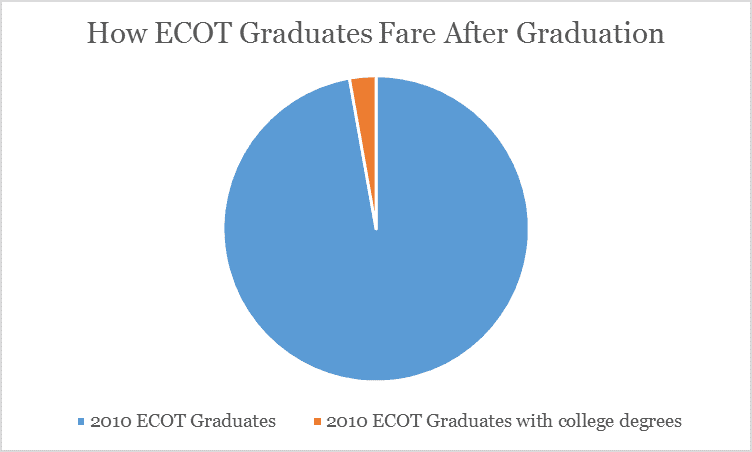
“ECOT infamously did a remarkably poor job of educating those who were, by the way. How poor? Only 109 of 3,794 ECOT graduates from 2010 earned a college degree within 6 years of graduating.”

B


Now, here is a startling and welcome development. Dennis Kucinich, who is running for Governor of Ohio, has proposed a complete ban on campaign contributions by charter operators. If charter operators couldn’t give campaign contributions, they would not be able to buy legislators or other state officials. Since public schools can’t make campaign contributions, that would level the playing field.

Are the voters of Ohio sick of charter corruption yet?

Charter school officials would be banned from making campaign contributions under a sweeping plan unveiled today by Democratic gubernatorial candidate Dennis Kucinich.

The former congressman and Cleveland mayor also wants a statewide vote on a constitutional amendment that would allow local school boards to decide whether they even want charter schools, which are privately operated but funded with taxpayer dollars.

“Ohio public educational funding has been subverted by special interest groups and for-profit charter school management companies, who through campaign contributions have, in the past decade, normalized the privatization of public education funding, creating an often substandard, for-profit system ‘education’ system, using and misusing billions of dollars in public funds,” Kucinich said.

“The normalization of what is essentially a wholly corrupt system constitutes one of the greatest scandals in the history of the state of Ohio because billions of public funds have been diverted away from public education and have enriched private, for-profit enterprises.”

He pointed to the founder of ECOT, the online charter school forced to close last month, who gave hundreds of thousands of dollars to state lawmakers who enabled lax oversight and the diversion of money from local school districts to charter schools.

“Any local school board member, member of the General Assembly, or employee of the Ohio Department of Education who accepts any payment, gratuity, or campaign contribution with a value of more than one dollar, or any pecuniary benefit in excess of one dollar from the operator of a charter school or on behalf of such entities will be subject to forfeiting any state benefit, including salary and pension,” Kucinich said.

He said he will ask the legislature to return to the public election of all members of the state school board, which was the case from 1956 to 1996, when governors were given the power to appoint several board members. Ironically, just two days ago Gov. John Kasich pushed to allow the governor to choose the entire board, because voters have no idea of for whom they are voting.

Kucinich pledged to “shine a light on the corrupt system that allows millions of taxpayer dollars to flow into the pockets of profiteering private charter operators, and then, into the political campaign coffers of politicians, all at the expense of local taxpayers, Ohio’s children, and quality public education.”

His running mate, Akron City Councilwoman Tara Samples, worked as a paralegal and board liaison for White Hat Management, long one of the state’s leading charter-school operators under Akron industrialist and major Republican campaign donor David Brennan.


A whistleblower informed state education officials that ECOT (the Electronic Classroom of Tomorrow) had used software that inflated its enroll,wants and its state reimbursements. He filed his complaint in early August but state officials ignored it until December.  

ECOT’s lobbyist disagreed.

“COLUMBUS, Ohio — Education regulators are reviewing a whistleblower’s claim that Ohio’s then-largest online charter school intentionally inflated attendance figures tied to its state funding using software it purchased after previous allegations of attendance inflation, The Associated Press has learned.

“A former technology employee of the now-shuttered Electronic Classroom of Tomorrow said he told the Ohio Department of Education last year that school officials ordered staff to manipulate student data with software obtained following the state’s demand that it return $60 million in overpayments for the 2015-2016 school year. He also took his claims to Republican Ohio Auditor Dave Yost, whose office said they were incorporated into a financial audit being prepared for release.

“The employee spoke to the AP on condition of anonymity for fear of professional repercussions for speaking out. His concerns were first raised in an Aug. 3 email to the state a month before it released its 2017 attendance review of ECOT.

“The state challenged ECOT over how it claimed student time using the new software, called ActivTrak, after finding that it duplicated learning hours, according to Education Department spokeswoman Brittany Halpin.”

ProgressOhio reported:

Columbus – Yesterday, the Associated Press reported that the Ohio Department of Education is reviewing allegations that the Electronic Classroom of Tomorrow (ECOT) deliberately inflated attendance records in order to get more money from the state. Though a whistleblower initially contacted the Department in August 2017, officials did not interview him until December.

“Manipulating attendance records is the cherry on top of ECOT’s cake of fraud that it keeps trying to serve Ohio taxpayers,” said ProgressOhio’s Monica Moran. “While taxpayers are happy to see that these claims are being looked at, it seems that once again the state is slow-walking the investigation. Ohio regulators cannot put their heads in the sand like they did for years while ECOT was still operating.”

From the report:

“A former technology employee of the now-shuttered Electronic Classroom of Tomorrow said he told the Ohio Department of Education last year that school officials ordered staff to manipulate student data with software obtained following the state’s demand that it return $60 million in overpayments for the 2015-2016 school year…

The whistleblower told the AP that the first run on the new software returned results showing students with just more than half the hours needed to justify ECOT’s full reported enrollment — and, with that, its full state payment. He shared his assessment with the Education Department’s top lawyer, Diane Lease, in an Aug. 3 email.”

Another perspective, taken from a personal email to me from a parent in Ohio, including the whistleblower’s letter:

http://www.wlns.com/ap-top-news/whistleblower-school-used-software-to-get-more-state-money/1135319359

In an Aug. 3, 2017, email, a whistle-blower who calls himself ECOT Voice sent explosive information to ODE Legal Counsel Diane Lease. He said ECOT implemented a new system to intentionally inflate its attendance and warned ODE to get back-up documentation of the attendance padding. Instead, ODE took ECOT’s word for the higher enrollment.

ECOT Voice urged the state to “demand clear documentation of the role of the ActivTrak software, how the data aggregation process distinguishes academic work from other use of the student computers, how much idle-time is allowed between verified student interactions, and how that data is used in relation to the other verified academic sources (the iQity Learning Management System, the Blackboard Collaborate online sessions, and other imported sources).

I have met with, and spoken to, ECOT Voice multiple times and verified his employment with ECOT. He said ECOT purchased new software from ActivTrak that allows the school count as classroom time anytime a window is opened on a student’s laptop. The whistleblower estimated that the new software allows ECOT to improperly collect an additional $10-20 million per school year.

It appears as if the “clear documentation” he urged Lease to obtain is readily available. I telephoned ActivTrack and spoke with both the salesman who handles the ECOT account and the CEO. They said ECOT purchased 20,000 copies of ActivTrak and provides ODE with two sets of reports: One that shows ALL time on the computer, another provides very detailed breakdowns of student activity.

We know that ECOT Voice’s warning was ignored because a Nov. 19, 2017, report in the Columbus Dispatch, states that ODE relied on ECOT’s attendance figures, clearly showing that the agency did not take ECOT Voice’s suggestion to “demand clear documentation of the role of the ActivTrak software….’’

From the Dispatch:

When the Ohio Department of Education audited ECOT’s attendance for a second school year last summer, the embattled online charter’s verified attendance went up more than 80 percent, and the amount it was forced to repay was $19.2 million, down from $60 million the previous year.

But documents show that the state used different methods during the second audit completed over the summer, as the two sides bickered over how to handle it. Instead of figuring out the attendance itself, as it had done in the previous year, the department asked the Electronic Classroom of Tomorrow on July 31 to compile computer records showing how many hours a year students performed classwork.

The process did not go smoothly. By mid-August, according to correspondence between the charter school and the department, the department was complaining to ECOT that “the manner in which the data was provided did not allow the department to validate the summary data” with ECOT’s underlying daily attendance records.

On Aug. 30, ECOT submitted yet more data that the state used “as the basis for the final determination.” In the end, the department signed off on the much-higher attendance number, but with the following caveat: “This final determination was based on the records provided by ECOT to the department,” Aaron Rausch, the department’s director of budget and school funding, wrote ECOT on Sept. 28.

Exactly what all this means about the independence of the latest audit is unclear. Neither Rausch nor department spokeswoman Brittany Halpin would answer questions about the most recent review, which ECOT will begin challenging before an arbitrator next month.

Here is the full email that warned of attendance padding:


From: ECOT Voice <ecotvoice@gmail.com>
Date: Thu, Aug 3, 2017 at 4:24 PM
Subject: ECOT Related Inquiry
To: Diane.Lease@education.ohio.gov

Ms. Lease,


I am a former ECOT employee who was referred to you by Tess Elshoff.  She declined to accept my approaching her due to pending litigation with ECOT.


As ODE is in the midst of evaluating the accuracy of reported engagement data from ECOT, I believe it to be an opportune time to express my concerns over the funding claims based upon that data. I am not an endorser of the change in how ODE is evaluating the services rendered and the resulting funding model change; nevertheless, I am also not supportive of claiming funds based upon suspect data.


While employed by ECOT (until July of this year) I had occasion to be present when strategies for calculating the per-pupil “educational opportunity” were considered, including various models tested by ECOT prior to submission.  The primary concern I would raise relates to how statistics were gathered that may not have sufficiently distinguished between non-academic and academic usage of systems, as well as the methods used to assess whether students were active or idle while logged on may have been overly generous in allocating classroom time during inactivity.


As I understand, the typical audit of selected students is unlikely to delve into the original source data used to determine the duration of student work sessions and the assumptions that may have been encoded in the processing of the raw data.  I would strongly advise that the audit process demand clear documentation of the role of the ActivTrak software, how the data aggregation process distinguishes academic work from other use of the student computers, how much idle-time is allowed between verified student interactions, and how that data is used in relation to the other verified academic sources (the iQity Learning Management System, the Blackboard Collaborate online sessions, and other imported sources).


While recent news reports indicate that a modest percentage of the audited students may have raised concern and identified need for further research, I am concerned that the scope of questionable data might be much larger.  Internal opinion at the time of my departure was that actual verifiable academic engagement is not likely to be much greater than 50% of the enrolled FTEs (a bit better than the 41% of last year) but that submitted data will represent a much higher funding rate than that — even on the order of 80% or higher.  A level many find difficult to believe.


Please consider this as a communication from a concerned citizen of the State of Ohio and forward its content as you deem appropriate for the purposes of completing an trustworthy audit of the public interest in charter school funding.


Regards,


E
 

Ohio testing is bogged down by failure of the online system supplied by vendor AIR. 

Can anyone remind me why everyone began switching to online assessment?

What was wrong with paper and pencil tests?

What was wrong with tests written by teachers?

How many billions have been wasted on testing in the past 20 years that could have been used to raise teachers’ salaries, reduce class size, repair buildings?


The Ohio State Senate wants to drop changes in test scores from teacher evaluations. However, the Cleveland district objects because the superintendent clings stubbornly to standardized tests of students as a reasonable measure of teacher quality. The fact that value-added measurement has flopped nationally doesn’t matter to him.

”District CEO Eric Gordon isn’t happy about the change and still wants to use test scores as a major part of teacher ratings. He looks at student scores — particular the “value added” measure of how much students learn in a year — as an important part of gauging whether teachers are doing well or not.”

Maybe no one told him that VAM is a sham.

Andrew Brenner is chairman of the House Education Committee in the Ohio Legislature. He hates public schools. He once referred to them as an example of “socialism.” He loves charter schools. Free enterprise! He was ECOT’s champion, the online charter that fraudulently inflated its enrollment and owes many millions to the state.

Brenner is now running for State Senate in District 19 in Delaware County. Take note if you are a parent or teacher.

The failed ECOT loved Brenner. It gave him lots of campaign $$$$.

Denis Smith details the love affair between Brenner and ECOT here. 


”The Youngstown Plan” was cooked up by corporate elites to strip democratic control from the people of the city and privatize their schools without their consent.

Bill Phillis of the Ohio Coalition for Equity and Adequacy writes:

“ The “Youngstown Plan” (HB 70) catches the attention of gubernatorial candidates

“Dennis Kucinich and Joe Schiavoni agree the legislation that removes boards of education from operation of school districts (HB 70) is bad public policy. Senator Joe Schiavoni has opposed HB 70 beginning with its morally-defective process of formulation, and passage. Dennis Kucinich proposes the repeal of this legislation.

“Not even the State Board of Education members were aware of this game-changing public policy until after the Governor signed the bill. This stealthy policy proposal became law in less than 24 hours after its introduction.

“Readers may recall the current Governor and the past Superintendent of Public Instruction; along with a half dozen or so Youngstown area folks, crafted this anti-democratic policy in dark underground chambers in the Mahoning Valley-away from public view.

“Now the boards of education for Youngstown and Lorain have been stripped of their rights to operate their respective districts.”

It is up to the voters of Ohio to stop this theft of democracy.

Stephen Dyer writes that ECOT will argue in court tomorrow that it should be paid for kids that were not there.