Archives for category: Ohio

Dan Greenberg is a teacher in Ohio and a member of the board of the Network for Public Education. He teaches high school English in Sylvania, in the northwest of the state.

Here he writes about the power of teachers, who are trusted by parents and the community to refute slanders about their schools.

He writes:

About a week before the November 2nd election, a colleague of mine sent me a picture of a campaign literature piece supporting candidates for school board in my community.

“Kids and Taxpayers FIRST! Keep ‘Woke’ politics out of our classrooms.”

The postcard was paid for by the NW Ohio Coalition for Public School Excellence, a group that was not only supporting conservative candidates in my community, but a neighboring community, with the exact same yard signs just different names.

Not to be outdone, the Northwest Ohio Conservative Coalition blanketed voters in my school district with robo-call messages telling voters to support the conservative candidates and “…keep woke politics out of the classroom.” The calls seem to go out indiscriminately; even the President of Democratic Club in my community received one.

These campaign tactics, filled with lies about schools teaching Critical Race Theory, had an interesting impact. I don’t know how much they motivated conservatives to head to the polls, but the group I saw them motivate most was the teachers. At a time when teachers are emotionally and physically exhausted, when they seem to be focused on making it through one day at a time, these campaign lies seemed to tap some reserve of strength and energy teachers did not know they had. Teachers started posting to social media, pushing back on the CRT lies. They started posting images of the four teacher union-endorsed candidates on their Facebook pages. They sent text messages to friends and family with the names of the teacher-endorsed candidates. One teacher even wrote a message across the entire back window of her van (in excellent teacher handwriting) telling community members to support teachers by voting for our endorsed candidates.

On November 2nd, as results came in the teacher-supported candidates were leading, and in the end, the four candidates in the two districts who were coming to the school boards with a priority of taking on “Woke politics” and Critical Race Theory lost.

The campaign money, the campaign literature, the yard signs, the robo calls… they could not beat the voice of teachers and the voice of truth.

Bill Phillis is a retired state deputy commissioner of education who is dedicated to the preservation and improvement of public schools in Ohio. He has dedicated his retirement years to publicizing the harm that vouchers and charters do to public schools. He founded the Ohio Coalition for Equity and Adequacy. The Ohio State Constitution guarantees a uniform system of public schools, a commitment that the Republicans who control the state have repeatedly violated with impunity.

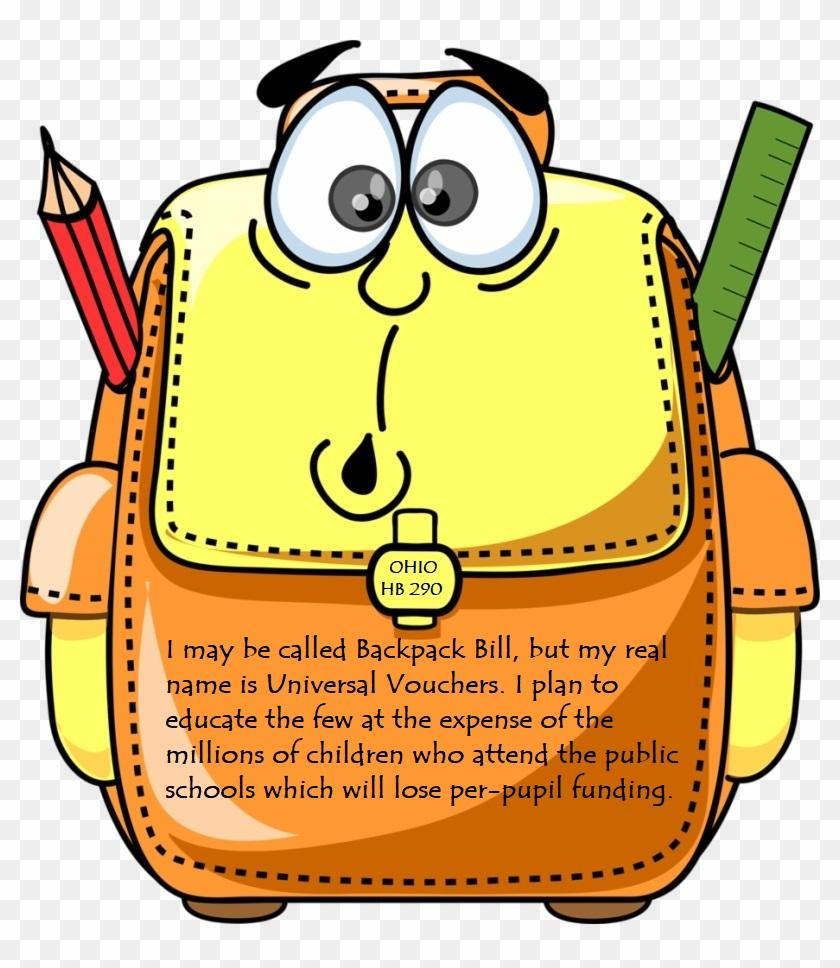
The latest gambit from the Republican privatizers called “the backpack bill,” symbolizing the idea that each child has a “backpack full of cash” to spend in any way their family chooses. They really need to see the wonderful documentary “Backpack Full of Cash.” You can rent the documentary and show it in your community.

Phillis writes:

THE OHIO UNIVERSAL VOUCHER CAMPAIGNERS USE CRITICAL RACE THEORY TO ENTICE FOLKS TO SUPPORT HB290 (UNIVERSAL VOUCHERS) IN A SLICK MAILER


The HB290 crusaders have produced and sent a fundraising mailer signed by one Aaron Baer to an undisclosed list of folks. The seven-page letter warns recipients that public schools are indoctrinating our children into radical anti-Christian ideology, “Critical Race Theory, and trans advocacy”. “They are being trained to hate America”, the letter says. They evidently combed through the classrooms of Ohio and found 4 students whose teachers were doing something that hinted at support for CRT or other controversial issues. They didn’t mention the 100,000 plus public school educators that are working selflessly to grow upstanding citizens.
The author of the letter makes such revealing statements as:

  • “…many of Ohio’s public schools have been failing our students for more than a generation.”
  • “…I initiated the Backpack Bill (HB290)…” (A couple legislators who sponsored the bill indicate they initiated the bill.)
  • “…The Backpack Bill ensures every Ohio student can have access to high quality education…”
  • The P.S. to the letter includes the statement, “Ohio students are trapped in failing public schools…”

The Backpack voucher campaigners are perpetuating the myth of the “failing public school monopoly” as a key plank in their campaign platform.

Public school advocates, who believe HB290 is too extreme to pass, need to wake up.

Follow the link to read the 8 Lies About Private School Vouchershttps://vouchershurtohio.com/8-lies-about-private-school-vouchers/

Like us on Facebook: https://www.facebook.com/OhioEandA


Photo Credit: Jeanne Melvin


The No Child Left Behind Act Has Put The Nation At RiskVouchers Hurt Ohio

William L. Phillis | Ohio Coalition for Equity & Adequacy of School Funding | 614.228.6540 |ohioeanda@sbcglobal.net| http://ohiocoalition.orgSign up for our newsletter!

The Republican war on “critical race theory” began in the closing months of Trump’s term in office, when he denounced it and called for “patriotic education.” One Republican state after another began passing resolutions and laws banning the teaching of CRT, which was interpreted to mean teaching about racism or anything that might make “some” children feel uncomfortable or be “divisive.” Teaching about the Ku Klux Klan or white supremacy apparently made some children feel uncomfortable.

Jan Resseger reports that the Ohio State Board of Education repealed a 2020 anti-racism resolution, since any such proposal are “divisive.” She goes into detail about the national reach of the Republican effort to eliminate anti-racist materials from the schools.

She begins:

Late on Wednesday night, the Ohio State Board of Education repealed Resolution 20, an important declaration passed in the summer of 2020 directing the Ohio Department of Education to establish staff diversity training and launch a curriculum review intended to reduce racism and bias in the state’s public schools.

The Columbus Dispatch’s Anna Staver reports: “Ohio’s State Board of Education repealed an anti-racism resolution Wednesday night and replaced it with one condemning any teachings that ‘seek to divide.'” Staver explains that the 2020 anti-racism resolution: “condemned hate crimes and white supremacy movements ‘in the strongest possible terms,’ but it also directed the Ohio Department of Education to teach its employees about implicit bias. Local school boards were asked to review their graduation rates, discipline records and classroom resources… Opponents… argued that (the resolution) opened the door for districts to teach ‘disturbing’ and ‘divisive’ material about racism and identity.”

State Board member Brandon Shea drafted Resolution 13, a counter statement which eventually passed but without some of Shea’s proposed language. Shea’s proposal, according to Staver’s report, “observed not only a growing national divide but a troubling focus on the color of one’s skin rather than on the content of one’s character.'” Shea’s proposal also condemned “critical race theory.”

While Staver reports that Resolution 13, as passed, removes the incendiary language about critical race theory, the replacement resolution condemns “any language that seeks to divide” and “any standards, curriculum, or training programs for students, teachers, or staff that seek to ascribe circumstances or qualities, such as collective guilt, moral deficiency, or racial bias, to a whole race or group of people.” This is, of course, language that conforms to the prescriptions of far right ideologues who want to protect the white majority from looking honestly at white privilege and examining the history of slavery and racism in the United States.

For The Intercept, Akela Lacy summarized the original July 2020 resolution which was rescinded on Wednesday night: “The resolution, introduced by board President Laura Kohler, acknowledges that ‘Ohio’s education system has not been immune’ to racism and inequality, and that ‘while we earnestly strive to correct them, we have a great deal of work left to do.’ It calls for the state education board to offer board members implicit bias training, programs designed to help people understand their own unconscious biases and the ways stereotypes can distort their beliefs; for all state Department of Education employees and contractors to take the training; for the department to reexamine curricula for racial bias; and for school districts to examine curricula and practices for hiring, staff development, and student discipline.”

As Lacy explains, ever since the original resolution passed, there has been an outcry from members of the public and a loud minority within the State Board itself complaining that the resolution constitutes “critical race theory.” Under pressure, the State Board finally asked Ohio Attorney General Dave Yost to determine whether the resolution is constitutional. He let the resolution stand, saying such a determination is outside his authority, except, he said, the State Board cannot impose these mandates on private contractors. For months, the resolution has been the subject of hearings in the Ohio House of Representatives’ State and Local Government Committee, where hundreds of educators and members of the public have offered testimony in favor of last year’s resolution. However, at one hearing, Lacy reports that one member of the State Board of Education, Diana Fessler, openly defended white supremacy.

It would be one thing if this sort of battle were happening only in Ohio’s state board of education, but instead the same fight is being reported in local school boards all across the country. And the arguments and downright fights are highly politicized. In the Washington Post, Adam Laats reported: “Conflicts (have) roiled school board meetings across the country, over a range of hot-button issues: masks, vaccines, policies for trans athletes, Critical Race Theory. The conflicts moved past yelling, to lawsuits and demands for recalls—and not just of individual members but entire boards. Over and over again, local school board meetings have turned from staid discussions of budgets and staffing to heated ideological forums, hosting a go-nowhere series of fights that have little to do with the actual needs of the local schools. Conservative pundits have talked up these confrontations as part of a larger political strategy… Why have school boards become ground zero for these aggressive ideological skirmishes? Quite simply: They are accessible. Most meetings are open to the public, in local town halls or school district offices; their members are local volunteers, who usually have no campaign war chests or partisan election support… And if school board meetings are disrupted, members recalled, teachers threatened, students intimidated, it is that much harder for schools to function and children to learn.”

Open the link and read on.

PRESS CONFERENCE ON UNIVERSAL VOUCHER BILL: 11:00 A.M., WEDNESDAY, OCTOBER 6

We have been warning the public school community and other Ohioans that the goal of voucher advocates has nothing to do with “rescuing poor kids from low performing school districts”; it is to give each kid a voucher. Fund the kid, not the system. Tune into the press conference to hear a universal voucher pitch first hand.

https://www.ohiochannel.org/

COLUMBUS – State Reps. Marilyn John (R-Richland County) and Riordan McClain (R-Upper Sandusky) will host a press conference on Wednesday, October 6th to announce new legislation known as the Backpack Bill. House Bill 290 will extend school choice to all students throughout Ohio, which will expand their educational opportunities.

During the press conference, the representatives will announce a sub-bill to HB 290. This very important legislation strives to ensure that Ohio maintains strong funding for public and private schools while also cultivating innovation and opportunity for all of Ohio’s children.

WHO: State Rep. Marilyn JohnState Rep. Riordan McClain

WHERE: Ohio Statehouse, Netzley Press Room,1 Capitol Square, Columbus, OH 43215

WHEN: Wednesday, October 6, 2021, at 11:00 a.m.

https://www.ohiochannel.org/


The No Child Left Behind Act Has Put The Nation At Risk

Vouchers Hurt Ohio

William L. Phillis | Ohio Coalition for Equity & Adequacy of School Funding | 614.228.6540 |ohioeanda@sbcglobal.net| http://ohiocoalition.orgSign up for our newsletter!

Denis Smith worked for many years in the Ohio State Department of Education, finishing his career in the Office of Charter Schools. He writes in the Ohio Capital Journal about the existential threat posed to our democracy and our society by the privatization of public schools. His advice: Be careful what you wish for.

In the last few months, Americans have witnessed a series of assaults by the political right on key parts of the bedrock principles of democracy. Those attacks include new restrictions on voting rights in more than half of the states, the storming of the U.S. Capitol on Jan. 6 by thousands of insurrectionists, and most recently, clear evidence that the former president pressured the top leadership of the Justice Department to help him overturn the 2020 election results.

Certainly these scary developments are newsworthy and have garnered banner headlines and filled airtime on the evening news. But these high-profile assaults on our democracy have served to obscure another, perhaps even more serious threat, an added variant and supplement to the seditious behavior of insurrectionists and a twice-impeached president who encouraged their assault on democracy.

In the midst of the chaos caused by angry militia types working to keep in power a rogue administration, and being mindful of the distraction these events have caused, it’s past time to get educated about the future viability of public education.

While the U.S. Capitol was placed under assault some months ago, public education has been targeted for forty years, when Ronald Reagan signaled his followers that the public sector was undesirable and that private enterprise was always preferable in the nation. His attitude was immortalized in his remark that “the nine most terrifying words in the English language are ‘I’m from the government and I’m here to help.’”

This observation has been interpreted by the right as a command from Reagan himself to privatize about everything in the public sector — except the military — as part on an ideology which holds that a private enterprise is always preferable to a public function. That thinking has morphed into a crusade to destroy perhaps the most recognized and common artifact in any community: the public school.

Individual liberty v. community responsibility

For those who know this institution’s place in American history, the terms public school and common school are used interchangeably, and the leading proponent who believed that every community should offer a program of education was Horace Mann, considered the father of American public education. In his role as the first commissioner of education in Massachusetts, Mann believed that “education should be free and universal, nonsectarian, democratic in method, and reliant on well-trained professional teachers.”

As Mann’s nineteenth-century idea of the common school spread across the new American Republic, in villages, small towns and cities where a community’s shared and accepted values were honored and embraced, the little red schoolhouse became an icon, the force that helped to mold the very idea of community.

That was the America we recognized until several decades ago.

Today, attacks by insurrectionists attired in their cammies and state legislators dressed in business suits are hard at work to undermine that very sense of community, of place. Instead of embracing the idea of place, the community and its schools which educated generation after generation, those same legislators mumble vaguely about something they call “socialism” or “government schools” and instead espouse something else called “educational choice.”

That word choice, used often in the same sentence with freedom, serves as the anti-government elixir peddled by legislators to further encourage insurrectionists and religious zealots who do not accept the idea of community – and its public or common schools.

And with the frequent use by the right of such terms as choice, freedom, and liberty, that tattered social fabric we should be concerned about is worn down even more.

Indeed, words – particularly those three – have consequences.

Several years ago, the New York Times columnist David Brooks critiqued the work of author Marcia Pally, who observed that Americans project a prominent duality – a need to explore as well as be “situated” – i.e., having a sense of community. But today, our very sense of community is under stress, a weakened social fabric fueled by politicians who in their continuing mischief and purposeful vandalism promote divisive policies that result in the transfer of public funds away from our common schools to support private, religious, and charter schools.

In spite of these destructive policies adopted by state legislatures that are antithetical to societal cohesion, the need for community comes at the very time, in Pally’s analysis, when the forces of global migration, globalization, and the internet are proving to be transformative and thus challenge the very idea of community, of being situated.

But it was Brooks’ added observation that a fourth force, in the form of individual choice, gained my attention then and now, particularly in the current and growing national atmosphere that proclaims it’s all about me and my freedom to choose, regardless of compelling community needs, including health, safety, and the transmission of a common cultural heritage, as Horace Mann, John Dewey, and other visionaries labored to establish in another, more unified time in our history.

The byproduct of this thinking — that it’s all about me — centered as it is on the individual and not the community, is seen in both the Capitol insurrectionists and the anti-vaxxers. These protesters are seemingly also armed with the idea that personal freedom and individual choice trump any responsibility in caring for the well-being of others, whether by wearing a mask or being vaccinated against COVID.

To hell with elections. It’s all about me and what I believe, we are being told by those who protest the warnings of scientists and public health experts. And to hell with masks and vaccinations. We don’t need tyranny, they tell us.

And while we’re at it, to hell with the idea of community. When it’s all about me and what I believe, there is no room for what you value.

It doesn’t take many dots to connect this thinking with the deterioration of the idea of community, of being situated, and of having common values like the public schools that were created to serve all the youth in a particular community. We hold that truth (or should we use the past tense now?) to be self-evident. Not.

But in all of this, of slogans like freedom and choice, be careful what you wish for.

In my reaction to Brooks and his review, I wrote this in April 2016:

“…how we preserve freedom serves to illustrate the certainty of unintended consequences for conservatives, viz., how can you promote the concept of choice, particularly educational choice, as a desired public policy outcome, while also warning about weakened community cohesion and a frayed, tattered, strained social fabric”?

Five years later, I stand by those words. In light of recent events, that strained social fabric is even more fragile, and approaching an irreparable state of repair. It follows that with such disrepair, the idea of community in this country may soon be on a ventilator.

Cookie-cutter legislation

The enemy, it seems, is within. We witnessed this bashing of democracy with the images of militia-types beating police with flagpoles. Another version of that assault is the introduction of cookie-cutter legislation, some of which was crafted by the Koch-funded American Legislative Council, which exists to destroy education by taking the word public out of it, and replacing elected local school boards with charter schools whose boards are hand-picked by for-profit chains rather than being elected by voters in a community.

When state legislators vote to create educational vouchers that subsidize private and religious school tuition with public funds, they are making a decision to support schools that often teach content that has not been subject to a thorough review process, as public schools are. By contrast, vouchers mean that students can now be attending schools, free from state regulation, that may not even teach science or other subjects, or use instructional materials that do not support appropriate knowledge about our world.

The image of a caveman and a dinosaur, coexisting in an earlier time, as displayed in a Kentucky museum, comes to mind. It’s not too hard to imagine that under a voucher scheme, if a church affiliated with the museum operated a school and offered a curriculum in line with such a view, it could be eligible for state educational choice dollars.

Yes. Your tax dollars. And mine.

But where is the proper public purpose for taxpayer support of such an imagined school? Right now, for example, the proposed expansion in some states including Ohio of so-called educational choice vouchers to religious schools could make such situations possible in the future. One wonders what would happen if private and religious schools would first be required to agree to a set of very detailed assurances, including the teaching of specific courses of study consistent with the curricular offerings of local public schools, before receiving any state funding in the form of educational vouchers.

I think we know the answer to that. It’s called having it both ways – getting public money with no accountability and no strings attached.

The purpose of public schools

And then there is the subject of citizenship and our common heritage. Besides its purpose to produce skilled and literate individuals, public schools have also been charged to prepare young people to be caring and ethical citizens. By contrast, it can be argued that with private and religious schools, their own unique missions may not place civic-related ideals in the top rank, but instead subordinate civic education and awareness to a more narrow or sectarian purpose that mirrors the defining purpose of the school.

But if in the name of freedom and educational choice there is already enough concern about the use of public tax dollars to help fund private, religious and charter schools and thus undermine public education, weaken our democracy, and further damage our social fabric, there is yet another problem created by the actions of state legislatures to fund religious schools through vouchers.

It’s the Establishment Clause.

A product of The Enlightenment, the First Amendment’s Establishment Clause was crafted by the nation’s founders, who knew that religious wars had consumed Europe in the centuries preceding the American Revolution. Currently, in my home state of Ohio, a coalition of school districts is preparing a court challenge to check the legislature’s intent to expand the state’s voucher program as not only a violation of the constitutional prohibitions against supporting sectarian schools but also a violation of the Ohio Constitution’s purpose to establish a “system of common schools.”

I trust that this language from the Ohio Constitution is illustrative of how other states establish a system of public education.

[Article VI, Sec. 2 Education] The General Assembly shall make such provisions, by taxation, or otherwise, as, with the income arising from the school trust fund, will secure a thorough and efficient system of common schools throughout the State; but, no religious or other sect, or sects, shall ever have any exclusive right to, or control of, any part of the school funds of this State.

Certainly, private and religious schools do not meet the definition of a common school that must be supported by public funds, yet in the name of educational choice there is a nationwide movement to expand voucher programs that will support private and religious schools, in spite of any Establishment Clause violation and other legal prohibitions.

So we return to the purpose of the common school as a unifying force to build community and not be a dividing force, as private and religious schools will be, if they are put on an equal footing with public education through support with public funds.

If all of these issues might seem to be troublesome, there is one which will likely prove to cause the most damage: How can you maintain the concept of E Pluribus Unum when public policy seems poised to support all types of schools and thus erode the idea of the common school, in this case the Unum in our national motto, as the essential driver to ensure that children who come from many backgrounds form a single nation through our common schools?

Indeed, we know that the mission of public education is to prepare young people to be skilled, literate, and ethical citizens. But that’s only part of it.

Let’s take a look at the Unum part of the equation. In an essay about the role of public education written two decade ago, Kenneth Conklin, a Hawai’i philosophy professor, raised some concerns about how a fragmented educational system can itself cause a fragmented society.

“If an educational system is altered, its transmission of culture will be distorted,” Conklin wrote. “The easiest way to break apart a society long-term without using violence is to establish separate educational systems for the groups to be broken apart.”

Public tax dollar support of private, religious, and charter schools clearly represent the establishment of separate educational systems. Such tax support violates the very idea of Horace Mann’s common school, the very image of democracy in every community.

Conklin provides some additional advice for us to consider:

“A society’s culture can survive far longer than the lifespan of any of its members, because its educational system passes down the folkways and knowledge of one generation to subsequent generations. A culture changes over time, but has a recognizable continuity of basic values and behavioral patterns that distinguishes it from other cultures. That continuity is provided by the educational system.” (Emphasis mine)

What’s next?

We’re in trouble. A community thrives on consensus, of shared values. The actions of agents of disinformation spreading lies about vaccines have undermined confidence in science and public health. And if we lose a consensus about public education and the shared values it represents, we have lost our democracy.

But there is hope.

In reaction to this assault on public education in Ohio, a group of 85 school districts have joined to challenge the intent of the Ohio General Assembly to greatly expand the Educational Voucher program and put private and religious schools on an equal footing to receive tax dollars siphoned away from constitutionally established common schools. Their position is that Article VI of the Ohio Constitution makes no provision for publicly supported but parallel and competing forms of education supported by public funds.

The Ohio Coalition for Equity and Adequacy of School Funding, which was itself established twenty-five years ago to ensure fair state funding for school districts irrespective of wealth, is facilitating the legal efforts of districts in challenging the constitutionality of educational vouchers and the blatant violation of the Establishment Clause in establishing funding for religious schools. With so much at stake for future state funding of public school districts, more districts are expected to join this lawsuit in the coming weeks

So what is the lesson to be learned from public support of private and religious schools, along with the privatization of what is left of public education?

Be careful what you wish for.

If you think freedom and choice are the purest ideals to possess and not a sense of community to hold us together, most prominently seen in our public schools, think again. Every vote in every state legislature to offer or expand choice in the end represents a choice for disunion, for a fragmentation of our cultural heritage, a basis for community – and our very nationhood.

We are on the brink. If there is not a counter-movement to roll back this destruction of our communities by the Ohio General Assembly through the planned destruction of the common school, we will get what we deserve.

Yes, be careful what you wish for.

Accurate link: https://ohiocapitaljournal.com/2021/09/16/public-schools-vouchers-privatization-and-educational-choice-be-careful-what-you-wish-for/
Bill Phillis of the Ohio Coalition for Equity and Adequacy of School Funding is a champion of public schools in a state with many charters and vouchers.

He writes:

A primary purpose for the creation of the common school system for all the children of all the people was to maintain a republican form of government. Knowledgeable people in unity with one another will ward off tyranny, in favor of liberty and equality. A virtuous government operating for the common good is the goal.

Common is a term of art that has universally-accepted meaning. As applied to school, it indicates a place or institution that serves all children free of charge, paid for by taxation. It relates to the community at large, in a symbiotic relationship.

Common means “belonging to all, used jointly, shared by all.” The “common” system is required by the Ohio constitution, and the “system” must be thorough and efficient.

Tax-supported vouchers and charters are foreign to the common school system required by the constitution. They are not only foreign to the system, but are parasitical in taking funds away from the common system. These schemes divide, rather than unite. They serve not all, but selected students. Their goal does not necessarily match the goal of the common system—to maintain the republican form of government. Their relationship to the community is often strained or non-existent, as opposed to symbiotic.

The No Child Left Behind Act Has Put The Nation At Risk

Vouchers Hurt Ohio

William L. Phillis | Ohio Coalition for Equity & Adequacy of School Funding | 614.228.6540 |ohioeanda@sbcglobal.net| http://ohiocoalition.org

Jan Resseger explains how the Ohio legislature, which is devoted to charters and vouchers, managed to cheat districts like hers while boasting about “fair student funding.”

In the new state budget, the Ohio Legislature supposedly fixed an inequitable scheme for funding the state’s extensive private school vouchers. But it was a bait-and-switch. Public schools were losers, especially in poor districts.

With the Ohio Legislature, Even When You Win, You Lose

In 2005, Ohio launched a new voucher program to “save poor kids from failing schools.” The voucher program served 3,000 students and cost $5 million.

Now the state’s voucher program serves 69,000 students and costs Ohio taxpayers $628 million annually. Voucher advocates want more.

The legislature continually rewrote the rules for eligibility to expand the number of students who can get a voucher.

At first, only students assigned to schools in “academic emergency” – the state’s lowest rating – for three consecutive years could apply for a voucher.

A year later it became schools in either academic emergency or academic watch for three years. Six months after that, the requirement dropped to two of the last three years.

In 2013, lawmakers created an income-based scholarship for all kids regardless of their home district. Then, they removed the requirement that kindergartners be enrolled in their local public school first and later expanded it all the way up to high school students.

Today, roughly half of Ohio’s families are eligible for an income-based voucher because the limit for a family of four $65,500 of annual household income.

Not many children are being “saved.” Most voucher schools perform worse than the public schools that the students left.

Most kids who use EdChoice scholarships perform worse on state standardized tests than their public school peers, a 2020 investigation by the Cincinnati Enquirer found. null

In 88% of Ohio cities where vouchers are used, the data showed better test results for the public schools. And when it came to Ohio’s eight largest cities, five of the districts (Akron, Canton, Cleveland, Toledo and Cincinnati) reported higher proficiency levels.

Akron City Schools had the biggest difference, scoring nearly 8 percentage points higher than the private schools in its area.

Public school advocates say that’s because many of the schools on the voucher list aren’t failing. The criteria for getting on the list is wrong, not the schools.

The goal of voucher advocates is not to “save poor children from failing schools,” but to transfer public funds for parents to use at private and religious schools, even though their public schools are better.

Jan Resseger writes here about the tussle in the legislature over the Ohio education budget. Funding was increased for public schools, but funding for charters and vouchers was also increased. And taxes were cut. Republican supporters of public schools saved the day from the voracious privatizers, led by Andrew Brenner, who is hostile to public schools.

Resseger writes:

The Ohio Constitution defines public schools as an institution embodying our mutual responsibility to each other as fellow citizens and to Ohio’s children.  The budget conference committee’s restoration of the Fair School Funding Plan, even if limited only to the upcoming biennium, will restore adequate funding to the schools that serve our state’s 1.7 million public school students and will significantly equalize children’s educational opportunity across our state’s 610 school districts.

However, the expansion of vouchers and charter schools opens the door for future growth of school privatization.  Ohio’s parents and citizens who believe in a strong system of public education will have work to do to preserve the Fair School Funding Plan beyond the current two-year limit and to prevent the rapid expansion of vouchers and charters at the expense of public schools in future state budgets.

This post appeared on the Network for Public Education website.

Paul Huang and Olivia Peebles: It’s time to pass a Fair School Funding Plan

This op-ed from Cleveland.com was written by a pair of students from Shaker Heights High School. Paul Huang is a senior; Olivia Peebles in a junior. Both are members of the Shaker Heights High School Student Group on Race Relations. In this op-ed, they lay out a defense of their high school against Ohio’s flawed school rating system.

In Shaker, we are fortunate to have educational opportunities ranging from honors courses and AP/IB classes to vocational training. We are also fortunate to have an administration and staff that strives to close achievement, opportunity and wealth gaps that stem from systemic racism.

Yet the Shaker Heights City School District has three so-called “failing” schools and received an overall “C” average on the Ohio Department of Education’s annual report card.

The school report card is based heavily on standardized achievement data, which is linked to socioeconomic status. Standardized tests do not consider the specific challenges some districts have, such as high poverty.

Schools with larger numbers of Black and brown students or children whose families have low incomes are more likely to be deemed “failing.”

The report card also grades districts on closing a “racial achievement gap,” without considering the opportunity barriers communities of color face due to years of segregation, discrimination and exploitation.

When the state considers a school to be “failing,” it can send the district’s funding to private schools via vouchers. This gap-closing metric actually widens achievement gaps by underfunding the schools that need extra resources to close them.

Read the complete op-ed here.

You can view the post at this link : https://networkforpubliceducation.org/blog-content/paul-huang-and-olivia-peebles-its-time-to-pass-a-fair-school-funding-plan/