Archives for category: New Orleans

This article in The Nation by Casey Parks tells the story of Sci Academy in New Orleans and the lessons it learned over time about making bold promises.

The school pledged that all its students would go to college and encouraged them to apply to four-year colleges that were outside their comfort zone (not close by and predominantly white).

In 2012, almost all of its graduates were accepted to colleges. By 2019, only 18% had graduated from college.

Parks describes what happened to some of Sci’s top students.

Only months after starting college, some students dropped out.

Most couldn’t point to just one reason for their decision. Some missed their families or needed to find jobs to pay for gaps remaining after their scholarships. Students who enrolled in a North Louisiana university found that the food was too bland. No other place in America is like New Orleans—not even North Louisiana—and it hurt too much to lose the city again after they’d been displaced by the hurricane. Others grew unfocused after they left Sci’s scaffolds.

Some earned their first Fs, and the failures depressed them. Eddie Barnes had been one of Sci’s most celebrated students. He finished with the fifth-highest GPA and won nearly every social accolade the school gave out. He went to Middlebury College, a selective school in Vermont, where only 4 percent of students are black.

His Russian intro class was tougher than advanced Spanish had been at Sci, and he couldn’t always bring himself to trudge through the snow to his 8 am psychology class. But he spoke up in his romantic literature course, and he helped other students with their African American religious history papers. Still, none of that mattered after his grades came back lower than he’d expected. By his second semester, he was on academic probation. He dropped out during his sophomore year.

Sci Academy tried to help students as they struggled. Its founder, Ben Marcovitz, realized that he needed a more diverse staff to connect with students. He also realized that some of his students were not equipped to succeed in the nation’s most competitive colleges. He even realized that college was not the right destination for everyone, and that some would find fulfilling careers and vocations without a bachelor’s degree.

Only six of Sci’s first graduates finished college within six years, the federal standard for on-time graduation. Three others earned degrees this year. Though eight, including Pierre, are still working toward a degree, 32 of the 49 who enrolled in college have dropped out.

Collegiate Academies is the only charter network in New Orleans that has publicly shared its college persistence results. Most of the city’s charter high schools don’t track the number of alumni who go on to earn bachelor’s degrees, and KIPP New Orleans, the one network that does, declined to share its data. KIPP’s first graduating class from New Orleans has been in college for only five years, shy of the federal cutoff for on-time graduation. But researchers at the Education Research Alliance for New Orleans, a Tulane-based organization that studies post-Katrina education reforms, found last year that the new high schools have increased college graduation rates by 3 to 5 percentage points since Hurricane Katrina. None have come close to achieving the college for all they once promised…Over time, Marcovitz has hired a more diverse teaching corps. That first year, only one of seven teachers identified as a person of color. Today, more than half of the 140 teachers who work at his schools do.

This is not a story about charter failure, but a story about lessons learned.


New Orleans is supposed to be the lodestar of the Corporate Reform Movement (or as I call it, the Disruption Movement), but the experiment in privatization is a costly failure, as Tom Ultican demonstrates in this post.

The old, underfunded school system was corrupt and inefficient. The new one is expensive, inefficient, and ethically corrupt because of its incessant boasting about what are actually very poor results.

Comparisons between the old and new “systems” are dubious at best because Hurricane Katrina dramatically reduced the enrollment from 62,000 to 48,000. As Bruce Baker pointed out in reviewing a recent puff study, concentrated poverty was significantly reduced by the exodus of some of the city’s poorest residents, who resettled elsewhere.

Ultican cites Andrea Gabor’s studies of the New Orleans schools to show that the lingering heritage of segregation and disenfranchisement has been preserved in the new all-charter system. The schools that enroll the most white students have selective admissions and high test scores. The majority of schools are highly segregated and have very low test scores.

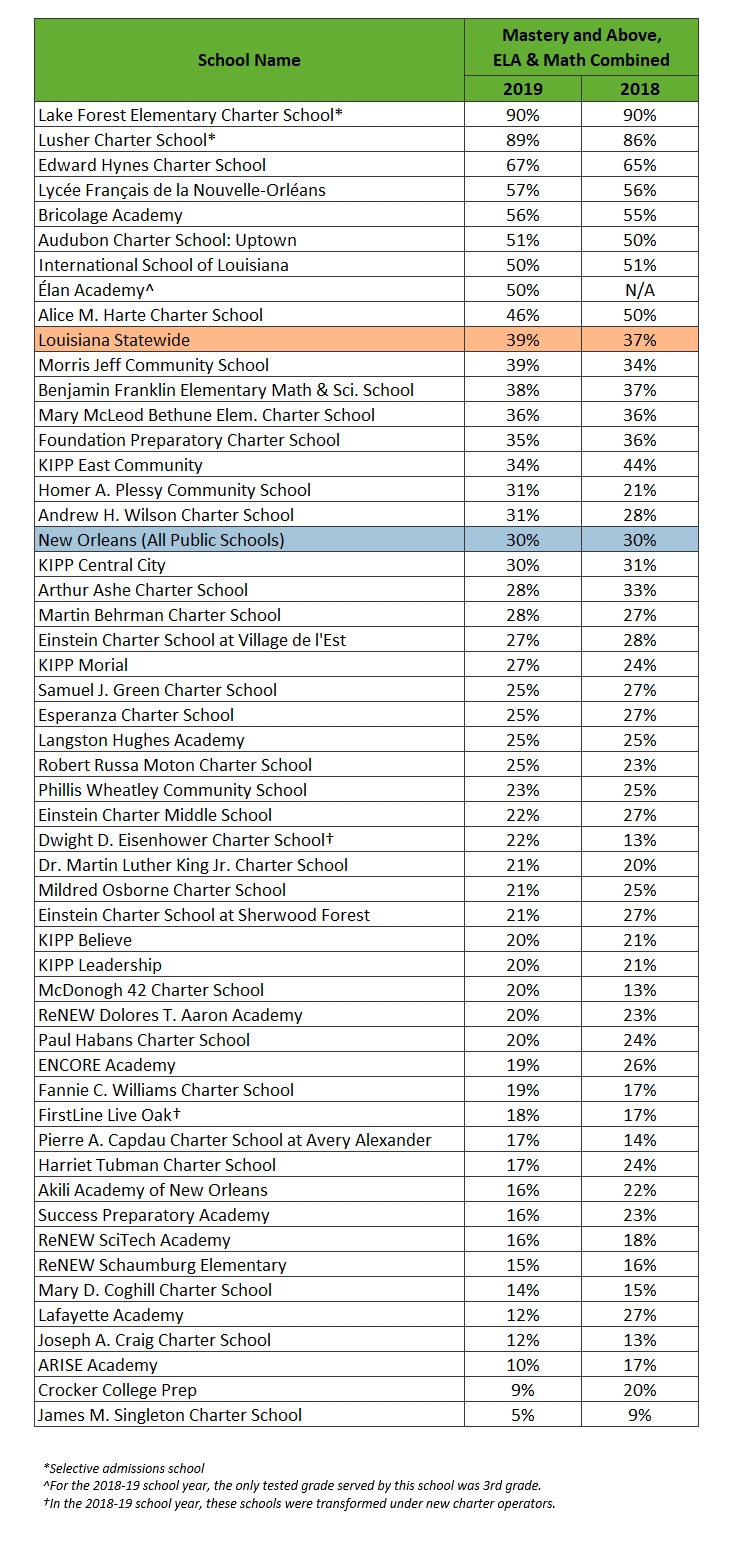
Be sure to open this link and scroll down to “Individual School Performance,” where you will see that the majority of charter schools in BOLA perform well below the state average.

Do not look to New Orleans for lessons about school reform. But do admire it as a shining example of propaganda and spin paid for by Bill Gates and other billionaires who don’t like public education, democracy, or local school boards.

Louisiana will hold elections for its state Board of Elementary and Secondary Education on October 12. This year, as in the past, out-of-State billionaires are spending heavily to keep control of the state board to promote privatization policies. During the tenure of State Superintendent John White, a former deputy to Joel Klein in New York, the state’s ranking on the National Assessment of Educational Progress (NAEP) Is near the absolute bottom in both mathematics and reading, in both 4th and 8th grades. New Orleans has gone all-Charter and its score are in the bottom third of the state’s districts while its schools are highly segregated and stratified. This much is clear: Disruption has won control of the state board but done nothing to improve education.

BESE recommendations from veteran educator Michael Deshotels –
 
Dear Friend of Public Education:
 
With just a few days left before the election of a new BESE, you can help restore sanity and independence to our State Board of Education.
 
Out of state donors are making huge contributions to elect candidates that LABI  and John White will totally control. You will surely see their ads in your mailbox and on radio and television. Do not be deceived! These are not friends of public education. They will be committed to John White,  school privatization, obsessive testing, crushing test prep., etc.  But the results of these so called reforms have been terrible using the very measures they (the reformers) think are so important; Our ranking on NAEP is the worst ever! Why would we want to continue failed policies? Just so that LABI never has to admit that they were wrong, that they know noting about education, and that our students are suffering instead of thriving because of their takeover of education?  See this latest post on my blog. http://louisianaeducator.blogspot.com
 
Here is my abbreviated voting guide listing independent minded, solid public education advocates. Please do your best to get them elected!
 
District 1: including St. Tammany and Jefferson. I recommend Lee Barrios
 
District 2: including Orleans, St. Charles, St. John, St. James and part of Assumption: I recommend Dr. Ashonta Wyatt
 
District 3: including St. Bernard, Plaquemines, Lafourche, Terrebonne, St. Mary, Iberia, St. Martin, part of Iberville and part of St. Landry: I recommend Janice Perea.
 
District 5: including Northeast LA and down to Rapides and Evangeline Parishes. I recommend Dr. Stephen Chapman
 
District 6: including EBR, Livingston, Ascension, Tangipahoa, and Washington Parishes. I recommend Gregory Spiers
 
District 7: including Southwest LA. I recommend Timmie Melancoin
 
District 8: including part of EBR, East and West Feliciana, St. Helena, Iberville, Pointe Coupee, Avoyelles, part of St. Landry part of St. Martin, and part of Assumption. I recommend Vereta Lee.


Mercedes Schneider writes here about a program in New Orleans to recruit new charter teachers. In the all-charter district, the teachers seem to be dropping like flies. Almost 40% of its teachers have less than three years experience.

The program at Xavier University issues a certification for life, but here is the catch: the certification is valid only in New Orleans!

On September 09, 2019, the Hechinger Report published an article entitled, “A New Teacher Vows to Help in a Classroom Full of Need: ‘Under the Right Conditions, They’d Be Stars.’”

The article features a teaching intern who is part of the Norman C. Francis Teacher Residency, an alternative teacher certification program specifically aimed at recruiting individuals who already hold a bachelors degree in another area to agree to teach three years beyond an initial “residency year” at an assigned New Orleans charter school in exchange for roughly $29K in residency-year financial assistance toward earning a masters degree in education.

From the site’s “about” page:

Who we are

The Residency is a first-of-its-kind partnership not only in New Orleans, but nationally.

And from the “what to expect” page:

Residency Year 1

The Norman C. Francis Teacher Residency merges the best of Xavier University of Louisiana’s teacher preparations practices with the work of five of New Orleans’ leading charter school networks.  During the residency year, a cohort of 30 residents enroll as full-time graduate school students, while also apprentice teaching at schools in the NCFTR network. Residents attend graduate school classes as they work alongside a mentor teacher in a classroom throughout the week.  They build confidence through practice and reflection, and over the course of the year, they gradually take on greater responsibility in the classroom.

Employment in Years 2-4

After year 1, the NCFTR team works with teachers and schools to ensure that the transition into year 2 is smooth. Residents who successfully complete the residency year move into classrooms of their own as full-time teachers of record. While working to complete their remaining Master’s Degree coursework, they apply the skills and knowledge they have built in order to take on the responsibilities of lead teaching. They continue to access the network of support that they have built with their residency year cohort.

Residents commit to teach for three consecutive years immediately following the residency year. After Year 1, Residents are highly likely to remain in the same school or CMO for their additional three-year commitment. Participants who leave a NCFTR partner school before their four-year commitment ends may be responsible for paying back a portion of funds received in their residency year.


My favorite line in the Hechinger Report article that Schneider cites is this one: Though it was just her first year of teaching, Molière, 49, was already an expert at motivating students, who raised their hands high in the air and vied for her attention, then beamed when they got it.

Presumably the teacher had begun work only a week or two ago (the start of the school year), but she was already an expert!

Only in New Orleans are teachers considered “experts” in this first few weeks on the job.

The Education Research Alliance at Tulane University has accomplished a spectacular feat with its latest report about the “academic progress” (or lack thereof) of the all-charter district in New Orleans. The report claims that the disruption strategy of school takeovers and closures is responsible for the academic improvements in the district, but at the same time admits “The average school improved from the first to the second year after it opened, but school performance remained mostly flat afterwards. Schools starting off above the state average saw slightly declining performance in later years.” Furthermore, “quality peaked around 2013 and has either stagnated or started to decline during 2014-2016.”

So, here is the New Orleans model: Close almost all public schools. Replace them with private charters. Fire all the teachers. Replace most of the teachers with inexperienced, ill-trained TFA recruits. Close low-performing charters and replace them with other charters. Keep disrupting and churning. In the first two years, scores will go up, then stall. By year eight, “quality” will stagnate or decline. The schools will be highly stratified and racially segregated. The few high-performing schools will have selective admissions.

Here is the report, released this morning.

This report should be read in tandem with the latest state scores, which shows the all-charter district lagging far below state average scores, actually declining. Most charter schools in New Orleans, as detailed in this link prepared by a pro-charter organization, are very low-performing. The high-scoring schools have selective admissions.

New Orleans is one of the lowest performing districts in one of the lowest-performing states.It is a model of how privatization increases stratification and segregation. It should not be copied elsewhere.

But the report claims the success of the venture in school closings and privatization! Remember that the Education Research Alliance won a $10 million grant from Betsy DeVos after its report last year claiming the success of the privatization experiment.

Here is the press release for today’s report:

Study shows average public school quality has increased in New Orleans since Hurricane Katrina as a result of school closures, takeovers, and charter openings

New Orleans – The quality of New Orleans’ public schools improved considerably after Hurricane Katrina as a result of performance-based closures and takeovers, as well as charter openings, according to a new study from Education Research Alliance for New Orleans (ERA-New Orleans) at Tulane University. The study also found that variation in school quality has decreased, which means fewer students are in very low-performing schools.

Now an all-charter district, New Orleans public schools have returned to the control of the local school board. The city’s education leaders face challenging decisions about the district’s role in in school improvement, especially when and how the district should help support low-performing schools or take over these schools. This study provides insight into how these decisions can affect school quality.

“There are two main paths to improving the city’s schools: improving the ones we have or replacing them,” said ERA-New Orleans Director and lead author Douglas Harris. “Our findings suggest that we’ve been more successful with closing and taking over low-performing schools.”

The study’s authors analyzed data from 2002-2016 and found that the average New Orleans public school improved from the first to the second year after opening, but school performance remained mostly flat after the second year.

The study also examined factors beyond academic achievement to better understand how the city’s schools have evolved.

“The number of extracurricular activities that schools say they offer has increased over time,” co-author and ERA-New Orleans research analyst Alica Gerry said. “Also, there may have been a slight upward trend in the variety of school options in the city after the reforms, though this could just reflect school marketing rather than actual program offerings.”

“Students now have access to a wider range of higher quality schools than they did before, even in the first few years of reform,” Harris said. “School closures and takeovers should be a last resort, but they also show some promise when schools are consistently low-performing.”

The study’s authors are Douglas Harris (Tulane University), Lihan Liu (Tulane University), Alica Gerry (Tulane University), and Paula Arce-Trigatti (Rice University).

The novice journalist is likely to read the claims made about New Orleans—that outcomes improved because of charters and closing schools with low scores—and assume that this strategy of disruption is the key to good results. But unless they read the report closely, they may not notice that gains ended after the first or second year of an experiment now in its 15th year.

Expect more headlines about the New Orleans “miracle,” about the stagnation of market-based reforms in a city where most schools “perform” far below state averages.

In New Orleans, the nation’s first all-charter district, a quarter of students are “chronically absent.”

But help is on the way! A new initiative, funded by the DeVos Foundation and the Grand Rapids public Schools, will educate students and parents about why it is a very bad idea to miss school.

The New Orleans myth continues to crumble, despite efforts by privatizers to call it a miracle.

The latest state scores (LEAP) were released, and the scores in New Orleans stalled or dipped. While the state average held steady from 2018 to 2019, the proportion of students who reached “mastery” on state tests dropped from 32% to 30%.

New Orleans scores continue to rank significantly below state averages. Louisiana is one of the lowest-performing states in the nation on NAEP.

The few high-performing private charters have selective admissions. Most of the city’s private charter schools are far below the state average. Most of the city’s charters perform far below the city’s average.

Last year, an extraordinary 30% of NOLA teachers quit. The charter promoter New Schools for New Orleans says teachers should have more professional development and higher pay.

Although the privatization lobby likes to claim that test scores and graduation rates have miraculously improved since the district’s schools were privatized, there is no valid comparison because the enrollment before and after Hurricane Katrina is very different. Enrollment was about 62,000 before the storm, and 48,000 now. It is not only much smaller, but less impoverished, with less concentrated poverty. Many of the poorest families left NOLA and never returned.


The parents of a student in New Orleans were dismayed when they realized that their daughter would graduate from high school even though she could neither count nor read. She was surely entitled under federal law to extra help but she never got it. Now she is a statistic: a graduate. A victory for the all-charter system that failed her.

Dennis Lewis remembers the moment clearly. It was the beginning of the school year, and he was trying to convince his wife that their 18-year-old wasn’t getting the services she needed from her public high school in New Orleans. 

He pulled out a handful of coins from his pocket, and asked his daughter how much money he was holding. 

“Sure enough, she couldn’t count it,” he recalled.


The look on his wife’s face — who would die from an aneurysm just three days later — was devastating.

Denesha Gray had just started the 12th grade. A few months later, still unable to perform basic addition, she beamed as she walked across the stage and received her diploma from McDonogh 35 Senior High School.

Gray, who struggles with attention deficit hyperactivity disorder and bipolar disorder, had been allowed to progress to this point despite several red flags. She couldn’t count money, and she read only as well as a second grader. The system also failed to provide her with the type of tailored education program that her diagnoses mandated until the very end of her high school career.

Gray’s story recalls a sad episode that was once held up as Exhibit A in the failure of New Orleans’ public schools — the story of Bridget Green, who, despite being her school’s valedictorian in 2003, could not pass the state’s graduate exit exam of basic skills.

But Gray graduated in 2018, after being educated almost exclusively in a school system that was held up after Hurricane Katrina as a laboratory for education reform.

Louisiana teacher and activist Lee Barrios posted this online comment in response to the article:

bit.ly/2KCE2k0

Just a sampling of not only how disastrous education reform has been for our public schools in general, but of the damage that continues to be done to the SPED children through pure neglect and, unfortunately, purposeful denial of every child’s right to a public education that meets their needs!  

Although this story thoroughly covers WHAT happened, as good journalistic reporting should, the public must now ask and demand the answer to WHY it is happening.  

Many of us (properly trained and experienced education experts) have been monitoring the progression of the educational experiment dubbed “reform.”  Our  children have been used as the guinea pigs for the experiment. There is no doubt as to WHY the experiment failed.  

As is true of all failed experiments, the hypothesis was flawed (an understatement).  It’s like an experiment based on the idea that if supplementing a cow’s feed with apple cider vinegar will result in increased milk production (true) that adding vinegar when watering our flowering plants will increase bloom. An adept scientist will know or learn enough about the components of the experiment FIRST to tell him from the start that the hypothesis is incorrect – worse than incorrect – it will kill the plant.  

Those who devised the various hypotheses of the educational experiment called reform include Presidents on down through the past few U.S. Secretaries of Education (Duncan, King, DeVos) to our State Superintendent John White.  And finally, placed in many of our classrooms are unqualified instructors (like Teach for America recruits) who are NOT qualified, properly trained or experienced educators.  It’s a fact.  Add to that lack of expertise along with the power and money of the backers of these experiments like  Bill Gates, the Waltons, and Jeb Bush bent on pushing their false theories.  Then quickly followed a long list of investors, politicians and charlatans and you have what we see today – our children, our public schools and our teachers “dying” – and many of us would say death by design. 

Many educators (and now parents) locally, nationally and even internationally have sounded the death knell for years. Our protests were particularly loud after Hurricane Katrina when the orchestrated takeover of New Orleans schools took place.

The volume increased in 2010 with the Race to the Top scheme pushed by Bobby Jindal.  We have been flailing our hands treading water ever since as John White was appointed State Superintendent via a waiver of qualifications by a corrupt or at least blind majority of BESE members whose campaigns were funded by millionaires and billionaires who succeeded in fooling the voting public that Might is Right!  

The single most important weapon used to facilitate the destruction of our public school system has been the use of our HIGH STAKES standardized test.  Imagine that.  One single test that combined with the disastrous Common Core Standards to which the test is aligned and the bogus unresearched  and unproven curriculum (that which is being taught in the classroom) has captured total control over our local school districts.  

And to make sure that the use of these three components of the experiment produce the desired results (privatization through school failure) an invalid accountability system was devised that has fooled the public into “believing” the results of John White’s manipulated and complicated formula of School Performance Scores. 

ALL FACTS folks.  We have the evidence. We have the proof which many of us allege to be fraud, malfeasance, and coercion.  But no one with the authority to conduct a full investigation has listened or taken action.  NO ONE!  It has been like standing at the bottom of the mountain warning that an avalanche is imminent but nobody in the restaurants and expensive homes below want to believe that the status quo is about to be disastrously broken!  Questioning if it could be possible that their lives are in danger of being changed forever.  

It too bad that the greatest victims have been our innocent children.  Let’s Stop!  This experiment is a failure!  

Lee P. Barrios, M.Ed., NBCT

Candidate – BESE District 1
La. Board of Elementary & Secondary Education


In this post, Mercedes Schneider tries to untangle the mess created by lack of oversight in all-charter New Orleans. 

She begins:

In all-charter New Orleans, New Beginnings Schools Foundation (NBSF) operates three charter schools in New Orleans, one of which is John F. Kennedy High School.

Kennedy is in the throes of an astounding fraud which resulted in almost 50 percent of its Class of 2019 being found to not have actually met state requirements for graduation. As a result, 87 out of 177 students who were allowed to participate in a graduation ceremony and who thought that they would receive diplomas discovered that they would not be receiving diplomas after all. In an effort to mop up this mess, the NBSF board offered post-haste summer school as an option that 53 of the affected seniors participated in. Mind you, this last-minute, thrown-together clean up effort put students who had been offered scholarships at a critical disadvantage because official, complete, state-approved high school transcripts were not available in May 2019, when the students supposedly/legitimately graduated.

It is now August 2019;  college/universty fall classes will soon begin, and the Kennedy seniors who participated in the alleged summer-school fixer still have not received copies of their transcripts. (For the extensive backstory and continuing saga, see here and here and here and here and here and here.)

On August 06, 2019, Nola.com reported on Kennedy student and parent efforts to require release of student transcripts via court order.

What is of particular importance in this all-charter arrangement is the fact that the Orleans Parish School Board (OPSB) (ironically renamed NOLA Public Schools) has no direct authority over those “public” schools to require the schools to release the transcripts. In this “portfolio model,” the school board is left out of any authority over ensuring school data integrity; the charter school deals directly with the state in delivering data, which is part of the problem since the state apparently had no controls in place to audit charter school grading practices.

The district was left out of Kennedy’s grading processes until a whistleblower brought the fraud to district attention, and then the district requested a state audit of all charter high school grading practices.

What comes through loud and clear is that any accountability depends of whistleblowers. The data mean nothing because they are generated by charter schools that are trying to create impressive records, even though fraudulent.


Mercedes Schneider has been watching the slow train wreck in New Orleans. As she puts it in her latest post, “Add another car.” 

School closings, graduation scandals, confused parents.

The great experiment in complete privatization is going into a ditch. There are thousands of children. Who will save them now?