This appeared on the website of the New York Times. It is about five minutes long.
Archives for category: International
Just this past week, there were two mass murders by gun: one at Club Q in Colorado Springs, another at a Walmart in Virginia. There have been more than 600 this year. When will enough be enough? When will our leaders—especially in Congress—stop the carnage? When they are personally affected? Maybe not even then. After all, a mob ransacked the Capitol on January 6, 2021, and most Republican members of Congress thought it was a group of excited tourists.
But “only” five people died. So the GOP did not mind.
Would they draw the line at carnage? Now, I think that Trump’s grim Inaugural Address, where he spoke of “American carnage,” was a prediction, not a reflection.
When, if ever, will enough be enough?
The Council on Foreign Relations published an important international study of gun ownership and gun deaths. The U.S. is far ahead of its peers in both categories. Thanks to Lloyd Lofthouse for sharing this study.
The study begins:
The debate over gun control in the United States has waxed and waned over the years, stirred by frequent mass shootings in civilian settings. Gun violence is the leading cause of death for children and young adults in the United States. In particular, the ready availability of assault weapons and ammunition has provoked national discussion after multiple mass shootings of school children, most recently in Uvalde, Texas. However, Congress has repeatedly been unable to pass meaningful gun legislation in the wake of these tragedies despite broad public support for new restrictions.
Recent years have seen some of the worst gun violence in U.S. history. In 2021, guns killed more than forty-five thousand Americans, the highest toll in decades; and the upward trend is on track to continue.
Many gun control advocates say the United States should look to the experiences of wealthy democratic peers that have instituted tighter restrictions to curb gun violence.
What’s the chance of Congress enacting gun control?
Republicans are adamantly opposed to any limits on access to guns.
Republican governors enact laws to allow anyone to carry a weapon, whether concealed or in open view. Texas passed a law eliminating the need to have a permit to buy a gun.
Two relatives of mine in Texas used a gun to commit suicide. Neither should have had access to a gun.
John G. Rodden writes on the website American Purpose about the educational struggle between Ukrainians and Russiand. Ukrainians want their children to learn the Ukrainian language and literature. Wherever Russia has captured tos, cities, or villages, it switches the curriculum to Russian language and literature. Rodden is a scholar who has written several books about George Orwell.
The 2022–23 school year in war-torn Ukraine began this fall under conditions that Americans—and even Europeans old enough to remember World War II—can barely fathom. Three-quarters of the schools have been unable to open at all because they lack bomb shelters, air raid sirens nearby, or underground classrooms and lavatories. Russian bombing campaigns can last for several hours; all classes are therefore held remotely, insofar as children have access to computers and Wi-Fi.
Understandably, the attention of the world, including that of President Volodymyr Zelenskyy and his advisors in Kyiv, is focused on battlefield advances and reversals. And yet a parallel war is under way, one that has received only spotty attention in the English-language media, though the German and French presses have covered it more extensively. It is a culture war, a Slavic “Battle of the Books” that goes far beyond the imaginary world in Jonathan Swift’s 1704 book. In Swift’s Battle of the Books, he imagined an epic battle in a library—a so-called “quarrel between the Ancients and the Moderns”—where books come alive, with authors both classical (e.g., Homer, Pindar, Plato, Aristotle, Vergil) and contemporary (e.g., Bacon, Hobbes, Descartes, Dryden, Aphra Benn) duking it out.
The twenty-first century Eurasian counterpart is no mere entry in a game of literary fisticuffs conducted with courtly fellow men of letters. It is a deadly serious affair that Ukrainian officials regard as a retaliatory counteroffensive. For the Ukrainians this isn’t just a Battle of Books–this is a deep, visceral, and emotional reaction to their country being eviscerated and destroyed by Russian forces.
In their view, they have been forced into it by the ruthless “reeducation” policy that Russia has undertaken in occupied Ukraine. The Slavic Battle of the Books is about which authors Ukrainians will read and study. It is a war to “win the minds of men,” as the old Stalinist slogan phrased it. Wherever it leads, it has already validated one venerable contention about which both the Ancients and the Moderns were in full agreement: Ideas have consequences.
The rest of the article is behind a paywall.
Timothy Snyder, historian at Yale and expert on European history, invites you to contribute to a very important fund that he created.
He writes:
Sometimes things are very simple. If you can easily do something to halt a genocide, then you should.
As I have been arguing here in “Thinking about…”, the Russian intention in Ukraine has been genocidal from the beginning.
The notion that Ukraine does not exist, that its state is artificial and its national consciousness a confusion — this Putinist rhetoric was genocidal. Moscow’s claims that Ukrainians are all Nazis or gays or Jews or Satanists (the current line) is nothing more than a fascist politics of us-and-them: the enemy is defined via hate speech as subhuman, as beyond any ethical concern, existing only to be destroyed.
The standard Russian occupation practices of kidnapping children, raping women, and executing local leaders are genocidal. Everywhere that Russia has been forced to leave Ukrainian territory, for example in Kherson region these last few days, Ukrainians find the death pits and the torture chambers. These and other actions constitute genocide in the sense of the 1948 convention, as I explain in this lecture.
It is Russian policy to deprive Ukrainians of light, heat, and water during the winter by destroying civilian infrastructure. Just yesterday Russia fired dozens more missiles at civilian targets, leaving about ten million people without electricity during very cold nights and days. As I write, people I care about are in bomb shelters, listening to explosions.
This deliberate creation of misery and lethal conditions for civilians is contrary to the laws of war. It is also another violation of the genocide convention, which forbids “deliberately inflicting on the group conditions of life calculated to bring about its physical destruction in whole or in part.” That this is indeed the intention is gleefully affirmed practically every day on Russian state television.
Yesterday’s attack was the largest on Ukrainian civilian infrastructure since the war began. Russia launched 95 missiles and drones. To stop the missiles, Ukraine needs Western government help with air defense and aircraft. The Shahed drones, from Iran, are what is known as loitering munitions. For weeks they have been used to destroy the Ukrainian power grid as well as other civilian targets. They are a terror weapon put to a criminal purpose.
The Ukrainians are good at repairing what the Russians destroy. But the large number of drones has made it hard to keep up. And the loss of the electricity grid as such will lead to horrific conditions and tremendous loss of life, especially among the vulnerable and the elderly.
This is where we can do something. We can help stop the drones. President Zelens’kyi’s United24Foundation asked me to raise money for a cause of my choice. As a historian, I could have chosen a destroyed library (which I visited in Chernihiv a few weeks ago), and in the future I will do just that. But right now Ukrainians need to get through this winter and win this war.
So rather than indulge my own preferences, I asked where I could be most immediately helpful. The answer from the Ukrainians I asked was a system to defend against the Iranian drones. And so that is what, as an ambassador of the president’s United24 platform, I have pledged to do: to raise $1.25 million for such a system, a Shahed Hunter.
Donate to fund a Shahed Hunter
I am honored to be among a wonderful group of ambassadors — including Mark Hamill, Liev Schreiber, and Barbra Streisand — who have made similar pledges to raise funds.
Now, the Ukrainians might think that I am famous, but I am not famous like these wonderful actors! So I am counting on you to help, and to spread the word.
A difference between this genocide and others is that you can do something to stop it easily and right now. Please make a contribution here to protect Ukrainians from the drones that are destroying their conditions of life. And then please share this post with others who might wish to do the same. Thank you.
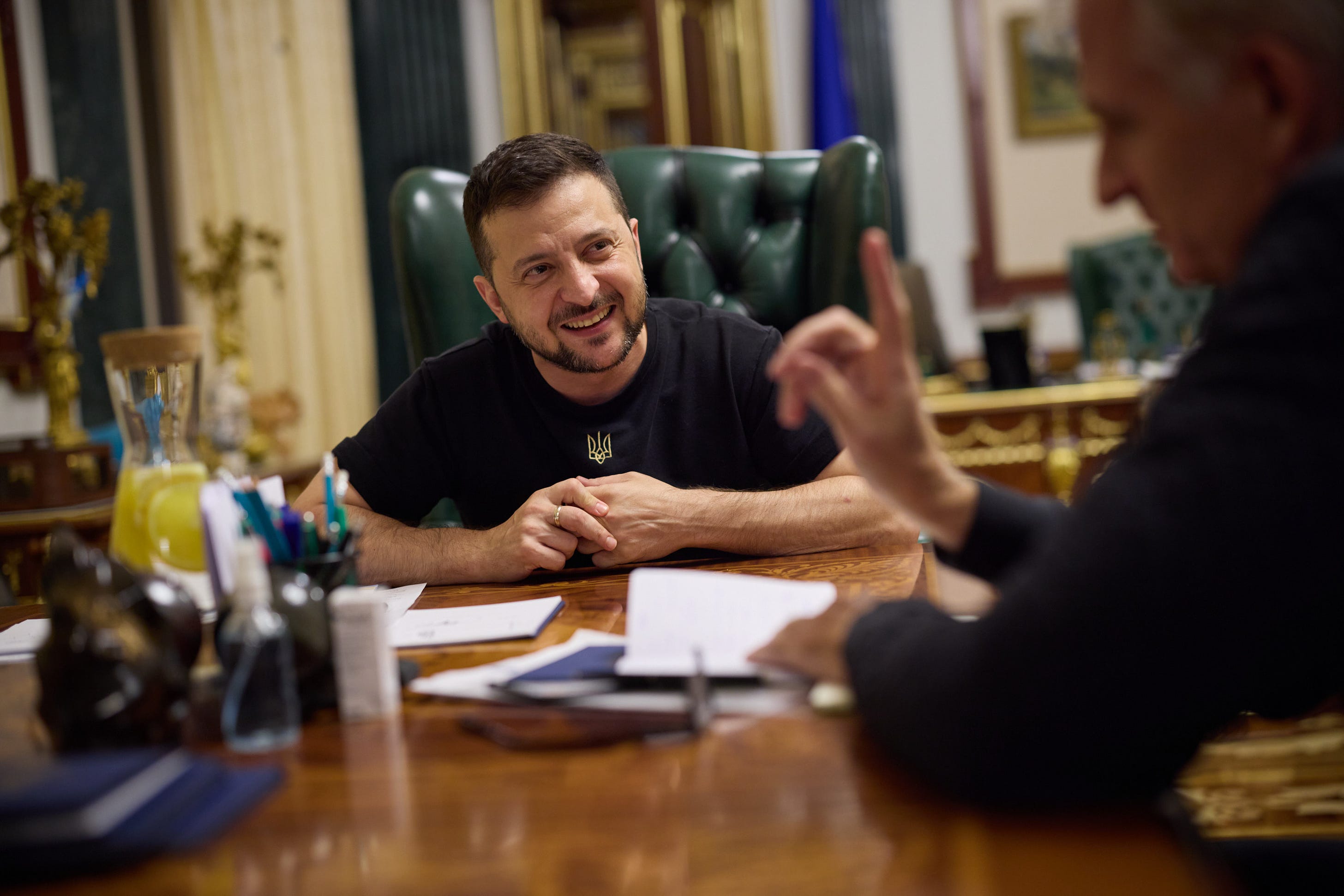
Another great actor… and profoundly decent man. I did get him to laugh once or twice. The warmth and intelligence he is able to show in these profoundly distressing conditions is just hugely admirable. Help me to get to that smile again by providing Ukrainians with what they need most.
Kherson was the first regional capital that the Russian army captured after the invasion of Ukraine. A few weeks ago, Putin declared that Russia had annexed four regions of Ukraine, including Kherson, and henceforth they would be “forever Russian.” That occurred at the same time that Russian troops were retreating before the Ukrainian forces. A few days ago, Russian troops abandoned Kherson, and Ukrainian troops arrived. They were greeted by jubilant crowds waving the Ukrainian flag and singing the Ukrainian national anthem.
But before the troops left, they carried out a special mission for V. Putin. They robbed the grave of Potemkin, who conquered Ukraine on behalf of Russia and Empress Catherine the Great in the 18th century. Simon Sebag Montefiore, a British historian of Russia, reports at the website Airmail that Putin is obsessed with Potemkin. Potemkin is Putin’s role model. His body was buried in St. Stephen’s Cathedral in Kherson. Before the Russians evacuated Kherson, they removed Potemkin’s bones and sent them to Moscow.
The New York Times reported the failure of “Russification” in Kherson:

KHERSON, Ukraine — Iryna Dyagileva’s daughter attended a school where the curriculum included memorizing the Russian national anthem.
But teachers ignored it, instead quietly greeting students in the morning with a salute: “Glory to Ukraine!”
The occupation authorities asked Olha Malyarchuk, a clerk at a taxi company, to settle bills in rubles. But she kept paying in the Ukrainian currency, hryvnia.
“It just didn’t work,” she said of Russian propaganda, beamed into homes through televisions and plastered on billboards for the nine months of Russia’s occupation of Kherson. On Sunday, she was walking in a park, waving a small Ukrainian flag.
One roadside billboard proclaimed in bold text, “We are together with Russia!” But a teenager who offered only his first name, Oleksandr, had shimmied up the supporting pole on Sunday and was tearing the sign to pieces. Asked how he felt, he said, “free.”
The Ukrainian army has reclaimed hundreds of villages in towns in three major counteroffensives, north of Kyiv, in the northeastern Kharkiv region and now in the southern Kherson region.
But the city of Kherson stands out: it was the focus of a major Russian campaign to assimilate the citizenry and stamp out of the Ukrainian identity. Judging by his assertions that Ukrainians and Russians are one nation, it was a goal President Vladimir V. Putin had harbored for all of Ukraine, had his military been more successful.
After Russian forces captured Kherson in the early days of the war, Ukrainian national songs were banned in the city. Speaking Ukrainian could lead to arrest. Schools adopted a Russian curriculum, and young students were to be told that they were Russians, not Ukrainians.
In the first hours and days after the city’s recapture by the Ukrainian army, signs have emerged suggesting that the Russian attempt was a largely futile effort, at least among those who remained in the city.
Many pro-Russian residents had evacuated as Ukraine’s army advance on the city, and the Kremlin-installed authorities had encouraged residents to leave. Many local government officials had collaborated with the Russians.
Serhiy Bloshko, a construction worker, had lived at the homes of friends through the nine-month occupation, fearful he’d be arrested for joining anti-occupation protests in March that broke out soon after the Russian army arrived. Soldiers indeed went to his home, he said. Not finding him, they made off with his television and refrigerator, he said.
“They repressed the pro-Ukrainian population,” he said while waiting in a line for water on Sunday afternoon. Friends had been detained and vanished, he said. Of the cultural assimilation effort, he said, “what happened here was ethnic cleansing.”
The entry into his city of the two armies, one in February and the other last week, was telling, he said.
“When our soldiers drove in, their machine guns were pointed up, into the air,” Mr. Bloshko said. “When the Russians drove in, their guns were pointed at the people. That explains everything. And they said they were our liberators.”
Timothy Snyder, historian at Yale, explains in this post why Crimea does not belong to Russia, except in Putin’s delusional, self-aggrandizing mind. Crimea, he explains, existed long before there was a Russian state. It has gone through many transformations, the most appalling of which was when Stalin deported its entire population, claiming that they were Nazis (sound familiar?).
It is a long and fascinating essay.
In a small excerpt, he writes:
Crimea is a district of Ukraine, as recognized by international law, and by treaties between Ukraine and the Russian Federation. Putin, however, has taken the view, for more than a decade now, that international law must yield to what he calls “civilization,” meaning his eccentric understanding of the past. The annoying features of the world that do not fit his scheme of the past are classified as alien, and illegitimate, and subject to destruction (Ukraine, for example).
The example of Crimea lays bare a problem within Putin’s thinking. The idea that there is some sort of immutable “civilization,” outside of time and human agency, always turns out to be based upon nothing. In the case of Crimea, Putin’s notion that the peninsula was “always” Russia is absurd, in almost more ways than one can count.
The Crimean Peninsula has been around for quite a long time, and Russia is a recent creation. What Putin has in mind when he speaks of eternity and is the baptism of a ruler of Kyiv, Valdimar, in 988. From this moment of purity, we are to understand, arose a timeless reality of Russian Crimea (and a Russian Ukraine). which we all must accept or be subject to violence. Crimea becomes “holy.”
It takes time to recount even a small portion of the ways in which this is nonsensical. First of all, the historical event itself is not at all clear. One source says that Valdimar was baptized in Crimea, as Putin likes to say; others that he was baptized in Kyiv. None of the sources date from the period itself, and so we cannot be certain that it took place at all, let alone of the locale. (If Valdimar was indeed baptized in Crimea, Putin’s logic would seem to suggest that the peninsula belongs to modern Greece, since the presumed site was part of Byzantium at the time.)
Valdimar was, to put it gently, not a Russian. There were no Russians at the time. He was the leader of a clan of Scandinavian warlords who had established a state in Kyiv, having wrenched the city from the control of Khazars. His clan was settling down, and the conversion to Christianity was part of the effort to build a state. It was called “Rus,” apparently from a Finnish word for the slavetrading company that brought the Vikings to Kyiv in the first place. It was not called “Rus” because of anything to do with today’s Russia — nor could it have been, since there was no Russia then, and no state would bear that name for another seven hundred years. Moscow, the city, did not exist at the time.
Baptism, whatever its other merits, does not create some kind of timeless continuum of power over whatever range of territory some later figure chooses to designate. If it did, international relations would certainly look very different. When Emperor Constantine converted to Christianity, the Roman Empire controlled what is now Portugal, Spain, France, the Balkans, Israel, Turkey, North Africa… But we would be very surprised to hear an Italian leader (even now) cite Constantine’s baptism to claim all of these countries…
Fiona Hill is a former diplomat who specializes in the study of Russia and Ukraine. She was a star witness in the first impeachment trial of Trump (the Former Guy).
She was recently interviewed by Politico. This is a fascinating discussion with a deeply informed expert. Please open the link and read it all.
In the early days of Russia’s war on Ukraine, Hill warned in an interview with POLITICO that what Putin was trying to do was not only seize Ukraine but destroy the current world order. And she recognized from the start that Putin would use the threat of nuclear conflict to try to get his way.
Now, despite the setbacks Russia has suffered on the battlefield, Hill thinks Putin is undaunted. She sees him adapting to new conditions, not giving up. And she sees him trying to get the West to accede to his aims by using messengers like billionaire Elon Musk to propose arrangements that would end the conflict on his terms.
“Putin plays the egos of big men, gives them a sense that they can play a role. But in reality, they’re just direct transmitters of messages from Vladimir Putin,” Hill says…
Whenever he has a setback, Putin figures he can get out of it, that he can turn things around. That’s partly because of his training as a KGB operative. In the past, when asked about the success of operations, he’s pooh-poohed the idea that operations always go as planned, that everything is always perfect. He says there are always problems in an operation, there are always setbacks. Sometimes they’re absolute disasters. The key is adaptation.
Another hallmark of Putin is that he doubles down. He always takes the more extreme step in his range of options, the one that actually cuts off other alternatives. Putin has often related an experience he had as a kid, when he trapped a rat in a corner in the apartment building he lived in, in Leningrad, and the rat shocked him by jumping out and fighting back. He tells this story as if it’s a story about himself, that if he’s ever cornered, he will always fight back.
But he’s also the person who puts himself in the corner. We know that the Russians have had very high casualties and that they’ve been running out of manpower and equipment in Ukraine. The casualty rate on the Russian side keeps mounting. A few months ago, estimates were 50,000. Now the suggestions are 90,000 killed or severely injured. This is a real blow given the 170,000 Russia troops deployed to the Ukrainian border when the invasion began.
So, what does Putin do? He sends even more troops in by launching a full-on mobilization. He still hasn’t said this is a war. It remains a “special military operation,” but he calls up 300,000 people. Then, he goes several steps further and announces the annexation of the territories that Russia has been fighting over for the last several months, not just Donetsk and Luhansk, but also the territories of Kherson and Zaporizhzhia.
Putin gives himself no way out except to pursue the original goals he had when he went in, which is the dismemberment of Ukraine and Russia annexing its territory. And he’s still trying to adapt his responses to setbacks on the battlefield….
Reynolds: If Putin wants Ukrainian territory so badly, why is he raining down such destruction on civilian areas and committing so many human rights abuses in occupied areas?
Hill: This is punishment, but also perverse redevelopment. You cow people into submission, destroy what they had and all their links to their past and their old lives, and then make them into something new and, thus, yours. Destroy Ukraine and Ukrainians. Build New Russia and create Russians. Its brutal but also a hallmark of imperial conquest….
Reynolds: We’ve recently had Elon Musk step into this conflict trying to promote discussion of peace settlements. What do you make of the role that he’s playing?
Hill: It’s very clear that Elon Musk is transmitting a message for Putin. There was a conference in Aspen in late September when Musk offered a version of what was in his tweet — including the recognition of Crimea as Russian because it’s been mostly Russian since the 1780s — and the suggestion that the Ukrainian regions of Kherson and Zaporizhzhia should be up for negotiation, because there should be guaranteed water supplies to Crimea. He made this suggestion before Putin’s annexation of those two territories on September 30. It was a very specific reference. Kherson and Zaporizhzhia essentially control all the water supplies to Crimea. Crimea is a dry peninsula. It has aquifers, but it doesn’t have rivers. It’s dependent on water from the Dnipro River that flows through a canal from Kherson. It’s unlikely Elon Musk knows about this himself. The reference to water is so specific that this clearly is a message from Putin.
Now, there are several reasons why Musk’s intervention is interesting and significant. First of all, Putin does this frequently. He uses prominent people as intermediaries to feel out the general political environment, to basically test how people are going to react to ideas. Henry Kissinger, for example, has had interactions with Putin directly and relayed messages. Putin often uses various trusted intermediaries including all kinds of businesspeople. I had intermediaries sent to discuss things with me while I was in government….
Putin plays the egos of big men, gives them a sense that they can play a role. But in reality, they’re just direct transmitters of messages from Vladimir Putin.
Reynolds: Putin is very comfortable dealing with billionaires and oligarchs. That’s a world that he knows well. But by using Musk this way, he goes right over the heads of [Ukrainian President Volodymyr] Zelenskyy and the Ukrainian government.
Hill: He is basically short-circuiting the diplomatic process. He wants to lay out his terms and see how many people are going to pick them up. All of this is an effort to get Americans to take themselves out of the war and hand over Ukraine and Ukrainian territory to Russia….
Putin invaded Ukraine in 2014, exactly 100 years after Germany invaded Belgium and France — and just in the same way that Hitler seized the Sudetenland, annexed Austria and invaded Poland. We’re having a hard time coming to terms with what we’re dealing with here. This is a great power conflict, the third great power conflict in the European space in a little over a century. It’s the end of the existing world order. Our world is not going to be the same as it was before.
I love Jon Stewart. His podcast “The Problem with Jon Stewart” is indispensable.
In this episode, he interviews a BBC journalist who is Iranian about the remarkable uprising against oppression by young Iranian women.
What an inspiring story of courage in the face of despotism!
Timothy Snyder is a political scientist at Yale who has written incisive books about fascism. In this essay, he describes a scenario that will bring Russia’s invasion of Ukraine to an end.
He does not believe that Putin will deploy nuclear weapons. He believes that the humiliating retreat of Russian soldiers on the battlefield will produce power struggles in Russia. The mercenaries that Putin has relied on from Chechnya and the Wagner Group (a neo-fascist militia) are unlikely to put their best troops at risk when the Russian military is retreating. The consequences will not be favorable for Putin.
Alexei Navalny has been Vladimir Putin’s most outspoken critic. In 2020, Navalny was poisoned while on a flight to Moscow and nearly died. He received treatment in a German hospital, where it was determined that he was poisoned by a substance made only in Russia. That’s the sort of thing that happens to Putin’s political opponents. Now Navalny is in prison, serving a nine-year term.
In 2021, he received the European Union’s Sakharov Prize for Freedom of Thought. If you want to learn more about Navalny, watch the CNN special about him. His daughter is a student at Stanford. His wife stands in for him. They could have fled Russia when he was hospitalized in Germany, but Navalny insisted on returning to Russia. He was arrested as soon as he arrived, as he expected. He insists on being a thorn in Putin’s side or a burr under his saddle, as they say in Texas. The funniest part of the CNN special is when Navalny and his team track down the men who made the poison that nearly killed him, call them at their cellphones, and pretend to be their bosses, demanding to know why they failed to finish him off.
He wrote this article from his penal colony. His legal team passed it on to the Washington Post, where it was published.
Navalny writes:
What does a desirable and realistic end to the criminal war unleashed by Vladimir Putin against Ukraine look like?
If we examine the primary things said by Western leaders on this score, the bottom line remains: Russia (Putin) must not win this war. Ukraine must remain an independent democratic state capable of defending itself.
This is correct, but it is a tactic. The strategy should be to ensure that Russia and its government naturally, without coercion, do not want to start wars and do not find them attractive. This is undoubtedly possible. Right now the urge for aggression is coming from a minority in Russian society.
In my opinion, the problem with the West’s current tactics lies not just in the vagueness of their aim, but in the fact that they ignore the question: What does Russia look like after the tactical goals have been achieved? Even if success is achieved, where is the guarantee that the world will not find itself confronting an even more aggressive regime, tormented by resentment and imperial ideas that have little to do with reality? With a sanctions-stricken but still big economy in a state of permanent military mobilization? And with nuclear weapons that guarantee impunity for all manner of international provocations and adventures?
It is easy to predict that even in the case of a painful military defeat, Putin will still declare that he lost not to Ukraine but to the “collective West and NATO,” whose aggression was unleashed to destroy Russia.
And then, resorting to his usual postmodern repertoire of national symbols — from icons to red flags, from Dostoevsky to ballet — he will vow to create an army so strong and weapons of such unprecedented power that the West will rue the day it defied us, and the honor of our great ancestors will be avenged.
And then we will see a fresh cycle of hybrid warfare and provocations, eventually escalating into new wars.
To avoid this, the issue of postwar Russia should become the central issue — and not just one element among others — of those who are striving for peace. No long-term goals can be achieved without a plan to ensure that the source of the problems stops creating them. Russia must cease to be an instigator of aggression and instability. That is possible, and that is what should be seen as a strategic victory in this war.
There are several important things happening to Russia that need to be understood:
First, jealousy of Ukraine and its possible successes is an innate feature of post-Soviet power in Russia; it was also characteristic of the first Russian president, Boris Yeltsin. But since the beginning of Putin’s rule, and especially after the Orange Revolution that began in 2004, hatred of Ukraine’s European choice, and the desire to turn it into a failed state, have become a lasting obsession not only for Putin but also for all politicians of his generation.
Control over Ukraine is the most important article of faith for all Russians with imperial views, from officials to ordinary people. In their opinion, Russia combined with a subordinate Ukraine amounts to a “reborn U.S.S.R. and empire.” Without Ukraine, in this view, Russia is just a country with no chance of world domination. Everything that Ukraine acquires is something taken away from Russia.
Second, the view of war not as a catastrophe but as an amazing means of solving all problems is not just a philosophy of Putin’s top brass, but a practice confirmed by life and evolution. Since the Second Chechen War, which made the little-known Putin the country’s most popular politician, through the war in Georgia, the annexation of Crimea, the war in Donbas and the war in Syria, the Russian elite over the past 23 years has learned rules that have never failed: War is not that expensive, it solves all domestic political problems, it raises public approval sky-high, it does not particularly harm the economy, and — most importantly — winners face no accountability. Sooner or later, one of the constantly changing Western leaders will come to us to negotiate. It does not matter what motives will lead him — the will of the voters or the desire to receive the Nobel Peace Prize — but if you show proper persistence and determination, the West will come to make peace.
Don’t forget that there are many in the United States, Britain and other Western countries in politics who have been defeated and lost ground due to their support for one war or another. In Russia, there is simply no such thing. Here, war is always about profit and success.
Third, therefore, the hopes that Putin’s replacement by another member of his elite will fundamentally change this view on war, and especially war over the “legacy of the U.S.S.R.,” is naive at the very least. The elites simply know from experience that war works — better than anything else.
Perhaps the best example here would be Dmitry Medvedev, the former president on whom the West pinned so many hopes. Today, this amusing Medvedev, who was once taken on a tour of Twitter’s headquarters, makes statements so aggressive that they look like a caricature of Putin’s.
Fourth, the good news is that the bloodthirsty obsession with Ukraine is not at all widespread outside the power elites, no matter what lies pro-government sociologists might tell.
The war raises Putin’s approval rating by super-mobilizing the imperially minded part of society. The news agenda is fully consumed by the war; internal problems recede into the background: “Hurray, we’re back in the game, we are great, they’re reckoning with us!” Yet the aggressive imperialists do not have absolute dominance. They do not make up a solid majority of voters, and even they still require a steady supply of propaganda to sustain their beliefs.
Otherwise Putin would not have needed to call the war a “special operation” and send those who use the word “war” to jail. (Not long ago, a member of a Moscow district council received seven years in prison for this.) He would not have been afraid to send conscripts to the war and would not have been compelled to look for soldiers in maximum-security prisons, as he is doing now. (Several people were “drafted to the front” directly from the penal colony where I am.)
Yes, propaganda and brainwashing have an effect. Yet we can say with certainty that the majority of residents of major cities such as Moscow and St. Petersburg, as well as young voters, are critical of the war and imperial hysteria. The horror of the suffering of Ukrainians and the brutal killing of innocents resonate in the souls of these voters.
Thus, we can state the following:
The war with Ukraine was started and waged, of course, by Putin, trying to solve his domestic political problems. But the real war party is the entire elite and the system of power itself, which is an endlessly self-reproducing Russian authoritarianism of the imperial kind. External aggression in any form, from diplomatic rhetoric to outright warfare, is its preferred mode of operation, and Ukraine is its preferred target. This self-generated imperial authoritarianism is the real curse of Russia and the cause of all its troubles. We cannot get rid of it, despite the opportunities regularly provided by history.
Russia had its last chance of this kind after the end of the U.S.S.R., but both the democratic public inside the country and Western leaders at the time made the monstrous mistake of agreeing to the model — proposed by Boris Yeltsin’s team — of a presidential republic with enormous powers for the leader. Giving plenty of power to a good guy seemed logical at the time.
Yet the inevitable soon happened: The good guy went bad. To begin with, he started a war (the Chechen war) himself, and then, without normal elections and fair procedures, he handed over power to the cynical and corrupt Soviet imperialists led by Putin. They have caused several wars and countless international provocations, and are now tormenting a neighboring nation, committing horrible crimes for which neither many generations of Ukrainians nor our own children will forgive us.
In the 31 years since the collapse of the U.S.S.R., we have witnessed a clear pattern: The countries that chose the parliamentary republic model (the Baltic states) are thriving and have successfully joined Europe. Those that chose the presidential-parliamentary model (Ukraine, Moldova, Georgia) have faced persistent instability and made little progress. Those that chose strong presidential power (Russia, Belarus and the Central Asian republics) have succumbed to rigid authoritarianism, most of them permanently engaged in military conflicts with their neighbors, daydreaming about their own little empires.
In short, strategic victory means bringing Russia back to this key historical juncture and letting the Russian people make the right choice.
The future model for Russia is not “strong power” and a “firm hand,” but harmony, agreement and consideration of the interests of the whole society. Russia needs a parliamentary republic. That is the only way to stop the endless cycle of imperial authoritarianism.
One may argue that a parliamentary republic is not a panacea. Who, after all, is to prevent Putin or his successor from winning elections and gaining full control over the parliament?
Of course, even a parliamentary republic does not offer 100 percent guarantees. It could well be that we are witnessing the transition to the authoritarianism of parliamentary India. After the usurpation of power, parliamentary Turkey has been transformed into a presidential one. The core of Putin’s European fan club is paradoxically in parliamentary Hungary.
And the very notion of a “parliamentary republic” is too broad.
Yet I believe this cure offers us crucial advantages: a radical reduction of power in the hands of one person, the formation of a government by a parliamentary majority, an independent judiciary system, a significant increase in the powers of local authorities. Such institutions have never existed in Russia, and we are in desperate need of them.
As for the possible total control of parliament by Putin’s party, the answer is simple: Once the real opposition is allowed to vote, it will be impossible. A large faction? Yes. A coalition majority? Maybe. Total control? Definitely not. Too many people in Russia are interested in normal life now, not in the phantom of territorial gains. And there are more such people every year. They just don’t have anyone to vote for now.
Certainly, changing Putin’s regime in the country and choosing the path of development are not matters for the West, but jobs for the citizens of Russia. Nevertheless, the West, which has imposed sanctions both on Russia as a state as well as on some of its elites, should make its strategic vision of Russia as a parliamentary democracy as clear as possible. By no means should we repeat the mistake of the West’s cynical approach in the 1990s, when the post-Soviet elite was effectively told: “You do what you want there; just watch your nuclear weapons and supply us with oil and gas.”
Indeed, even now we hear cynical voices saying similar things: “Let them just pull back the troops and do what they want from there. The war is over, the mission of the West is accomplished.” That mission was already “accomplished” with Russia’s annexation of Crimea in 2014, and the result is a full-fledged war in Europe in 2022.
This is a simple, honest and fair approach: The Russian people are of course free to choose their own path of development. But Western countries are free to choose the format of their relations with Russia, to lift or not to lift sanctions, and to define the criteria for such decisions. The Russian people and the Russian elite do not need to be forced. They need a clear signal and an explanation of why such a choice is better. Crucially, parliamentary democracy is also a rational and desirable choice for many of the political factions around Putin. It gives them an opportunity to maintain influence and fight for power while ensuring that they are not destroyed by a more aggressive group.
War is a relentless stream of crucial, urgent decisions influenced by constantly shifting factors.
Therefore, while I commend European leaders for their ongoing success in supporting Ukraine, I urge them not to lose sight of the fundamental causes of war. The threat to peace and stability in Europe is aggressive imperial authoritarianism, endlessly inflicted by Russia upon itself. Postwar Russia, like post-Putin Russia, will be doomed to become belligerent and Putinist again. This is inevitable as long as the current form of the country’s development is maintained. Only a parliamentary republic can prevent this. It is the first step toward transforming Russia into a good neighbor that helps to solve problems rather than create them.

 Diane Ravitch's blog