Judge Aileen Cannon of Florida was appointed by Trump. When the Justice Department and FBI investigated the highly classified documents that Trump moved from the White House to Mar-a-Lago when he left in 2017, Judge Cannon slowed down the prosecution at every opportunity, then threw it out because she decided that Jack Smith’s appointment was unconstitutional.
The federal judge who handled President-elect Donald J. Trump’s classified documents case temporarily barred the special counsel, Jack Smith, on Tuesday from releasing his final report on the investigation to the public.
In a brief ruling, Judge Aileen M. Cannon, a Trump appointee who dismissed the documents case in its entirety this summer, enjoined Mr. Smith from sharing his report outside the Justice Department until a federal appeals court in Atlanta, which is now considering a challenge to her dismissal of the case, makes a decision about how to handle the report.
Mr. Trump’s legal team wrote a letter to Attorney General Merrick B. Garland asking him to stop the release of the report, which was set to be made public as soon as Friday. In a separate move, lawyers for Mr. Trump’s co-defendants in the documents case, Walt Nauta and Carlos De Oliveira, went directly to Judge Cannon, of the Southern District of Florida, asking for an emergency order blocking the release.
The legal scrambling continued on Tuesday, as Mr. Nauta and Mr. De Oliveira asked the appeals court hearing the case to weigh in on blocking the report and Mr. Trump sought to join their motion in front of Judge Cannon.
With the case already dismissed, the report would essentially be Mr. Smith’s final chance to lay out damaging new details and evidence, if he has any, about how Mr. Trump mishandled a trove of classified documents after he left office in 2021.
Judge Cannon threw out the case in July, ruling, in the face of decades of precedent, that Mr. Smith had been unlawfully appointed special counsel. Mr. Smith quickly challenged that decision in front of the 11th Circuit Court of Appeals in Atlanta.
But after Mr. Trump won the election in November, Mr. Smith dropped the appeal where Mr. Trump was concerned, effectively ending his part in the matter. Mr. Smith did not drop the appeal against Mr. Nauta and Mr. De Oliveira, and federal prosecutors in Florida intend to pursue it once Mr. Smith steps down and disbands his team.
When Trump is inaugurated, his top defense lawyers will have key roles in the Justice Department. This case will be shelved, along with Jack Smith’s report.
Bloomberg.com reported that the 500 richest people in the world have $10 trillion in wealth.
The biggest winners were leaders of the tech industry. Elon Musk is the richest man in the world, with a fortune exceeding $400 billion.
The world’s 500 richest people got vastly richer in 2024, with Elon Musk, Mark Zuckerberg and Jensen Huang leading the group of billionaires to a new milestone: A combined $10 trillion net worth.
An indomitable rally in US technology stocks played a key role in turbocharging the trio’s wealth, as well as the fortunes of Larry Ellison, Jeff Bezos, Michael Dell and Google co-founders Larry Page and Sergey Brin. The eight tech titans alone gained more than $600 billion this year, 43% of the $1.5 trillion increase among the 500 richest people tracked by the Bloomberg Billionaires Index.
But consider this: The United States is considered the richest country in the world, and yet 37.9 million (11.5%) of its residents live in poverty.
The tech bros could pool their excess billions and end poverty in America. Imagine if each of the top 500 contributed $1 billion to a fund to end poverty. What’s $1 billion to someone with $10 billion or $50 billion or $400 billion. Pocket change.
Homelessness is on the rise across the country, including in Massachusetts, which had the third largest increase among all states in 2024.
The number of people experiencing homelessness across the nation rose 18.1 percent between 2023 and 2024, according to new data from the federal housing agency’s annual report to Congress. In New England, the data showed diverging trends, with two states, Massachusetts and Rhode Island, reporting steep increases, while two others, Maine and New Hampshire, had smaller homeless populations.
In Massachusetts, the homeless population increased by 53 percent, to about 29,300 in 2024, from just over 19,100 the year before. That’s nearly three times the national rate, and behind only Illinois and Hawaii. Massachusetts is unusual among states in that it has a right-to-shelter law, so the majority of homeless families had a place to sleep indoors in a state-sponsored facility.
In New York State, where I live, 158,000 people are homeless, a 53% increase from 2023 to 2024.
In California, 187,000 are homeless, an increase of 3%.
During the pandemic, the Biden administration expanded the child tax credit, and child poverty plummeted. But Republicans refused to renew the higher payments proposed by Biden, and child poverty rate more than doubled from 5.2% in 2021 to 12.4% in 2022, according to the US Census Bureau.
I recommend to you a book called The Spirit Level: Why Greater Equality Makes Societies Stronger. It was written by British sociologists Richard Wilkinson and Kate Pickett. The more equality, the happier people are. Extreme inequality contributes to envy, rage, and despair.
Again, the fabulously wealthy tech bros could end poverty in America. But I’m not holding my breath. They are too engaged in competing to see who can amass the biggest fortune.
For five days, the public was obsessed with the search for the man who murdered the CEO of United Healthcare. For a while, he seemed to be a mastermind, evading the surveillance state that so closely monitored his movements. But then he was caught while eating breakfast at a McDonald’s in Altoona, PA.
There is no excuse for murder. None, unless you are acting in self-defense, which Luigi Mangione was not. He has ended the life of Brian Thompson, the CEO of UHC, and simultaneously destroyed his own life. He is likely to spend the rest of his life in prison. Couldn’t he have thrown a bucket of red paint in protest? Or a cream pie?
The health insurance industry in this country is a mess. Most insurance companies operate for profit, and their actions seem to based on the prospect of profit, not the well-being of their customers. The industry makes obscene profits, based on its frequent denials of reimbursement.
This post was written by Qasid Rashid. When he learned that his child had a deadly disease, he sought help from his insurance company but was repeatedly denied any help. Read the story. It shows how repellent privatized for-profit insurance is. The insurance company was willing to let the child die rather than pay the cost of her desperately needed treatment.
He and his wife wrote:
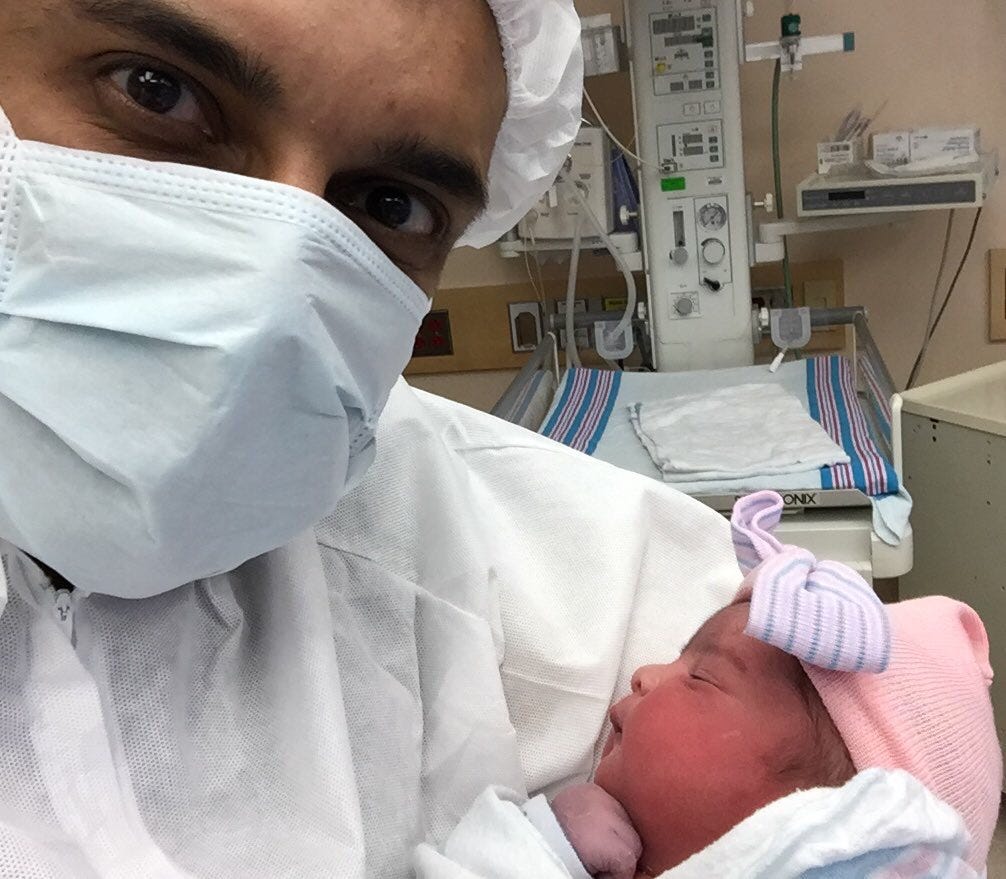
This article is a deeply personal and vulnerable piece about our daughter Hannah Noor. It is primarily written by my wife Ayesha Noor. We are sharing this not because our daughter’s story is special, but sadly, because her story is all too common. Every year thousands of children and adults suffer incomprehensible pain, suffering, and even death. They suffer not because we lack the means to treat them, but because exploitative insurance companies, incompetent bureaucrats, and apathetic politicians deny them access to the life saving care they need. In light of recent events [See: America’s Violent Health System], we are sharing this story to bear witness to the preventable suffering of so many, the deadly violence imposed upon them, and to give hope that even in the darkest of times things can get better if we demand it. Let’s Address This.
Hannah Noor (Pictured Right) at 5 hours old.
A Scream in the Dark
It was just after her sixth birthday in 2021 when our daughter screamed from her bed in the middle of the night. We rushed to her room to find she had thrown up all over her bed. We cleaned her up, changed her sheets, and blamed the incident on the Oreos she’d eaten after dinner. The next day she complained of a stomach ache and rushed to the bathroom, experiencing diarrhea. Like most parents, we dismissed it as a passing bug—kids get diarrhea now and then. But something felt different this time, even though it was her first experience.
When it happened again just a short time later, the stomach pain was more severe. She screamed, cried, and rushed to the bathroom, but this time there was blood—so much blood. It terrified us. Before we could even make it to urgent care, she had another episode with even more bleeding. We hurried her in, only to be told by the nurse practitioner to “keep her hydrated” and that it was probably a stomach virus. But again, something in our gut told us otherwise.
This was just before Thanksgiving 2021, and I convinced myself she’d recover over the break and be able to return to school. She loved school, as most kindergarteners do. But the bleeding continued. The pain worsened. More urgent care and pediatrician visits followed, but answers did not. By now, our once energetic and chatty daughter was pale, frightened, and visibly losing weight.
Navigating Through the Dark
We reached out to a close friend who happened to be a pediatric gastroenterologist. His questions and careful listening indicated it was not a simple virus, but he didn’t say much directly. He urged us to connect with the GI team at Children’s National Hospital in Washington D.C. Unfortunately, we were met with insurance hurdles and skepticism from her pediatrician. Weeks passed, and her condition deteriorated until, thanks to our friend’s intervention, we finally secured an appointment with a pediatric GI doctor in December.
Hannah Noor, now frail and scared, was put on iron supplements, and an colonoscopy was scheduled for January. She now weighed just 30 pounds—skin and bones, and we feared the worst. Her fear of eating, going to the bathroom, or even moving too much consumed her days. Our winter break became a period of sleepless nights, endless tears, and prayers. We felt like prisoners trying to navigate through treacherous terrain while blindfolded and shackled.
The preparation for the scope was grueling—a 24-hour liquid diet. To make matters worse, a severe snowstorm in early January 2022 left us without power for three days. Despite the chaos, we made it to the hospital. As I held her tiny hand, she bravely went under anesthesia. Hours later, the doctors confirmed what we feared: Hannah had ulcers all over her colon.
Inflammatory Bowel Disease (IBD) was the diagnosis—a chronic, lifelong condition that would require extensive management. Even as the doctor explained, I couldn’t fully grasp the gravity of it. I naively asked, “How long will she need the medication?” The doctor replied—“Do you understand what it means to have IBD? This is for life.”
It shattered me. My world crumbled.
Steroids, with their array of side effects, initially helped stabilize her condition, and she was subsequently started on mesalamine. However, managing IBD is never straightforward. Moving homes and finding a new doctor compatible with our insurance became an uphill battle. Procuring mesalamine was a nightmare, as our insurance kept on requiring prior-authorization—a term we’d never even heard before. Evidently, even though our doctor had prescribed a specific medication to save our daughter’s life, the insurance company required their non-medically trained admins to agree that our board certified physician knew what she was doing in prescribing the medication she prescribed. Spoiler: They disagreed and repeatedly denied the critical medication our daughter needed.
Making matters worse, moving meant we were in between doctors. Desperate to try anything to improve Hannah’s quality of life, we spent hours consulting with a nutritionist to see if dietary changes could make a difference. We invested extensive time and resources into a gluten-free diet, but it did not help at all; in fact, it made her averse to eating. We also tried the FODMAP diet, which was recommended during a flare, but it added to the confusion of what she should or shouldn’t eat. Every day became a battle over something as simple as food—one filled with uncertainty and frustration. Despite our efforts, Hannah’s condition remained unpredictable, with debilitating flares continuing to disrupt her life. By late 2023, we had pursued every imaginable route to find a way to protect our daughter’s health and life, and yet felt exhausted and at a dead end.
It was clear that only one option remained—she needed a quickly advancing form of therapy known as biological treatment. This would be a direct IV infusion of medication to stabilize the IBD, every six to eight weeks, forever.
A Dark Dead End
We were at the end of the road. If we couldn’t access biologic treatment, there was nowhere left to go. But what we hoped would finally bring us closure and healing, resulted in yet another emotional roller coaster and painful circus—our insurance corporation blocked us. Turns out, insurance corporations block more than 51% of patients whose doctors prescribe them biologic treatment to save their lives.
The recommended biologic promised not a cure, but a chance at living a healthy life. Our insurance rejected us outright reasoning that we hadn’t tried other medications first—a policy called “step therapy.” Despite our daughter’s life threatening condition, they wanted us to try every other variation of every other possible medication—knowing full well they would likely fail just as much and make our daughter suffer, vomit, bleed, and lose weight. But that did not matter to them, because that was the preferable path to ensure they “maximized shareholder value.”
Our doctor stepped in and conducted a peer-to-peer direct meeting with the insurance company to show all the data, blood tests, and medical reports to prove that our daughter needed biologics to live. To show without a shadow of a doubt that the yet untried medications they demanded we try were not substantively different than the plethora of medications we had tried and had not worked. Yet, that meeting also went in vain. The insurance company still refused to approve our claim. And Hannah Noor’s condition worsened. She was pale, swollen from steroids, in pain, losing weight, and back to missing school.
We finally contemplated paying for the biologic treatment out of pocket. We knew it would only require six doses a year. How much could one dose be, after all? We checked and our hearts sank once more. Each dosage cost and administration would run into the tens of thousands of dollars. A year’s supply to keep our daughter alive would run into the hundreds of thousands. We certainly did not have that kind of money. We were cornered and desperate.
We contemplated what any parents might. Do we sell the house and cars and move into a small apartment? Do we set up a GoFundMe? Do we borrow money from family and friends? Do we take out a second mortgage?
Do we file for medical bankruptcy, as 500,000 Americans do annually?
But we soon learned another sinister result of hyper-privatization of health insurance—even if we had the excessive means to pay the hundreds of thousands of dollars out of pocket, the hospital would not accept the funds. Why? The industry is such that not only do insurance companies deny 51% of claims, they have enacted policies forbidding people from paying for the critical medication they need out of pocket, lest the insurance company lose control and revenue. “Either you pay us, or you pay no one,” is a line you’d expect out of a mafia handbook—not out of a health provider. This is not health insurance, this is health exploitation.
A Spark of Light in the Darkness
In that moment of confusion we happened to run into to a fellow parent who, now is a great friend, and learned her children shared a similar medical struggle. She suggested calling the biologic manufacturers directly and applying for their patient assistance program. An idea that seems so obvious now, but something we did not even know was a possibility then.
The application process was tedious, and even then, it was initially rejected. But after weeks of back-and-forth, countless phone calls, and sleepless nights, a miracle happened—we finally secured approval. We let out a cathartic sigh of relief after more than two years of suffocation. And to be sure, the approval was not through our insurance company, who never even bothered to offer such an option, likely because it would cost them money. Rather, the approval was from the drug manufacturer directly. To this day our health insurance company has refused to budge on their cruel and calloused “maximizing shareholder value” decision to deny our daughter the medicine she needs to live.
On March 6, 2024—more than two months after the doctor first prescribed it, a period in which our daughter suffered horrific and unimaginable pain, bleeding, and vomiting—Hannah Noor received her first infusion at Comer Children’s Hospital in Chicago. And since then, everything has changed. Her spark of light returned. Our daughter was back.
The Light We Create
A process that should have only taken 30-60 days from the night we heard that scream in the dark, took us on a 28 month torturous journey to finally see light again. Hannah Noor’s journey since starting biologic treatment has been a blessing. She’s eating, playing, drawing, and even learning karate (currently a Yellow Belt). The last three years of her life had been a torture for her, but now she is finally thriving as any 9-year-old girl should. Though the fear of flares always looms, we refuse to let it dictate our lives. Herbal and homeopathic treatments complement her medical regimen, and her strength inspires us daily.
As for our insurance company? Those corporate leeches also denied covering the hospital costs as well. Fortunately, despite that high price tag still running into the thousands, we tightened our belts and found a way to pay for that out of pocket, and continue to pay for that out of pocket. (We were shocked there wasn’t some additional insurance rule preventing us from paying our hospital directly). Despite us paying our insurance premiums every single month without exception, our insurance company has not covered a single penny of our daughter’s critical healthcare needs. The care she needs to live. But at least they’re maximizing shareholder value.
This story isn’t just about one child’s struggle with IBD; it’s about the systemic barriers hundreds of millions of families face every single day. From insurance denials to inaccessible care, to step therapy nonsense, to prior authorization red tape, the system fails the most vulnerable. What if we didn’t speak English? What if we couldn’t afford out-of-pocket costs for tests and treatments? What if one of our close friends didn’t just happen to be a national expert on this particular rare disease, and couldn’t leverage his relationships to get us access to a world leading expert? What if we didn’t have a network of supportive friends to recommend new ways to acquire this life saving medicine?
A Brighter Future Is Possible
We named our daughter Hannah Noor because Hannah was the mother of Mary Mother of Jesus, and Noor means light. We couldn’t think of a more beautiful name for our only daughter, and she has lived up to it every day of her life.
In these darkest of times, she is the Light of our eyes.
Hannah Noor (now 9) at a recent family vacation in Lahore, Pakistan. Here she is giggling at a cat that wandered over to say meow, which Hannah Noor reminded us means “hello” in cat language.
Hannah Noor’s story highlights a flawed and cruel system that places profits over people. Yet it also underscores the power of advocacy, persistence, and community. To every parent navigating the complexities of chronic illness: stay strong, fight relentlessly for your child, and lean on the resources available, like the Crohn’s and Colitis Foundation, and do not underestimate support groups on Facebook. If I can be of any support, do not hesitate to reach out at ayesha [dot] noor @ gmail.com.
Hannah Noor is living proof that even in the darkest moments, there is hope. She teaches us daily to believe in miracles—and to fight for them when necessary. It is also a reminder that our for profit exploitative health insurance system will always only serve the wealthy elites, the stock market, and whatever private investor who decides to buy and sell these corporations. They will not serve the people. Not our beautiful baby girl, nor the nearly 70,000 Americans who die annually due to lack of care, nor the 500,000 Americans who are forced to file for medical bankruptcy every single year. It is by the sheer grace of the Almighty that we still have our wonderful Light with us today. But for so many parents and families, the end result is not so fortunate.
Perhaps the most frustrating part about all of this is that the medication to save our child’s life existed all along. But because some calloused business person decided her life wasn’t profitable enough and worth saving, it was an acceptable cost to reject her claim and let her die.
It is our responsibility to demand better, not just for our daughter, but for all the daughters, sons, and children out there. We do not suffer from a lack of resources, but from an excess of greed. We can ensure high quality, accessible, and affordable healthcare for all people in this country—but we cannot ensure the satiation of greed for the billionaire corporations, corrupt politicians, and elitists who care more about shareholder value than the survival of innocent children. We have to choose one side. And we choose the children of this great country—we hope you do too.
Margaret Sullivan, the last public ombudsman for The New York Times, wrote on her blog that ABC News was wrong to settle with Trump for $15 million for “defaming” him. On television, ABC’s George Stefanopolous said that Trump had been found liable for raping E. Jean Carroll. Trump said that was wrong and malicious because he had been found guilty of “sexual assault,” not rape.
She points out that when she was chief editor of The Buffalo News, the paper had a longstanding policy of fighting every claim of defamation or libel. They did so to discourage future lawsuits and send a message: we will vigorously oppose lawsuits. If you sue, prepare for a long battle.
Trump’s lawyers claimed that Stephanopoulos was wrong to say that Trump was found guilty of rape and that he had defamed Trump. ABC settled before trial and agreed to pay $15 million for the future Trump Presidential Library and $1 million for Trump’s legal fees.
Media experts were stunned. Not only did ABC abandon its First Amendment defense, but it abandoned a viable claim that Stephanopooulos was right to use the language he did.
Judge Lewis Kaplan, who presided over the Carroll defamation case, said:
“The finding Ms. Carroll failed to prove she was ‘raped’ within the meaning of the N.Y. Penal Law does not mean she failed to prove Mr. Trump ‘raped’ her as many people commonly understand the word ‘rape’. Indeed, as the evidence at trial… makes clear, the jury found Mr. Trump in fact did exactly that.”
By settling–and at such a hefty price–ABC has encouraged Trump and other politicians to continue to sue journalists and their employers.
Sullivan believes ABC might well have won if they continued to fight:
ABC News should never have caved. They might well have prevailed if they had hung in there. The legal bar is very high for libeling a public figure, and Trump is the ultimate public figure. Instead, this outcome encourages Trump in his attacks on the press — and he needs no encouragement.
As one law professor told the Times, what ABC News did was very unusual. News organizations generally don’t settle “because they fear the dangerous pattern of doing so and because they have the full weight of the First Amendment on their side.”
Why did ABC News throw in the towel? It‘s hard to know for sure, but gets easier if you are aware that the news organizations is owned by Disney, a huge corporation with a lot of turf to protect. As the Times reported, the Disney executive who oversees ABC News had dinner with Trump’s top aide, Susan Wiles, just days before the settlement, as “part of a visit by several ABC News executives to Florida to meet with Mr. Trump’s transition team.”
Was this settlement, which includes ABC’s public expressions of regret, a simple case of kissing the ring? It sure looks that way. Trump has sworn to get revenge on his enemies and he values, above all, loyalty and kowtowing.
But loyalty and kowtowing isn’t the job of the press, which is supposed to represent the public in holding powerful people and institutions accountable.
After his victory, Trump threatened to sue the Des Moines Register for posting a poll before the election that showed Biden beating him in Iowa. He also threatened to sue Bob Woodward, “60 minutes,” and the Pulitzer Prizes. This is the mischief that ABC News unleashed.
Last night Trump’s lawyers sued the Des Moines Register for publishing Ann Seltzer’s poll. The implications are frightening. The media publishes polls frequently during campaigns. They may be right, they may be wrong. If they are wrong, will candidates sue them for “election interference”? How did Trump suffer any damages by publication of that poll? He won Iowa by 13 points.
Win or lose, Trump has a strategy: to strike fear in the hearts of every journalist who dares to write critically about him.
Be sure to read Jeff Tiedrich’s condemnation of ABC’s capitulation. He attributes the deal to Disney’s overriding principle: “Protect the mouse.”
A study of the crime rates of immigrants–both the documented and the undocumented–was released in September 2024. It found that undocumented immigrants had the lowest crime rates, compared to native-born citizens and documented immigrants.
This is directly counter to the current claim by Republicans that undocumented immigrants are responsible for vicious crimes.
An NIJ-funded study examining data from the Texas Department of Public Safety estimated the rate at which undocumented immigrants are arrested for committing crimes. The study found that undocumented immigrants are arrested at less than half the rate of native-born U.S. citizens for violent and drug crimes and a quarter the rate of native-born citizens for property crimes.[1]
The question of how often undocumented immigrants commit crimes is not easy to answer. Most previous research on crime commission by immigrant populations has been unable to differentiate undocumented immigrants from documented immigrants. As a result, most studies treat all immigrants as a uniform group, regardless of whether they are in the country legally.
The estimates in this study come from Texas criminal records that include the immigration status of everyone arrested in the state from 2012 to 2018. These data enabled researchers to separate arrests for crimes committed by undocumented immigrants from those committed by documented immigrants and native-born U.S. citizens. (For more detail on the study’s data sources and methodology, see the sidebar “What Makes the Texas Data Unique?”)
The researchers tracked these three groups’ arrest rates across seven years (2012-2018) and examined specific types of crime, including homicides and other violent crimes.[2] They used these arrest rates as proxies for the rates of crime commission for the three groups. It should be noted that arrest is a commonly used, but imperfect measure of crime that in part reflects law enforcement activity rather than actual offending rates.
During this time, undocumented immigrants had the lowest offending rates overall for both total felony crime (see exhibit 1) and violent felony crime (see exhibit 2) compared to other groups. U.S.-born citizens had the highest offending rates overall for most crime types, with documented immigrants generally falling between the other two groups.
Exhibit 1.Total felony crime offending rates in Texas for U.S.-born citizens, documented immigrants, and undocumented immigrants
Researchers also looked specifically at homicide arrest trends. These rates tend to fluctuate more than the overall violent crime arrest rates because murders are relatively rare compared to other crimes. In addition, a large share of homicides go unsolved. Still, undocumented immigrants had the lowest homicide arrest rates throughout the entire study period, averaging less than half the rate at which U.S.-born citizens were arrested for homicide.[3] (The homicide rate for documented immigrants fluctuated. Sometimes it was higher than the rate for U.S.-born citizens and sometimes it was lower.)
Every other violent and property crime type the researchers examined followed the same general pattern. The offending rates of undocumented immigrants were consistently lower than both U.S.-born citizens and documented immigrants for assault, sexual assault, robbery, burglary, theft, and arson.
For drug offenses, too, undocumented immigrants were less than half as likely to be arrested as native-born U.S. citizens.[4] Moreover, the drug crime arrest rate for the undocumented population held steady throughout the seven years of data, while the rate for native-born citizens increased almost 30% during that time. As a result, undocumented immigrants had a smaller share of arrests for drug crimes in 2018 than they had in 2012.
Finally, the researchers conducted statistical tests to determine whether the share of crimes committed by undocumented immigrants had increased for any offense types between 2012 and 2018. They concluded, “There is no evidence that the prevalence of undocumented immigrant crime has grown for any category.”[5] As with drug offenses, evidence suggests the share of property and traffic crimes committed by undocumented immigrants decreased or remained close to constant throughout the period.
About This Article
The work described in this article was supported by NIJ award number 2019-R2-CX-0058, awarded to the University of Wisconsin.
Jeff Tiedrich proposes in his blog that President Biden should operate a “pardon factory” to protect everyone who has been threatened by Trump or Kash Patel.
One of the features of democracy is an assumption that parties will contend for power, accept their win or loss graciously, then prepare for next time. There will always be the next election to try again.
The threats by Trump and his toadies to prosecute his critics disrupts the comity on which a democratic system depends.
Trump thinks of his critics as “enemies,” not critics. He has made clear repeatedly that he will use his power as President to prosecute, imprison, and crush his enemies.
He said recently that the members of the January 6 Commission “should be in jail.” Why? Is it normal or acceptable that a mob summoned by the President descends on the U.S. Capitol as they meet to certify the election, smash through the windows and doors, beat up police officers, and rampage through the building? What was criminal? The summoning of the mob? The actions of the mob? Or the investigation of the events of the day?
Biden, writes Tiedrich, should issue pre-emptive pardons to all those whose lives and freedom might be endangered by Trump, Kash Patel, or Pam Bondi.
The next four years will be a trial for our democracy. Will the norms and institutions survive the reign of this bitter, vindictive old man?
Trump is demonstrating his intention to purge the FBI by naming his close associate Kash Patel as FBI Director. Patel has said repeatedly that the FBI is loaded with “Deep State” enemies, and he plans to fire them.
The FBI is supposed to be an independent agency, not a vengeance weapon belonging to the President. Patel has made clear that he will find and punish Trump’s enemies. He will run the FBI, if confirmed, as Trump’s man, serving Trump, not justice and not the American people. He will be Trump’s avenger, as he destroys the reputation of the FBI.
President Donald Trump announced Saturday night that he has picked staunch Trump loyalist Kash Patel as the next director of the Federal Bureau of Investigation.
Patel, a Trump transition insider, has been one of Trump’s most visible and vocal allies, showing up at his criminal trial in Manhattan, perpetuating conspiracy theories about the 2020 election. He worked as chief of staff to the secretary of Defense during the first Trump administration, and has been outspoken about calling for a purge of Trump’s enemies from the Justice Department, FBI and other intelligence agencies.
President-elect Donald J. Trump said on Saturday that he wants to replace Christopher A. Wray, the F.B.I. director, with Kash Patel, a hard-line critic of the bureau who has called for shutting down the agency’s Washington headquarters, firing its leadership and bringing the nation’s law enforcement agencies “to heel.”
Mr. Trump’s planned nomination of Mr. Patel has echoes of his failed attempt to place another partisan firebrand, Matt Gaetz, atop the Justice Department as attorney general. It could run into hurdles in the Senate, which will be called on to confirm him, and is sure to send shock waves through the F.B.I., which Mr. Trump and his allies have come to view as part of a “deep state” conspiracy against him.
Mr. Patel has been closely aligned with Mr. Trump’s belief that much of the nation’s law enforcement and national security establishment needs to be purged of bias and held accountable for what they see as unjustified investigations and prosecutions of Mr. Trump and his allies.
Mr. Patel “played a pivotal role in uncovering the Russia, Russia, Russia Hoax, standing as an advocate for truth, accountability and the Constitution,” Mr. Trump said in announcing his choice in a social media post….
Mr. Patel, a favorite of Mr. Trump’s political base, has worked as a federal prosecutor and a public defender, but has little of the law enforcement and management experience typical of F.B.I. directors.
He served in a series of administration positions at the tail end of Mr. Trump’s first term, including posts on the National Security Council and in the Pentagon. Before leaving office in early 2021, Mr. Trump floated the idea of making Mr. Patel deputy director of either the C.I.A. or the F.B.I. William P. Barr, the attorney general at the time, wrote in his memoir that Mr. Patel would have become deputy F.B.I. director only “over my dead body.”
FBI directors are appointed for a 10-year term, so their tenure is allegedly nonpolitical. Although Trump appointed Christopher Wray as FBI Director, Trump soured on him after the FBI raid on Mar-a-Lago to recover hundreds of top/secret documents. Trump made clear to Director Wray that he should resign or be fired.
Current and former law enforcement officials have worried that a second Trump term would feature an assault on the independence and authority of the F.B.I. and the Justice Department, and for many of them, Mr. Patel’s ascension to the director’s role would confirm the worst of those fears.
Mr. Patel laid out his vision for wreaking vengeance on the F.B.I. and Justice Department in a book, “Government Gangsters,” calling for clearing out the top ranks of the bureau, which he called “a threat to the people.” He also wrote a children’s book, “The Plot Against the King,” telling through fantasy the story of the investigations into Mr. Trump’s 2016 campaign’s possible ties to Russians.
“Yes, we’re going to come after the people in the media who lied about American citizens, who helped Joe Biden rig presidential elections — we’re going to come after you,” he said last year. “Whether it’s criminally or civilly, we’ll figure that out.”
After Mr. Trump lost the 2020 election and staff members began an exodus from the White House, Mr. Patel’s upward trajectory continued. Mr. Trump named him to one of the most important jobs at the Pentagon: chief of staff to Christopher Miller, the acting defense secretary.
Gen. Mark A. Milley, then chairman of the Joint Chiefs of Staff, was shocked when Mr. Patel presented him a document signed in Sharpie by the outgoing Mr. Trump ordering a full withdrawal of all American troops from Afghanistan by Jan. 15. General Milley, the top military adviser to the president, had never even seen the order, and neither had several other senior advisers. It turned out it was drafted by Douglas Macgregor, a retired colonel named as an adviser to the Pentagon after he impressed Mr. Trump with his appearances on Fox News, according to an account in “The Divider,” a book by Peter Baker and Susan Glasser.
Mr. Trump backed away from the Afghanistan plan, but soon sought to again elevate Mr. Patel by making him deputy director of either the C.I.A. or the F.B.I. Only after Gina Haspel, the C.I.A. director, and William P. Barr, the attorney general, both threatened to quit — Mr. Barr vowed that Mr. Patel would become F.B.I. deputy only “over my dead body”— did Mr. Trump abandon the idea.
Mr. Patel stayed at the Pentagon for three months, crediting himself in his book with leading “the biggest transition’’ of the Defense Department “in U.S. history.”
Repeat after me: The school choice movement began in response to the Brown Decision of 1954.
School choice was a euphemism for using public dollars to fund segregation academies for whites, to enable them to escape anticipated desegregated schools.
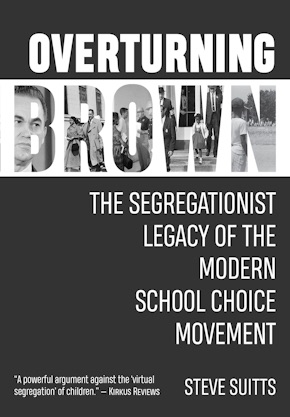
Steve Suitts wrote an excellent book about the history of school choice, called Overturning Brown: The Segregationist Legacy of the Modern School Chhoice Movement.
On May 14, the final day for submitting new bills in the Mississippi Legislature, a bold new package of them landed on the desks of Mississippi lawmakers. The plans called for the creation of a voucher program that paid for students to attend private schools.
A few weeks later, in the heat of mid-June, the governor urged lawmakers to support the $40 million program, promising it “will bear the sound fruit of progress for a hundred years after this generation is gone.” Public school support would continue, he assured. But vouchers would “strengthen the total educational effort” by giving children “the right to choose the educational environment they desire.”
It was 1964.
Key backers of the move included a group of white segregationists that had formed after the U.S. Supreme Court ruled state-mandated public school segregation unconstitutional.
Across the South, courts had already rejected or limited similar voucher plans in Alabama, Louisiana, Virginia and Arkansas. But Mississippi lawmakers plowed forward anyway and adopted the program. For several years, the state funneled money to white families eager for their children to attend new private academies opening as the first Black children arrived in previously all-white public schools.
Now, 60 years later, ProPublica has found that many of these private schools, known as “segregation academies,” still operate across the South — and many are once again benefiting from public dollars. Earlier this week, ProPublica reported that in North Carolina alone, 39 of them have received tens of millions in voucher money. In Mississippi, we identified 20 schools that likely opened as segregation academies and have received almost $10 million over the past six years from the state’s tax credit donation program.
“The origins of private schools receiving public funds were with the segregation academies,” said Steve Suitts, a historian and the author of “Overturning Brown: The Segregationist Legacy of the Modern School Choice Movement.”
Most private schools receiving money from the voucher-style programs exploding across the country aren’t segregation academies. But where the academies operate, especially in rural areas, they often foster racial separation in schools and, as a result, across entire communities.
Despite the passage of decades, most segregation academies across Mississippi remain vastly white — far more so than the counties where they operate, federal private school surveys show. Mississippi is the state with the highest percentage of Black residents.
At 15 of the 20 academies benefiting from the tax credit program, student bodies were at least 85% white as of the last federal private school survey, for the 2021-22 school year. And among the 20, enrollments at five were more than 60 percentage points whiter than their communities. Another 11 were at least 30 percentage points whiter.
In 1964, the White Citizens’ Council was among those pushing for the voucher plan. The pro-segregation group was founded in the Mississippi Delta town of Indianola in the 1950s by Robert “Tut” Patterson, who sought to “save our schools if possible” from integration and “if that failed, to develop a system of private schools for our children.”
For Patterson, it was personal. His family, including a young daughter who would start school that fall, lived on what he called a “plantation” with 35 Black families. As he later told an interviewer, “We took care of them. We practically lived with them. We loved them. We tended to them, but I didn’t want to mingle my children with them.”
Vouchers. This is the education idea that Republicans have been pushing for 30 years. This is the policy that is now universal in half a dozen red states. This is the main policy idea of the next Trump regime.
The blog known as “That’s Another Fine Mess” declared November 25 , 2024, the worst day in our history. Read on to know why.
Do you agree?
Donald Trump’s real reason for running for re-election in 2024 was to stay out of prison. He knew that only a return to the White House would prevent him standing trial for initiating the January 6 insurrection, and standing trial for the theft of top secret documents. Conviction in either case would mean he would end his days as a convicted felon, quite possibly dying in prison.
Mission accomplished.
November 25, 2024, will be remembered in American history as the day the constitutional rule that no individual is above the law was ended.
Whether this leads to the end of the democratic constitutional republic – that has existed because of that rule – being overthrown by Donald J. Trump is unknown at this point, but it is at a minimum a severe blow to the foundation of that republic that will be difficult if not impossible to repair.
This morning, Special Counsel Jack Smith moved to drop both cases. This afternoon, that motion was granted in the case of the Seditious Insurrection by Juge Tanya Chutkan. The action was taken “without prejudice,” meaning that the charges could be brought again at some time in the future. Does anyone think that one of the first acts of Attorney General Pam Bondi will not be to drop the cases in such a way that they can never be reinstituted?
This is the worst defeat of the forces of democracy in the history of this country.
Two men are solely responsible for this outcome: President Joseph R. Biden and Attorney General Merrick Garland.
As productive as his presidency has been, Joe Biden suffered from the fatal flaw of being unable to see that his bedrock belief in “go along to get along” congressional bipartisanship had been decisively overthrown over the 20 years before he took office as president – something he hold have learned from his botched handling of the nomination of Clarence Thomas to the Supreme Court in 1991 – and was no longer an operating philosophy that could be successful. His Irish stubbornness led to his inability to see modern Republicans as the deadly enemy of everything he believed in that they were – which he only began to clearly see in the final two years of his presidency, when it was too late – was directly responsible for this defeat. His inability to take the kind of decisive action against that enemy – commencing the investigation and prosecution of the criminal Trump and his fellow conspirators on Day One of his term of office – meant that the enemy would be able to use the rights and privileges of a defendant when the investigation and prosecution was finally authorized too late, and defeat the system by retaking power, using the rules of the system to defeat it.
Biden’s inability to understand the true nature of the threat he faced was compounded by his decision to nominate the exact wrong candidate to be his Attorney General. Merrick Garland did not and does not have the heart of a fighter, which is the quality that was most needed in whoever took that office at that time. His judiciousness would have been excellent had he been able to become the Supreme Court Associate Justice President Obama nominated him to be. It is tragic that neither Garland – the victim of the “conservative movement” that had consumed the GOP – nor then-Vice President Biden who took part in making the nomination and was an eyewitness to the treason of Mitch McConnell as President of the Senate – took the proper understanding from what they had been part of.
Both men desperately held on to obsolete beliefs with the tenacity of French Generals who stared uncomprehendingly at the German panzers that thoroughly defeated them in 1940. They clung to the idea that they could “look forward” and ignore the Great Crime that had been committed, but this time papering over the recent past only made the defeat inevitable. How thorough this defeat will loom in the history of the United States cannot be known at this time, but it cannot be seen as anything other than the Major Defeat that it is. There is no argument to be made that it is anything other than a disaster.
Those who fail to understand when the knowledge on which they have based their lives becomes obsolete cannot end other than how Joe Biden and Merrick Garland have arrived at the end their careers. This failure will outweigh all their other successes, viewed with the 20-20 hindsight of history.
Joe Biden should have listened to the counsel of Alexander Solzhenitsyn, who said: “Let your credo be this: Let the lie come into the world, let it even triumph. But not through me.”
Retired Oklahoma City teacher John Thompson wrote in The Oklahoman about the early days of the teacher-bashing movement. At its center he found a journalist-entrepreneur named Steve Brill, who wrote a slashing attack on teachers, tenure, and teacher unions in The New Yorker. Even in Oklahoma, Brill’s article was big news, because it identified the scapegoat that legislators wanted: teachers. Brill subsequently wrote a book celebrating charter schools, called Class Warfare. In that book, he falsely claimed that I had been bribed by teachers’ unions to become pro-union and pro-public school. So, as you might imagine, he is not a friend of mine.
John Thompson wrote:
In 2010, I attended an Oklahoma legislative committee meeting where most lawmakers were reading a New Yorker article, Steve Brill’s “The Rubber Room.” It was full of attacks on teachers. Legislators found his narrative persuasive, and it contributed to the passage of the most destructive education bill I ever witnessed.
I then reached out to Brill, trying to share the social and cognitive science that explained why he was using invalid and unreliable data in support of a blame game that would undermine teaching and learning.
So, I was curious about what he now believes. After all, the subtitle for a recent interview with him was:
But, Brill, a non-educator, still sticks with an anti-teacher ideology, propagated by “astro-turf think tanks” that rejected the scientific method when trying to use venture capitalism procedures for transforming traditional public schools. Even after those reward-and-punish policies demonstrably failed, Brill says, “in public education, I think there’s a pretty good argument that the people abusing and undermining the system are actually the teachers.”
“The Rubber Room” presented little evidence that teachers were to blame. His sources focused on “the twentieth of one percent of all New York City teachers” who had been removed from the classroom, but not fired. He believed the PR from corporate reformers like The New Teacher Project (TNTP) and the New York City Schools Chancellor Joel Klein who thought “tenure is ridiculous.”
Although value-added models (VAMs) were the foundation for holding teachers accountable for test score growth, Brill only used the term “value-added” once, and he didn’t bother to address that statistical model’s flawed methodology for evaluating individual teachers. (Some of those models even held teachers accountable for outcomes of students they never met!)
Brill merely wrote that the “value-added scores” was “a phrase that sends chills down the spine of most teachers’ union officials.”
Brill didn’t understand why it was impossible to recruit top teachers to highest-poverty schools using evaluation metrics that were biased against inner city teachers. Neither did he understand why these data-driven evaluations would prioritize “jukin the stats” and drill-and-kill instruction that would undermine holistic and meaningful teaching and learning. Brill certainly didn’t understand that teachers and unions also fought against VAMs in order to protect their students from teach-to-the-test malpractice which they would incentivize.
Brill was also dismissive of peer review, which the teachers union supported, and which was a constructive and efficient method of removing ineffective teachers from the classroom. (In my experience, union leaders invested a great deal of political capital in removing ineffective teachers; it was administrators that would lose their nerve and not exit those teachers.)
Brill drew upon the anti-union TNTP, which spread inaccurate information on the Toledo Plan, where districts and unions worked together to efficiently remove ineffective teachers. The TNTP claimed that the Toledo peer review program only removed .7% of probationary teachers over a five-year period. In fact, 12.9% of teachers in the plan were removed from the classroom in 2009. The percentages of 2008 probationary teachers removed from the classroom in Syracuse (9.7%), Rochester (7%), Montgomery County (10.5%), and Minneapolis (37%) were far greater than outcomes that VAMs produced.
And that brings us to today’s attacks on education. After a history of failure, corporate reformers have moved away from teacher evaluation systems that rely on test score growth, even though they still tend to blame teachers and unions. But state schools Superintendent Ryan Walters now represents today’s version of disempowering teachers.
Walters pushed for and succeeded in getting the Oklahoma State Board of Education to revoke the license of Norman High School’s Summer Boismier, who “covered her bookshelves with red paper, [with] the words ‘books the state doesn’t want you to read,’ and a QR code to the Brooklyn Public Library, which offers any student free access to banned books.”
If teachers lose their due process rights, who will be able to resist Walters’ civics curriculum committee which includes the Heritage Foundation’s Kevin Roberts, a key sponsor of Project 2025?




 Diane Ravitch's blog